

Why Most AR Automation Fails at Partial Payments and Short-Pay Disputes

In short: Partial payments and short-pay disputes still trip up AR automation. You route them to manual review because the system cannot decode intent—what the customer meant to pay, which invoices they covered, and why the amount fell short. AI-enhanced cash application helps by reading remittance advice and tracing promotional agreements before applying cash. Many deductions your team investigates are valid but undocumented customer actions your billing process missed, so the ROI comes from upstream data cleanup. Short payments force finance into multi-touch investigations that extend DSO and trap working capital in unresolved exception queues.
The Three-Sentence Version
Partial payments and short-pay disputes remain recurring AR exceptions that many finance workflows still handle manually, slowing cash flow and consuming resources. An AI-enhanced cash-application playbook built on intent detection, invoice-level allocation, open-balance tracking, reason coding, and exception routing can reduce manual effort and speed resolution. The question is whether your platform can distinguish legitimate deductions from payment tactics before you apply the cash.
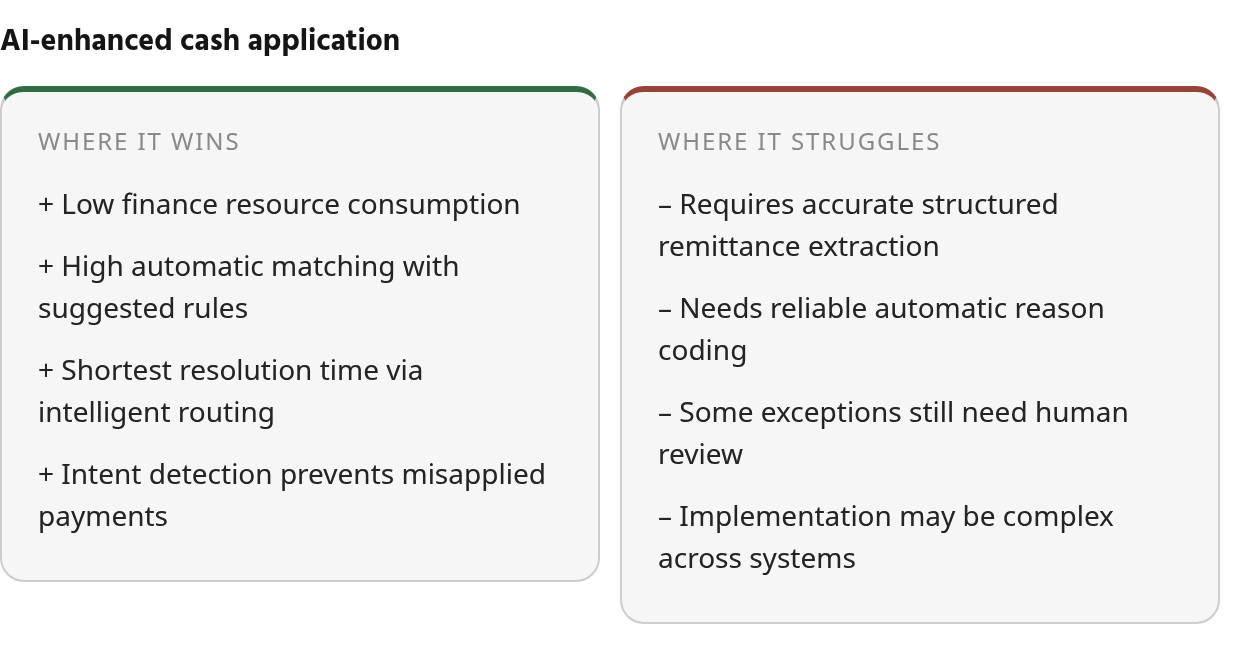
| Workflow Stage | Manual Cash Application | Basic Rule-Based Automation | AI-Enhanced Cash Application |
|---|---|---|---|
| Manual Effort | High finance resource consumption | Moderate finance resource consumption | Low finance resource consumption |
| Match Rate | Low automatic matching with high error rate | Moderate automatic matching | High automatic matching with suggested rules |
| Resolution Time | Longest resolution cycle for discrepancies | Moderate resolution time for exceptions | Shortest resolution time with intelligent routing |
| Cash-Flow Impact | High—slowdowns from exceptions | Medium—still requires manual investigation | Low—intent detection prevents misapplied payments |
The table compares three approaches to handling partial payments. Manual workflows rely on one or two people who know customer history by heart. When they leave, that knowledge leaves with them. Basic automation improves match rates but still treats partial payments as a math problem when the real challenge is reconstructing intent: what the customer meant to pay, which invoices they intended to cover, and why the amount fell short. AI-enhanced systems solve the intent problem first by reading remittance advice, tracing promotional agreements, and gathering supporting documents before applying cash. That prevents misapplied payments that are costly to unwind later.
Three checkpoints before you start:
- Classify the exception type before applying cash. A short pay tied to damaged goods is a dispute. An installment is an agreed plan. A deduction for an early-payment discount is contractual. Each has a different owner and resolution path. Misclassifying one sends it to the wrong place and delays the fix.
- Track both the applied amount and the remaining open balance. Applying $4,200 against three invoices without documenting which ones creates a backlog of unresolved exceptions that compounds over time.
- Route valid deductions separately from invalid short pays. The real question: are these expected short pays or unexpected short pays? Expected deductions need verification. Unexpected short pays need investigation and, often, collections follow-up.
Why Partial Payments Trap Working Capital
Your team sees a $4,200 short payment against three invoices. The remittance advice says nothing about which invoices it covers or why the amount fell short. Someone has to piece together whether it’s a legitimate trade promotion, a disputed freight charge, or a customer tactic to improve their own cash position. That investigation, not the arithmetic, is where partial payments drain resources.
Accounts receivable automation can match clean payments to invoices in seconds, but partial payments and short-pay disputes remain the exception-heavy workflows most platforms still route to manual review. Working with subscription businesses and service providers, the pattern is consistent: systems handle full-invoice matches at scale, then stall when the remittance doesn’t decode intent. The result is a backlog of unresolved exceptions that block cash application and distort aging reports.
Why Short Payments Cascade Beyond the AR Team
Short pays force your team into investigation mode before cash can be applied. Each deduction or partial payment requires multiple touches to resolve, far more than clean payments. For a mid-market company processing a few thousand invoices monthly, that multiplier creates real resource drag.
The ripple effects extend past finance. Collections keeps reaching out to a customer who believes they paid what they owed. Sales gets pulled into disputes over promotional agreements that weren’t documented in your billing system. The controller can’t close the month cleanly because unresolved short pays sit in an exception queue. Each day of delay extends DSO and traps working capital in open items. Cash-flow slowdowns often come from recurring exceptions like these, problems your team solves repeatedly because the underlying workflow hasn’t been restructured.
The Complexity Behind Every Short-Pay Investigation
Short payments complicate reconciliation because your team must reconstruct intent from incomplete data. You need to determine which invoice the customer meant to pay, apply the money to the right line items, preserve the unpaid balance, code the reason for the shortfall, and route the exception to the right owner. Each step depends on the one before it: misclassify the payment type and you send a legitimate trade promotion to collections, or you absorb an unauthorized deduction that should have been disputed.
Most deductions turn out to be valid when investigated. That means the automation ROI is strongest before payment, not after. If most short pays are legitimate but undocumented, the bottleneck is the promotion sheet, pricing contract, or delivery record that never reached cash application. Capturing that data upstream prevents a valid customer action from becoming a manual research task. Your team currently spends hours tracking down promotional agreements, proof-of-delivery records, and pricing contracts because the information wasn’t captured when the invoice was generated. Intelligent automation can compress resolution time by cross-referencing supporting documents automatically and routing only the genuine disputes to human review.
The short pays that are unauthorized require a different response. These include payment tactics to manage cash flow, unearned early-payment discounts taken past the deadline, or partial payments submitted without complete remittance information. Identifying these patterns early prevents write-offs and preserves margins.
What Triggers Partial Payments
The trigger matters because it determines ownership. A deduction tied to a sales agreement should not sit with AR. A freight claim should not be worked as a collections issue. A recurring unexplained reduction should not be treated like an innocent paperwork gap.
Why Customers Send Less Than the Full Amount
Most short payments fall into a handful of trigger buckets, and recognizing which one you’re dealing with determines who owns resolution and how fast it moves.
Trade promotions and agreed deductions account for a substantial share. Public materials from firms tracking deduction trends suggest that many customer deductions relate to trade promotions—co-op advertising, volume rebates, and shelf-placement fees that were negotiated but not reflected on the original invoice. The customer applies the deduction at payment time, often without advance notice. If your promotion agreements live in scattered spreadsheets rather than a system linked to billing, accounts receivable automation can’t cross-reference them during cash application, and the payment becomes a manual research task.
- Capture trade-promotion-related deductions with a reason code at cash application so you can report recurring patterns later
- Route deductions to the sales or contracts team that owns the underlying promotion rather than leaving AR to investigate pricing history
- Track the frequency of specific deduction types by customer to identify whether agreements need renegotiation
Pricing, quantity, and PO mismatches generate another common bucket. The customer receives fewer units than invoiced, disputes the per-unit price against their contract, or flags a line item that doesn’t match their purchase order. These are data-quality disputes, not payment tactics, and they require someone to reconcile the invoice against the delivery record and contract terms before the payment can be applied.
Freight, logistics, and service-level disputes appear when the customer challenges a surcharge, claims a damaged shipment, or deducts for late delivery. These short pays need documentation from shipping or operations before finance can validate or contest them.
Installment payments and recurring short-pay exceptions represent scheduled partial payments the customer agreed to in advance—subscription cadence adjustments, agreed payment schedules, or phased billing for large projects. These should be flagged in the ERP at the time the agreement is made, but when they’re not, AR teams spend time reconstructing whether the partial payment was authorized.
The short pays that fall outside these buckets—customer cash-flow tactics, unearned discounts taken after the deadline, or unexplained reductions—are the ones that signal bad-faith behavior. Pattern recognition helps here: if a customer consistently short-pays across multiple invoices without reason codes, that’s a flag for collections to escalate rather than finance to research. The goal is to capture the trigger at the point of cash application so recurring short-pay causes show up in reporting later, which lets you fix upstream data accuracy rather than fighting the same exceptions every cycle.
Why Standard AR Tools Can’t Solve Intent
Accounts receivable automation handles full-payment matches at scale when configured correctly. The gap appears when the remittance is incomplete, the invoice total does not equal the cash received, and the system has to decide whether the difference is acceptable, recoverable, or disputed. Simple rule-based logic was not built for that judgment call.
Standard Automation Stalls on Intent Recognition
Your AR platform can match the payment to the account, but it cannot always decode the business reason behind the shortfall. Simple matching rules look for exact amounts or apply preset allocation logic, which works when remittance data is clean but fails when the customer provides only partial context. Manual cash application still consumes significant finance resources because this judgment layer often sits outside the automation.
Standard tools tend to treat short payments as a matching failure, then hand the item to a human analyst. But the analyst’s actual job is broader: check customer history, find related contracts, look for prior disputes, and decide whether the remaining balance should stay open, move to a dispute workflow, or escalate to collections. When those data sources live across separate systems, the platform cannot complete the workflow without help.
Why Oldest-First Logic Creates Misapplied Payments
Most rule-based AR automation applies partial payments using oldest-first or proportional allocation: the system divides the received amount across open invoices by age or balance. This approach works when the customer meant to pay exactly what the rule assumes, but it creates a misapplied payment when intent differs. A customer might pay the two most recent invoices and skip the oldest disputed one, or they might pay all invoices minus a recurring trade deduction. Oldest-first logic posts the cash incorrectly, and someone has to unwind the entry later, work that costs far more than the original application.
The investigation burden compounds when your platform lacks open-balance tracking. After applying a partial payment, the system should preserve the unpaid balance and flag it as a follow-up item with the original reason code attached. Standard AR tools often close the invoice or leave the balance in an untracked state, forcing analysts to reconstruct the shortfall history manually when the customer disputes the account weeks later. How AR Automation Clears Aging Buckets Without Adding Collections Staff describes the same context loss from the collections side.
How AI-Powered Cash Application Improves Matching
AI-enhanced cash application improves automatic match rates because it can detect patterns that simple logic misses. The system reads deduction memos, remittance context, and customer historical behavior to assign predefined reason codes, routing valid trade promotions to auto-approval and flagging anomalies for review. This shifts the work from manual investigation to exception triage: your team reviews only the cases the AI cannot resolve confidently.
- Intent detection before cash posting: AI reads remittance notes and cross-references promotional agreements to determine which invoices the customer meant to pay before applying the cash
- Invoice-level allocation with reason coding: The platform allocates partial payments to specific invoices and tags each with a deduction category—trade promotion, pricing dispute, freight error—so analysts see the full context without searching
- Open-balance tracking tied to original reason: After posting a partial payment, the system preserves the unpaid balance as a follow-up item linked to the deduction reason, preventing lost context when the customer disputes weeks later
- Exception routing based on validity patterns: Valid trade deductions flow to auto-approval; anomalies that break historical patterns route to collections with supporting documents attached
Companies using automated deductions management can recover previously written-off trade deductions because the system catches invalid claims that manual review missed. Short payments that are legitimate but undocumented—primarily trade promotions and pricing corrections—clear faster when the platform validates them against agreement data before investigation. Those that represent cash-flow tactics or human error get flagged by anomaly detection, and your team focuses resolution effort where it matters.
How AI Turns Exception Backlogs Into Pattern Recognition
Accounts receivable automation that stops at clean matching leaves the hardest part of the cash-application cycle unresolved. Effective implementations connect payment data, deduction context, customer behavior, and downstream ownership so the system can move an exception toward closure instead of simply labeling it as unmatched.
Example workflow: subscription SMB short-pay. A customer sends a $4,200 payment against three monthly invoices. The remittance is silent. A rule-based system applies oldest-first and closes the oldest invoice; the analyst then emails the customer’s AP team, pulls the contract, loops in sales, and reworks the application after the customer says the shortfall is a contracted co-op advertising deduction. The case passes through AR, sales, and AP over several days. An intent-aware workflow classifies the shortfall as a trade-promotion deduction from customer history, posts the payment against the two current invoices and part of the oldest, keeps the residual amount open with reason code “trade promotion,” routes the item to sales operations for approval, and escalates to finance if the residual stays unresolved past the seven-day review threshold. The AR analyst touches the case once to approve.
AI-enhanced cash application platforms learn from remittance context, historical patterns, and customer-specific payment behavior to improve automatic match rates over time. By connecting matching to collections workflow, teams can reduce manual intervention and free up hours each week for higher-value work.
- [ ] Verify Your Platform Extracts Structured Remittance Data Accurately
Structured remittance extraction is where automation starts. If your system can’t pull invoice numbers, amounts, and reason codes from email attachments, PDFs, and portal messages automatically, your team is still doing data entry.
- [ ] Check Whether Reason Coding Runs Automatically on Every Short-Pay
Auto-classification should turn messy deduction notes into usable workflow data. The system needs to recognize the difference between a pricing error, a freight dispute, a promotional allowance, and an installment so each item can be reported, routed, and resolved consistently.
- [ ] Confirm Suggested Rules Learn From Your Resolved Exceptions
Match-rate improvement comes when the platform suggests new rules based on recurring exceptions. If your team manually resolves the same freight charge dispute five times, the system should propose an automatic offset rule for that customer.
- [ ] Test Whether the Platform Routes Unresolved Items to the Right Owner
Trade promotions go to sales. Quality disputes go to operations. Tax withholding goes to the tax team. Exception routing that sends everything to one inbox creates a bottleneck.
Workflow Capabilities That Actually Handle Short Payments
Use this checklist to evaluate whether your cash-application process can move beyond basic matching. Strong partial-payment handling should identify the payment type, post only what can be supported, keep the residual amount visible, document the reason, and hand the exception to the person who can actually resolve it.
Capabilities Your Platform Should Support
Start by confirming your accounts receivable automation can distinguish between a clean payment and a partial payment before attempting to apply it. The system should flag any remittance where the amount doesn’t match the open invoice total, then extract structured data from the remittance advice—invoice numbers, deduction codes, reason descriptions—without requiring manual entry. Manual processing of deductions costs significantly more than clean payments, and that cost compounds when the system guesses wrong and creates a misapplied entry someone has to unwind later.
- Invoice-level matching that preserves open balances – Verify the platform applies partial payments to specific invoices and leaves the unpaid balance visible and actionable, rather than forcing a write-off or creating an unapplied credit that disappears into a suspense account.
- Intent detection before cash application – Confirm the system attempts to classify the deduction reason—trade promotion, pricing dispute, damaged goods, early-pay discount—before posting the payment, using remittance text and historical patterns to reconstruct what the customer meant.
- Reason-code capture and reporting – Check that every partial payment gets tagged with a structured reason code you can report on, so you can track whether short payments are concentrated in specific customer segments, product lines, or deduction types.
Exception Routing and Escalation Paths
Once the system identifies a partial payment, it needs to route the case to the right owner based on the deduction type. Trade promotions go to sales operations for validation against promotional agreements. Pricing disputes go to customer service with the original contract attached. Freight discrepancies go to logistics with the proof of delivery. The platform should handle this routing automatically, not dump every exception into a shared inbox where it ages until someone notices. Intelligent routing that assigns cases by type can reduce resolution time from weeks to days.
- Automatic exception routing by deduction type – Confirm the system routes disputes to sales, freight issues to logistics, and pricing errors to finance based on the classified reason, rather than treating all short payments as AR’s problem.
- Aging thresholds that trigger escalation – Verify the platform escalates unresolved deductions after a defined period—say, seven days for small amounts, three days for large ones—so high-value disputes don’t quietly age into write-offs.
Success Metrics and Audit Controls
The checklist should include tracking capabilities that show whether the automation is actually reducing manual work. Automatic match rate measures what percentage of payments apply without human intervention. Resolution time tracks how long short payments sit open before closure. Manual hours saved quantifies the direct efficiency gain.
- High automatic match rate with AI-suggested rules – Set a baseline expectation that the platform should handle the majority of payments automatically, with AI-suggested rules closing the gap on the remainder.
- Deduction touches per case – Track how many times a human has to intervene on each short payment; the goal is reducing manual intervention to one review-and-approve step.
FAQ
Why do partial payments cause more work than full payments even when the dollar amount is smaller?
Because the payment cannot be treated as complete until the remaining balance has a clear status. Your team has to decide whether the difference should stay open, become a dispute, move to a deduction workflow, or trigger follow-up. A smaller cash variance can still create more operational work than a large clean payment.
How can I tell whether a short payment is a legitimate deduction or a collections problem?
Start with evidence. If the customer provides support tied to an agreement, delivery issue, contract term, or approved payment arrangement, validate it through the appropriate owner. If the reduction arrives without context or repeats across invoices with no reason code, move it out of routine AR research and into a collections escalation path.
What happens when my AR system applies a partial payment using oldest-first logic but the customer meant something different?
The account record stops reflecting the customer’s intent. Cash may appear to clear the wrong invoice while the invoice the customer actually meant to address remains open, creating confusion in aging, collections outreach, and later dispute conversations. The correction usually requires manual reversal, reapplication, and explanation.
Why do most short-pay disputes turn out to be valid when investigated?
They often trace back to business activity that happened outside the invoice workflow. The sale, shipment, contract update, or service adjustment may be real, but the supporting detail never reached cash application in a usable form. That makes the short pay look like a dispute even when the root issue is missing documentation.
What should my AR platform do immediately after posting a partial payment?
It should keep the residual amount visible, attach the reason code or provisional classification, assign the item to the correct workflow owner, and monitor the item against an escalation threshold. Posting the cash is only the first step; the open balance still needs a controlled path to resolution.