

AR Automation Software Compared: Which Handles Multi-Entity Reconciliation Without Manual Cleanup

What You Need to Know
- No AR automation vendor has fully solved multi-entity reconciliation, so your team still cleans up exceptions involving transfer pricing, timing differences, and FX gains.
- Tolerance rules can automate variance approvals within set thresholds, but policy judgment still belongs to your team.
- Controllers using QuickBooks, legacy ERPs, SQL databases, and spreadsheets spend significant time each month gathering and combining fragmented financial data.
- The ROI inflection point for intercompany automation is entity relationship stability, not transaction volume.
- Auto-match rates matter most when you separate routine AR matching from intercompany matching.
What auto-match benchmarks actually show
Reviewed Trintech and HighRadius materials describe strong routine auto-match rates, but no vendor has fully solved multi-entity reconciliation. Intercompany matching still faces reciprocal balances, currency translation adjustments, and consolidation rules that rule-based tools cannot resolve without accounting-policy judgment.
| Source / material | What reviewed materials show | What to verify before relying on it |
|---|---|---|
| Trintech case studies | Automatic intercompany matching; Cadency workflow automation; settlement-time reduction in multi-entity data. | Your multi-entity auto-match rate, residual exception mix, subledger architecture, and ERP-version fit. |
| HighRadius intercompany guide | Out-of-the-box rule coverage for transaction auto-match and intercompany record reconciliation. | Intercompany elimination support, exception compression, and multi-ERP depth on your specific stack. |
| Zuora revenue reconciliation material | Routine revenue matching for revenue records. | Legal-entity or intercompany matching; elimination or FX translation support. |
| Large manufacturing case study | Reduced line items requiring manual analysis from thousands to hundreds after automating month-end intercompany close. | Baseline workload, remaining exception severity, and transferability to your environment. |
| General standalone AR tooling | Dashboards only, not a live AR subledger; batch latency hides cash movement until month-end. | Whether a named vendor’s subledger architecture removes multi-entity tie-outs or just visualizes them. |
Tolerance rules help you avoid chasing pennies. Automated systems should approve variances within set thresholds rather than flagging every rounding discrepancy. You will still investigate exceptions where a subsidiary reports a payable that doesn’t match the counterparty’s receivable, or a mid-month contract modification recalculates the revenue schedule without updating the intercompany invoice.
Why integration depth determines your reconciliation tax
Fragmented systems create a reconciliation burden that compounds with entity count. Controllers managing entities across QuickBooks, legacy ERPs, SQL databases, and spreadsheets often spend significant time each month manually gathering and combining financial data. Consolidating to integrated systems with automated intercompany eliminations can reduce that manual work substantially.
The ROI inflection point is not transaction volume. It is entity relationship stability. The strongest candidates for intercompany automation repeatedly reconcile the same counterparty pairs each close or maintain elimination schedules outside the ERP. If your team works late nights during close, you are likely paying the reconciliation tax that multi-ERP integration and rule-based adjustments eliminate. Standalone AR tools provide dashboards only, not a live AR subledger, with batch latency that hides cash movement until month-end and forces manual tie-outs to align revenue with AR settlement detail.
Multi-entity work involves currency difference calculations, elimination postings for consolidated financials, and counterparty identification across multiple ERP systems. Automation prevents discrepancies upfront by matching documents and creating postings automatically rather than reconciling mismatches after the fact, but your team still reviews flagged exceptions where timing or policy judgment matters.
Your due-diligence checklist should verify how each vendor handles fragmented systems: Can the platform identify counterparty-related transactions across your ERPs? Does it automate currency difference calculations and post-system reconciliations, or does your team run those manually? Trintech and HighRadius materials describe multi-entity support, but version-specific proof for your ERP versions, elimination rules, currencies, and chart of accounts still needs to come from a live demo with your actual entity structure and sample exceptions, not a generic sandbox.
Why multi-entity reconciliation matters
Multi-entity reconciliation becomes critical when your finance team spends more time investigating mismatches between subsidiaries than interpreting the business story behind the numbers. The pressure builds as legal entities multiply: separate source systems, delayed visibility into cash, and spreadsheet-dependent close work make month-end harder to defend.
When subsidiaries and currency translation create cleanup work
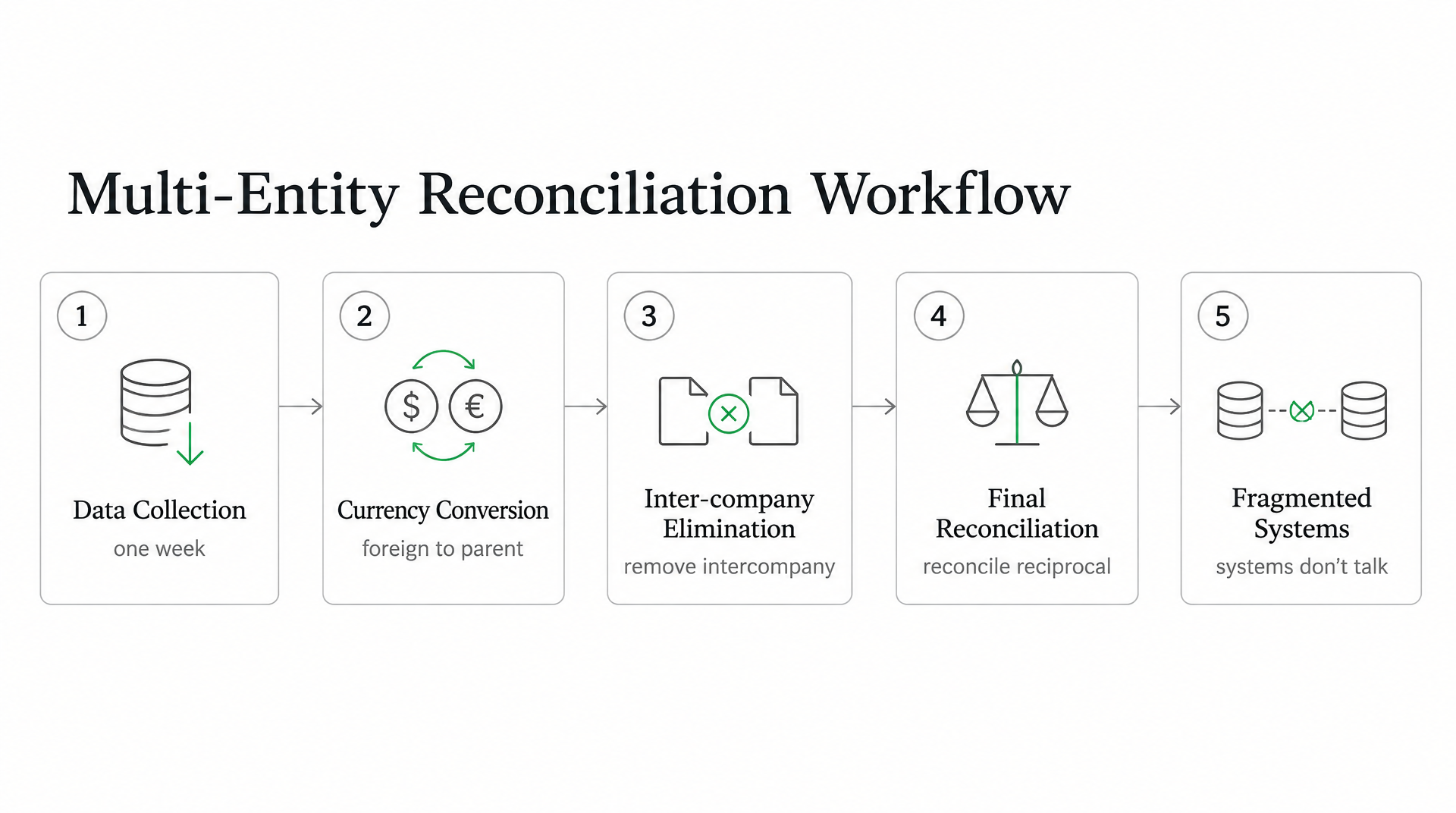
Once subsidiaries are involved, AR data must support legal-entity reporting, consolidation, and internal counterparties that may book the same transaction differently. Transfer pricing between entities may include markups that affect inventory balances and cost of sales across both the sending and receiving entity. Your AR team often becomes the group reconciling those downstream effects because the billing workflow at one entity does not automatically reflect the accounting entry booked by the other.
The workload is rarely one large problem. It is a stack of small handoffs: each export, reformat, mapping table, and offline journal entry adds another place for entity codes, customer names, invoice references, or exchange-rate treatments to drift. By the time the close package reaches review, the team is explaining why balances differ instead of analyzing what changed in the business.
The spreadsheet risk that scales with entity count
Operational spreadsheets used at scale carry consistently high error rates. When the close depends on lookup formulas across entity exports, errors can move into consolidated financials before anyone notices. Streamlined intercompany reconciliation reduces that exposure only when it replaces the spreadsheet layer rather than producing another file for someone to manipulate.
The risk is also audit defensibility. Auditors have limited patience for workbooks that function as unofficial subledgers because they rarely show a clean chain of custody. Finance teams that retire complex Excel workbooks move from formula policing to exception review, which is a better use of accounting judgment.
Spreadsheet-heavy processes also create continuity risk. They often depend on a few people who remember why a workbook is structured the way it is. When those people are unavailable, the close slows because the process documentation lives in cell comments, file naming conventions, and institutional memory.
Three evidence-backed pain points multi-entity AR teams face
First, fragmented systems across entities create reconciliation bottlenecks. When subsidiaries run different ERPs or billing platforms, your AR team becomes the integration layer. Dashboard-only tools can make the backlog easier to see, but visibility is not the same as a synchronized subledger.
Second, cash-flow visibility deteriorates when billing, collections, and customer-facing teams operate from separate records. CFO Dive, citing a Capchase report, found that median DSO increased from 31 to nearly 40 days since 2021. When collections operates separately from billing and customer success, dunning emails can land during a renewal conversation. The customer experiences one company; internally, three teams may be acting on different data.
Third, manual exception cleanup consumes time that should go toward analysis. Automated systems perform best when source data is clean and the entity structure is simple. In a multi-entity environment, the difficult items tend to be structural: unmatched counterparties, inconsistent booking dates, incomplete intercompany references, and adjustments that require accounting-policy judgment.
Automation can shrink and organize exception work, not guarantee that every intercompany imbalance will disappear.
Performance and ROI considerations
Your actual auto-match rate is the number your ROI model should reflect. AR automation software matches routine transactions at high rates, while intercompany workflows add complexity that lowers the match percentage. That gap is where your manual cleanup budget lives, and it belongs in your ROI model before any subscription quote does.
Case studies describe outcome shape, not a guaranteed number. The large manufacturing example shows exception volume collapsing from thousands to hundreds, but exceptions do not vanish. Someone still owns the remaining work.
The ROI math you should run yourself
Skip vendor calculators. Four steps get you a defensible number.
Log one actual close. Break cleanup into categories: unapplied cash, counterparty research, exchange-rate treatment, elimination support, and reviewer follow-up. Estimates usually miss the small interruptions that make close week feel longer than the task list suggests.
Apply a reduction range, not a single best-case number. Model a conservative outcome first and test whether the lower end still clears the investment hurdle. If the business case only works when the system catches nearly everything, the assumption is too fragile.
Price the cash effect conservatively. Slower collections make working-capital improvement more valuable, but do not credit the project for every overdue dollar. Convert only the benefit you can explain to your CFO without vendor optimism.
Subtract the full cost: subscription, integration build per ERP, data cleanup, testing, and ongoing rule maintenance. Integration depth is the line item most teams underprice. Our comparison framework for AR tools walks through how to pull those details out of vendor pages quickly.
One honest limit. If you run two entities on a single ERP with only a small set of predictable internal invoices, a dedicated matching engine may not earn back its implementation. The decision point is not sheer invoice count. It is whether the same intercompany relationships create repeatable cleanup every close.
What multi-entity AR automation actually delivers
Multi-entity reconciliation software will not eliminate your close exceptions, but it can shrink the population your team has to investigate. The strongest case for automation is when you repeatedly reconcile the same counterparty pairs each close, maintain elimination schedules outside the ERP, or spend late nights manually gathering data from fragmented systems. The weakest case is a simple entity structure, low stable volume, and review controls that already catch errors before consolidation.
If your team is still explaining balance differences instead of analyzing business changes, the operational ROI probably exists. If the close depends on a few people who remember why the workbook is structured the way it is, continuity risk probably justifies investment. But the subscription should clear your investment hurdle at the conservative end of the auto-match range, not the aspirational number in the demo deck.
Frequently Asked Questions
Can AR automation software automatically post intercompany eliminations during consolidation, or will my team still handle that manually?
Expect the system to prepare the work, not own the accounting conclusion. Many platforms can identify likely intercompany activity, group related records, route exceptions, and support proposed adjustments. Your accounting team still needs to approve the final treatment before consolidation, especially when the item affects policy-sensitive reporting.
If my subsidiaries use different ERP systems, does that kill the ROI of intercompany automation?
No, but it changes the evaluation. Multi-ERP environments can still benefit when the vendor can connect cleanly to the systems you actually run and preserve the dimensions your close process depends on. In demos, use your real entity structure, account mappings, currencies, and sample exceptions rather than a generic sandbox.
How do I know if tolerance rules will actually reduce exception volume, or just hide problems my auditors will catch later?
Treat tolerances as documented controls, not shortcuts. Define approval bands with finance leadership and your audit team, limit them to low-risk variance types, and review the population they clear. If the automatically approved items remain immaterial and repeatable while meaningful timing, pricing, or counterparty issues stay visible, the rules are reducing noise rather than burying risk.