

Which invoice-to-cash solutions offer automation for recurring billing?

Key Takeaways
- Almost every modern AR platform automates recurring billing. The real differentiator isn’t feature count.
- It’s how the tool treats the customer on the other end.
- The invoice-to-cash market splits in two: lighter integrated tools for SME teams, and AI-native suites for mid-market and enterprise buyers.
- Blixo targets churn-sensitive SaaS with AutoPay, churn prediction, and a usable customer portal.
- HighRadius serves enterprise AR teams on custom pricing, pairing AI agents with policy-driven rules for collections and cash application.
- The automation gap is widest downmarket, where many smaller teams still key in payment data by hand.
- Enterprise suites like Sidetrade, Billtrust, and Esker win on AI depth and integration reach.
- Sidetrade sets itself apart as an AI-native platform built on a proprietary B2B Data Lake for payment prediction.
Quick Summary
If you’re comparing which invoice-to-cash solutions offer automation for recurring billing, the short answer is most modern AR platforms handle it. The differences show up in how they treat the customer on the other side of that automation. For SaaS teams fighting churn, that human layer matters more than the length of a feature list.
The market splits into two tiers. Lighter integrated tools serve smaller SaaS and SME teams. AI-native suites like HighRadius, Sidetrade, Billtrust, and Esker serve mid-market and enterprise. Downmarket, the fight is usually getting off manual spreadsheets. Upmarket, buyers focus on optimizing complex, multi-entity workflows.
Which recurring billing automation tools compare best?
The table maps the main options by best-fit buyer, starting price, and standout strength. We only list prices we can verify.
| Solution | Best For | Starting Price | Key Strength |
|---|---|---|---|
| Blixo | SaaS with churn-sensitive recurring billing | Custom quote | AutoPay, churn prediction, and a human-friendly customer portal |
| HighRadius | Enterprise AR teams | Custom quote | Collections Management + Cash Application AI |
| Billtrust | Mid-market billing consolidation | Custom quote | Unified billing, invoicing, and payment in one flow |
| Sidetrade | Data-driven payment prediction | Custom quote | AI-native platform with proprietary B2B Data Lake |
| Esker | End-to-end I2C automation | Custom quote | Workflow automation with real-time dashboards |
| Invoiced | SMB/SME recurring billing | Custom quote | Recurring billing plus payment reminders |
What sets the enterprise suites apart?
The heavyweight suites win on depth of AI and integration reach. HighRadius pairs AI agents with policy-driven decision rules to automate collections and cash application. Billtrust folds billing, invoicing, and payment acceptance into one system, which cuts manual reconciliation. Esker layers workflow automation over the full invoice-to-cash cycle and surfaces receivables performance on live dashboards.
Sidetrade takes a different route. Its platform leans hard on predictive analytics to forecast when and how accounts will settle their balances. That forward-looking angle is why it keeps coming up for SaaS retention.
How does automation actually lower SaaS churn?
Faster collections isn’t the real churn lever. Earlier at-risk detection is. Pair automated recurring billing with AI-driven payment-behavior prediction, and your I2C data starts working as a retention early-warning system.
A declined card or a slipping payment pattern is often the first signal an account is about to lapse. Catch it early and a person can reach out warmly before the subscription dies. Miss it and automation just fires a cold dunning sequence that pushes the customer out the door faster.
That’s the balance we care about. Invoiced covers recurring billing and reminders well for SMB teams. Blixo leans into the retention angle for churn-sensitive SaaS, combining automated payment processing with self-service tools and proactive communication.
Our recommendation: If you’re enterprise with a large AR team, the AI-native suites earn their price. If you’re a SaaS company where every cancelled subscription stings, weigh how each tool handles the human moment when a payment fails. And skip the heavy suites if you’re under a few hundred customers. The integration overhead won’t pay off yet.
Why the Cheapest Tool Isn’t Always the Right One
Every recurring-billing tool automates the basics. The reason you still shop around comes down to cost structure, feature gaps, and how well a platform fits the way your SaaS actually grows. Ask which invoice-to-cash solutions offer automation for recurring billing and the honest answer is most of them. The better question: which one won’t quietly cost you customers.
Optimizing for speed of collection can backfire. If your system only knows how to dun aggressively, you risk alienating customers hitting temporary payment friction. A balanced approach uses billing data to prompt a proactive, relationship-saving conversation instead of an immediate automated penalty.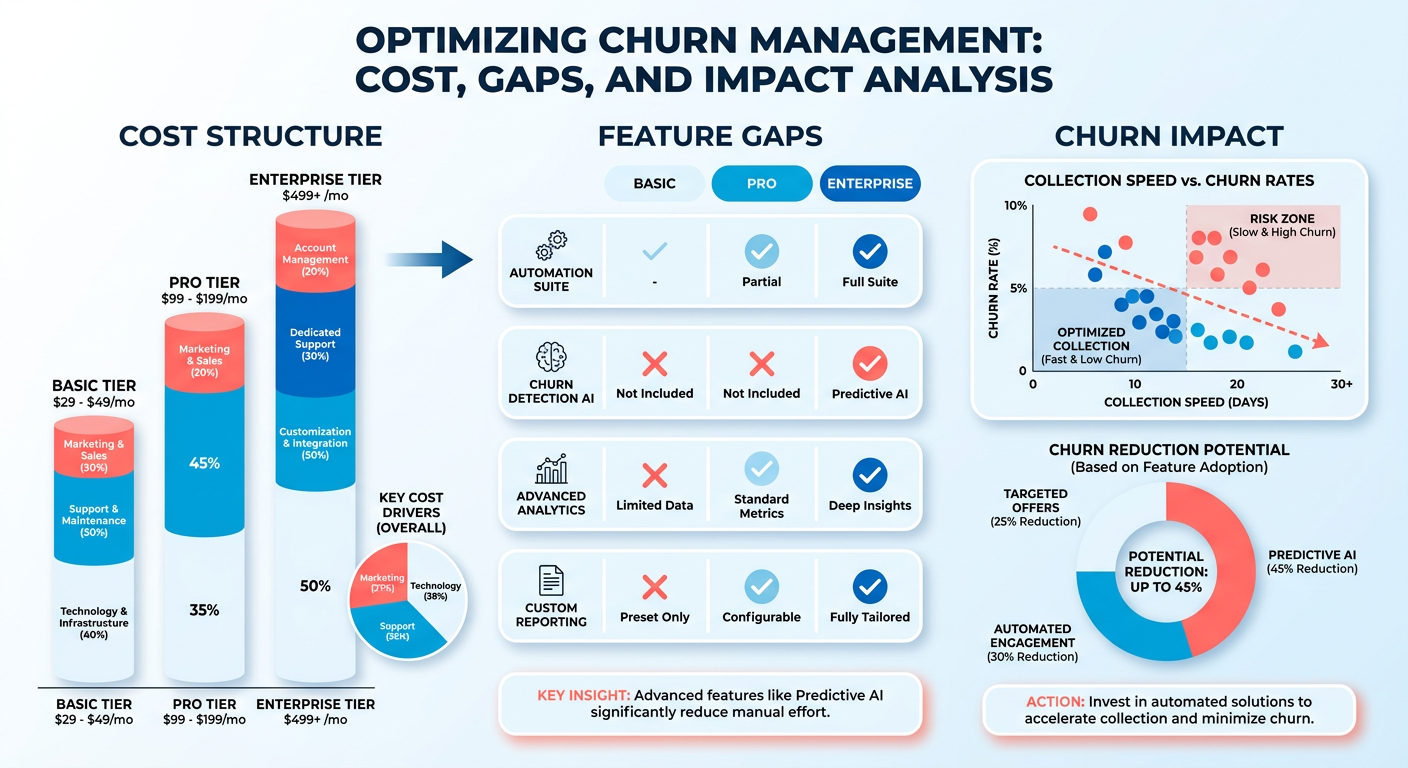
When does cost push you toward an alternative?
Cost fit: The gap between a lightweight recurring-billing tool and an enterprise suite isn’t just the monthly price. It’s the implementation and migration cost hiding underneath.
Enterprise platforms carry heavy onboarding overhead. For a 12-person SaaS with predictable subscription tiers, that spend buys automation you’ll never touch. You pay for deductions management and multi-entity cash application when all you needed was clean recurring invoices and smart reminders.
Skip the enterprise suite if your billing is simple and your volume is low. The math doesn’t work until manual AR starts eating real finance hours.
Where do feature gaps actually hurt SaaS teams?
Feature gap: Most recurring-billing failures trace back to dirty contract and pricing data, not the platform itself. A tool that automates flawlessly on bad data just automates your mistakes faster.
This bites hardest during migration. Moving contracts off a legacy system is where revenue leakage and customer-facing billing errors creep in. The research on SaaS billing transformation is blunt about it: clean migration is what prevents revenue leakage and keeps operations stable.
Our recommendation is a parallel-processing approach. Run the old and new billing engines side by side, validate every invoice batch, then cut over. Slower, yes. But a wrong charge on a recurring invoice is exactly the kind of friction that sends a customer hunting for the cancel button.
Does the tool flex as you grow?
Growth flexibility: The platform that fits at 50 customers may not fit at 5,000. Usage-based and tiered billing models break simpler tools fast.
AI-native systems handle the messy edges. They manage partial payments and multi-currency transactions with a precision smaller tools often can’t match. The large platforms lean on massive historical datasets to refine their algorithms. Emagia, for instance, processes over $1 trillion in receivables annually. That scale buys prediction accuracy a younger tool can’t touch yet.
| Tier | Best For | Strength | Watch-out |
|---|---|---|---|
| Blixo | Growing SaaS & SME teams | Automated recurring billing with a human-friendly customer touch | Lighter enterprise-grade deductions features |
| Invoiced | Small-to-mid SaaS | Recurring billing plus payment reminders | Limited predictive analytics |
| Sidetrade / HighRadius | Mid-market to enterprise | AI payment-behavior prediction | High onboarding cost |
| Emagia | Global enterprise | Multi-currency, partial-payment precision | Overkill for simple billing |
Our read: pick the tool that automates billing without flattening the customer relationship. The right fit keeps finance efficient and the human layer intact, which is where SaaS churn is won or lost. Blixo is built around that balance.
Alternative 1 - Featured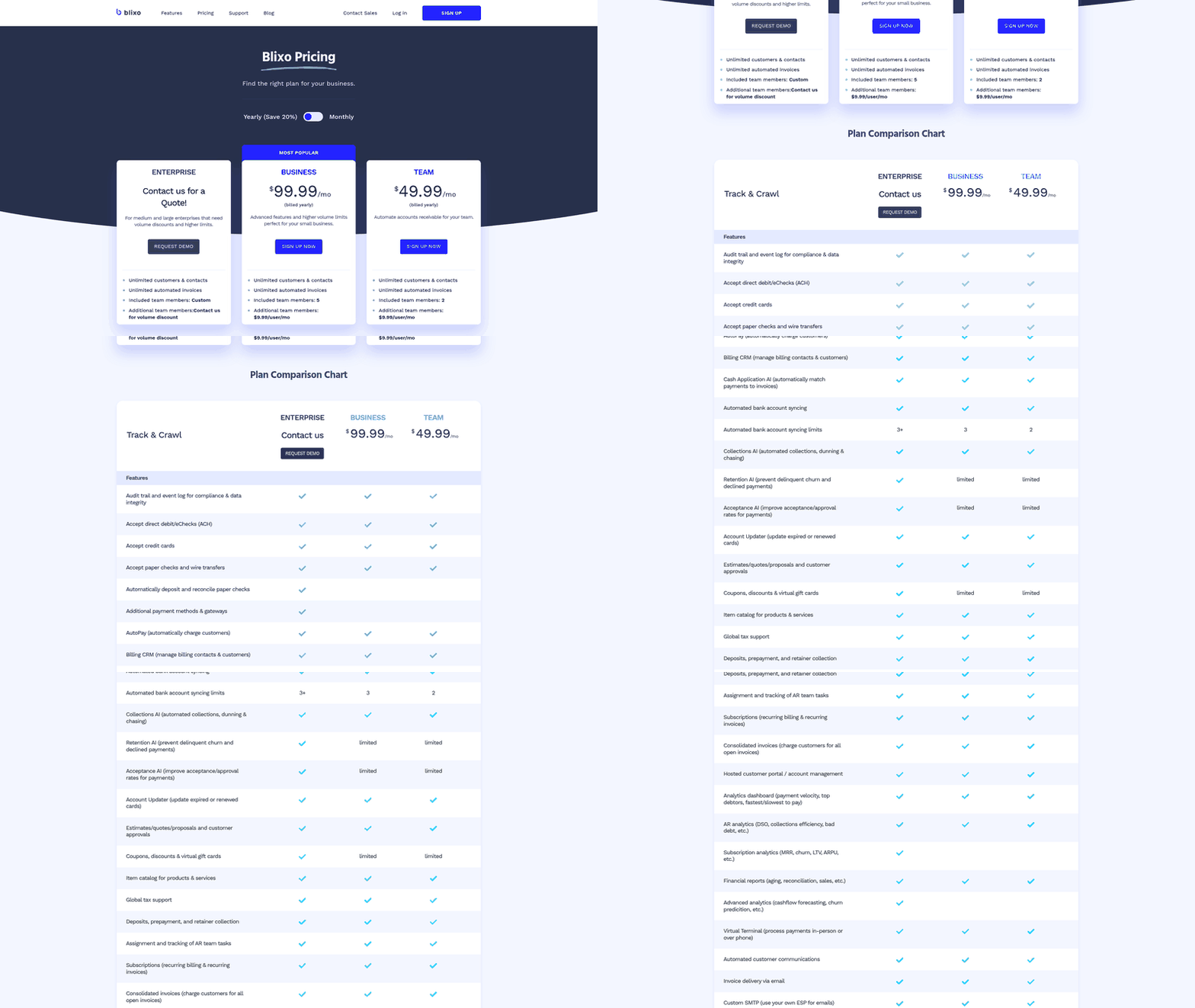
Our pick for SaaS teams fighting churn is Blixo, and the reason is simple. Most invoice-to-cash solutions with automation for recurring billing optimize for speed of collection. We built ours to spot the accounts about to lapse before the dunning even starts. That shift, from chasing payments to protecting relationships, is where recurring revenue actually holds.
The platform automates the whole cycle: recurring invoice generation, payment reminders, cash application, reconciliation. Where it diverges is the human layer sitting on top. You get the efficiency of a machine plus the ability to reach a customer with a real message before a failed charge becomes a cancellation.
What Makes This Recurring Billing Automation Different?
The difference is at-risk detection, not faster dunning. Our approach pairs automated recurring billing with Retention AI and Acceptance AI, so your team can prevent delinquent churn and lift payment approval rates instead of letting a declined charge quietly push a wavering customer out the door. Churn prediction and an Account Updater that refreshes expired or renewed cards keep more subscriptions alive.
For a subscription business, a failed payment is rarely just a card problem. It’s often the first visible sign of a churn decision already forming. Treat every declined charge as a retention moment instead of a collections task, and the math on recurring revenue changes.
That reframing matters because the wider market rewards the opposite behavior. AI-native suites like HighRadius, Sidetrade, Billtrust, and Esker are excellent at collections throughput. Where they stop is the recovery follow-up: a flagged account gets a faster reminder, not a tailored outreach. Throughput without a built-in path to a human touch just means you collect faster from customers who then leave.
Who Is It Built For?
Best for SaaS teams where retention economics beat collection speed. If a saved subscription is worth more than a few days of DSO improvement, this is your fit. Smaller SaaS and SME teams still doing manual payment entry get the most immediate lift, freeing up administrative hours. Blixo scales up too. Our Enterprise plan is built for medium and large companies that need volume discounts, higher limits, and high-volume rate limits, with a dedicated account manager and SLA. Whether you’re leaving manual entry behind or replacing an outdated AR system at scale, the platform grows with you.
Subscription management, Cash Application AI, and Collections AI work together to automate recurring billing end to end. To see whether the retention-first model fits your stack, request a demo and we’ll walk through the workflow.
How Does It Compare?
| Tool | Best For | Standout Strength | Watch-Out |
|---|---|---|---|
| Blixo | SaaS churn reduction | At-risk detection + human outreach layer | Deductions tooling is lighter than the big suites |
| HighRadius | Enterprise AR ops | AI agents for collections & cash application | Heavier implementation |
| Sidetrade | Mid-market/enterprise | Payment-behavior prediction from B2B data lake | Prediction without built-in human step |
| Billtrust | Mid-market billing | Unified billing, invoicing, payment | Collections-first focus |
| Invoiced | SMB SaaS | Recurring billing + payment reminders | Lighter at-risk signals |
Pros: Retention-focused automation, strong fit for growing SaaS, quick lift for teams leaving manual entry behind, Enterprise plans with high-volume rate limits.
Cons: Not the deepest deductions engine. Teams needing heavy deductions management should compare the AI-native suites first.
Our verdict: if churn is the number you lose sleep over, start here. If deep deductions tooling is your priority, look at the heavyweights above.
Alternative 2
Our second pick is Sidetrade, and for SaaS teams that want prediction over reaction, it earns the spot. Among invoice-to-cash solutions with automation for recurring billing, few lean as hard into behavioral forecasting. Its AI-native platform reads how customers pay and flags trouble before an account goes quiet.
The engine analyzes vast transaction histories to predict payment behavior rather than just chase overdue invoices. For a subscription business, that prediction layer is the difference between reacting to a failed renewal and heading it off.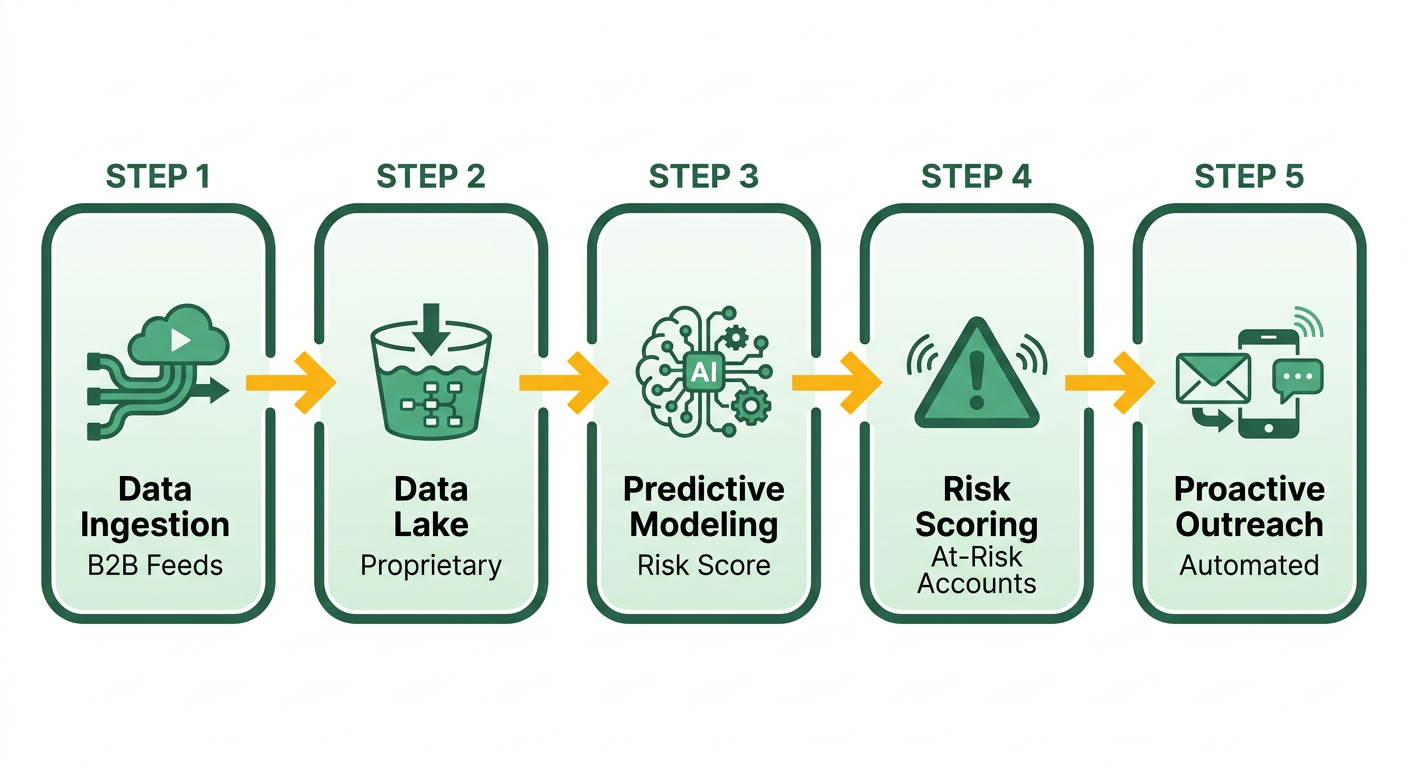
What Makes Sidetrade’s Recurring Billing Automation Different?
Sidetrade: an AI-native order-to-cash platform that manages billing, collections, and cash application while forecasting payment behavior across the customer base. It automates the routine work and surfaces the accounts worth a human touch.
The prediction model is the standout. Most recurring billing tools automate dunning and cash application well. This one tries to tell you which customer is about to slip. For churn-sensitive SaaS, that early signal is worth more than shaving days off collection time.
The catch is fit. This is a mid-market and enterprise tool. Run a small SaaS with a lean finance team and the depth here outpaces what you need, and the setup effort won’t pay off.
Sidetrade Pros, Cons, and Ideal User
Best for: mid-market and enterprise SaaS with enough transaction volume to feed the prediction model.
Pros: strong payment-behavior forecasting, unified order-to-cash automation, and a data foundation that improves as your volume grows. The at-risk detection genuinely supports retention, not just recovery.
Cons: built for scale, so smaller teams pay for depth they can’t use. Onboarding takes real effort, and the value only shows once enough billing history feeds the model.
If your recurring revenue base is large and your renewals are lumpy, this fits. Skip it if you’re pre-scale. A lighter integrated tool will serve you better until your volume justifies the model.
How Does It Compare on Recurring Billing?
| Tool | Best for | Recurring billing | Standout strength |
|---|---|---|---|
| Blixo | SaaS fighting churn | Yes | Retention AI to prevent delinquent churn |
| Sidetrade | Mid-market/enterprise SaaS | Yes | Payment-behavior prediction from B2B data |
Both platforms treat automation as a means to a human end, not an end in itself. Where they differ is timing. Sidetrade predicts across a broad book of accounts, which rewards scale. Blixo focuses on immediate automated payment recovery and customer-centric communication workflows, so billing issues get resolved before they touch the relationship.
The honest read: if you have the volume and want deep O2C forecasting inside one enterprise suite, Sidetrade is a strong call. If you’re earlier in your growth and want retention tools without the enterprise overhead, the fit shifts. Either way, the winning pattern is the same. Automate the routine, then spend your human attention where the churn risk actually sits.
Blixo brings subscription billing, automated collections, cash application, and a branded customer portal into one platform, so the whole invoice-to-cash cycle runs from a single source of truth.
Alternative 3
Our third pick is Invoiced, and it earns the spot for smaller SaaS teams that want real recurring billing automation without an enterprise price tag. Among invoice-to-cash solutions with automation for recurring billing, it sits in the lighter-integrated tier, built for SMB and SME operators graduating from manual data entry into a proper AR workflow.
The platform automates invoicing, payments, collections, and reconciliation, with recurring billing and payment reminders baked in. For a growing subscription business, that combination handles the repetitive cycle work so your team stops keying in payment data by hand.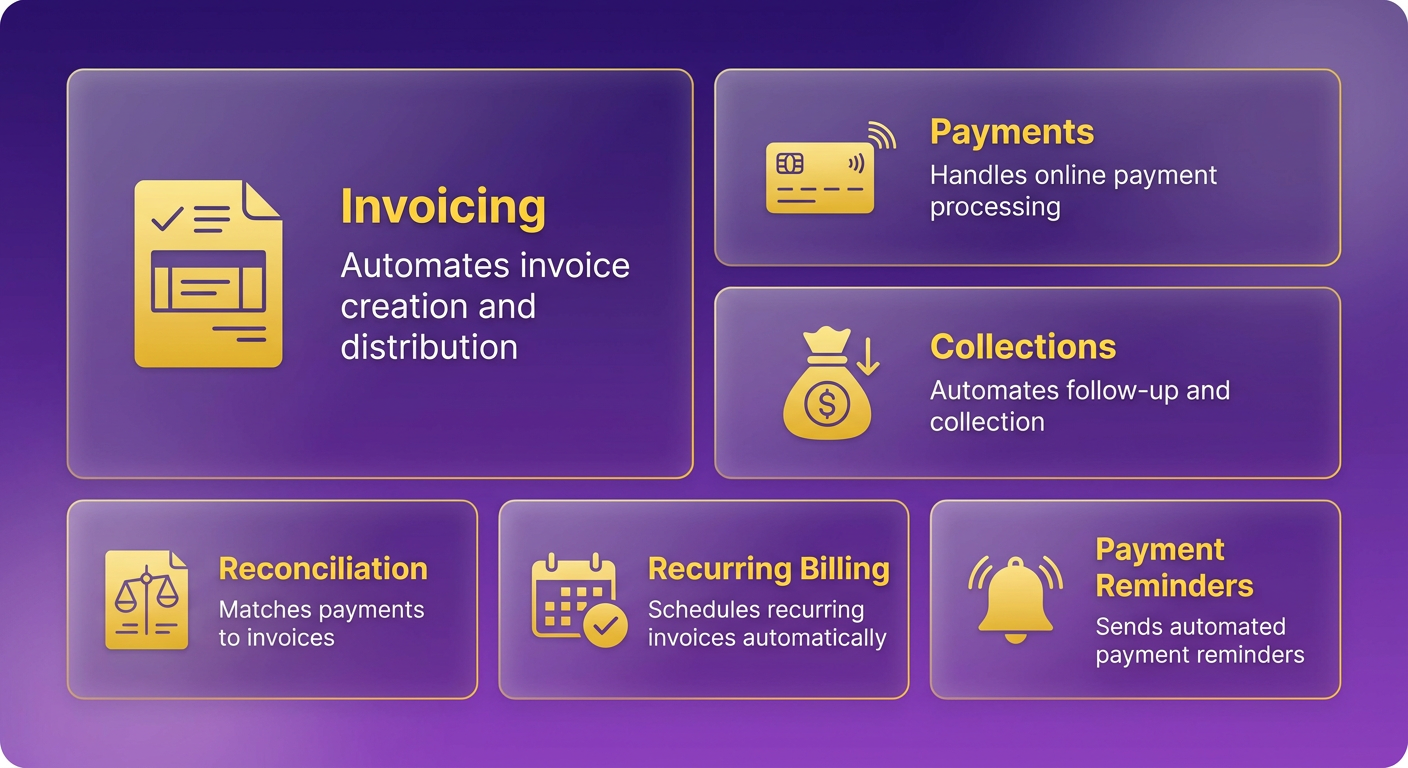
What Makes Invoiced’s Recurring Billing Automation Different?
Invoiced: a cloud-based AR platform that automates invoicing, payments, collections, and reconciliation, with recurring billing and automated payment reminders built for smaller teams.
The standout is scope-per-dollar. You get the full invoice-to-cash cycle in one tool without stitching together a billing app, a reminder service, and a reconciliation layer. That’s valuable for lean finance teams that need to consolidate their software stack and keep overhead low.
The honest read: this tier automates the workflow well, but it reacts to overdue invoices rather than predicting them. AI-native suites like Sidetrade forecast payment behavior from large transaction datasets. Invoiced does not. For a small SaaS team, that trade-off is often fine. You get affordable automation now and add prediction later as you scale.
Who Should Choose Invoiced?
Ideal user: SMB and SME SaaS teams that need affordable, all-in-one recurring billing automation and aren’t yet ready for a full AI-native I2C suite.
Choose it if you’re moving off spreadsheets and manual entry. The payment reminders alone recover cash you were previously chasing by email. The reconciliation automation frees hours each month a small team badly needs elsewhere.
Skip it if churn prevention is your primary goal. This tier chases payments; it doesn’t flag the account about to lapse before dunning starts. If early at-risk detection is the retention lever you care about, a platform with behavioral prediction fits better. Blixo, by contrast, wires proactive payment recovery tools directly into the billing cycle to handle failed transactions before they escalate.
How Does Invoiced Compare?
| Tool | Best for | Standout strength | Watch-out |
|---|---|---|---|
| Blixo | SaaS fighting churn | Proactive payment recovery & customer portal | Newer name vs. legacy suites |
| Invoiced | SMB/SME SaaS | All-in-one AR at low cost | Reacts, doesn’t predict |
| Sidetrade | Mid-market/enterprise | Behavioral payment forecasting | Enterprise pricing and scope |
Pros: full I2C cycle in one tool, recurring billing and reminders included, strong fit for lean teams leaving manual work behind.
Cons: no predictive at-risk scoring, less depth than enterprise suites, limited retention tooling for churn-focused teams.
Our rating: a solid 4 out of 5 for its target buyer. For a small SaaS team that just needs reliable automation without enterprise overhead, it’s one of the cleanest options in the lighter tier. If you want to close the automation gap with churn prevention built in, Blixo pairs the full invoice-to-cash cycle with Retention AI and automated collections in one platform.
Alternative 4
Our fourth pick is HighRadius, and it belongs here for enterprise SaaS teams running high volumes of recurring invoices. It sits firmly in the AI-native tier, built to automate financial operations at a scale where manual work stops being an option. For a subscription business with thousands of accounts renewing every month, that scale is the point.
The platform automates collections management, cash application, and deductions management, pairing AI agents with policy-driven decision rules to handle routine tasks. Among invoice-to-cash solutions with automation for recurring billing, few match its depth on the back end. Where it earns its keep is applying payments and matching them to open invoices without a person keying in the data.
What Makes HighRadius Different for Recurring Billing?
HighRadius: a cloud-based order-to-cash suite that automates collections, cash application, and deductions using AI agents combined with policy-driven decision rules.
The AI agents capture, classify, and prioritize tasks, which cuts the manual effort that buries enterprise AR teams. That matters for SaaS because reconciliation at volume is where errors and delays pile up. When a renewal charge fails and the cash application misfires, an account can go quiet before anyone notices.
The raw automation is excellent, but it’s tuned for collections efficiency, not churn prevention. Pair that engine with a human outreach layer and you turn payment-behavior data into an early-warning signal. HighRadius gives you the machine. The retention play is on your team to build around it.
Pros, Cons, and Ideal User
Best for: enterprise and upper mid-market SaaS with large recurring-invoice volumes and a dedicated AR team.
Pros: deep automation across the full cycle, strong cash application matching, AI-driven task prioritization, proven at enterprise scale. If your bottleneck is volume, this clears it.
Cons: it’s built for teams that already have receivables headcount. Smaller SaaS operators will find it heavy and priced beyond reach. If your customer base is still modest, a lighter integrated tier fits your needs much better without the enterprise overhead.
How These Recurring Billing Tools Compare
| Tool | Best-Fit Buyer | Standout Strength | Watch-Out |
|---|---|---|---|
| Blixo | SaaS fighting churn | Proactive payment recovery & customer portal | Newer than legacy suites |
| HighRadius | Enterprise SaaS, high volume | AI agents for cash application at scale | Heavy for small teams |
| Sidetrade | Mid-market, prediction-first | Behavioral payment forecasting | Enterprise pricing |
| Invoiced | SMB/SME SaaS | Recurring billing without enterprise cost | Lighter feature depth |
The honest read: HighRadius is the strongest pure automation engine in this roundup for teams operating at scale. If you’re processing recurring invoices by the thousand and your AR team is drowning in reconciliation, it solves that problem well.
But automation speed alone doesn’t hold recurring revenue. The teams that lower churn are the ones who use payment data to reach a customer before a failed charge becomes a cancellation. That human layer is what separates a collections engine from a retention system, and it’s the gap we built our own invoice-to-cash approach to close.
Alternative 5
Our fifth pick is Billtrust, and for mid-market teams that want a single unified system instead of a stack of bolted-together tools. Among invoice-to-cash solutions that offer automation for recurring billing, its strength is consolidation. It folds billing, invoicing, payment, and cash application into one place.
The platform integrates those functions into a single Unified AR solution, which cuts the manual work of moving data between systems. For a subscription business, that means one source of truth for who owes what, delivered electronically and accepted in multiple payment formats.
What Makes Billtrust’s Recurring Billing Automation Different?
Billtrust: an AI-native AR platform that combines billing, invoicing, payment acceptance, and cash application to reduce manual tasks and improve cash flow visibility.
The differentiator is breadth on one system rather than depth on one feature. Where Sidetrade leads with behavioral prediction and HighRadius with back-end cash application at scale, this one competes on removing the seams between AR functions. Electronic invoice delivery and multi-format payment acceptance sit inside the same workflow.
That consolidation matters for SaaS because fragmented AR data is where churn signals get lost. When billing lives in one tool and payments in another, nobody sees the customer whose card started failing two cycles ago. A unified view at least keeps the data together. What it doesn’t do on its own is turn that view into a human intervention before the account lapses. That gap is where a retention-first approach pulls ahead.
Pros, Cons, and Who It Fits
Pros: One unified system for billing through cash application. Strong electronic invoice delivery. Multi-format payment acceptance. Solid fit for mid-market volumes.
Cons: Enterprise-oriented pricing and setup. Heavier than an SMB team needs. The unified data is descriptive, not predictive, so at-risk detection still leans on your team watching the dashboard.
Ideal user: A mid-market SaaS finance team drowning in disconnected AR tools that wants to collapse them into one platform. Skip it if you’re a small team under a handful of people. The consolidation payoff needs enough volume and enough tool sprawl to justify the lift.
How Does Billtrust Compare to the Others?
| Tool | Best For | Standout Strength | Recurring Billing | At-Risk Prediction |
|---|---|---|---|---|
| Blixo | SaaS fighting churn | Proactive payment recovery & customer portal | Yes | Yes |
| Billtrust | Mid-market consolidation | Unified AR on one system | Yes | No |
| Sidetrade | Prediction-first teams | Behavioral forecasting | Yes | Yes |
| HighRadius | Enterprise volume | Cash application at scale | Yes | Partial |
| Invoiced | Smaller SaaS teams | Affordable full-cycle AR | Yes | No |
The pattern across these tools is clear. Almost every option automates recurring billing well. The real separation shows up in whether the platform helps you reach a customer before a failed charge becomes a cancellation.
For a SaaS team, we’d rank Billtrust as the strongest choice when your problem is tool sprawl. Its unified system genuinely reduces manual handoffs. But if your problem is churn, consolidation alone won’t fix it. You still need the layer that flags the account going quiet and prompts a real person to reach out. That’s where a retention-first platform, paired with clean automation, does the work a pure AR engine never will.
Alternative 6
Our sixth pick is Esker, and for mid-market and enterprise teams that want workflow automation paired with real-time visibility into receivables performance. Among the invoice-to-cash solutions offering automation for recurring billing, it stands out for how much it surfaces on a dashboard rather than burying it in reports.
The platform streamlines the entire invoice-to-cash process with workflow automation and AI capabilities. For a subscription business, that means recurring invoices, reminders, and cash application run on autopilot while your team watches the numbers move in real time.
What Makes Esker’s Recurring Billing Automation Different?
Esker: an AI-native AR solution suite that combines workflow automation with real-time dashboards to track receivables performance across the invoice-to-cash cycle.
The differentiator is visibility. Where some suites automate the back end and leave you guessing, this one puts collection status, aging, and cash flow on live dashboards. You see which accounts are slipping without pulling a report.
For SaaS, that live view is only half the retention story. A dashboard tells you an account went overdue. It doesn’t tell you the renewal was already wobbling three weeks earlier. Pair that visibility with payment-behavior prediction and a monitoring tool becomes an early-warning system for churn. The dashboard shows you the fire. Prediction lets you smell the smoke first.
That gap is why Blixo built its approach to address payment friction before problems escalate. Real-time reporting and predictive intervention solve different problems, and growing teams often need both.
Pros, Cons, and Who It Fits
Pros: strong workflow automation across the full cycle, genuinely useful real-time dashboards, and AI features that cut manual receivables work. The visibility layer is a standout for teams that want to manage AR by exception.
Cons: it’s built for mid-market and enterprise scale, so smaller SaaS teams may find it heavier than they need. Pricing is quote-based, which means a sales conversation before you know your number.
Ideal user: a subscription business with enough volume that manual monitoring has stopped working, and a finance team that wants to run collections off a live board instead of static spreadsheets.
How the Options Compare
| Tool | Best for | Standout strength | Pricing model |
|---|---|---|---|
| Blixo | SaaS fighting churn | Proactive payment recovery & customer portal | See site |
| Esker | Mid-market & enterprise SaaS | Real-time performance dashboards | Quote-based |
| Sidetrade | Prediction-first teams | Behavioral payment forecasting | Quote-based |
| HighRadius | High-volume enterprise | Cash application at scale | Quote-based |
Skip this one if you’re a small team still moving off manual data entry. The dashboards are powerful, but you’ll pay enterprise complexity for a scale you haven’t reached yet. Lighter integrated tools handle recurring billing without the overhead.
For SaaS teams that have hit real volume, the combination of automation plus live visibility earns its place. Just remember that seeing the churn happen and preventing it are two different jobs. Blixo pairs automated collections, chasing, and dunning with proactive customer communication, so you can act before an account lapses. Which is where recurring revenue actually holds.
Alternative 7
Our seventh pick is Versapay, and for SaaS teams where the customer relationship during billing matters as much as the billing itself. Among invoice-to-cash solutions that offer automation for recurring billing, it takes a different route. It builds collaboration between your finance team and the customer directly into the payment flow.
The platform handles invoice presentment and payment processing, but its defining feature is real-time collaboration. For a subscription business, a disputed charge or a confused renewal gets resolved in a shared thread instead of a chain of one-way dunning emails. That human touchpoint is exactly the kind of intervention that keeps an at-risk account from walking.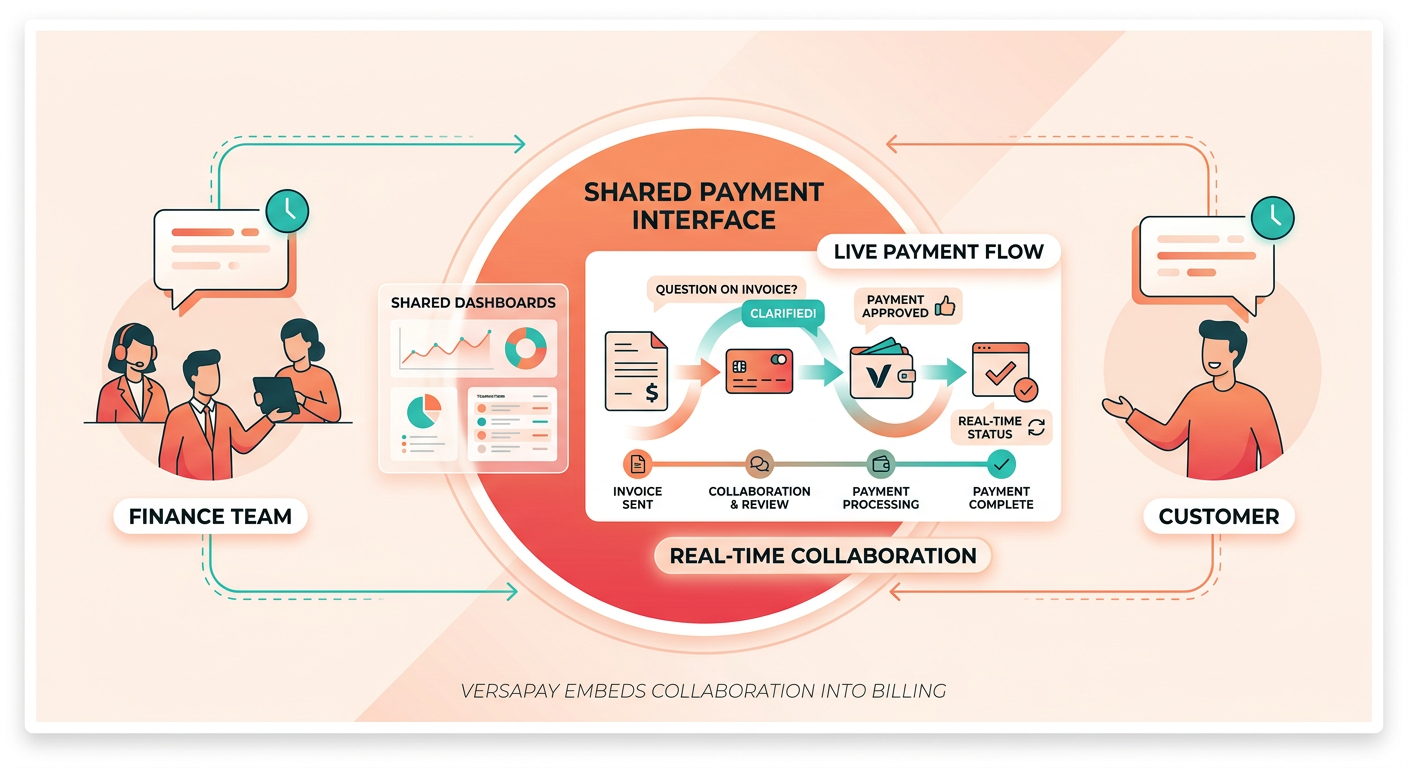
What Makes Versapay’s Recurring Billing Automation Different?
Versapay: a collaborative AR platform that pairs automated invoice presentment and payments with a shared workspace where finance teams and customers communicate in real time.
The automation runs the repetitive cycle. Invoices go out, reminders fire, payments process. What sets it apart is the layer on top. When a customer has a question, they answer it inside the same system, not in a separate inbox your team never sees.
For SaaS, this matters more than it looks. Most billing friction that leads to churn is a communication breakdown, not a payment failure. A real-time collaboration channel catches that friction before it hardens into a cancellation.
Pros, Cons, and Who It Fits
Pros: the collaborative workspace reduces back-and-forth on disputes, invoice presentment is clean, and customers can self-serve answers. That cuts the manual load on your AR team while keeping a human option open.
Cons: the collaboration-first design is strongest when your customers are willing to engage in a portal. For high-volume, low-touch subscription accounts, that interaction layer adds little. Pricing isn’t publicly listed, so you negotiate per deal.
Ideal user: mid-market SaaS teams with B2B customers and enough account value to justify a relationship-led billing approach. Skip it if your base is thousands of small self-serve subscribers who never open a billing portal. The overhead isn’t worth it there.
How Does It Compare on Recurring Billing?
Versapay solves the communication gap after billing friction appears. That’s valuable, but it’s reactive. The customer has to surface the problem first.
The angle we’ve pushed throughout this roundup is earlier detection. Pair automated recurring billing with predictive insights and you flag an at-risk account before the customer ever raises a hand. Blixo’s subscription management includes built-in tools to handle failed transactions gracefully, which is why we lead with it for churn-focused teams.
Both keep a human in the loop. The difference is timing. Versapay gives your customer a better channel to reach you. Blixo focuses on improving retention before the customer needs to reach out, using automated collections and subscription analytics to surface at-risk accounts early.
| Tool | Best for | Standout strength |
|---|---|---|
| Blixo | SaaS fighting churn | Churn prediction and retention before dunning starts |
| Versapay | Relationship-led B2B SaaS | Real-time finance-customer collaboration |
Pick Versapay if collaborative dispute resolution is your biggest leak. Pick a prediction-led tool if silent churn is the problem you can’t see coming.
Alternative 8
Our eighth pick is Quadient AR Automation, and for SME and lower-mid-market teams that want reliable recurring-billing delivery without a heavy implementation. Among the invoice-to-cash solutions offering automation for recurring billing, it keeps the focus narrow: get invoices out the door and reminders in front of customers on schedule.
The platform automates invoice delivery and payment reminders to improve cash flow performance. For a subscription business, every renewal notice lands when it should, and follow-ups fire without a person watching the calendar. That reliability is the baseline you need before you layer anything human on top.
What Makes Quadient’s Recurring Billing Automation Different?
Quadient AR Automation: an AR platform that optimizes receivables with automated invoice delivery and payment reminders to strengthen cash flow and operational efficiency.
Where it fits is the middle ground. It sits above the manual spreadsheet-and-email routine many smaller SaaS teams still run, but below the deep AI-native suites built for thousands of monthly renewals. If you want dependable delivery and structured reminders without a forecasting engine, this is the tier you shop in.
Here’s the trade-off worth naming. The reminder automation is solid, but it leans reactive. It nudges after a payment is due, not before an account starts to wobble. For SaaS teams chasing churn, that gap matters. The tools worth paying more for read payment behavior and flag risk early, so you can reach a customer with a real message before the failed charge becomes a cancellation.
Our take: pair a delivery-first tool like this with a genuine at-risk signal, or pick a platform that already bundles both. Automated reminders keep the cycle running. Early detection keeps the customer.
Pros, Cons, and Who Should Pick It
Best for: SME and lower-mid-market SaaS teams that need dependable recurring-invoice delivery and reminder automation without enterprise complexity.
Pros:
- Automated invoice delivery removes manual send-and-track work.
- Structured payment reminders keep cash flow moving on schedule.
- Lighter footprint than full AI-native suites, so it’s faster to stand up.
Cons:
- Reminders are reactive, not predictive. No behavioral forecasting to catch at-risk accounts early.
- Thinner on the human collaboration layer that helps resolve disputes before they turn into churn.
How Does It Compare on the Churn Lever?
Straight answer: strong on delivery, light on retention. If your churn problem is missed or late renewal notices, this tool fixes it. If your churn problem is silent accounts drifting toward cancellation, you’ll want prediction and a human touchpoint the delivery-first approach doesn’t provide.
| Tool | Best for | Recurring billing automation | At-risk detection |
|---|---|---|---|
| Blixo | SaaS fighting churn | Yes | Yes, AI-driven prediction |
| Quadient | SME / lower-mid-market SaaS | Yes | No |
For teams where the real fight is retention, we’d steer you toward a platform that treats billing data as an early-warning system rather than a send-and-remind loop. Our own invoice-to-cash automation approach is built on exactly that idea: keep the automation humming, but spot the lapsing account first.
What I’d Actually Recommend
Which invoice-to-cash solutions offer automation for recurring billing? Nearly all of them. The pick that lowers churn is the one that pairs that automation with a human touchpoint before an account lapses. For SaaS teams, that pairing matters more than the length of the feature list.
Our read across the whole market: automation and personalization reinforce each other. Giving subscribers a choice of delivery and payment options helps close the gap between invoice and payment. The customer-centric move isn’t just automating billing. It’s letting people choose how they receive and pay. Which is why Blixo lets customers pay through a brandable portal, manage saved payment methods, and receive invoices via email, SMS, letters, or automated calls.
Which recurring billing tool fits your budget and stage?
Match the tool to your stage, not the longest feature list. Smaller SaaS teams want lighter integrated platforms that end manual data entry. Enterprise teams need AI-native depth to handle thousands of renewals. Before you commit, weigh three practical factors: setup time, how many accounts you manage today, and where your revenue leaks now. A team losing subscribers to failed charges has different needs than one drowning in manual reconciliation. Run a short pilot on a subset of accounts, measure the change in days-to-payment, and let that number decide instead of the sales demo.
What’s the best pick for specific SaaS needs?
Pick by the problem you’re solving, not the brand. Best for budget is Invoiced, which delivers recurring billing, reminders, and reconciliation for teams graduating from spreadsheets. Best for enterprise is HighRadius, built for high-volume cash application without a person keying in data.
If prediction is your priority, Sidetrade reads payment behavior and flags trouble early. For consolidation, Billtrust folds billing and cash application into one system. Need the customer relationship baked into the payment flow? Versapay resolves disputes in a shared thread instead of a one-way dunning chain.
What’s our final verdict on recurring billing automation?
For SaaS teams, our pick is Blixo. The reason is the angle we’ve pushed all along: the value of automation is in how it supports the customer relationship during the moments a payment can make or break a subscription.
The platform runs the full cycle. Recurring invoicing, reminders, cash application, and reconciliation all happen without manual work. What sets it apart is the human layer on top. Blixo helps you manage declined payments smoothly, so you can spot accounts about to lapse and reach a customer with a real message before a failed charge turns into a cancellation. It also refreshes expired or renewed cards automatically, closing one of the most common gaps that costs subscriptions.
If you’re operating at a smaller scale, a lighter tool like Invoiced or Quadient will do more for your team than an enterprise platform you never fully configure. And if your churn is a product problem, no billing tool fixes that. Automation buys you the early warning. The human follow-up is what saves the account.
Frequently Asked Questions
1. Can I switch from a lighter tool like Invoiced to an enterprise suite later as I scale?
Yes, but plan for migration carefully. Transitioning contracts off a legacy system requires meticulous validation to prevent billing errors. A phased approach works best: test the new billing engine with a small cohort of accounts first, verify that invoice calculations and payment gateways align perfectly, and gradually migrate the rest of your customer base to ensure operational stability.
2. What happens when a customer’s card expires on a recurring subscription?
An expired card triggers a declined charge, which can disrupt service if left unaddressed. Modern billing platforms handle this by communicating directly with card networks to retrieve updated card numbers and expiration dates behind the scenes. This ensures continuous service for the customer and uninterrupted revenue for your business without requiring manual outreach.
3. Why do some recurring billing tools still fail even with strong automation?
Even the most advanced automation fails if it is built on inaccurate underlying data. If subscription terms, tax rules, or customer contact details are outdated, the system will simply generate incorrect invoices at scale. Ensuring data hygiene before automating your workflows is critical to preventing customer disputes and billing discrepancies.
4. At what customer count does an enterprise suite start making sense?
Enterprise suites generally start making sense when your transaction volume and organizational complexity demand specialized features. If your team is small and your pricing model is straightforward, the overhead of configuring complex modules like multi-entity cash application or dispute management will outweigh the benefits. Wait until manual reconciliation begins to consume a significant portion of your finance team’s weekly hours.
5. What’s the difference between faster collections and churn prevention?
Collections focus on recovering outstanding balances after a payment has already failed, often using structured dunning emails. Churn prevention, on the other hand, looks at billing interactions as customer touchpoints. By identifying payment friction early, you can engage customers with personalized support rather than relying solely on automated, transactional reminders that might alienate them.
6. How does Sidetrade’s prediction differ from Blixo’s retention approach?
Sidetrade is designed for enterprise-scale operations, analyzing massive transaction volumes to forecast payment timelines across complex corporate accounts. Blixo is tailored for subscription-native businesses, focusing on immediate payment recovery, customer self-service, and reducing involuntary churn through smooth, automated billing workflows.
7. Which tool handles multi-currency and partial payments best?
Enterprise-grade platforms are specifically built to handle complex financial scenarios like multi-currency billing, partial payments, and cross-border tax compliance. While smaller tools can manage basic international transactions, global suites offer the robust reconciliation engines needed to match partial payments to multiple open invoices across different regions automatically.