

Solution for Invoice to Cash Automation

Key Takeaways
- Manual invoice processing costs $29.83 per invoice and takes 20 days. Automation drops that to $2.00 in under a week.
- Organizations adopting invoice to cash automation typically save 40-60%, with many investments paying back within months.
- One consumer goods company recovered $33.4 million with a 34-day resolution time, well below the 90-day industry average.
- A separate organization cut $1.3 million in annual interest costs by improving cash management through automation.
- Subscription and SaaS businesses gain the most, since payment friction during recurring billing directly drives churn.
- Forrester research indicates a positive billing experience can raise customer retention by as much as 92%.
- Customers leave over frustrating payment processes, not product dissatisfaction.
Why Invoice to Cash Automation Matters
Working with service businesses and SaaS companies, we’ve seen the same pattern: teams spend entire afternoons chasing misapplied payments, reconciling spreadsheets, following up on overdue invoices. Work that automation handles in seconds. The cost difference is stark. Manual invoice processing requires significant staff hours and extended processing times. Automated systems compress the cycle to a fraction of the time and cost.
The financial impact shows up in multiple ways. Organizations implementing automation report substantial operational savings, with many investments paying for themselves rapidly. By accelerating dispute resolution and optimizing cash management, companies unlock millions in trapped capital and significantly reduce annual interest expenses. These aren’t marginal gains. They’re the difference between tight cash reserves and the working capital you need to invest in growth.
Who Benefits Most from Automating Invoice to Cash
Subscription-based businesses and SaaS companies stand to gain the most from a complete invoice to cash solution. When you’re billing customers monthly or quarterly, administrative friction in the payment process directly threatens customer loyalty. Industry research highlights that a smooth billing experience is a major driver of customer retention. We see this constantly: customers walk away not due to product dissatisfaction, but because administrative errors, confusing invoices, or payment hurdles degrade their experience.
Technology companies with usage-based billing or milestone invoicing face a different challenge—complex pricing structures that manual systems struggle to handle accurately. Automation ensures you bill correctly the first time, reducing disputes and accelerating collections. Manufacturing and distribution businesses processing high invoice volumes see similar benefits, as automated workflows eliminate the delays from manually routing approvals and applying payments.
The Real Cost of Partial Automation
Many teams automate invoice generation but leave payment collection and cash application manual. This creates a bottleneck that cancels out most of your efficiency gains. The invoice-to-cash cycle has six connected stages: invoice generation, delivery, payment collection, cash application, AR management, and revenue recognition. When you automate just one or two stages, you’re still stuck with the high overhead costs from the remaining manual steps.
Most automation failures trace back to data quality issues upstream. If your contract data from CRM is messy, or your usage data from product infrastructure contains gaps, even the best automation platform will struggle. The solution isn’t to skip automation—it’s to clean up your data first. Automated cash application systems can hit above 90% accuracy in most implementations, but only when they’re working with clean input data.
Automation doesn’t eliminate human judgment. It eliminates routine execution. Your team still handles exceptions, makes decisions on disputed charges, and manages customer relationships. The difference is they’re no longer drowning in repetitive tasks. Financial services teams working with automated systems report focusing on strategic work instead of manual data entry, which improves both productivity and job satisfaction.
For businesses relying on timely payments to maintain cash flow, the invoice-to-cash process isn’t just an accounting function—it’s a revenue protection mechanism. When you’re waiting weeks for payments to clear because of manual bottlenecks, you’re giving your customers an interest-free loan. Automation tightens that cycle, reduces your days sales outstanding, and puts cash back in your account. Skip this for businesses with fewer than ten monthly invoices; the setup effort won’t justify the savings. But if you’re processing volume or managing recurring billing, a complete invoice to cash solution becomes one of the most direct improvements you can make to your financial operations.
Selecting the Right Automation Solution
When you’re evaluating a solution for invoice to cash automation, look beyond surface-level features and consider how the platform handles the complete cycle—from subscription billing through cash application. We’ve seen too many SaaS companies patch together separate tools for invoicing, payment processing, and reconciliation, only to find that partial automation creates more bottlenecks than it solves. The ROI curve isn’t linear. You enable real value only when the entire workflow integrates seamlessly, which is where a unified platform built for subscription businesses matters most.
What Features Actually Move the Needle?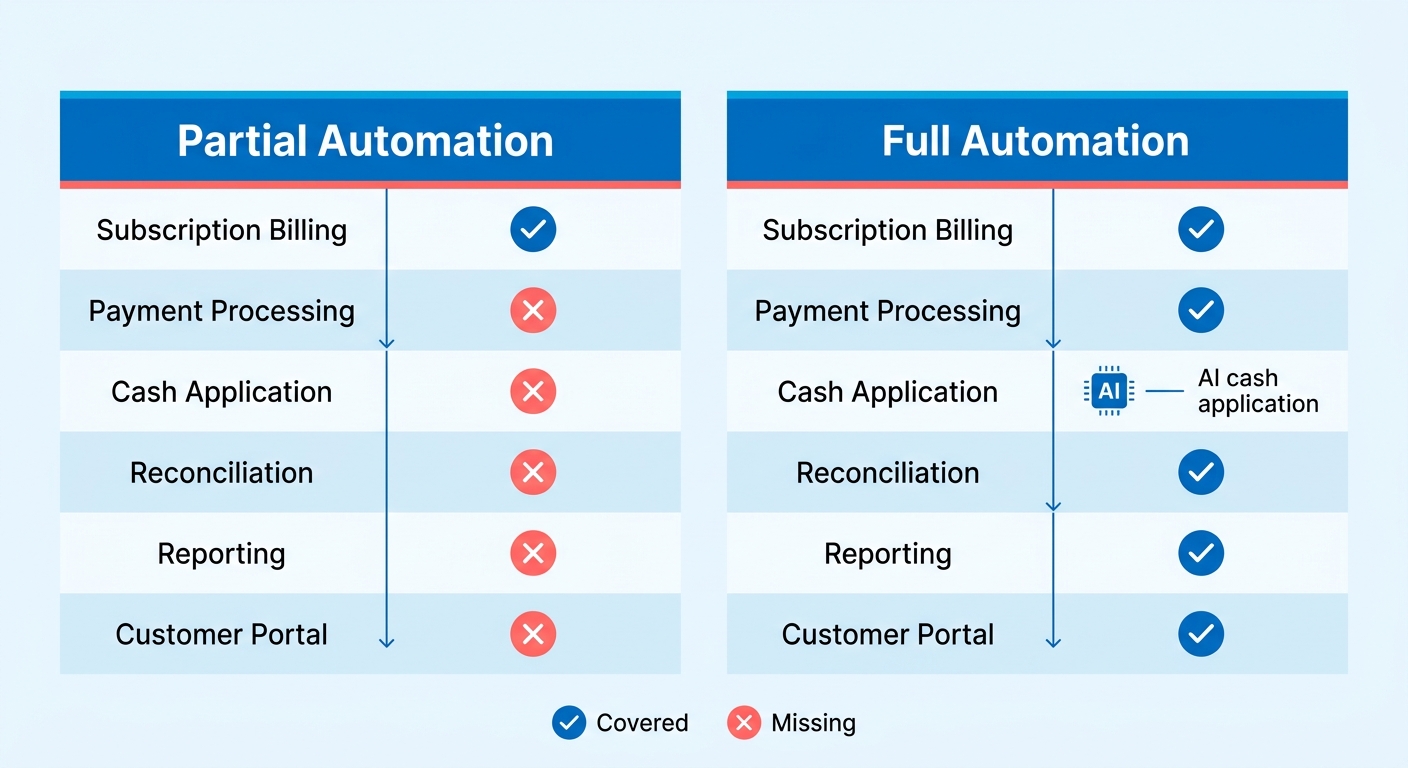
Start with AI-powered cash application. Blixo’s intelligent matching engine delivers market-leading match rates at the envelope and item level from multiple sources, matching payments to open invoices automatically with very high accuracy. The technology should handle unstructured payment data—pulling details from bank files, email remittances, and payment portals—then match them to open invoices without human review, growing smarter over time as your team edits matches. That kind of speed matters when you’re managing recurring revenue and can’t afford payment friction to trigger churn.
Look for customer-facing portals that give subscribers 24/7 access to invoices, payment history, and account balances. Finance teams that offer self-service payment options often see days sales outstanding drop by a week or more, since customers settle invoices on their own schedule instead of waiting on a collections email. When customers can self-serve—updating payment methods, batch-paying outstanding invoices, downloading statements—you reduce support load and improve the subscription experience simultaneously.
Integration breadth determines whether automation actually saves time or just shifts work around. The platform should connect to your ERP, payment gateways, banks, and credit agencies without custom development. Blixo integrates with accounting software like QuickBooks, Xero, Sage Intacct, and NetSuite, and offers custom ERP integrations for Oracle, SAP, and Microsoft Dynamics, so data flows automatically and reconciliations stay accurate. For SaaS businesses running usage-based billing or tiered subscriptions, you also need native revenue recognition capabilities that align with ASC 606 requirements—otherwise you’re maintaining a separate system just to close the books each month.
How Do You Know If It’ll Scale with Your Business?
Test the platform’s handling of subscription complexity before you commit. Can it manage revenue recognition schedules, metered billing, add-ons, coupons, and multi-currency billing without manual workarounds? Blixo’s flexible subscription management supports many unique business requirements, predicts churn, optimizes retention, and automatically updates expired or replaced credit cards. We recommend running a proof-of-concept with your actual subscription data—including edge cases like downgrades, refunds, and annual-to-monthly conversions—to see where the automation breaks down.
Security and compliance matter for your finance team. The solution should provide the controls and approval workflows that keep payment handling accurate and auditable. By pairing structured approval paths with automated reconciliation, the system ensures your team maintains oversight and compliance documentation without having to manually verify every transaction.
Our approach with clients is straightforward: if you’re a SaaS business dealing with recurring revenue, churn risk, and complex billing scenarios, you need a platform that treats subscription management and invoice-to-cash as a single integrated workflow. Breaking down silos between billing and collections isn’t just cleaner architecture—it’s how you prevent the partial-automation trap that leaves manual bottlenecks scattered across your revenue cycle.
When Should You Skip This Entirely?
Don’t automate for automation’s sake. If you’re billing only a handful of clients each month with basic payment terms and no subscription complexity, manual processes remain perfectly adequate. The inflection point arrives when you begin managing recurring billing cycles, dealing with payment failures, or spending hours each week on manual reconciliation. That’s when the operational overhead justifies transitioning to a dedicated platform.
Implementing Invoice to Cash Automation
A successful rollout of a solution for invoice to cash automation starts long before you flip any switches. The businesses that get real value plan for data cleanup, map their integrations, and phase the rollout stage by stage. The ones that struggle rush straight to configuration and inherit every mess from their old system.
A critical factor in implementation success is the state of your legacy data. If customer records, contract terms, and pricing rules are inconsistent going in, the automation logic will struggle to map transactions correctly. Addressing these inconsistencies beforehand ensures a much smoother transition.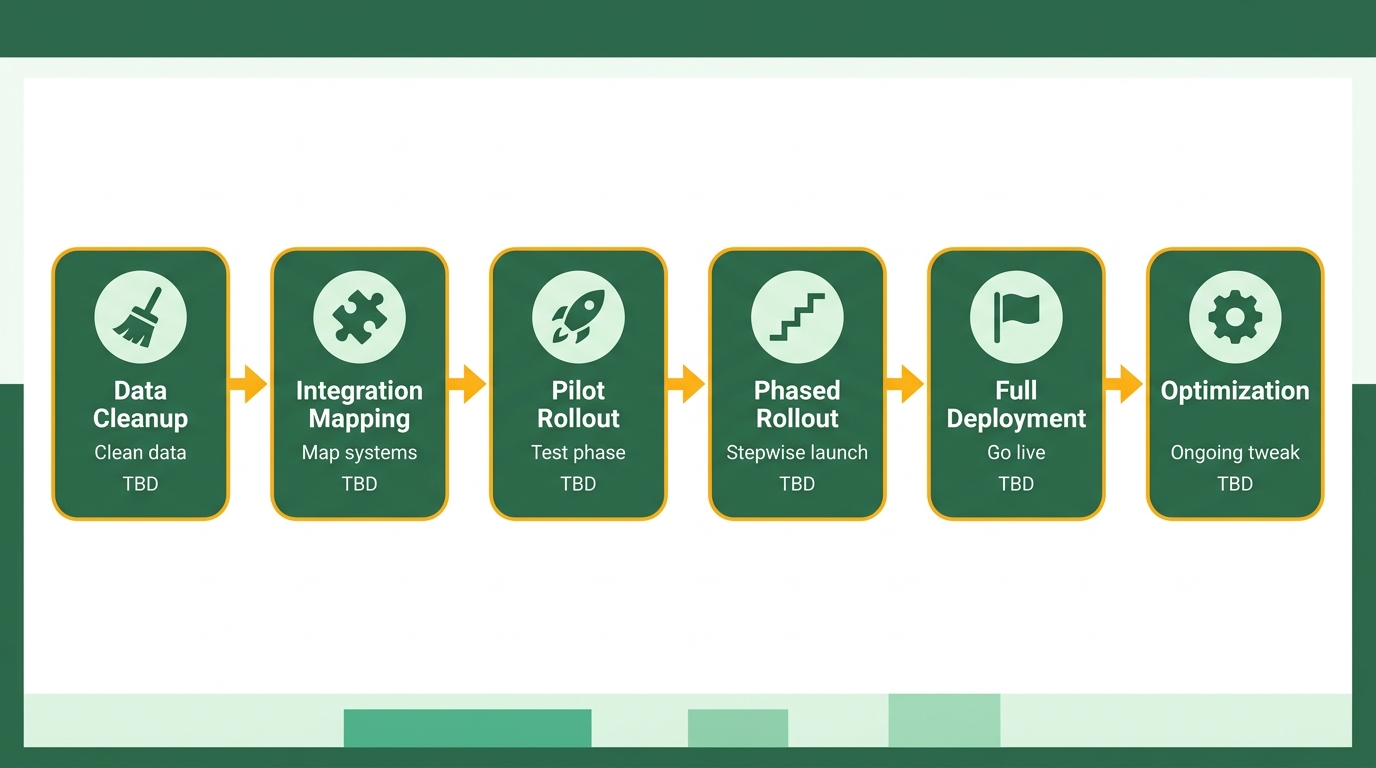
How Should You Prepare Before Implementation?
Preparation means auditing your data and confirming your systems can talk to each other. Reconcile open invoices, deduplicate customer records, and validate that your subscription plans and pricing tiers are accurate. This unglamorous work is what makes everything downstream reliable.
For SaaS teams, the integration map matters more than for most. Your billing engine needs clean contract data from your CRM and accurate usage data from your product. When those feeds are wired correctly, the system can match payments to accounts immediately. When they aren’t, you spend your first quarter fixing exceptions instead of banking the time savings.
We also recommend documenting your current workflows before you change them. You can’t improve a process you haven’t mapped. Breaking down the silos between billing, collections, and reconciliation is half the battle, and Blixo is built to be the single source of truth for reconciled real-time revenue data across those functions.
What Configuration Choices Matter Most for SaaS?
Configure subscription billing and dunning together, not as separate projects. For SaaS, the invoice-to-cash cycle is a churn lever, not just a finance efficiency play. A failed card that triggers a rude, poorly timed reminder loses you a customer who would have happily updated their payment method.
Set up automated retry logic, grace periods, and payment-failure workflows that feel like service, not collections. Configure remittance matching to handle your real payment patterns: partial payments, consolidated payments across multiple subscriptions, and mid-cycle upgrades. Getting this right is where automation shifts from cost-cutting to retention.
Designing the workflow around your team’s expertise is equally important. By automating repetitive tasks, staff can focus their attention on resolving complex disputes, managing key account relationships, and handling unique billing exceptions that require a personal touch.
What Pitfalls Derail Implementation?
The two most common failures are inadequate testing and rushed training. Test with real invoice data across your messiest scenarios before go-live, including disputed items and unusual payment structures. Skipping this is how teams find problems in production.
The payoff for doing it right is concrete. Once the system is properly calibrated, reconciliation times drop significantly, allowing your finance department to handle scaling transaction volumes without needing to hire additional staff for manual data entry.
Don’t treat go-live as the finish line. Monitor your DSO, match rates, and exception volumes monthly, and tune your rules as your pricing and customer base evolve. Automation that isn’t maintained slowly drifts back toward manual work.
Measuring the ROI of Invoice to Cash Automation
ROI on a solution for invoice to cash automation shows up first in your numbers, then in your retention. Track two headline metrics from day one: days sales outstanding (DSO) and net cash flow. If DSO drops and cash lands faster, the automation is paying for itself. One AI-driven accounts receivable transformation cut the receivables period by roughly 22%, which is the kind of movement you want to see within your first two quarters.
Finance teams report freeing up 15 to 20 hours per week once invoice matching and payment application run automatically. That time typically shifts to strategic work like customer outreach on high-value accounts or building better forecasting models. But most ROI math misses this: an invoice to cash solution built for subscription billing also protects revenue you’d otherwise lose to payment friction and involuntary churn. That’s the metric no spreadsheet defaults to, and it’s where SaaS founders find the real return.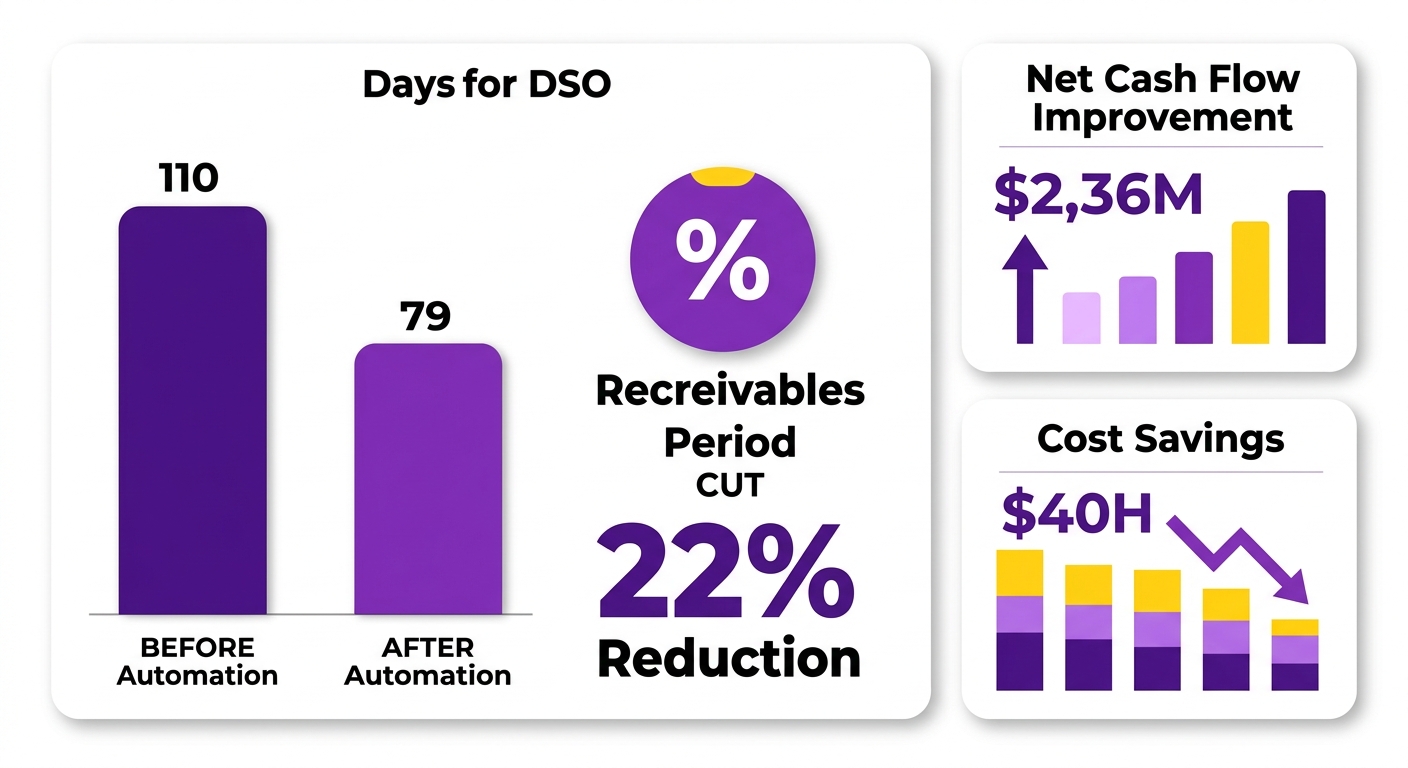
What Metrics Actually Prove ROI?
Track four things: DSO reduction, cash flow acceleration, unapplied cash, and error rates in payment application. Unapplied cash is the sleakiest of the four. Advanced cash application can cut it by up to 99%, meaning payments match to invoices automatically instead of sitting in a suspense account while your team plays detective.
For SaaS specifically, add a fifth metric your finance peers rarely watch: churn tied to billing failures. When a card declines or an invoice goes unpaid, that’s often an operational problem masquerading as a lost customer. Automated retries, dunning, and clean reconciliation recover revenue that manual chasing lets slip. For subscription businesses, invoice-to-cash automation is a churn lever first and a finance-efficiency play second.
How Do You Set Realistic Benchmarks?
Benchmark against your own baseline before you chase industry averages. Record your current DSO, error rate in cash application, and unapplied cash percentage in the 90 days before rollout. Those numbers are your control group.
Many see DSO improvements of 12 to 18 days within the first year, and error rates in payment matching drop from 8-12% to under 1%. A useful rule from research is that top AR teams are 189.5% more likely to support e-invoicing, which correlates with faster collections. Set your first-year goal at the lower end of established improvement bands. Beating a conservative target beats missing an aggressive one.
A word of caution on partial rollouts. Automating one stage while leaving the rest manual creates bottlenecks, and the ROI curve stays flat until subscription billing, invoicing, and cash application all connect. Don’t benchmark half a system and expect full-system returns.
Estimating Return Before You Commit
An ROI calculator turns these benchmarks into a projection you can take to your finance lead. Feed in your invoice volume, current DSO, and error rate, and you get an estimated payback window and annual savings. It’s a planning tool, not a promise, so revisit it against actuals each quarter.
Ongoing monitoring is where ROI holds or erodes. 78% of CFOs who invested in AI report positive returns, but that return depends on watching the metrics after go-live, not just at pitch time. Review your DSO, unapplied cash, and recovered subscription revenue monthly. If a number stalls, you’ve found your next fix before it costs you.
Real-World Success Stories of Invoice to Cash Automation
The most convincing case for automating invoice to cash isn’t a single headline number. It’s what happens when you stack the returns. When you read successful implementations side by side, a solution for invoice to cash pays back in four different currencies at once: recovered cash, faster cycle time, interest saved, and cost stripped out.
That four-dimensional payoff matters most for subscription businesses, where a small monthly leak compounds into serious lost revenue. Below are the patterns we see repeat across real implementations, and the lessons worth stealing before you roll out your own invoice-to-cash solution.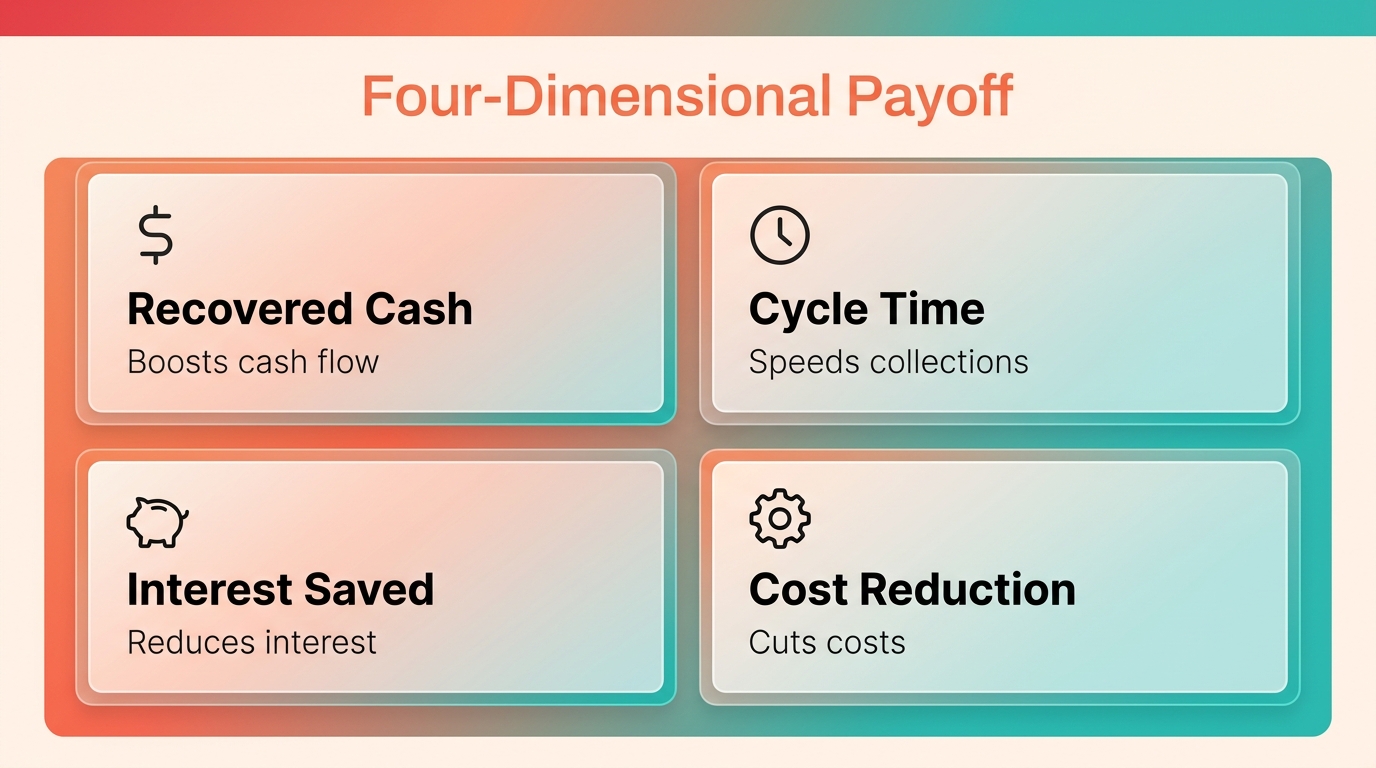
What Do Real Automation Results Look Like?
Companies implementing invoice-to-cash automation typically see value across multiple dimensions simultaneously. Automated collections systems help recover revenue that would otherwise slip through the cracks. Intelligent matching engines compress the time between payment receipt and reconciliation. Streamlined processes reduce administrative overhead and the interest costs that come with delayed cash application.
No single metric captures the win. Some businesses focus on recovered revenue and faster dispute resolution. Others prioritize interest savings from accelerated cash application. Many see the biggest impact in pure cost reduction as manual reconciliation work disappears. Read together, these outcomes show automation returning value on multiple fronts simultaneously, which is why one-dimensional ROI math consistently undersells it.
For a SaaS founder, this reframes the question. You’re not just chasing a lower cost per invoice. You’re recovering revenue that would otherwise churn out silently, shortening the gap between billing and cash, and freeing your finance team from reconciliation grunt work all at the same time.
What Lessons Come From Successful Implementations?
The businesses that win share one habit: they treat automation as a program, not a project. Automated cash application and intelligent matching accelerate the invoice-to-cash cycle and shorten turnaround, but only when the underlying data and workflows are clean going in.
A few best practices we see repeat:
- Start where the pain is measurable. Teams that led with automated collections or cash application saw the fastest, most defensible wins.
- Phase the rollout. Nobody who succeeded flipped every process on at once. They proved value on one stage, then expanded.
- Keep a human in the loop early. Approval workflows let the matching engine learn from corrections, so accuracy climbs over the first few months instead of stalling.
The common pitfall? Treating go-live as the finish line. Match rates and dunning rules need tuning as your product, pricing, and customer base shift. Ongoing support and periodic reviews are what separate a system that keeps improving from one that quietly decays.
Where Do Businesses Expand Next?
The teams that get the most value rarely stop at collections. Once invoicing and cash application are automated, they leverage the unified data to improve cash flow forecasting, refine pricing strategies, and enhance long-term financial planning.
This is the natural path for a subscription business. You automate getting paid, then use the clean revenue data as your single source of truth for forecasting and retention. Each new stage you connect raises the return on the stages already running.
That compounding is the real story behind sustained improvement. The recovered cash and reduced administrative costs are the entry point. The durable advantage is a finance operation that gets tighter, faster, and more predictable every quarter you run it.
Frequently Asked Questions
1. What if my business has fewer than 50 invoices per month—should I still automate?
Automation is most beneficial when the volume and complexity of billing create significant administrative overhead. For very low-volume operations with basic payment terms, manual tracking is often sufficient. The need for automation arises when managing recurring subscriptions, handling frequent payment failures, or spending substantial weekly hours on manual reconciliation.
2. How does invoice-to-cash automation reduce customer churn in SaaS businesses?
Billing issues are a primary driver of involuntary churn. When payment attempts fail or invoices are unclear, customers may disengage. Automation addresses this by implementing smart retry schedules, sending gentle automated reminders, and providing self-service portals where clients can update their payment details easily, preventing service interruptions.
3. Why do most partial automation attempts fail to deliver ROI?
Automating only one part of the cycle, such as invoice creation, leaves manual bottlenecks downstream in payment matching and reconciliation. Because the entire process is interconnected, the efficiency gains of one stage are often wiped out by the manual labor required in another. True ROI is achieved when the workflow is integrated from end to end.
4. What happens to finance teams after implementing invoice-to-cash automation?
Rather than replacing staff, automation shifts their focus. Instead of spending days manually matching bank deposits to open invoices, team members can dedicate their time to analyzing cash flow trends, resolving complex billing disputes, and proactively managing relationships with high-value clients.
5. How long does it take for invoice-to-cash automation to pay for itself?
Many organizations see the investment pay for itself within the first few months. Payback accelerates as outstanding receivables are collected faster, payment matching errors are minimized, and unapplied cash is resolved. This rapid improvement in cash flow velocity quickly offsets the initial setup costs.
6. What integration requirements matter most when selecting an automation platform?
The platform should offer native connectors to your existing ERP, banking partners, and payment gateways to ensure seamless data flow. For subscription-based businesses, it is also critical that the system supports complex billing models and complies with standard revenue recognition guidelines, preventing the need for manual spreadsheets at month-end.
7. When should I start measuring ROI after implementing invoice-to-cash automation?
You should begin tracking key performance indicators immediately after go-live, comparing them to your historical baseline. Regular monthly reviews are essential to ensure the system remains optimized as your business scales, helping you identify and resolve any new bottlenecks before they impact your cash flow.