

Stripe Billing Handles Charges. Blixo Closes the Order-to-Cash Loop.
Stripe Billing Handles Charges. What Happens After?

Key Takeaways
- Businesses that reengineer their order-to-cash process can increase revenues through reduced friction and faster collection cycles.
- Manual invoicing and collections processes cost companies revenue through duplicate data entry, reconciliation errors, and missed follow-ups.
- B2B SaaS companies often carry significant days sales outstanding, while top performers bring that metric down through integrated workflows.
- Stripe Billing’s Smart Retries recovers a meaningful portion of failed payments and delivers strong return on the feature.
- Automated billing solves card charging but leaves a collection gap when failed transactions and overdue accounts remain manual.
- Fragmented tools for dunning, collections, and reconciliation create friction even after companies implement subscription billing automation.
- The real revenue leak occurs not in the initial charge itself, but in everything that happens after charges fail or invoices go out.
The Gap Between Charging a Card and Getting Paid
Automatic subscription billing solves the initial transaction puzzle. It does not guarantee cash in the bank. Plenty of organizations can process card payments instantly and still wait weeks for money to actually land, because the delay isn’t in the charge itself. It’s in what happens after a charge fails or an invoice goes out.
Those post-billing workflows directly affect working capital. When dunning, collections, and reconciliation run in separate silos, every handoff between systems adds friction and extends the time between sale and cash. That delay inflates days sales outstanding (DSO) and locks up capital that could fund growth.
The hidden cost of fragmented tools
Manual processes introduce operational vulnerabilities through duplicate data entry, reconciliation errors, and missed follow-ups. When invoicing automation leaves collections and cash application running on spreadsheets and email threads, every handoff between systems introduces delay and error. Integrated order-to-cash workflows can eliminate these gaps and accelerate revenue recognition across the board.
Payment recovery mechanisms target transaction-level success, whereas comprehensive order-to-cash automation focuses on reducing overall receivables cycle time. These represent distinct operational improvements. Rather than choosing between optimizing card authorization rates and accelerating invoice collections, high-growth businesses require both layers to function in tandem.
Who benefits most from closing the loop
Fast-growing SaaS companies with recurring or usage-based billing hit the pain point first. When you’re adding hundreds of customers a month, manual dunning and collections don’t scale. Professional services firms—agencies, consultancies, dev shops—see the same bottleneck with project-based invoicing and net-30 terms. Manufacturers and wholesalers managing complex supply chains and large order volumes need tight integration between order management, fulfillment, and accounts receivable to avoid inventory cost bleed.
Regulatory pressure adds weight. ASC 606 and IFRS 15 require accurate revenue recognition across the entire order-to-cash flow, not just at the point of sale. Finance teams can spend hours reconciling payments to invoices when their billing system and AR platform don’t talk to each other. That’s where integrated O2C platforms pull ahead—they tie charge handling, dunning, collections, and cash application into one workflow.
AI and predictive dunning
AI-driven cash application is becoming table stakes. Companies using AI-powered matching have reported improved reconciliation rates within the first year. Predictive dunning segments customers by payment behavior and risk profile, so you’re not sending the same generic reminder to a loyal customer and a habitual late payer. Real-time analytics let you monitor credit risk and adjust terms before a problem escalates.
Stripe Billing handles the charge layer with payment recovery. Blixo picks up where Stripe stops—dunning workflows, collections automation, and cash application that close the receivables loop. Payment success and cash acceleration are two halves of the same outcome. You need both to optimize working capital and keep revenue flowing.
Stripe Billing: What the Charge-Handling Layer Actually Does
When a customer clicks “Subscribe” or “Buy now,” Stripe Billing orchestrates the sequence that turns that click into collected revenue. The platform tokenizes payment details, creates a PaymentIntent object, authorizes the charge with the issuing bank, captures the funds, and generates a receipt—all within seconds. Automatic subscription billing succeeds when it handles not just the initial charge but the ongoing lifecycle: renewals, proration adjustments, usage metering, and recovery when a card expires or a payment fails.
Stripe processes this flow for a large number of companies, covering cards, ACH, Apple Pay, Google Pay, SEPA Direct Debit, and regional methods across many countries. The platform’s uptime record means a subscription business can rely on the charge infrastructure without maintaining fallback processors. For teams running Node, Ruby, Python, or React frontends, typical integration time runs one to two weeks—most of that spent mapping your product catalog to Stripe’s pricing models rather than debugging API calls.
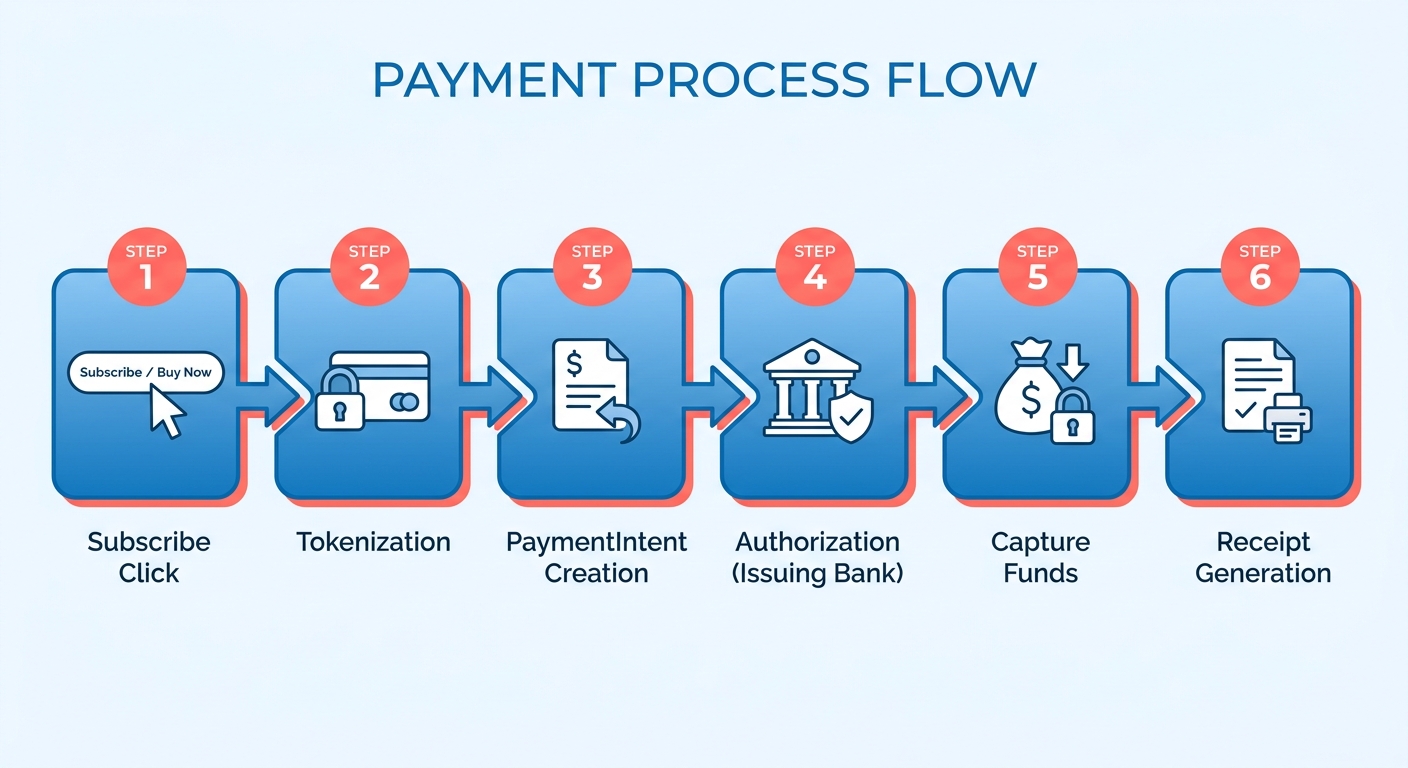
The Charge Flow: From Click to Cleared Payment
Stripe’s subscription engine stores customer records and payment methods, then auto-generates invoices at each billing interval. When an invoice finalizes, Stripe attempts collection immediately if the payment method is on file. The Subscription object transitions through statuses: incomplete during trial or initial setup, active once the first payment clears, past_due when a charge fails, and canceled if dunning cycles exhaust without recovery.
Businesses use automatic subscription billing logic that adjusts mid-cycle for plan upgrades, add-ons, or usage overages. Stripe prorates charges by default, calculates the difference between the old and new plan, and adds or credits the balance on the next invoice. For usage-based models—seats consumed, API calls logged, compute hours burned—the Billing API accepts metered events throughout the billing period, aggregates them at cycle close, and invoices the total.
Payment Recovery: Smart Retries and Their Limits
Stripe’s Smart Retries use machine-learning signals—time of day, card type, failure reason—to schedule retry attempts when success likelihood peaks. Rather than firing fixed retries on a calendar schedule, the model spaces attempts across a window that can extend several weeks, and it distinguishes between hard declines worth abandoning and soft declines worth retrying. Stripe also runs an automatic card updater that refreshes expired or reissued card numbers directly from card networks, catching a common failure cause before a retry is even needed.
Those signals help close the payment-success gap, but they operate only on subscription charges and card-on-file transactions. Once a payment fails and the subscription moves to past_due, Stripe sends templated dunning emails—reminders that a charge failed and the customer should update their payment method. Some companies have reported significant reductions in involuntary churn from expired cards after migrating to Stripe. But email reminders don’t handle manual invoices sent to enterprise customers, partial payments, or disputes that require human negotiation. For those scenarios, you still need a receivables workflow outside Stripe’s charge-handling layer.
Stripe’s charge-handling model covers the automated side of billing cleanly: recurring subscriptions, card-on-file retries, and templated reminders. It stops short of the manual receivables layer—invoices sent to enterprise buyers on net terms, partial payments applied against multiple open invoices, and disputes routed to a human. Multi-channel dunning through SMS or phone, receivables aging reports, and cash application for checks or wire transfers all sit outside the processor. Teams that need those functions layer a dedicated AR tool on top of Stripe rather than expecting the billing engine to reach that far.
Where the Charge-Handling Model Ends
Stripe’s revenue recognition API surfaces data for financial reporting, and Stripe Tax calculates sales tax or VAT at checkout. But the platform doesn’t manage accounts receivable aging, payment plans for overdue balances, or customer communication beyond the initial dunning cycle. Some companies have reported reductions in billing-related support tickets after integrating Stripe Billing, but that win comes from automating the charge itself—not from eliminating AR follow-up work.
This boundary highlights where payment processing ends and receivables management begins. While optimizing the initial transaction layer is critical, accelerating the overall collection cycle requires managing the post-billing phase. This includes structured collections workflows, dispute resolution, and cash application—operations that sit outside a payment processor’s scope. Stripe optimizes the payment-success layer; closing the loop requires tooling that manages receivables after the invoice goes out or the payment fails its final retry.
Blixo: Closing the Loop Between Billing and Cash
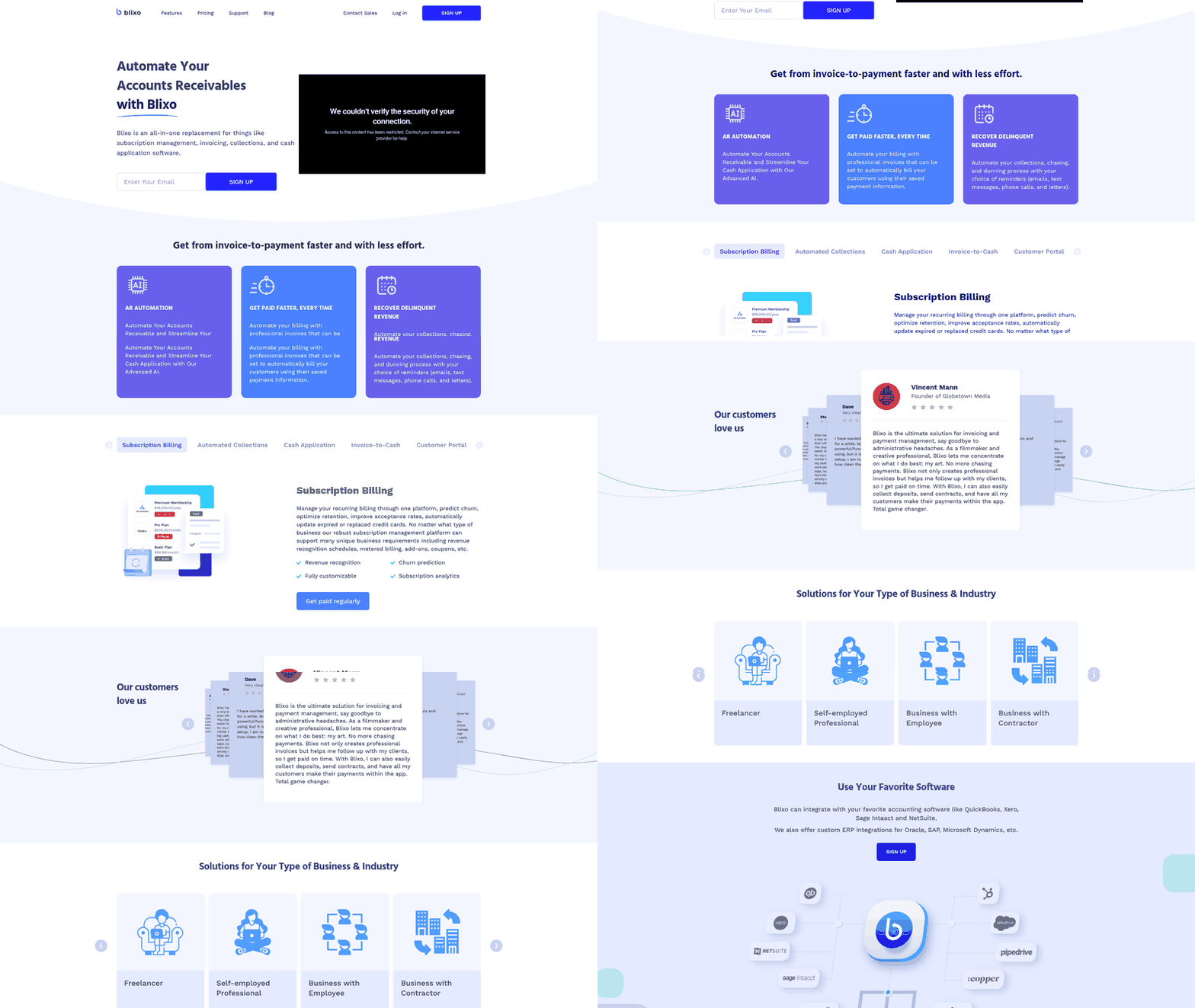
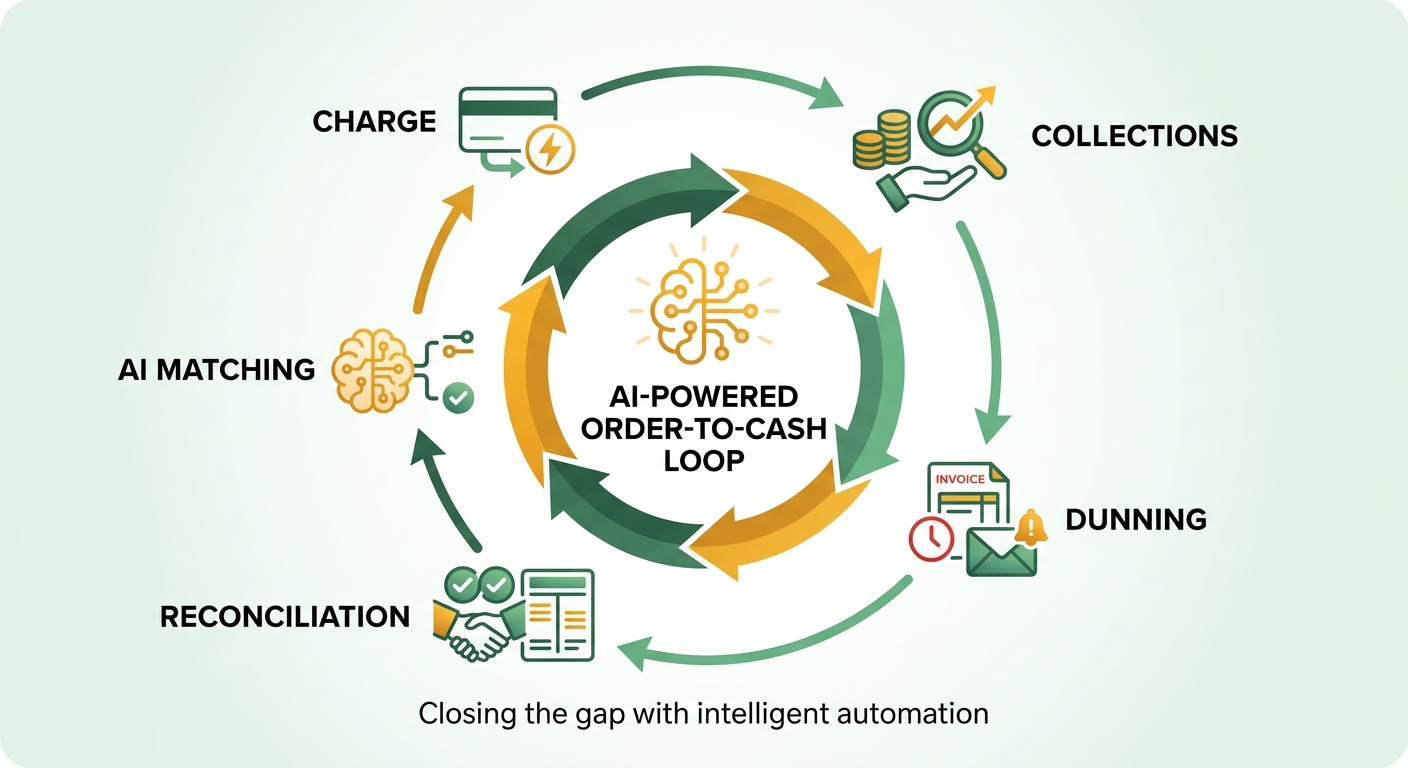
Blixo is a SaaS platform built to close the gap between billing and cash. Logistics providers and medical billing groups can invoice a client in minutes but still experience significant payment delays because collections, dunning, and reconciliation run on email threads and spreadsheets. Automatic subscription billing handles the charge; Blixo handles what happens when the charge fails, when the invoice sits unpaid, or when a wire transfer hits the bank with no identifier attached.
The platform’s approach centers on AI-powered cash application. When a payment arrives, the platform matches it to the correct invoice using transaction metadata, customer history, and payment patterns. The system learns as it processes, so accuracy improves with volume. Manual reconciliation drops to exception cases only, reducing the administrative workload on your AR team.
Automated Collections That Adapt to Customer Behavior
Blixo runs collections through intelligent dunning workflows that tier by risk and payment history. High-value accounts on a temporary delay get a personal email from the account manager. Chronic late payers receive multi-channel reminders—email, SMS, and voice—on an escalating schedule. You set the rules: grace periods, escalation triggers, and when to flag an account for manual review. Personalizing the outreach cadence can cut average DSO more effectively than raising reminder frequency across the board.
Service businesses see their finance teams freed from repetitive AR follow-ups, allowing them to focus on cash forecasting instead of chasing down invoices. This pattern repeats across various business models—dunning automation compounds when paired with a self-service portal where customers can view statements, set up auto-pay, and resolve disputes without opening a support ticket.
Real-Time Revenue Recognition and GL Integration
Blixo’s revenue reconciliation engine syncs with QuickBooks, Xero, and NetSuite in real time. Every payment, refund, and credit memo flows into the general ledger automatically. Finance teams can compress month-end close time because invoices, payments, and journal entries stay aligned throughout the billing cycle rather than requiring end-of-month batch processing.
The platform also handles subscription upgrades, downgrades, and proration adjustments without manual intervention. When a customer switches plans mid-cycle, Blixo calculates the prorated credit, applies it to the next invoice, and logs the revenue adjustment—all in one atomic operation. That level of automation matters most for SaaS teams running usage-based pricing or tiered plans, where manual proration becomes a bottleneck at scale.
| Capability | What It Does | Why It Matters |
|---|---|---|
| AI cash application | Matches incoming payments to invoices using metadata and customer history | Eliminates manual reconciliation labor; accuracy improves with volume |
| Multi-channel dunning | Sends escalating reminders via email, SMS, voice based on risk tier | Compresses DSO through personalized outreach cadence |
| White-label portal | Lets customers view statements, pay invoices, set up auto-pay | Cuts support tickets; enables self-service dispute resolution |
| Real-time GL sync | Syncs payments and revenue adjustments to QuickBooks, Xero, NetSuite | Compresses month-end close time; keeps invoices and payments aligned |
| Native integrations | Connects to QuickBooks, Xero, NetSuite, Salesforce, HubSpot, and Shopify via API | Closes the O2C loop without custom middleware |
Implementation and Onboarding
Blixo maps your existing chart of accounts, imports historical invoices, and configures dunning rules based on your current AR policies. The platform runs parallel processing for the first billing cycle to verify that invoice generation, payment matching, and GL posting align with your legacy system before cutover. Enterprise customers receive comprehensive onboarding, training, and a dedicated account manager.
By dividing responsibilities, the systems address different revenue leaks: Stripe recaptures failed transactions at the gateway level, while Blixo automates the follow-up on open invoices that have already been delivered to the customer.
What This Actually Costs: Stripe Fees vs. the Labor You’re Already Paying
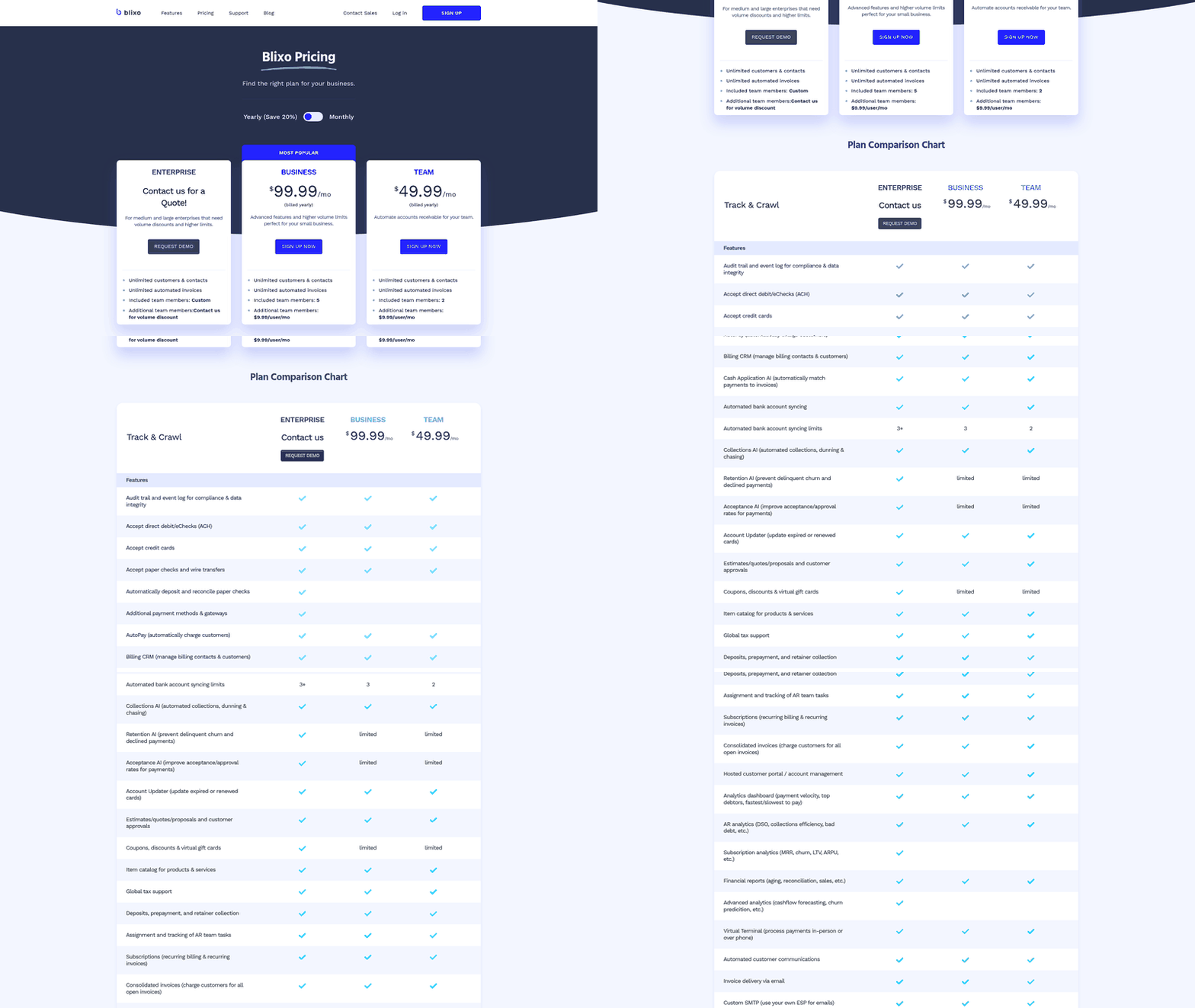
Blixo pricing starts at $49.99 per month for the Team plan and $99.99 per month for the Business plan, with unlimited customers, contacts, and automated invoices on all paid tiers. Stripe Billing charges 2.9% plus 30¢ per transaction, plus $0.50 per active subscription. At first glance, the transaction-fee model looks cheaper—until you factor in the manual labor required to close the loop after the charge succeeds or fails.
The hidden costs pile up when automatic subscription billing handles the charge but leaves collections, dunning, and reconciliation to spreadsheets and email threads. Consider a mid-sized SaaS business processing 5,000 transactions monthly: Stripe’s transaction and subscription fees add up quickly. The same business spends meaningful amounts on accounts-receivable labor and carries delayed cash-flow costs from extended collection cycles. The billing platform closes one gap; the labor and cash-cycle costs remain.
What Stripe Recovers vs. What Stays Manual
Stripe’s recovery mechanisms target payment failures at the transaction layer—expired cards, insufficient funds, temporary declines. The tools work on the narrow window between charge initiation and charge completion. What happens after a successful charge sits outside that scope: invoices marked paid but never reconciled, partial payments that require manual allocation, wire transfers that arrive without reference numbers, customers who ignore dunning emails after the third attempt.
The gap shows up in reconciliation time. Finance teams at subscription businesses can spend significant hours per month matching payments to invoices. For businesses processing mixed payment types—credit cards, ACH, wire transfers, checks—the matching work expands further. Stripe automates the charge; it does not automate the close.
How Automation Changes the Cost Structure
A subscription business with $1 million in annual recurring revenue processes roughly 12,000 transactions per year at an average ticket of $83. Stripe’s fees total around $30,000 annually in transaction costs plus $6,000 in subscription fees—$36,000. Manual accounts-receivable work (15 hours per week at $25 per hour) costs $19,500. Delayed cash flow from extended payment terms locks up $41,000 in working capital, costing roughly $2,000 in opportunity cost at a 5% hurdle rate.
Blixo automates collections, dunning, cash application, and reconciliation—the manual work that typically follows each charge. The AI-powered cash application eliminates the reconciliation bottleneck, and automated collections reduce the time spent chasing payments. These changes compress the cash-to-cash cycle and shift AR staff from routine matching work to exception handling. Businesses using both Stripe for charge handling and Blixo for receivables automation gain payment-success optimization on the front end and receivables-cycle control on the back end.
When B2B Firms Close the Full Loop
A commercial equipment lessor with $5 million in revenue and 2,000 annual invoices faces higher manual costs. Stripe's transaction fees hit $150,000 annually. AR labor at 30 hours per week costs $39,000. Delayed collections lock up $205,000 in working capital, costing $10,000 annually in opportunity cost.
Blixo’s intelligent matching engine, automated dunning, and collections AI address the post-charge workflow—automated chasing, payment-to-invoice matching, and reconciliation. Firms with complex receivables, high invoice volume, or long collection cycles see faster cash conversion and reduced manual workload. The hybrid model stacks Stripe’s payment-success layer with Blixo’s receivables automation for end-to-end order-to-cash control.
Feature Set and Recommended Use Cases
| Feature | Stripe Billing | Blixo | Stripe + Blixo Hybrid |
|---|---|---|---|
| Scope | Charge handling, subscription lifecycle, payment recovery | Collections, dunning, cash application, reconciliation | Full O2C from charge to cash |
| Pricing Model | 2.9% + 30¢ per transaction + $0.50/subscription | Starting at $49.99/mo (Team), $99.99/mo (Business) | Additive fees |
| Integration Effort | Native Stripe ecosystem | API integrations with Stripe, QuickBooks, NetSuite | Unified data flow |
| Time to Value | 1–2 weeks for basic setup | 3–4 weeks for full O2C config | 4–6 weeks |
| Best For | Businesses prioritizing payment success and subscription logic | Teams with complex receivables, high invoice volume, or long DSO | SaaS and services firms needing end-to-end O2C control |
Firms with under 500 transactions annually may not need dedicated receivables automation; Stripe alone handles their needs. Above 1,000 transactions, the labor and cash-cycle improvements make the case for closing the full loop.
Implementation, Integration & Technical Complexity
Setting up automatic subscription billing infrastructure requires developer resources, but the effort varies dramatically depending on whether you’re solving just the charge or the full order-to-cash loop. Stripe Billing’s developer-centric model gets you from zero to recurring charges in roughly 80 hours. Blixo’s implementation extends beyond payment processing into collections, dunning, reconciliation, and legacy data migration from ERP and AR systems that weren’t built for subscription workflows.
Developer Effort: Stripe’s Quick Start vs. Full O2C Integration
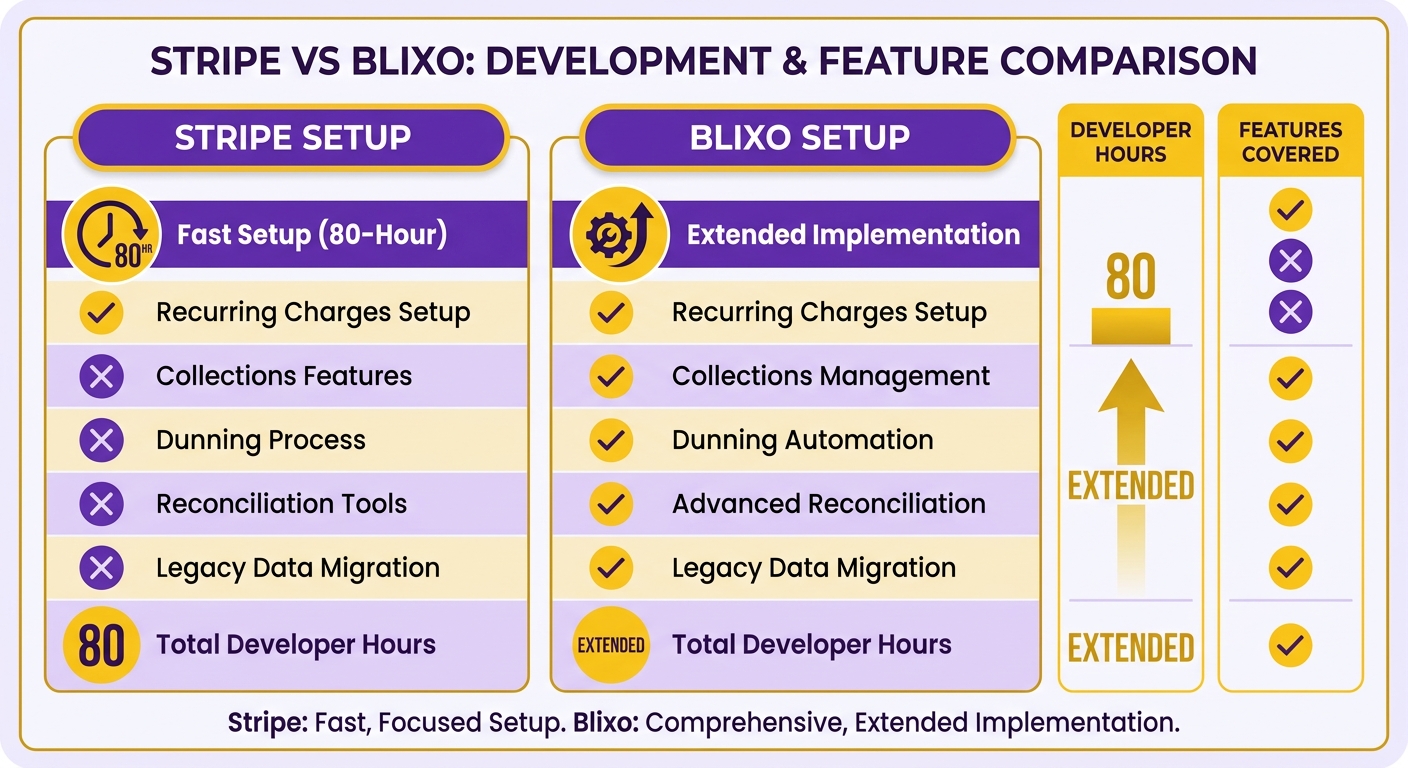
Stripe provides SDKs for eight languages, a sandbox environment, and quick-start guides designed to get developers charging cards fast. By leveraging these pre-built tools, engineering teams can implement complex pricing models and manage subscription lifecycles without building custom billing logic from scratch.
Blixo’s architecture accepts payment data through webhooks and APIs from multiple payment gateways. When a charge succeeds or fails, when a subscription renews, or when a card expires, payment events feed into the platform where they’re matched to the correct customer and invoice, triggering the appropriate dunning sequence if the charge failed and applying cash when the charge succeeds. That webhook-driven architecture keeps systems in sync without manual reconciliation, but it requires mapping payment gateway subscription lifecycle statuses to the correct workflows in your collections process.
The integration model works because payment gateways handle PCI-DSS compliance at the payment layer, and Blixo inherits that compliance when receiving tokenized payment data through webhooks. The audit-ready reconciliation layer adds the paper trail required for financial reporting without forcing you to build your own compliance program. Some companies have reported significant reductions in invoice-to-cash time after implementing automated cash application and payment matching, eliminating the manual work of reconciling bank deposits to open invoices across multiple customers.
Migration Effort and Team Skillset
Blixo offers comprehensive onboarding and training to help businesses migrate from legacy systems. Legacy AR data rarely maps cleanly to a subscription billing model—invoice line items don’t always have SKUs, payment terms vary by customer, and partial payments sit in spreadsheets instead of a structured ledger. The platform supports bulk data import via CSV or API to bring historical invoices, customers, and payment data into the system, and reconciles opening balances so your reports match on day one.
Stripe’s implementation is dev-centric: you need backend engineers who can write API calls, handle webhook events, and debug payment flows. Blixo’s implementation requires a mix of dev and finance ops because the work spans both payment processing and receivables management. The platform includes comprehensive onboarding and training to help your finance team map existing dunning rules, approval workflows, and cash application logic into the system. That consultative layer reduces implementation risk when you’re replacing manual processes rather than just automating an existing system.
Support Models and Long-Term Ownership
Stripe offers 24/7 developer support, which matters when a payment gateway goes down or a webhook stops firing. Blixo’s Enterprise plan includes a dedicated account manager for businesses that need ongoing strategic support, while all plans include email support. O2C problems often require business context, not just technical troubleshooting. When a customer disputes an invoice, when a wire transfer hits your bank with no identifier, or when a dunning sequence needs adjustment mid-quarter, you need support that understands your workflow rather than just technical troubleshooting.
| Feature | Stripe Billing | Blixo |
|---|---|---|
| Implementation Time | ~80 hours | Varies by scope |
| Primary User | Backend developers | Dev + finance ops |
| PCI-DSS Compliance | Handled at payment layer | Inherited via payment gateway integration |
| Data Migration Service | Not offered | CSV/API import + onboarding support |
| Support Model | 24/7 developer support | Email support (all plans); dedicated account manager (Enterprise) |
| Best For | Teams building subscription billing from scratch | Teams closing the full O2C loop from charge to cash |
The ROI case compounds in ways charge-handling metrics don’t capture. Payment success rates measure whether a transaction cleared, but they don’t track the time between invoice generation and cash receipt or the labor spent matching payments to invoices. Some companies have reported significant reductions in monthly close time after automating invoice-to-payment matching and eliminating manual spreadsheet reconciliation. The value isn’t just in collecting more payments—it’s in compressing the entire cycle from billing to bank deposit while reducing the finance team’s workload.
Customer Experience & Brand Impact
When a subscription charge succeeds, your customer sees a receipt and moves on. When it fails—or when an invoice sits unpaid for 30 days—the experience that follows shapes whether they stay or leave. Automatic subscription billing platforms handle the first moment well; what matters for retention is how you handle everything after.
Payment Interface: Stripe’s Branded Checkout vs. Full White-Labeling
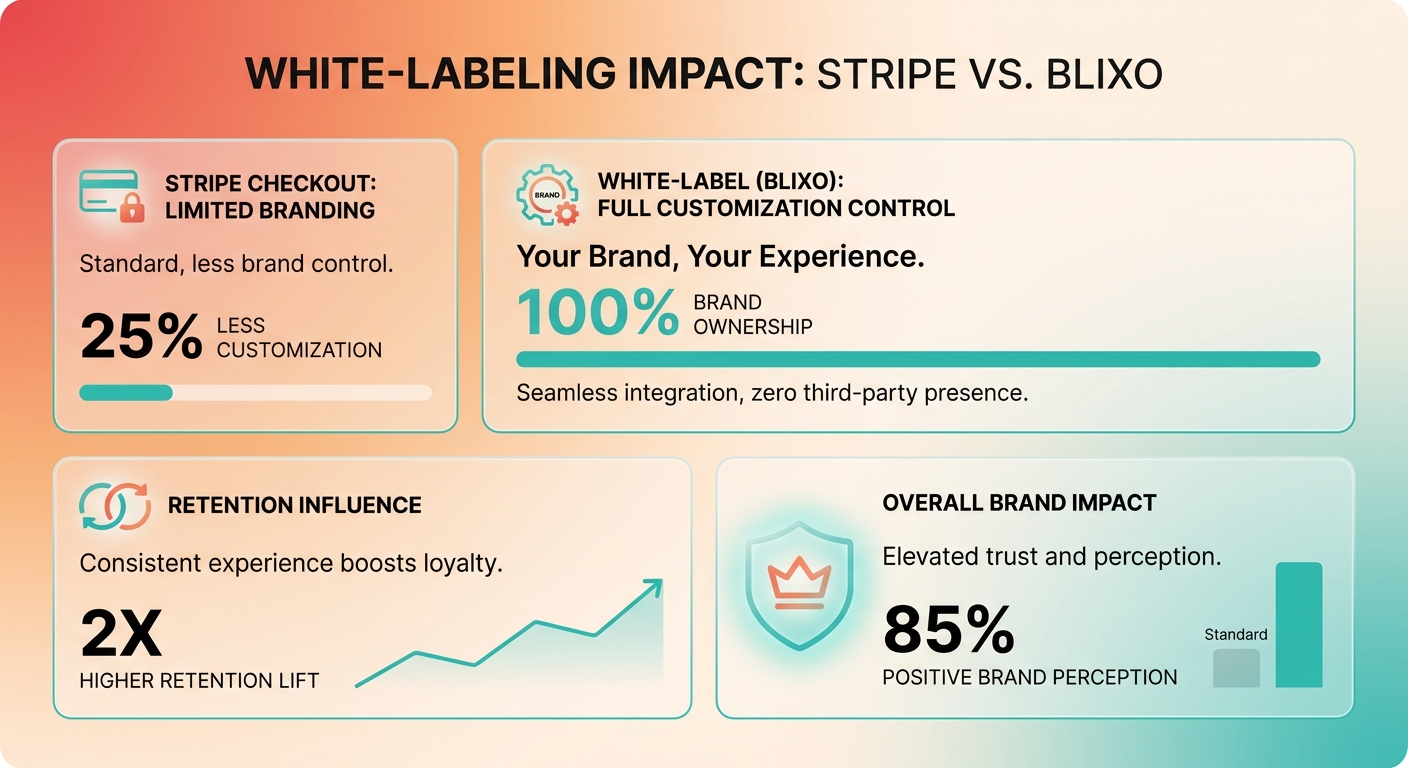
Stripe Checkout carries Stripe’s logo and limited branding control. You can adjust colors and add a business name, but the footer reads “Powered by Stripe” in every transaction. For product-led SaaS companies where the checkout is a step in a larger flow, that’s acceptable. For agencies and consultancies where the invoice is the primary brand touchpoint, it reads as outsourced.
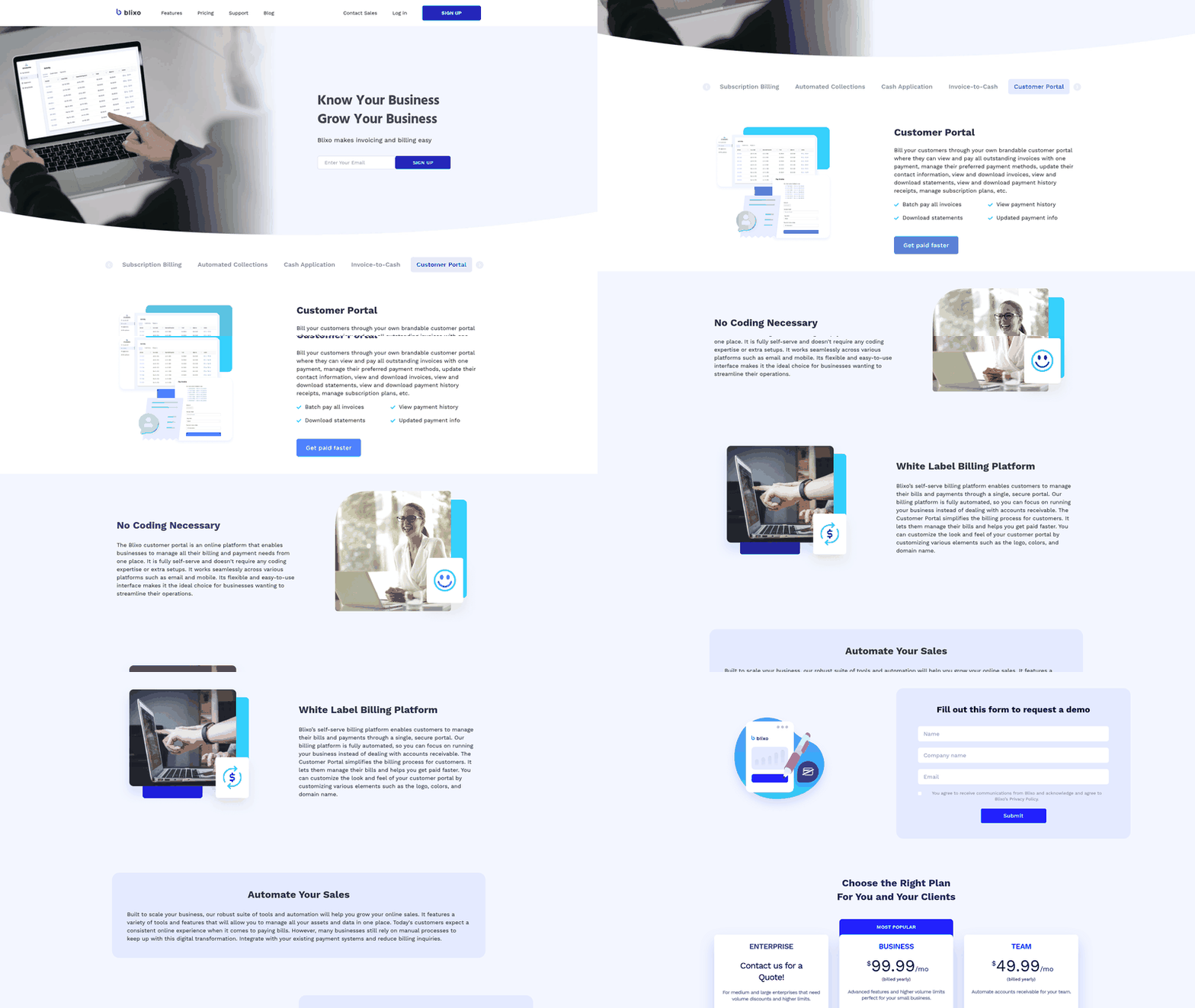
Blixo’s hosted customer portal integrates with your brand. The payment page, invoice layout, and customer account management dashboard carry your logo, colors, and domain. Multi-language support means a client in Paris sees French copy, not auto-translated English. Customers can view outstanding balances, download past invoices, and update payment methods without emailing your AP team. The whitelabel option removes the “Powered by Blixo” logo entirely, making the experience feel like an internal system rather than a third-party billing page.
Dunning: Generic Retry Emails vs. Tailored Recovery Workflows
The emails that accompany Stripe’s automated retries follow a standard template: “Your payment failed. Update your card.” The tone is functional, the design is Stripe-branded, and the options are binary—pay now or lose access. Customization options are limited to basic text changes within Stripe’s template structure.
Blixo’s automated collections system treats payment failure as a relationship moment, not a transaction error. You control the email tone, send frequency, and escalation path through custom invoice and email templates. For a late invoice, you might send a friendly reminder on day 7, a firmer notice on day 21, and escalate contact methods on day 35 before suspending service. The platform supports invoice delivery and collections via email, text messages (SMS), automated phone calls, and even US mail. That flexibility matters when you’re collecting $50,000 invoices from enterprise clients, not $29 SaaS subscriptions.
Retention Impact: Why Self-Service Options Reduce Churn
Providing self-service account management options directly reduces the volume of routine billing inquiries sent to support teams. When customers wait 24-48 hours for email responses about invoice status or payment history, frustration builds and renewal conversations stall.
Blixo reduces that friction through its customer portal, where clients can view invoice history, track payment status, and communicate directly with your team through invoice chat—all without calling your AR department. The platform’s Retention AI works to prevent delinquent churn and handle declined payments before they turn into lost accounts. When a client can log into a portal, see exactly what they owe, and resolve issues through self-service tools, they’re more likely to stay engaged than to churn.
| Feature | Stripe Billing | Blixo |
|---|---|---|
| Checkout Branding | Stripe logo required, limited customization | Fully white-labeled, custom domain |
| Dunning Tone | Standard templates, Stripe-branded | Customizable messaging, your brand |
| Self-Service Portal | Basic card updates | Full invoice history, chat, multi-language |
| Dunning Channels | Email and retries | Email, SMS, phone calls, US mail |
| Whitelabel Option | Not available | Available (removes “Powered by Blixo” logo) |
Compliance: Security and Data Handling
Stripe’s infrastructure processes payment data under PCI DSS Level 1 certification, meaning card details never touch your servers. Blixo applies bank-grade AES encryption and PCI DSS Level 1 certification to receivables data—customer payment history, dunning logs, and reconciliation records stay encrypted and protected.
The platform tracks invoice view and open activity, automates customer communications, and maintains an audit trail and event log for compliance and data integrity. For businesses managing complex AR workflows across multiple jurisdictions, that visibility into payment activity reduces friction when reconciling accounts or responding to customer inquiries.
What Blixo Recommends
Blixo was built to solve a problem Stripe Billing doesn’t address: managing the collections cycle after a charge attempt fails or an invoice remains unpaid. When a payment fails after multiple retry attempts, or when an invoice sits unpaid for weeks, finance teams are often forced back into spreadsheets, email threads, and manual follow-up. This administrative bottleneck delays cash flow, turning recognized revenue into outstanding receivables.
The gap shows clearly with corporate training providers. A training provider invoices a client in seconds, but the client pays weeks later because collections run on manual outreach. The charge succeeded, but cash flow didn’t improve. In Blixo’s approach, collections, dunning, and reconciliation close the loop—automated matching connects incoming payments to invoices, dunning workflows recover failed charges without human intervention, and reconciliation happens in real time rather than at month-end.
When Stripe Billing Is the Right Choice
Stripe Billing fits product-led SaaS businesses where the checkout is the main friction point and most customers pay on time. If you’re processing thousands of low-touch transactions, need usage-based billing, or want to quickly deploy recurring charges, Stripe delivers. The platform handles automatic payment retries, proration logic for plan changes, and real-time revenue recognition for complex billing scenarios.
Skip Stripe Billing if your revenue model depends on high-touch B2B invoicing, if customers routinely pay 30–60 days after invoicing, or if you’re spending hours each week reconciling wire transfers and ACH payments. The platform wasn’t built for collections workflows, and the transactional pricing model ($0.50 per active subscription plus 2.9% + $0.30 per charge) compounds when you layer on third-party tools for dunning, reconciliation, and AR automation.
When Blixo Closes the Gap
Blixo is a fit when reducing collection cycle times matters more than checkout conversion. If your team spends more than 10 hours per week chasing payments, reconciling incoming wires, or managing overdue accounts, the cost of manual labor outweighs the cost of the platform within the first quarter. By layering Blixo on top of your payment processor, you gain automated collections, streamlined reconciliation, and a unified dashboard that shows payment velocity, top debtors, and cash flow forecasting in real time.
Blixo’s pricing tiers are structured to scale with your business, offering options for team access, advanced analytics, and automated communication limits. For medium and large enterprises that need volume discounts and higher limits, custom Enterprise pricing is available—contact Blixo for a quote. The ROI case compounds when you factor in labor savings: eliminating one full-time AR clerk saves $50,000 annually, and accelerating collections frees up working capital that would otherwise remain locked in unpaid invoices.
Pairing Existing Payment Infrastructure with Full Collections
If you’ve already invested in payment infrastructure and don’t want to migrate everything, Blixo can take over the collections and reconciliation side. When a payment fails, Blixo’s dunning workflows take over. When a wire transfer hits your bank, the cash application AI matches it to the correct invoice. You keep your existing payment method support while closing the O2C loop on Blixo’s end, with bulk data import via CSV or API to get your billing data into the platform.
This approach works for companies that process both high-volume subscription charges and high-value B2B invoices. The subscription side runs through your current billing setup; the invoicing and collections side runs through Blixo. You avoid ripping out existing infrastructure, and you get a unified AR dashboard that spans both billing models.
Decision Matrix: What to Evaluate Before Choosing
Start by evaluating your collection cycle metrics. If outstanding receivables are taking too long to clear, payment capture isn’t your bottleneck—collections and reconciliation are. Check how many hours your team spends on manual AR tasks each week; high manual workloads indicate immediate automation ROI. Review your billing complexity: if you issue a low volume of invoices per month and most customers pay on time, Stripe Billing alone may suffice. If you manage net-30 or net-60 payment terms, or handle multiple currencies and payment methods, you need full O2C automation.
Count your AR headcount. If you have more than one person reconciling payments, matching transactions, or chasing overdue invoices, the labor cost justifies platform investment. Check your integration timeline: basic billing setups can go live quickly, whereas full O2C integration typically takes longer because it involves migrating legacy AR data from ERP systems, training your team on new workflows, and syncing with existing CRM and accounting software. If you need immediate payment capability, a phased implementation starting with the payment gateway may outweigh the long-term O2C efficiency gains.
What to Test Before You Commit
Schedule a demo and bring real invoices, payment data, and reconciliation headaches. Watch how cash application handles messy payment metadata—wire transfers with no invoice number, ACH payments from subsidiaries with different legal names, partial payments that need manual allocation. Test dunning workflows with your actual customer segments: some customers respond to email reminders, others need SMS or phone outreach, and high-value accounts require white-glove manual follow-up before automation kicks in.
Ask how the platform handles edge cases: disputed invoices, partial refunds, currency conversion errors, and payments that arrive after an account has been written off. Check whether analytics dashboards surface actionable insights—payment velocity trends, customer risk segmentation, collections efficiency benchmarks—or just display raw transaction counts. Verify that integrations with your existing tools (QuickBooks, Salesforce, NetSuite) sync in real time rather than requiring nightly batch uploads.
Run a pilot with 50–100 invoices before committing to full migration. Track how much time your AR team saves in the first month, how quickly overdue balances drop, and whether DSO improves within the first quarter. If the pilot shows measurable gains, scale to full deployment. If it doesn’t, the issue may be upstream—credit policies, invoicing accuracy, or customer payment behavior—rather than tooling.
Frequently Asked Questions
1. What happens to my existing Stripe subscription data if I add Blixo for collections?
Blixo connects to Stripe through webhooks and APIs, receiving payment events without replacing your existing subscription infrastructure. Your Stripe subscriptions continue processing charges normally while Blixo handles the post-charge workflow—dunning sequences for failed payments, cash application for successful ones, and reconciliation with your accounting system.
2. Why does DSO matter more than payment success rate for B2B businesses?
Payment success rate measures whether a charge clears, but DSO measures how long revenue stays locked in receivables after delivery. B2B firms often experience significant payment delays even when charges succeed, because manual invoices, net terms, and delayed reconciliation create a collection gap that payment processors don’t address.
3. Can automated dunning hurt customer relationships by being too aggressive?
Risk-based dunning workflows prevent that problem by segmenting customers before sending reminders. High-value accounts with temporary delays receive personal outreach from account managers, while chronic late payers get multi-channel escalation. You control grace periods, escalation triggers, and when to flag accounts for manual review instead of generic reminder blasts.
4. How does AI cash application improve accuracy compared to manual matching?
AI matching uses transaction metadata, customer history, and payment patterns to connect incoming payments to the correct invoice, learning from each processed transaction. This automated approach can significantly increase matching rates compared to manual methods by reducing the guesswork that manual matching introduces.
5. What specific receivables tasks sit outside Stripe’s scope after a charge succeeds?
Stripe handles the charge itself but stops before managing accounts receivable aging, payment plans for overdue balances, partial payment allocation across multiple invoices, wire transfer reconciliation without reference numbers, or customer communication beyond initial dunning emails. Those post-charge operations require dedicated AR tooling.
6. When does the cost of manual AR work justify adding a dedicated platform?
The breakpoint appears when manual reconciliation time and the opportunity cost of delayed cash flow become measurable. Below a certain transaction volume, Stripe alone may suffice. Above that threshold, labor savings and cycle-time compression from automated collections typically recover platform costs within the first billing quarter.