

Quadient AR vs Versapay in 2026: Portal-Led Automation or Broader Invoice-to-Cash Control?

Before we get into it, the short version:
- In the public documentation reviewed, many AR and collections capabilities overlap between Quadient AR and Versapay. A smaller subset separates them.
- Quadient AR’s documented strengths concentrate around credit risk scoring and digital credit application workflows.
- Versapay’s documented strengths concentrate around multi-channel remittance capture and exception handling for unmatched payments.
- Pricing for both incumbents is generally quote-based. Versapay is often described as pricing by invoice volume.
- Blixo lists open subscription tiers on its website, while Quadient AR and Versapay use quote-only models.
- Public vendor materials list Sage Intacct, NetSuite, Dynamics 365, SAP, Sage X3, and Acumatica for Quadient AR. Versapay’s materials add Oracle Fusion Cloud.
- “Not evidenced” means missing public documentation, not necessarily a missing feature. A capability may still exist behind a demo.
The verdict in one screen
Quadient AR vs Versapay isn’t a better-versus-worse call. It’s a choice between upstream credit and forecasting control on one side, and front-end collaboration with faster payment application on the other. Both are cloud products. Both sell through quotes. Both make the most sense when you match them to a specific receivables bottleneck.
The pattern is simple based on the public evidence reviewed. Quadient AR has stronger public documentation around credit decisions and payment prediction. Versapay is better documented for remittance intake, buyer-facing payment workflows, and clearing unmatched cash. That distinction beats a generic feature count, because invoice-to-cash teams almost never struggle equally across the whole cycle.
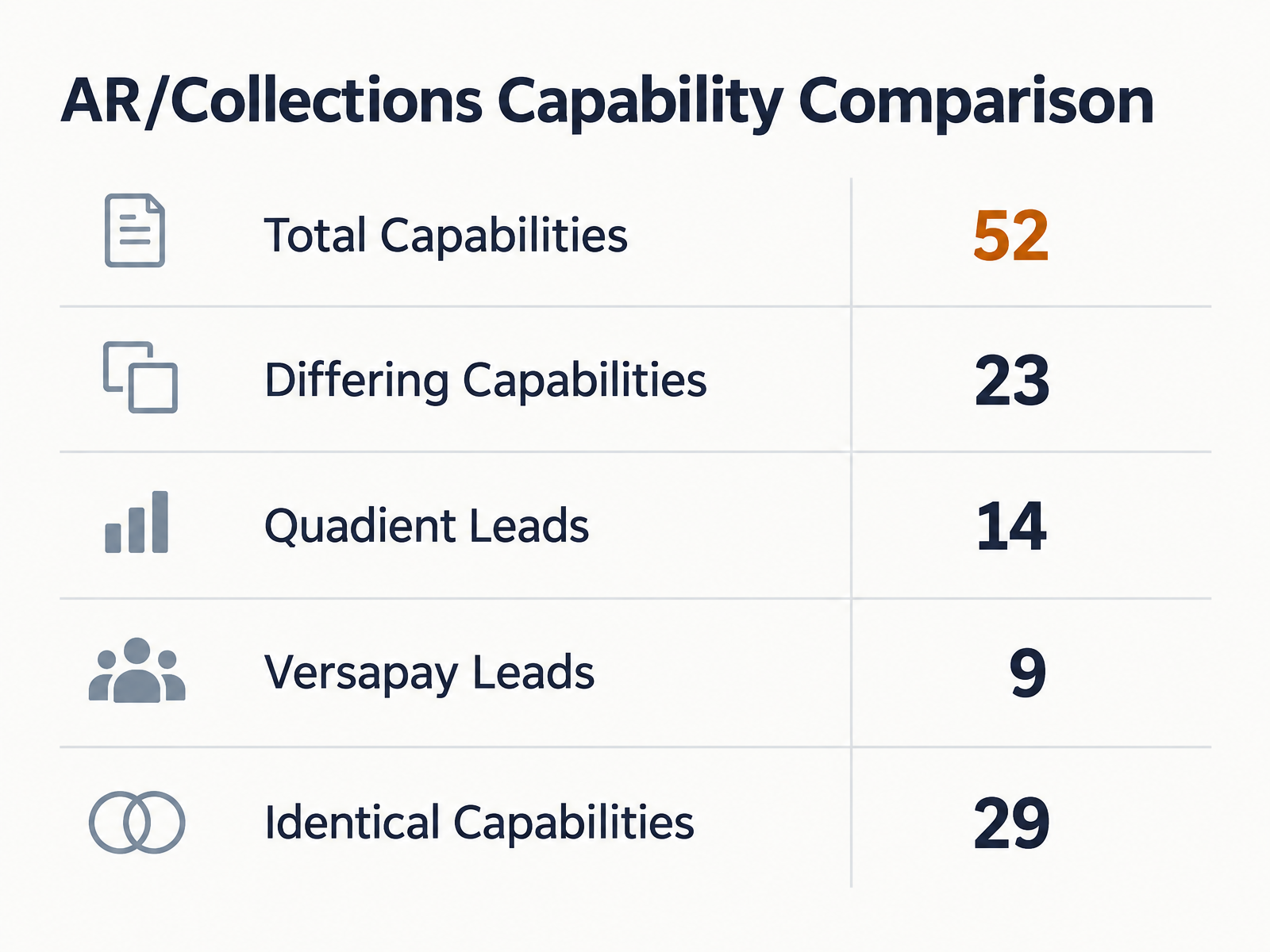
How do Quadient AR and Versapay compare at a glance?
Quadient AR fits credit management, payment-behavior forecasting, and multi-entity operations. Versapay fits cash application, buyer-supplier collaboration, and quicker deployment. Blixo is positioned as the subscription-native alternative when recurring billing and payment matching need to live in one system.
| Factor | Quadient AR | Versapay | Blixo |
|---|---|---|---|
| Pricing | Quote-based, feature-tiered | Quote-based, often by invoice volume | Published open tiers; Enterprise custom |
| Deployment | Cloud | Cloud | Cloud (SaaS) |
| Documented strengths | Credit scoring, forecasting | Cash application, remittance capture | AI cash application, subscription billing |
| ERP reach | Public materials list Sage Intacct, NetSuite, Dynamics 365, SAP, Sage X3, Acumatica | Public materials list NetSuite, Sage Intacct, Dynamics 365, Oracle Fusion Cloud | QuickBooks, Xero, Sage, NetSuite, custom ERP |
| Best for | Credit and forecasting control | Front-end collaboration, faster deployment | Automated AR with more transparent pricing |
One caveat on the capability table. “Not evidenced” means the research found no public documentation, not that the feature is missing. A vendor may still offer it. Confirm anything that matters to you on a live demo.
Which is cheaper, Quadient AR or Versapay?
You can’t run a sticker-price comparison from public pages, because neither incumbent publishes a full list price in the documentation we reviewed. The number that matters is the fully loaded first year: subscription or license, implementation, support, users, transaction charges, and any payment-processing economics that apply.
This is where a subscription-native option may change the math. Blixo lists open pricing tiers on its site, which can make pricing easier to evaluate before a sales call. For teams trying to model AR software cost against invoice volume and customer growth, that visibility may be useful.
What should you weigh beyond the feature list?
Quadient’s own marketing materials promote AR automation outcomes such as DSO improvement and ROI. Those claims are worth reading. They’re also worth weighing against rollout complexity, data quality, integration work, and whether your team will actually use the workflows once they’re live.
Vendor metrics and lived operating fit measure two different things. A tool can look strong on paper and still create friction if it doesn’t match how your collectors, billing staff, and customers already work. Peer-review ratings and third-party category comparisons can be useful, but they are only one input; confirm them against your own workflow and ERP version.
The practical question isn’t which incumbent looks safer. It’s whether your cash stalls before invoices go out, after customers pay, or inside the recurring billing process itself. That answer decides which system is most likely to move DSO.
Why these two even make the shortlist
Start with where your cash actually gets stuck. That one question decides more than any feature list, and it’s the honest way to read a Quadient AR vs Versapay comparison. One vendor pulls hardest at the front of the cycle. The other works upstream at credit and forecasting. Neither is “better” in the abstract.
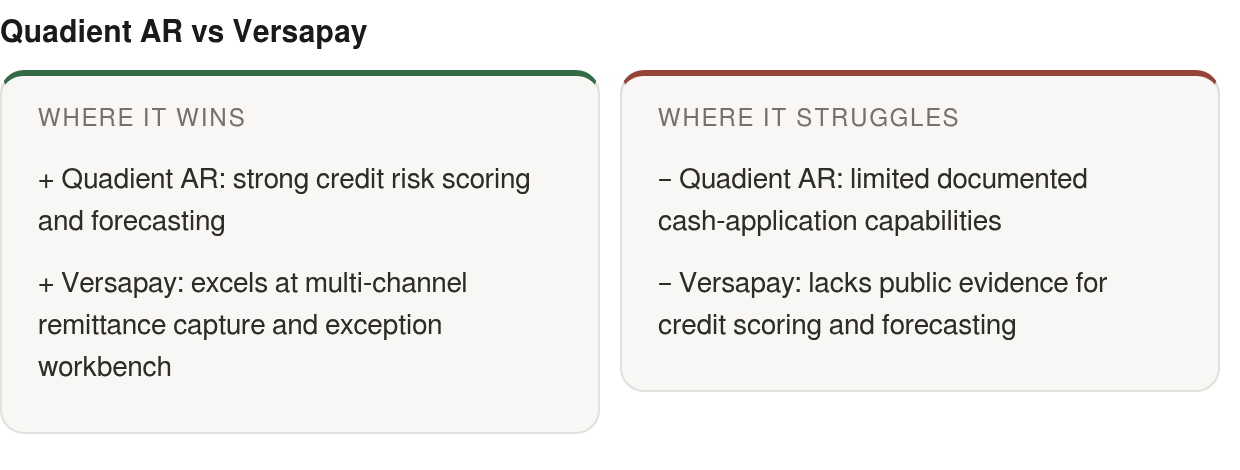
The difference isn’t a single overall score. It’s a difference in operating philosophy visible in the public documentation. Quadient AR is documented more clearly around evaluating customer risk before and during the receivables lifecycle. Versapay is documented more clearly around receiving remittance data, routing payment information, and helping teams resolve payment exceptions once invoices are already in motion.
Who is each option actually built for?
Versapay fits teams whose bottleneck is remittance and deployment friction. Its documented strengths include pulling detached remittance data from email, PDFs, and AP portals, then helping staff resolve unmatched payments in a dedicated workbench. If your AR team burns time hunting for payment context after cash arrives, that front-end focus may pay off quickly.
Quadient earns its place when the drag lives upstream. Its public materials support a stronger credit-control story: scoring, applications, limit monitoring, and payer-behavior insight. It’s most relevant when receivables risk is created before the collections team ever touches an account.
Then there’s how to weigh capability against fit. Public documentation never tells the whole story, so treat it as a shortlist filter, not a final verdict. Test each claimed strength against your own workflow, data structure, and ERP reality.
What should drive your shortlist?
| Selection factor | Blixo | Quadient AR | Versapay |
|---|---|---|---|
| Best fit | Subscription and usage-based billers evaluating AI cash application in one platform | Credit-heavy teams needing forecasting control | Teams prioritizing deployment speed and remittance capture |
| Pricing model | Subscription | Subscription, feature-based | Annual quote, often by invoice volume |
| Deployment | Cloud | Cloud | Cloud |
| Capability signal | AI cash application inside the billing system | Credit scoring and payment-behavior forecasting | Multi-channel remittance capture |
Three factors should shape your list.
First, onboarding effort. Ask each vendor for a realistic go-live timeline at your data volume, who does the configuration work, and how much of your team’s time the rollout eats. A tool that scores well on paper but takes two quarters to stand up can stall the exact bottleneck you bought it to fix.
Second, pricing transparency. Unless public pricing is available, insist on a single comparable first-year estimate that includes implementation, required modules, support, and any transaction-related cost.
Third, where the invoice-to-cash cycle breaks for you. For subscription and recurring-revenue firms, a platform with AI-driven cash application inside the billing system may reduce matching friction because invoice data is already native to the platform. If your revenue is recurring and your bottleneck is reconciliation, that category is worth adding to any two-vendor bake-off. For a structured way to run it, our guide on comparing AR automation software keeps the shortlist honest.
What each tool actually owns
Start with what separates these two on the feature sheet, because a Quadient AR vs Versapay decision lives in the capability detail, not the marketing. One tool pulls hardest at cash application and buyer collaboration. The other owns credit and forecasting. That split may decide which one moves your DSO.
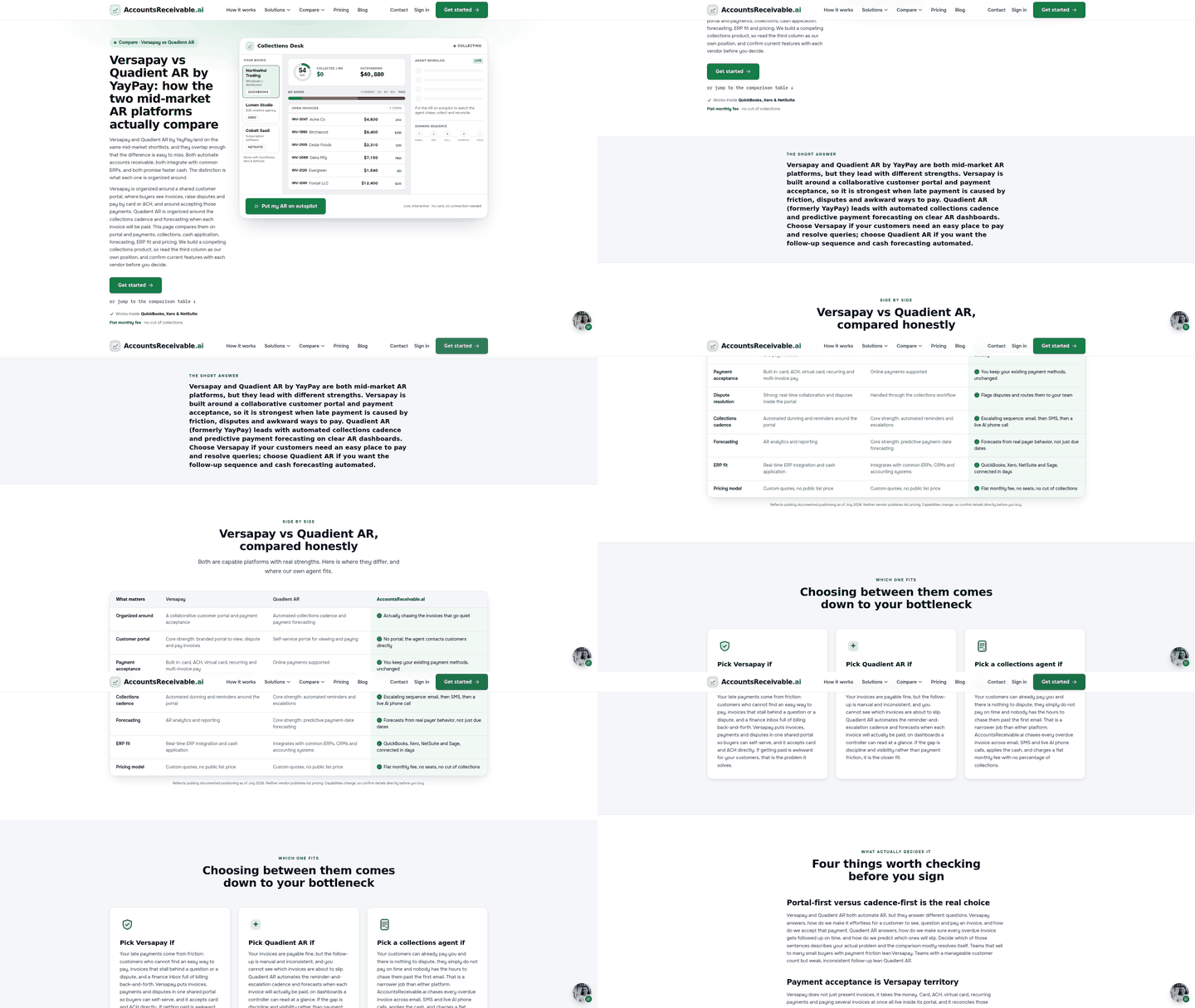
For subscription companies, there’s another layer: where matching happens. If the billing platform already knows the customer, invoice schedule, subscription terms, and expected payment pattern, cash application can use that context right away. A portal-led AR tool may still be valuable, but it is often working from data imported out of another billing system.
What does each tool own on the feature sheet?
Versapay’s evidenced strengths cluster at the payment-intake and customer-collaboration layer. Public vendor documentation describes remittance capture across multiple document and channel types, help with resolving payment mismatches, and support for recurring billing, AutoPay, embedded payment links, and interchange-plus surcharging. The product is built to help customers pay and to help AR teams apply cash faster.
Quadient AR sits upstream. Public materials describe automated credit risk scoring and ongoing credit limit monitoring to gate risk before an invoice ever ships. Its AI-powered payment-behavior forecasting plus multi-entity, multi-currency support round out a credit-and-planning story.
| Capability | Quadient AR | Versapay | Blixo |
|---|---|---|---|
| AI cash application | Not evidenced | Exception workbench | Documented focus |
| Multi-channel remittance capture | Not evidenced | Documented strength | Not evidenced |
| Credit risk scoring | Documented strength | Not evidenced | Not evidenced |
| Payment-behavior forecasting | Documented strength | Not evidenced | Not evidenced |
| Recurring / subscription billing | Not evidenced | Documented strength | Documented focus |
| Open API / developer platform | Not evidenced | Documented support | Documented support |
| Multi-entity / multi-currency | Documented strength | Not evidenced | Supported for subscription billing |
Use the blanks in this table as demo prompts. If a capability is load-bearing for your team, ask the vendor to show it against your own data flow rather than accepting a roadmap answer.
Where does the split leave your DSO?
Match the tool to your bottleneck. If cash gets stuck in messy remittance and slow application, Versapay’s documented capture and workbench strengths may earn their keep. If your losses start earlier, with bad credit decisions and unpredictable payers, Quadient’s scoring and forecasting may do more.
For many subscription businesses, the bottleneck is application volume rather than one-off credit checks. That’s where a subscription-native platform with AI cash application may compete directly. Some platforms position their matching engines as applying payments to recurring invoices automatically and improving as users correct edge cases. If you want a structured way to weigh these, our guide on comparing AR automation software walks the process.
Does “the safe choice” survive the evidence?
Both incumbents lead in different lanes. Quadient AR is documented more strongly for pre-collection control. Versapay is documented more strongly for post-invoice payment handling. Neither should be treated as owning the whole invoice-to-cash cycle by default.
So Versapay’s real documented win is front-of-cycle capture and application. A specific strength, not category leadership. The “pick the established vendor” instinct doesn’t hold when neither leads everywhere. Judge them on the one capability that fixes your cash bottleneck, then compare total commercial terms on the same assumptions.
Performance means faster cash, not faster software
Performance in accounts receivable software isn’t a raw-speed number. It’s how fast cash actually lands in your account, and that depends on where your cycle stalls. So a meaningful Quadient AR vs Versapay read on performance has to start with the bottleneck, not a benchmark.
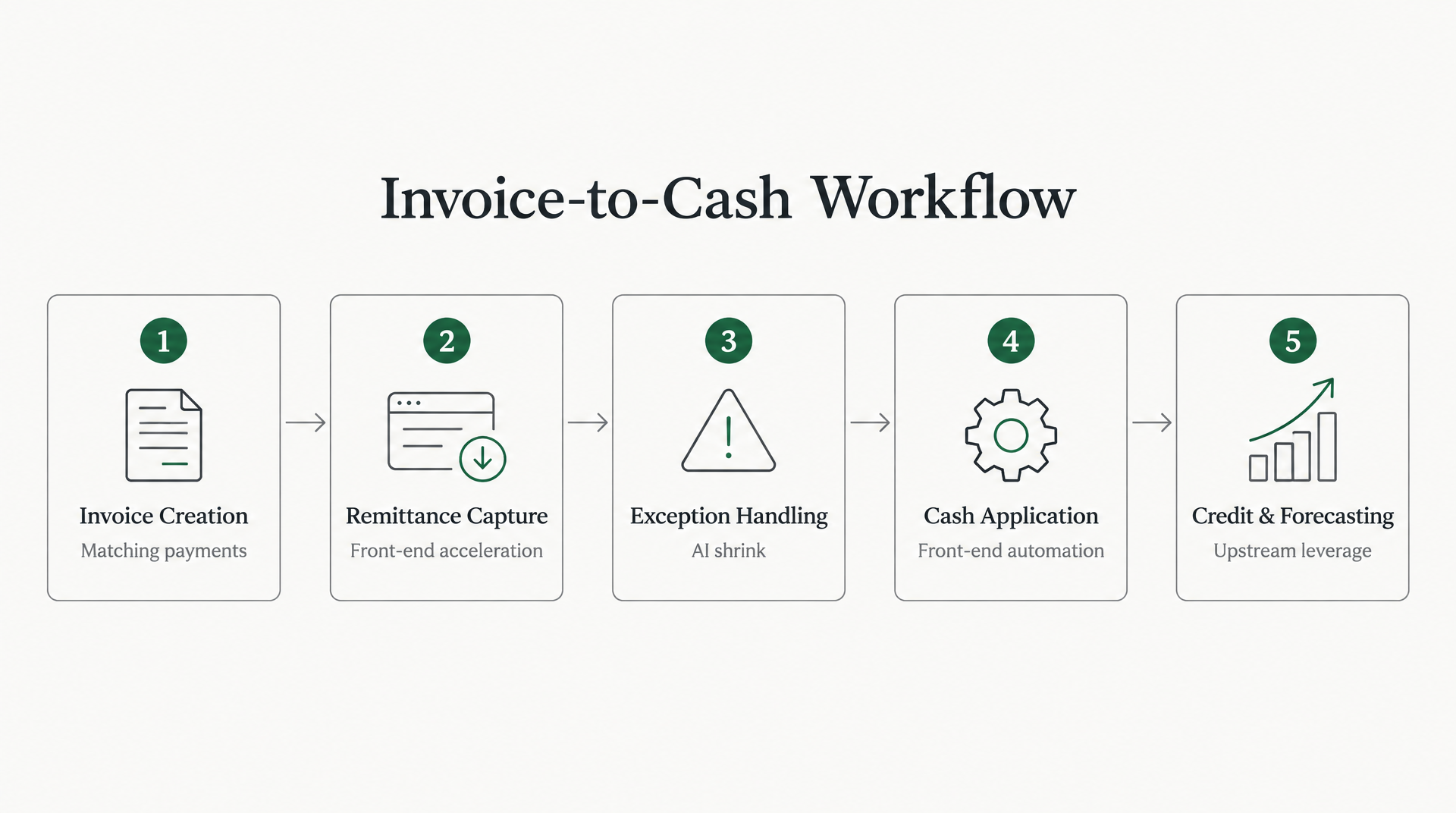
The two tools speed up different stretches of the invoice-to-cash cycle. Versapay pulls hardest at the front end, capturing remittance and clearing payment exceptions before they pile up. Quadient AR works upstream, using credit controls to lower the odds that risky accounts turn into aged receivables. Same goal, opposite ends of the pipe.
Speed depends on where your cycle stalls
If your DSO problem lives in cash application, front-end automation may move the needle faster. Unmatched payments and detached remittances are common manual-labor sinks that stretch out reconciliation, and clearing them quickly may shorten the gap between payment received and payment applied.
If your delays start earlier, at credit decisions and unpredictable payer behavior, forecasting and risk scoring may do more. That’s the upstream lever, and it tends to show up as fewer bad accounts entering the aging queue rather than faster clerical cleanup after payment.
For subscription billing, the sharpest speed gains often come from matching payments against recurring invoices already generated. A matching engine that uses native invoice data can reduce manual reconciliation.
Scaling across entities and volume
Scalability splits along two axes: organizational complexity and transaction volume. Public vendor documentation positions Quadient AR for multi-entity, multi-currency operation and for consolidating invoice, customer, and payment data across several simultaneous ERP connections. That may suit a business adding subsidiaries or currencies.
Versapay’s documented scalability story runs through open APIs and flat-file integration, and its commercial model should be evaluated against billing growth. If invoice count is likely to rise sharply, model the cost curve before you sign, not after the system is live.
| Scaling factor | Quadient AR | Versapay | Blixo |
|---|---|---|---|
| Deployment | Cloud | Cloud | Cloud, subscription-native |
| Multi-entity / multi-currency | Documented strength | Not evidenced | Supported for subscription billing |
| Open API / developer platform | Not evidenced | Documented support | Documented support |
| Volume cost model | Feature-based subscription | Quoted by invoice volume | Subscription plans |
| Cash application | Not evidenced | Documented strength | AI-driven matching within billing platform |
Cloud deployment keeps the load off your team
Both platforms run fully in the cloud, so neither asks you to provision servers or manage on-prem infrastructure. That keeps resource usage low on your side, which matters most for lean finance teams without dedicated IT support.
Cloud deployment doesn’t erase every implementation burden, though. ERP mapping, customer master cleanup, payment-method setup, permissions, and reporting design all take real time. Confirm throughput claims on a demo with your own volume, and if you’re weighing several tools, our guide on comparing AR automation software lays out how to test that without wading through every vendor page.
Pros and cons
Weigh these two on strengths and weaknesses, not a single verdict, and the Quadient AR vs Versapay choice gets a lot clearer. Each tool is strong where the other is thin. The pros of one are often the limits of the other.
The trick is to avoid treating a comparison grid as a legal contract. Public pages are uneven. Some vendors document operational details aggressively, others hold them for sales conversations. Use the pros and cons below as a due-diligence map.
Quadient AR wins upstream, then goes quiet at cash application
The documented advantages sit at the credit decision. Automated credit risk scoring, credit workflows, limit monitoring, and payment-behavior forecasting are its public core strengths. If slow-payers and blown credit limits drive your aging, that’s relevant. Those upstream levers are where its collections impact tends to come from.
The weakness is the other end of the pipe. Public materials don’t make the same cash-application case Versapay does. For a SaaS shop drowning in unmatched payments against recurring invoices, that may leave the most painful manual work underserved. On integrations, Quadient’s public materials list SAP, Sage X3, and Acumatica.
Versapay’s front-end collaboration comes with an upstream blind spot
The pros cluster at cash application. Detached remittance capture from email, PDFs, and AP portals, plus automated exception handling, target the labor sinks that inflate DSO after the invoice ships. Recurring billing, AutoPay, and an open API round it out, and its public materials list Oracle Fusion Cloud.
The con is credit and forecasting. Credit risk scoring, digital credit applications, and payment-behavior prediction aren’t publicly evidenced in the documentation reviewed. If your cash sticks before the invoice goes out, the collaborative portal may not reach far enough upstream.
| Capability focus | Quadient AR | Versapay | Blixo |
|---|---|---|---|
| Credit scoring & forecasting | Documented strength | Not evidenced | Partial |
| Cash application on recurring invoices | Not evidenced | Documented strength | Documented focus |
| Subscription / recurring billing | Not evidenced | Documented strength | Documented focus |
| Pricing model | Quote, feature-based | Quote, often by invoice volume | Subscription |
| Deployment | Cloud | Cloud | Cloud |
The pricing you can’t compare off the shelf
Neither incumbent gives buyers a full public list price to benchmark from in the documentation reviewed. That makes early comparison harder, and it leaves room for implementation fees, per-user add-ons, payment-processing cuts, or support tiers to swing the actual total. The clean move is to normalize the assumptions and force each quote into the same first-year format.
That quote-only reality is also where the invoice-to-cash trade-off bites. Buying portal-led automation or upstream credit control may mean bolting AR onto billing you run somewhere else. A subscription-native approach may fold AI-driven cash application into the subscription platform itself, so matching runs against invoices already generated and exceptions may shrink before manual review.
Skip a standalone AR bolt-on if your billing is already recurring and your bottleneck is matching. Owning the full cycle may beat stitching two systems together. For the credit-heavy, non-subscription case, Quadient’s upstream strengths are the honest pick. If you want a repeatable way to score tools like these, our guide on comparing AR automation software lays out the shortcut.
Use cases and ideal users
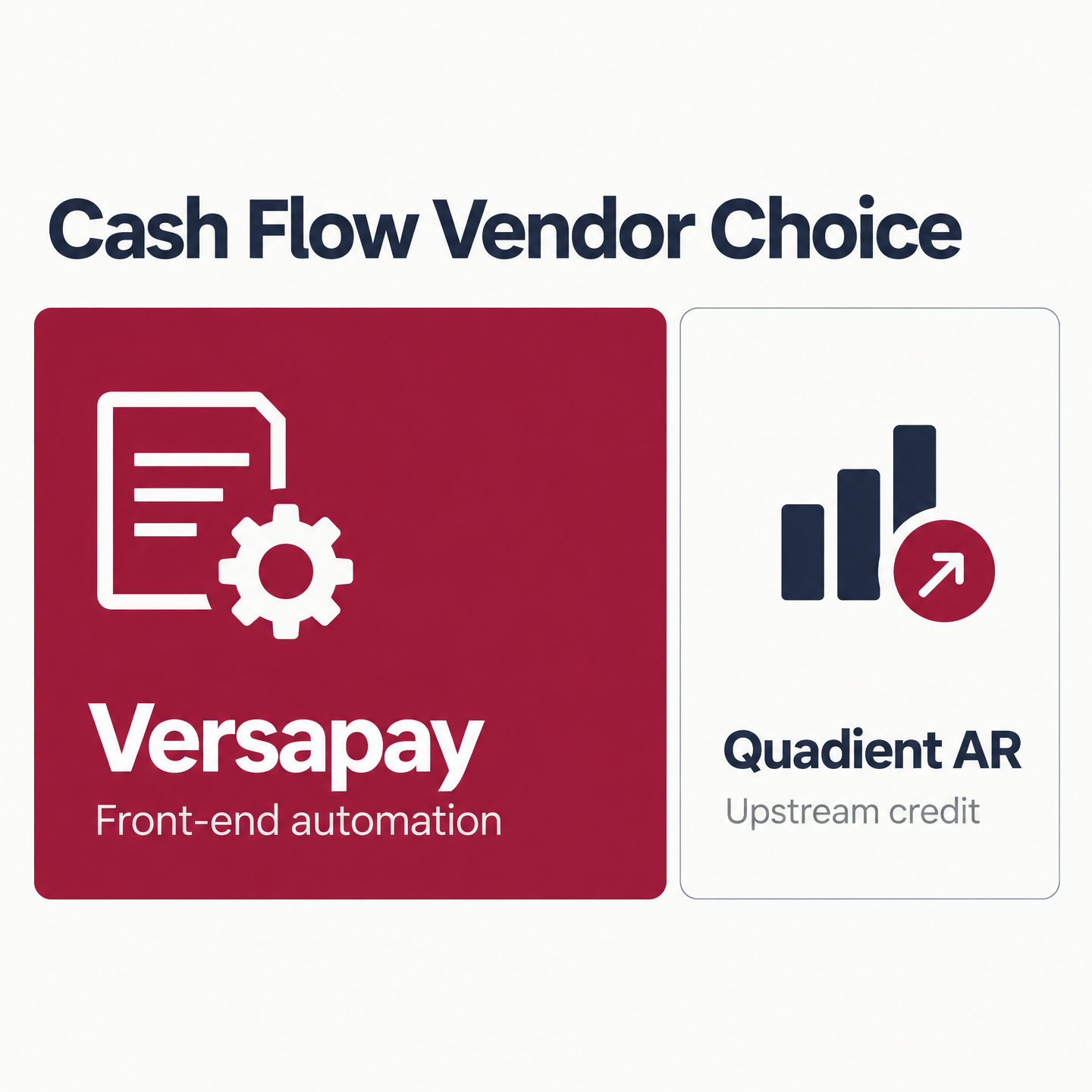
A Quadient AR vs Versapay choice usually comes down to one question: which end of your invoice-to-cash cycle is leaking cash? That single answer sorts most buyers faster than any feature grid.
The pattern is consistent across many subscription and services businesses. Teams that bleed time after payment arrives need cash-application strength. Teams that get burned before the sale becomes collectible need upstream control. Comparing Quadient AR against Versapay only makes sense once you know which camp you’re in.
Who should pick Versapay?
Pick Versapay if your bottleneck lives at cash application and buyer communication. Its documented strengths point toward teams dealing with messy remittance data, buyer-side payment workflows, and payment exceptions that need quick resolution.
There’s a connectivity angle worth calling out too. Versapay’s public documentation describes open APIs and flat-file integration for connecting to other systems, plus recurring billing and AutoPay. If front-end matching and buyer-facing payment flows matter most, that’s a relevant point in its favor.
One honest limit: the strength is concentrated after invoices are issued. Versapay isn’t publicly documented as deeply for credit applications, limit governance, or predicting payer behavior. Strong at cash application and remittance, thinner on upstream credit control.
Who should pick Quadient AR?
Choose Quadient AR when credit and forecasting are where you lose money. Its documented core fits teams carrying large receivables ledgers across many customers, where a single bad credit decision can cost more than a month of matching delays.
Weigh the tradeoff, though. Quadient’s public strength sits before and around the collections process, not in the buyer-payment workflow lane where Versapay stands out. Strong on credit tooling, thinner on the cash-application front end.
Skip Quadient if your pain is purely payment matching. Its remittance capture and exception workflows aren’t documented with the same clarity, so you may be buying sophisticated credit tooling when your real issue is reconciliation labor.
Where does a subscription-native platform fit?
Both vendors leave this piece open. If AI-driven cash application runs inside the subscription platform that generated the invoices, matching can use the same customer, invoice, plan, and payment context from the start. Some platforms are designed to work at the envelope and item level from multiple sources, reducing exceptions before manual review.
The safe-incumbent assumption isn’t enough on its own. What matters is where your cash actually leaks: front-end cash application, upstream credit, or the recurring billing process that feeds both. Match the tool to that, not to reputation.
| Ideal fit | Best for | Watch-out |
|---|---|---|
| Blixo | Subscription/usage billing with cash-app DSO drag | Best when billing lives in-platform |
| Versapay | Cash application, buyer portals, open APIs | Not evidenced on credit tooling |
| Quadient AR | Credit scoring, forecasting, multi-entity | Not evidenced on cash application |
One last decision factor: price the operating model, not just the software category. Ask each vendor to show how cost changes as customers, invoices, users, payment methods, and entities grow. For a deeper framework, our guide on comparing AR automation software walks through it.
What I’d actually do
Neither Quadient AR nor Versapay wins outright. One pulls hardest at credit and forecasting, the other at buyer collaboration and payment application. Your bottleneck picks the winner, not a brand name or a single feature count.
That framing matters because a subscription-native platform changes the evaluation. If billing and cash application share the same data layer, the system may prevent some mismatches instead of passing them downstream for cleanup. That mechanism is where SaaS firms often compress DSO fastest, and it sits outside the Quadient-versus-Versapay tradeoff most buyers stop at.
Match the tool to where your cash stalls
Pick based on the leaking end of your cycle. Versapay is the stronger fit when the pain is remittance, payment application, and buyer-facing collaboration. Quadient is the stronger fit when the pain is customer risk, credit exposure, and payment predictability.
| Scenario | Best fit | Why |
|---|---|---|
| Cash stuck at remittance and exceptions | Versapay | Documented detached remittance capture plus exception workbench |
| Credit limits and payer risk drive aging | Quadient AR | Documented credit scoring, limit monitoring, payment forecasting |
| SAP, Sage X3 or Acumatica shop | Quadient AR | Public materials list those connectors |
| High dispute volume tied to buyer portals | Versapay | Buyer-side collaboration threads may resolve line-item disputes in place |
Each portal-led tool anchors a different failure point, and that split is most of the decision. For a subscription business with heavy cash-application work, a tool that reduces mismatch at the billing layer may perform better than one that only cleans it up afterward. Some subscription-native platforms position their matching as improving over time.
Read the blanks and the quotes before you sign
Two traps close out this comparison.
First, don’t overread silent public documentation. Treat gaps as demo questions, not verdicts. Confirm the capability live with a reference customer on your ERP version.
Second, quote-based pricing needs pressure-testing. Push for the fully loaded figure: implementation fees, onboarding, support, user limits, payment costs, transaction surcharges, and anything tied to volume. Those details can shift a year-one total by a wide margin.
Do that, and pricing stops being a fog. It also surfaces a structural gap. Portal-led vendors may bundle cost around usage and seats, while a subscription tool may offer a more predictable recurring rate. That difference can compound for recurring-revenue shops most likely to hit cash-application drag.
So: Quadient AR for upstream credit and forecast control. Versapay for front-end collaboration and faster deployment. And if your DSO pain concentrates in cash application on recurring invoices, a subscription-native platform may close that gap before either portal-led tool gets a chance to.
FAQ
1. If my company runs on SAP or Oracle, which vendor connects to it?
Use ERP fit as an early filter. Public vendor materials position Quadient AR as the better documented match for SAP-centered environments, especially when Sage X3 or Acumatica also matter. Versapay is better documented when Oracle Fusion Cloud is the key requirement. Confirm the exact connector, supported version, and implementation responsibilities on a demo.
2. Does “not evidenced” in the comparison tables mean the feature doesn’t exist?
No. It means the feature was not confirmed in public documentation reviewed for the comparison. The vendor may still offer it, bundle it differently, or show it only during sales. Treat every blank as a question to validate with your actual workflow.
3. What extra costs should I watch for beyond the quoted price?
Look beyond the headline subscription number. Implementation, configuration, data migration, user access, payment processing, premium support, and transaction-related charges can all affect the real total. Ask for one complete first-year figure and a renewal-year estimate under the same usage assumptions.
4. I run a subscription business. Is a standalone AR tool the right fit?
It depends on where the work breaks. If your recurring invoices are created in one system and reconciled in another, a standalone AR layer may still leave handoff friction. A subscription-native platform may run AI cash application inside the billing system, so payment matching can use invoice data that already exists in the platform.
5. How should I evaluate onboarding time between these tools?
Ask each vendor for a realistic go-live timeline at your data volume, who handles the configuration work, and how much of your team’s time the rollout consumes.
6. My cash gets stuck before invoices even ship. Which tool helps?
That is Quadient AR’s lane. If the issue is customer risk, credit exposure, or accounts that predictably pay late, upstream credit and forecasting controls are more relevant than buyer-payment collaboration alone. Versapay may help once invoices are issued, but it is not the stronger public fit for pre-invoice risk control.