

Quadient AR vs Versapay for Cash Application and Reconciliation: What Finance Teams Need

Quick Comparison Summary
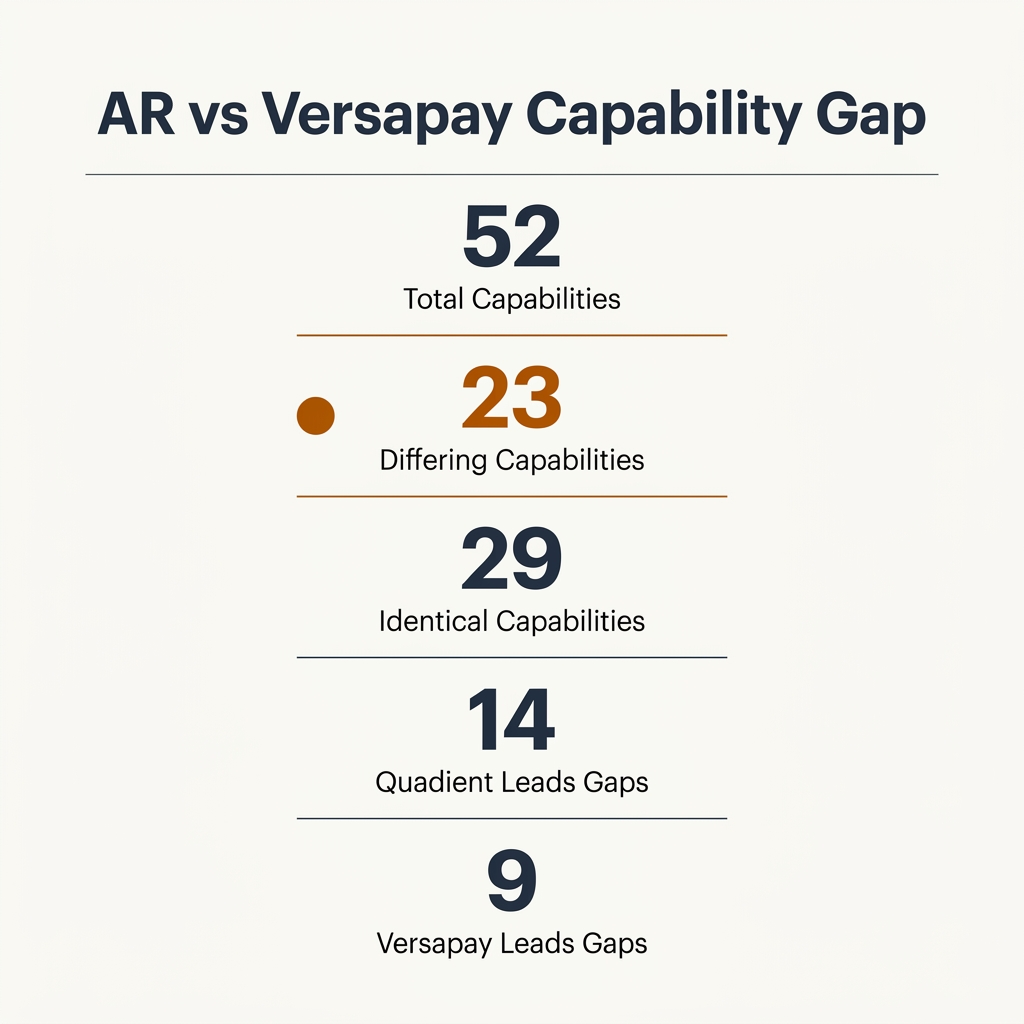
A third-party audit by ERP Research, as cited in this comparison, scored Quadient AR and Versapay against a 52-point AR and collections taxonomy. The audit reports the tools differed on 23 capabilities and graded identically on the remaining 29. That makes the decision a matter of a few gaps, not a wholesale feature contest.
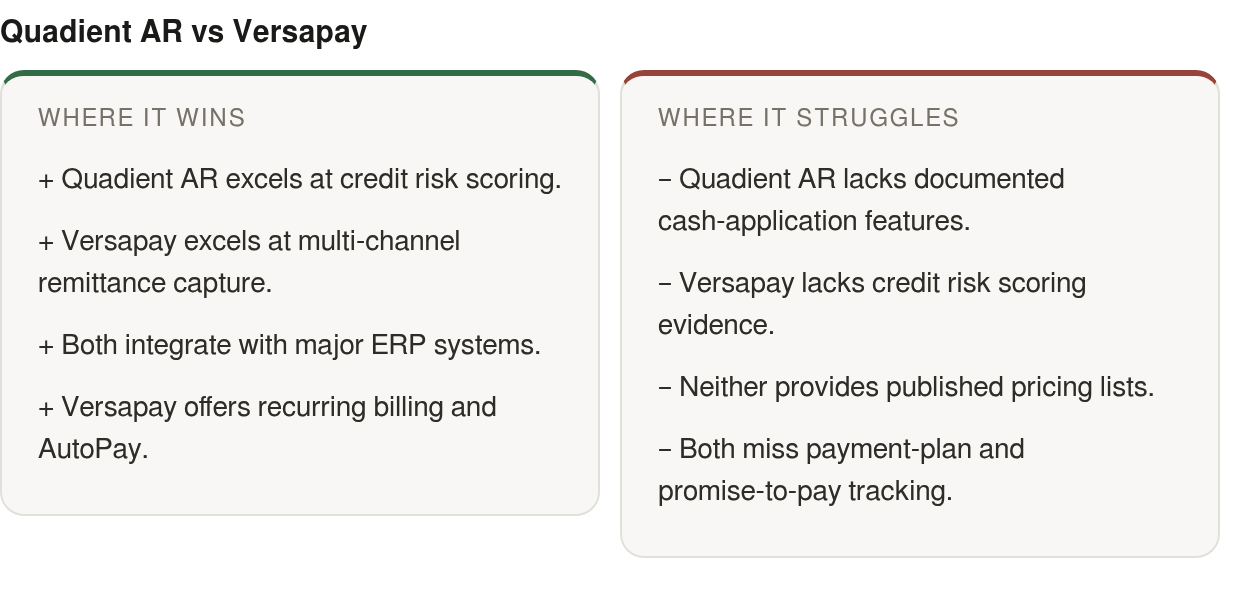
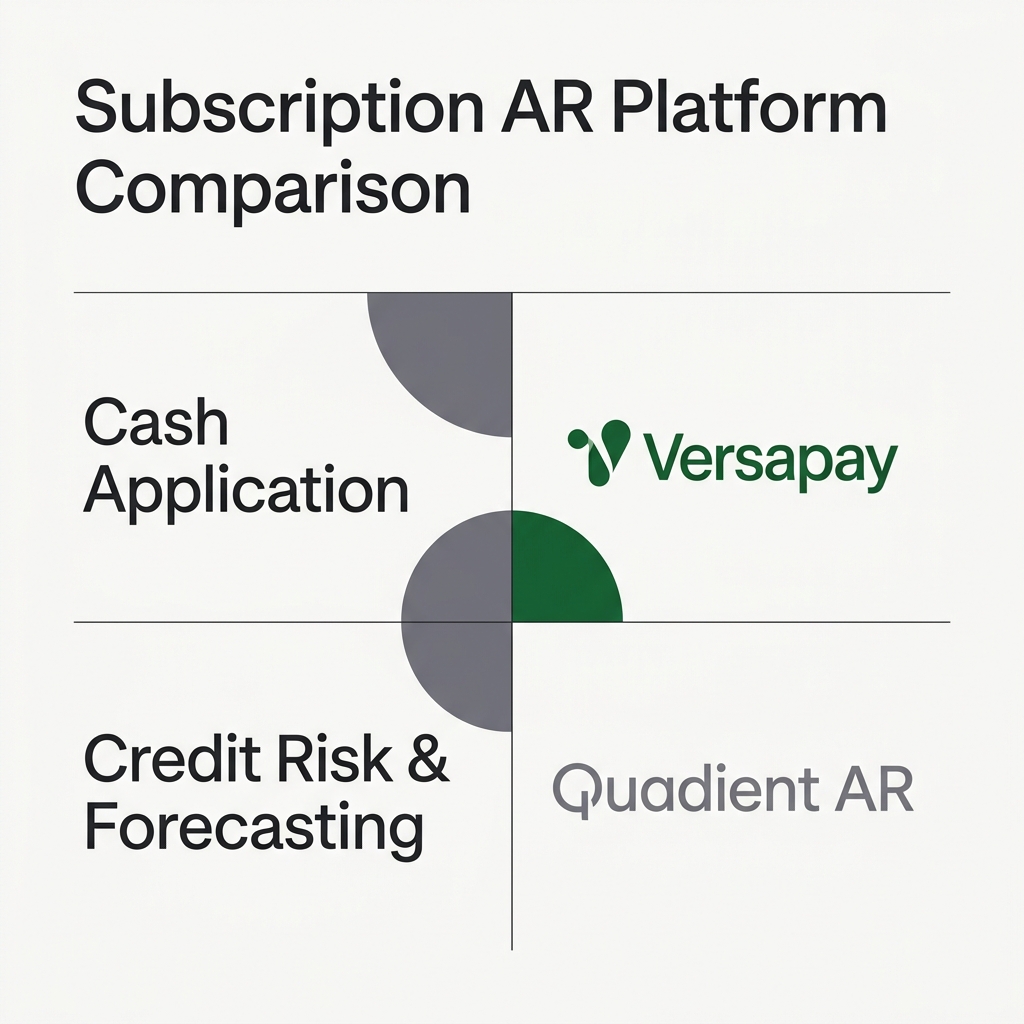
Where those gaps fall matters for subscription finance. According to the same audit, Quadient AR showed stronger evidence on 14 of the 23 differing capabilities, led by credit risk scoring and digital credit application workflow. Versapay led on 9, driven by multi-channel remittance capture and an exception-handling workbench. In that evidence, one tool leans toward the credit and forecasting side, and the other leans toward cash application.
At-a-Glance Comparison Across the Two Tools
| Factor | Quadient AR (by YayPay) | Versapay | What to verify |
|---|---|---|---|
| Pricing model | Quote-based subscription, feature-based | Annual subscription, quote-based by invoice volume | No list prices published in materials reviewed; ask for all-in first-year cost at actual seat count and volume |
| Cash application strength | Not evidenced in cited audit | Evidenced in cited audit: remittance capture, exception handling | Ask to see open-format email/PDF/EDI examples, not just vendor-controlled payments |
| Credit management | Evidenced in cited audit: risk scoring, credit apps | Not evidenced in cited audit | Confirm credit workflow if this is a priority |
| Recurring / subscription billing | Not evidenced in cited audit | Evidenced in cited audit: recurring billing and AutoPay | Ask about retry, partial payment, dunning logic |
| Forecasting | Evidenced in cited audit: cash flow and payment-behavior forecasting | Vendor-published AR aging visibility | Ask for scenario examples |
| ERP integrations | Vendor-published list: Sage Intacct, NetSuite, Dynamics 365, SAP, Sage X3, Acumatica | Vendor-published list: NetSuite, Sage Intacct, Dynamics 365, Oracle Fusion Cloud | Confirm current support for your ERP version |
One note on method. In this audit, “not evidenced” means the researchers found no public documentation of that capability. The vendor may still offer it. Treat those cells as questions to raise on a demo, not confirmed absences.
The Subscription Gap Neither Vendor Documents
Here’s the catch for recurring-revenue teams. In the cited audit, both tools are not evidenced on payment plans and instalments, and both are silent on promise-to-pay tracking. Those are the exact workflows subscription AR runs on. So neither is a turnkey subscription cash-application setup out of the box based on the evidence reviewed.
Versapay does evidence recurring billing and AutoPay, which helps the invoicing side. But the follow-up mechanics after a failed or partial payment, and the churn-adjacent collections work, appear to sit in the gap for both.
The Pricing Reality: Nobody Lists a Number
Neither Quadient AR nor Versapay publishes a list price in the materials reviewed. Both quote. Vendor materials in the original comparison describe Versapay’s quote as scaling with invoice volume, which can climb fast for high-transaction SaaS billing.
That makes a clean comparison hard. Ask each vendor for one figure: the all-in first-year cost at your actual seat count and volume. Then compare those single numbers, not headline feature lists. Push on match-rate claims too, and ask each vendor exactly how the number is measured and across which remittance formats before you treat it as settled.
This review did not include Versapay-specific ROI evidence. If a payback claim appears in a proposal, ask for the assumptions behind the calculation and benchmark the claimed savings against the quote-only first-year cost for your actual invoice volume, users, and implementation scope. Otherwise, a percentage improvement can hide a low baseline or skip channels that still require manual review.
If you want a deeper method for cutting through quote-only vendor pages, a guide on how to compare AR automation software walks through it.
The Quick Verdict
Quadient AR and Versapay are close competitors, but audit evidence suggests they win in different parts of the receivables cycle. Quadient AR is better evidenced for credit management and forward-looking collections signals. Versapay is better evidenced for capturing remittance and clearing unmatched payments. For a subscription finance team, start the decision from your operational pain: forecasting risk before invoices age, or applying messy inbound cash faster. Treat undocumented capabilities as demo prompts, not final judgments, and insist on pricing and workflow proof against your real invoice volume.
Why This Is a Closer Call Than It Looks
Anyone weighing Quadient AR against Versapay for a subscription business is usually solving the same Monday-morning problem. Recurring invoices stack up, payments land in a dozen formats, and someone on the finance team is matching cash to invoices by hand. The question isn’t which tool wins in the abstract. It’s which one fits the way subscription revenue actually moves through your books.
That framing matters because the audit evidence splits these two tools across the receivables ledger. One side leans toward credit risk and forecasting; the other leans toward getting cash matched fast. Subscription SaaS finance needs both working in one flow, so picking between them forces you to decide which side you can least afford to run thin on.
What Subscription Cash Application Actually Demands
Subscription revenue needs recurring invoicing to connect cleanly with failed-payment recovery, collections notes, and reconciliation. Public documentation does not make that end-to-end motion equally clear for either vendor. So test the actual renewal, retry, partial-payment, and follow-up workflow rather than assuming it exists behind the feature grid.
Versapay’s documented strengths, per the cited audit, sit in multi-channel remittance capture and exception handling for unmatched payments. Read the feature grids carefully, though. A vendor’s own portal is a closed loop where the payment and the invoice reference are already linked, so matching there tells you little about messier remittance arriving by email, PDF, and data file. When you compare match rates, separate vendor-controlled channels from open-format matching, or you’ll be comparing two different things.
Which Gap Should Steer Your Choice
Map each tool to where subscription finance feels pain. Versapay’s documented strength sits in remittance capture and exception handling. Quadient AR’s sits in credit scoring and cash-flow forecasting, the churn-and-collections-risk side of the ledger.
| What subscription finance needs | Quadient AR | Versapay | Verification prompt |
|---|---|---|---|
| Recurring / subscription billing | Not evidenced in cited audit | Evidenced in cited audit | Ask for renewal, retry, partial-payment workflow |
| Multi-channel remittance capture | Not evidenced in cited audit | Evidenced in cited audit | Ask for open-format email/PDF/EDI examples |
| Credit risk scoring & forecasting | Evidenced in cited audit | Not evidenced in cited audit | Ask for credit policy and forecasting scenarios |
| Exception handling for unmatched cash | Not evidenced in cited audit | Evidenced in cited audit | Ask for exception queue examples |
That leaves SaaS buyers with a practical trade-off: prioritize the system that keeps risky receivables from aging, or the one that reduces hands-on work after cash arrives. Some platforms are positioned as subscription-native, but apply the same evidence standard before treating that positioning as a documented capability.

Before demos, make the commercial comparison concrete. Ask for a proposal based on your real transaction mix, users, entities, and implementation assumptions, then line up the totals side by side.
Feature by Feature, Where Each One Wins
The split is not subtle once you get past the marketing pages. One tool documents deeper evidence in matching cash; the other documents deeper evidence in judging credit risk. For subscription finance, that difference decides which side of your receivables you can afford to run thinner on.
Start with the cash-application side, since that’s the Monday-morning fire most SaaS teams want out. On raw matching capability, the cited audit points to Versapay as the one with evidenced depth. It describes checks, wires, and ACH, pulls remittance from email, PDFs, EDI files, and AP portals, then reconciles against the bank with OCR and machine learning. Treat that description as the vendor’s documented model and ask to see it on your own remittance samples.
Versapay Earns Its Keep on the Matching Side
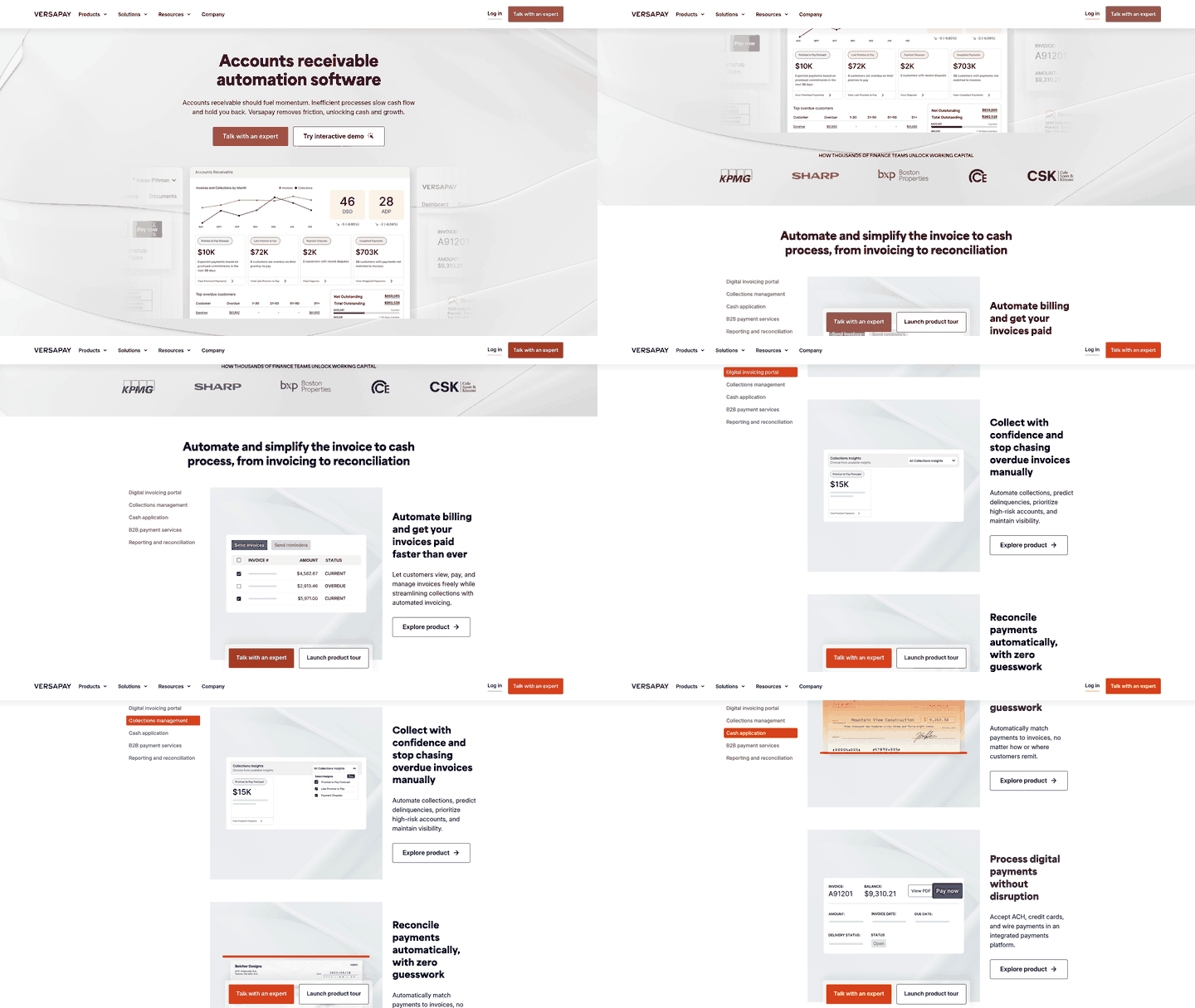
Versapay’s evidenced strengths, per the cited audit, cluster on the intake side: detached remittance capture from email, PDFs, AP portals, and data files, plus an automated exception-handling workbench for unmatched payments. That’s the part of cash application that usually eats a team’s Monday.
When you evaluate it, ask to see a sample that looks like your receivables inbox, not a polished internal payment flow. The capture layer matters most when references are incomplete, remittance arrives separately, or one payment covers multiple invoices.
Credit and Forecasting Belong to Quadient AR
Quadient AR owns the other half of the ledger in the cited evidence. It documents automated credit risk scoring, digital credit application workflows, ongoing credit-limit monitoring, and AI payment-behavior forecasting. Versapay evidences none of those publicly in the cited audit.
For a recurring-revenue book, where churn signals and non-payment risk matter as much as posting speed, that credit-and-forecasting layer is not a nice-to-have. It’s how you see trouble before the invoice ages.
| Subscription-critical capability | Quadient AR | Versapay | Verification prompt |
|---|---|---|---|
| Multi-channel remittance capture | Not evidenced in cited audit | Evidenced in cited audit | Ask for open-format remittance sample |
| Exception handling for unmatched payments | Not evidenced in cited audit | Evidenced in cited audit | Ask for exception queue logic |
| Recurring / subscription billing | Not evidenced in cited audit | Evidenced in cited audit | Ask for retry and partial-payment flow |
| Credit risk scoring | Evidenced in cited audit | Not evidenced in cited audit | Ask for credit scoring criteria |
| Payment-behavior forecasting | Evidenced in cited audit | Not evidenced in cited audit | Ask for forecast accuracy examples |
| Payment plans / promise-to-pay tracking | Not evidenced in cited audit | Not evidenced in cited audit | Ask for live workflow demo |
The Subscription Gap Both Vendors Leave Open
For subscription AR, the open question is not whether either product can automate pieces of receivables. They can. The harder question is whether the workflow holds together when a renewal slips, a customer makes a partial payment, or collections needs a clear next action tied to the account record.
Use the audit language carefully. A blank in public research should trigger a live workflow test, not an assumption. Bring sample invoices, sample remittance, and a realistic account history to the demo so the vendor has to show the process rather than describe it.
No single platform in this comparison evidences strength across both cash application and credit forecasting in the cited audit. If a unified subscription workflow is the target, verify any vendor’s recurring billing, cash application, and collections claims against the same evidence standard you apply to Quadient AR and Versapay.
How They Perform Under Real Volume
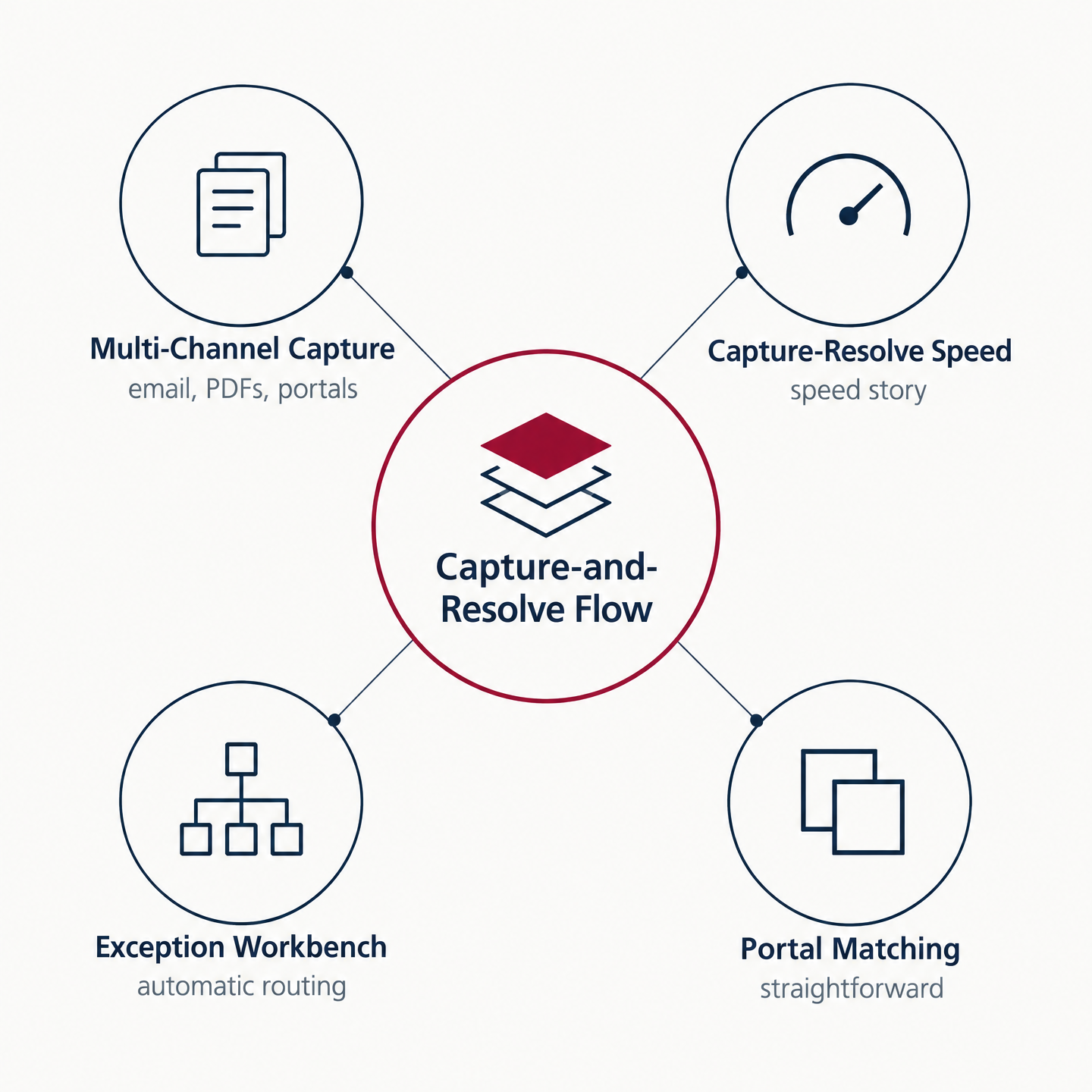
Start with what each vendor actually documents about its cash-application engine, because neither puts a hard match-rate figure on the table. Versapay’s evidenced strength, per the cited audit, is multi-channel remittance capture: pulling remittance detail from email, PDFs, AP portals, and data files, then routing unmatched items through an exception-handling workbench. That capture-and-resolve pattern is easy to misread.
For subscription books, the performance test should mirror how customers actually pay: renewals, add-ons, credits, partial balances, and account-level payments that don’t always reference the right invoice. Clean demo data rarely exposes those edge cases.
Straight-Through Processing Only Counts on Open-Format Cash
Speed in cash application is not about how fast the engine runs. It’s about how few payments land in a human’s queue. Versapay’s documented edge, per the cited audit, is the exception-handling workbench that routes unmatched items automatically, so the finance team touches fewer transactions per cycle.
Quadient AR does not publish an equivalent match-rate figure in the materials reviewed. Its evidenced performance sits on the forecasting side, predicting when accounts will pay so collectors work the right accounts first. Both reduce manual effort; they just cut it at different points in the flow.
How Quadient AR and Versapay Scale With Invoice Volume
Scalability shows up in operating design as much as commercial design. A high-growth SaaS team needs to know whether the system can absorb more invoices, more customers, more payment channels, and more entities without pushing work back into spreadsheets.
| Performance dimension | Quadient AR | Versapay | What to ask |
|---|---|---|---|
| Documented match rate | Not published in materials reviewed | Not published in materials reviewed | Ask for definition, included channels, exclusions |
| Speed strength | Evidenced focus on payment-behavior and cash-flow forecasting | Evidenced focus on automated exception handling | Ask for examples against your remittance mix |
| Scaling basis | Feature-based subscription | Annual subscription, quoted by invoice volume | Ask for volume-based renewal estimates |
| Manual-load reduction | Prioritizes collector effort by risk in cited evidence | Reduces items hitting the exception queue in cited evidence | Ask for before/after workload estimate |
Model cost at scale with the same discipline you apply to operational scale. Use your expected invoice growth, payment mix, and user count so implementation and renewal economics don’t become a surprise later.
The Subscription Workflow Is the Weakest-Documented Area for Both
At scale, disconnected follow-up gets expensive. If billing status, collections promises, and reconciliation live in separate systems, finance teams lose the account context needed to decide whether to retry, escalate, credit, or write off.
That’s the real performance verdict in the evidence reviewed. One tool is better positioned around applying incoming cash; the other is better positioned around anticipating collection risk. If you need the matching engine, the forecasting brain, and the recurring-billing logic reconciling in one flow, you’ll either stitch two tools together or evaluate a subscription-native platform against the same evidence standard. Do not assume the subscription-native claim resolves the gap without a live workflow test.
Pros and Cons
Each tool is strong on roughly half of what a subscription finance team needs, based on the cited audit, and neither hides it well. Versapay documents deep cash-application muscle. Quadient AR documents deep credit and forecasting muscle. Pick either and you inherit the other’s blind spot, unless you add the missing half elsewhere.
So before you weigh them on a feature checklist, decide which weakness you can live with for the next three years.
Versapay’s Cash-Application Strength Has a Boundary
Versapay’s pitch is speed on the matching side, and its documented strengths back that focus. The cited research evidences multi-channel remittance capture, detached remittance pulled from email, PDFs, AP portals, and data files, plus automated exception handling for payments that don’t match cleanly.
The boundary is control. Versapay can look strongest where it controls the payment experience or can reliably capture the supporting remittance. Your due diligence should focus on customers who pay outside preferred channels, because those transactions decide how much manual work remains.
The upside is real for teams whose pain is inbound matching. The cited research also credits Versapay with electronic invoice delivery carrying embedded payment links, plus recurring billing and AutoPay, which keeps more payments flowing through channels it can reconcile automatically.
The downside for a SaaS book is that Versapay’s evidenced strength appears to stop at the cash-application line. It leans thin on credit risk scoring and payment-behavior forecasting in the cited audit, the exact tools you want when churn and non-payment are your biggest revenue leaks.
Quadient AR Owns the Credit Side and Skips the Match
Quadient AR flips the picture. In the cited audit, it documents automated credit risk scoring, digital credit applications, and AI-driven payment-behavior forecasting. For a subscription business trying to see collections risk before it becomes bad debt, that may be the more valuable half.
The catch is blunt. On cash application itself, Quadient AR shows no public evidence in the cited audit of multi-channel remittance capture or an exception-handling workbench. Those are the two functions cash-app buyers often care about most. If matching messy inbound payments is your Monday-morning fire, this is not the obvious lead choice.
Neither One Is a Turnkey Subscription Platform
The shared weakness is not a minor add-on. Subscription finance depends on continuity from invoice creation to collection action to cash posting. Split those motions and the team ends up rebuilding context by hand.
The case for a unified platform, if pursued, is that recurring invoicing, cash application, and collections follow-up live in one flow. That claim still needs the same evidence standard as the two tools above. Do not shortcut the audit on a positioning statement.
| Dimension | Quadient AR | Versapay | What to verify for any subscription-native option |
|---|---|---|---|
| Cash-app matching | Not evidenced in cited audit | Evidenced in cited audit | Ask for open-format remittance example |
| Credit risk & forecasting | Evidenced in cited audit | Not evidenced in cited audit | Ask for churn and non-payment risk scenarios |
| Recurring / subscription billing | Not evidenced in cited audit | Evidenced in cited audit | Ask for retry, partial-payment, dunning flow |
| Payment plans & promise-to-pay | Not evidenced in cited audit | Not evidenced in cited audit | Ask for live demo of plan and promise tracking |
| Best fit | Credit-risk-heavy books | Open-format matching | Validate proof, not just category |
One pricing caveat belongs in every buying-committee discussion: don’t compare proposals until each one reflects the same users, entities, payment channels, invoice load, and implementation scope.
Use Cases and Ideal Users
Picking between these two rarely comes down to a feature score. It comes down to which finance team you are. The decision splits along the shape of your receivables, not the length of a spec sheet.
So before you book demos, figure out where your Monday-morning pain actually lives. Is it matching messy incoming cash, or judging credit risk and forecasting when the money lands? That single question sorts most subscription finance teams into one camp or the other.
Where Versapay Fits: High-Volume, Mixed-Remittance Teams
If your customers pay in every format under the sun, Versapay’s documented strengths, per the cited audit, are pulling detached remittance from email, PDFs, AP portals, and data files, then handling unmatched payments through an exception workbench.
Those capabilities fit teams drowning in check and wire volume, especially when remittance arrives separately from the deposit. Versapay is less compelling if most customers already pay through a clean, controlled flow and your bigger concern is risk segmentation.
Its edge sits squarely in the messy-channel work. Weight those channels when you evaluate it, because that’s where your actual day-to-day work lives.
Where Quadient AR Fits: Credit-Led, Multi-Entity Finance
Quadient AR is the pick when your risk lives on the front end. Its evidenced strengths, per the cited audit, cluster around credit application workflows, ongoing limit monitoring, and AI-powered cash flow forecasting.
That profile suits subscription businesses running multiple subsidiaries and currencies, where knowing which accounts are about to slip may matter more than shaving seconds off matching. If churn and collections risk keep you up at night, this side of the ledger is likely your priority.
The Subscription Workflow Both Tools Leave Thin
The difficult use case is the one many SaaS teams care about most. A customer renews, misses a payment, receives a collections touch, makes a partial payment, and then needs that payment applied cleanly against the right account history. Neither competitor presents the whole loop as clearly as a subscription finance team would want in the cited evidence.
So neither is an obvious turnkey choice for subscription cash application out of the box based on that evidence. You buy one side of the ledger and inherit the other side’s gap, plus a subscription-specific workflow that needs careful validation.
If a unified subscription-native platform is on your list, apply the same scrutiny: demand evidence for recurring billing, cash application, collections, and payment-plan handling rather than assuming the platform closes the gap.
| Best for | Recommended pick | Verification needed |
|---|---|---|
| High-volume mixed remittance and exception handling | Versapay | Open-format remittance demo |
| Credit risk scoring, limit monitoring, multi-entity forecasting | Quadient AR | Credit workflow demo |
Two decision factors settle most calls. First, normalize the commercial proposals so each vendor is quoting against the same operating assumptions. Second, make every undocumented workflow part of the live demo script.
What I’d Actually Do Before Signing
Neither tool closes the loop a subscription finance team actually runs in the cited evidence. One documents deep credit-and-forecasting muscle. The other documents deep cash-matching muscle. Buy either and you inherit the other’s blind spot, then spend the next budget cycle papering over it.
That matters because recurring revenue doesn’t stop at invoice delivery or cash posting. The hard work happens between them: retries, partial payments, collections context, customer promises, and reconciliation. Make vendors prove that middle layer before you sign.
Neither Tool Is a Turnkey Subscription Cash-App Platform
Read the evidence plainly and the pattern holds. Versapay owns the messy-remittance side in the cited audit. Quadient owns the credit-risk and forecasting side. But recurring billing, instalment schedules, and promise-to-pay tracking sit in the gap between them, and that gap is exactly where churn and dunning live for a SaaS book.
So the single human-centric platform a finance team wants doesn’t fall out of this matchup based on the audited evidence. You’re choosing which half of the ledger to run strong and which half to bolt on later. That’s a priority call, not a clean win, and it’s worth naming out loud before the demos start.
Pick by Where Your Monday Pain Lives
Skip the feature-count scoreboard. The right choice tracks the shape of your receivables, not the length of a spec sheet.
| Option | Best for | Documented strength in cited audit | Watch-out |
|---|---|---|---|
| Versapay | High-volume, mixed-format remittance | Multi-channel capture, exception handling | Thinner on credit and forecasting evidence |
| Quadient AR | Credit-risk and forecasting-heavy books | Credit scoring, cash-flow prediction | Less evidenced on cash matching |
| Subscription-native option, if evaluated | Recurring or usage-based SaaS billing | Vendor-supplied claims only | Confirm ERP fit and live workflow evidence |
Choose Versapay if incoming cash arrives in every format and matching is your fire. Choose Quadient AR if judging credit and forecasting when money lands is the harder problem. If the recurring invoice, the collections nudge, and the reconciliation need to sit in a single workflow rather than three stitched systems, evaluate any subscription-native platform with the same evidence standard you apply to the other two.
Two Questions to Ask Every Vendor
Ask vendors to show their pricing assumptions in plain language: users, entities, payment channels, invoice load, services, implementation, and renewal terms. A low software line item can still turn expensive if the workflow needs heavy services or parallel tools.
Then ask them to run your hardest subscription scenario live. Use real examples of renewals, partial payments, failed payments, credits, and account-level balances. A canned portal payment isn’t enough evidence for a finance team that lives in messy receivables every Monday.
Match the tool to your actual receivables, price it honestly, and demand proof on the workflow you run every Monday.
Questions People Ask
Should I rule out a vendor if a capability shows “not evidenced” in the audit?
No. Treat that label as a research limitation and a buying prompt, not a confirmed absence. Put the capability into your demo script, ask the vendor to show it using your workflow, and make sure the answer appears in the proposal or statement of work.
Can I run Quadient AR and Versapay together to cover both halves of the ledger?
You could. The risk is operational: billing context, payment application, collections notes, and account status may not move cleanly between systems. If you take a two-vendor path, budget time for integration design and exception ownership.
Why do vendor match-rate claims need extra scrutiny?
Because a single percentage can hide very different payment types. Ask what transactions are included, what channels are excluded, how partial payments are counted, and how many items still require human review.
Do Quadient AR and Versapay integrate with the same ERPs?
Vendor-published integration lists in this comparison overlap on NetSuite, Sage Intacct, and Dynamics 365. Quadient AR’s published list also includes SAP, Sage X3, and Acumatica, while Versapay’s list includes Oracle Fusion Cloud. Confirm current support for your specific ERP version and any middleware requirements before shortlisting.
How should I compare pricing when neither vendor publishes a number?
Create one pricing worksheet and force each proposal into it. Include subscription fees, implementation, integrations, users, invoice or transaction assumptions, support, and expected growth. The winner is the vendor whose total cost and workflow proof both hold up under your real operating model.