

Quadient AR vs Versapay: Comparing Customer Portals, Collections, and ERP Integrations

Key Takeaways
- In the side-by-side review, Quadient AR and Versapay overlap more than they diverge; the public documentation shows clear differences in only a subset of AR capabilities.
- Versapay shows the strongest public evidence in customer self-service and cash application, while Quadient AR’s public materials lean more toward forecasting and credit workflows.
- Both vendors list multiple ERP connectors, but a listed connector does not necessarily mean the same thing as a native, prebuilt integration.
- Available summaries suggest Versapay’s cost may be tied to invoice volume and to payment processing; confirm the current commercial model before comparing.
- Neither vendor publishes list pricing, implementation timelines, or support SLAs in the reviewed material.
Quick Summary
The short version: pick Quadient AR if credit risk scoring and forecasting sit at the top of your list, Versapay if a buyer-facing portal and remittance capture matter most, and a subscription-native tool if the real job is fighting failed recurring payments. Across the reviewed material the two incumbents overlap more than they diverge, so the call comes down to the handful of areas where their product emphasis appears genuinely different.
Methodology note
This comparison uses a vendor-capability matrix. In the sections below, “evidenced” means a capability was described in public vendor documentation, marketing pages, or demo materials reviewed. “Not evidenced” means the reviewer did not find public documentation for it, not that the feature is absent. Every “not evidenced” item should be treated as a demo checklist question rather than proof of a missing capability.
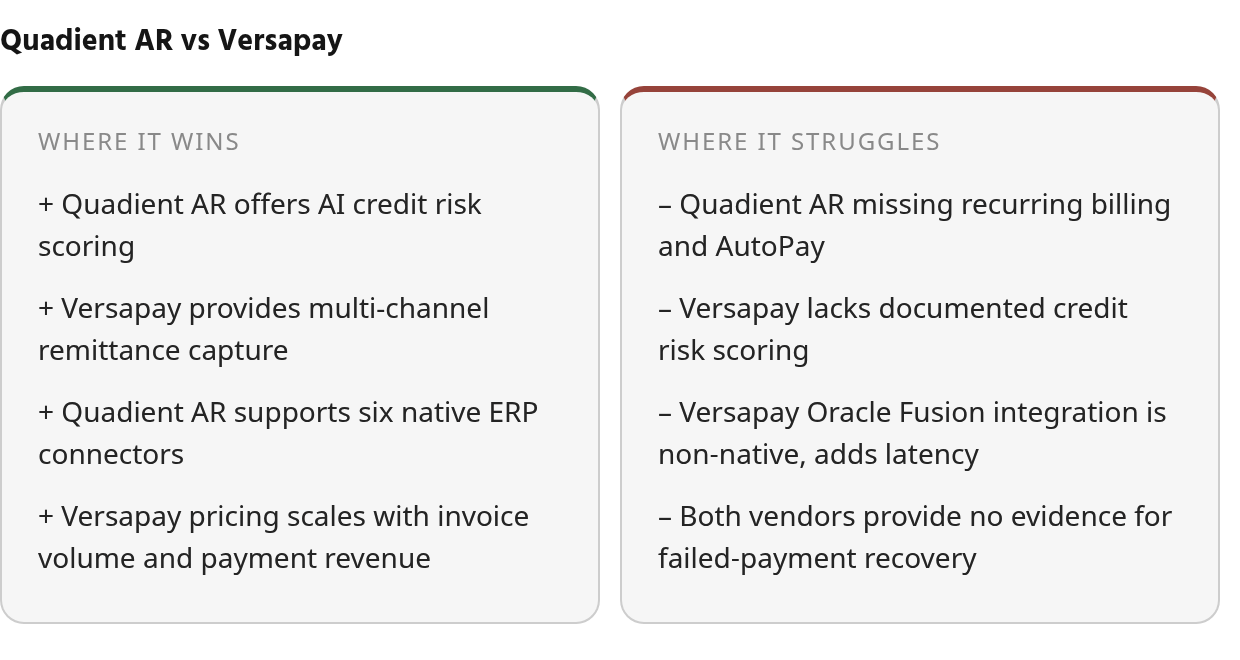
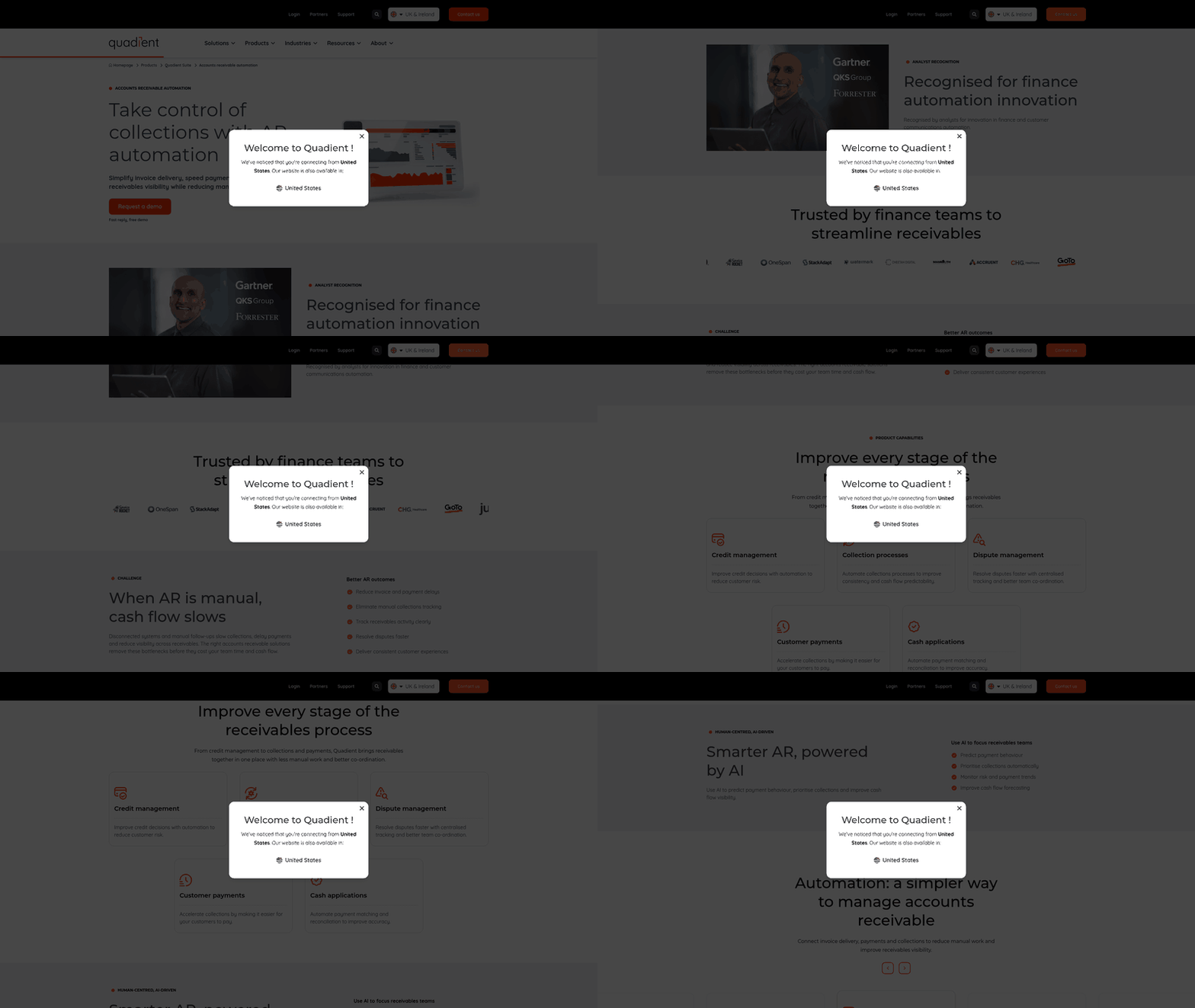
Most quadient ar vs versapay debates fixate on portal polish. For a recurring biller, the deciding factors are how each handles automated cash application, dunning, and the churn that follows a declined card. Public materials suggest neither demonstrates a complete recurring-payment recovery loop out of the box.
How Do Quadient AR, Versapay, and Blixo Compare at a Glance?
| Metric | Quadient AR (by YayPay) | Versapay | Blixo |
|---|---|---|---|
| Deployment model | Cloud (vendor materials) | Cloud (vendor materials) | Cloud / web-based (vendor materials) |
| Portal customisation | Self-service portal (stated) | Self-service buyer portal (stated) | Brandable portal (stated; verify scope) |
| Collections automation | Vendor materials emphasize forecasting and sequencing | Vendor materials emphasize collector prioritization | Vendor materials describe collections and dunning workflows; verify channels and automation |
| Stated ERP connectors | Several named ERP connectors, including Sage Intacct and NetSuite (verify count and versions) | Several named ERP connectors, including NetSuite and Oracle Fusion Cloud (verify connector type) | QuickBooks, Xero, Sage, NetSuite, Oracle, SAP, Dynamics (verify current list) |
| Pricing model | Feature-based subscription, quote (stated) | Quoted, possibly tied to invoice volume and payments (verify) | Published tiers plus enterprise quote (verify current terms) |
| Implementation time | Not published | Not published | Not published |
| Support SLA | Not published | Not published | Stated on higher tiers; confirm in writing |
Two cells deserve attention. Versapay’s Oracle Fusion Cloud connection is described in available materials as an open API or file-based exchange rather than a native connector. For automated cash application in a subscription business, that may mean additional mapping work and sync latency. Pricing also deserves a closer look: Versapay’s commercial model may include both invoice volume and payment processing, so compare the total cost against a subscription-only rival before choosing.
What Are the Top Strengths and Weaknesses?
Quadient AR
- Strengths: public materials emphasize automated credit risk scoring, cash-flow forecasting, multi-entity and multi-currency support.
- Weaknesses: recurring billing, AutoPay, and remittance capture are not evidenced in reviewed documentation.
Versapay
- Strengths: public materials emphasize multi-channel remittance capture, exception-handling workbench, recurring billing and AutoPay, plus a collaborative buyer-supplier network.
- Weaknesses: credit risk scoring and payment-behavior prediction are not evidenced in reviewed documentation, despite AI marketing.
Blixo
- Strengths: vendor materials describe recurring billing, AI cash application, multichannel dunning, and published pricing; verify which capabilities apply to your plan.
- Weaknesses: some capabilities and volume limits may vary by plan tier; confirm feature availability and limits on a demo.
One qualifier runs through all three: “not evidenced” means we found no public documentation, not proof a feature is missing. Confirm anything critical in a live demo. Payment plans, promise-to-pay tracking, and account segmentation—the exact levers for involuntary churn—are unevidenced for both incumbents in the reviewed material. That gap is where a subscription-billing-native approach may add value. For a deeper walk-through, our portal-led vs invoice-to-cash breakdown covers the tradeoffs in full.
Customer Portal Feature Comparison
In short: portal polish gets all the attention, but for a recurring biller the portal only matters if it captures payments cleanly and recovers the failed ones. On raw portal capability, the quadient ar vs versapay comparison tilts toward Versapay’s buyer-facing model in the reviewed material. On closing the churn loop behind that portal, reviewed documentation gives neither a clear win.
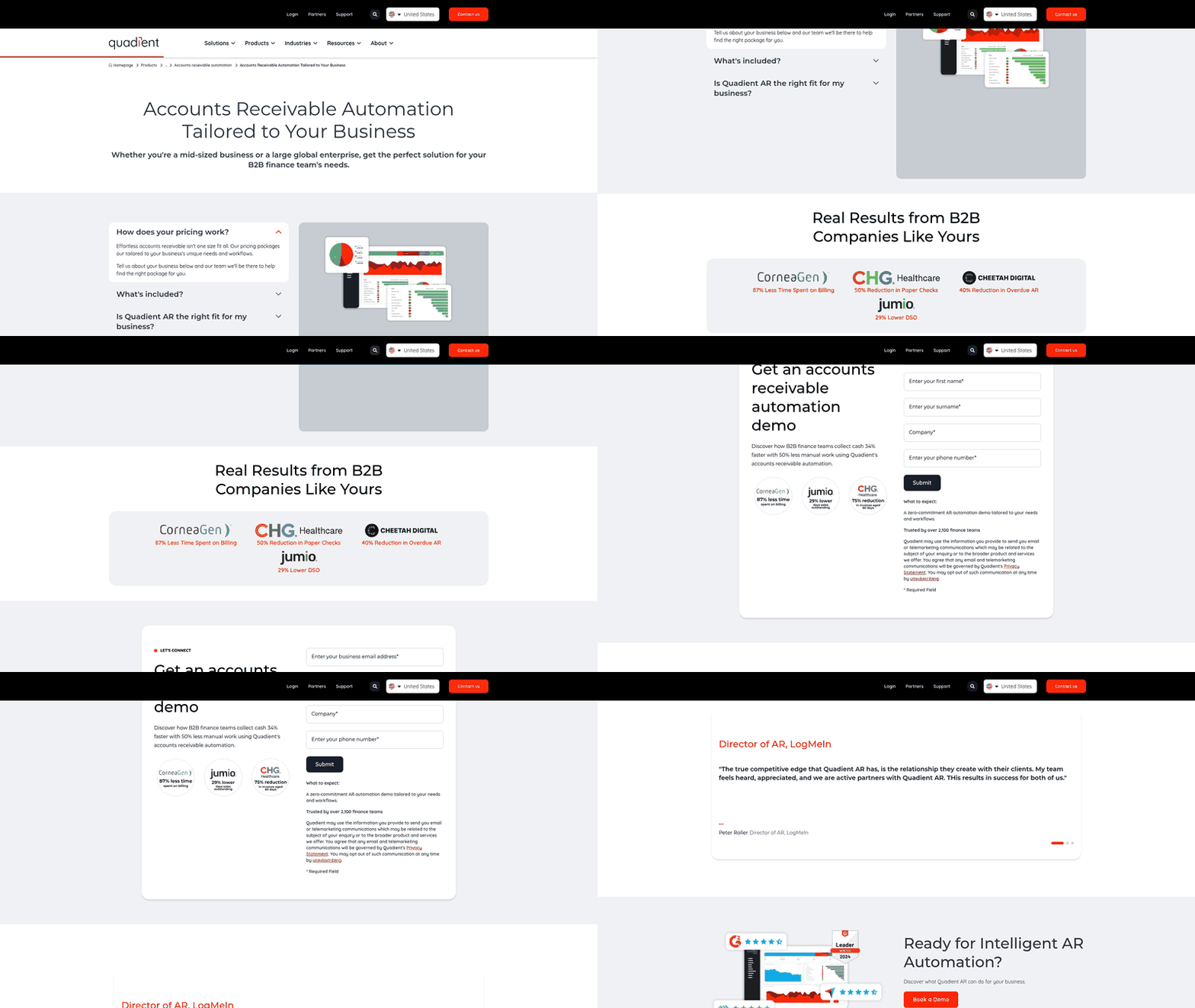
Versapay’s strongest public evidence sits where a customer portal lives: self-service payments and cash application. Public materials describe a collaborative workspace where buyers view invoices, dispute charges, and pay online. Quadient leans the other way, marketing an AI layer weighted toward forecasting and credit workflows. Two different bets. Verify both in a live demo before you trust the marketing.
Which portal wins on payments and self-service?
According to Versapay’s public product pages, the portal can accept ACH, credit card, virtual card, and wire, and its cash application can match detached remittance from email, PDFs, and AP portals back to open invoices. That remittance capture is the standout. For a subscription shop drowning in mixed payment formats, it may cut manual matching more than a prettier UI ever would.
Quadient’s public materials emphasize forecasting and credit workflows over portal payment breadth. Reviewed docs don’t detail its exact payment-method list, so treat the portal-to-portal payment comparison as unconfirmed until you see both walkthroughs.
| Portal capability | Quadient AR | Versapay | Subscription-native tool (Blixo) |
|---|---|---|---|
| Self-service pay portal | Yes (verify scope) | Core strength in public materials | Recurring-billing portal (stated) |
| Payment methods | Not detailed in reviewed docs | Public materials list ACH, card, virtual card, wire | Card + ACH for subscriptions (stated) |
| Automated cash application | AI-driven (asserted) | AI-driven, evidenced in public materials | Auto-match to recurring invoices (stated) |
| Failed-payment recovery | Not evidenced | Not evidenced | Automated collections, dunning & chasing (stated) |
| Cost driver | Feature subscription (stated) | Invoice volume + payment take (verify) | Plan + team members + transaction/messaging fees (stated) |
What about branding, mobile, and security claims?
This is where the record thins out. Reviewed documentation for both vendors doesn’t spell out custom-CSS depth, white-label options, native mobile apps, or specific security certifications like SOC 2, ISO 27001, or PCI-DSS. Both are established cloud products, but you won’t confirm the specifics from public pages. Put those on your demo checklist and ask for the audit reports directly.
Does either portal actually close the churn loop?
Not based on the reviewed public material, and this is the part the feature grids bury. The capabilities a subscription business needs to fight involuntary churn stay unconfirmed in the public material for both platforms. A polished portal that still can’t stage a recovery workflow leaves the recurring-revenue gap open.
A subscription-billing-native tool may fill that space, with automated collections, dunning, and chasing wired into the same hosted portal in its vendor materials. The portal-led automation breakdown walks it in more depth, but the short of it is simple: choose on the churn workflow, not the screenshot.
Collections Management Capability Comparison
In short: on collections specifically, Quadient AR’s public materials emphasize rule-driven dunning and cross-team dispute work, while Versapay emphasizes AI-driven prioritization and its buyer-facing portal. Push into the churn-recovery pieces a recurring biller actually needs, though, and the Quadient AR vs Versapay comparison may end in a tie neither vendor fully documents.
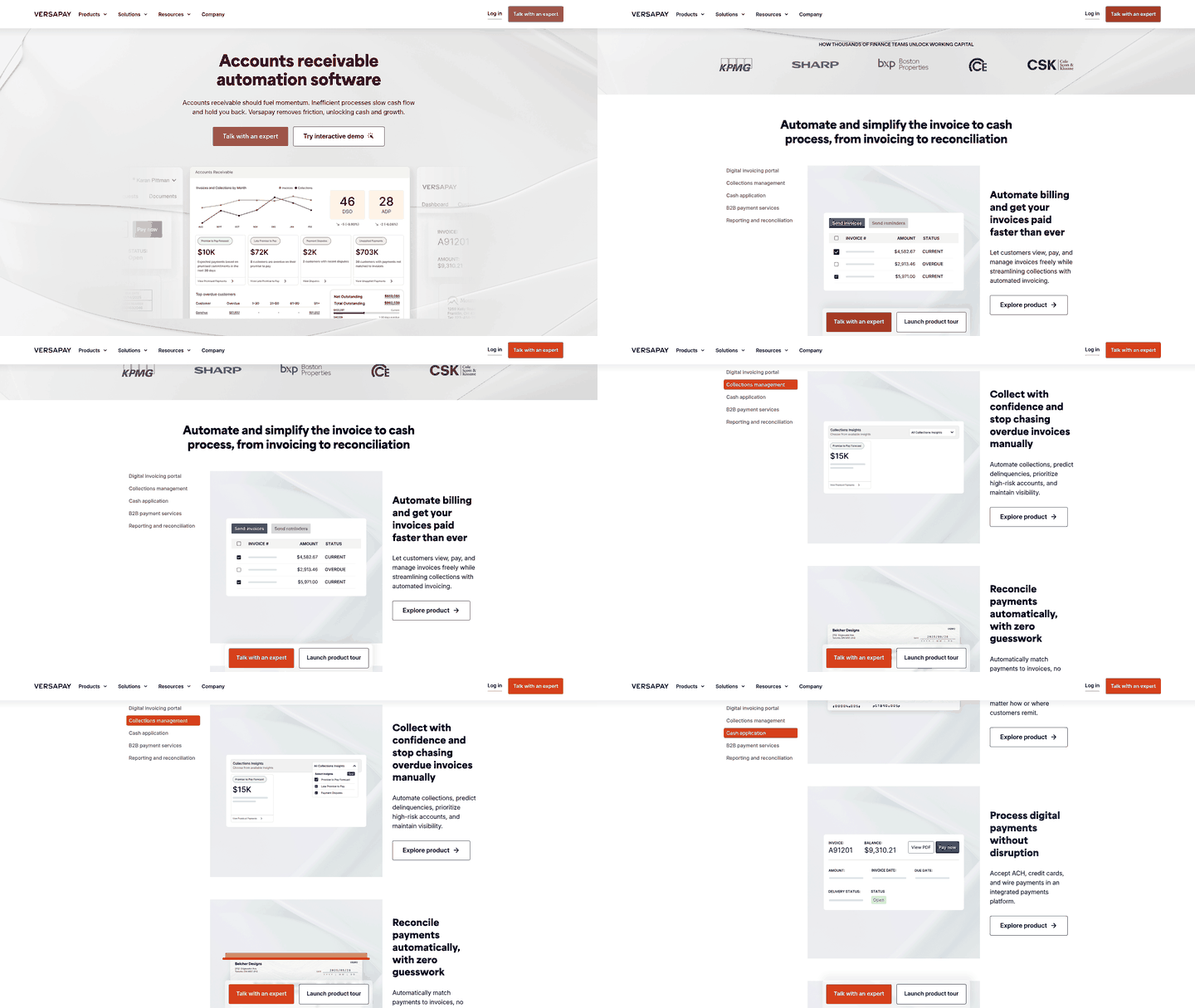
Versapay’s public materials describe automated workflows, collector prioritization, and task management. The missing proof matters most where collections crosses into retention. If your team depends on structured repayment commitments, staged recovery paths, or customer-level routing rules, make those demo questions explicit instead of assuming they ship.
How deep does each dunning engine go?
Quadient’s public materials describe payment reminder sequencing with escalation triggers. That’s the shape of a configurable, multi-stage dunning flow. Versapay documents automated reminders too, but breadth beyond email isn’t documented.
For a subscription shop, dunning isn’t just polite nudging. It’s the recovery path after a card declines. Neither vendor’s public docs describe retry logic tied to failed recurring charges, which is the exact moment involuntary churn starts.
| Collections capability | Quadient AR | Versapay | Blixo |
|---|---|---|---|
| Multi-channel dunning sequencing | Supported in public materials | Partial (email documented) | Stated: email, SMS, calls, letters |
| AI-driven prioritization | Forecasting emphasis in public materials | Core strength in public materials | Not the focus |
| Promise-to-pay tracking | Not evidenced | Not evidenced | Not evidenced |
| Payment plans / instalments | Not evidenced | Not evidenced | Not evidenced |
| Failed-recurring-payment recovery | Not evidenced | Not evidenced | Stated core strength; verify |
Who wins remittance capture and dispute resolution?
This is Versapay’s home turf on the capture side in public materials. Its cash application is described as ingesting detached remittance from email, PDFs, AP portals, and data files. That solves a real pain: matching a payment when the remittance advice arrives separately from the money.
Quadient takes disputes in the reviewed material. Public docs credit it with cross-team dispute resolution workflows, while Versapay handles disputes inside its portal. If your deductions need finance, sales, and ops to weigh in, the cross-team model fits better. If most disputes are buyer questions on a single invoice, in-portal handling is enough.
On AI, watch the evidenced-versus-asserted gap. Quadient backs its payment-behavior forecasting with documentation in the reviewed material. Versapay markets AI, but its AI platform and credit management capabilities show up as unconfirmed. Both may do more than the docs show. Verify on a demo.
Where does this leave subscription billers?
For recurring revenue teams, the practical issue is workflow continuity. Invoice delivery, payment capture, card failure handling, dunning, and account follow-up need to operate as one motion. Public materials for the two AR incumbents show strong pieces of that chain, but not the full loop.
A subscription-native tool may fill that gap. Blixo is described by its vendor as building around recurring invoicing, automated collections and dunning, and retention-focused AI. If fighting failed payments is your real job, weigh that described fit against a portal-first or forecasting-first rival. Our collections-and-dunning buyer’s guide digs deeper into the workflow differences.
One cost note. For a high-volume biller, be careful with any model that moves in step with both invoice count and payment flow. Quadient’s module-led approach appears to behave differently from Versapay’s usage-linked structure, so the cheaper option may depend heavily on your billing profile.
ERP Integration market Comparison
In short: on ERP breadth the Quadient AR vs Versapay matchup splits cleanly in public material. Quadient AR lists more back-office ERPs; Versapay lists fewer but emphasizes certified, payment-embedded connectors. For a recurring biller, the connector’s sync behavior matters more than the logo count.
What separates the two isn’t the ERP names both claim to support. It’s what sits behind each name. Reviewed documentation is the source here, so verify each connector against your ERP version with a reference customer before you commit.
The Connector Count Hides the Real Difference
A listed integration is not the same as a native connector. That distinction matters in subscription billing.
Connector types can differ within a vendor’s own stack. For example, some available pages describe Versapay’s NetSuite integration as a certified marketplace SuiteApp, while Sage Intacct and Dynamics 365 may run through prebuilt connectors. Other listed integrations may rely on API or file-based exchange rather than a prebuilt connector, and that may be a meaningful gap once you look past the logo.
Why does this matter for recurring revenue? Less automated sync can mean more implementation detail to own: field mapping, timing, error handling, and reconciliation checks. When billing status needs to trigger follow-up quickly, the plumbing matters as much as the portal.
Sync Direction and Data Scope Decide Reconciliation Speed
The documented sync scope can suggest how much reconciliation stays manual. Some public materials describe Versapay’s Sage Intacct connector as syncing invoices, payments, and journal entries bi-directionally, with payment acceptance embedded inside Sage workflows. One caveat worth checking: confirm whether that listing lives on the vendor site or in a formal marketplace/partner directory.
| Integration detail | Quadient AR | Versapay | Blixo |
|---|---|---|---|
| Certified marketplace listing | Verify per ERP | NetSuite SuiteApp described in public materials | Confirm on a demo |
| Open API / developer platform | Not evidenced | Supported in public materials | Confirm on a demo |
| Multiple simultaneous ERP connections | Supported in public materials | Not evidenced | Confirm on a demo |
| Multi-entity / multi-currency | Core strength in public materials | Not evidenced | Confirm on a demo |
Read that table with the disclaimer intact. “Not evidenced” means public documentation didn’t confirm the capability, not that it’s missing. Confirm each cell in a live demo rather than assume the gap is real.
One split is worth flagging. Quadient AR is described as supporting multiple simultaneous ERP connections and multi-entity, multi-currency operations. Versapay’s open API appears where a developer platform may be the emphasis. If you run several ERPs after an acquisition, those are different bets.
Integration Cost Scales With Two Different Meters
The connector docs rarely expose the commercial impact. A highly automated native connector may reduce implementation burden, while a more flexible developer path may give you control at the cost of internal or partner engineering time. That tradeoff belongs in the same conversation as licensing, not after the contract is signed.
Neither vendor publishes list pricing. Ask each for the all-in first-year cost at your seat and volume, as one number, and compare those. If you want a wider view before demos, our guide to comparing AR automation software covers what to press vendors on.
Pricing, Licensing, and Total Cost of Ownership Comparison
In short: neither vendor prints a price, so the Versapay cost question can’t be answered from a pricing page. Both quote. The structural difference in how each meter may run could decide which one gets cheaper as you grow.
For a recurring biller, your invoice count climbs every month you add subscribers. A pricing model tied to invoice volume may rise with it. So the Versapay decision on total cost of ownership isn’t really about the sticker; it’s about which model your billing profile feeds.
Which Pricing Model Punishes High Invoice Volume?
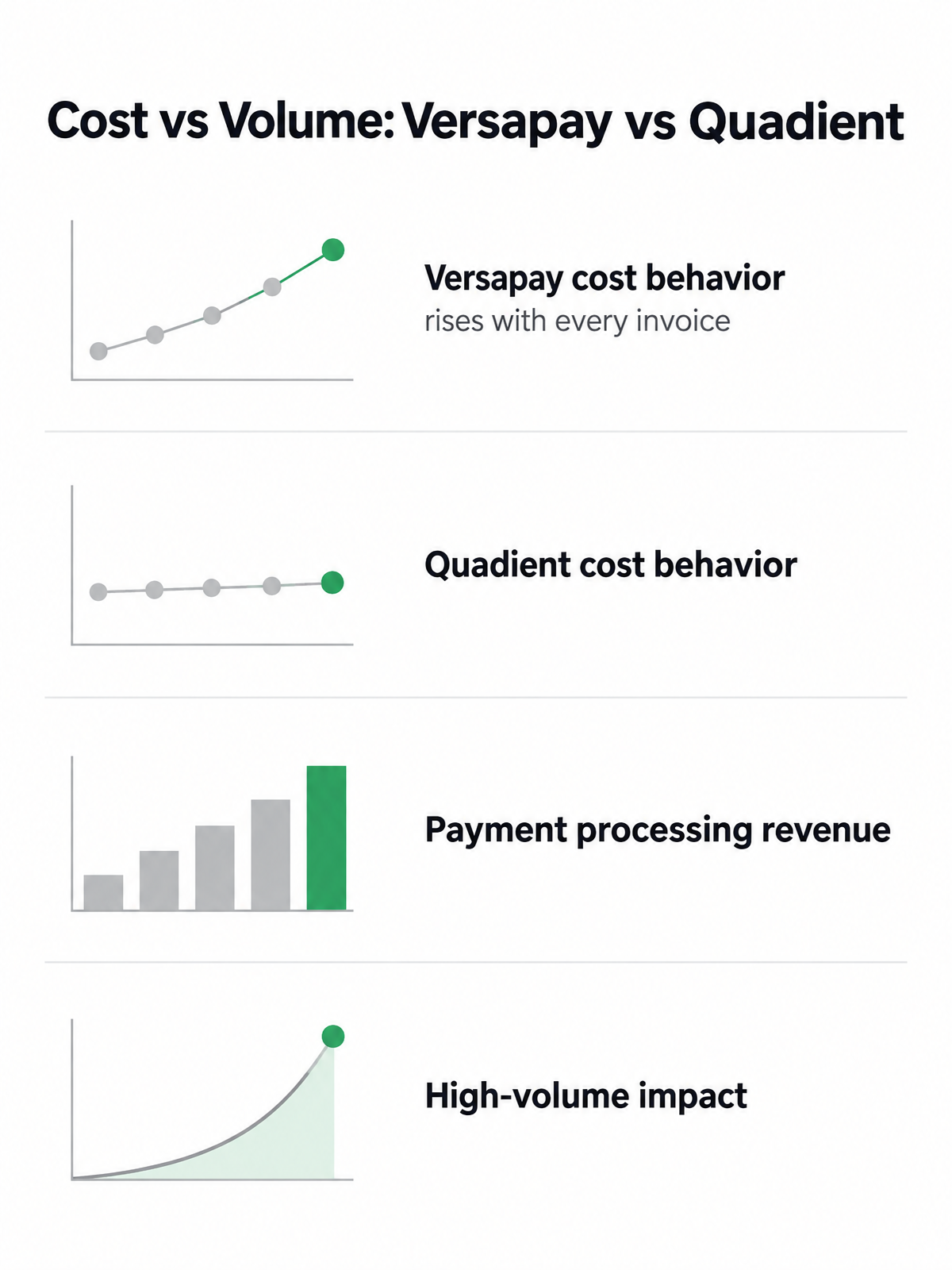
Available documentation suggests Versapay’s quote may be tied to invoice volume, while Quadient’s may track the modules you switch on. That decoupling matters. Add subscribers and Quadient’s cost may only move if you enable a new module; a volume-linked meter may climb with invoice activity.
There may be a second layer with Versapay many buyers miss. Vendor materials describe embedded B2B payment acceptance, so the platform may earn on funds flowing through its portal. One available review summary recommends checking what the platform earns on the payments moving through the portal before comparing it against a subscription-only rival.
Neither vendor publishes a figure, so treat any range you find as a rough band, not a quote. Your real number depends on volume and payment mix, and the only reliable way to size it is a live quote at your seat count.
| Cost factor | Quadient AR (by YayPay) | Versapay | Blixo |
|---|---|---|---|
| Cost driver | Modules enabled (stated) | Invoice volume + payments processed (verify) | Plan tier + team size (stated) |
| Scaling behavior | Appears flat until a module is added | May rise with invoice volume | Steps by tier, not per invoice (stated) |
| Payment-processing revenue | Not evidenced | Described as earning on funds through portal; confirm | Native recurring collection (stated) |
| Published list price | None (quote) | None (quote) | Public tiers, billed yearly; Enterprise quote (verify current tiers) |
What Hidden Costs Should You Price In?
Implementation, onboarding, and premium support tiers aren’t disclosed in the reviewed material for either product. That’s normal for enterprise AR tools, but it’s exactly where first-year budgets can surprise. Ask each vendor to itemize professional services and any SLA upgrade before you sign.
Watch the connector layer too. If an ERP connection depends on file exchange or custom API work, include the cost of mapping, testing, exception handling, and ongoing maintenance. Those costs may sit outside the subscription line item, but they still affect TCO.
Ask each for the all-in first-year cost at your seat count, as one number, and compare those. If you want the fuller side-by-side reasoning, our portal-led automation breakdown walks the same tradeoff.
Does Either Model Fit a Subscription Biller?
Skip the volume-priced model if your invoice count is high and your margins are thin; a dual meter may not reward thousands of small recurring charges. A feature-based approach may fit better there, but it still may not recover a failed card on its own.
That’s the gap. Blixo is described as pricing around plan tier and team size rather than per invoice, and its vendor materials describe retention-focused automation. Confirm every pricing claim in a live quote. Absence of a published price isn’t absence of a fair deal.
Implementation, Onboarding, & Support Comparison (with Final Verdict)
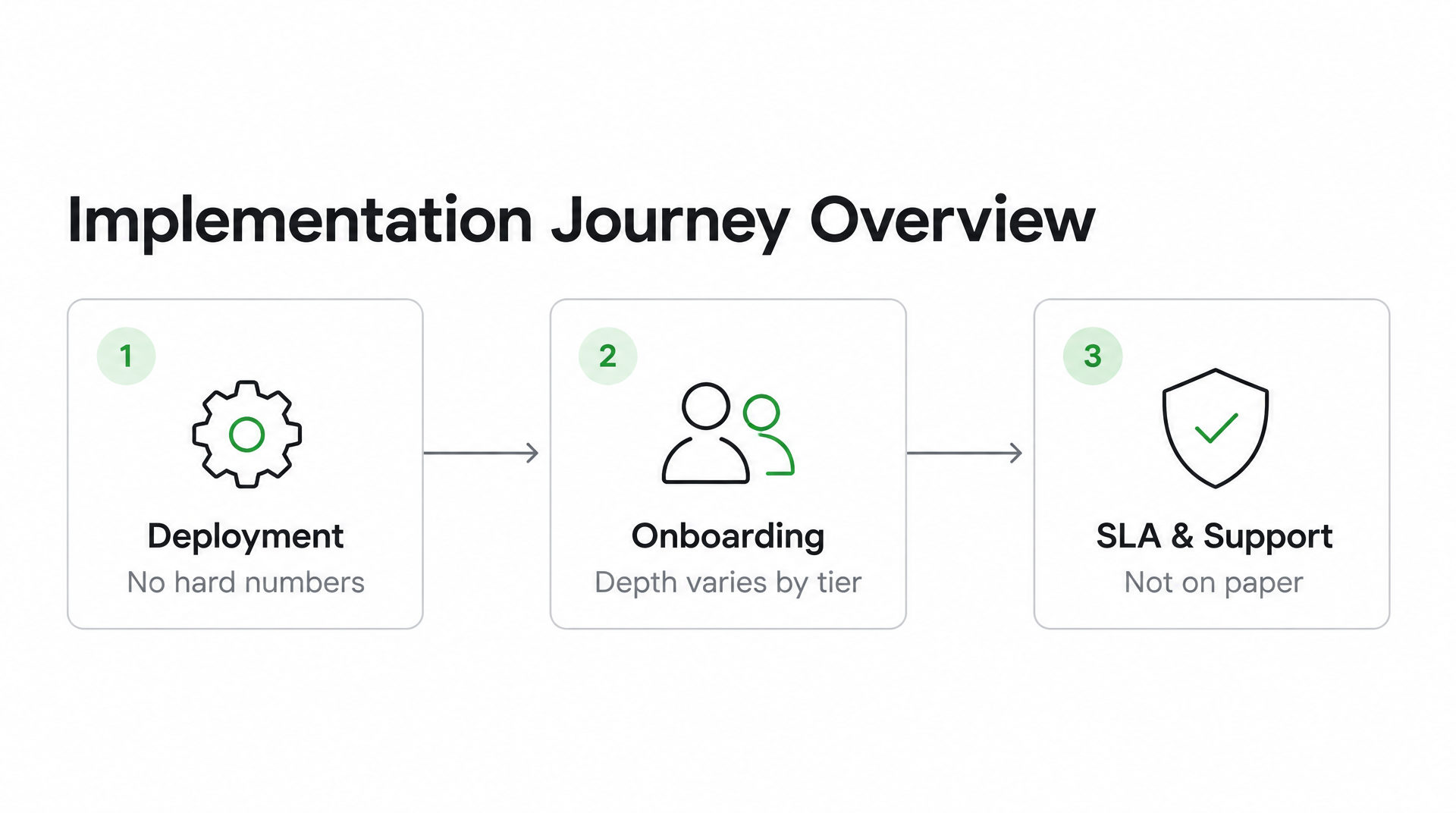
In short: on deployment speed, onboarding depth, and SLA guarantees, the honest answer is that neither vendor appears to publish hard numbers, so the Versapay decision can’t be settled on rollout timelines alone. Reviewed documentation covers features far better than it covers weeks-to-go-live. Judge each implementation by how it handles your recurring-billing motion, not by a promised launch date.
Public materials for both products describe cloud deployment, ERP-connected onboarding, and ongoing vendor support. What they don’t print is an average implementation window, a stated uptime percentage, or a published NPS. That doesn’t mean the support program is weak. It means you confirm those numbers in a live demo and get the SLA in writing before you sign.
What Should You Actually Verify Before You Sign?
Ask for a documented implementation timeframe in weeks, named against a customer with your ERP and your invoice volume. A logo on a slide isn’t a timeline.
Pin down onboarding specifics. Is there a dedicated success manager, migration tooling for open AR balances, and training resources for your collectors? Both vendors position themselves as full-service, but the depth may vary by contract tier, so make it contractual.
Then nail the SLA. Uptime target, support response times, and resolution commitments belong in the agreement, not in a sales conversation. If a vendor won’t put a number on paper, treat that as your answer.
How Do the Three Decision Dimensions Stack Up?
The verdict rides on three things a recurring biller feels every month: portal experience, collections automation, and integration depth. Here’s the shape of it, drawn from the feature matrices covered earlier.
| Dimension | Quadient AR | Versapay | Blixo |
|---|---|---|---|
| Portal experience | Credit/forecasting lean | Strong buyer-facing portal in public materials | Subscriber-facing billing portal (stated) |
| Collections automation | Rule-driven dunning in public materials | AI-driven prioritization in public materials | Recurring-first dunning + automated chasing (stated) |
| ERP integration | Broad back-office list in public materials | Certified payment connectors in public materials | Native billing + AR sync (stated) |
| Recurring-billing fit | Not evidenced end-to-end | Not evidenced end-to-end | Built for it (stated) |
Both are capable AR platforms, and each appears to own a lane in that table. Where they land the same is the bottom row. In public materials, neither documents a complete recurring-collections loop, and that’s the row a recurring biller lives in.
Your next move if you bill on subscriptions
For a mid-market firm that bills on subscriptions, my pick may still be the subscription-native option. Its vendor materials describe recurring invoices, automatic cash application, and automated chasing. That’s the collections work the two rivals may leave you to bolt on. If you want the reasoning behind comparing these tools without reading eighteen vendor pages, this breakdown lays it out.
One scope limit, stated plainly. If you’re an ultra-large enterprise needing deep on-prem customization or a specialized credit-scoring engine, Quadient AR still deserves a look. For everyone else invoicing on a recurring cycle, the all-in-one platform may be the cleaner fit. This verdict rests on published feature matrices, pricing-model descriptions, and third-party review summaries, so book a live demo and confirm it against your own billing profile before you commit.
Common Questions
If I run several ERPs after an acquisition, which platform handles that better?
A multi-ERP environment may push Quadient AR toward the front of the shortlist because its public documentation emphasizes more complex entity and currency structures. Versapay may still fit if your team values developer flexibility and can support more integration work internally. Either way, confirm your exact ERP versions with a reference customer.
Is Versapay’s Oracle Fusion Cloud connector the same as its NetSuite integration?
Not based on available public material. Versapay’s NetSuite link is described as a certified marketplace SuiteApp, while the Oracle Fusion Cloud connection is described differently. Treat them as separate implementation paths, and ask the vendor to show the data flow, error handling, and reconciliation process for your exact Oracle setup.
What does “not evidenced” actually mean in this comparison?
“Not evidenced” means the reviewed public documentation didn’t confirm a capability. It is not proof that the feature is missing. Use every unevidenced cell as a demo checklist item and ask the vendor to show the workflow live.
Which pricing model gets more expensive as I add subscribers?
If subscriber growth creates more invoices, a volume-linked model may become more sensitive to scale. Quadient AR’s feature-based subscription may behave differently because the commercial trigger appears tied to enabled functionality rather than every billing event.
What should I press vendors on about failed-payment recovery in a demo?
Ask them to show the complete recovery path from a declined recurring payment through customer outreach, retry handling, escalation, and collector follow-up. The important point is not whether the vendor has a collections module in general; it is whether that module is wired to the subscription failure event.
Is Quadient AR ever the better choice despite the recurring-billing gaps?
Yes. Quadient AR deserves a look if credit risk scoring, cash-flow forecasting, or complex enterprise AR operations top your priorities. Its documented strengths center on forecasting and credit workflows rather than buyer-facing portals.