

How to integrate accounts receivable cloud with HighRadius and payment gateways

What you’re actually wiring together
If you’re about to commit a sprint to this, understand the shape of the project first. An accounts receivable cloud integration with HighRadius and one or more gateways is really three layers under one roof: a subscription-billing module that already knows each renewal’s amount and date, HighRadius for cash application and collections, and the gateways (ACH, credit card, e-Pay) that actually move the money.
The payoff can be concrete. Some finance teams report significant cash posting automation gains after clearing ERP roadblocks, and platforms like HighRadius are designed for straight-through cash posting from multiple data sources. For renewal-heavy SaaS, that’s what keeps a failed charge from quietly becoming an involuntary cancellation.
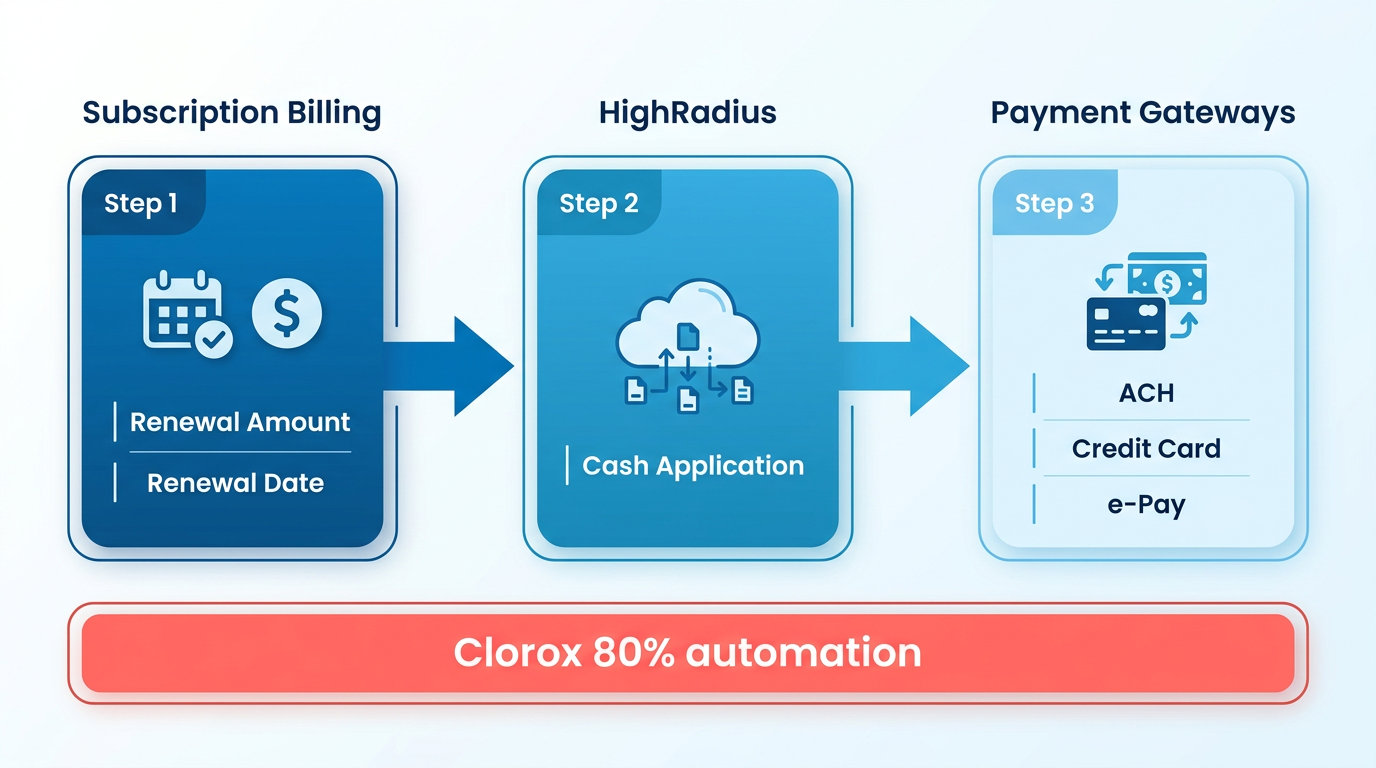
The end-to-end workflow at a glance
Integration means connecting billing data, HighRadius AR modules, and payment gateways so cash applies itself against the right invoice. HighRadius offers ERP and accounting connectors plus EIPP support, so much of the plumbing is configuration, not custom code.
| Step | Owner |
|---|---|
| Provision sandbox + API keys, whitelist IPs | DevOps |
| Map billing data to HighRadius (bi-directional sync) | DevOps + Finance |
| Connect payment gateways (ACH, credit-card, e-Pay) | DevOps |
| Pre-register renewals as expected remittances | Finance |
| Configure dunning + predictive collections rules | Finance |
| Reconciliation validation in sandbox, then go-live | Finance + DevOps |
Native connectors matter here. Credit-card and ACH flows through HighRadius EIPP are usually configuration rather than custom code. Niche regional e-Pay methods may need extra mapping. Confirm gateway coverage before you scope the work.
Two milestones, not one
Go live is not the same as fully reconciling. HighRadius positions its ERP-agnostic platform for relatively quick deployment, but the timeline depends on scope. Standing up one connector is one milestone. Getting the full cash-application and dunning stack clean is another, and the second one decides whether the investment pays off. For planning purposes, a single connector may be configured in weeks; a full multi-module rollout across ERPs and gateways can take months depending on the environment.
The no-remittance matching rule is the piece that matters: configure it so a payment counts as matched only when amount and date both line up. Subscription renewals already have both values in advance. Pre-register each renewal as an expected remittance and match rates lift well past what manual AR ever reaches.
Compliance and prerequisites
Any project moving cardholder data crosses PCI-DSS scope. Enterprise AR buyers will ask for SOC-2 evidence during procurement. Bake both checkpoints into the plan now, not at go-live.
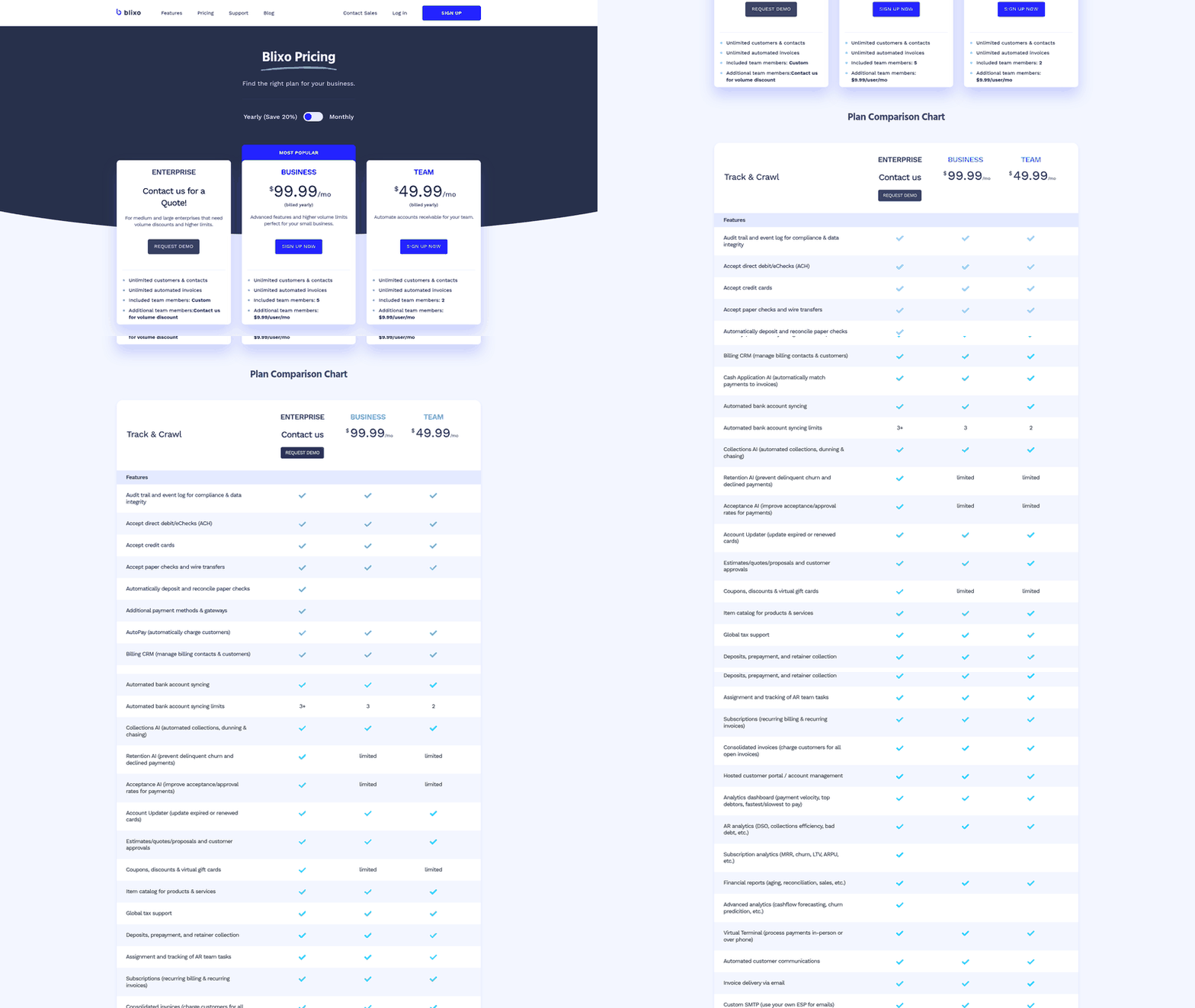
Before you start, line up:
- Network whitelisting for API-over-HTTPS and SFTP batch transfers
- A test set of live-like renewal invoices for reconciliation validation
- PCI-DSS scoping and SOC-2 documentation for finance and security sign-off
One scope note: HighRadius’s full integrated-receivables stack is aimed at enterprises running multiple ERPs. If your AR is simple and volume is low, a lighter subscription-billing layer sitting in front of HighRadius will serve you better than adopting the whole enterprise footprint on day one.
What to put in the kickoff note
- Integration plumbing, not model accuracy or workflow design, is the usual stall point in AR automation projects.
- Cash posting automation succeeds after ERP roadblocks are gone, not before.
- HighRadius turns much of the plumbing into configuration through ERP and accounting connectors plus EIPP support.
- Subscription renewals already carry the amount and billing date that HighRadius’s remittance validation wants, which lifts auto-match rates.
- The full integrated-receivables stack is enterprise territory. A lighter subscription-billing layer in front of it fits lean AR teams better.
- PCI-DSS scoping and SOC-2 documentation need to be in the first plan, not a go-live surprise.
Why the plumbing decides the outcome
The thing most likely to sink an accounts receivable cloud integration with HighRadius and your gateways isn’t the AI. It’s getting systems to talk to each other. Across AR automation work, the integration layer is often a bigger obstacle than accuracy concerns or workflow design.
That should dictate build order. Prove the billing-to-HighRadius data connection before you enable predictive collections or automated dunning. Turn on the smart features first and you’re stacking machine learning on a shaky base.
Integration, not feature breadth, decides whether this works
The AR software market is crowded. Enterprises keep adding modules. The differentiation rarely comes from another dashboard or a new predictive score. It comes from whether the systems exchange data without a human rekeying it.
HighRadius’s connector coverage makes that realistic. But the parts still have to be mapped to your billing feed and your gateways. That mapping work, not the platform’s feature list, determines whether cash posts straight through or sits in a review queue.
Renewal cash is the easiest to auto-apply
Subscription renewals hand over two values before a charge ever runs: a known amount and a known billing date. Pre-register each renewal as an expected remittance and the downstream matching engine has exactly what it needs. Straight-through posting on that kind of clean data beats anything manual reconciliation can do.
The gateway side closes the loop. ACH, card, and e-Pay options feed real-time payment data back. A successful renewal charge lines up with what was expected without someone touching it. Automated match rates on predictable flows climb far above the numbers you get from messy, ad hoc payments.
Match the stack to your actual size
HighRadius earns its reputation in complex, multi-ERP receivables. Reviewers also note that it can be more comprehensive than a small team with simple AR needs, and less flexible for lean setups.
Both things are true. The breadth that helps a global finance org is dead weight for a ten-person SaaS company. Don’t take the full enterprise order-to-cash suite just to solve renewal reconciliation. Put a light subscription-billing layer in front of HighRadius, let it own renewal logic and recurring invoicing, and route only what genuinely needs the AI engine downstream.
For renewal-heavy SaaS, that’s the difference between a failed charge quietly becoming a cancellation and a system that catches it, retries, and applies the cash before anyone notices.
Setting up the environment before you code
Most delays in an accounts receivable cloud integration with HighRadius and gateways come from access and alignment work, not code. Get the prerequisites done in week one.
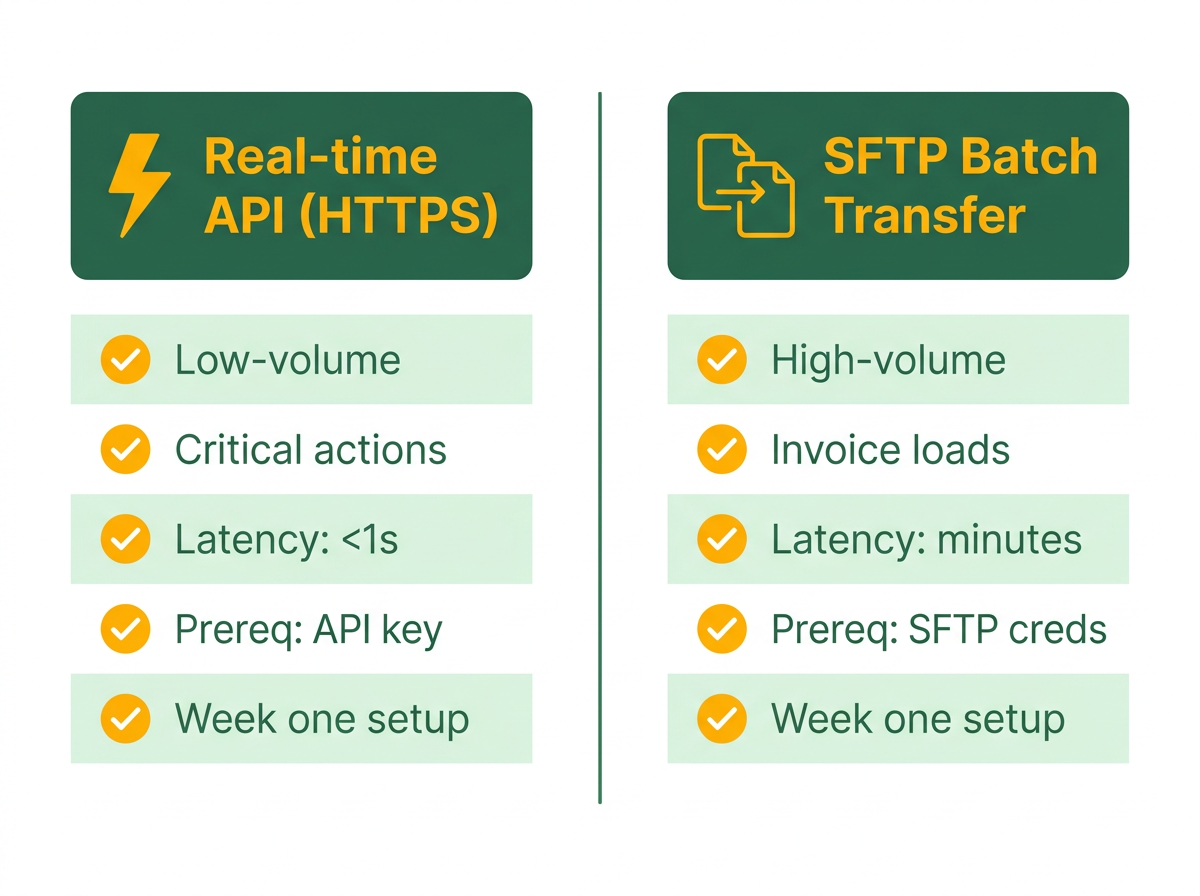
Platforms like HighRadius can be configured to exchange data two ways: real-time APIs over HTTPS for low-volume, critical actions, and SFTP batch transfers for high-volume loads like invoices and customer master data. Decide which path each data type takes before provisioning anything.
Authentication gates every sandbox test, so sort it out early. Pull the official auth methods for both your billing module and HighRadius. Confirm whether each endpoint expects OAuth2 tokens, API keys, or signed JWTs. Store the secrets in a vault your integration engineer controls. Payment APIs lean on strict authentication protocols to keep financial data safe in transit, so treat PCI-DSS scope as a design input, not a cleanup task.
Data model alignment before sandbox testing
Data mapping is where quiet failures start. Many AR platforms offer connectors for ERP systems such as SAP, NetSuite, and Workday, but a subscription-billing feed is not a standard ERP export. You own the field mapping.
Build a mapping table that pairs each billing field with its target: invoice number, currency, payment terms, customer metadata on one side, the AR cloud’s expected schema on the other. Invoice-number formats and multi-currency handling break more integrations than anything else. Lock those conventions down and test them against a sandbox before production.
The detail that matters most: cash-application platforms like HighRadius can be configured to count a payment commitment as valid only when both amount and date match the promised values. Subscription renewals already carry both. If your billing export pre-registers each renewal’s amount and billing date as an expected remittance, you feed the matching engine exactly what it needs to post cash without a human. That mechanism is what makes renewal reconciliation touchless.
Who owns the rollout?
An integration this cross-functional stalls without clear roles. Name three owners up front: a product owner who holds scope, an integration engineer who owns connectors and auth, and a finance lead who signs off on cash-application accuracy.
The finance lead matters most. HighRadius’s AR modules span cash application, collections, credit, deductions, and EIPP. That breadth is an asset for a global enterprise and a liability for a lean SaaS team.
Don’t stand up every module at once. Scope the first phase to cash application driven by your renewal feed. Prove the data connection holds, then decide whether collections or deductions earn their place. A lighter billing layer in front of HighRadius keeps your team out of enterprise complexity you don’t need yet.
Dunning, payment links, and the portal that saves you
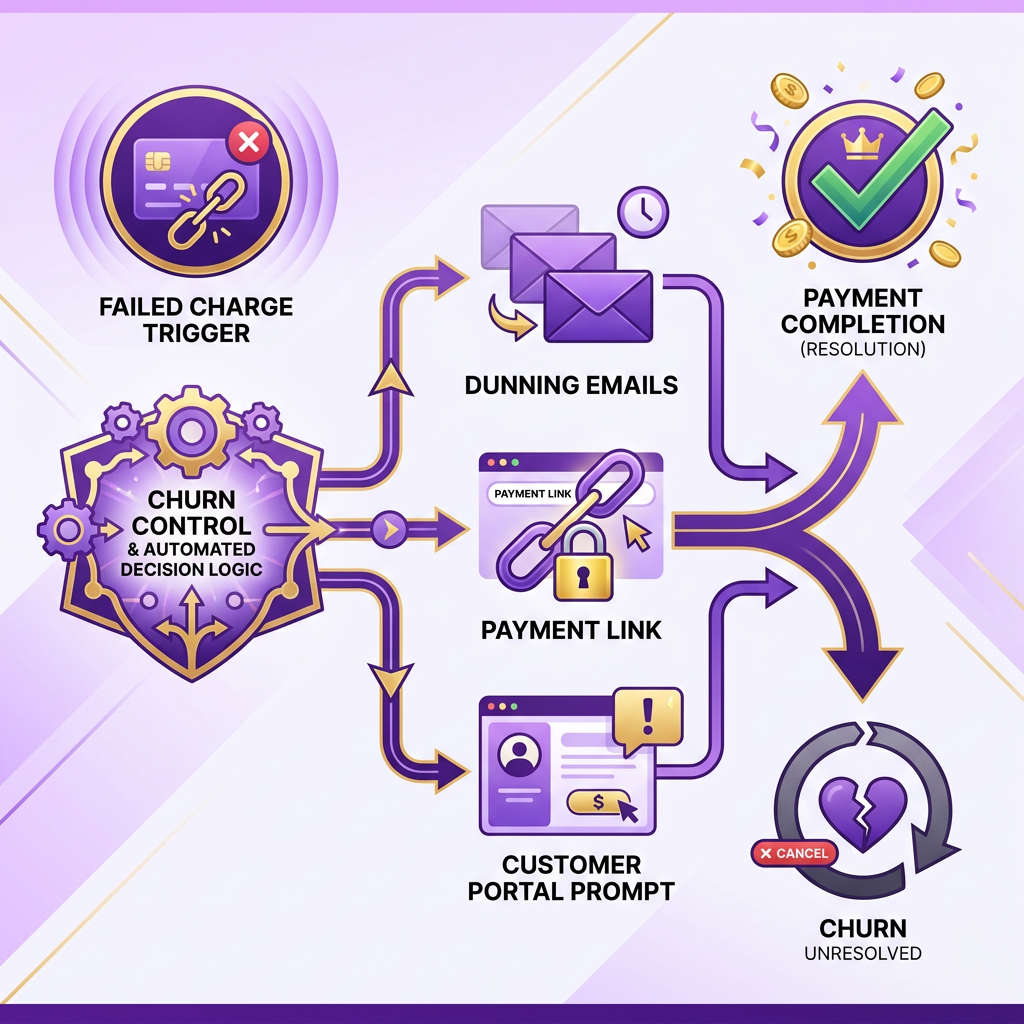
The moment a renewal charge fails, a clock starts. Your dunning layer decides whether it becomes a paid invoice by Friday or a quiet cancellation. Founders underrate this part because it feels like email plumbing. It’s churn control.
Automated collections tooling prioritizes accounts that need attention, not just the oldest invoices. For subscription revenue, that changes the job: you’re not chasing aged debt, you’re intervening on at-risk renewals before a soft decline turns into an involuntary churn event.
Every reminder needs a payment path
A dunning email without a pay path is a nudge. A dunning email with a live payment link is a transaction waiting to happen. Automate the reminders through whatever channel actually reaches the customer: email, text, phone, letter. Consistency matters more than volume.
The self-service portal does the same job for people who want context first. Customers can view outstanding invoices, pay them, batch-pay everything in one go, manage preferred payment methods, and download invoices, statements, and receipts. That transparency reduces follow-up burden on your collectors.
Then route every payment back through cash application so the ledger clears itself. A link that collects money but leaves a human to reconcile it defeats the whole point.
Cadence beats volume, but volume still matters
Automated outreach can materially increase collection email volume. That throughput only helps if the sequence is tuned, not blasted.
Stage cadence by invoice signal, not a fixed calendar. Friendly reminder before the due date. Firmer follow-up a few days past. Escalating tone as the balance ages. Segment content too: a high-value renewal from a long-tenured account needs a different message than a small first-cycle charge.
The payoff often shows up as fewer past dues and higher collector productivity. Your ERP’s native aging report won’t track either one.
Don’t automate a broken message
Skip aggressive escalation on accounts a predictive model flags as likely to self-cure. A stern third notice to a customer whose renewal will clear on retry burns goodwill for no reason. Let the scoring decide who needs a human, and let automated reminders do the quiet work for everyone else.
If your billing volume is low enough that one person can read every failed charge by hand, hold off on the full sequence engine. Cadence automation earns its keep once renewals outrun your ability to watch them one at a time. For most growing SaaS teams that crossover arrives faster than expected, and a working AR automation stack should be in place before churn shows up.

Monitoring, reporting, and tuning what you built
Decide what “healthy” looks like before go-live. Once the integration is live, the systems will produce numbers. Whether those numbers mean anything depends on the KPIs you choose now.
Your ERP gives you static aging reports and little else. It won’t tell you if DSO is falling, whether automation is saving hours, or whether a renewal cohort is quietly slipping into arrears. That gap is why the integration has to surface operational metrics your accounting system was never built to track.

Match rate is the health signal that matters
For subscription revenue, cash-application match rate tells you more than any other metric. It’s the percentage of incoming payments that auto-apply to the right invoice without a human touching them. An intelligent matching engine can work at the envelope and item level from multiple sources, paired with an approval workflow so the system keeps learning as you correct it. The payoff is fewer receivables slipping past due and less manual reconciliation.
Watch this weekly. A sudden dip usually means a gateway changed its remittance format or a new plan SKU broke your matching rules. Catching that on a dashboard beats discovering it three weeks later in a reconciliation backlog.
Pair the HighRadius view with your billing module’s renewal report. The HighRadius view tells you what posted; subscription data tells you what was owed. Reconciling the two automatically closes the loop between a charge and a confirmed renewal.
Alerts should fire on renewals, not just on aging
Dashboards are passive. Alerts wake people up. Configure triggers for three events that threaten recurring revenue: a failed gateway charge, an invoice flagged high-risk by collections scoring, and any account crossing an SLA threshold you set for dispute resolution.
Routing matters. A soft card decline on a $99 monthly plan doesn’t need a phone call. A failed ACH pull on an annual enterprise renewal does. Wire alert severity to contract value and renewal proximity so your team spends attention where churn risk is highest.
Test the dunning layer instead of setting it and forgetting it
Treat recovery sequences as something you tune, not something you finish. A/B test the two levers that move recovery rates: the subject line of the failed-payment email and where the payment link sits in the message. Send half your soft declines one variant, half the other, and let the recovery data tell you which worked faster.
Small wins compound. A subject line that lifts open rates by a few points across thousands of monthly renewals is real money kept. Review results quarterly, promote the winner, start a new test. That habit turns a working integration into one that keeps improving.
Troubleshooting the failures that actually happen
Most integration problems fall into three buckets: data that won’t match, connections that time out, and versions that drift. The fix is rarely custom engineering. In an accounts receivable cloud integration with HighRadius and gateways, mapping and configuration resolve more incidents than code.
The instinct to write a bespoke handler for every edge case is what turns a two-week wire-up into a two-quarter project. Don’t.
Invoice IDs that don’t match
Mismatched invoice numbers between your billing module and HighRadius are common. A renewal charge lands, but the cash-application engine can’t tie it to the right open invoice, so it drops into a review queue instead of posting.
Before you assume a bug, check the field mapping. The two systems often format the same ID differently, or one strips a prefix the other keeps. Fix the mapping and match rate recovers without touching application logic.
For genuine no-remittance situations, platforms like HighRadius can support collector-keyed capture inside an integrated portal. That human-in-the-loop step is the intended path for residual payments automation can’t resolve. Route those to a person instead of engineering around them.
Gateway latency and timeouts
Payment-gateway APIs throttle under load, and renewal runs create load. Fire a batch of charges at once and you’ll see timeouts and rate-limit responses that look like failures but are really the gateway asking you to slow down.
Two mitigations work. First, respect the gateway’s rate limits by spacing calls rather than blasting them. Second, treat any timeout as unknown, not failed. Query transaction status before retrying so you never double-charge a customer whose payment actually went through.
Platforms like HighRadius can be configured to use real-time APIs over HTTPS for critical, low-volume actions and SFTP batch transfers for high-volume loads. Match the transport to the job. Sending a renewal batch through a real-time endpoint built for single lookups is a self-inflicted timeout.
Keeping the integration healthy over time
The failure mode that sinks live integrations is silent drift. An API version deprecates, a webhook stops firing, and nobody notices until a reconciliation report looks wrong. A few routines prevent that.
- Run a daily reconciliation job. Compare posted cash against what your billing module expected. A widening gap surfaces problems before a customer does.
- Validate webhooks, don’t trust them. Verify signatures on inbound events and log every one. A missed renewal notification is a quiet churn event waiting to happen.
- Track deprecation notices. When a provider announces a version sunset, pin your calls to a supported version and migrate on your schedule, not theirs. Test the new version in a sandbox before cutover.
Durability comes from monitoring and configuration discipline, not clever code. Keep the plumbing observable, treat exceptions as human-review work rather than engineering tickets, and the integration keeps paying renewals into your account instead of your queue.
Common Questions
Do I need to adopt the entire HighRadius integrated-receivables stack before seeing cash application benefits?
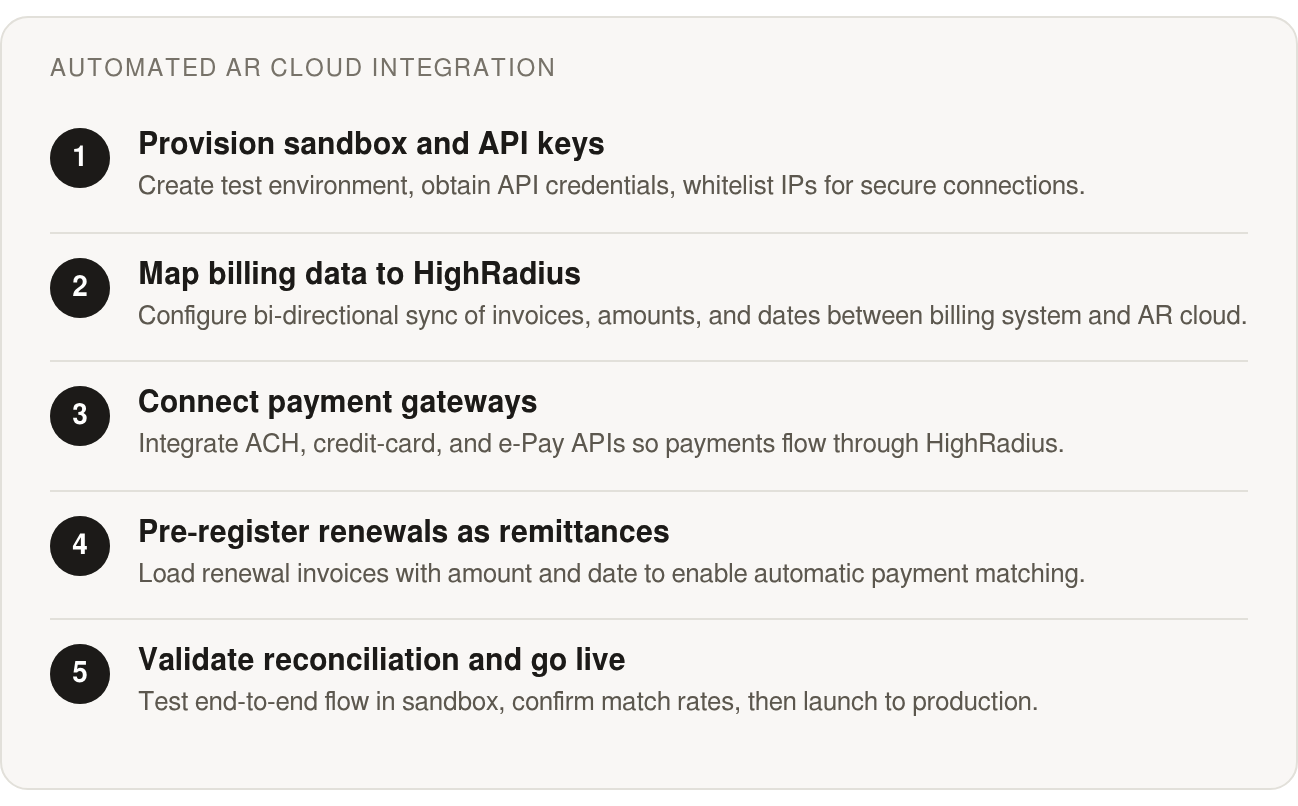
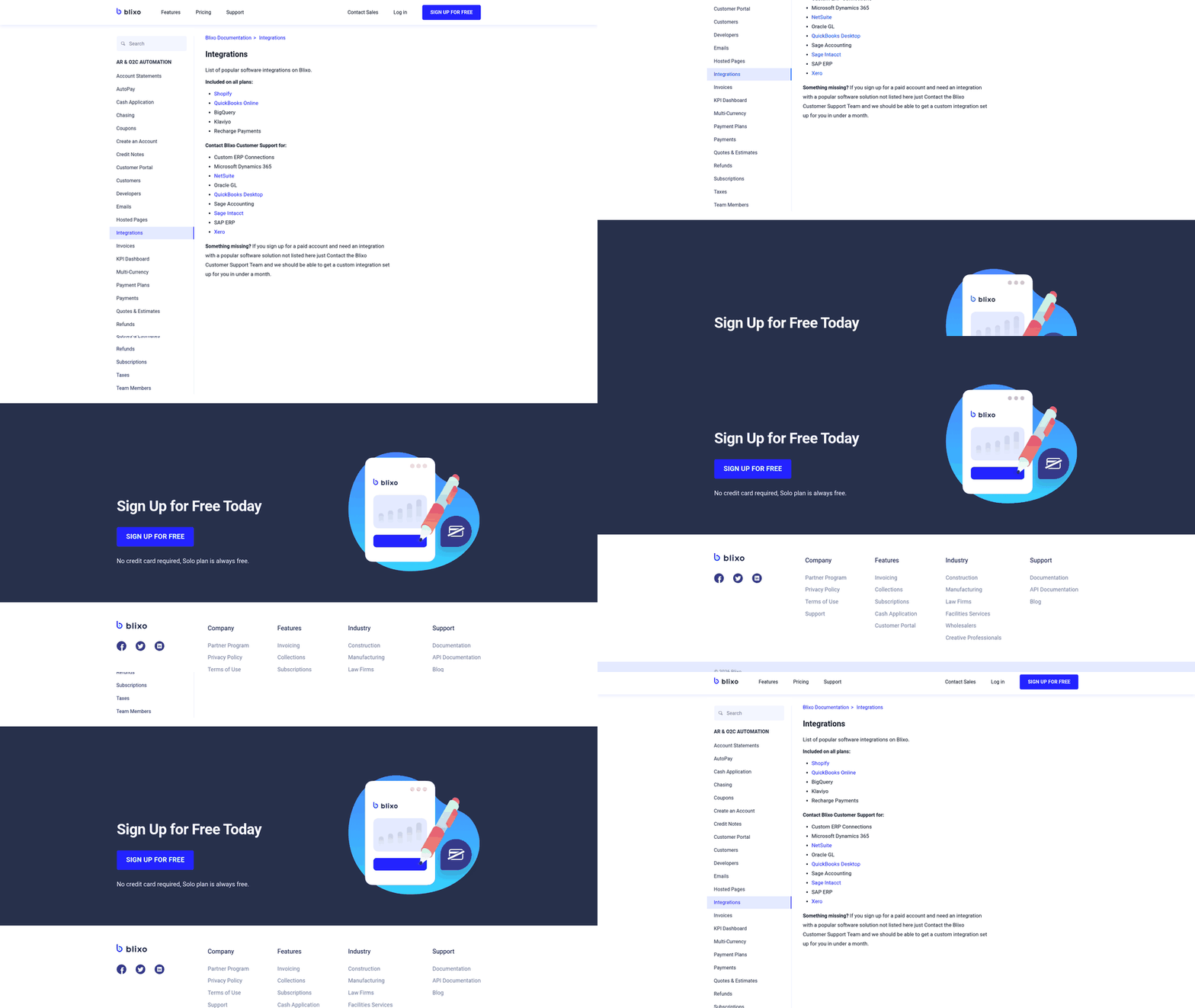
You do not need the entire enterprise stack to capture the core benefit. Start with only the cash application module driven by a subscription-billing renewal feed. A lighter billing layer such as Blixo in front of HighRadius can own recurring invoices and expected remittance dates, routing only unmatched or complex items downstream. That keeps a lean SaaS team out of enterprise-grade complexity until volume justifies more modules.
Which payment gateway types should I confirm before committing to native connectors?
Credit-card and ACH flows through HighRadius EIPP are usually configuration rather than custom code. Niche regional e-Pay methods often need extra field mapping or may not have native coverage, which changes scope and timeline. Confirm gateway support and PCI-DSS scoping for any cardholder data before signing off on the integration plan.
At what point should a lean team turn on automated dunning sequences?
Hold off on full sequence automation while one person can still read every failed charge by hand. The cadence engine earns its keep when renewal volume outpaces manual review, because it can segment by invoice signal and let predictive scoring suppress aggressive reminders for accounts likely to self-cure. Until then, route failed charges through a simple manual or semi-automated follow-up.
How do I distinguish a gateway timeout from a true payment failure during renewal batches?
Treat every timeout as an unknown outcome, not a failure. Query the gateway for the transaction’s actual status before retrying, because a failed response may actually mean the charge settled but the acknowledgement was lost. Also space renewal batch calls to respect rate limits, and avoid sending high-volume batches through a real-time endpoint designed for single lookups.