

Credit Note vs Credit Memo: Which One Fixes Reconciliation Faster

The Short Version
Credit notes and credit memos are one document with two regional labels. “Credit note” dominates across the UK and EMEA. A refund is a different animal: it sends cash back through a separate payment transaction, while a credit changes the customer’s balance and leaves the original invoice intact. Reconciliation isn’t done when the credit is created. It’s done when the credit is matched to the receivable it corrects. Issuing credits barely moves DSO, because receivables and net credit sales drop together; the aging report shows the real effect. Automatic application depends on capturing the invoice reference and reason at creation. And posted invoices, including subscription invoices already sent, need a separate credit document rather than an edit.
Same Document, Different Label: Focus on the Data Instead
A credit note and a credit memo are the same accounting document. “Credit note” is the common term in the UK and across EMEA; “credit memo” shows up more widely elsewhere. Which word your team uses has zero effect on how fast things reconcile. The quality of the reference data and the application process decides that.
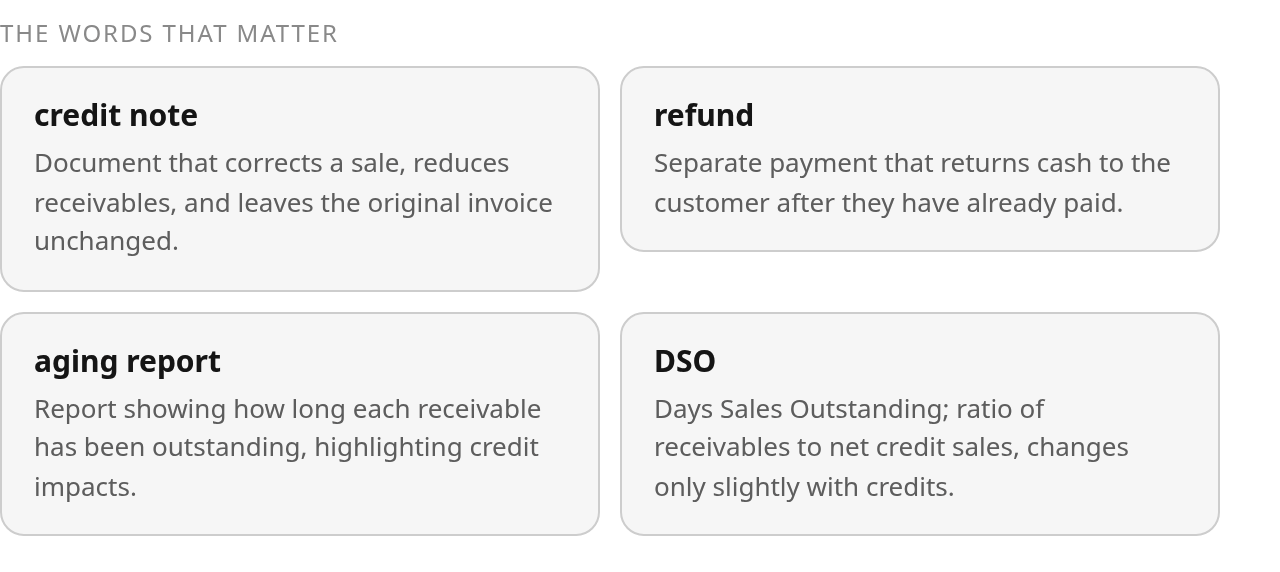
My advice is simple: stop debating the label and audit what goes into the document. A credit records a correction against an existing sale and keeps the original invoice available for audit review. A refund belongs to the payment process. You use it when money has to leave the business.
Credit Note, Credit Memo, and Refund Side by Side
| Document | Typical use case | Accounting effect | Application workflow |
|---|---|---|---|
| Credit note | Returns, pricing errors, resolved disputes, scope changes | Reduces receivables and net revenue; tax reduced proportionally | Applied to a referenced invoice, held on account, or refunded |
| Credit memo | Same triggers, different regional label | Identical to a credit note | Identical to a credit note |
| Refund | Customer already paid and wants money back | Cash leaves your account | Processed as a payment, ideally backed by a credit memo |
Time-to-Apply Is What Actually Closes the Receivable
The finish line is the invoice match. A credit created on day one but parked in an unapplied queue doesn’t close the disputed receivable. A valid credit dropped onto the wrong invoice is arguably worse: the customer’s balance looks settled while the original dispute stays open.
At minimum, the record should carry the original invoice number, the credit amount, a separately identified tax adjustment, and a precise explanation. If the original sale included tax, the reversal should match the portion being credited.
Automation only helps when those relationships are captured consistently. Recurring invoices give a credit a predictable place to land, but how any platform actually handles this should be verified in a live demo, not assumed from marketing pages. For day-to-day usage, Blixo’s guide to credit notes goes deeper.
What a Misapplied Credit Does to Your AR
A credit note sitting against the wrong invoice creates a misleading receivable. Your collections team keeps chasing a balance that should already be lower. Your customer opens their statement and sees numbers that don’t match what you agreed on the phone. The longer that mismatch sits, the more likely it turns into extra manual work for everyone.
So the document has two jobs. It records the commercial correction, and it gives AR enough information to put that correction in the right place. Issue it without applying it and you’ve done half the job.
What Does an Unapplied Credit Note Do to Your Aging?
Take a common B2B case. A distributor bills one price, then confirms the customer qualifies for a lower contract price. The difference is owed back as a credit. Until that credit is issued and applied, the full invoice sits in aging as if every dollar were collectible. It never was.
| Metric | Before issuing credits | After issuing credits |
|---|---|---|
| Total AR | Overstated by the disputed amount | Reflects what’s actually owed |
| Over 60 days past due | Inflated by disputed invoices | Drops by the credited amount |
| DSO | Barely different | Barely different |
DSO moves only slightly. Here’s the reasoning: the adjustment reduces receivables and net credit sales at the same time, so the ratio absorbs most of the change. The aging report tells the clearer story, because the oldest bucket shrinks by exactly the amount that was genuinely disputed. Watch both. A flat DSO can hide a pile of unresolved credits.
Why Does Structure Matter More Than the Name?
A sparse credit document sends someone digging through emails, orders, and customer statements to reconstruct what happened. Two required fields head off most of that: the original invoice number and a specific reason. “Adjustment” as a reason helps nobody during a later review or exception workflow.
Require both fields before approval, not after the document hits the ledger. That moves the quality check to the moment the correction is created, which is the only moment anyone still remembers the details.
Credit Note vs Credit Memo: Terminology and the Differences That Count
“Memorandum” and “note” describe the same record here. The distinction worth your attention isn’t between the two labels. It’s between a credit and the other transactions that touch a customer account.
Credit memo: a corrective document that lowers an existing receivable and references the original invoice, which stays on the books unchanged.
A Credit Note Corrects a Posted Invoice
A posted invoice reflects what was delivered and billed at that point in time. If the deal changes later, the correction gets recorded separately so the original entry stays available for audit. An unpaid status doesn’t, on its own, make a posted invoice editable.
This trips up recurring billing teams most. Every subscription invoice already sent to the customer is an issued record. A later correction needs its own document.
| Trigger | Example | Where the credit lands |
|---|---|---|
| Damaged goods | Some units arrive with broken packaging | Original invoice, for those units only |
| Retroactive rebate | Buyer reaches an annual spend tier | Invoices in the qualifying period, or the next invoice |
| Post-sale price change | A promotion starts days after purchase | Original invoice balance |
| Tax correction | $200 credit on an 8% taxed sale | Same document carries a $16 tax reversal |
The rebate is the easiest one to miss. No customer files a dispute to prompt it, so it can sit unnoticed until quarter-end close.
Refunds Move Cash; Credits Move Balances
A credit changes the amount outstanding or creates a balance for a future charge. A refund handles cash after payment has already landed. Which one you use depends on where the customer’s account stands, not on what the adjustment is called.
UK sellers have timing rules on top of that. HMRC sets expectations for when a credit note should be issued after a decrease in consideration, and the specifics should be checked against current HMRC guidance. The relevant date is typically tied to when you refund the customer or offset the credit against what they owe, so it makes sense to issue and apply the credit in the same step.
How the Right Document Speeds Up Cash Application
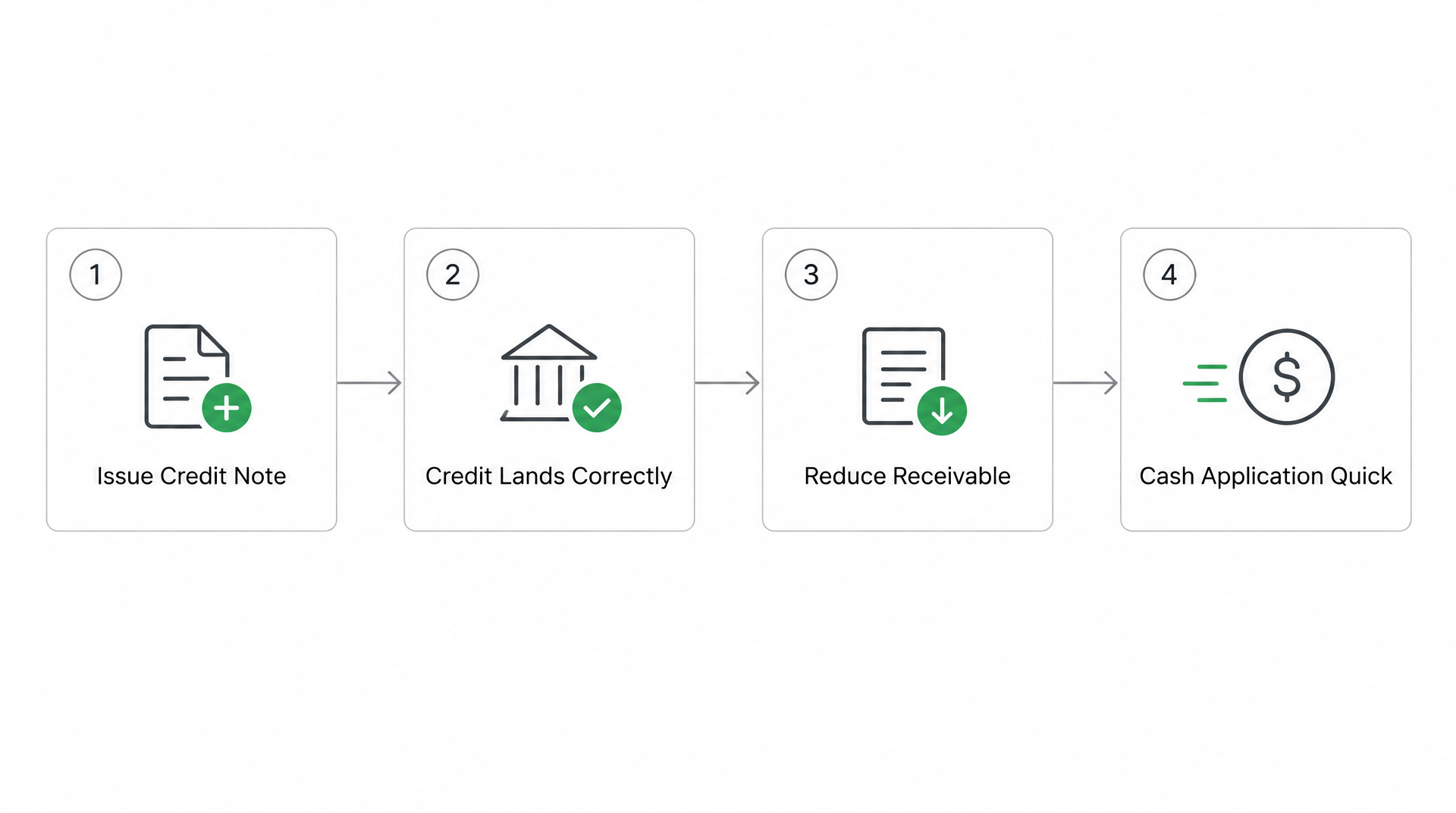
Cash application gets faster when the adjustment carries enough information for matching to find its destination right away. No regional label can make up for a missing reference or a fuzzy amount.
Treat the credit, its application, and any later payment as connected stages of one account process. They aren’t three unrelated transactions.
What Does a Credit Note Need to Apply Cleanly?
| Field | Why it matters | What breaks without it |
|---|---|---|
| Related invoice number | Tells your team which receivable to reduce | The credit floats or lands on the wrong invoice |
| Credit amount | Sets the exact reduction | Partial matches leave stray balances |
| Customer balance | Confirms the net amount still owed | Collectors chase money that’s already credited |
| Proportional tax | Keeps tax aligned with the reduced sale | Tax stays on the books for revenue that no longer exists |
One caveat. Public research doesn’t quantify how much faster structured credits match, and it doesn’t include accounting-body guidelines on formatting credits for automation. Read this table as practical workflow guidance, not a published standard.
What Does a Working Application Workflow Look Like?
The sequence is short. Create the document, identify its receivable, apply it to the original or a later invoice, then verify the resulting balance. Don’t skip that last step. A successful posting doesn’t necessarily mean the intended invoice was the one reduced.
Exceptions need an owner. Any unapplied balance should land in a queue with a named person deciding whether to match it, carry it forward, or arrange a payment. Recurring billing makes future allocation easier because you know the next charge is coming, but that control still needs testing.
If you’re evaluating Blixo or any AR platform for this, test the behavior in a live demo. A feature missing from public materials isn’t proof the feature doesn’t exist.
The Bottom Line on Getting Credit Memos Right
Most avoidable errors start at entry. No approval chain, however thorough, can reconstruct an invoice reference, tax treatment, or business reason that was never recorded.
Build your intake form around the transaction being corrected. It should capture the related invoice, credit amount, specific reason, and applicable tax treatment. That gives reviewers something concrete to check before the entry ever reaches AR.
Tax Follows the Credit Note Proportionally
If the original invoice carried sales tax, the credit has to reverse its share. A partial credit on a taxed sale needs a proportional tax reduction on the same document. Leave it off and your receivable and your tax liability stop agreeing.
Reason fields deserve the same care. “Price adjustment” tells an auditor nothing six months later. Write the actual cause, so whoever reviews the credit understands it without tracking down the person who issued it.
Applied Credits and Refunds Do Different Jobs
| Option | What it does | Use it when |
|---|---|---|
| Applied credit | Reduces an open receivable or carries to a later invoice | The customer still owes you, or will be billed again |
| Refund | Sends cash back as a separate payment transaction | The customer has paid and expects money returned |
Routing approvals by size and risk keeps control without slowing small fixes. A tiered setup tends to work well. As an illustration, a minor pricing correction might need only a lightweight sign-off, while a larger adjustment tied to a disputed contract term goes to a senior finance reviewer. Resist adding approval layers for routine small corrections. They add delay without catching the intake errors that actually break reconciliation.
One limit, stated plainly. The research behind this article doesn’t establish Blixo’s credit ingestion workflow, its required fields, how it compares with legacy AR systems, or any reconciliation-time results. Public materials suggest an approval workflow exists within Blixo’s cash application matching, but how that extends to credits should be verified in a live demo. Absence of evidence here isn’t absence of a feature. Your next step: bring two or three of your messiest real credit scenarios (a partial taxed credit, a retroactive rebate, a credit on a sent subscription invoice) to that demo and watch where each one lands.
FAQ
Can you edit an unpaid invoice instead of issuing a credit note?
Only while the invoice remains an unposted draft. After posting, preserve the original record and document the correction separately. This is especially relevant to recurring billing, where an invoice already delivered to the customer should not be silently rewritten.
If a customer already paid, do you need both a credit memo and a refund?
The two records address different parts of the account. The credit establishes the commercial adjustment; the refund records the movement of money back to the customer. Whether both are required depends on the accounting workflow and the outcome agreed with the customer, but the payment should be traceable to the underlying adjustment.
What happens to a credit note when the customer has no open invoice to apply it to?
It can remain as a customer balance for a later charge, subject to the business’s account policy. The team should monitor that balance rather than letting it disappear into a general unapplied queue. If the customer is entitled to cash instead, the appropriate payment process can be considered.
Why didn’t DSO improve after you cleared a batch of disputed credits?
DSO is a broad ratio and may not show the operational improvement clearly when the credit also reduces the sales base used in the calculation. Compare it with invoice-level aging and the value of open disputes. Those views indicate whether collectible balances, rather than only the ratio, have been corrected.