

AR CSV Integration vs Contract-Aware Sync: Why SaaS Finance Teams Are Leaving Generic Imports Behind

Key Takeaways
In short: CSV imports are fine for flat pricing. Once signed contracts start driving variable invoices, contract-aware sync is the better bet. The numbers and mechanics:
- B2B invoices take an average of 61 days to collect. That number grows when contract terms, usage data, and payment matching live in separate systems.
- A CSV export captures invoice data at one moment. Mid-cycle amendments to discount tiers or usage credits mean someone has to re-export and reconcile by hand.
- Contract-aware platforms pull billing rules, usage commitments, and payment terms straight from signed agreements, then update downstream invoices automatically when an amendment lands.
- Usage-based, hybrid subscription, and milestone billing all produce disputes when invoices drift from negotiated terms. A CSV import can’t detect that drift.
- CSV setup is usually faster. Initial contract ingestion can take longer, though modern tools can complete usage-based adoption in under 30 days.
- CSV workload rises in step with invoice volume. Contract-aware automation absorbs higher volume without a matching jump in finance headcount.
- Tabs has public documentation confirming automated contract term extraction. Blixo’s equivalent capability isn’t confirmed in public materials and should be checked in a live demo.
The Short Version
AR CSV integration tends to break down the moment your billing moves past fixed subscriptions. Collection cycles stretch when the contract, the usage data, and the payment match each sit in their own system with no shared context.
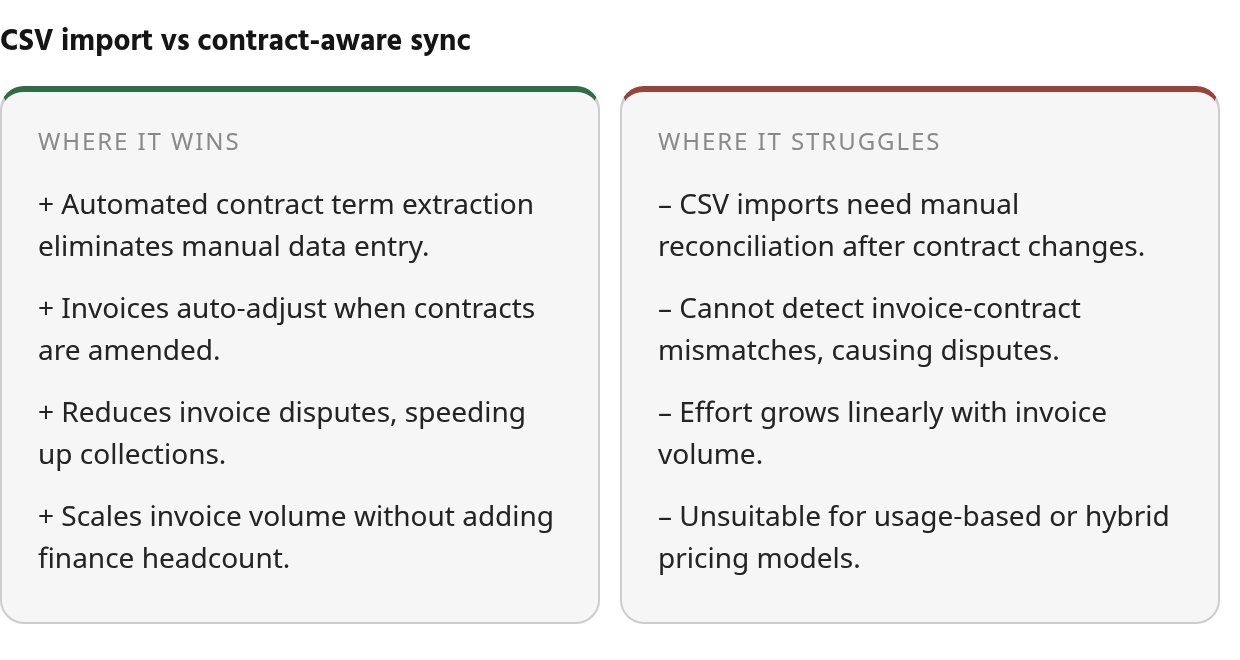
The difference is architectural. A generic CSV import moves an invoice snapshot into your ERP or accounting system. That’s it. Data goes from point A to point B. Contract-aware sync works from the other direction: it reads the signed agreement, extracts the billing rules, usage commitments, and payment terms, and generates invoices that match what sales actually negotiated.
Now add an amendment. A customer moves up a tier mid-cycle, or gets a block of credits after an outage. A contract-aware platform updates downstream billing on its own. A CSV workflow needs a person to notice the change, export fresh data, and re-import it. If that person is on vacation during close, good luck.
When CSV imports still do the job
My advice is simple. If your pricing is static and your invoice volume is low, stay on CSV. Fixed annual contracts with predictable billing schedules don’t need real-time contract sync. A monthly batch export to QuickBooks or NetSuite handles it without new infrastructure.
Same goes if your billing is genuinely boring: no usage tiers, no milestone payments, no mid-cycle amendments. The setup cost of a contract-aware platform outweighs what you’d get back.
Where split systems turn into slow collections
Trouble starts when contracts govern variable invoices. Usage-based SaaS, hybrid subscriptions, and milestone billing all generate disputes when the invoice doesn’t match the contract. The customer’s AP team spots the mismatch, kicks it back, and your invoice sits. CSV imports can’t catch those mismatches because they don’t carry contract context forward.
High-growth SaaS companies report that aged receivables pile up when invoices don’t reflect the usage commitments in signed agreements. Contract-aware automation cuts the invoice errors that trigger disputes in the first place, which lets finance teams grow invoice volume without adding headcount.
So the fix isn’t chasing harder. More dunning emails won’t solve a wrong invoice. Removing the reason for the dispute will.
CSV import vs. contract-aware sync at a glance
| Dimension | CSV Import | Contract-Aware Sync | Verification Notes |
|---|---|---|---|
| Setup time | Lightweight setup | Heavier initial contract ingestion | Research sources indicate modern tools can accelerate usage-based rollout materially |
| Contract term extraction | Manual re-entry | Automated reading of signed agreements | Public docs confirm automated extraction for platforms like Tabs; Blixo claims require demo verification |
| Invoice accuracy for usage tiers | Requires manual reconciliation | Contract rules drive invoice generation | Verified for Tabs; Blixo capability needs public documentation |
| Collection speed impact | No direct effect; disputes slow DSO | Reduces disputes by matching contract terms | High-growth SaaS companies report improved collections when invoice accuracy increases |
| Ongoing maintenance | Manual export/import each cycle | Automated sync on contract events | ERP integration scope varies by platform; verify supported systems in demo |
| Scalability | Linear effort with invoice volume | Handles increased volume without proportional headcount growth | Pattern confirmed across SaaS companies adopting contract-aware automation |
A note on the Blixo rows. Its contract-aware sync is marked “needs demo verification,” not confirmed. Public materials suggest the platform handles multi-ERP sync and recurring invoice automation, but the documentation reviewed for this article doesn’t explicitly describe contract term extraction or automated usage-based reconciliation. That’s absence of evidence, not evidence of absence. If Blixo is on your shortlist, ask in a live demo whether it reads contract terms directly or relies on manually configured billing rules.
The bigger point holds for any verified platform. Contract-aware sync moves your source of truth from hand-maintained billing rules to the signed agreement. CSV imports can’t make that move, because they treat each invoice as an isolated event instead of the output of contract logic. For a SaaS team running variable pricing at scale, that’s the difference between collections as a bottleneck and collections as a background process.
Generic CSV Imports vs. Contract‑Aware Sync: Where the Snapshot Breaks
AR CSV integration usually fails the first time pricing stops being predictable. A CSV export is rows of invoice data frozen at one point in the billing process. Change the contract and the file has no idea anything happened. Someone in finance or RevOps has to trace the change, refresh the data, and figure out which invoices or ledger entries need fixing.
File format isn’t really the problem. Interpretation is. When the sync layer can’t read a PDF or CRM deal data, your team ends up re-keying pricing, discounts, payment terms, and usage commitments by hand. Errors start upstream and show up weeks later as collections friction. Industry guides describe the same pattern: one system for invoicing, another for collections, a third for revenue recognition. The symptoms are invoice disputes and month-end fire drills. The cure is cutting out the handoffs that caused the delays.
What actually changes when you switch
| Dimension | Generic CSV Import | Contract-Aware Sync |
|---|---|---|
| Contract term extraction | Manual re-entry of pricing, discounts, payment terms, usage commitments | Reads signed agreements; extracts billing schedules, amendments, credits, and exceptions automatically |
| Amendment handling | Requires a new CSV export + manual reconciliation when terms change | Detects contract updates; adjusts invoices and billing logic without manual intervention |
| Usage-based billing | Separate metering system; requires manual mapping to contract minimums and overages | Links usage data to contract thresholds; generates variable invoices that reflect negotiated terms |
| Collections context | Generic payment reminders sent on a fixed schedule | Dunning sequences that honor payment terms, net-60 clauses, and milestone dependencies from the contract |
| ERP reconciliation | Batch sync of invoice totals; mismatches require manual investigation | Maintains a connection between contract line items, invoices, and accounting records for audit-ready reconciliation |
CSV workflows crack as contract complexity grows. Usage-based pricing is increasingly common, and every usage-based contract produces a different invoice from one cycle to the next. A lean finance team can often handle the exceptions at low volume. Hybrid contracts are where it gets fragile: subscriptions, consumption tiers, and milestone payments blended into one agreement. Invoice volume outpaces review capacity, and the gaps between CRM, billing, and ERP start compounding errors.
Contract-aware platforms treat the signed agreement as the governing record. When terms change, billing adjusts from the contract instead of from a spreadsheet someone updated three weeks ago. Collections follow-ups respect payment terms, so your enterprise customer on net-60 doesn’t get a “your invoice is overdue” email on day 31. Revenue recognition lines up with what was negotiated, not with what someone transcribed months earlier. The contract drives every downstream step instead of a chain of disconnected exports.
What to Make Blixo Prove in a Contract‑Aware Sync Demo
Treat this section as a demo script, not a spec sheet. Public materials reviewed for this article describe Blixo’s intelligent matching engine, bank and ERP integrations, and API access with webhooks. They don’t document how contract amendments flow through to invoices. Every capability below should be verified live. A gap in public documentation is a question for the vendor, not an answer in either direction.
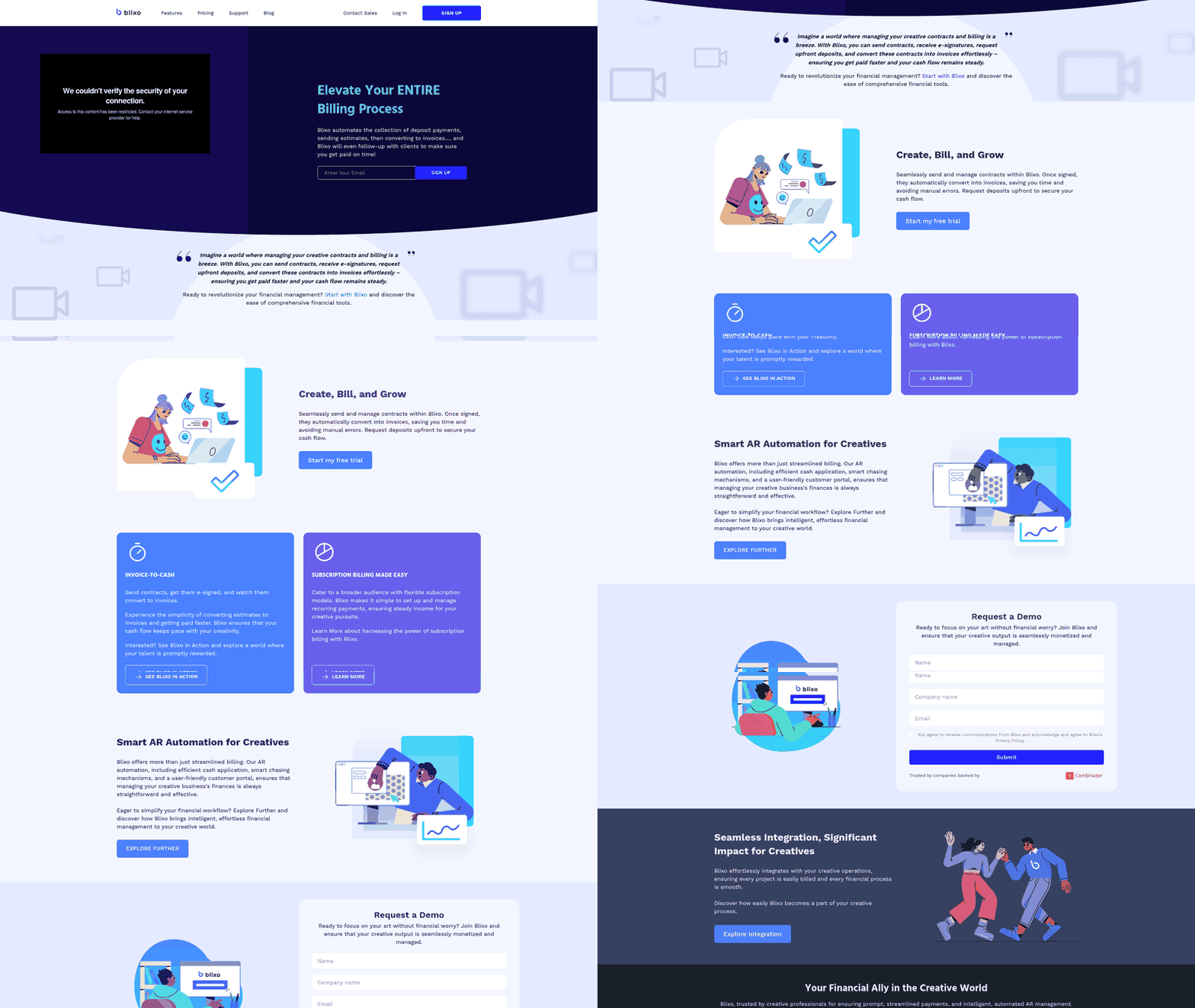
Every vendor replacing an AR CSV integration promises cleaner data. The real test is what happens when a contract changes and the related usage data shows up after the original billing setup.
Six demo requests that separate architecture from marketing
| What to ask Blixo to show | What a strong answer includes | Status |
|---|---|---|
| Sync mechanism | Whether it uses webhooks, APIs, native ERP connectors, a built-in matching engine, or another method | Verify in demo |
| Amendment handling | A contract revision with a new effective date, updated pricing, and revised line items | Verify in demo |
| Single source of truth | One record linking contract, invoice, and payment after the revision | Verify in demo |
| AI cash application | How matches get decided, how confidence gets scored, where exceptions go | Verify in demo |
| Smart invoicing rules | Usage tiers, minimum commitments, credits applied automatically | Verify in demo |
| ERP integrations | Supported systems, prerequisites, data requirements, known limits | Verify in demo |
The contract-change test carries the most weight. Ask the team to revise a live agreement on the call. Then watch the effective date, the pricing logic, and the next invoice. If the flow leaves the application and depends on a file upload, you’ve found where the automation ends.
Apply the same skepticism to AI cash application. Public materials suggest Blixo’s matching engine works at both the envelope and item level, routes matches through an approval workflow, and uses machine learning to improve as you manually edit matches. That’s a description. Not proof. Ask how remittance data gets matched and what happens when a match fails, because short-pays and bundled payments are where cash app tools earn their keep or don’t.
Ask for the limits before the features
Get the integration documentation in writing. Public materials list QuickBooks, Xero, Sage Intacct, and NetSuite, plus custom ERP integrations for Oracle, SAP, and Microsoft Dynamics. Which of those connect natively for your setup? Which fields need to be clean before sync starts? Where does data stop flowing? ERPs often miss collections logic and payment matching, so the handoff points deserve your hardest questions.
The Bottom Line on AR CSV Integration for a Scaling SaaS
Most teams don’t live at either extreme. They sit in the messy middle, where a hybrid approach fits until the signals below tip one way.
A fixed monthly subscription runs fine through an AR CSV integration. Add a base fee plus usage overages and every invoice becomes its own thing. Each export now needs someone to check the billed amount against the agreement. When that check becomes routine instead of occasional, it’s time to revisit the setup.
Invoice growth rate is the trigger, not a magic number
Don’t wait for some benchmark monthly invoice count. Watch the rate. If invoice volume grows faster than your finance headcount, manual reconciliation becomes the bottleneck well before anyone calls it that.
The cost of waiting shows up in operations. SaaS teams running consumption pricing and hybrid contracts often find billing review, dispute handling, and reconciliation eating the hours that should go toward improving cash processes. A small finance team carrying hundreds of invoices across several pricing models feels this first. There’s no single threshold. What matters is the gap between invoice complexity and your team’s capacity to review exceptions.
| Signal | Stay with CSV | Hybrid | Contract-aware sync |
|---|---|---|---|
| Pricing model | Flat subscriptions | Base fee plus occasional overages | Usage-based or multi-model contracts |
| Amendment frequency | Rare | Periodic | Frequent, often mid-cycle |
| Invoice growth vs. Headcount | Flat | Rising slowly | Outpacing the team |
| Audit needs | Basic exports suffice | Some change history | Full contract versions and approvals |
| Integration resources | Minimal | Some ops support | Limited engineering, needs packaged connectors |
Your demo questions settle build vs. buy
Start with a frank internal check. Do you have engineers free to maintain ERP and API connectors? Who fixes a broken sync in the middle of month-end close? How much manual work are you willing to accept as a permanent cost? If the answers come back “no one” and “not much,” building your own sync is the wrong call.
Then press each vendor on specifics:
- Confirm out-of-the-box support for your CRM, billing system, payment processor, ERP, and data warehouse.
- Show the live flow from contract ingestion through invoice creation, cash application, ERP posting, and reconciliation.
- Prove the audit trail keeps contract versions, approval history, invoice changes, and payment matches.
If a vendor can’t show one of these, write the gap down and make it a follow-up requirement. A missing answer in a demo isn’t necessarily a missing feature. But it should be a documented one before you sign.
Questions People Ask
Can you run CSV imports and contract-aware sync side by side?
Yes. Keep CSV exports for predictable subscription lines and route variable invoices through contract-aware logic. This lets finance modernize the riskiest billing workflows first without rebuilding every AR process at once.
Will tightening your dunning schedule lower DSO on usage-based contracts?
Only if late payment is the real issue. When the invoice itself conflicts with negotiated terms, the customer will dispute the bill regardless of reminder cadence. The better lever is invoice accuracy before collections begins.
Should your team build its own contract sync instead of buying one?
Build only if your team can maintain connectors, monitor failures, and support the workflow during close. The hidden cost is not the first integration; it is every schema change, edge case, and exception queue that follows.
How can you tell whether a vendor’s contract-aware claim is real?
Ask the vendor to demonstrate a contract change from agreement through billing impact. A credible workflow should preserve the link between the governing contract record, the generated invoice, and the payment or reconciliation activity that follows.
Does Blixo connect natively to your ERP?
Confirm native support for your environment directly with Blixo. Public materials name QuickBooks, Xero, Sage Intacct, and NetSuite, with custom integrations for Oracle, SAP, and Microsoft Dynamics. Request written documentation on required fields, sync direction, and known limits.