

Accounts Receivable Automation: Rule-Based vs AI Matching for Short Pays and Split Invoices

Why Short Pays & Split Invoices Matter
In B2B accounts receivable, the problem isn’t late payments. It’s the manual effort that builds up when payments arrive messy. A customer pays five invoices with one wire transfer. The remittance details show up two days later by email. Another customer short-pays an invoice by 8%, and the reason appears as “damaged goods” in a portal you need to log into separately. Until your team matches each payment to the right invoice, that cash sits unapplied—the money is in your bank, but your ERP still shows the invoice as outstanding.
Why cash application decides whether AR automation works
This pattern is common: matching payments manually consumes significant AR analyst time. That’s not a rounding error—it’s one of the most time-consuming tasks in the order-to-cash cycle.
The real cost isn’t just hours. Unapplied cash distorts your aging report, inflates DSO artificially, and sends collections chasing customers who already paid. A customer who wired payment last Tuesday but whose remittance is stuck in an inbox gets a dunning email on Friday. That strains the relationship and wastes collector time on accounts that need no follow-up.
Automation differences show up fast here. The gap reflects the matching layer: rule-based systems stall when remittances arrive in unexpected formats or payment references don’t match invoice numbers exactly. Blixo’s intelligent matching engine uses machine learning to improve matching over time, routing unmatched cases to an approval workflow instead of leaving them in a queue.
Industry research suggests that optimizing AR procedures can improve receivables-related working capital. The lever isn’t collections cadence—it’s getting payments applied the day they land, so your cash position is visible in real time and your team works only the exceptions that genuinely need judgment.
In short:
- Unapplied cash from mismatched payments distorts aging reports, inflates DSO, and triggers unnecessary collection calls.
- Rule-based systems stall when remittances arrive in unexpected formats or payment references don’t match invoice numbers exactly.
- A customer paying $9,200 on a $10,000 invoice may need portal review before resolving the $800 shortfall.
- Blixo’s intelligent matching engine uses machine learning that improves over time and routes unmatched cases to approval workflows.
- Manual cash application consumes substantial AR analyst time when customers bundle multiple invoices into one wire transfer or send remittance details separately.
Rule-Based Matching: How It Works
In accounts receivable automation, rule-based matching uses explicit logic to pair payments with invoices. The system checks reference numbers, matches amounts within tolerances you set, and applies pre-written allocation rules when a customer pays multiple invoices at once. When the logic fails—partial payment, missing reference, bundled remittance—the exception lands in a manual queue for your team to resolve.
Common rule categories in cash application
Most rule-based systems operate on four core patterns. Reference parsing scans incoming payment data for invoice numbers, purchase orders, or customer account IDs. If the bank statement shows “INV-4503” and you have an open invoice with that number, the system matches them. Payer-to-customer mapping links bank account details to your customer master file, so a wire from ABC Corp’s account automatically routes to ABC Corp’s open invoices. Amount tolerances let you define acceptable variance to handle rounding differences or small disputed charges without manual review.
Allocation rules handle split payments. A customer sends one wire for five invoices. Your rule might say: apply payments oldest-to-newest, by invoice number sequence, or proportionally across all open balances. When the remittance detail arrives separately—an ACH payment lands Monday with a truncated reference while the emailed breakdown arrives Wednesday—the system has no complete set of instructions to execute. The payment therefore sits unmatched, dependent on a later manual step.
How a short-payment example plays out
A customer owes $10,000 but remits $9,200 with a note: “damaged goods on shipment 2401.” Your rule-based system checks the reference, finds the invoice, applies the $9,200, and flags the $800 shortfall with a reason code. The invoice moves to a partial-payment queue. Someone on your team logs into the customer’s AP portal, confirms the damage claim, and either writes off the $800 or disputes it, depending on your contract terms. The work is manual, but the rule successfully routed the exception to the right person.
A different allocation problem occurs when the remittance does not identify how a total should be distributed. A customer pays $15,300 against four open invoices totaling $15,800, with no breakdown. Your oldest-to-newest rule clears three invoices and leaves $200 unpaid on the fourth—but the customer actually intended to short-pay invoice two by $500. Without the correct remittance data, the rule applied cash incorrectly. Your team discovers the error when the customer disputes the next statement.
Manual cash application takes substantial time in accounts receivable operations. Rule-based systems handle known cases well, but every new remittance format or invoice structure change requires developer reprogramming and ongoing maintenance. AI-driven matching offers an alternative by learning patterns from payment history rather than relying on pre-written logic alone, though the actual improvement in straight-through processing depends on the complexity of your payment mix and remittance formats.
AI-Powered Matching: How It Works
In accounts receivable automation, AI matching uses pattern recognition and historical learning to pair payments with invoices when the clean reference data rule-based systems depend on is missing. The system scans remittance text for invoice numbers and customer identifiers, analyzes payment amounts and timing patterns based on each customer’s history, and proposes matches for review when it finds enough supporting signals. When genuine ambiguity remains—such as a partial payment with no explanation or a bundled remittance that cannot be confidently split—the transaction goes to a review queue rather than being treated as resolved.
How AI handles remittance text and historical patterns
Remittance-text analysis applies natural language processing to emails, PDFs, and payment memos to extract invoice references even when formatting varies. If a customer writes “paying INV-4501, 4503, 4505” in an email subject line rather than uploading a structured file, the AI parses that text, matches it against open invoices, and allocates the payment.
Historical matching adds customer-specific context. The system can recognize recurring payer behavior, familiar reference formats, and the relationship between payment timing and remittance delivery. That context helps it distinguish an unfamiliar transaction from a repeated pattern that deserves a proposed match.
Straight-through processing rates for B2B invoice volumes vary widely by implementation. Match rates depend on data quality and implementation maturity—cleaner master data and more sophisticated models achieve higher automatic processing rates. The gap reflects differences in customer payment behavior and how thoroughly the platform learns each customer’s patterns.
What AI cannot yet do without further evidence
Public materials don’t document an AI short-pay allocation example that works without a preset tolerance. If a customer shorts an invoice with no stated reason, the system flags it as an exception rather than automatically deciding how to allocate the deduction. Reviewed documentation also doesn’t substantiate a split-invoice case in which AI clusters line items and automatically matches them across multiple invoices without human confirmation.
Retraining frequency and required data volume remain implementation questions requiring additional evidence. Some platforms may retrain models quarterly, others may rely on continuous learning loops, and the minimum invoice history needed for accurate matching likely varies by vendor.
The practical benefit is speed and exception reduction, not perfect automation. Your team reviews genuinely unresolved cases while the platform handles more of the repetitive identification work. That distinction matters when evaluating vendors: a proposed match still needs an appropriate confidence threshold and an approval path.
Rule-Based vs AI: Head-to-Head
In our work with finance teams, we see the choice between rule-based and AI-powered cash application framed as a features race. That misses the actual decision line. The difference is not capability breadth—it’s how each system handles the exceptions that rule engines were never built for.
What separates rule-based from AI matching
Rule-based systems are transparent and predictable: they check a defined field, apply a tolerance, and follow an allocation instruction. That makes them useful for stable payment patterns and straightforward controls. Their weakness is maintenance. When the underlying data changes, the rule may need to be rewritten before it can deal with the new format.
AI matching weighs several signals across historical payment data. It can interpret less-structured remittance text and use customer-specific behavior to rank possible matches. The tradeoff is that finance teams must establish review controls, monitor confidence levels, and validate the system against their own data rather than assuming that a general model will perform uniformly across every payer.
| Dimension | Rule-Based | AI-Powered | Evidence Source |
|---|---|---|---|
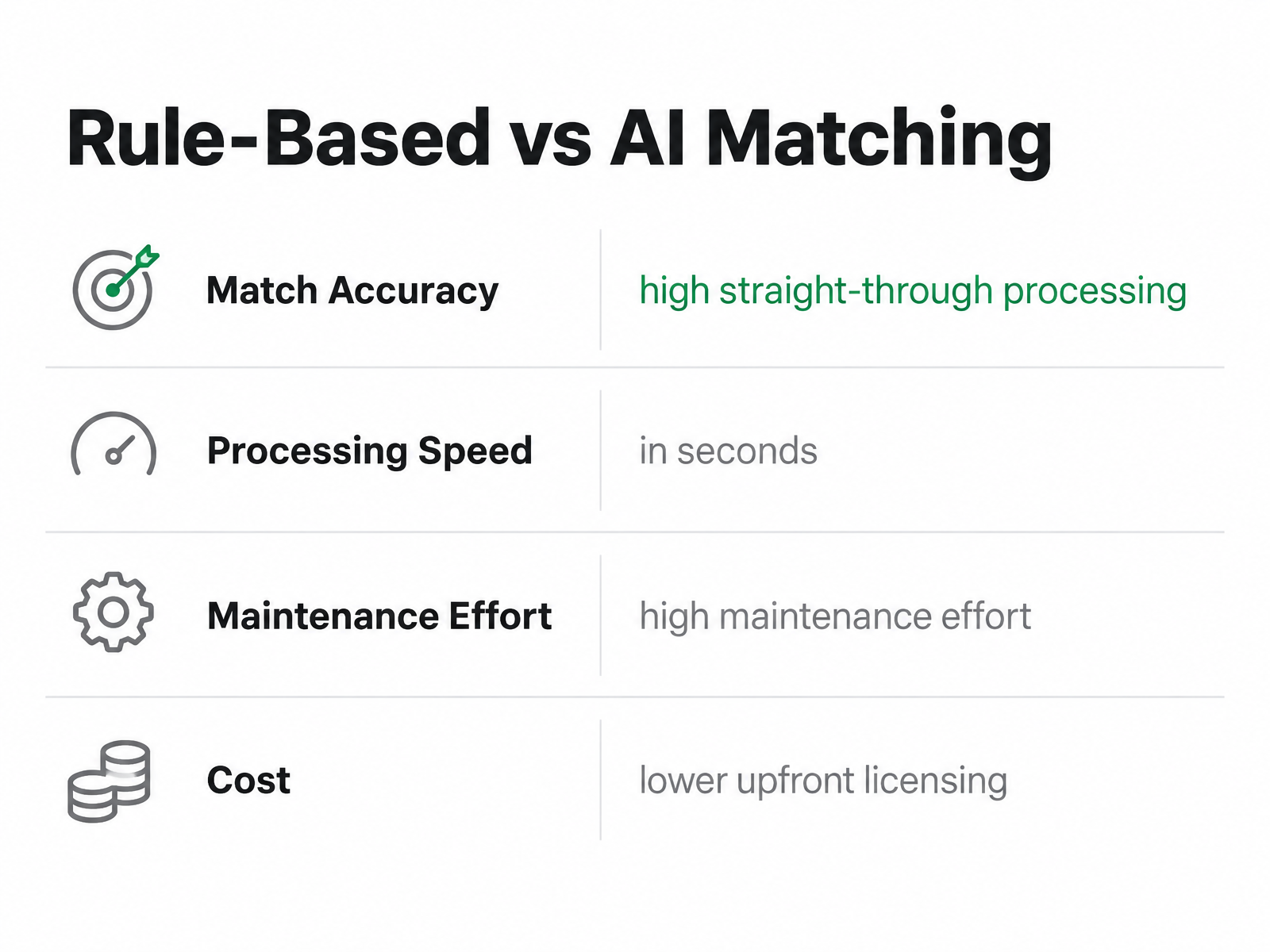
| Match accuracy | Depends on clean reference data; fails on partial payments, bundled remittances, or missing invoice numbers | High straight-through processing in typical deployments; performance improves with mature implementations and clean master data | Vendor-reported benchmarks (no controlled third-party comparisons found) |
| Processing speed | Matches clean payments instantly; exceptions queue indefinitely | Processes most transactions in seconds; holds unmatched payments in context and applies retroactively when missing remittance data surfaces | Qualitative descriptions only; no published head-to-head timing studies |
| Maintenance effort | High: every new remittance format or invoice structure change requires developer reprogramming | Low: systems trained on company-specific data improve match rates over time without manual reconfiguration | Industry practitioner accounts; no formal maintenance-cost studies |
| Exception handling | Stops at first ambiguity; requires human review for short pays, split invoices, or decoupled remittances | Scores confidence level for each match; escalates only genuinely ambiguous cases | Design descriptions; no quantitative exception-resolution benchmarks |
| Cost | Lower upfront licensing; hidden maintenance debt scales with customer diversity | Higher upfront investment; maintenance costs decline as model learns | No public pricing or total-cost-of-ownership data found |
When rule-based automation stops working
The gap between these approaches shows up when payments and remittance data arrive asynchronously. A rule engine generally cannot connect a payment to its later explanation unless the workflow has been designed to hold and reconcile both records. AI systems can use that timing and customer history as additional context, but they still need a reliable escalation path when the evidence remains incomplete.
For businesses whose customers pay via bank transfer with separate email notifications, this temporal flexibility can determine whether automation is practical. The relevant test is not how well either system handles a clean invoice; it’s how much research remains after references are truncated, deductions are unexplained, or several open balances could plausibly receive the same payment.
Automated processing reduces work only when exceptions actually clear. A system that handles clean transactions but leaves a large and unpredictable review population may have improved the first step without reducing the overall burden. Evaluation should therefore include exception volume, review effort, and the quality of the context presented to an analyst.
Blixo’s Approach to Short Pays and Split Invoices
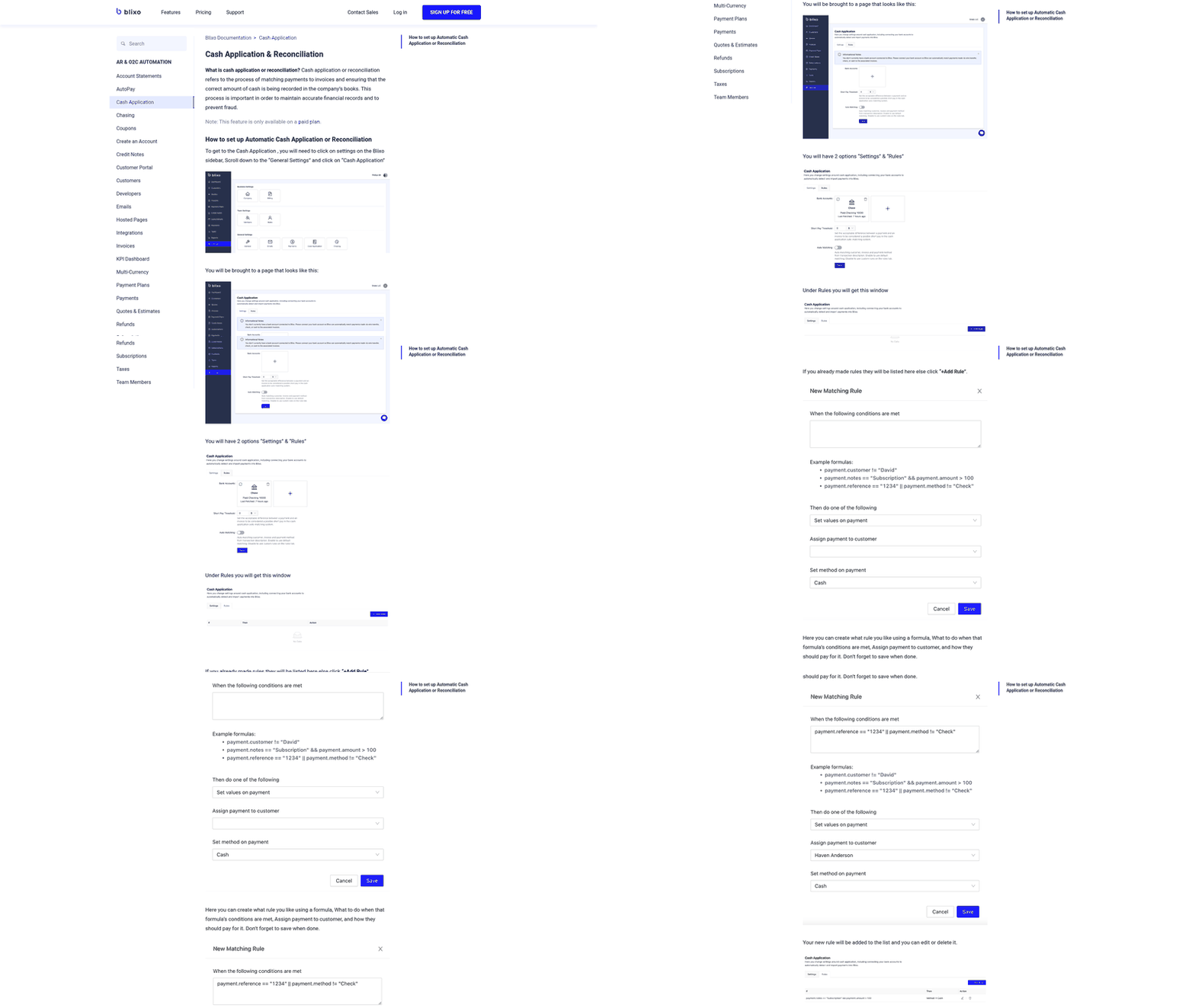
Public materials confirm that Blixo’s cash application uses an intelligent matching engine to match payments to invoices, even when reference data is incomplete or payments arrive without complete remittance detail. The system routes genuine ambiguity to a manual approval workflow rather than letting unmatched payments pile up in your bank feed. As you manually resolve exceptions, the system uses machine learning to improve future matching accuracy.
What reviewed documentation doesn’t substantiate: specific match rates, detailed integration workflows for individual ERPs or banking APIs, pricing structure, or quantified time savings from customer deployments. If those details matter for your evaluation, request a demo or ask our team directly.
Industry research indicates that AI-powered AR systems can achieve high straight-through processing rates for B2B invoice volumes when trained on representative data. The operational shift is from maintaining a separate instruction for every variation to reviewing how the system handles the exceptions that remain. Traditional rule-based systems route those cases to analysts when logic fails; AI systems can learn from approved resolutions, subject to the controls and evidence available in a particular deployment.
| Capability | What public materials confirm | What requires verification |
|---|---|---|
| AI matching for short pays | AI-powered cash application confirmed | Match rate, exception volume |
| Intelligent matching engine | Multi-source, envelope and item level | Multi-invoice allocation logic |
| ERP integration | QuickBooks, Xero, Sage Intacct, NetSuite; custom integrations for Oracle, SAP, Microsoft Dynamics | API specs, setup workflow |
| Pricing model | Not published | Per-seat, usage-based, or flat rate |
Evaluate any AR automation platform—ours included—by requesting access to a sandbox environment with your actual remittance data. Upload a sample of messy payments: bundled wires, truncated references, partial payments with no attached detail. The system that handles those cleanly without manual intervention is the one worth deploying.
Implementation: Where to Start
Start with your current cash application process, validate your data, pilot with human oversight, and track the right KPIs—not a formal consulting checklist, but a controlled rollout that lets you see where automation helps before you trust it with production cash.
Document your current process before automation
Map out every step your team takes to match payments right now. Where does remittance data arrive—bank feeds, email, customer portals, or EDI files? How long does each payment sit before it’s applied? What percentage of payments need manual research because the reference is missing or wrong? This baseline shows where deterministic rules are sufficient and where an AI system would need to interpret less-structured information.
Clean your master data before you start. Standardize customer codes, validate invoice numbers against customer records, and fix duplicate payer entries. A payment that lands with a reference your system doesn’t recognize won’t match under any logic, rule-based or AI. If you have historical matching data—spreadsheets where your team logged manual decisions—use it. AI systems trained on your specific payment patterns will perform better than systems trained on generic B2B data.
Pilot with human review, not silent automation
Route proposed matches to manual approval rather than posting them automatically. Start with low-risk invoices: small amounts, customers with clean payment history, and payments that match one invoice exactly. Let the system handle those while your team reviews anything partial, bundled, or missing remittance detail. This reduces the risk of misapplied cash during the learning phase and gives you a queue of genuinely unresolved transactions that need judgment.
Track straight-through match rate, exception volume, time to apply each payment, and manual cash application hours before and after go-live. Days sales outstanding (DSO) and collector capacity matter, but they lag. Match rate and exception volume tell you within days whether the system is learning your customers’ payment behavior or simply creating a different kind of manual work. Set up an escalation workflow where low-confidence matches surface with the full remittance and invoice context so your team can close them quickly rather than researching from scratch.
Quick Questions, Straight Answers
What happens to unapplied cash when my team can’t match a payment immediately?
The immediate operational issue is visibility. Until someone identifies the payment and applies it, the cash cannot be reliably associated with the customer account or open receivable. The finance team should assign ownership, preserve the bank and remittance records, and document the eventual application so the audit trail explains how the balance was resolved.
Can AI matching handle a customer who always sends one wire for multiple invoices with details arriving days later?
It can use recurring customer behavior as one signal when proposing a match, but the result still depends on the quality and completeness of the later remittance. A pilot should test whether the platform can associate the incoming explanation with the earlier transaction and present the combined context for approval. If the evidence does not identify the intended invoices clearly, the case should remain in review rather than being allocated speculatively.