

Why AI AR Tools Are Replacing Manual Chasing and Cash Application

Key Takeaways
- Most modern cash application tools advertise auto-match rates above 85%, but top AR teams achieve 25-35 day DSO by resolving messy exceptions faster.
- The performance gap between leading and average AR teams comes from handling the remaining 15-20% of problematic payments, not automating clean transactions.
- Workflow automation moves structured data through systems quickly, while exception-reasoning automation interprets partial payments and deduction codes without human review.
- Companies with clean remittance data benefit from workflow suites like HighRadius and BlackLine, which excel at processing straightforward payments at scale.
- The industry average DSO lingers at 40-55 days, showing that high auto-match rates alone do not solve the cash collection challenge.
- Exception-reasoning tools target the messy minority of payments where partial amounts, unapplied cash, and unclear invoice references create manual bottlenecks.
- Selecting the right AR platform depends on where teams actually spend their time, not which vendor claims the highest automated matching percentage.
Quick Comparison Summary
When companies ask what’s the best invoicing platform for getting paid faster on outstanding invoices, they’re usually weighing three categories. Workflow automation suites handle clean payments at scale. Exception-reasoning tools tackle messy remittances. All-in-one platforms blend both. The right fit depends on where your AR team actually spends its time, not just which vendor claims the highest auto-match rate.
The Auto-Match Myth: Why 85% Doesn’t Tell the Full Story
Most modern cash application tools advertise auto-match rates above 85% for structured remittance data. HighRadius and BlackLine both hit that benchmark when payments arrive with clear invoice numbers and matching amounts. But here’s the catch: top AR teams achieve days-sales-outstanding (DSO) between 25 and 35 days, while the industry average lingers at 40 to 55 days. The gap does not come from handling the clean 85%. It comes from how fast you resolve the remaining 15-20% of messy exceptions.
Kognitos frames this as the difference between workflow automation and exception-and-reasoning automation. Workflow automation moves clean data through your system faster. Exception-and-reasoning automation interprets partial payments, unapplied cash, and deduction codes without human review. If your bottleneck is the messy minority, a high auto-match rate just means you’re automating the easy part.
Workflow Suites vs. Exception-Reasoning Tools
Workflow-focused platforms like HighRadius and BlackLine excel when you process high volumes of straightforward transactions across multiple regions. They connect to banks, customer portals, and ERPs to pull payment details and post them automatically. Large enterprises managing global remittance matching see the biggest efficiency gains here. One case study showed HighRadius helping a Fortune 50 food and beverage company reduce costs by over $1 million annually through tighter cash application.
Exception-reasoning tools like Kognitos handle the payments that break the rules. That includes short pays with three-line explanations in an email, partial settlements referencing multiple invoices, or wire transfers with cryptic reference codes. Kognitos uses deterministic AI to read messy remittances and resolve exceptions in plain language. It also logs every decision for compliance. Blixo’s intelligent matching engine delivers high match rates at the envelope and item level. Its approval workflow grows smarter through machine learning as you manually edit, helping you match payments to invoices quickly and accurately.
Pricing and Feature Tiers at a Glance
| Platform | Starting Price | Best For | Key Strength | Deployment Speed |
|---|---|---|---|---|
| HighRadius | Custom enterprise pricing | Global enterprises with high transaction volumes | Multi-region remittance matching | 8-12 weeks typical |
| BlackLine | Custom (mid-market+) | Teams needing tight ERP integration | Structured data auto-matching | 6-10 weeks |
| Kognitos | Custom (quoted per use case) | AR teams drowning in messy exceptions | Plain-language exception resolution | 4-6 weeks |
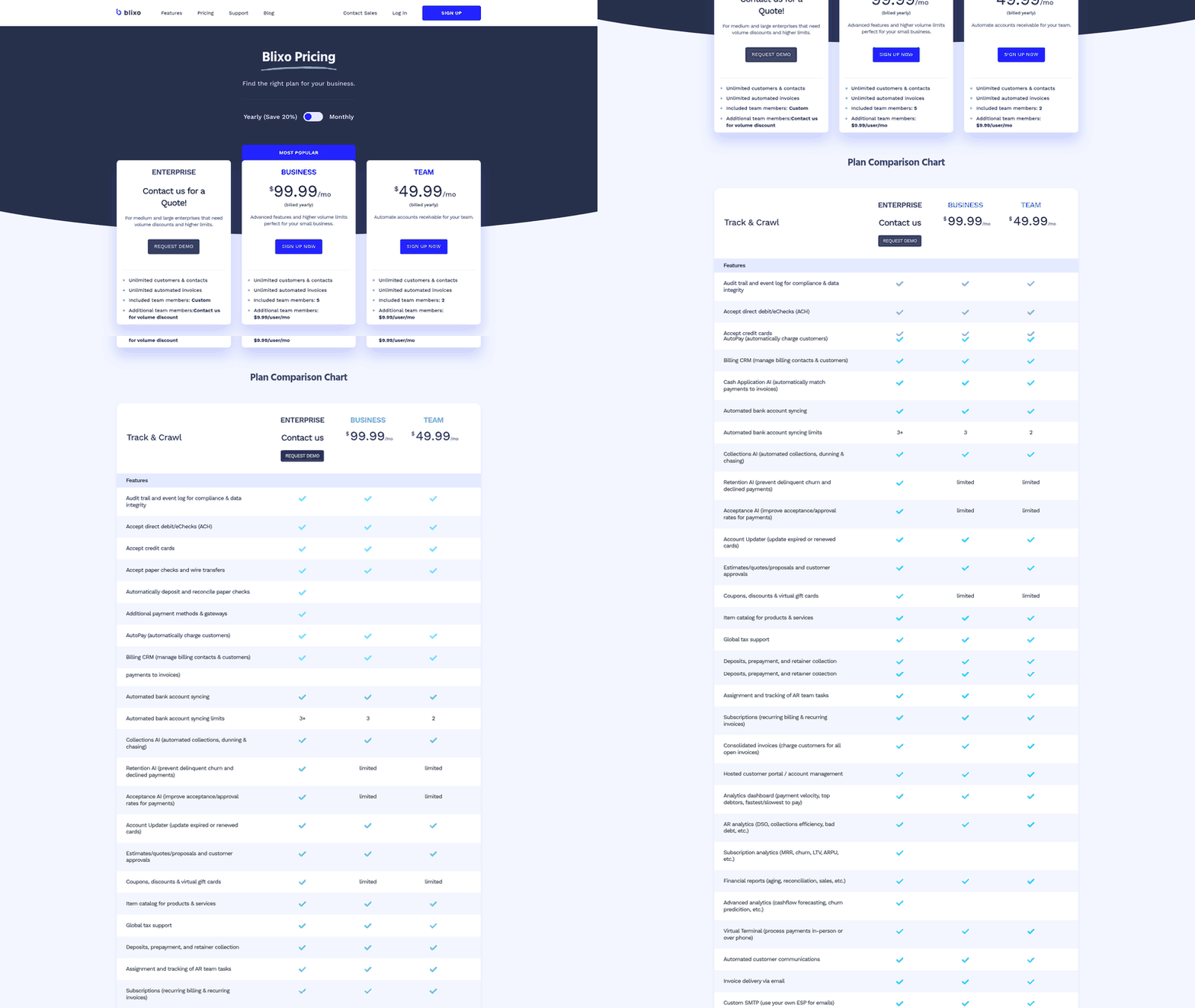
| Blixo Team | $49.99/mo (billed yearly) | Small teams needing automated AR | Cash Application AI with unlimited invoices | Fast setup |
| Blixo Business | $99.99/mo (billed yearly) | Small businesses with higher volumes | Advanced analytics + Collections AI | Fast setup |
| Blixo Enterprise | Custom quote | Medium and large enterprises | Volume discounts and higher limits | Custom onboarding |
Blixo automates collections, chasing, and dunning with emails, text messages, phone calls, and letters. It helps companies recover delinquent revenue and get paid faster. Companies using AR automation broadly see a 10-60% reduction in overdue balances within the first month of full usage, according to data from multiple vendors.
Integration Speed: The Hidden Differentiator
Deployment timelines rarely make it into comparison charts, but they matter. If you’re a SaaS company launching a new subscription tier or a consultancy switching from spreadsheets to automated invoicing, waiting three months for an enterprise rollout kills momentum. Blixo integrates with QuickBooks, Xero, Sage Intacct, NetSuite, and offers custom ERP integrations for Oracle, SAP, and Microsoft Dynamics. Customers describe setup as easy and intuitive. HighRadius and BlackLine expect 8-12 weeks for full enterprise deployments.
For organizations with highly complex AR processes, such as multiple subsidiaries, custom ERP integrations, and global tax rules, the longer setup pays off. If you need to start collecting faster this quarter, prioritize tools built for rapid onboarding. Integration speed becomes a cost factor when you calculate how many weeks of manual work you’re avoiding—or perpetuating.
Why Consider These Options
When you’re evaluating what’s the best invoicing platform for companies that need to get paid faster on outstanding invoices, the first step is understanding where your AR bottleneck actually lives. We see two distinct camps of tools in this market, and picking the wrong category costs you time and money even if the tool itself works well.
Workflow Automation vs. Exception Reasoning: Why the Distinction Matters
Most AR platforms excel at workflow automation. They route clean payments through your system at scale, send scheduled reminders, and auto-match invoices when the data arrives structured and complete. These tools handle high-volume, straightforward transactions efficiently, processing thousands of payments daily without manual intervention.
Exception-reasoning automation tackles the minority of cases that do not fit standard patterns. Instead of rigid matching rules, these platforms interpret unstructured remittance data the way a human analyst would. They read PDFs, infer intent from payment notes, and apply logic to ambiguous scenarios. Think of payments that arrive with cryptic references like “April services” covering three different invoices, or consolidated wire transfers from a parent company settling bills across five subsidiaries. While automated systems accelerate overall collections, the most significant financial returns cluster around resolving complex payment discrepancies rather than simply processing clean transactions faster.
The split matters because your team’s actual workload concentrates in different places depending on your business model. B2B manufacturers dealing with large corporate buyers often face complex remittance scenarios where a single check references multiple purchase orders across different divisions. Retail suppliers working with major chains encounter frequent short-pays and deductions that require investigation. Misdiagnosing which problem dominates your AR function leads to investing in speed when you needed reasoning, or vice versa.
Selection Factors: What Actually Predicts Success
We’ve found three factors that matter more than feature checklists when evaluating invoicing platforms. First, integration speed separates serious contenders from lengthy enterprise rollouts. Some platforms deploy via API in three to four days, while others require multi-month implementations that delay ROI and tie up your finance team.
Second, look at how the platform handles your specific payment complexity. SaaS subscription businesses with recurring billing face different challenges than agencies chasing one-off project invoices. Businesses automating recurring workflows can compress billing cycles significantly, while those focused on remittance matching often collect revenue weeks earlier than manual processes allow. Your use case determines which capability matters.
Third, consider whether you need one tool or a stack. High-performing finance departments often deploy a multi-layered strategy, using standard workflow tools to handle predictable transactions while layering on specialized reasoning engines to manage complex edge cases. Combining strengths often outperforms betting everything on a single platform that claims to do both.
Common Needs Across Business Types
Service businesses—agencies, consultancies, dev shops—need customer-behavior intelligence more than raw speed. AI-driven tools that adapt outreach timing and tone based on past payment patterns reduce friction and preserve relationships. We see this approach work better than aggressive automated dunning sequences that treat every late payment the same way.
Technology and SaaS companies with usage-based billing need native integration between billing and collections. When your invoicing data lives in one system and your cash application runs in another, reconciliation errors compound. Platforms that handle both ends of the cycle eliminate the manual handoff that creates unapplied cash and customer disputes.
Professional services firms juggling multiple clients and project-based billing prioritize audit trails and compliance. Every decision the AI makes during cash application needs documentation for SOC 2, HIPAA, or GDPR requirements. Tools that black-box their reasoning, even if they’re fast, introduce risk that finance teams can’t accept.
A common pitfall is focusing solely on vendor promises about automation rates and speed. The documented wins come from matching the tool’s core strength—workflow or exceptions—to where your team actually loses time. Enterprise-level case studies demonstrate that the true cost sink lies in manual dispute resolution and deduction management, where human analysts spend hours cross-referencing disconnected systems.
Feature Comparison
When evaluating invoicing platforms for companies that need to get invoices, the feature matrix reveals a clear split. Workflow suites excel at volume throughput, while exception-reasoning platforms tackle the costly minority of messy payments. We see teams waste months on the wrong tool because they prioritized advertised capabilities over the bottleneck that actually burns their time.
Auto-Match Rates vs. Exception Intelligence
Pattern-based matching handles structured payments effectively. Invoice numbers align, amounts reconcile, and transactions flow through without friction. The challenge surfaces when remittance data arrives fragmented across email threads, mixed in PDFs with unrelated line items, or accompanied by deduction codes that do not map to your system’s categories.
This operational gap is why advanced platforms focus heavily on unstructured data parsing. By deploying deterministic AI that reads emails and PDFs in plain language, teams can automatically extract context from messy remittances. This creates a clear audit trail without manual intervention. This approach addresses the complex remittance gaps that standard workflow suites typically fail to parse.
Skip exception-reasoning tools if your payment volume is under 500 monthly invoices with standard remittance formats. The deployment overhead outweighs the benefit for small, predictable payment flows.
Integration Speed and Deployment Timelines
| Platform | Integration Method | Typical Deployment | Real-World Speed |
|---|---|---|---|
| HighRadius | Multi-portal sync | 6-8 weeks | Large enterprise deployments |
| Blixo | Native AR system | Streamlined setup | SaaS subscription focus |
The integration timeline matters more than most feature checklists acknowledge. API integration connecting to SAP, Oracle, NetSuite, and Dynamics without modifying existing systems stands in stark contrast to the six-to-eight-week implementations typical of enterprise workflow suites. For SaaS subscription businesses that need cash application running this quarter, not next year, deployment speed becomes a feature in itself.
A unified architecture simplifies this process. When billing, collections, and cash application are native to a single platform, the need for complex, multi-system API mapping disappears. That allows teams to go live without extensive IT overhead. This setup eliminates integration friction by working in a unified environment where invoice data and payment context already live together.
Human-in-the-Loop vs. Autonomous Exception Resolution
The architectural divide shows up starkest in exception handling. Traditional workflow tools route complex cases to human queues, preserving oversight but requiring manual intervention for every unclear payment. That approach makes sense when you’re automating the first wave of AR volume, but it caps your ceiling at whatever your team can manually process.
Agentic AI flips that model. Platforms using reasoning automation handle exceptions autonomously, then surface results for review. One financial institution reported a 30% decrease in unapplied cash within the first quarter after deploying Emagia’s AI tools, which reduced processing time by 50% by eliminating the manual reconciliation step entirely. The platform resolved payment-to-invoice matching independently, leaving staff to handle only genuine disputes.
The tradeoff: you gain throughput but lose granular control over every decision. For SaaS businesses with recurring billing patterns, that’s usually the right tradeoff. When payment structures repeat monthly, AI learns your customer remittance patterns and applies them consistently, often more reliably than rotating AR staff.
Feature Depth for Short Pays and Deductions
| Capability | Workflow Suites | Exception Reasoners | Blixo |
|---|---|---|---|
| Short pay handling | Rule-based matching | Natural language parsing | Intelligent matching engine |
| Deduction resolution | Manual queue routing | Autonomous dispute categorization | Integrated dunning workflows |
| Multi-currency support | Yes (most platforms) | Limited (verification required) | Full support for global SaaS |
| Audit trail compliance | Transaction logs | Decision documentation with reasoning | Real-time visibility across invoice-to-cash |
Short pays and partial deductions expose platform depth. HighRadius routes these to specialist teams for deduction management across multiple regions, which works for global enterprises with dedicated AR operations. Bishop Lifting took a different approach and now manages 50% more accounts per person because AI handles 91% of outbound communications, including payment clarification requests that previously required manual follow-up.
Subscription-based businesses require specialized logic to handle recurring billing cycles, metered usage, add-ons, and promotional discounts. When these billing structures generate complex payment splits, the platform automatically aligns incoming cash with the correct revenue recognition schedules, ensuring compliance and accuracy. This eliminates the need to manually reconcile usage-based edge cases or split payments across multiple billing periods.
Mid-market companies implementing intelligent cash application report Days Sales Outstanding (DSO) improvements of 12-18 days within the first six months, translating directly to freed working capital. That range reflects deployment quality and baseline AR health. Teams starting with 45+ day DSO see steeper initial gains than those already running tight collections processes.
Performance Comparison
When you’re deciding platform for getting paid faster, the performance numbers tell only half the story. The real test is how systems behave when payments deviate from the happy path. That includes when a customer includes three invoice numbers in one wire, references a PO instead of an invoice, or sends a check with nothing but an account number scrawled in the memo line.
Processing Speed: Where the Bottleneck Really Lives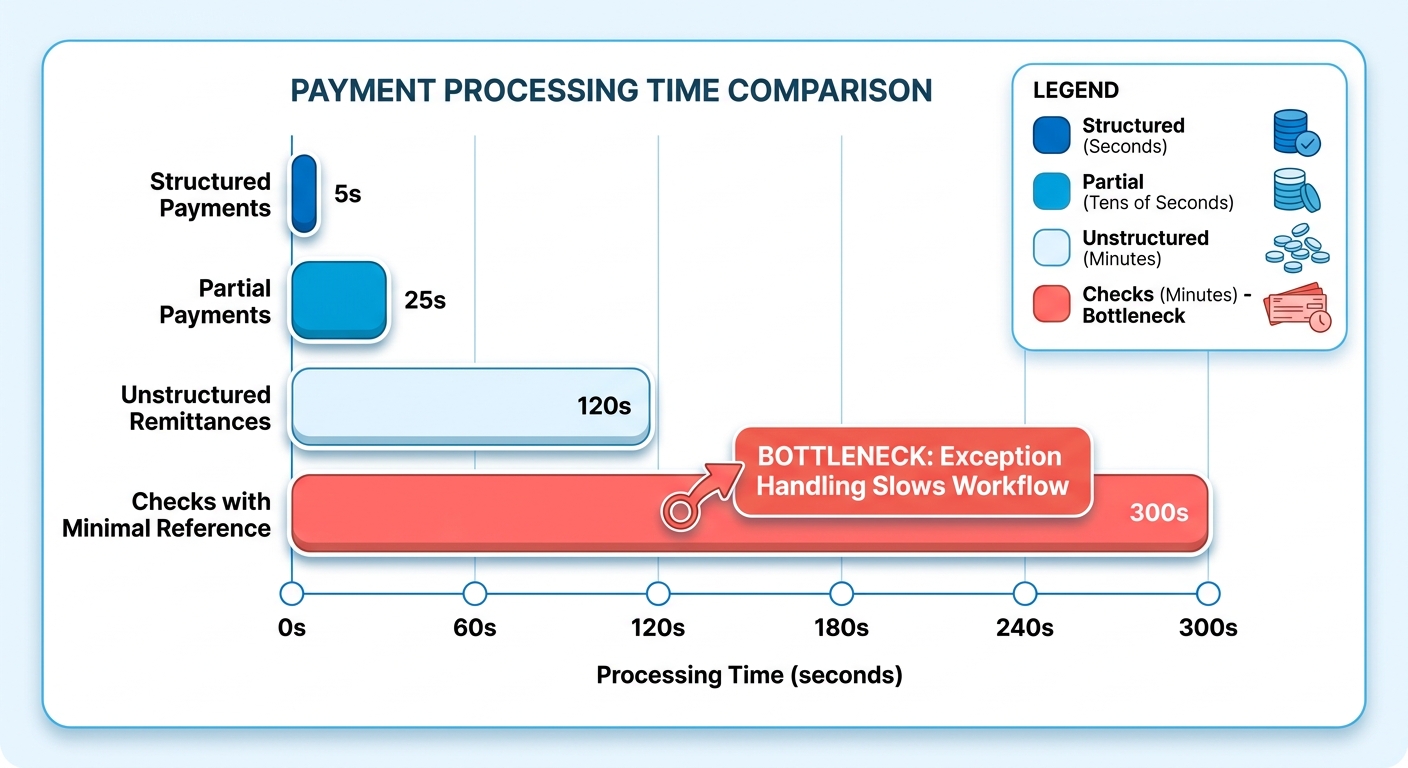
Most workflow automation tools clear structured payments in seconds. Stuut processes clean remittances at market-leading rates, and customers report an average 37% DSO reduction after deployment. HighRadius and BlackLine deliver similar throughput for high-volume enterprises managing thousands of invoices daily. But speed collapses when a payment arrives with an ambiguous reference line or a short-pay deduction buried in an email attachment. Advanced cash application platforms use matching logic that reduces manual review time for exceptions that would otherwise require significant human work.
Stuut’s API connects to SAP, Oracle, NetSuite, and Dynamics in 3 to 4 days, while legacy systems often require weeks of custom mapping. Rapid deployment directly correlates with financial impact. When a platform connects quickly to existing ledgers, companies see a measurable decrease in unapplied cash within the first quarter, avoiding the prolonged double-work that typically plagues multi-month software rollouts.
Scalability: Handling Volume Without Adding Headcount
Modern AR automation allows businesses to manage more accounts per person by handling outbound communications automatically. That’s the scalability metric that matters for growing SaaS businesses, not just transaction throughput, but how many customer relationships each AR professional can steward without burnout. Companies add hundreds of new customers per quarter without expanding their finance team when automation handles routine follow-ups, payment confirmations, and exception resolution autonomously.
Automating routine outreach allows growing businesses to manage expanding customer portfolios without a linear increase in administrative headcount. By scheduling multi-channel reminders based on past payment behavior, teams can maintain consistent communication while focusing human effort on high-risk accounts. Traditional automation tools scale linearly. You add users, you add seats, you add cost. Exception-reasoning platforms scale differently because they learn customer-specific remittance patterns over time, which means the second thousand invoices process faster than the first thousand. Intelligent automation delivers exponential returns at enterprise scale by reducing the manual workload required to resolve payment exceptions.
Resource Efficiency: The Real Cost of Manual Intervention
Cash application software can reduce manual AR workload significantly, but that statistic masks where the savings actually happen. Resource efficiency should be measured by unapplied-cash rates and manual-touch time per exception, not by total transaction count. True resource efficiency is measured by the reduction of manual-touch time per exception. When an intelligent system handles the initial parsing and suggests matches, AR professionals shift from data entry to exception approval, significantly reducing the cognitive load and context-switching that slows down month-end closing.
Advanced AI tools reduce processing time by eliminating the constant context-switching that kills productivity. When AR teams open an email, search for a PO number, cross-reference an invoice, and manually post a partial payment, that’s time they won’t get back. Automated approaches route those tasks to intelligent systems that work in parallel, which means human professionals handle strategic decisions—approving write-offs, negotiating payment plans, escalating high-risk accounts—while routine exceptions clear automatically in the background. The productivity gain isn’t just about minutes saved per transaction. It’s about reclaiming cognitive bandwidth so AR professionals can focus on judgment calls that actually require human expertise.
Pros and Cons
When you’re evaluating cash application platforms, the choice hinges on where your team actually loses time. Most AR leaders assume the problem is payment volume, but in practice, clean payments process themselves. It’s the messy minority that consumes your day. The right tool depends on whether your bottleneck is throughput or complexity.
Here’s how the categories break down in real deployments.
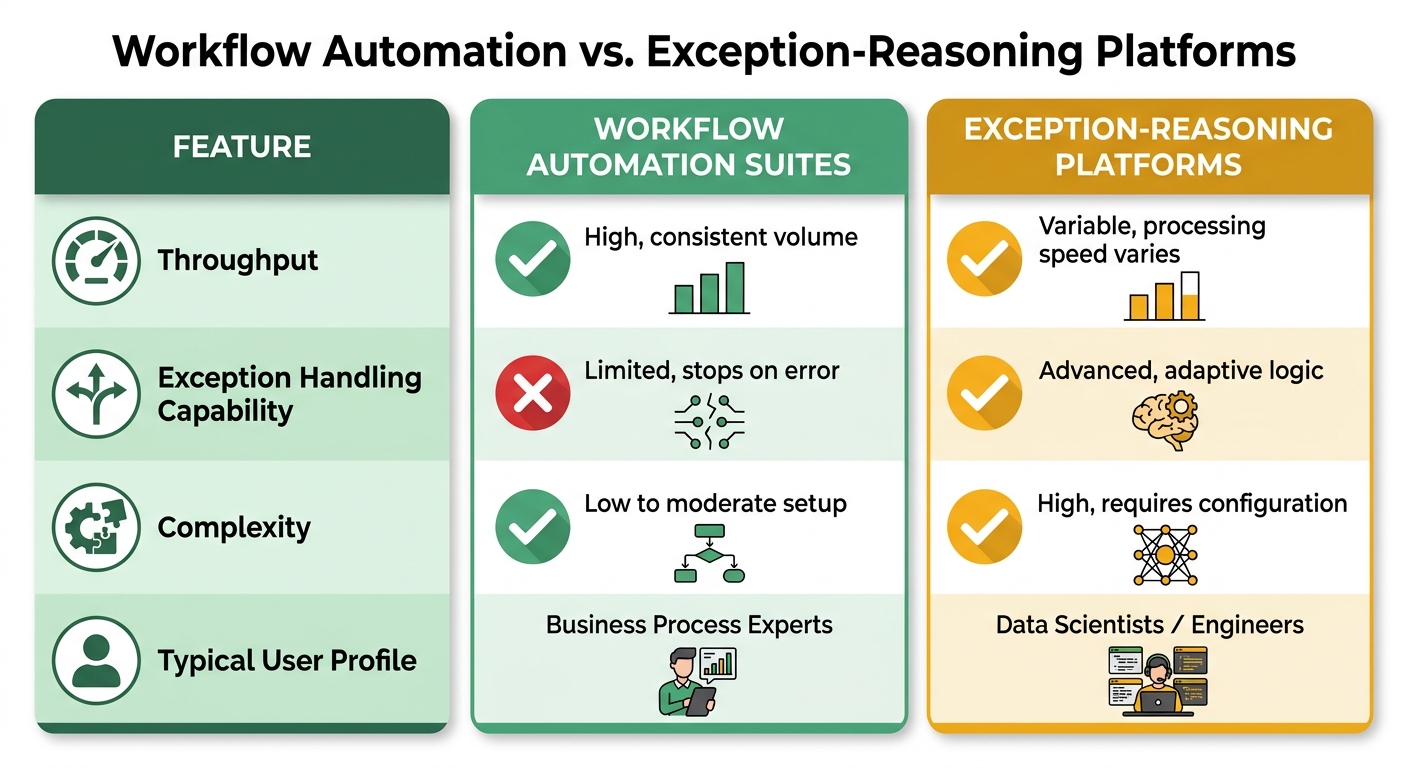
Workflow Automation Suites: Speed at the Expense of Exception Handling
These systems excel at high-volume, predictable transactions, providing reliable throughput for structured data. The limitation appears when payments deviate from the template. A partial payment on three invoices, an email remittance with no reference numbers, or a wire transfer from a renamed subsidiary—these land in manual queues because workflow automation routes exceptions rather than reasoning through them. You still pay people to decipher cryptic notes and match amounts by hand.
Modern API-first workflow tools deploy rapidly, allowing teams to automate standard collections and communications quickly. When standard payment flows dominate your receivables, these platforms deliver immediate operational relief. However, the cost equation tilts toward large enterprises. If you’re a mid-market SaaS company with 300 customers, you’re funding features you won’t use while your team still burns hours on the exceptions these tools sidestep.
Exception-Reasoning Platforms: Intelligence Where Rules Break Down
Kognitos and Ledge solve a different problem. Instead of maximizing throughput, they address the messy payments that consume most AR labor. That includes partial pays across multiple invoices, unstructured email remittances, and payments missing reference numbers entirely. By targeting the complex cases that consume the majority of AR labor, these platforms unlock significant hidden margin.
The strength here is genuine interpretation. Kognitos uses deterministic AI to read messy remittances in plain language, then documents every matching decision to satisfy audit requirements. Ledge connects to ERPs, banks, and payment processors to automate matching where traditional rule-based systems fail. One finance leader described it directly: “AI shines in the messy, judgment-heavy middle where rules break down.”
The tradeoff: these platforms process lower transaction volumes than workflow suites, so if you handle thousands of routine payments daily, you’ll need a separate system for high-volume throughput. And because exception-reasoning requires training the AI on your specific remittance patterns, such as customer naming conventions, payment timing, and common reference formats, setup takes longer than plug-and-play workflow automation.
All-in-One Platforms: Blixo’s Hybrid Approach
We built Blixo to bridge that gap. Our intelligent matching engine automates cash application at scale while handling the exceptions that burn most AR team hours, so you’re not forced to choose between volume and complexity. For SaaS subscription businesses, this matters because recurring billing generates predictable clean payments and usage-based edge cases that need intelligent matching, not just routing.
This approach simplifies the technology stack by connecting directly with major accounting software and ERPs. By combining automated matching with an intuitive review interface, the system continuously refines its accuracy based on historical adjustments, reducing software fatigue and training overhead. And because we designed the platform for small and mid-market companies, pricing reflects actual usage rather than enterprise premiums built for global deployments.
The limitation: if you’re processing payments across 50 subsidiaries in 30 countries with complex intercompany reconciliation, our scope targets smaller deployments. We excel at the SaaS subscription sweet spot—recurring invoices, usage-based billing, and the messy remittances that come with both—but we’re not optimized for massive multi-entity consolidations.
| Platform Type | Best For | Primary Strength | Exception Handling | Integration Speed |
|---|---|---|---|---|
| HighRadius / BlackLine | Large enterprises, high clean-payment volume | Rule-based throughput at scale | Routes to human queue | Weeks to months |
| Kognitos / Ledge | Mid-market teams drowning in messy remittances | Interprets unstructured data | AI reasons through exceptions | Moderate setup time |
| Blixo | SaaS subscription businesses | Balances volume and complexity | Intelligent matching with approval workflow | Quick setup via standard integrations |
One pattern emerges across successful deployments. Companies achieve measurable improvements the first month of full usage, but only when they’ve matched the tool category to their actual bottleneck. Choose workflow automation when your team spends most hours on high-volume clean payments. Choose exception-reasoning when messy remittances burn your time. And if you’re running a SaaS subscription business that needs both, platforms like ours eliminate the forced tradeoff by handling volume and complexity in a single deployment.
Use Cases and Ideal Users
When companies ask, the answer depends on where their AR bottleneck lives. We see three distinct user profiles emerge from real deployments: high-volume SaaS companies drowning in structured remittances, multi-channel businesses dealing with partial payments and deduction disputes, and lean finance teams that need one tool to handle both clean flows and messy exceptions without maintaining separate systems.
SaaS Subscription Businesses With Clean Payment Flows
If you run a subscription SaaS business where most customers pay via ACH or card with structured invoice references, workflow automation suites deliver the fastest time-to-value. Some specialized tools integrate with ERP systems like NetSuite and Dynamics through API connections, and deployment speed varies widely across the market.
Your bottleneck lives in payment matching speed, not exception reasoning. When remittance data arrives clean, invoice numbers match and amounts align. You need throughput, not judgment. High-volume AR automation platforms focus on processing structured payment data at scale. Companies in this category often process hundreds or thousands of payments monthly where pattern recognition matters more than context awareness.
Skip exception-reasoning platforms if your payment data already arrives structured. The added complexity won’t accelerate what already flows smoothly, and you’ll pay for capabilities your team won’t use.
Mid-Market Companies Handling Partial Pays and Short Pays
If your AR team spends hours reconciling partial payments, unstructured email remittances, and deduction disputes, you need exception intelligence over workflow speed. The messy cases—where invoice numbers are missing, amounts don’t match, or customers bundle multiple invoices without clear remittance data—create the most friction in mid-market operations.
Platforms built for this scenario tackle the judgment-heavy middle where rule-based matching breaks down. Finance directors report that their teams spend two to four hours daily on email archaeology: hunting through forwarded threads, parsing PDF attachments, and cross-referencing customer payment portals to piece together which invoices a wire transfer covered.
You’ll waste months on a workflow-first tool if exceptions burn most of your team’s hours. The vendors that advertise frictionless automation often optimize for the straightforward cases while leaving the hard problems in your team’s lap.
Lean Finance Teams Managing Both Clean and Complex Cases
Small-to-midsize businesses that can’t afford separate tools for workflow and exceptions need all-in-one platforms that handle both lanes without forcing you to toggle between systems. Blixo fits this profile by providing a unified workspace where a single analyst can oversee both automated collections and exception handling, eliminating the need to jump between disconnected software systems.
Your team doesn’t need to layer multiple vendors or maintain separate workflows for structured versus unstructured data. We see this approach work best: one system to route clean payments automatically while giving your team the tools to resolve exceptions efficiently.
The tradeoff: you won’t get specialized deployment timelines or ultra-deep exception engines built for enterprise-scale complexity. But you also won’t need to integrate two tools, train your team on separate interfaces, or pay for overlapping capabilities.
| User Profile | Best Fit | Primary Bottleneck | Skip If… |
|---|---|---|---|
| High-volume SaaS with clean ACH/card flows | Workflow automation platforms | Payment matching speed | You handle frequent partial pays or disputes |
| Mid-market with partial pays and deductions | Exception-reasoning tools | Resolving messy remittances | Your data already arrives structured |
| Lean teams managing both clean and complex cases | All-in-one platforms (Blixo) | Context-switching between tools | You need ultra-specialized exception logic |
Decision Factors: Match the Tool to Where Time Burns
Start by auditing where your AR team actually spends their day. Track how many payments require manual investigation versus straight-through processing. If the vast majority of your volume flows cleanly, a workflow suite will clear your backlog faster than a tool built for exceptions. If your team regularly fields customer inquiries about applied payments or spends meaningful time reconstructing payment intent from incomplete data, advertised throughput rates won’t solve your real problem.
Integration speed matters more than most comparison grids admit. Deployment timelines vary significantly across AR platforms, and faster implementations deliver ROI sooner. If you’re choosing between two platforms with similar capabilities, the one that goes live faster changes your breakeven timeline. Teams that get stuck in six-month implementation cycles often see initial enthusiasm fade before the system ever processes its first payment.
Human review queues remain essential even with AI automation. Tools that route complex cases to your team with suggested matches outperform platforms that attempt full autonomy on judgment calls. Your finance team knows customer history, dispute patterns, and edge cases that no algorithm will surface reliably. The best platforms recognize this reality and design workflows that augment human judgment rather than trying to replace it entirely.
Conclusion
When you’re asking platform to get invoices, the real answer depends on where your AR bottleneck lives. If you spend most of your time chasing clean payments from high-volume subscription customers, a workflow automation suite handles that efficiently. But if your team burns hours untangling partial payments, unstructured remittance emails, and deduction disputes, you need an exception-reasoning platform that interprets messy data without routing everything to a human queue.
We see the strongest results when companies match tool selection to their actual pain point rather than chasing advertised auto-match rates. A platform that posts 95% structured matches still fails if you lose three hours per exception on the remaining 5%.
When Workflow Automation Is the Right Fit
Workflow automation suites work best for subscription SaaS businesses with predictable payment patterns and structured remittance data. If most customers pay via ACH or card with clean invoice references, platforms that route high volumes quickly deliver the fastest time-to-value. You’ll see immediate gains in throughput and your team can focus on growth-stage collections strategy instead of posting payments manually.
Skip this approach if you regularly handle partial payments, customer-initiated adjustments, or remittances buried in email threads. Workflow tools flag those cases as exceptions, and your team ends up resolving them the same way they did before: manually.
When Exception-Reasoning Platforms Deliver ROI
Exception-reasoning tools make sense when your cash application team closes the month three days late because they’re reconciling payment discrepancies instead of posting receivables. The long-term ROI of exception-reasoning tools comes from eliminating manual detective work on complex cases, allowing teams to close the books faster and with greater accuracy.
The ROI comes from eliminating manual detective work on complex cases, not from speeding up clean payments.
The Hybrid Approach for Multi-Channel AR Teams
Finance teams managing both high-volume structured payments and frequent exceptions get the best results from a hybrid stack: a workflow suite for clean throughput paired with an exception-reasoning layer for messy cases. This setup avoids forcing one tool to handle tasks it wasn’t built for.
For growing teams, a unified platform like Blixo offers a balanced solution. It combines automated matching for structured payments with an intelligent system that learns from manual adjustments, providing a streamlined, user-friendly alternative to clunky legacy tools. You get automated remittance matching for structured payments with an intelligent system that learns from your team’s input on complex cases, all in a simple, human-friendly platform designed to replace clunky legacy AR tools.
| Use Case | Best Tool Type | Why It Fits |
|---|---|---|
| High-volume subscription SaaS with clean payment flows | Workflow automation suite | Handles structured remittances at scale with minimal setup |
| Multi-channel businesses with frequent partial payments and deductions | Exception-reasoning platform | Interprets messy data and resolves disputes without manual queues |
| Growing SaaS teams managing both clean and complex payments | Hybrid platform (Blixo) | Combines workflow speed with intelligent matching that learns from your team |
Companies using cash application software report up to 75% reductions in manual AR workload, but those gains only materialize when you pick the tool that addresses your actual bottleneck. If you’re handling messy remittances with a workflow-only suite, you’re automating the wrong 80%.
Frequently Asked Questions
1. What should I do if my AR team already uses a workflow suite like HighRadius or BlackLine but still struggles with DSO?
Add an exception-reasoning layer instead of replacing your existing platform. Top AR teams often run a workflow suite for clean payments plus a reasoning tool for messy remittances, combining strengths rather than betting everything on one vendor that claims to handle both types of automation equally well.
2. How do I know whether my bottleneck is workflow speed or exception complexity?
Track where your team actually spends time. If staff process hundreds of clean payments quickly but spend hours deciphering partial payments, cryptic wire references, or deduction codes, your constraint is exception reasoning, not throughput. High auto-match rates only prove you’re automating the easy part.
3. Why does deployment speed matter more for mid-market companies than enterprises?
Mid-market SaaS businesses and agencies need cash flowing this quarter, not after a three-month implementation. When you’re launching a new subscription tier or switching from spreadsheets, every week of manual AR work costs revenue. Enterprises with complex multi-region ERP integrations justify longer rollouts; smaller teams cannot afford that delay.
4. Can exception-reasoning tools handle compliance requirements like SOC 2 or HIPAA?
Exception-reasoning platforms that document every AI decision with a full audit trail meet compliance standards, but black-box systems introduce risk. Professional services firms juggling multiple clients need transparent logic for every cash application decision, so verify that the platform logs reasoning alongside transaction data before committing to deployment.
5. What happens if my payment volume is under 500 invoices per month?
Skip exception-reasoning tools entirely at that volume. The deployment overhead and learning curve outweigh the benefit when payment flows are small and predictable. Workflow automation or an all-in-one platform with straightforward setup delivers better ROI because you’re not funding enterprise features you won’t use.
6. How does intelligent matching improve over time compared to rule-based systems?
Machine learning platforms analyze manual edits and corrections to refine matching logic, continuously improving accuracy as the system processes more transactions. Rule-based systems require someone to update matching rules manually whenever customer remittance patterns change, which reintroduces the human bottleneck that automation was meant to eliminate.
7. What metric should I track to measure real AR automation ROI beyond auto-match rates?
Monitor unapplied-cash rates and manual-touch time per exception, not total transaction count. A platform that auto-matches 90% of payments but leaves the remaining 10% in human queues for days still creates a DSO problem. Real ROI shows up when exceptions clear autonomously and working capital frees up faster.