

Integrated Invoice-to-Cash Applications in 2026: What Changes for Esker, HighRadius, and Versapay Buyers

Key Takeaways
- Integrated invoice-to-cash platforms in 2026 range from entry-level SMB plans to six-figure annual enterprise contracts.
- HighRadius and Esker optimize post-invoice AR automation. Versapay adds buyer-seller messaging to reduce payment disputes.
- SaaS revenue leakage often starts at the subscription billing-to-invoice boundary, before collections teams get involved.
- HighRadius specializes in SAP S/4HANA and Oracle Fusion integrations for enterprises exceeding $100 million in annual revenue.
- Esker bases pricing on annual document volume, making it suitable for Fortune 500 companies processing high transaction counts.
- Versapay embeds buyer-seller communication in invoices to address missing remittance data and disputes.
- Mid-market platforms typically cost between $50,000 and $200,000 annually. They sit between SMB tools and enterprise suites.
Quick Comparison
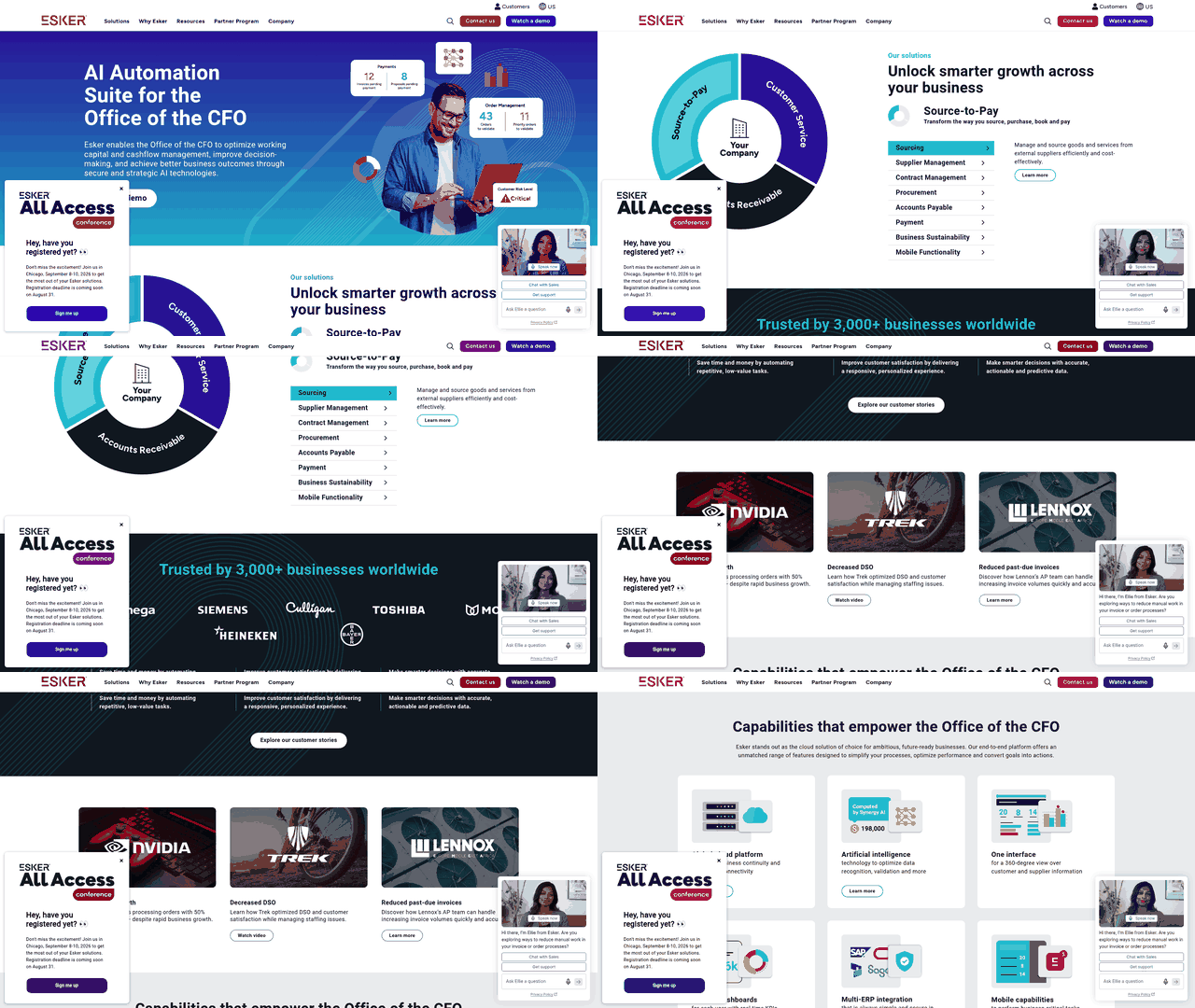
Integrated invoice-to-cash applications fall into distinct tiers based on company size. HighRadius, Esker, and Versapay compete at the enterprise and mid-market levels. Each platform targets a different point where revenue can leak during billing.
The main difference is operational philosophy. Traditional systems streamline internal ledger reconciliation. Collaborative platforms focus on communication with customers. For subscription businesses, risk often appears earlier, when contract terms become billing data.
How the Three Stack Up
| Feature | HighRadius | Esker | Versapay |
|---|---|---|---|
| Best for | Enterprises over $100M revenue with large AR teams | High-volume document processing (Fortune 500) | B2B companies prioritizing buyer collaboration |
| Core strength | Deep SAP S/4HANA and Oracle Fusion integrations | Tiered pricing based on annual document volume | Buyer-seller messaging embedded in invoices |
| AI focus | Autonomous remittance matching and payment forecasting | Workflow automation across order-to-cash | Collaborative dispute resolution |
| Pricing model | Custom enterprise (typically $300K+ first year) | Volume-based tiers favoring high throughput | Mid-market starting around $50K annually |
| Integration depth | Enterprise ERP-first (SAP, Oracle, NetSuite) | Multi-channel document capture and routing | Payment networks with 13M+ buyer connections |
HighRadius suits organizations with established, multi-person AR departments. Its system uses automated matching algorithms to ingest and reconcile high-volume payment data. This helps when manual ledger entry creates the main administrative bottleneck.
Esker focuses on document ingestion and routing. It captures billing documents from varied sources, including paper scans, EDI feeds, and email attachments. The platform converts them into structured data. This approach helps global organizations standardize billing formats across regional business units.
Versapay shifts attention outward by creating a shared portal for finance teams and customers. Clients can view, question, and pay invoices through one interface. This approach aims to reduce offline communication, which often contributes to outstanding days sales outstanding (DSO).
Where SaaS Buyers Face Different Risk
For recurring revenue businesses, risk often occurs before ledger entry. Variable usage, tiered subscriptions, and contract amendments can make invoice validation difficult. Standard AR tools may not verify whether generated invoices reflect contract terms. Billing errors can pass through downstream automation and cause disputes, regardless of processing speed.
The practical question is where your DSO problem begins. Is it slow payment matching, document-routing chaos, buyer disputes, or subscription billing errors? Match the bottleneck to the platform’s core strength, not its feature count.
Why Consider These Options
Teams evaluating integrated invoice-to-cash applications in 2026 often compare features before identifying revenue leakage. HighRadius, Esker, Versapay, and Blixo all automate accounts receivable. Each platform targets a different layer of the invoice-to-cash stack. Selection should begin with your bottleneck, not the vendor with the longest module list.
When Workflow Complexity Outweighs Feature Count
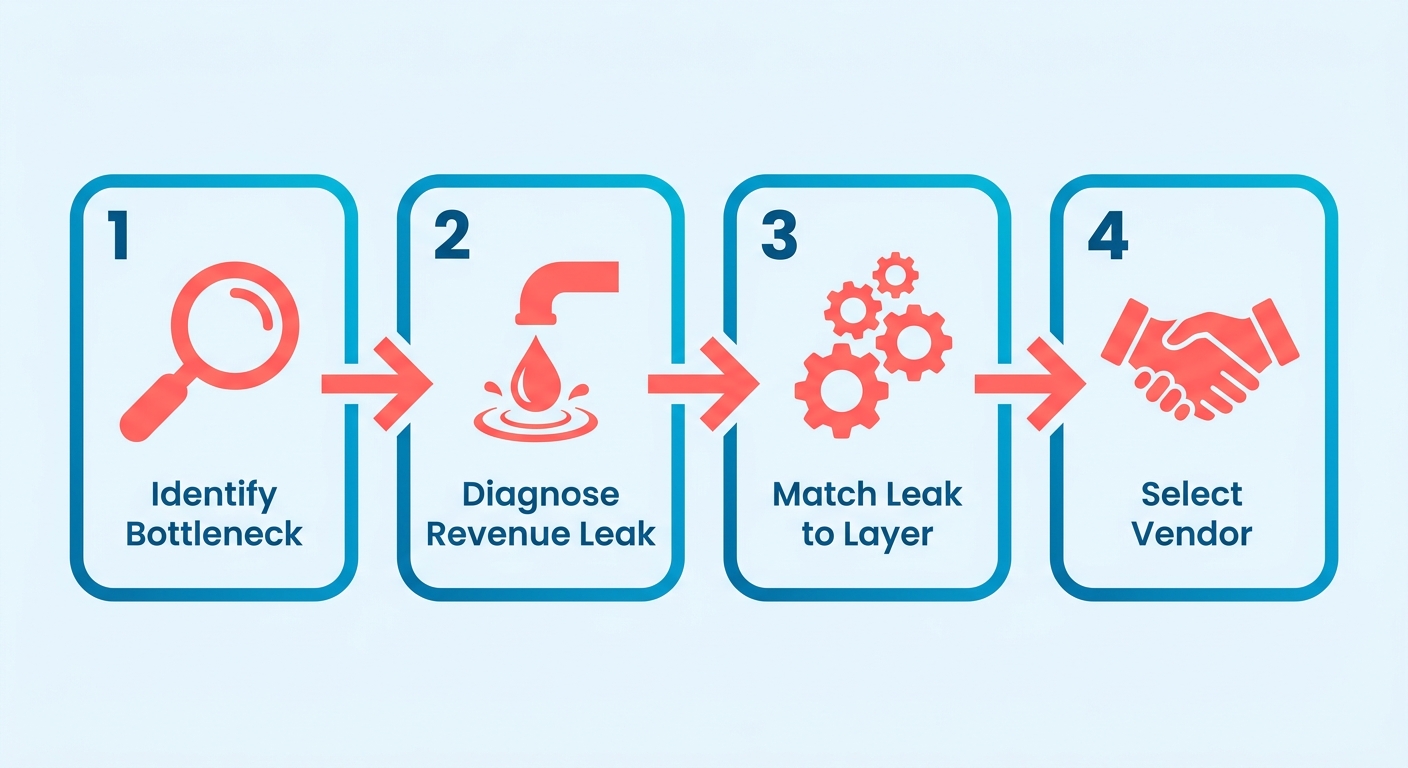
Operational alignment often predicts implementation success better than feature coverage. Legacy systems may assume billing data is accurate. They then focus on post-issuance work, including collection cadences and payment portals. That assumption can fail when contract amendments or complex pricing create inaccurate invoices. A platform like Blixo, which unifies subscription management with the AR ledger, can help prevent these errors from compounding.
When billing logic and ledger management operate separately, finance teams may make manual adjustments. These adjustments reconcile contract terms with actual payments. They also create compliance risks and administrative work. Businesses with dynamic pricing need tools that validate billing against active contracts. Otherwise, automation may distribute incorrect invoices and shift corrections to support and collections teams.
The Exception Layer vs. The Workflow Layer
High auto-match rates can mislead finance teams. Platforms may advertise strong cash application accuracy, but the remaining unmatched payments still matter. These include partial payments, disputed line items, and multi-currency remittances. Some teams resolve disputed invoices in days instead of weeks. That improvement can reduce DSO without changing clean-payment processing.
Manual resolution of short payments and disputed line items consumes staff time. Effective systems need routing logic that flags discrepancies and assigns them to the right account manager. Some platforms use customer communication portals. Others apply automated rules to categorize and queue exceptions internally. This lets analysts address high-value disputes first.
Selection Criteria That Actually Predict Fit
Start by mapping AR pain points to their source. Late or inaccurate invoices indicate an upstream billing problem. Collections automation will not fix it. Accurate invoices with unmatched payments require cash application intelligence. Customers disputing line items may need collaborative AR tools to reduce the exception backlog.
If one controller handles invoices part-time, enterprise suites like HighRadius may add unnecessary complexity. Teams could spend months configuring unused modules while revenue continues leaking at the billing stage. A platform suited to the current scale may be more practical. Teams can move to a heavier suite when AR becomes a dedicated function with specialized roles.
Buying for the wrong layer is a common mistake. Teams may purchase enterprise cash application when inconsistent invoice creation causes the problem. Diagnose whether DSO stems from workflow speed, exception complexity, or billing accuracy. A workflow suite for structured data combined with targeted exception tools may outperform one platform attempting to solve everything.
Feature Comparison
The key feature gap in integrated invoice-to-cash applications is architectural focus. HighRadius, Esker, Versapay, and Blixo all automate accounts receivable. The right choice depends on the revenue-cycle bottleneck you need to solve.
Where Cash Application Accuracy Meets Exception Handling
Reconciliation depends heavily on payment-data ingestion. Enterprise systems can connect directly to bank lockboxes and clearinghouses. They pull structured remittance files for processing. Mid-market organizations often parse unstructured sources, including email confirmations and PDF receipts. The system converts these formats into standardized ledger entries.
The operational test comes when payments do not match outstanding balances. The system must isolate unpaid invoice amounts while applying received funds correctly. Automated deduction management can resolve partial-payment disputes faster than spreadsheets. This prevents small discrepancies from stalling entire accounts.
Enterprise platforms prioritize real-time synchronization with financial ledgers. Credit limits and customer balances update across global entities. Other platforms emphasize document lifecycle management. They provide secure archiving and audit trails for high-volume international billing.
Collaborative AR Versus Post-Invoice Automation
A collaborative approach requires customer participation. Platforms need self-service portals where buyers can view statements, schedule payments, and submit inquiries against line items. Success depends on customer adoption. Buyers using external channels may limit the portal’s impact.
Finance teams report fewer disputes and shorter resolution cycles when customers use these portals. The approach works when delays involve administrative questions or minor billing issues. Bulk payments across multiple bank accounts create a different challenge. In those cases, processing throughput and ledger integration remain essential.
| Feature | HighRadius | Esker | Versapay | Blixo |
|---|---|---|---|---|
| Primary optimization layer | Post-invoice AR automation | Document workflow at scale | Collaborative buyer-seller AR | Subscription billing integration |
| Cash application speed | High (AI-powered matching) | High (volume-optimized) | Moderate | High (intelligent matching) |
| Exception handling | Rule-based workflows | Tiered document routing | Collaborative dispute resolution | Approval workflow with ML |
| ERP integrations | Deep SAP, Oracle, NetSuite | SAP, Oracle, Microsoft | Moderate depth | QuickBooks, Xero, Sage Intacct, NetSuite |
| Best for | Enterprise order-to-cash suites | High-volume document processing | Customer engagement-driven AR | SaaS recurring revenue teams |
The Subscription Billing Blind Spot
Recurring revenue businesses must align billing schedules with contract terms. Variable usage, tiered pricing, and mid-month upgrades complicate that work. Traditional AR tools may not verify compliance with revenue recognition standards. Errors may require correction after the invoice reaches the customer.
Unifying subscription management with AR lets contract updates flow into billing automatically. A single data model can calculate usage charges and apply prorations before invoice generation. Machine learning in the approval workflow can learn from manual adjustments. This may improve billing accuracy and reduce post-issuance credit notes.
Subscription revenue errors can compound across renewal cycles. Research suggests that many SaaS companies discover leakage during annual audits. At that point, contract terms and billed amounts may diverge. Tiered pricing and consumption-based models can make this gap a major source of disputes and delayed collections.
Performance Comparison
Processing speed matters most under real collection workloads. Platforms differ in record throughput, exception latency, and concurrent-user capacity. These metrics determine whether AR teams clear backlogs or manage unresolved exceptions.
When Record Volume Defines Your Bottleneck
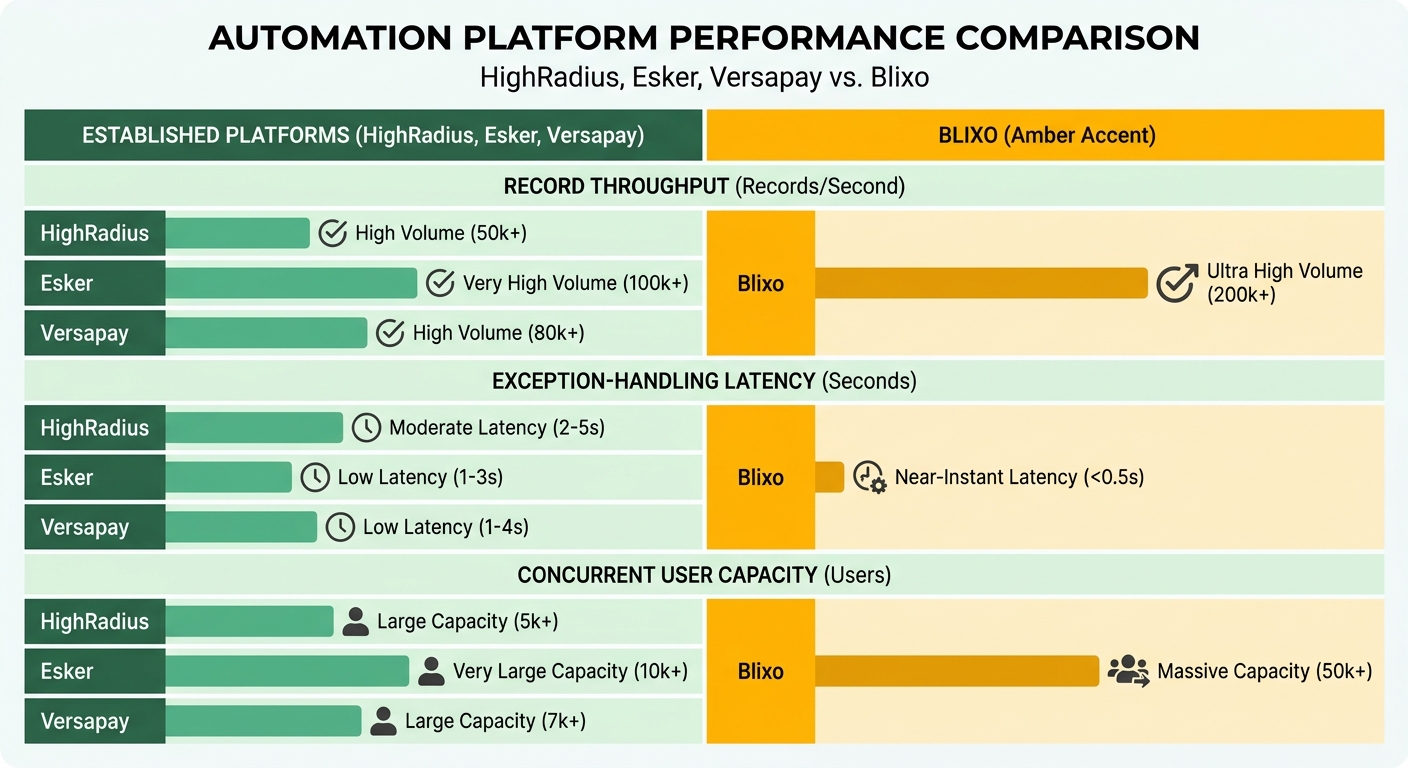
Platforms built for high-transaction environments process cash applications at different scales. Bluecopa’s Samyx Recon engine processes over 5 million records per hour at 97-99% accuracy. This benchmark matters for teams reconciling tens of thousands of payments daily across subsidiaries or currencies. It matters less when the main constraint involves unresolved payments, partial remittances, dispute deductions, or missing reference numbers.
Exception queues become the bottleneck when they grow faster than teams can clear them. A platform may process millions of monthly payments with high match accuracy and still create many exceptions. Researching each exception can require several minutes. The resulting workload may equal multiple full-time employees. Faster matching cannot help if the unmatched remainder overwhelms the team.
Pre-reconciliation validation offers another way to manage exceptions. Customers can flag billing discrepancies or submit remittance details before payment. This resolves issues before they enter the ledger. Moving from reactive dispute resolution to proactive validation can reduce unmatched transactions during peak periods.
Scalability Under Concurrent Load
Performance may decline when analysts, cash application clerks, and dunning workflows run simultaneously during month-end close. A platform may handle transaction volume in isolation but slow when many users query payment status, apply cash, and generate aging reports. This is especially likely during the final days of a quarter.
Bluecopa’s unified O2C architecture uses distributed query processing across its integrated data layer. It maintains sub-2-second response times when 25+ users access overlapping datasets during quarter close. This matters when analyst productivity, rather than overnight batch capacity, limits performance.
Data synchronization latency can also affect performance. High volumes of usage data may need simultaneous processing and billing. API limits and batch delays can create bottlenecks. Billing architecture must support rapid data transfers without reducing system responsiveness. This is necessary for accurate, real-time financial reporting.
Resource Consumption and Infrastructure Overhead
A platform’s infrastructure requirements can increase with transaction volume. Cloud applications may maintain response times at lower volumes but degrade as volume rises. Higher-tier infrastructure may then become necessary. Finance teams increasingly test simulated peak loads before committing. Advertised specifications rarely account for concurrent month-end activity.
Esker requires minimal ongoing IT maintenance for teams using standard ERP configurations. Its document layer operates separately from core financial systems through EDI and PDF parsing. It avoids deep database integrations that can break during ERP updates. This reduces DevOps work but creates a tradeoff. Customer master data and GL account updates do not automatically sync to Esker’s document layer. Periodic manual alignment remains necessary.
Bluecopa’s unified data layer consolidates Order-to-Cash, Procure-to-Pay, and Record-to-Report through one integration point. Teams do not need separate AR, AP, and GL reconciliation connectors. This can reduce integration breakpoints and ongoing DevOps costs for mid-market teams without ERP specialists.
Self-service document retrieval can also improve administrative efficiency. Customers can access historical invoices, payment receipts, and tax documents independently. This reduces routine finance inquiries. Staff can focus on strategic accounts and complex collections.
What Integrated Invoice-to-Cash Applications Win At (and What They Don’t)
HighRadius offers broad enterprise module coverage in 2026. Its modules span credit management, billing, cash application, collections, and dispute resolution. This breadth helps AR teams managing tens of thousands of monthly invoices across multiple ERPs. Implementation remains a tradeoff. Enterprise deployments often take six to nine months. The platform also requires finance resources for configuration and workflow mapping. HighRadius may justify that effort when teams process structured remittances with few exceptions.
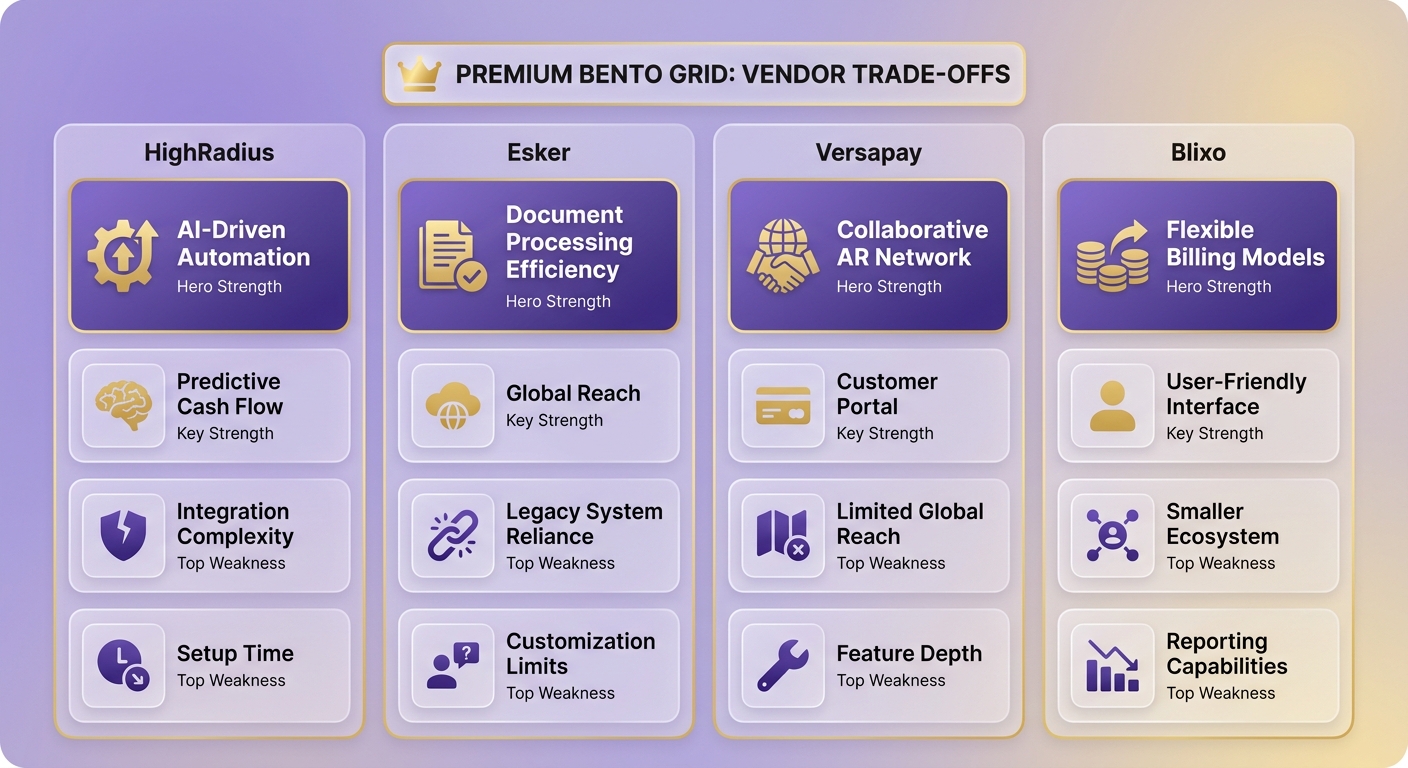
Esker’s licensing model suits organizations with variable staffing and predictable transaction volumes. Pricing by document throughput allows broad internal access without increasing seat costs. However, customized billing terms and complex regional taxes may require frequent manual template adjustments. Those changes may be necessary for local regulatory compliance.
Versapay’s portal-based approach suits businesses with concentrated customer bases and high-touch service needs. Centralized communication can resolve questions about payment terms or delivery discrepancies. However, high-volume, low-value transactions may need automated clearinghouse matching instead. A communication-focused portal could add unnecessary payment steps.
Where the Unified Approach Changes the Equation
Maintaining data integrity across separate systems challenges subscription businesses. Billing engines, CRM platforms, and accounting ledgers may operate independently. Reconciling those systems requires extensive manual work. A unified system reflects upgrades and cancellations in the ledger automatically. It also creates an audit trail and reduces unbilled usage risk.
Removing middleware reduces system complexity and integration costs. Usage data and billing schedules operate alongside accounts receivable. Customer updates can then occur in real time. Payments can be matched to originating contract terms. This reduces the work required to close books each month.
The carve-out: skip Blixo if your business uses simple, fixed-price invoicing without subscription complexity. Companies billing the same amount to the same customers monthly may not need contract-to-cash automation. They need fast payment acceptance and collections workflows, which HighRadius and Billtrust handle at massive scale. Subscription billing logic adds overhead these businesses will not use. Blixo suits recurring revenue models where billing variability drives DSO, rather than payment matching speed.
| Platform | Best For | Implementation Timeline | Weak Spot |
|---|---|---|---|
| HighRadius | Enterprise teams processing 50K+ invoices monthly with deep ERP integrations | 6-9 months | Exception-heavy payment scenarios; long implementation cycles |
| Esker | High-volume document processing with minimal IT resources | 3-5 months | Reasoning layer for complex remittances; limited subscription billing support |
| Versapay | Mid-market buyers requiring invoice clarification before payment | 2-4 months | Lower transaction throughput in high-volume reconciliation scenarios |
| Blixo | SaaS and subscription businesses with recurring billing and AR automation needs | Contact for timeline | Overkill for fixed-price invoicing; not optimized for non-recurring revenue |
When Pricing Structure Affects Total Cost
Many enterprise vendors now emphasize an “agentic” or “autonomous” approach. Pricing sensitivity, however, has risen faster than AI capability claims. Some platforms add per-transaction fees to annual platform costs. This can penalize high-volume, low-value invoices common in SaaS and usage-based billing. Finance teams increasingly model transaction fees with subscription costs. Base fees can grow substantially when per-invoice charges reach scale.
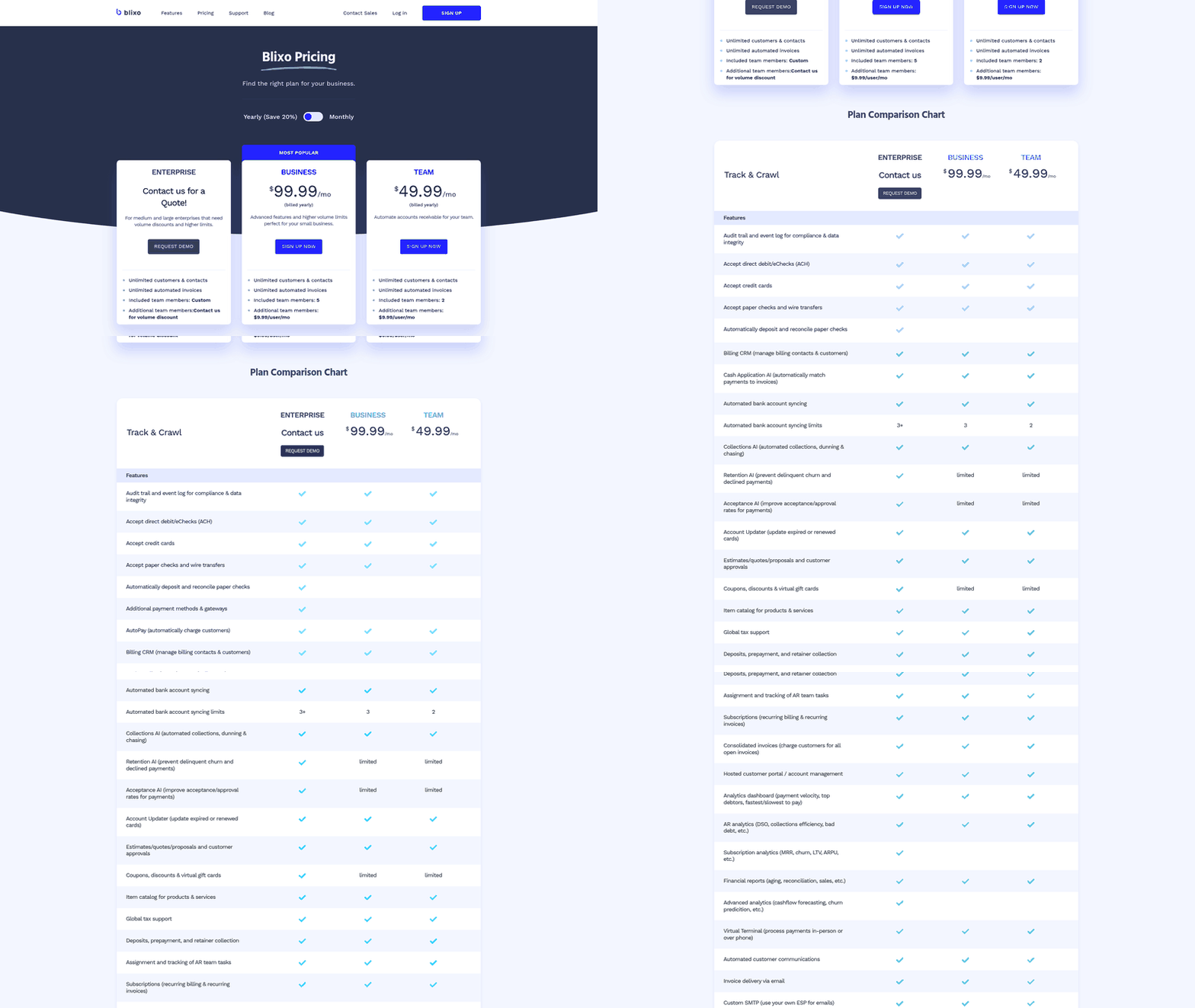
Blixo offers predictable subscription pricing. The Team plan starts at $49.99/month. The Business plan starts at $99.99/month when billed yearly. Additional team members cost $9.99/user/month. This model supports invoice-volume growth without escalating processing charges. Blixo does not offer the same credit risk modeling or dunning customization as HighRadius. Large enterprises may need those features for hundreds of customer credit profiles. If credit decisions matter more than billing accuracy, Blixo’s feature set may not cover that need.
Use Cases and Ideal Users
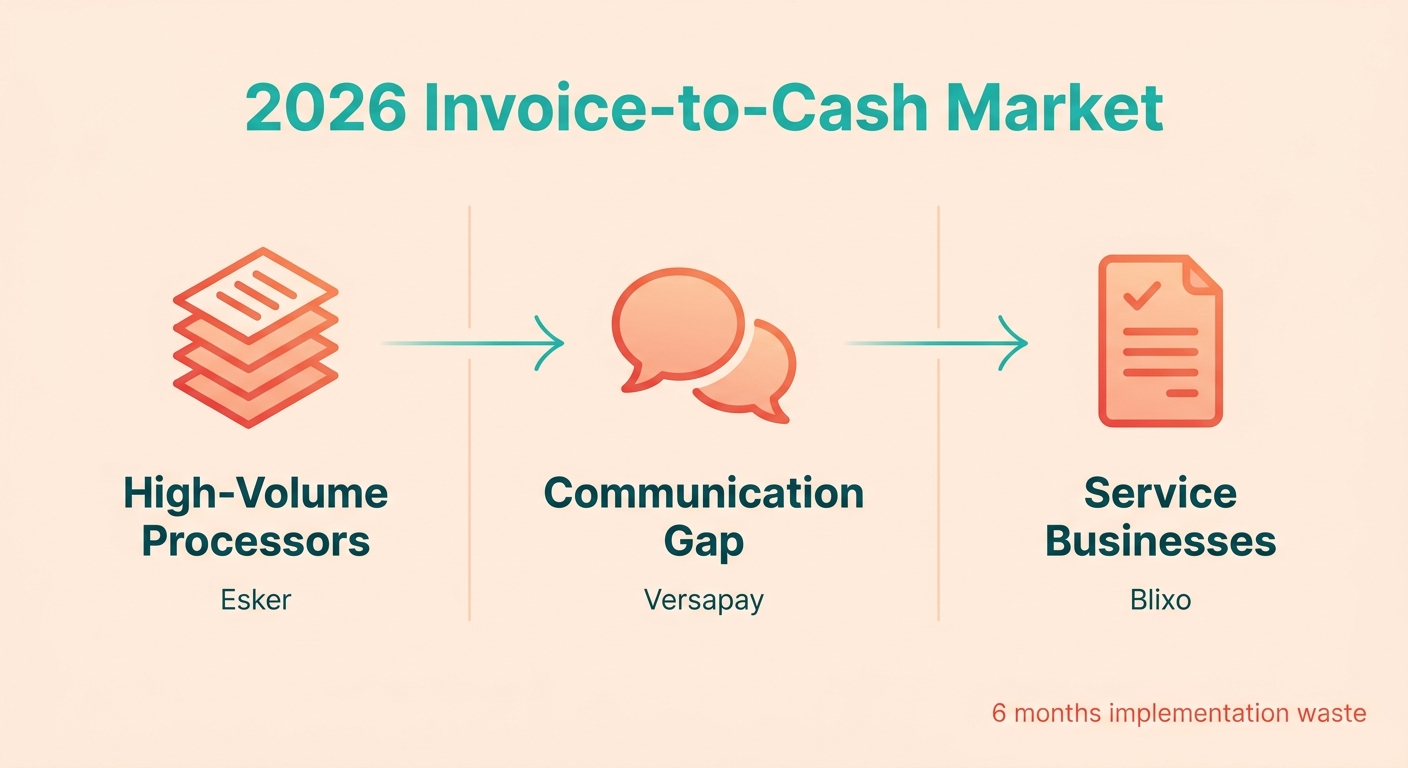
Three buyer profiles stand out in the 2026 invoice-to-cash market. Choosing the wrong tier can create more friction than staying manual. Esker targets high-volume document processors that prioritize transaction cost per invoice. Versapay suits payment delays caused by buyer-seller communication gaps. Blixo serves service businesses and agencies seeking straightforward invoice-to-payment workflows. Companies outside these profiles may spend months implementing tools for problems they do not have.
When Subscription Billing Creates the Actual Leakage Point
Organizations with variable billing structures must translate contract terms into accurate invoices. Manual usage tiers, prorations, and mid-cycle upgrades create opportunities for errors. Specialized platforms like LedgerUp can automate this process by reading contract terms and generating invoices. This helps maintain billing accuracy from the start.
Volume Processing vs. Exception Complexity
Enterprise buyers must choose between raw transaction volume and complex exception handling. Billtrust processes over $1 trillion in invoiced volume annually across a network of 13 million buyers. This makes it suitable for enterprises with predictable, high-volume payment flows. Persistent backlogs involving unmatched payments, partial remittances, or multi-currency transactions require a different approach. Advanced deduction management may provide more value than faster matching.
What Defines Your Actual Bottleneck
Teams that correctly identify their constraint can reduce DSO meaningfully within the first quarter. Adding automation modules alone will not close the gap. Companies often misdiagnose the problem in three ways.
First, they assume invoicing speed drives DSO when inconsistent customer follow-up causes the delay. Second, they buy workflow automation when the problem lies in exception handling. Partial payments and disputed charges may never auto-match. Third, they prioritize ERP integration depth when their revenue model does not fit standard billing cycles.
If revenue stalls because invoices are late, usage charges are missed, follow-up is inconsistent, or reconciliation takes too long, begin with the stalled stage. Do not choose the vendor with the longest module list.
Budget predictability also affects platform selection. Tiered volume pricing can reduce costs at scale. It can also create unexpected expenses when volumes exceed contract thresholds. Portal-based communication tools depend on customer adoption. Buyers using their own accounts payable systems may not produce the expected efficiency gains.
What to Do Next
Selecting an integrated invoice-to-cash application requires a clear view of billing bottlenecks. The main challenge may involve cash application, buyer communication, or cross-functional reconciliation. The platform must address that operational need. Otherwise, complex enterprise modules may fail to resolve payment delays.
Match Your Bottleneck to the Right Platform Layer
HighRadius suits large enterprises with complex ERP environments and deep integration requirements. Its broad module coverage can standardize AR processes across business units. The organization must have enough IT resources and administrative capacity for a detailed, multi-month deployment.
Esker suits organizations standardizing document delivery and routing across global operations. Its architecture handles large volumes of incoming billing documents. It works best when the goal is reducing manual document handling rather than managing complex payment disputes.
Versapay addresses payment delays through buyer-seller communication. Its shared interface centralizes dispute resolution and payment inquiries. This makes it suitable for businesses where customer relationships and high-touch service shape collections.
When Subscription Billing Defines the Leakage Point
Recurring revenue businesses must address billing accuracy before invoice generation. Post-invoice automation tools manage collections and reconciliation well. They cannot correct billing-calculation errors. Tight integration between the billing engine and AR ledger helps prevent those upstream discrepancies.
A unified platform reduces the data silos that cause billing errors. Subscription updates, usage metrics, and payment records remain together. This reduces manual-entry errors. Finance teams can maintain accurate records without complex middleware.
Implementation Readiness Determines ROI Timeline
The time from contract signature to measurable DSO improvement varies by platform. Organizational readiness explains much of that difference. HighRadius requires finance-team availability for configuration workshops. Expect weekly sessions across multiple quarters. Understaffing can add months to go-live timelines.
Esker’s setup depends on consistent invoice formats. Clients with standardized AP workflows typically deploy faster. Reconciling templates across several subsidiaries takes longer. Versapay moves fastest when buyers already use self-service payment methods. Adoption lags when customers expect paper checks and phone calls.
Blixo deploys immediately for teams moving from spreadsheets or basic invoicing tools. SaaS companies replacing Zuora or Chargebee face more complex data migration. That complexity extends onboarding. Blixo supports standard subscription models out of the box. Custom revenue recognition rules and complex amendments require API configuration, adding weeks to deployment.
The Diagnostic Framework That Predicts Implementation Success
The most common mistake in 2026 is evaluating platforms by advertised AI capabilities. First identify which invoice-to-cash layer causes DSO drag. Many enterprise vendors emphasize an “agentic” or “autonomous” approach. These systems focus on cash application and payment forecasting. Those capabilities matter only when cash application is the bottleneck. Faster matching will not resolve subscription billing errors or contract-to-invoice mismatches.
Review outstanding AR and categorize past-due invoices by their main delay cause. Unresolved customer questions indicate a need for communication tools. Manual reconciliation of high-volume payments indicates a need for an enterprise matching engine. Billing calculation errors require a unified subscription and ledger system.
Frequently Asked Questions
1. If my invoices are already accurate, which platform reduces DSO fastest for high-volume B2B payments?
For accurate billing data, the choice depends on existing IT infrastructure. One approach uses deep, native ERP integration to automate ledger updates for large finance departments. The other ingests and routes diverse document formats. It helps standardize billing across subsidiaries without extensive custom development.
2. When does collaborative AR actually compress payment cycles versus just adding another portal customers ignore?
Collaborative AR tools work best when communication causes payment delays. Examples include minor billing questions and missing documentation. Organizations must onboard customers actively and provide an easy interface. Internal reconciliation bottlenecks require automated matching engines instead.
3. Why do SaaS companies face different revenue leakage risks than traditional B2B invoice-to-cash workflows?
Subscription models vary with usage, contract terms, and mid-cycle adjustments. Disconnected contract and AR systems can create calculation errors before invoice generation. Traditional AR tools process existing invoices. They cannot detect or correct upstream billing discrepancies.
4. What causes high auto-match rates to mislead finance teams evaluating invoice-to-cash platforms?
High match rates can hide the workload from unmatched transactions. Even a small exception percentage can create a major backlog. The important measure is how efficiently the platform routes, categorizes, and resolves partial payments and disputed deductions.
5. How do mid-market companies avoid paying for enterprise features they won’t use for three years?
Mid-market organizations should match platforms to their current capacity. Enterprise suites often require extensive configuration and dedicated administrators. A modular solution can automate core billing and collections first. Teams can add advanced features as the finance department grows.
6. Does platform performance degrade during month-end close when multiple analysts access the system concurrently?
System responsiveness can decline during month-end close. Multiple users may run reports and apply payments simultaneously. Ask vendors about concurrent-user capacity and database architecture. Distributed data layers can maintain performance under heavy workloads.
7. Which integration approach reduces ongoing DevOps overhead for mid-market teams without dedicated ERP specialists?
Integration architecture affects long-term maintenance costs. Standardized file parsing minimizes update-related connection failures. It may still require periodic manual data alignment. A unified data platform uses one connector for multiple financial workflows. This reduces failure points but requires more initial setup.
This analysis helps finance teams evaluate integrated invoice-to-cash applications against operational bottlenecks. Platform capabilities and pricing structures change frequently. Verify current details directly with vendors before making procurement decisions.