

What Gartner’s 2026 criteria mean for integrate accounts receivable cloud

In short:
- Some analyst frameworks now describe automated cash application and collections as core AR cloud requirements, not bolt-ons.
- AI-assisted collections can be configured to automate dunning, capture promise-to-pay commitments in message threads, and prioritize collector worklists using next-best-action recommendations trained on B2B transaction data.
- Cloud-first finance migrations can create integration gaps because cloud financial systems may lack some GL workflow depth found in legacy on-premise platforms.
- Modern AR platforms are often expected to reduce manual export-reconcile loops by automating remittance matching using advice information and learning from manual edits.
- AI-driven collection automation may deliver ROI only at meaningful volume. With a small overdue invoice count, process overhead may exceed manual effort saved.
What Gartner’s 2026 AR cloud criteria actually mean for your evaluation
For finance teams comparing accounts receivable cloud platforms, evaluation themes increasingly shift the buying conversation from “does this tool send reminders?” to “can this platform run core invoice-to-cash work without spreadsheet workarounds?” The strongest themes are functionality depth, AI-assisted collections, cloud finance fit, and proof that the vendor can connect cleanly to the systems your AR team already uses.
Publicly available materials do not provide a Blixo-specific Gartner scorecard, implementation-effort rating, or ROI timeframe. Absence of evidence is not absence of feature, but it does mean you verify claims in live demos rather than accepting product pages at face value.
The practical verdict: a Gartner-aligned AR cloud evaluation should confirm operational capability, AI-agent readiness, integration reliability, and customer proof before concluding that any vendor meets the new bar.
Requirements Matrix: Modern AR Cloud vs Legacy Baseline
| Capability | Legacy/Manual AR Baseline | Modern AR Cloud Target State | Blixo (TBD—Pending Product Documentation) |
|---|---|---|---|
| Cash Application | Manual remittance matching; export ERP data to spreadsheets | Automated matching using remittance advice; learning from manual edits | Public materials mention AI-powered cash application and an intelligent matching engine; verify in demo |
| Collections | Reactive follow-ups; collectors manage their own queues | Automated personalized dunning; promise-to-pay capture in-thread; next-best-action prioritization | Public materials mention automated collections, chasing, dunning via email/SMS/phone/letters; verify in demo |
| Cloud Integration | Export invoices; reconcile payments offline | Direct ERP sync; no export step | Public materials mention QuickBooks, Xero, Sage Intacct, NetSuite integrations; custom ERP integrations; verify in demo |
| AI-Assisted Intelligence | None | Collections agents prioritize high-value accounts; churn prediction; acceptance rate optimization | Public materials mention subscription analytics and churn prediction; feature depth not independently confirmed |
| Order-to-Cash Data Scale | Isolated AR data; no benchmarking | Access to B2B transaction benchmarks for risk scoring | No public data lake claims found; customer validation needed |
Use this matrix as a starting point. The “TBD” column reflects what public materials suggest, not what a live demo or customer reference will confirm.
What Gartner now demands as core functionality
The core change is that AR cloud software can no longer present browser-based receivables tracking as modernization by itself. Gartner-style evaluation frameworks increasingly push vendors toward operational ownership of the invoice-to-cash workflow: matching incoming payments to open invoices, using remittance advice intelligently, triggering collections activity, and supporting disputes, deductions, and credit-risk handling inside the receivables process.
That matters because the AR layer increasingly carries work that older finance stacks handled through deeply embedded workflows. If your receivables platform cannot interpret payment context, surface exceptions, and coordinate follow-up, your team may end up rebuilding the same old spreadsheet process around a newer interface.
AI-assisted collections and order-to-cash intelligence
AI accounts receivable agents are most useful when they reduce the number of routine decisions collectors must make. The supported buyer persona may be the CFO assessing, piloting, and operationalizing these agents, but the daily users are usually AR clerks, credit managers, and collections teams who need better prioritization rather than more dashboards.
The strongest systems combine customer history, invoice behavior, payment patterns, and collections outcomes so the software can recommend what to do next instead of simply logging what already happened. This is where order-to-cash intelligence becomes more than workflow automation—the platform may help identify which accounts need attention, which communications are likely to work, and which issues should be escalated before they become write-offs.
There is a scope limit. If your receivables book is small and predictable, a disciplined manual process may still be simpler than configuring a full AI-assisted workflow.
Cloud finance fit and reduced manual effort
Cloud-first change is part of broader finance-system migration and market disruption, not a proven AR-specific mandate on its own. The implication for SaaS billing and receivables tools is straightforward: they can show that cash application works as part of the finance environment, not as a disconnected sidecar.
A modern AR platform can be configured to reduce the number of judgment calls that land on your finance team’s desk. Policy-driven decision rules, orchestration layers, capture tools, classification logic, and prioritization can move routine items forward while reserving ambiguous cases for human review. The point is not to hide complexity; it is to route complexity to the right person with enough context to act.
The available research does not provide vendor-level implementation rankings or guaranteed payback windows. Treat public claims as hypotheses to test. Stop exporting ERP data to reconcile payments by hand walks through the manual-effort pain points these platforms are meant to eliminate.
Evaluating vendors against Gartner’s Magic Quadrant logic
If you are borrowing Gartner-style Magic Quadrant logic, remember that there may not be a dedicated Cloud AR Magic Quadrant. Some analyst coverage has focused on cloud core financial management applications, but that broader category does not necessarily give a definitive ranking of receivables point solutions.
A useful framework still starts with two lenses: ability to execute and completeness of vision. Ability to execute covers whether the vendor can deliver today through stable integrations, active customers, reliable support, security maturity, and documented performance. Completeness of vision covers whether the roadmap reflects where receivables is heading: AI-assisted cash application, multi-entity support, usage-based billing models, and richer invoice-to-cash intelligence.
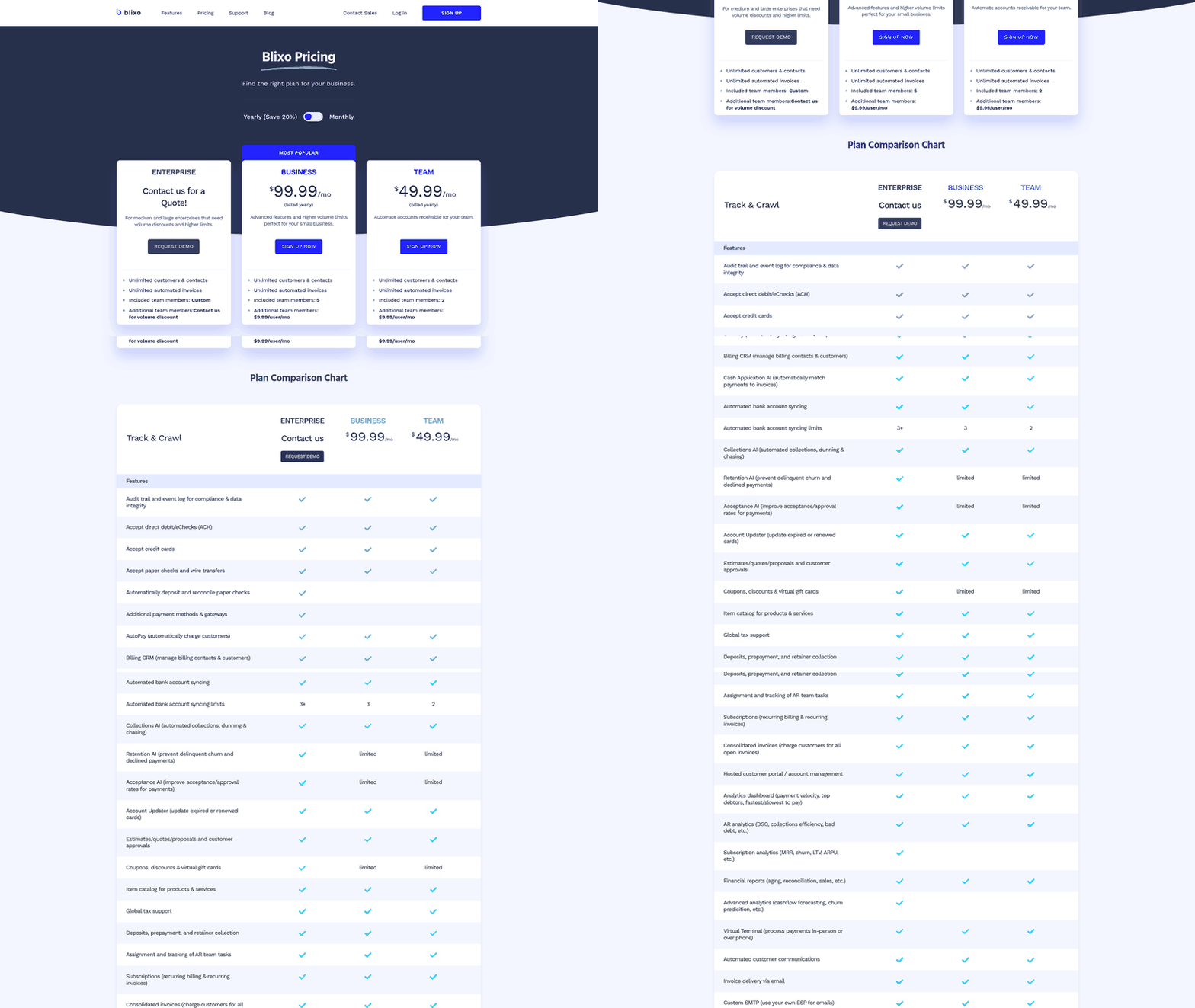
For standalone AR vendors, the execution bar is especially integration-heavy. They are expected to work cleanly with major ERPs and the long tail of mid-market finance systems. Public materials describe Blixo integrations with QuickBooks, Xero, Sage Intacct, and NetSuite, and custom ERP integrations for Oracle, SAP, and Microsoft Dynamics. You should verify their depth in demos.
Red flags to verify in live demos
Public materials often make integration sound cleaner than it is. In demos, ask the vendor to show the actual path a payment takes from receipt to invoice match to posting. Look for weak spots: manual CSV steps, partial remittance ingestion, thin multi-currency support, dunning workflows that still require review on every message, unclear handling of payment data, ERP mappings that break under real customer references, and limited proof from companies that resemble yours.
The most revealing tests happen in sandbox environments. A vendor that claims intelligent matching can be asked to show how the configured engine handles ambiguous references, partial payments, multiple invoices paid together, and corrections made by users. Slide decks can describe automation; test data shows whether it survives the messy cases your AR team handles every week.
Implementing a Gartner-aligned AR cloud
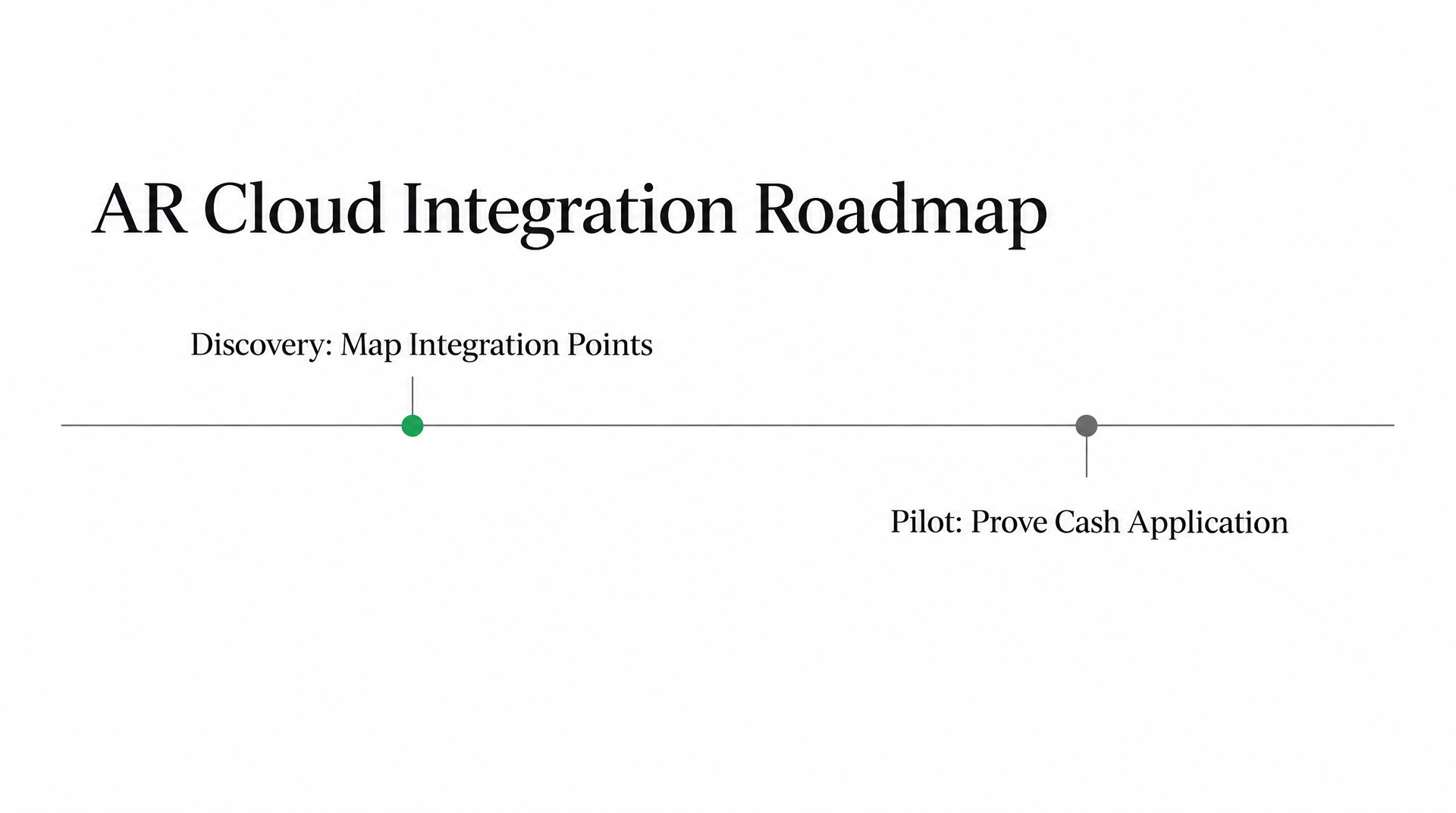
An AR cloud implementation aligned to those evaluation themes is not a one-sprint configuration exercise. Discovery, pilot, full deployment, and post-launch optimization form the standard arc. Each phase needs clear ownership across finance, IT, credit, and operations, because receivables automation touches customer communication, accounting accuracy, and systems architecture at the same time.
Discovery: map integration points before you write code
Start by cataloging every system that touches receivables data today. Your ERP holds invoice master records. Your payment gateway captures remittance advice. Your CRM tracks customer contact history and dispute notes. If you export CSV files to reconcile payments by hand, that export is a data integration point you need to replace, not replicate. Document the frequency of each data flow, the format it arrives in, and who owns reconciliation when mismatches surface.
Evaluation frameworks often flag integration maturity as a key execution criterion. For implementation planning, translate that into concrete questions: which fields must sync, which system is the source of truth, how quickly updates must post, and what happens when the AR platform and ERP disagree. Identify which remittance formats your customers use—EDI 820, email with PDF attachments, wire transfer reference codes—and confirm whether your chosen platform can parse or map those formats without manual data entry.
Phased pilot: prove cash application before full rollout
Run a pilot with a constrained invoice population. One business unit or customer segment that represents your complexity without risking the entire receivables book. Configure dunning workflows, test cash application logic against real remittance files, and measure how often the system matched payments automatically versus flagging exceptions for manual review. If your pilot shows lower auto-match rates than expected on straightforward payments, the root cause may be incomplete remittance parsing or missing customer reference mapping, not a flaw in the platform.
Train a cross-functional team during the pilot: AR clerks who apply cash daily, credit managers who escalate disputes, and IT staff who maintain integrations. Hands-on testing surfaces workflow friction that demos never reveal. Document every exception case the pilot surfaced and confirm the platform can handle each one at scale before expanding.
Where AI and automation take AR cloud next
The next generation of AR cloud is less about adding another collections dashboard and more about making receivables systems active participants in finance operations. AI accounts receivable agents are one of the clearest trends discussed in AR cloud evaluations. They take on repeatable collections and classification work while leaving finance teams to handle judgment-heavy exceptions, customer-sensitive escalations, and policy decisions.
The intelligence layer behind these agents may depend on broad order-to-cash data. Leading AR platforms could build O2C data sets spanning large transaction volumes, invoices, and buyer populations—the scale needed to train next-best-action models that suggest which accounts to prioritize, which payment terms to offer, and which disputes warrant immediate escalation. This data-backed approach may be more sustainable than static rule-based dunning, because rule-based dunning without learning can deteriorate when your customer mix shifts.
This evolution also changes competitive pressure. Receivables tools that stay narrow may be treated as temporary workflow patches, while platforms that connect invoice data, payment behavior, customer communication, and ERP posting can become harder to replace. The winners may be the systems that make finance teams faster without forcing them to surrender control over exceptions, approvals, and customer relationships.
What the available research does not support: predictive-dunning ROI benchmarks, 2028 market-size forecasts, blockchain invoicing adoption timelines, or regulatory impacts on cross-border AR automation. Verify those claims in live vendor demos rather than accepting them from product pages, because the evidence is not public yet.
Common Questions
Should I skip AI-powered AR automation if my company only has a handful of overdue invoices each month?
Usually, yes. If the workload is small, start with cleaner reminder templates, tighter payment terms, and better internal ownership before buying a system designed for higher-volume receivables operations.
Why does Gartner’s 2026 redefinition matter more than just adding new buzzwords to vendor marketing?
If the described 2026 criteria reflect actual analyst research, they matter because they change what buyers should demand in evidence. Instead of accepting “AI collections” or “cash application” as labels, ask vendors to demonstrate the workflow from payment receipt through matching, exception handling, customer follow-up, and ERP update.
What’s the real integration problem created when my finance team migrates to cloud ERP systems?
The risk is fragmentation. Billing, payments, customer notes, dispute history, and accounting records can end up in separate systems unless the AR platform becomes the connective layer that keeps receivables activity synchronized.
How do I verify a vendor’s claimed AI-assisted collections capability before I buy?
Use your own data in a pilot. Include ordinary invoices, partial payments, unclear references, dispute messages, and customer segments with different payment behavior. The goal is to see how the system handles real operating conditions, not polished demo examples.