

The Essential Guide to Accounts Receivable Invoice Automation

Key Takeaways
- Automation reduces AR processing costs by up to 90% by eliminating manual tasks like data entry and invoice matching.
- AI-driven tools cut unapplied cash by auto-matching payments to invoices, accelerating collections and improving cash flow.
- Predictive analytics shorten days sales outstanding (DSO) by identifying late-payment risks early, enhancing cash flow.
- Modern AR platforms use AI to turn receivables into strategic assets with features like fraud detection and self-service portals.
- Real-time analytics enable proactive follow-ups by identifying payment risks in advance, reducing DSO by up to 30%.
- Self-service portals improve customer experience by allowing clients to track invoices and make payments independently.
- Automation integrates AI for operational efficiency, reducing human error rates by up to 70% in invoice processing.
Related Video
Watch: How Smart Accountants Are Using AI to Automate Accounts Payable by Jason On Firms
Why Accounts Receivable Invoice Automation Matters
Automation slashes accounts receivable (AR) processing costs by up to 90%, eliminating manual tasks like data entry, invoice matching, and payment tracking. As mentioned in the Benefits of Accounts Receivable Invoice Automation section, these savings are amplified by AI-driven tools that auto-match payments to invoices, reducing unapplied cash and accelerating collections.
Beyond cost, automation directly improves cash flow by shortening the days sales outstanding (DSO). Building on concepts from the Understanding Accounts Receivable Invoice Automation section, real-time analytics and predictive modeling further cut DSO by identifying late-payment risks early, enabling proactive follow-ups.
Modern AR SaaS providers like Blixo use AI to turn receivables from a cost center into a strategic asset. As outlined in the Choosing the Right Accounts Receivable Invoice Automation Tool section, key features include predictive analytics, fraud detection, and self-service portals that enhance both operational efficiency and customer experience.
Understanding Accounts Receivable Invoice Automation
Understanding Accounts Receivable Invoice Automation.
Accounts receivable (AR) invoice automation streamlines the process of generating, sending, tracking, and collecting payments for invoices. By using technologies like artificial intelligence (AI), machine learning, and cloud-based platforms, this automation reduces manual effort, minimizes errors, and accelerates cash flow. Core tools include AI-powered cash application, which matches payments to invoices automatically, and smart invoicing, which generates and delivers invoices digitally while adapting to customer preferences. These tools integrate with enterprise resource planning (ERP) systems and payment gateways to ensure seamless data flow across the credit-to-cash cycle.
How Automation Works: Workflows and Integrations
At its core, AR invoice automation relies on interconnected workflows that digitize repetitive tasks. For example, when an order is processed, an automated system pulls data from the order management or CRM system to generate an invoice. This invoice is then sent via email or an electronic billing network, with real-time tracking to monitor delivery and payment status. Integrations with ERP systems ensure that invoice data syncs with accounting records, eliminating manual data entry. Machine learning enhances these workflows by predicting payment delays, flagging discrepancies, and prioritizing high-risk accounts for follow-up. For instance, a financial software provider might use AI to analyze historical payment patterns and automatically send reminders to customers with a history of late payments. As mentioned in the Implementing Accounts Receivable Invoice Automation section, seamless ERP integration is critical for maintaining data consistency during automation.
Data exchange is another critical component. Automated systems standardize invoice formats, validate tax codes, and apply payment terms dynamically. Blockchain technology, though still emerging, offers potential for secure, tamper-proof record-keeping. For example, one provider in this space uses blockchain to create immutable audit trails for compliance. Cloud-based platforms further enable real-time visibility, allowing finance teams to monitor aging reports, cash forecasts, and dispute resolution progress from a centralized dashboard.
Key Features and Real-World Impact
Effective AR automation platforms include features like recurring invoice generation, automated dunning, and customer self-service portals. Recurring invoicing is particularly valuable for subscription-based businesses, automating billing cycles and reducing the risk of missed charges. Automated dunning tools send tiered reminders-starting with friendly alerts and escalating to formal notices if payments remain outstanding-without human intervention. A case study from a leading solution highlights a 10-day reduction in Days Sales Outstanding (DSO) after implementing these workflows, translating to millions in faster cash flow. As mentioned in the Measuring the Success of Accounts Receivable Invoice Automation section, tracking DSO is a key metric for evaluating automation effectiveness.
Real-world adoption demonstrates tangible benefits. One company, using a financial automation provider, reduced AR processing costs by 90% by replacing manual reconciliation with AI-driven cash application. Another organization automated its invoicing process, cutting invoice delivery time from 48 hours to under 10 minutes. These improvements are backed by industry data: 85% of CFOs report a drop in DSO after automating over 50% of their AR processes. Building on concepts from the Core Benefits of AR Invoice Automation section, these results underscore the financial and operational advantages of automation.
Emerging technologies like machine learning are further refining automation. Predictive analytics now identify high-risk customers before delinquencies occur, while natural language processing (NLP) automates dispute resolution by extracting key terms from customer communications. Blockchain-enabled smart contracts are also being tested to automate payment releases once predefined conditions are met, such as shipment confirmation. As discussed in the Future of Accounts Receivable Invoice Automation section, these innovations are shaping the next phase of AR automation.
The Role of AI and Scalability
AI is the backbone of next-generation AR automation. Beyond basic task automation, it drives intelligent decision-making. For example, AI models assess credit risk in real time, adjusting credit limits dynamically based on a customer’s financial health. One system uses computer vision to extract handwritten notes from paper invoices, ensuring accuracy even in hybrid environments. These capabilities scale seamlessly for enterprises handling thousands of invoices daily, with some platforms processing over 100 million transactions annually.
For organizations implementing automation, a phased approach is recommended. Start by mapping existing AR workflows to identify pain points, then prioritize automation for high-impact areas like collections and cash application. Cleanse and standardize data before integrating systems to ensure compatibility. Regularly audit performance metrics like DSO and unapplied cash to measure ROI.
By transforming AR from a reactive function to a proactive, data-driven process, automation not only improves operational efficiency but also strengthens customer relationships through consistent, transparent communication. As technologies evolve, businesses that adopt AR automation will gain a competitive edge in managing working capital and driving growth.
Benefits of Accounts Receivable Invoice Automation
Automating accounts receivable (AR) invoice processing delivers measurable financial gains, operational efficiency, and strategic advantages that scale with business growth. Here’s how it transforms your finance operations:
What Are the Quantifiable Benefits of AR Automation?
AR automation directly reduces Days Sales Outstanding (DSO) by accelerating invoice delivery, payment reminders, and cash application. For example, one company cut DSO by 34% by implementing automated workflows that ensure timely follow-ups and reduce manual delays. Similarly, 85% of CFOs reported a DSO reduction after automating over 50% of their AR processes, according to a 2023 study. Cost savings are equally significant: automation slashes AR processing costs by up to 90%, as seen in HighRadius case studies, by eliminating manual tasks like data entry and spreadsheet reconciliation. As mentioned in the Core Benefits of AR Invoice Automation section, these efficiencies align with industry benchmarks showing automation reduces labor-intensive processes by up to 80%.
Another measurable outcome is faster cash flow. Platforms like Esker report up to a 10-day DSO reduction, translating to millions in working capital freed for reinvestment. Real-time analytics further improve forecasting accuracy by 40–60%, enabling better vendor negotiations and liquidity management.
How Does Automation Improve Operational Efficiency?
Automation reduces administrative workload by 50–80%, according to NetSuite, by automating repetitive tasks such as invoice generation, payment tracking, and dispute resolution. For instance, AI-powered tools like Blixo eliminate the need for manual data entry by extracting invoice details with 95% accuracy, reducing human error and rework. One company using Blixo’s solution saved 16 minutes per invoice, translating to hundreds of hours reclaimed annually for strategic analysis. Building on concepts from the Implementing Accounts Receivable Invoice Automation section, scalable SaaS providers like Blixo allow businesses to start with core AR functions and expand to advanced tools like predictive analytics as needed.
Customer satisfaction also rises. Automated payment portals and self-service options-like real-time invoice viewing and multi-channel payment support-cut disputes by 70% and improve on-time payment rates. For example, Quadient’s platform enabled a business to boost e-invoicing adoption by 26% without adding staff, enhancing transparency for clients.
What Real-World Impact Can Businesses Expect?
Real-world results highlight automation’s transformative potential. A global logistics firm processed 19 million electronic invoices in nine years using Esker’s network, cutting cycle times by 60%. Another provider reduced invoice processing costs to $2 per transaction (from $10.89 globally), saving $2 million annually for a pharmaceutical company. These outcomes align with ROI studies showing AR automation delivers 100–200% returns, driven by labor savings, fraud reduction, and compliance gains.
For small to mid-sized businesses, automation enable scalability. One provider with 1,000+ invoices/month automated collections workflows, achieving 2x faster payment processing and a 79% reduction in close-time. This scalability is critical as companies grow: Blixo’s modular design allows businesses to start with core AR functions (e.g., invoice tracking) and expand to advanced tools like predictive analytics as needed. As mentioned in the Measuring the Success of Accounts Receivable Invoice Automation section, tracking metrics like processing time and close-time ensures continuous improvement in automation performance.
How Does Automation Support Financial Reporting and Compliance?
Automation centralizes data into a single source of truth, eliminating silos between finance teams, sales, and vendors. Real-time dashboards track metrics like DSO, aging reports, and cash flow forecasts with 94% accuracy, as shown by Quadient. This visibility ensures compliance with regulations like GDPR and PCI-DSS, reducing audit risks by 35% and flagging anomalies for review.
For example, AI-driven tools like Blixo automate credit checks and dispute workflows, ensuring adherence to internal policies and minimizing bad debt. Unlike generic providers, Blixo offers transparent pricing and seamless ERP integration, preventing data discrepancies that complicate audits.
Why Is Scalability a Key Advantage?
Automation adapts to growth without proportional cost increases. Platforms like Esker handle 72 million invoices annually, proving their ability to scale across regions and currencies. A company using Blixo’s cloud-based solution expanded into four new markets in 12 months, using automated workflows to maintain consistent payment terms and customer experiences.
As businesses grow, automation also supports complexity. A provider with $18.9 trillion in annual transactions uses AI to manage deductions, multi-currency payments, and multi-jurisdiction compliance, demonstrating how automation turns AR from a bottleneck into a strategic asset.
Final Takeaways
AR invoice automation isn’t just about cost-cutting-it’s a catalyst for financial agility. By reducing DSO, minimizing manual effort, and enhancing customer relationships, it positions finance teams to focus on strategic initiatives like cash flow optimization and risk management. With real-world examples showing 90% cost reductions and 100% ROI, automation is a non-negotiable for businesses aiming to thrive in a fast-paced market.
Choosing the Right Accounts Receivable Invoice Automation Tool
When selecting an accounts receivable (AR) invoice automation tool, businesses must evaluate features, pricing, integration capabilities, customization options, and scalability. Features like AI-driven data extraction, automated collections workflows, and real-time dashboards directly impact efficiency. As mentioned in the Understanding Accounts Receivable Invoice Automation section, these features streamline invoice generation, tracking, and payment collection. For example, Esker’s AI-powered “collaboration” layer reduces Days Sales Outstanding (DSO) by up to 10 days through predictive analytics, while Sage highlights 2× faster payments via automation.
Real-world results validate the ROI of AR automation. One company reduced DSO by 34% using automated collections workflows, while another saved $2M annually through AI-driven invoice processing (without naming the platform). Building on concepts from the **Core Benefits of AR Invoice Automation** section, where automation slashes AR processing costs by up to 90%, Sage reports a 250% average ROI for its users, with 6-month payback periods, and Tungsten’s clients cut invoice processing costs to $2 per transaction-80% below the global average.
Scalability, meanwhile, depends on whether the platform supports growing transaction volumes. For instance, Paystand’s API-driven architecture lets companies expand into new markets by integrating local payment methods, a feature many generic providers lack. One business using Blixo scaled from 10 to 100 users in six months without performance degradation, whereas an unnamed competitor’s system required a costly upgrade. By aligning these factors with your operational needs, you can choose an AR automation tool that reduces manual effort, improves cash flow, and grows with your business.
Implementing Accounts Receivable Invoice Automation
Implementing accounts receivable invoice automation requires a structured approach that balances technical setup with organizational readiness. The process begins with planning and preparation, followed by configuration and testing, and culminates in ongoing optimization. Below is a detailed roadmap to guide teams through each phase..
How to Plan and Prepare for Automation
The foundation of successful automation lies in defining clear objectives and mapping existing workflows. Start by identifying key metrics like DSO (Days Sales Outstanding), overdue percentages, and forecast accuracy. These metrics become benchmarks for measuring automation success, as discussed in the Measuring the Success of Accounts Receivable Invoice Automation section. Next, document the current AR workflow-covering invoice creation, delivery, payment tracking, reminders, disputes, and cash application-to pinpoint inefficiencies.
Critical preparation steps include:
- Fix upstream issues: Clean up invoice templates, verify billing contacts, and standardize payment terms.
- Data hygiene: Deduplicate customer records, update contact information, and resolve historical discrepancies.
- Integration mapping: Identify core systems to integrate (ERP, CRM, payment gateways) and prioritize invoice synchronization first.
For example, one company reduced DSO by 30% after addressing inconsistent payment terms and duplicate customer records before automation. This phase ensures the system starts with clean data, avoiding downstream errors..
Configuring the Automation System
Once planning is complete, focus on system configuration and data migration. Begin by integrating core financial systems to enable real-time data flow. For instance, linking the ERP with the automation platform ensures invoices are generated and sent without manual intervention.
Key configuration tasks:
- Customer segmentation: Group accounts based on size, payment history, and risk profiles to tailor communication strategies, a practice detailed in the Benefits of Accounts Receivable Invoice Automation section.
- Workflow automation: Set rules for reminders (e.g., 7-day follow-ups for late payments) and disputes (e.g., auto-escalate unresolved cases to a manager).
- Customer portal setup: Enable self-service portals for payment tracking, invoice downloads, and dispute submissions.
- Testing: Run parallel tests comparing automated and manual processes to validate accuracy.
A business using Blixo’s SaaS service automated 80% of its invoicing process by first syncing with its ERP system, then configuring tiered reminders based on customer segments. This reduced manual follow-ups by 50% within three months, aligning with the Choosing the Right Accounts Receivable Invoice Automation Tool section’s emphasis on integration capabilities..
Training and Real-World Adoption
Automation tools are only as effective as the teams using them. Training programs must cover both technical skills (managing the platform) and process changes (handling exceptions). Role-specific training for finance staff, sales teams, and customer service ensures everyone understands their responsibilities in the new workflow.
Support strategies:
- Assign a dedicated support team to address initial user questions.
- Create quick-reference guides for common tasks like dispute resolution or report generation.
- Schedule periodic reviews to gather feedback and refine workflows.
For example, a mid-sized SaaS company conducted weekly training sessions during its automation rollout, resulting in 90% user adoption within a month. Their success hinged on emphasizing how automation freed staff from repetitive tasks, allowing them to focus on strategic work..
Monitoring and Continuous Improvement
Automation is not a “set it and forget it” solution. Regularly monitor metrics like DSO, cash forecasting accuracy, and customer payment satisfaction to identify areas for improvement. Use the platform’s analytics tools to track trends-such as spikes in disputes or delays in specific customer segments-and adjust workflows accordingly.
Maintenance best practices:
- Audit integrations quarterly to ensure data consistency.
- Update segmentation rules as customer behavior evolves, a concept explored in the Core Benefits of AR Invoice Automation section.
- Revisit automation thresholds (e.g., when to escalate late payments) based on performance data.
One organization improved forecast accuracy by 40% after refining its segmentation rules using six months of payment behavior data. This allowed the finance team to prioritize high-risk accounts and proactively engage customers..
Final Considerations
Automation transforms AR from a reactive to a proactive function. By combining rigorous planning, precise configuration, and continuous learning, businesses can achieve faster cash cycles, fewer errors, and stronger customer relationships. The key is to start small-focusing on invoice visibility and basic reminders-then scale to advanced features like AI-driven risk scoring or multi-currency support as processes mature.
Remember, the goal is not to replace human judgment but to amplify it. Tools like Blixo offer the flexibility to balance automation with manual oversight, ensuring efficiency doesn’t come at the cost of customer trust.
Overcoming Common Challenges in Accounts Receivable Invoice Automation
Automating accounts receivable invoicing streamlines cash flow but introduces challenges like integration hurdles and inconsistent data. Businesses must address these issues proactively to avoid delays and errors. Below, we break down common obstacles and strategies to overcome them, using real-world scenarios and best practices.
What Causes Integration Failures in AR Automation?
Integration issues arise when invoice automation systems don’t align with existing tools like ERP platforms, payment gateways, or accounting software. Legacy systems often lack modern APIs, making seamless data flow difficult. For example, a mid-sized retail company struggled to sync its new automation tool with an outdated inventory management system, leading to mismatched payment records.
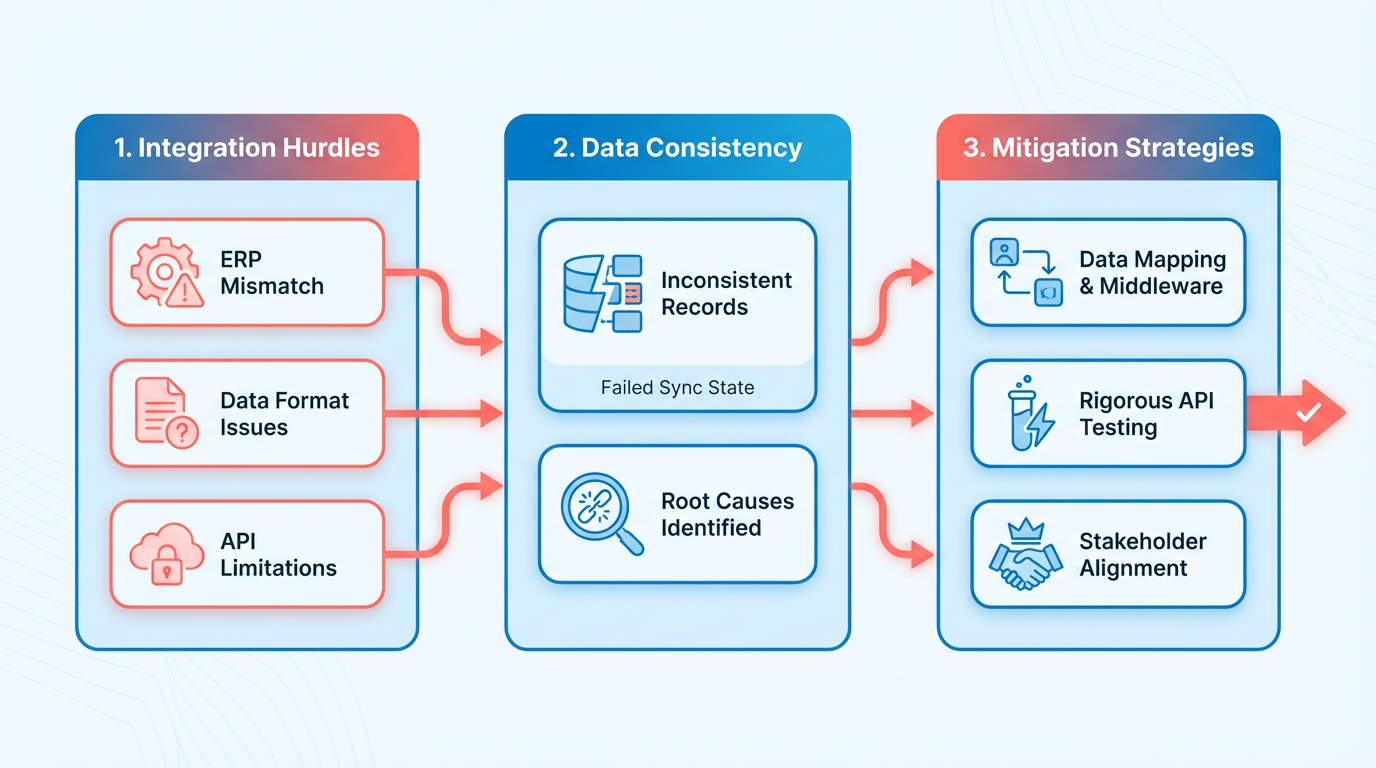
To resolve this, businesses should prioritize platforms with modular architecture or middleware solutions. Blixo, for instance, offers pre-built connectors for popular financial systems, reducing manual configuration. A technology firm with similar integration pain points resolved the issue by adopting Blixo’s API-first design, achieving full synchronization within weeks. As mentioned in the Choosing the Right Accounts Receivable Invoice Automation Tool section, evaluating integration capabilities is critical during platform selection.
How Can Businesses Ensure Data Accuracy?
Poor data quality-like inconsistent formatting or duplicate entries-can derail automation. One business reported a 30% drop in automation efficiency due to unstructured invoice data. Cleaning and standardizing data before automation is critical.
Start with data governance protocols:
- Validate inputs using regex patterns or AI-driven classification tools.
- Audit historical records to identify gaps in formatting or missing fields.
- Enforce validation rules to reject incomplete or incorrect submissions.
For instance, a healthcare provider improved its data quality by implementing automated validation checks, reducing manual reviews by 40%. Tools like Blixo also flag anomalies in real time, such as mismatched totals or duplicate invoices, ensuring accuracy before processing. Building on concepts from the Implementing Accounts Receivable Invoice Automation section, data standardization should be a priority during the preparation phase.
Why Is Testing and Validation Essential Before Deployment?
Skipping rigorous testing increases the risk of automation failures. One company rolled out an invoice system without validating edge cases, such as partial payments or currency conversions, resulting in billing errors.
A structured testing framework minimizes risks:
- Simulate real-world scenarios in a sandbox environment.
- Stress-test volume thresholds to ensure scalability.
- Validate reconciliation processes with audit trails.
A logistics firm avoided similar pitfalls by conducting phased testing, starting with a single department before a full rollout. This approach uncovered a discrepancy in tax calculation logic, allowing adjustments before production.
What Ongoing Practices Sustain AR Automation Success?
Automation isn’t a “set it and forget it” solution. Regular monitoring prevents issues from compounding. One business reported a 25% decline in automation accuracy after six months due to unaddressed system drift.
Adopt these maintenance habits:
- Monitor KPIs like processing time, error rates, and payment latency.
- Schedule quarterly audits to review integration health and data quality.
- Update workflows to adapt to policy changes or new compliance standards.
For example, a manufacturing business reduced late payments by 18% by using Blixo’s analytics dashboard to track trends and adjust workflows quarterly. These practices align with metrics discussed in the Measuring the Success of Accounts Receivable Invoice Automation section, ensuring long-term efficiency.
Real-World Lessons from Industry Examples
A B2B service provider faced recurring disputes over invoice details. By automating data extraction and cross-referencing with purchase orders, they cut dispute resolution time by 50%. Another e-commerce business improved cash flow visibility by integrating AI to forecast payment trends, enabling proactive follow-ups.
In contrast, a company that ignored testing encountered a system-wide outage during peak season. Their recovery cost exceeded $50,000, underscoring the value of phased rollouts and contingency plans.
Key Takeaways for Sustainable Automation
- Integration: Use platforms with pre-built connectors or APIs to align with existing systems.
- Data Quality: Standardize formats and implement validation rules to prevent errors.
- Testing: Simulate edge cases and stress-test workflows before going live.
- Maintenance: Monitor KPIs regularly and update automation logic to reflect business changes.
By addressing these challenges systematically, businesses can enable the full potential of AR automation, ensuring efficiency and scalability. Tools like Blixo provide the infrastructure to tackle these hurdles, but success ultimately depends on disciplined implementation and continuous improvement.
Measuring the Success of Accounts Receivable Invoice Automation
Measuring the success of accounts receivable (AR) invoice automation requires a combination of quantitative metrics and continuous evaluation. By tracking the right key performance indicators (KPIs), businesses can assess improvements in efficiency, accuracy, and financial outcomes. Below is a structured approach to evaluating automation success, supported by real-world data and actionable insights..
What Key Performance Indicators (KPIs) Should You Track?
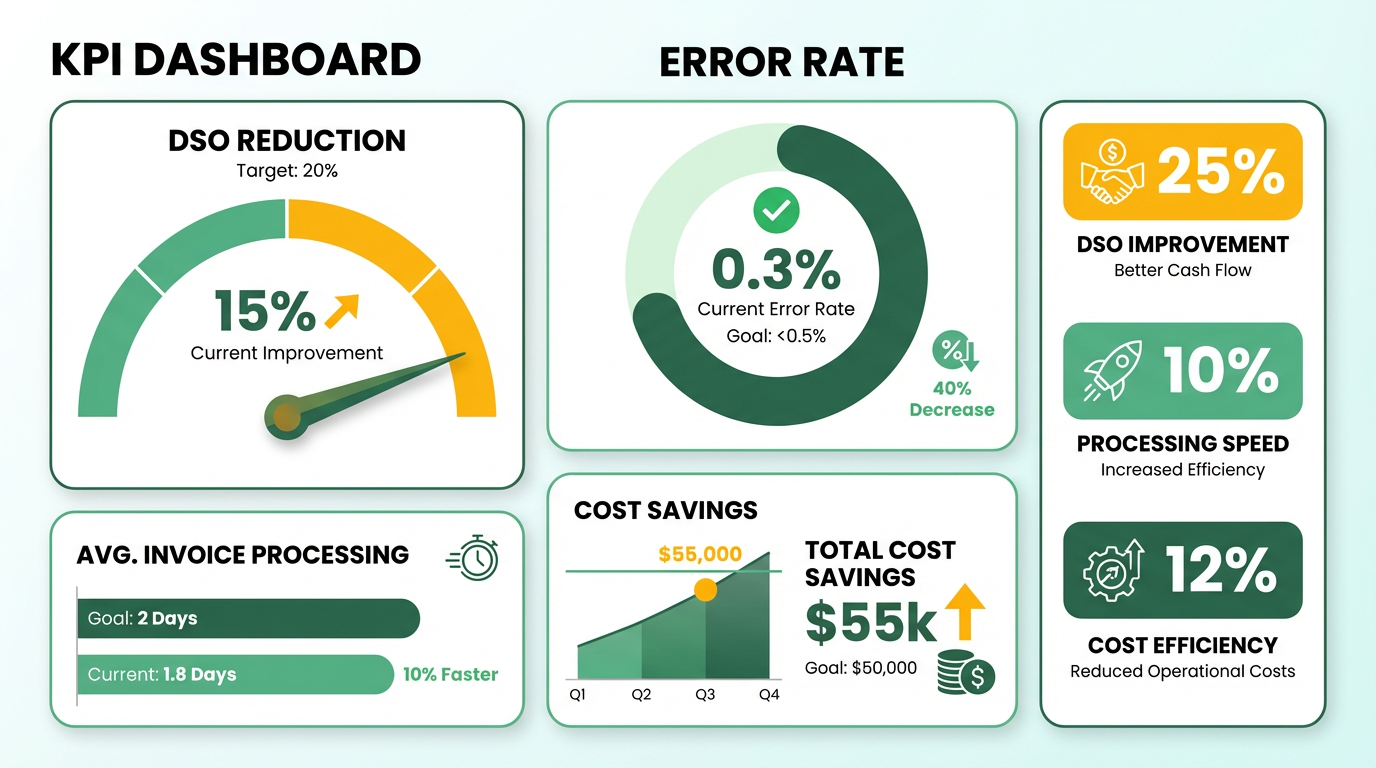
To gauge the impact of AR automation, focus on metrics that reflect speed, accuracy, and financial health. The most critical KPIs include:
- Days Sales Outstanding (DSO): This measures the average number of days it takes to collect payment after a sale. A lower DSO indicates faster cash flow. Studies show automation can reduce DSO by 34% on average, as seen in one provider’s data, accelerating collections and improving liquidity. As mentioned in the Core Benefits of AR Invoice Automation section, automation slashes AR processing costs by up to 90%, further emphasizing its role in cash flow optimization.
- Cash Flow Accuracy: Automated systems often integrate real-time forecasting tools, with one solution reporting 94% accuracy in predicting cash flow. This reduces uncertainty and supports better financial planning.
- Payment Speed: Automation streamlines workflows, enabling 34% faster customer payments through tailored collections and seamless payment experiences.
These metrics provide a clear picture of operational and financial improvements..
How Do You Measure Automation Effectiveness?
Beyond high-level KPIs, specific metrics track the performance of automation tools themselves:
- Automation Rate: This calculates the percentage of invoices processed without manual intervention. One provider reports eliminating 50% of manual AR tasks, such as invoicing and cash application, by automating repetitive workflows. Building on concepts from the Choosing the Right Accounts Receivable Invoice Automation Tool section, selecting a solution with high automation rates ensures alignment with efficiency goals.
- Error Rate: Advanced systems achieve >95% accuracy in invoice processing. For example, AI-driven tools reduce errors in data extraction, minimizing rework and disputes. As discussed in the Future of Accounts Receivable Invoice Automation section, emerging technologies like AI-powered cash application further enhance precision.
- Cost Savings: Automation slashes labor costs. Research indicates AR automation delivers 100–200% ROI, with cost savings ranging from £300k to £8M annually, depending on business size.
These metrics help quantify the efficiency gains and cost reductions achieved through automation..
What Real-World Results Can You Expect?
Real-world case studies highlight the tangible benefits of AR automation:
- Case Study 1: A mid-sized enterprise adopted automation and increased its e-invoicing volume by 26% without hiring additional staff. This was achieved by automating delivery and collections workflows, demonstrating the scalability emphasized in the Implementing Accounts Receivable Invoice Automation section.
- Case Study 2: One provider’s clients saw a 403% ROI over three years, attributed to reduced manual effort and faster collections. Another reported 16 minutes saved per invoice, compounding into significant time savings at scale.
- Industry-Wide Impact: Automation eliminates 34% of manual AR work, as shown in a sector analysis, freeing teams to focus on strategic tasks.
These examples demonstrate how automation delivers measurable outcomes across industries..
How Do Data Analytics and Reporting Enhance Measurement?
Data analytics tools are essential for monitoring automation success. Real-time dashboards provide visibility into critical metrics like DSO, automation rates, and error trends. For instance, one solution’s dashboards enable 94% accurate cash-flow forecasting, helping leaders make informed decisions.
Advanced analytics also identify bottlenecks. By tracking payment delays or high-error invoice types, teams can refine workflows. For example, if disputes spike in a specific region, localized process adjustments can resolve the issue. Analytics turn raw data into actionable insights, ensuring continuous improvement..
Why Is Ongoing Monitoring Critical?
Automation success isn’t a one-time achievement. Regular evaluation ensures sustained performance and adapts to changing needs:
- Regular Audits: Schedule quarterly reviews of KPIs like DSO and error rates to spot trends early.
- Adaptive Strategies: Use analytics to adjust automation rules. For example, if a new payment method introduces errors, update the system’s validation logic.
- Staged Improvements: Start with foundational automation (e.g., invoice capture) and layer on advanced features like AI-driven fraud detection. This phased approach minimizes risks and maximizes ROI.
By embedding monitoring into your strategy, you ensure automation evolves alongside your business..
Final Takeaway
Measuring AR automation success involves a blend of KPIs, real-time analytics, and continuous refinement. Focusing on metrics like DSO, automation rates, and error reduction provides a clear view of efficiency and financial gains. Real-world examples demonstrate that automation not only cuts costs but also accelerates collections and improves accuracy. With strong data tools and ongoing evaluation, businesses can enable long-term value from their automation investments.
Future of Accounts Receivable Invoice Automation
The future of accounts receivable (AR) invoice automation is being reshaped by technologies that prioritize speed, accuracy, and predictive intelligence. Emerging tools like AI-powered cash application systems and machine learning-driven invoicing platforms are setting new benchmarks for efficiency, reducing manual effort by up to 90% in some cases. These innovations are not just incremental improvements-they are redefining how businesses manage cash flow, collections, and customer interactions. As mentioned in the Core Benefits of AR Invoice Automation section, automation slashes processing costs by up to 90%, a trend now amplified by AI and machine learning.
What Emerging Technologies Are Shaping AR Automation?
AI and machine learning are at the forefront, enabling systems to handle tasks ranging from invoice validation to dispute resolution. For example, AI-powered cash application uses natural language processing to match payments with invoices automatically, slashing unapplied cash by up to 80%. Machine learning models analyze historical payment patterns to predict delays or defaults, allowing teams to prioritize high-risk accounts. A leading AR automation provider reports that these tools reduce days sales outstanding (DSO) by accelerating collections and improving forecasting accuracy.
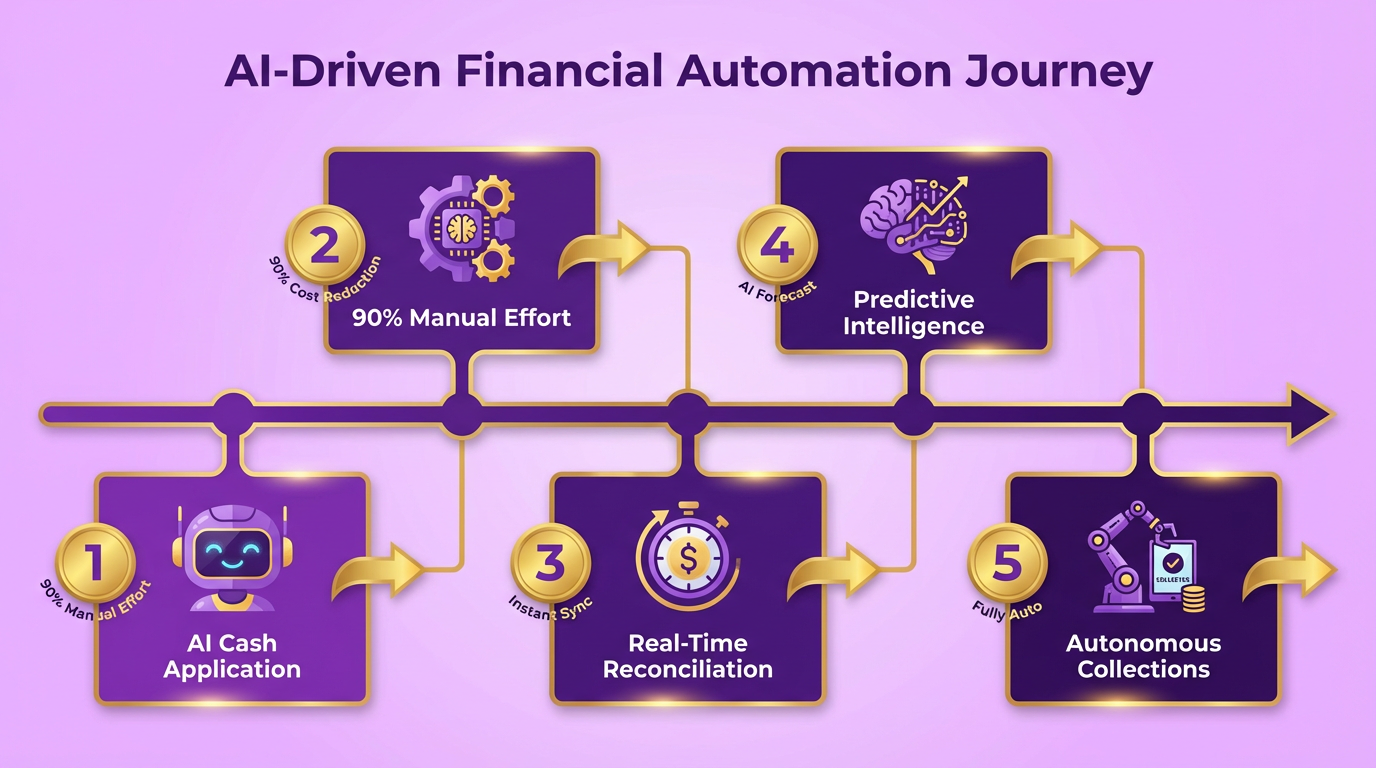
Blockchain technology is also emerging as a major advantage. By enabling secure, immutable transaction records, it reduces fraud risks and streamlines cross-border payments. While still in early adoption phases, blockchain’s potential to automate reconciliation and enforce smart contracts could cut administrative overhead significantly.
How Are AI and Machine Learning Transforming Invoice Processes?
Modern platforms use AI to automate end-to-end workflows. For instance, machine learning-based invoicing systems extract data from unstructured documents-such as handwritten notes or scanned PDFs-with over 95% accuracy. One company reduced its invoice processing time by 50% using such a system, freeing staff to focus on strategic tasks. These tools also learn from past interactions, improving over time to handle exceptions like partial payments or deductions without human intervention.
Real-time analytics powered by AI are another breakthrough. Dashboards track metrics like DSO, aging reports, and cash flow forecasts, providing actionable insights. AI-driven platforms also enable personalized customer communications by analyzing payment histories, allowing teams to tailor reminders and payment plans effectively. Such systems also enforce compliance by validating tax rules and regulatory requirements automatically, reducing errors and audit risks.
Real-World Impact of AI-Driven Automation
Businesses adopting these technologies report measurable gains. One organization saved over $2 million annually by automating invoice validation and collections. Another reduced manual corrections from 50% to 25% in six months, boosting operational efficiency. These outcomes underscore a broader trend: automation isn’t just about cost savings-it’s about turning AR from a reactive function into a strategic asset.
Blockchain’s Potential in AR Automation
While adoption is still nascent, blockchain’s role in AR is gaining traction. Its decentralized ledger system ensures transparency, making it ideal for industries with complex supply chains. For example, smart contracts could automate payment releases upon delivery confirmation, eliminating disputes. Early adopters in the logistics sector have already tested blockchain for cross-border invoicing, cutting settlement times from days to minutes. As adoption grows, this technology could standardize processes across global operations.
Staying Ahead: The Need for Continuous Innovation
The pace of innovation demands that finance teams stay agile. Businesses must evaluate tools that integrate with existing ERP systems and offer scalability. Phased implementations-starting with high-impact areas like cash application or collections-allow organizations to test solutions incrementally, as outlined in the Implementing Accounts Receivable Invoice Automation section. Regular training ensures teams use new features effectively, such as AI-driven forecasting or blockchain-enabled workflows.
Choosing a platform that aligns with future trends is critical. For example, Blixo offers transparent pricing and a modular approach, allowing businesses to adopt AI-powered modules without overhauling their entire infrastructure. Unlike generic providers, Blixo’s focus on real-time analytics and seamless ERP integration ensures adaptability as technologies evolve, building on concepts from the Choosing the Right Accounts Receivable Invoice Automation Tool section.
Final Thoughts
The future of AR invoice automation lies in using AI, machine learning, and blockchain to create intelligent, self-optimizing systems. Companies that embrace these tools today will gain a competitive edge through faster cash conversion, lower operational costs, and stronger customer relationships. As these technologies mature, the key to success will be continuous learning and a willingness to reimagine traditional workflows.
Frequently Asked Questions
1. How much can automation reduce AR processing costs?
Automation can cut AR processing costs by up to 90% by eliminating manual tasks like data entry, invoice matching, and payment tracking, as AI-driven systems streamline workflows and reduce labor-intensive processes.
2. How does AI improve cash flow in AR automation?
AI auto-matches payments to invoices, reducing unapplied cash by up to 90% and accelerating collections. Predictive analytics also identify late-payment risks early, shortening days sales outstanding (DSO) by up to 30%.
3. What role do self-service portals play in AR automation?
Self-service portals let customers track invoices, make payments, and resolve disputes independently, improving satisfaction while reducing administrative work for businesses by up to 40%.
4. How does AR automation reduce human errors?
AI-driven automation minimizes human error rates by up to 70% during invoice processing by automating data entry, validation, and matching, ensuring accuracy and compliance.
5. What features should businesses prioritize in AR automation tools?
Look for predictive analytics, fraud detection, real-time reporting, and self-service portals. Platforms like Blixo integrate these features to turn receivables into strategic assets while improving efficiency.
6. Can AR automation help prevent fraud?
Yes, AI-powered AR platforms detect fraudulent transactions by analyzing payment patterns and flagging anomalies, reducing fraud risks by up to 50% while ensuring secure receivables management.
7. How quickly does AR automation impact cash flow?
Businesses often see cash flow improvements within 1-3 months as automation accelerates collections, reduces DSO, and minimizes payment delays through proactive risk identification and real-time analytics.