

SAP and Oracle Handle Accounting: AR Automation Handles Dunning and Reconciliation

In short:
SAP S/4HANA Cloud and Oracle ERP Cloud handle accounting, consolidation, and the general ledger. They do not publish product-level benchmarks on dunning speed, reconciliation cycle time, or touchless-posting rates. Most finance teams resolve AR exceptions—short payments, lump-sum deposits, mismatched remittance—by hand, because end-to-end AR automation remains incomplete.
SAP and Oracle anchor the system of record. The AR automation question is narrower: how well do they handle dunning cadence, payment matching, exception routing, and reconciliation follow-through once invoices are overdue or payments arrive without clean remittance data?
Public materials show SAP S/4HANA Cloud offering receivables-management modules for credit, collections, and dunning. Oracle ERP Cloud emphasizes multi-GAAP consolidation, treasury, and enterprise finance architecture. Neither product page provides the benchmarks a finance leader would want before deciding whether ERP-native AR is enough: reconciliation cycle time, exception-resolution rate, automated dunning lift, or cash-application throughput.
The strongest case for adding a human-in-the-loop AR layer does not rest on replacing SAP or Oracle. It rests on focusing a specialized workflow tool on the tasks ERP systems often leave slow, fragmented, or dependent on analyst judgment.
What the evidence actually covers
SAP’s S/4HANA Cloud receivables page describes strategy-based collections, dispute management, and AI functions for high-risk accounts. SAP tutorial materials walk through transaction code F-32 for payment clearing, showing how partial payments and residual items require manual review before the system clears the document. Oracle’s ERP Cloud materials emphasize enterprise project structures and multi-ledger accounting but stop short of naming specific dunning-rule engines or remittance-matching algorithms. SAP’s Public Cloud tier and Oracle pricing structures remain quote-based in reviewed materials.
The reconciliation and DSO benchmarks that do exist come from AR automation vendors, not ERP product pages. Reviewed AR automation benchmarks include 92% touchless payments, an 80% reconciliation-time reduction, a 39-day average DSO, and APQC’s 30/38/46-day DSO spread. The same materials suggest most finance teams have not yet fully automated AR operations, leaving significant capital tied up in receivables.
| Dimension | SAP S/4HANA Cloud | Oracle ERP Cloud | General AR Automation Evidence |
|---|---|---|---|
| Receivables management availability | Strategy-based collections, disputes, credit with built-in AI for high-risk and late payments | Multi-GAAP consolidation, treasury, invoice-to-pay emphasized; AR module details not equivalent to SAP page | Reviewed benchmarks include 92% touchless payments and 80% reconciliation-time reduction |
| Dunning & payment clearing | Tutorial evidence shows manual F-32 workflow for clearing open items; SAP page mentions payment clearing and dunning at high level | Reviewed documentation does not provide equivalent dunning-workflow detail | Automated dunning and reminders are common in specialized tools; no SAP/Oracle-specific benchmarks are published |
| Reconciliation outcomes | SAP Cash Application software listed as add-on; no published reconciliation-time benchmarks | Oracle Fusion Financials noted for AI-driven cash application in comparison; no published reconciliation-time benchmarks | Benchmarks include a 39-day average DSO and APQC top/median/bottom quartile DSO of 30/38/46 days |
| Implementation & cost | Timeline and cost information not verified in supplied materials | Timeline and cost information not verified in supplied materials | Some providers report faster implementations than ERP rollouts; no source-backed timeline was verified for Blixo |
| Pricing | Quote-based | Custom quote | Varies by provider; no source-backed pricing schedules were verified in supplied materials |
SAP payment clearing and dunning appear in the S/4HANA tutorial as part of the receivables process, but the demonstration stops at manual clearing rather than showing end-to-end escalation across reminders, disputes, and remittance exceptions. Oracle’s materials emphasize ERP-level accounting rather than AR-specific automation features. Current evidence does not verify pre-built connectors or payment-gateway support by SAP, Oracle, or other vendors at the product-page level. Company-size positioning from the ERP comparison places Oracle for large enterprises and SAP Public Cloud for mid-market and standardized operations, but a verified positioning for any AR-specific tool would require product-overview pages not yet in evidence.
For SaaS founders already committed to SAP or Oracle, the practical question is not whether the ERP can store receivables data. It can. The question is whether the AR workflow closes fast enough to protect cash flow when remittance details are missing, customers underpay, or collectors need consistent escalation rules. That is where a lightweight AR automation layer can complement the ledger instead of competing with it.
Why AR automation for dunning and reconciliation matters
When overdue invoices trap working capital and lengthen collection cycles, dunning and reconciliation stop being back-office chores. They become cash-flow controls. The performance gap between ordinary collection operations and top-performing finance teams is where AR automation earns attention.
What actually slows down collections
Overdue invoices accumulate for predictable reasons. Payment references get lost. Customers combine many invoices into a single transfer without a usable breakdown. Processor fees reduce the received amount, forcing your team to compare payout statements against open AR before cash can be applied. These are not edge cases for growing B2B companies—they are the daily frictions that keep receivables from turning into available cash.
Clean matches are rarely the whole problem. Your platform may handle straightforward payments well and still leave the most judgment-heavy work in a queue. The unresolved items tend to be the ones that matter most: unexplained short payments, deposits that cover multiple invoices, or remittance files that arrive in inconsistent formats. Those are the moments where collectors and accountants lose hours, and where cash remains technically received but operationally unreconciled. Reviewed data points to a large auto-match exception problem, which suggests that even automated matching often leaves material judgment work for analysts.
Why reconciliation trails matter for audit
Cleaner reconciliation trails support audit readiness, especially where payment matching, revenue recognition, and SOX-relevant reporting require documented proof of how each deposit tied to its invoice. Manual spreadsheet reconciliation introduces version-control gaps and makes it harder to show reviewers a complete chain of custody from invoice to cash application. Automation platforms that log every match, adjustment, and reviewer override preserve that trail without requiring your team to reconstruct it at quarter-end.
DSO reduction is one of the clearest measurable outcomes of AR automation, but the operational benefit is broader than a single metric. Reviewed data shows 32% of B2B payments still move through cash/check channels, which require heavier reconciliation work than cleaner electronic payment flows. Automating cash application turns a recurring close-cycle liability into a process your team can review, tune, and improve.
SAP AR automation deep dive
SAP positions S/4HANA Cloud as an integrated receivables suite, but the gap between what the product page promises and what finance teams actually run shows up fast. SAP’s receivables-management module offers strategy-based collections, dispute workflows, and AI functions for high-risk accounts. Pricing and implementation details vary by deployment model and customer requirements. That’s the marketing story.
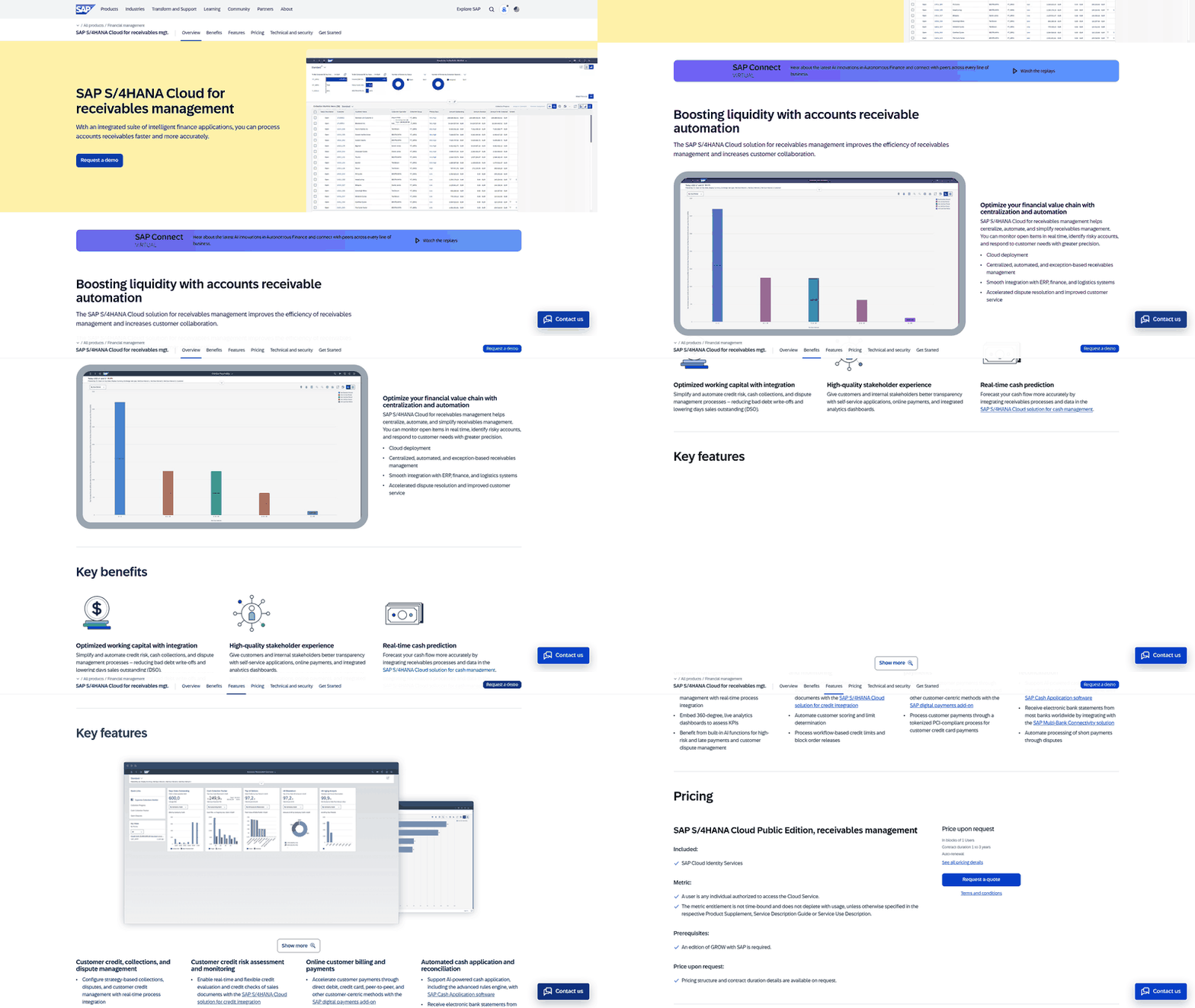
What SAP actually delivers for accounts receivable automation
The operational story sits closer to the transaction layer. In the F-32 example, the user works through open items, fiscal-period logic, and clearing steps before the document is fully resolved. Partial payments remain visible until the appropriate clearing action is taken. Residual payments create new documents that have to be tracked through the receivables process.
SAP lists automated cash application with an AI-powered rules engine, but that capability lives in a separate SAP Cash Application add-on. Multi-bank connectivity pulls electronic statements through another integration point. Short-payment processing through disputes exists as a feature bullet, but the workflow still depends on exception review instead of fully autonomous resolution.
| Capability | SAP S/4HANA Cloud | Lightweight AR Layer |
|---|---|---|
| Implementation timeline | Varies by deployment | Varies by provider; some report faster setup than ERP |
| Pricing model | License and subscription | Subscription-based |
| Dunning workflow | Configurable, batch-oriented | Configurable and often API-driven |
| Exception handling | Manual transaction codes | Human-in-the-loop automation |
Where ERP-native AR hits its ceiling
Companies trap capital in the reconciliation gap. SAP and Oracle excel at recording transactions and maintaining the general ledger, but dunning cadence and payment matching require a different kind of velocity. The dunning program in SAP runs as a scheduled batch job through Financial Accounting settings. You define dunning levels, grace periods, and correspondence templates, then execute the run. That works for high-volume, low-complexity receivables where most invoices clear cleanly.
The pressure appears when the payment does not match the invoice neatly. If your customer sends one deposit for a batch of open invoices or a processing fee creates a small variance against the expected amount, your collector needs context, approvals, and a path to resolution. Another ERP screen may record the outcome, but it does not necessarily accelerate the reasoning required to get there. APQC’s 30/38/46-day DSO spread makes the same point: the gap between median and top-quartile performance represents working capital you’re financing instead of deploying.
SAP offers centralized, exception-based receivables management with real-time risk monitoring. The architecture supports it. The execution model—clearing transactions, module-specific updates, and scheduled dunning activity—creates friction where speed matters most. For SaaS companies already locked into SAP or Oracle for accounting, layering a purpose-built AR tool on top addresses dunning precision and reconciliation intelligence without replacing the system of record.
Oracle AR automation deep dive
Oracle positions its ERP Cloud platform for multi-entity consolidation and treasury management, but the accounts receivable automation story requires closer examination. Public materials describe implementations spanning multiple months with costs that vary by scope; Oracle does not publish standard pricing or deployment timelines. The platform draws evaluation from companies migrating off on-premise Oracle systems or organizations that need consolidated reporting across subsidiaries. Documentation confirms Oracle’s cloud-native financial architecture and multi-GAAP consolidation capabilities, though these strengths operate at the enterprise GL layer rather than at the dunning and reconciliation workflows that directly compress collection cycles.
Supplied evidence does not include Oracle-specific technical documentation on dunning automation, AI-driven cash application logic, or reconciliation exception handling comparable to what competing enterprise platforms have released. The reviewed materials highlight Oracle’s general strengths in financial accounting, subledger management, invoice-to-pay processing, and order-to-cash workflows, but they stop short of product-level detail on dunning cadence customization or reconciliation-exception throughput. Without granular AR automation benchmarks, the business case for Oracle as a dunning and reconciliation engine depends on broader ERP positioning instead of quantified automation gains.
Companies selecting this platform typically arrive from on-premise Oracle installations or need to unify financial reporting across multiple legal entities. Oracle can fit regulated finance environments, public sector agencies, and higher education institutions where multi-GAAP consolidation and treasury functionality justify the deployment investment. For a SaaS company already standardized on Oracle for core accounting and the general ledger, the central question becomes whether that ERP foundation also gives collectors the operational leverage they need—or whether it mainly solves a different finance problem.
Reviewed materials highlight an 85% auto-match exception problem, and 32% of B2B payments still move through cash/check channels. Implementation duration matters as much as feature depth; longer deployments mean more manual dunning and spreadsheet-based reconciliation while the ERP rollout continues. Oracle’s cloud-native architecture does not automatically accelerate AR outcomes, particularly when measured against lighter-weight AR workflows that can be deployed faster, depending on configuration and accounting-system fit.
| Dimension | Oracle Fusion Cloud ERP | SAP S/4HANA Cloud |
|---|---|---|
| Deployment timeline | Verify through vendor demo | Verify through vendor demo |
| Investment range | Quote-based; no published list pricing | Verify through vendor demo |
| Entry-level commitment | Custom scoping required | Verify through vendor demo |
| Finance module analyst score | Verify through vendor demo | Verify through vendor demo |
| Primary use case | Multi-GAAP consolidation, regulated industries, public institutions | Manufacturing operations, process standardization, SAP migration paths |
Side-by-side comparison and decision matrix
The table below isolates the operational differences that determine whether your AR team will actually use the system daily or route around it with spreadsheets.
Feature comparison: ERP-native vs. lightweight AR automation
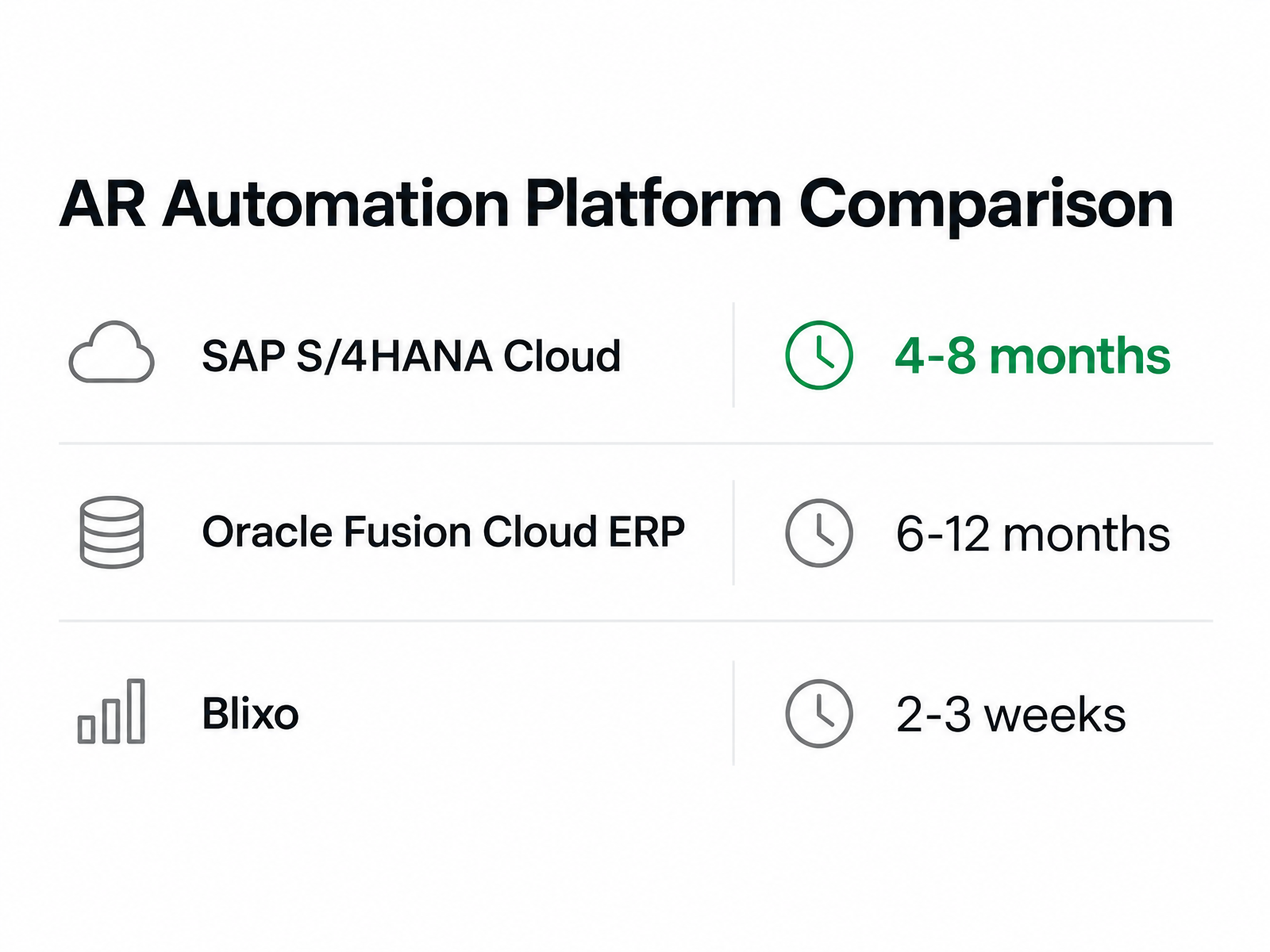
| Dimension | SAP S/4HANA Cloud | Oracle Fusion Cloud ERP | Blixo |
|---|---|---|---|
| Deployment speed | Varies by deployment model; no source-backed timeline in reviewed materials | Varies by project scope; no source-backed timeline in reviewed materials | Provider reports faster setup; no independent timeline verified in supplied materials |
| Licensing model | Quote-based; licensing depends on deployment | Custom quote; reviewed materials do not publish list pricing | Subscription-based; plan details not verified in supplied materials |
| Cash-application matching | Rules engine requiring configuration of tolerance bands and assignment logic | Materials mention AI-driven cash application; no published matching benchmarks | Configured matching workflows with exception review |
| Dunning workflow | Configurable, batch-oriented; manual clearing shown in tutorial | Reviewed materials do not provide equivalent dunning-workflow detail | Automated reminders and escalation workflows, as configured |
| Exception handling | Manual open-item selection and fiscal period assignment | No equivalent exception-handling detail in reviewed materials | Human-in-the-loop queue for unmatched and short-paid items |
| Integration depth | Native across finance, procurement, manufacturing, and supply chain | Cross-module consolidation with treasury and tax | Provider lists accounting-system connectors and an API; specific integrations not independently verified |
| Best for | Global manufacturers needing real-time inventory and finance integration | Multi-national corporations requiring statutory consolidation across subsidiaries | Growing B2B companies that invoice regularly and need faster AR cycle improvement |
SAP’s S/4HANA Cloud promises centralized receivables management, but the user experience can still land in accountant-driven clearing activity. The issue is not that SAP cannot represent receivables accurately. It is that accuracy alone does not create a fast collections motion when the payment data is incomplete, fragmented, or disputed.
Oracle Fusion wins on depth, but its deployment model and enterprise-level cost can put it out of reach for many mid-market teams. SAP’s deployment model can also delay time-to-value when the immediate problem is overdue invoices, not enterprise transformation. B2B organizations continue to face collection cycles that depend heavily on follow-up discipline and reconciliation bandwidth.
Blixo is positioned for the gap between manual AR and six-figure ERP implementations. It is designed to support deposit matching, dunning cadence, and collections automation, with approval workflows for review before entries sync back to your GL. Reviewed AR automation benchmarks do not support a universal 30–40% DSO reduction claim; the reviewed figures include 92% touchless payments, an 80% reconciliation-time reduction, a 39-day average DSO, and APQC’s 30/38/46-day DSO spread.
When each platform wins
Pick SAP S/4HANA Cloud if you’re a standardized enterprise already running SAP across manufacturing, logistics, and finance. The real-time financial statements and embedded analytics dashboards justify the enterprise implementation cost when you need consolidated reporting across multiple entities. Skip it if your finance team lacks the headcount to configure strategy-based collections or the patience to wait months for go-live.
Pick Oracle Fusion Cloud ERP if you’re migrating from legacy Oracle E-Business Suite and need statutory reporting across multiple legal entities, currencies, and tax jurisdictions. The platform excels when your primary requirement is multi-book accounting with intercompany eliminations and automated period close. It’s the wrong choice if you’re a mid-market company trying to automate dunning and reconciliation this quarter; the project scope can consume the budget and attention before collections workflows improve.
Pick Blixo if you’re a growing business that needs a lighter-weight AR workflow. Blixo fits service businesses, agencies, consultancies, and SaaS companies that invoice customers regularly and want dunning workflows, cash application, and automated collections without hiring more collectors or spending months configuring an ERP. That setup approach makes sense when you’re losing working capital to manual reconciliation cycles and want to streamline your payment recovery process without enterprise complexity.
The bottom line on AR automation in SAP vs. Oracle
SAP and Oracle handle the ledger with enterprise-grade depth. But if receivables work still depends on collectors noticing overdue accounts, accountants interpreting imperfect remittance, and managers approving exceptions after the fact, the bottleneck is not the chart of accounts. It is the workflow around cash. Blixo earns its budget by automating the repetitive dunning and matching work that ERPs make cumbersome, improving cash flow and reducing administrative workload without the complexity or cost of an enterprise implementation.
Common Questions
1. Can SAP or Oracle actually automate dunning workflows, or do I still need manual intervention?
They can support dunning, but the reviewed evidence does not show fully autonomous, product-benchmarked dunning performance for both platforms. SAP provides configurable receivables and dunning capabilities, while Oracle’s public materials focus more on broader enterprise finance architecture. In practice, many teams still need human review for exceptions, disputes, and payments that do not match cleanly.
2. What’s the real reason ERP-native AR tools leave so much manual work in collections?
ERP-native AR often breaks down at the point where context matters. A ledger can store the receivable and record the payment, but collections teams still need to decide how to handle missing remittance, customer disputes, partial settlements, and follow-up timing. Those judgment-heavy workflows are where purpose-built AR tools tend to add the most leverage.
3. If I’m already locked into SAP or Oracle for accounting, what’s the actual case for adding a separate AR tool?
The case is complementing the ERP, not replacing it. SAP or Oracle remains the accounting system of record, while the AR tool manages reminders, matching, approvals, and collector workflow around it. That separation lets finance improve cash collection without reopening a full ERP implementation.
4. How does manual payment clearing in SAP F-32 actually slow down my reconciliation cycle?
F-32 can slow reconciliation when the user has to interpret which open items belong to a payment before clearing can occur. The delay is especially noticeable when remittance data is incomplete or when the payment creates a residual item that must be tracked after the initial clearing step.
5. Why do Oracle’s multi-GAAP consolidation strengths not translate into faster AR outcomes?
Multi-GAAP consolidation is a close and reporting strength; faster AR depends on payment matching, collector prioritization, dunning execution, and exception resolution. Those are related finance processes, but they are not the same problem. A company can have strong enterprise consolidation and still need a more focused workflow layer to accelerate receivables.