

Reduce Days of Sales Outstanding with Automation

Key Takeaways
- Reducing DSO improves cash flow by accelerating payment collection and freeing up tied-up funds.
- Mid-sized U.S. businesses are owed $304,066 on average due to late payments, straining liquidity.
- Companies spend 14 hours weekly chasing overdue invoices, diverting resources from core operations.
- Healthcare suppliers face 69% DSO exceeding 30 days, often caused by manual processes like paper checks.
- Automating deduction workflows can cut invoice resolution time from weeks to under five days.
- High DSO increases financial risk and limits growth by delaying reinvestment opportunities.
- Retail suppliers improve DSO by resolving deductions faster, strengthening buyer-supplier trust.
Why Reducing Days of Sales Outstanding Matters
Reducing Days Sales Outstanding (DSO) is critical for maintaining healthy cash flow, optimizing working capital, and building trust between buyers and suppliers. A high DSO means cash is tied up longer, increasing financial risk and limiting growth opportunities. By shortening the time it takes to collect payments, businesses can reinvest funds faster, reduce reliance on external financing, and improve operational efficiency. This section explores why DSO matters, its real-world impact, and who stands to benefit most from its reduction.
How Does a High DSO Impact Cash Flow?
DSO measures the average number of days it takes to collect payment after a sale, a metric detailed in the Understanding Days of Sales Outstanding section. For mid-sized U.S. businesses, the financial stakes are significant: on average, companies are owed $304,066 by late-paying customers. This delay not only strains liquidity but also costs time-businesses spend 14 hours weekly chasing overdue invoices, diverting resources from core operations.
The ripple effect of delayed payments extends beyond cash flow. For example, in healthcare, 69% of suppliers report DSO exceeding 30 days, often due to manual processes like paper checks or fragmented systems. These delays hinder suppliers’ ability to invest in growth and signal potential cash flow issues for providers, risking patient care. Similarly, retail suppliers face inflated DSO from deductions (e.g., chargebacks) that manually resolving can take weeks. Automating deduction workflows, as one major retailer’s clients did, cut resolution time to under five days, dramatically improving DSO and supplier relationships. This aligns with strategies covered in the Automation Solutions for Reducing Days of Sales Outstanding section.
What Challenges Does Reducing DSO Solve?
Prolonged DSO stems from systemic issues in accounts payable (AP) and accounts receivable (AR) processes. Manual invoice processing, errors in documentation, and lack of real-time visibility are common culprits. For example, 60% of B2B payments remain electronic, leaving room for improvement. By digitizing these workflows, businesses eliminate bottlenecks like late payments, duplicate invoices, and disputes.
Automation addresses these challenges by streamlining invoice generation, enabling electronic payments, and providing real-time tracking. For instance, healthcare providers using automated platforms reduced DSO by digitizing payments and syncing AP/AR systems. This eliminated match exceptions-a root cause of late payments-while cutting administrative costs. Retailers using AP automation saw similar gains, resolving deductions faster and reducing DSO by up to 25–30%.
Who Benefits Most from Lowering DSO?
While all businesses gain from improved cash flow, certain industries and roles reap specific advantages:
- Mid-sized companies: These firms often lack the resources to manage high DSO manually, making automation a cost-effective solution to reclaim lost time and capital.
- Healthcare providers and suppliers: Tight payment windows and high-volume transactions demand precision. Automating AP/AR workflows ensures compliance and reduces delays.
- Retailers and B2B suppliers: Frequent deductions and chargebacks require real-time dispute resolution, which automation accelerates.
- Finance teams: By reducing manual tasks, automation frees staff to focus on strategic initiatives rather than chasing payments.
A case study illustrates this impact: one company reduced DSO by 50% after adopting a platform that automated invoicing, reminders, and payment tracking. This freed $2.5 million in trapped capital within six months, enabling reinvestment in inventory and marketing. The Best Practices for Reducing Days of Sales Outstanding section outlines additional strategies for achieving such outcomes.
Why Should Businesses Prioritize DSO Reduction?
Beyond financial benefits, lowering DSO strengthens supplier relationships. Prompt payments foster trust, enabling negotiations for discounts or extended terms. For example, a manufacturer that cut DSO from 45 to 28 days secured 2% volume discounts from vendors, boosting margins. Additionally, shorter DSO improves financial resilience, allowing businesses to weather economic downturns without relying on costly loans.
In essence, reducing DSO is not just a technical fix-it’s a strategic lever for growth. By automating AP/AR processes, companies enable liquidity, reduce operational friction, and position themselves to respond swiftly to market changes. The next step is identifying the right tools to turn these insights into action.
Understanding Days of Sales Outstanding
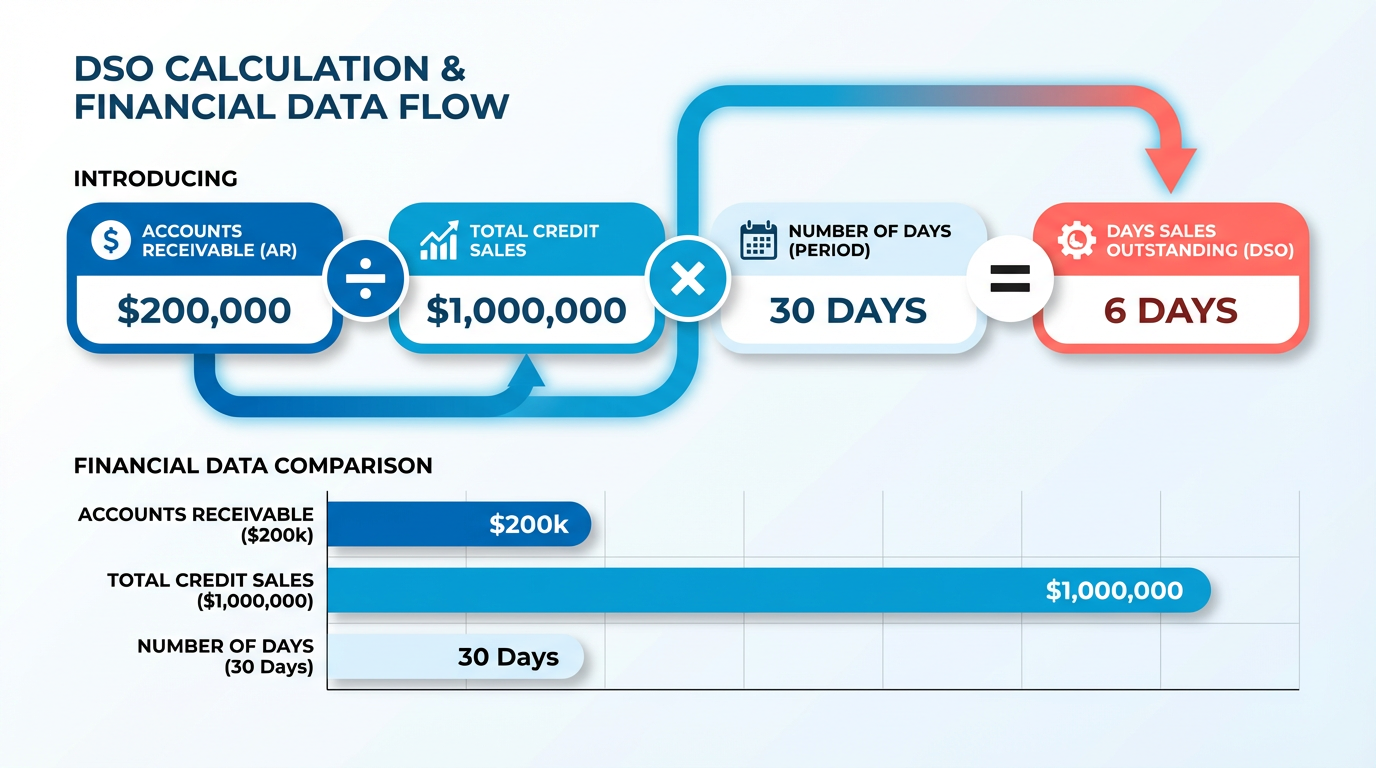
Understanding Days of Sales Outstanding (DSO) is critical for managing cash flow and operational efficiency. DSO measures the average number of days it takes a company to collect payment after a credit sale. A lower DSO indicates faster collections and healthier cash flow, while a higher DSO signals delays or inefficiencies in payment processes. This metric is calculated using the formula: (Accounts Receivable ÷ Total Credit Sales) × Number of Days. For example, if a company has $200,000 in accounts receivable (A/R) and $600,000 in credit sales over a 30-day period, its DSO is 10 days.
What Industry Benchmarks Reveal About DSO
DSO benchmarks vary significantly by sector. Retail and e-commerce typically maintain DSOs of 5–20 days, while wholesale operations average 30–50 days. SaaS businesses often see DSOs of 30–45 days, and healthcare or construction may face longer cycles of 45–90+ days. These benchmarks reflect industry norms, such as retail’s reliance on quick card payments versus healthcare’s complex insurance claims. Monitoring DSO against these standards helps identify operational gaps. For instance, a SaaS company with a DSO of 60 days may struggle with slow collections or overly lenient credit terms, as explored in the Why Reducing Days of Sales Outstanding Matters section.
Key Factors That Influence DSO
Several variables directly impact DSO, including:
- Payment Terms: Net 30 terms set a baseline, but stricter terms (Net 15) or lenient ones (Net 60) shift DSO by 15–25 days.
- Invoice Accuracy: Errors in billing increase dispute resolution times, adding 5–20 days to DSO.
- Collections Efficiency: Manual follow-ups delay payments by 10–18 days, whereas automated reminders cut this by half, as demonstrated in the Automation Solutions for Reducing Days of Sales Outstanding section.
- Customer Creditworthiness: Customers with credit scores below 650 are 40–60% more likely to pay late, inflating DSO.
For example, a retail supplier using Blixo to automate deductions and invoicing might reduce DSO from weeks to under 5 days by resolving claims faster. This contrasts with companies relying on manual processes, where deductions from retailers like Walmart or Amazon can delay cash flow for months, as discussed in the Implementing Automation for Accounts Receivable section.
Why Monitoring DSO Matters
DSO is a leading indicator of cash flow health. A DSO that exceeds payment terms by 50%+ signals systemic issues, such as poor credit screening or inefficient collections. Regular monitoring allows businesses to:
- Forecast cash flow: Predict when revenue will materialize to meet obligations.
- Benchmark performance: Compare DSO against industry peers to identify strengths or weaknesses.
- Optimize credit policies: Adjust terms or tighten approval thresholds for high-risk customers.
Consider a wholesale company with a DSO of 50 days in an industry where 30 days is standard. This 20-day gap represents **$1 million in trapped working capital** for every $6 million in annual revenue. Addressing this through automation-like Blixo’s tools for real-time invoice tracking-can enable liquidity and reduce borrowing costs, aligning with strategies outlined in the Why Reducing Days of Sales Outstanding Matters section.
By understanding DSO’s drivers and benchmarks, businesses can pinpoint actionable improvements. Whether through stricter credit checks, early-payment incentives, or automation, reducing DSO strengthens financial resilience and operational agility.
Automation Solutions for Reducing Days of Sales Outstanding
Automation solutions offer a powerful way to shorten Days Sales Outstanding (DSO), the metric that measures how quickly a company collects cash from credit sales. By streamlining accounts receivable (AR) processes, invoicing workflows, and cash application, automation reduces manual delays, minimizes errors, and accelerates cash flow. As mentioned in the Understanding Days of Sales Outstanding section, DSO directly impacts working capital and operational efficiency, making automation a strategic imperative.
Types of Automation Solutions
1. Accounts Receivable Automation: This solution digitizes invoice creation, payment tracking, and collections. For example, SaaS providers like Blixo offer transparent pricing and automate tasks like remittance matching, dispute resolution, and payment reminders. Unlike generic providers, Blixo integrates seamlessly with ERP systems, ensuring real-time visibility into aging receivables.
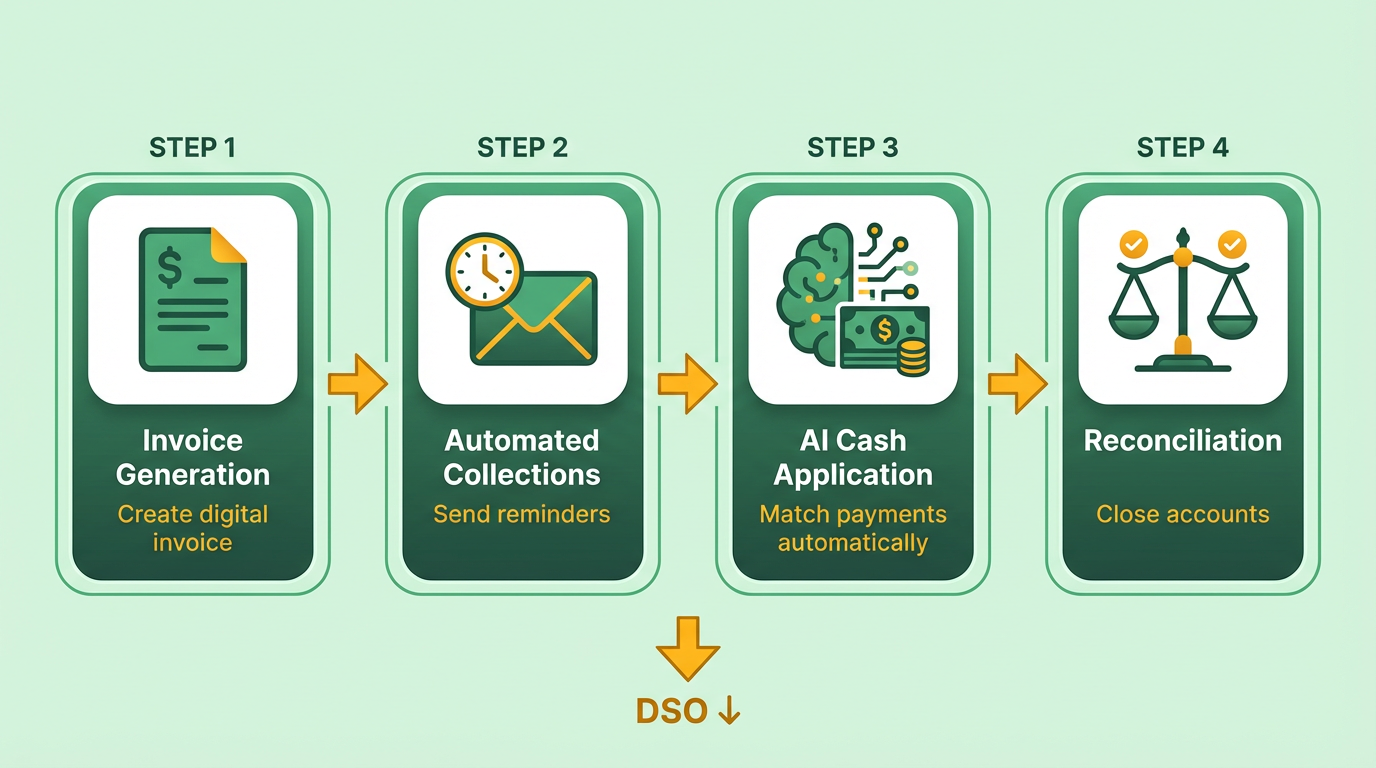
2. Invoicing Software: Automated invoicing tools generate and send bills instantly after a transaction, reducing delays. Salesforce highlights that electronic invoicing cuts DSO by 6–10 days by minimizing manual processing. Features like self-service portals and early-payment discounts (e.g., 2% for payment within 10 days) further incentivize faster payments.
3. Cash Application Tools: These tools automatically apply payments to the correct invoices, reducing reconciliation time. Research from Credit Pulse shows that OCR-driven cash application reduces manual errors by 60–70%, accelerating cash availability by 12–18 days.
Benefits of Automation
- Reduced Manual Errors: Automation eliminates data-entry mistakes and ensures accurate invoice-to-payment matching. A study by Premier Inc. found that 69% of suppliers previously faced DSO >30 days due to manual bottlenecks, but automation slashed this by 20–35%.
- Improved Cash Flow: By shortening DSO, companies enable working capital. As explained in the Why Reducing Days of Sales Outstanding Matters section, faster cash flow enhances supplier-buyer trust and liquidity.
- Real-Time Insights: Dashboards track metrics like DSO and collections efficiency index (CEI), enabling proactive adjustments.
Case Study: A Retail Supplier’s DSO Reduction
A retail supplier struggling with high DSO implemented automation to handle deductions from major retailers like Walmart. Before automation, resolving 1,000+ monthly deductions took weeks, inflating DSO. After adopting a platform with automated deduction workflows, the company reduced resolution time from weeks to under 5 days, cutting DSO by 30% and improving accounts receivable turnover.
Key Features to Consider
When selecting an automation solution, prioritize:
- Integration: Compatibility with existing ERP systems (e.g., SAP, Oracle) ensures seamless data flow.
- AI-Driven Analytics: Predictive models identify late-payment risks and suggest early interventions.
- Omnichannel Payments: Support for ACH, credit cards, and digital wallets reduces friction.
- Scalability: The solution should handle growth, whether expanding to new markets or increasing transaction volumes.
Why Automation Outperforms Manual Methods
Manual processes are prone to delays and errors, especially in industries with high transaction volumes. For example, healthcare providers using paper checks and faxed invoices often see DSO exceeding 60 days. By contrast, automation SaaS providers like Blixo digitize end-to-end workflows, cutting DSO by 15–25 days on average.
Measuring ROI
The return on automation is measurable. A Credit Pulse analysis found that companies adopting AR automation achieved 20–35% DSO reductions and 30–50% lower bad-debt write-offs. Building on concepts from the Measuring and Optimizing Automation Effectiveness section, these metrics demonstrate the long-term financial benefits of automation. For a business with $10 million in annual revenue, this translates to $200,000–$350,000 in annual savings.
By automating AR processes, businesses not only improve liquidity but also enhance customer relationships through faster, error-free transactions. The combination of speed, accuracy, and scalability makes automation the most effective lever for reducing DSO in today’s fast-paced markets.
Implementing Automation for Accounts Receivable
Implementing automation for accounts receivable begins with selecting a platform that integrates seamlessly with your existing ERP or accounting software. This ensures real-time synchronization of data, eliminating manual entry errors and delays. For example, automating invoice generation immediately after a sale or milestone reduces the time between delivery and billing, a practice highlighted by Salesforce as critical for lowering Days Sales Outstanding (DSO). As mentioned in the Understanding Days of Sales Outstanding section, DSO measures the average number of days it takes to collect payments, making it a key metric for cash flow management. Start by mapping your current AR processes to identify bottlenecks, such as delayed invoicing or inconsistent payment reminders. Tools like robotic process automation (RPA) can then be configured to handle repetitive tasks, such as generating invoices, sending payment alerts, and reconciling payments.
Setting Up the Automation Framework
To configure automation, begin by standardizing data formats across systems. This includes aligning customer information, payment terms, and historical transaction records. For instance, Salesforce recommends defining clear payment terms early in customer contracts and embedding them into automated workflows to enforce consistency. Next, integrate your automation platform with core financial systems-such as ERP or CRM-to enable real-time updates. RPA platforms, as noted in academic studies, often require recording user actions (e.g., invoice creation steps) to build bots that replicate these processes. This ensures tasks like sending invoices or tracking late payments occur without manual intervention.
Training Teams for Effective Adoption
Successful automation hinges on training employees to manage and monitor automated workflows. Teams must understand how to interpret dashboards, respond to exceptions (e.g., mismatched payments), and use analytics for decision-making. Salesforce emphasizes the importance of weekly AR reviews using automated aging reports, which highlight overdue invoices and prioritize follow-ups. Cross-functional collaboration is equally vital-sales, finance, and customer service teams should align on protocols for handling payment disputes or adjusting credit limits. For example, one company reduced DSO from 45 to 22 days by training staff to use predictive analytics tools, a strategy detailed in the Best Practices for Reducing Days of Sales Outstanding section.
Overcoming Common Implementation Challenges
Data migration and integration pose significant hurdles. Legacy systems may lack standardized formats, requiring cleansing before automation can operate efficiently. A study on RPA adoption found that 40% of implementation delays stem from poor data quality, underscoring the need for thorough audits. As discussed in the Overcoming Common Challenges and Obstacles section, addressing these issues often requires phased rollouts and dedicated project teams to ensure alignment between departments. Additionally, integrating automation with third-party platforms (e.g., payment gateways) demands API compatibility checks. To mitigate these issues, adopt a phased rollout: pilot automation on a single process (e.g., invoice generation) before scaling. This allows teams to address integration gaps incrementally.
Best Practices for Sustained Success
- Segment Customers: Tailor automation rules based on payment behavior. High-risk clients might trigger automatic prepayment reminders, while reliable customers receive fewer alerts.
- Offer Multiple Payment Options: Automate support for credit cards, ACH, and digital wallets to reduce friction. Intuit highlights that businesses offering diverse payment methods often see a 15–20% faster cash conversion.
- use Predictive Analytics: Use AI to forecast payment delays and adjust collections strategies. For example, machine learning models can flag customers likely to default, enabling early intervention, a practice outlined in the Best Practices for Reducing Days of Sales Outstanding section.
A mid-sized manufacturing firm implemented these strategies, automating 80% of its invoicing and collections. By centralizing AR data and automating reminders, the company cut DSO by 30% within six months. Challenges like initial data migration were addressed through a dedicated project team, ensuring alignment between IT and finance departments. The key takeaway is that automation isn’t a one-time setup-it requires continuous refinement of workflows, staff training, and adaptation to evolving customer needs. By embedding automation into daily operations, businesses can maintain low DSO while improving customer satisfaction through faster, more transparent billing processes.
Measuring and Optimizing Automation Effectiveness
To effectively measure and optimize automation solutions for reducing Days Sales Outstanding (DSO), businesses must focus on key performance indicators (KPIs) and metrics that directly reflect cash flow health and operational efficiency. Automation’s success hinges on tracking these metrics consistently and refining workflows based on actionable insights. Below are structured strategies, examples, and challenges to guide this process.
What Are the Critical KPIs for Measuring Automation Effectiveness?
The most impactful KPIs for evaluating automation’s role in reducing DSO include:
- DSO itself: A lower DSO (e.g., below 30 days for B2C or 30–60 days for B2B) indicates faster cash conversion. As mentioned in the Understanding Days of Sales Outstanding section, DSO measures the average number of days it takes to collect payment after a credit sale.
- Collections Effectiveness Index (CEI): Measures the percentage of receivables collected within agreed terms.
- Dispute rate: Tracks the frequency of invoice disputes, which automation can reduce by minimizing errors.
- Write-off rate: Reflects bad debt losses, often lowered through proactive collections.
- Automation rate: The percentage of accounts receivable processes (e.g., invoicing, reminders) fully automated.
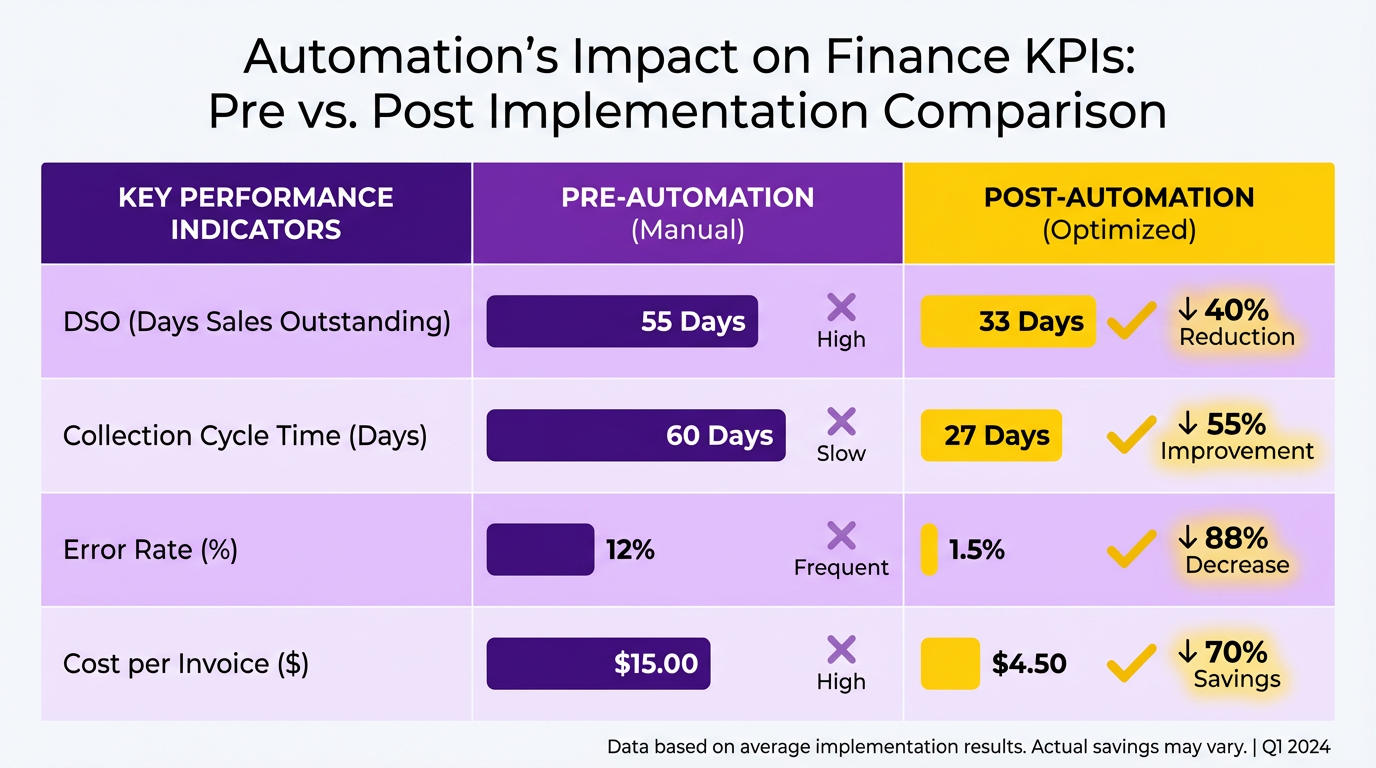
For example, a company using Blixo’s SaaS service reported a 25% reduction in DSO and a 40% drop in dispute rates within six months by automating invoice generation and payment reminders.
How Do Metrics Like Error Reduction and Automation Rates Drive Success?
Automation’s value is best measured through specific metrics:
- Error reduction rate: Manual processes often introduce 3–5% invoice errors, delaying payments by 5–10 days. Automation can cut this to under 1%.
- Time-to-cash: The total days from a sale to cash receipt. Automation can shave 12–18 days from this cycle by streamlining invoicing and collections.
- Customer satisfaction: Automated, omnichannel payment options (e.g., ACH, cards) reduce friction, with 74% of B2B buyers preferring flexible terms.
One retail supplier improved its DSO by 30% after automating deduction disputes. Previously, resolving 1,000+ Walmart claims took weeks; automation reduced resolution time to under five days, boosting both DSO and accounts receivable turnover.
What Challenges Hinder Automation Optimization?
Common obstacles include:
- Data quality issues: Inconsistent or incomplete data from legacy systems can skew automation outputs. For instance, mismatched customer records may delay payment matching. Building on concepts from the Overcoming Common Challenges and Obstacles section, data hygiene is critical for ensuring automation tools operate effectively.
- System integration: Integrating automation tools with ERPs, CRMs, or payment gateways often requires custom workflows. A lack of standardized APIs can slow deployment.
- Adoption resistance: Teams may resist automation due to fear of job displacement or unfamiliarity. Training and phased rollouts are critical.
A healthcare provider faced delays in DSO reduction due to fragmented patient billing systems. After consolidating data sources and training staff on automated workflows, DSO improved by 18%.
Final Recommendations
- Start with a baseline: Calculate current DSO, CEI, and dispute rates to set measurable goals. As outlined in the Understanding Days of Sales Outstanding section, establishing a clear baseline is foundational for tracking progress.
- Prioritize high-impact areas: Automate invoicing and collections first, as these directly influence DSO.
- Invest in data hygiene: Clean and standardize customer and transaction data to avoid automation errors.
- Use AI for predictive insights: Use machine learning to forecast payment risks and personalize collections strategies.
By aligning automation efforts with these metrics and addressing challenges proactively, businesses can enable significant cash flow improvements. Tools like Blixo provide the infrastructure to turn these strategies into measurable outcomes, ensuring long-term financial agility.
Overcoming Common Challenges and Obstacles
How Do Data Quality Issues Impact DSO Automation? Poor data quality is a leading cause of failed automation initiatives. For example, if an automation system pulls data from a legacy database with duplicate customer entries, it might generate conflicting invoices, prolonging collections and inflating DSO. As mentioned in the Understanding Days of Sales Outstanding section, a high DSO means cash is tied up longer, directly affecting working capital.
To resolve this, companies must prioritize data cleansing before deploying automation tools. This includes standardizing customer information, reconciling discrepancies in transaction records, and validating payment histories. Blixo’s SaaS service includes built-in data validation tools that cross-reference invoice details with ERP data in real time, reducing manual reconciliation. One mid-sized manufacturing company reduced its DSO by 30% after using Blixo to clean and automate its invoicing process, ensuring payments were processed without delays caused by manual corrections.
Why Is System Integration a Major Obstacle? Many businesses operate with fragmented systems-ERP software, accounting platforms, and customer relationship management (CRM) tools that don’t communicate seamlessly. Integrating automation solutions into these ecosystems often requires custom workflows, which can be time-consuming and costly. Building on concepts from the Automation Solutions for Reducing Days of Sales Outstanding section, selecting tools that align with existing ERP systems is critical for seamless automation.
The solution lies in selecting automation tools designed for ERP compatibility. Blixo’s SaaS service integrates directly with systems like SAP, Oracle, and Infor, enabling real-time data flow without requiring extensive re-engineering. This ensures that automated tasks-such as generating invoices post-shipment or triggering payment reminders-align with existing workflows. A case study from a logistics firm highlights this: after integrating Blixo with its Oracle ERP, the company achieved a 40% reduction in DSO within six months by automating end-to-end collections and eliminating manual handoffs.
How Can Organizations Manage Resistance to Change? Even the most advanced automation tools fail if teams resist adopting them. Employees accustomed to manual processes may distrust automated systems or lack the training to use them effectively. For example, accounts receivable staff might worry that automation will replace their roles, leading to passive resistance or incomplete adoption of new workflows.
Successful change management requires a structured approach. The Measuring and Optimizing Automation Effectiveness section discusses how real-time dashboards can track DSO improvements, which can be shared with teams to demonstrate automation’s value. By training finance teams to monitor automated workflows and reassign their focus to resolving complex customer disputes, businesses can achieve measurable DSO reductions while maintaining employee engagement.
Best Practices for Reducing Days of Sales Outstanding
Reducing Days Sales Outstanding (DSO) is critical for improving cash flow and operational efficiency. By automating processes, using data analytics, and strengthening customer communication, businesses can significantly shorten the time it takes to collect receivables. Below are actionable best practices supported by real-world insights..
1. Automate Invoice Processing and Payment Collection
Automation streamlines the entire accounts receivable (AR) process, reducing manual errors and accelerating payment cycles. For example, automated invoice generation and delivery eliminate delays caused by manual data entry. Platforms that integrate with ERP systems can generate invoices instantly upon shipment or service delivery, ensuring timely billing.
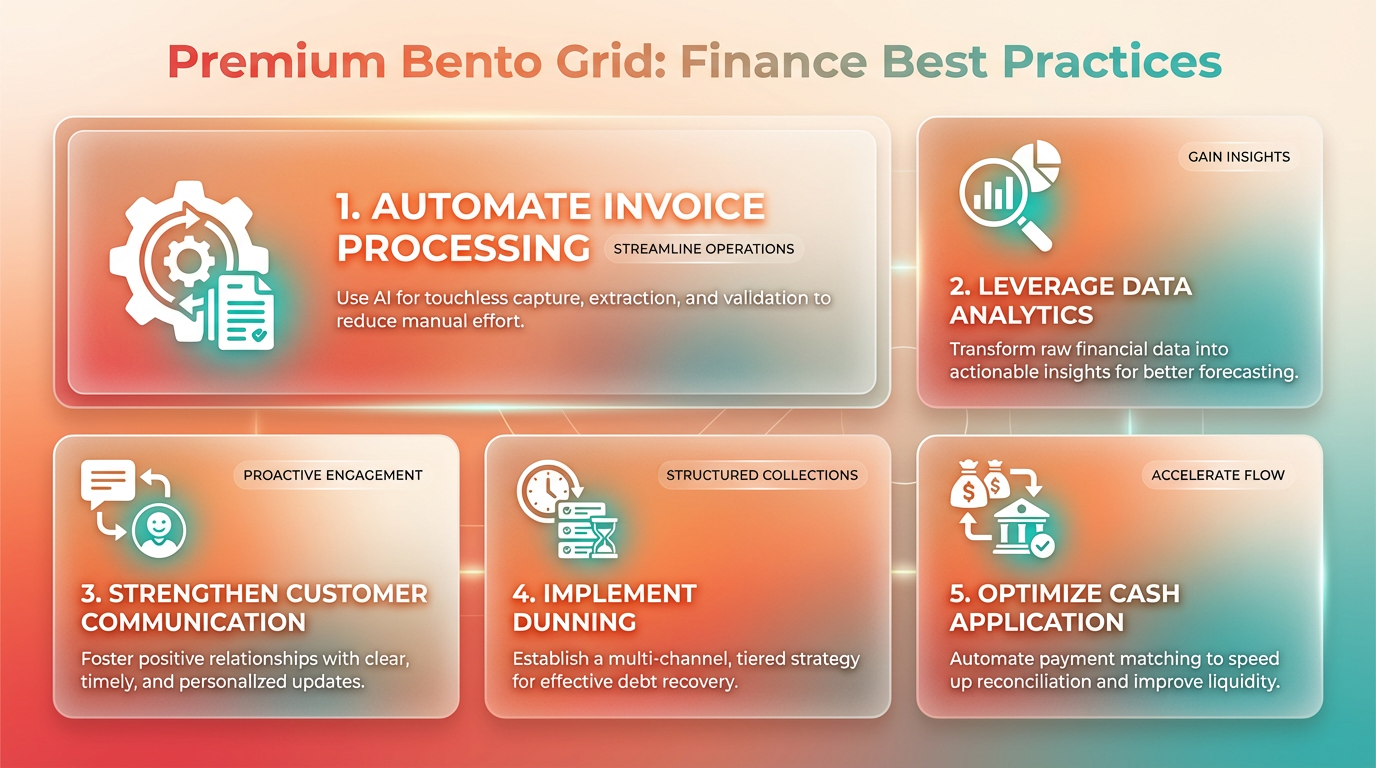
Key automation strategies include:
- Electronic invoicing: Replacing paper invoices with digital formats reduces processing time by up to 60% (Tungsten Automation), as outlined in the Automation Solutions for Reducing Days of Sales Outstanding section.
- Automated reminders: Scheduled follow-ups for due or overdue payments cut DSO by 12–18 days, as shown in Credit Pulse studies.
- Real-time payment tracking: Dashboards provide visibility into invoice status, enabling quick resolution of disputes and delays.
A generic provider in the healthcare sector reported a 30% reduction in DSO after implementing a cloud-based platform that digitized ordering, invoicing, and payments, replacing paper checks and manual approvals..
2. use Data Analytics for Proactive Management
Data-driven insights help identify bottlenecks and optimize collections. For instance, predictive analytics can forecast payment risks by analyzing historical patterns and customer behavior. Tools that integrate with AR systems highlight accounts nearing default, allowing teams to prioritize follow-ups.
Best practices for data analytics:
- Track DSO trends: Regularly analyze aging reports to identify accounts that consistently pay late, a practice emphasized in the Measuring and Optimizing Automation Effectiveness section.
- Segment customers: Group clients by payment reliability and tailor communication strategies (e.g., urgent reminders for high-risk accounts).
- Monitor payment methods: Encourage electronic payments, which are 3–5 days faster than checks, and account for 60% of B2B transactions (TreviPay).
A mid-sized enterprise improved DSO by 20% by using analytics to identify inefficiencies in its invoicing workflow and implementing targeted early-payment discounts..
3. Strengthen Customer Communication and Relationships
Clear communication prevents misunderstandings and builds trust, which is critical for timely payments. Clear payment terms (e.g., net-30, net-60) set expectations from the outset, a key point from the Why Reducing Days of Sales Outstanding Matters section. Salesforce highlights that 74% of B2B buyers would increase purchases if invoicing at checkout with flexible terms were available.
Effective communication tactics:
- Immediate invoicing: Send invoices right after a sale or service delivery to avoid delays.
- Personalized follow-ups: Use customer portals where clients can view invoices, make payments, and track status.
- Proactive outreach: Call or email customers ahead of due dates for large invoices, offering assistance if needed.
One company reduced DSO from 45 to 30 days by combining clear payment terms with a customer portal that simplified self-service payments..
4. Implement Phased Automation and Continuous Monitoring
A structured approach ensures smooth adoption of automation tools and sustained improvements. Start with a pilot project-such as automating a single department’s invoicing-to test workflows and measure impact.
Implementation steps:
- Baseline assessment: Calculate current DSO and identify pain points (e.g., manual invoice approval delays).
- Prioritize automation: Focus on high-impact areas like invoice generation and electronic payments.
- Train teams: Ensure finance and sales staff understand new tools and processes.
- Monitor and adjust: Track KPIs like DSO, dispute rates, and payment accuracy weekly.
A phased rollout at a manufacturing firm reduced DSO by 25% within six months by automating supplier onboarding and enabling real-time invoice tracking..
Case Study: Real-World DSO Reduction
A mid-sized SaaS company struggled with a DSO of 50 days due to manual invoicing and delayed collections. By implementing an AI-powered AR platform, they automated invoice creation, integrated electronic payments, and introduced early-payment discounts. Within three months, DSO dropped to 32 days, freeing $500,000 in working capital. The platform’s analytics also flagged 15% of invoices with errors, reducing disputes and accelerating payment cycles..
Final Recommendations
- Start small: Automate one process at a time to build momentum.
- Encourage collaboration: Involve finance, sales, and IT teams to align on goals.
- Review regularly: Adjust strategies based on performance data.
By combining automation, analytics, and customer-centric practices, businesses can turn DSO reduction into a sustainable competitive advantage.
Frequently Asked Questions
1. What is Days of Sales Outstanding (DSO) and why does it matter?
DSO measures the average days to collect payment after a sale. High DSO ties up cash, strains liquidity, and increases financial risk. Mid-sized U.S. businesses are owed $304,066 on average due to late payments.
2. How does automation reduce DSO?
Automation accelerates invoice resolution by streamlining workflows. For example, automating deductions cuts resolution time from weeks to under five days, improving cash flow and supplier relationships.
3. Which industries struggle most with high DSO?
Healthcare suppliers face 69% DSO exceeding 30 days, often due to manual processes like paper checks. Retail suppliers also face delays from unresolved deductions.
4. How much time do businesses waste chasing overdue invoices?
Companies spend 14 hours weekly manually tracking late payments, diverting resources from core operations and slowing growth opportunities.
5. What financial risks stem from prolonged DSO?
High DSO delays reinvestment, limits growth, and increases reliance on external financing. Retailers with unresolved deductions risk losing supplier trust and revenue.
6. Can automation improve supplier-buyer relationships?
Yes. Faster deduction resolutions and transparent processes build trust. Retail suppliers report stronger relationships after automating payment workflows.
7. What’s the average DSO for mid-sized U.S. businesses?
Mid-sized businesses have an average DSO tied to $304,066 in overdue payments. Automation can cut this by accelerating collections and reducing manual errors.