

Recurring Subscription Billing vs Usage-Based Billing: Which Cuts SaaS Churn

Key Takeaways
- Your billing model isn’t a finance detail. It drives churn, the accuracy of your revenue forecast, and how many hours your team loses to reconciliation.
- Recurring subscriptions give you predictable revenue through fixed fees. Usage-based revenue moves with what customers actually consume.
- Usage-based pricing tends to lower churn because customers dial spending down instead of canceling. Subscriptions get the blunt, binary cancel.
- Subscriptions ask for an upfront commitment, which raises the bar to sign up. Usage-based pricing lowers that bar and makes the product easy to try.
- Subscription billing runs on simple systems. Usage-based billing needs real metering and consumption tracking underneath it.
- The right model depends on one question: does your product’s value scale with seats or with volume? Neither approach wins everywhere.
Related Video
Watch: PODCAST EP145: Usage-Based Pricing: What Most SaaS Businesses Need to Know with Kyle Poyar by Impact Pricing
Quick Summary
The billing model you pick shapes your churn rate, your revenue forecasting, and how much manual work lands on finance. Short version: recurring subscription billing gives you predictable revenue and simple operations. Usage-based billing ties cost to value and lowers the barrier to entry. Neither wins outright. The deciding factor is whether your product’s value scales with seat count or with consumption volume.
How the two models stack up
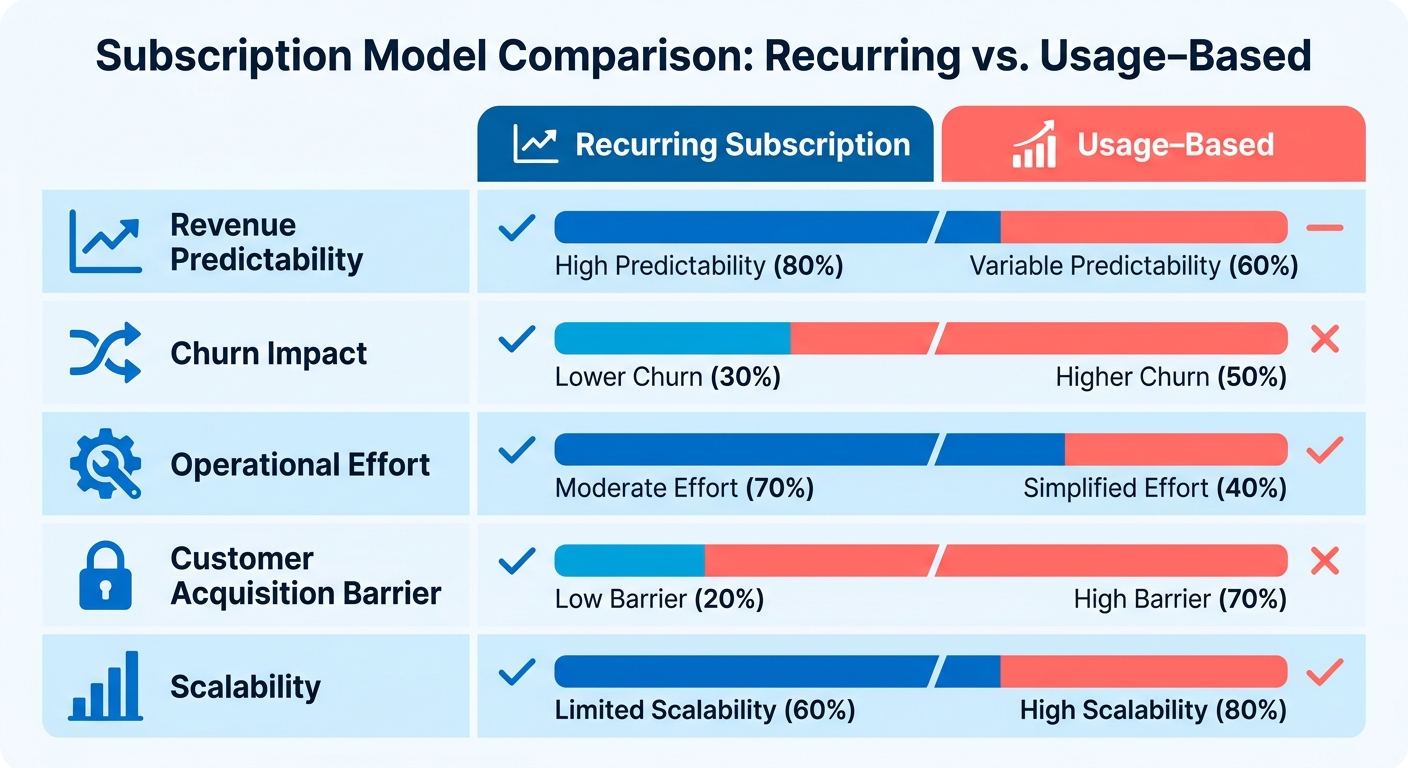
The table breaks down the metrics that actually matter when you’re weighing these. The figures come from SaaS pricing research; the effort estimates come from what the billing infrastructure really demands.
| Factor | Recurring Subscription | Usage-Based |
|---|---|---|
| Revenue predictability | High; fixed recurring fees | Lower; revenue fluctuates with consumption |
| Churn impact | Cancellations are binary and visible | Lower friction; customers scale down instead of leaving |
| Customer acquisition | Higher barrier; commit upfront | Lower entry cost; easier to try |
| Billing complexity | Simple; basic systems handle it | High; needs real-time metering |
| Implementation effort | Days to weeks | Weeks to months |
| Reconciliation load | Steady, predictable | Heavy; variable invoices each cycle |
| Best fit | Stable usage, streaming, SaaS tools | Cloud services, APIs, seasonal workloads |
One number worth holding onto: nearly two-thirds of SaaS companies have adopted usage-based pricing, and 46% now run hybrid models that blend both. This isn’t a fringe debate anymore.
What each model is good at
Recurring subscription billing charges a fixed fee on a set interval, usually billed annually upfront. Steady cash flow, clean forecasting. Salesforce runs tiered per-seat pricing this way. Streaming platforms lean on it too, because access is the value, not volume.
Usage-based billing charges for what customers consume. AWS bills on compute time and storage. Twilio charges per API call or message. Snowflake runs on consumption credits tied to compute. The quiet appeal: customers underestimate their own usage and spend more over time, which lifts recurring revenue.
Which one is harder to run
Usage-based, and the difficulty is operational, not strategic. It needs metering and real-time usage tracking. Every cycle produces a different invoice per customer, and that’s where manual reconciliation starts eating your finance team alive.
Subscription billing runs on simpler systems. Predictable amounts mean predictable matching. No spreadsheet gymnastics required.
This is the trade-off most billing-model debates skip. Usage-based pricing can cut churn by showing customers a clear line between cost and value. But that benefit collapses if billing errors and reconciliation friction sour the relationship. Automated cash application is what keeps a variable-invoice model from turning into a payment-dispute machine.
The honest carve-out: if your usage is stable and your customers want predictable bills, don’t chase usage-based pricing for its own sake. Simple, predictable bills lower churn too. Match the model to how your product creates value, then automate the reconciliation either way.
Why Billing Models Matter
Your billing model decides more than how the invoice looks. It shapes churn, revenue predictability, and how many hours finance burns on reconciliation. Get it right and customers feel fairly charged. Get it wrong and every billing cycle becomes a friction point that quietly nudges people toward the door.
How much does the model actually move churn?
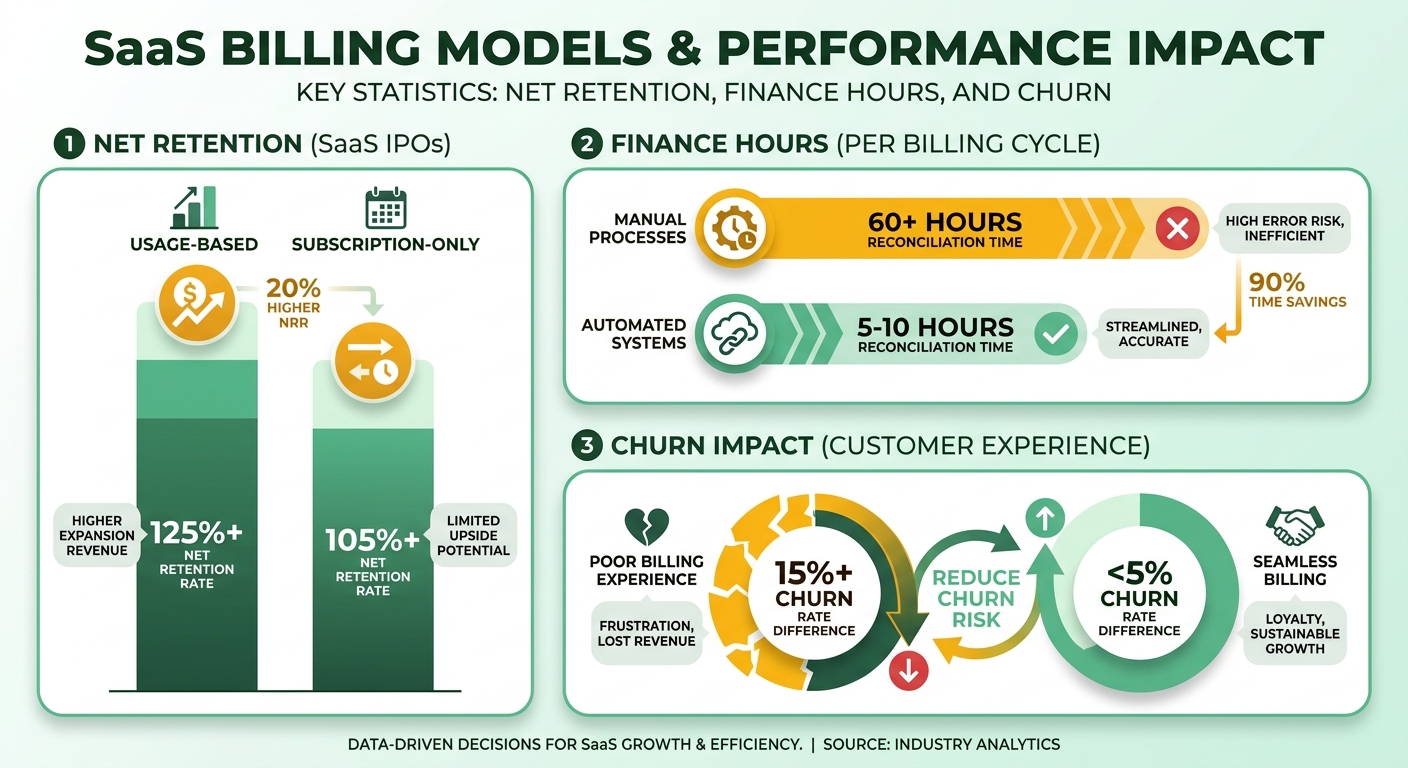
More than you’d think. Seven of the nine SaaS IPOs with the best net retention in recent years ran usage-based pricing, including Slack, Snowflake, and Elastic. When cost tracks value, customers scale up instead of canceling.
The retention gap is measurable. Companies on usage-based models often report net revenue retention above 120%, while flat-rate subscription peers tend to cluster closer to 100% to 110%. The reason is structural. When a customer’s bill grows only as their own usage grows, expansion happens without a new contract or a renewal negotiation, and the pressure to cancel during a slow quarter eases.
There’s a catch the usual debate skips, though. Usage-based billing only reduces churn if the payment experience stays clean. Sloppy invoices and mismatched payments do more damage than the pricing model ever fixes.
Who’s the better fit for each?
Recurring subscription billing fits products with stable consumption and buyers who want predictable bills. Streaming services and most per-seat B2B tools live here. Salesforce’s tiered per-seat pricing gives different segments flexibility plus a renewal number they can forecast.
Usage-based billing fits variable or high-volume consumption. Twilio per message, Snowflake per credit, AWS per compute hour. It also lowers the barrier to entry, pulling in startups and solo operators who’d never commit to a flat fee upfront.
| Factor | Recurring Subscription | Usage-Based |
|---|---|---|
| Best fit | Stable usage, per-seat B2B, B2C content | Variable usage, high-volume, developer tools |
| Revenue predictability | High | Fluctuates month to month |
| Billing infrastructure | Simple | Metering, rating, reconciliation |
| Entry barrier for buyers | Higher | Lower |
ConvertKit shows the middle ground well. Monthly cost slides up as a user’s email list grows. Lighter users pay less, heavier users pay more, and nobody feels overcharged.
Where reconciliation friction hides
In the gap between what you metered and what the customer actually paid. Subscription billing runs on simple systems. Usage-based billing demands metering, rating, and invoicing every cycle, and then someone has to match incoming payments back to those variable invoices. That matching step is where finance teams lose hours and customers lose patience.
This is the trade-off most comparisons ignore. A fluctuating invoice plus manual reconciliation creates exactly the payment friction that drives churn, even when your pricing is fair. ASC 606 compliance and deferred revenue tracking only raise the stakes.
Automated cash application closes that gap. Blixo matches payments to usage-based invoices without spreadsheets, so a fair price actually arrives as a clean, predictable experience. The reconciliation tax becomes something the buyer never feels, which is the real lever on retention. Picking a model is step one; whether it cuts churn depends on the billing operations underneath. For more on how recurring structures work in practice, see subscription billing vs. recurring billing.
Recurring Subscription Billing: How It Works and Its Impact on SaaS Churn
Recurring subscription billing charges a fixed fee at set intervals, usually monthly or annually. The amount holds whether a customer logs in daily or once a quarter. That predictability is the whole appeal: steady revenue for you, a known line item for them.
Subscriptions typically bill annually upfront, while usage-based billing runs monthly in arrears. So with a subscription, cash often lands before the value is delivered. Forecasting gets easier, and the billing system stays simple because there’s no metering to track.
How predictable revenue keeps customers around
Predictable revenue lowers churn because buyers can budget without surprises. Transparent, simple pricing reduces the friction of signing up and the friction of staying. When a customer knows exactly what hits their card each cycle, there’s no bill shock to start a cancellation conversation.
BambooHR built a full licensing and packaging architecture on that idea and hit step-change growth once the structure was in place.
The trade-off sits on the other side: revenue volatility. Usage-based revenue swings with consumption, which makes forecasting harder and can spook a finance team during slow months. Subscription billing trades that upside for stability.
Where recurring billing falls short
The biggest drawback is inflexibility. Per-seat pricing assumes every user pulls equal value, which is rarely true. A team buys 50 seats, uses 20, and starts eyeing the renewal as waste. That perceived overpayment is a quiet churn driver.
The flip side is over-usage risk. A flat fee means a power user costs you the same as a light one, so heavy accounts erode your margin while you’re locked into a fixed price. Neither problem fixes itself. Both push companies toward hybrid models that bolt usage onto a base subscription.
| Factor | Recurring Subscription | Usage-Based |
|---|---|---|
| Revenue pattern | Predictable, often billed annually upfront | Variable, billed monthly in arrears |
| Forecasting | Straightforward | Harder, swings with consumption |
| Billing infrastructure | Simple systems | Metering plus reconciliation |
| Churn risk | Underused seats feel like waste | Bill shock from spikes |
Why hybrid billing creates a reconciliation problem
The catch most debates skip: the moment you add a usage component to your subscription, finance inherits manual reconciliation. Systems now have to handle proration, multi-currency, discounts, and ASC 606 compliance without falling back on spreadsheets.
That’s where Blixo fits. It automates cash application for usage-based and hybrid SaaS, matching incoming payments to invoices so nobody is hand-keying figures at month-end. Killing that grind keeps revenue recognition clean and frees the team for the human side of billing.
Payment friction is often where churn starts. A mismatched invoice. A payment stuck in limbo. A customer chasing a correction. Clear those automatically and billing stops being a reason to leave.
Usage-Based Billing: How It Works and Its Impact on SaaS Churn
Usage-based billing charges customers for what they actually consume instead of a flat fee. The cost tracks the volume used: messages sent, gigabytes stored, API calls made. It goes by a few names too, including metered, consumption-based, and pay-as-you-go.
That alignment between cost and value is the whole pitch. Customers feel they’re paying for results, not shelf space. And lower entry costs make it easy to start small, then grow.
The three moving parts
Usage-based billing runs on metering, rating, and invoicing. You track consumption against a value metric, apply your pricing rule, then bill in arrears, usually monthly.
The pricing structure varies. Per-unit flat charges the same rate for every unit. Volume-tiered drops the rate as usage climbs. Graduated pricing stacks different rates across usage bands.
Real examples make it concrete. Twilio charges per message sent. AWS bills on compute time, storage, and data transfer. ConvertKit uses a sliding scale where monthly cost rises as your email list grows. Each ties the invoice to a metric the customer can see and control.
The benefits, and the catches
The big win is retention through flexibility. Customers scale usage up or down without canceling, so a slow quarter trims the bill instead of triggering a churn decision. OpenView credits usage-based models with stronger CAC payback and better net dollar retention among growing SaaS companies. Light users also stop feeling cheated, which kills the under-usage resentment that flat fees breed.
The drawbacks are real. Revenue fluctuates, so forecasting gets harder. The model demands sophisticated metering to track usage accurately in real time. And if your value metric is wrong, customers ration their usage to control costs, which suppresses the very adoption you wanted.
| Factor | Usage-Based Billing |
|---|---|
| Cost alignment | Tracks actual consumption |
| Entry barrier | Low; pay as you grow |
| Revenue predictability | Fluctuates month to month |
| Infrastructure needed | Metering, rating, invoicing |
| Main churn risk | Usage suppression from unclear metrics |
How it actually affects churn
Usage-based pricing lowers churn when consumption maps to value, because growing customers expand their own spend instead of leaving. The model is gaining ground fast: Stripe reports 74% of suppliers adopting it, and Zylo projects 70% of the top 20 SaaS vendors will offer consumption-based pricing by 2027.
But monthly billing in arrears sets a hidden trap. Variable invoices mean variable payments, and matching every incoming payment to the right customer and usage period turns into manual reconciliation. That friction lands on finance and slows the cash you’ve already earned.
This is where Blixo changes the math. It automates cash application for usage-based SaaS, matching payments to invoices without anyone touching a spreadsheet. Reconciliation stops being a monthly grind, and customers get clean, accurate billing they can trust. That’s exactly what keeps consumption-based customers from drifting toward the exit.
Blixo: A Hybrid Approach to Billing and Its Impact on Churn
A hybrid model pairs a fixed subscription fee with usage-based charges. You get predictable baseline revenue while still rewarding lighter users. This is where Blixo fits. It runs the metering, rating, and cash application for hybrid SaaS pricing so finance stops reconciling payments by hand.
The hybrid approach solves a real tension. Pure usage-based billing makes revenue swing month to month. A flat subscription ignores how much value a customer actually pulls from your product. Blend the two and you get a stable floor plus a fair top-up tied to consumption.
What Blixo actually does
Blixo handles the back-end work that makes hybrid billing viable: tracking consumption against a value metric, applying your pricing rules, and matching incoming payments to the right invoice automatically. That last part, automated cash application, is what most billing debates skip entirely.
Manual reconciliation is where usage-based models quietly break. When a customer’s bill changes every cycle, finance teams spend hours matching deposits to invoices. Get it wrong and customers get dunning emails for invoices they already paid. That’s a churn trigger nobody put in the pricing deck.
Blixo removes that step. Payments reconcile themselves, so the only time a customer hears from billing is when something genuinely needs attention. Quiet billing is sticky billing.
How hybrid billing reduces churn
Hybrid billing lets customers scale spending without canceling. They commit to a tier for the predictable part, then pay for overage on the variable part. No forced upgrade decision, no penalty for a slow month.
This matches what Kyle Poyar observed on the topic: the customers who stay and spend more tend to consume more. A model that lets consumption grow naturally captures that expansion instead of capping it behind a seat count. You keep the customer, and the revenue grows with them.
The cash-application piece compounds the effect. When billing accuracy is automatic, the time your team spends with customers shifts from chasing payments to actual support. Payment friction becomes a non-event.
How it compares to the alternatives
| Factor | Pure Subscription | Pure Usage-Based | Hybrid (Blixo) |
|---|---|---|---|
| Revenue predictability | High | Low | Medium-high |
| Rewards light users | No | Yes | Yes |
| Reconciliation effort | Low | High | Automated |
| Churn risk from billing friction | Low | High | Low |
| Captures expansion revenue | Limited | Yes | Yes |
Real products already run versions of this split. Twilio charges per SMS sent. ConvertKit raises the monthly fee as an email list grows. Both prove customers accept consumption-linked pricing when the charge tracks value.
The difference Blixo brings is the reconciliation layer underneath. Twilio and ConvertKit built that infrastructure themselves. Most teams don’t have that engineering budget. Best for usage-based SaaS teams that want hybrid pricing without building a cash-application system from scratch.
Skip it if your product is genuinely flat-rate with no consumption component. Nothing to meter, and a simpler subscription tool will serve you fine.
Implementation Checklist: Transitioning to a New Billing Model
Switching billing models is a project, not a config change. The cleanest transitions follow three phases: assess what your customers actually value, plan the pricing structure and tooling, then execute with new customers before you touch the existing base. Get the sequence wrong and you trade predictable revenue for reconciliation chaos and avoidable churn.
What the transition actually looks like
Start with the value metric, not the price. The model is downstream of harder decisions: what you charge on, what’s included, and which price points survive real deals. Pick a metric customers can predict and control. A metric they can’t forecast undermines the whole model no matter how clean your execution.
Companies that move deliberately tend to land it. Nearmap, the aerial imagery SaaS, ran a multi-year pricing transformation and repositioned its premium architecture without breaking its base. BambooHR rebuilt its licensing and packaging and hit step-change growth. Both treated pricing as a structured rebuild, not a flip of a switch.
Your transition checklist
Work through these in order. Each one cuts the friction that drives churn during a model change.
| Phase | Key Step | Why It Matters |
|---|---|---|
| Assess | Identify the value metric customers can control | Unpredictable metrics make buyers ration usage |
| Assess | Pull your current churn and net retention baseline | You can’t measure impact without a starting point |
| Plan | Set spending caps and clear usage dashboards | Caps build trust; surprise bills break it |
| Plan | Choose billing infrastructure that automates cash application | Manual reconciliation collapses at usage scale |
| Execute | Roll out to new customers first | Limits blast radius and lets you tune pricing |
| Execute | Communicate changes with resources and examples | Confused customers churn faster than overcharged ones |
The infrastructure line is where most transitions quietly fail. Usage-based billing means metering, rating, and invoicing every cycle, plus matching variable payments to variable invoices. Do that in spreadsheets and your finance team drowns. This is the gap Blixo closes: it runs the metering and automated cash application so payments reconcile themselves instead of landing on someone’s desk.
That automation isn’t a back-office nicety. When reconciliation breaks, disputes pile up and customers feel friction at exactly the moment they’re deciding whether to renew. Clean, accurate invoices keep the billing relationship low-stress, which is the churn-reducing payoff most model debates skip.
Pitfalls to avoid
The biggest mistake is choosing a metric that punishes usage. If costs spike as customers use more, they suppress consumption and adoption stalls. Spending caps and real-time tracking prevent that anxiety.
The second pitfall is forcing every existing customer onto the new model at once. Start with new signups, prove the pricing holds, then migrate. If you’re blending a fixed fee with consumption charges, keep the structure legible so buyers can predict their bill. For the mechanics of dependable recurring charges underneath a hybrid plan, the recurring billing best practices guide covers the fundamentals worth locking down before you layer usage on top.
Frequently Asked Questions
1. Can I switch from usage-based billing back to subscription billing if it doesn’t work?
Switching back is possible but should follow the same phased approach as any model change: roll out the new structure to new customers first, then migrate existing accounts gradually. Sudden forced migrations confuse buyers and increase churn faster than overcharging. Always pull a churn baseline before changing anything to measure the impact.
2. What is the difference between metered, consumption-based, and pay-as-you-go billing?
These are three names for the same model: usage-based billing. All charge customers for what they actually consume, such as messages sent, gigabytes stored, or API calls made. The terms are interchangeable in SaaS contexts and rely on the same three components: metering consumption, rating it against pricing rules, and invoicing in arrears.
3. How do volume-tiered and graduated pricing differ in usage-based models?
Volume-tiered pricing drops the rate as total usage climbs, applying one lower rate across all units once a threshold is hit. Graduated pricing stacks different rates across usage bands, so each band is charged at its own rate. Per-unit flat pricing, by contrast, charges the same rate for every unit consumed.
4. Why does billing customers in arrears create reconciliation problems?
Usage-based billing runs monthly in arrears, meaning variable invoices produce variable payments each cycle. Finance teams must manually match every incoming payment to the correct customer and usage period. This matching step consumes hours and can trigger errors like dunning emails for already-paid invoices. Automated cash application, like Blixo provides, eliminates this manual grind.
5. What net revenue retention should I expect from each billing model?
Companies on usage-based models often report net revenue retention above 120%, while flat-rate subscription peers typically cluster between 100% and 110%. The gap is structural: usage-based customers expand spending as their own consumption grows, without new contracts or renewal negotiations, and slow quarters trim bills instead of triggering cancellations.
6. How do I choose the right value metric for usage-based pricing?
Pick a metric customers can predict and control, such as email list size or messages sent. A metric buyers can’t forecast leads them to ration usage, suppressing the adoption you want. Set spending caps and real-time dashboards to build trust. The value metric decision comes before pricing, since the model depends on it.
7. Is hybrid billing worth it for a flat-rate product with no usage component?
Hybrid billing isn’t worth it for genuinely flat-rate products with nothing to meter. A simpler subscription tool serves you better and avoids unnecessary metering infrastructure. Hybrid models suit teams whose product value scales with consumption, where a fixed baseline plus variable overage captures expansion revenue that pure per-seat pricing would cap.