

Quadient AR vs HighRadius: Faster collections for your agency payments
Quadient AR vs HighRadius: Which One Actually Fits Your Stack?

Key Takeaways
- HighRadius ships 190+ AI agents and full order-to-cash automation for Fortune 500 operations. Expect 3–6 month implementations.
- Quadient AR goes after mid-market teams with faster deployment and connectors for NetSuite, Sage Intacct, and Acumatica.
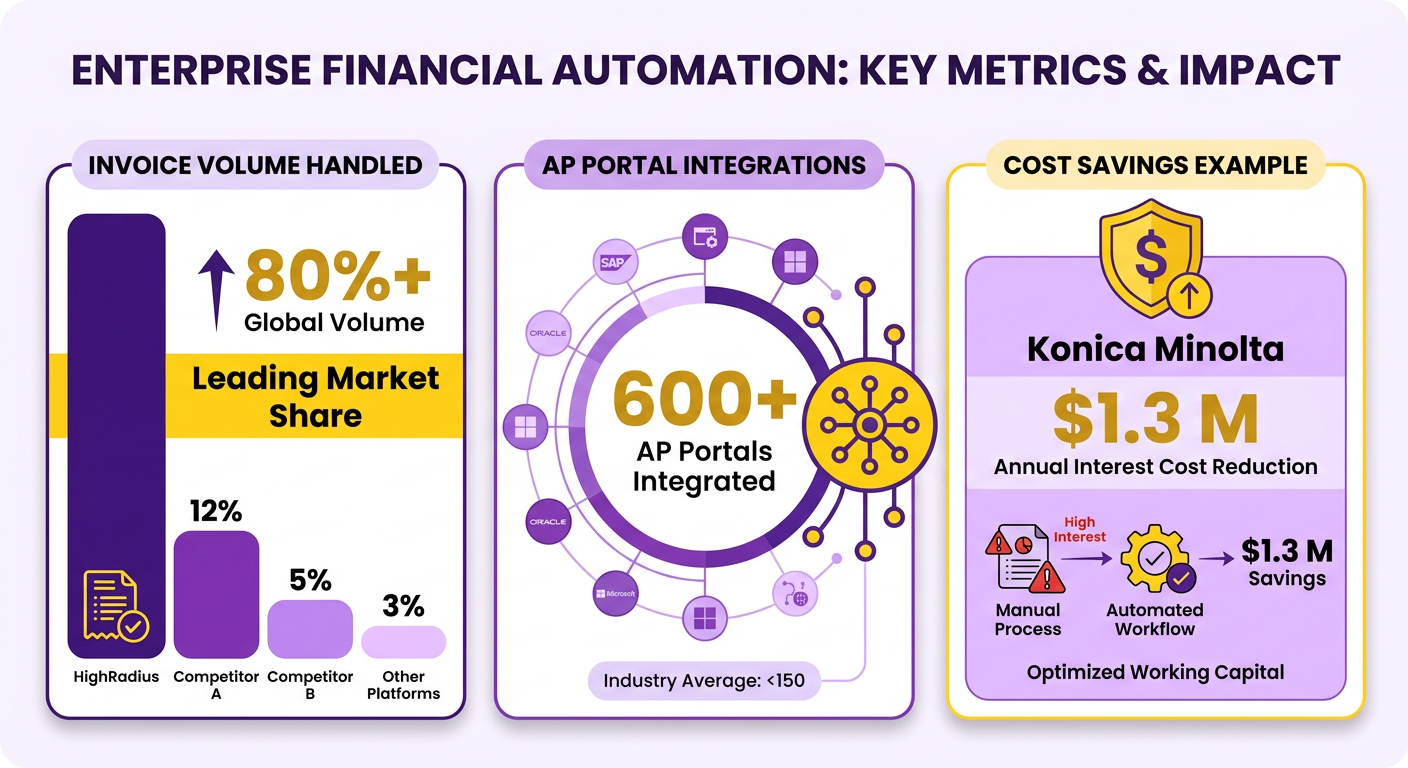
- Coca-Cola Bottlers recovered $33.4 million with a 34-day resolution time using HighRadius, versus a 90-day industry average.
- HighRadius automates 600+ AP portal uploads and delivered 20% drops in past-due invoices plus 30% productivity gains.
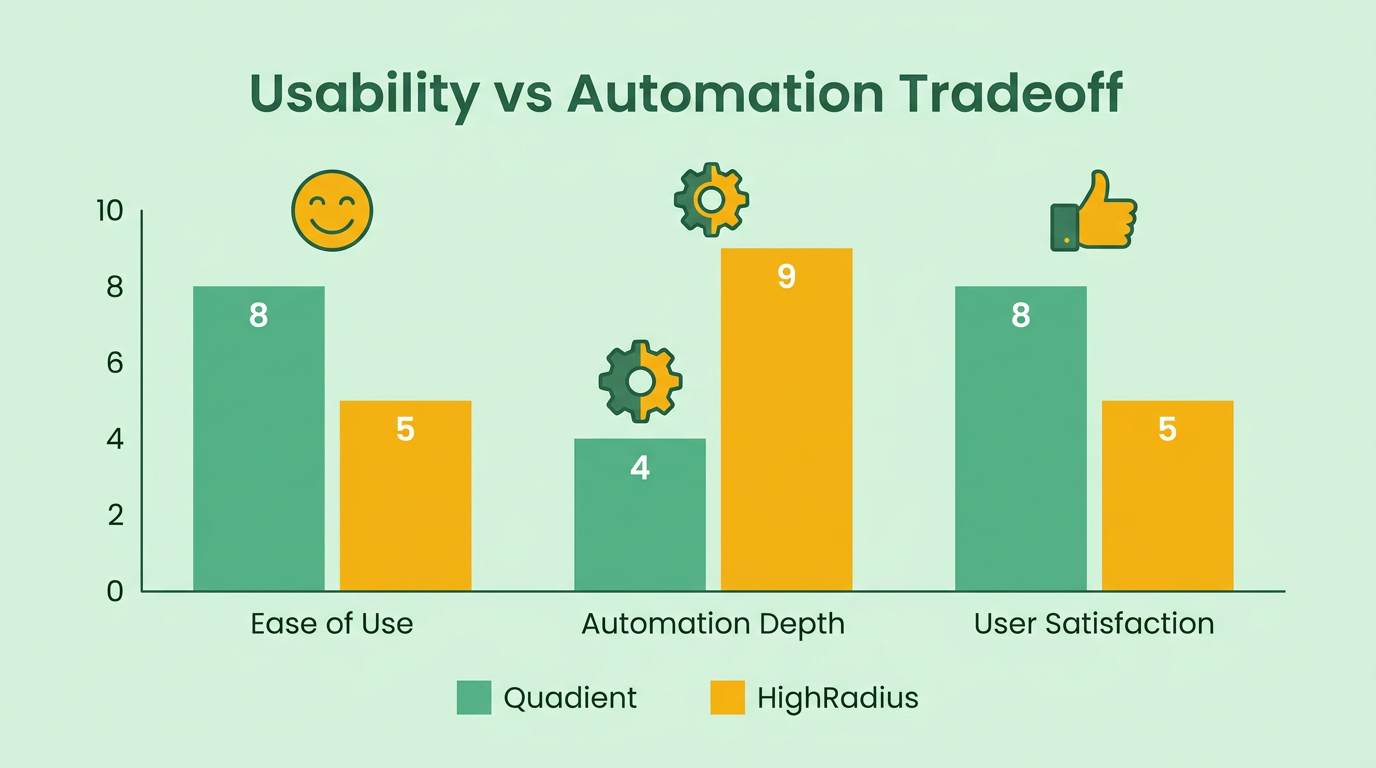
- HighRadius wins on automation depth for enterprises. Quadient AR wins on usability for smaller teams.
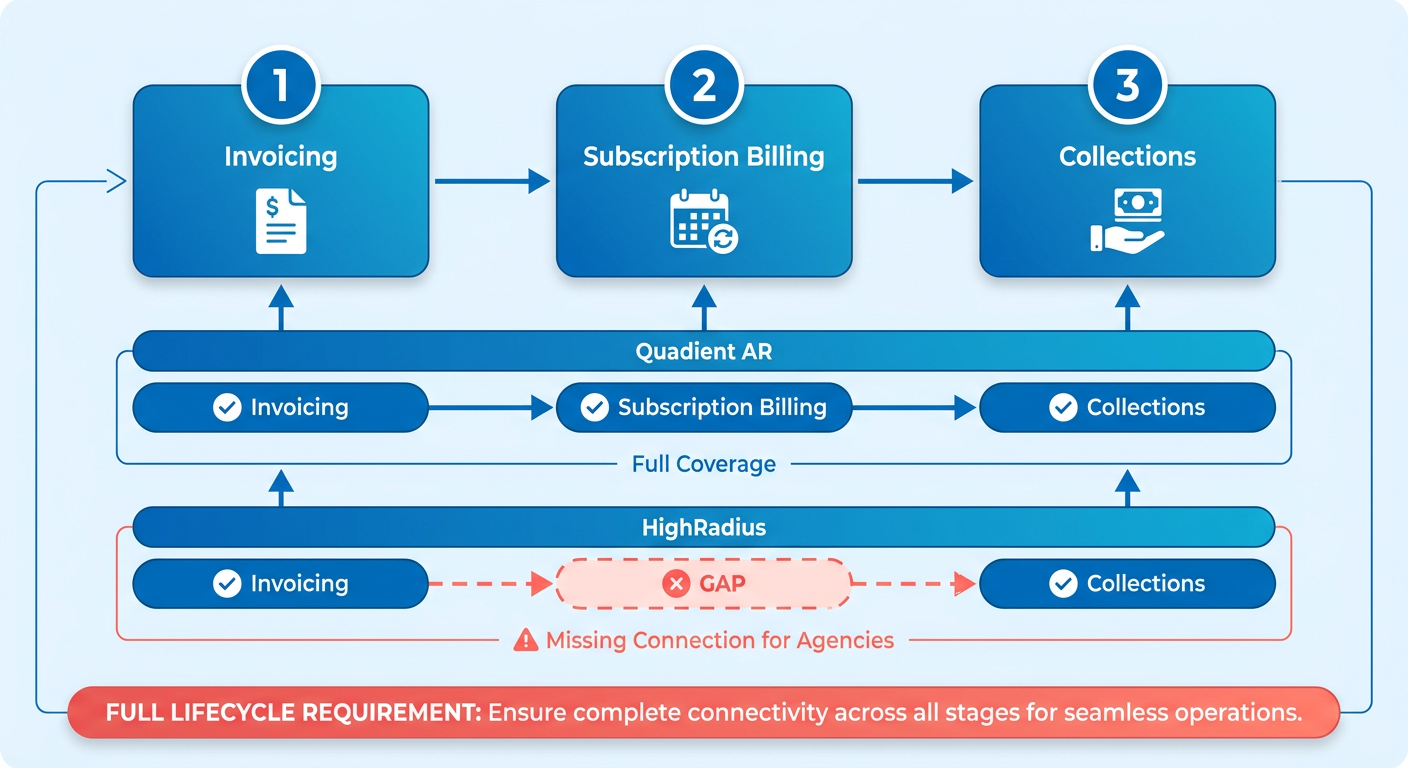
- Neither covers the full payment cycle agencies need: invoicing, subscription billing, and collections under one roof.
- Quadient AR uses predictive analytics to rank collections by customer payment behavior.
Where Each Platform Actually Lands
Most comparisons frame Quadient AR and HighRadius as market-segment alternatives: enterprise versus mid-market. That’s true, but it misses the bigger gap both leave open. Neither addresses the full payment lifecycle agencies run: invoicing, subscription billing, and collections in one place.
Quadient AR vs HighRadius: Different problems, different buyers
Quadient AR targets mid-market teams. It offers faster implementation, predictive analytics for collections prioritization, and integrations with NetSuite, Sage Intacct, and Acumatica. Deploy it quickly when you need collections running now.
HighRadius serves enterprise clients. Implementations run 3–6 months, with connectors into SAP, Oracle, and Microsoft Dynamics. The platform automates 600+ AP portal uploads and cut past-due invoices by 20% with 30% productivity gains in recent rollouts. Coca-Cola Bottlers recovered $33.4 million with a 34-day resolution time using HighRadius, versus a 90-day industry average. That’s the payoff if you have the runway for an extended setup.
This divide forces finance leads to pick between automation depth and day-to-day usability. One usually means accepting friction in the other.
Pricing and ERP integration: what the spec sheets won’t tell you
HighRadius uses outcome-based pricing. Quadient AR runs a subscription model tied to features, scaling from small team plans to custom enterprise quotes. Both offer modular add-ons, but verifying your specific ERP version with reference customers is non-negotiable. Integration sheets rarely account for legacy customizations or non-standard configurations.
Industry surveys show 90% of enterprises plan to buy more AR software next year. That statistic underlines how widely businesses rely on fragmented stacks—using separate systems for invoice generation, subscription management, and dunning workflows. Neither Quadient AR nor HighRadius bridges those divides on its own.
The integration gap that doesn’t show up in vendor decks
HighRadius connects to enterprise ERPs. Quadient AR integrates with mid-market accounting platforms. Subscription management sits outside both workflows. You still need separate software to handle recurring billing, churn prediction, and revenue recognition, then reconcile payments across systems.
In practice, that setup forces manual handoffs between invoicing, collections, and cash application. Your team chases payments in one platform, applies cash in another, and manages subscriptions in a third. Context-switching and manual entry overhead quickly erase the performance gains promised by collections automation.
Agencies sidestep this by adopting platforms that consolidate invoicing, subscription management, and collections into unified infrastructure. When an integrated system handles invoice generation, automatic payment processing, and escalation logic at the same time, cash flow accelerates naturally.
| Feature | Quadient AR | HighRadius |
|---|---|---|
| Best for | Mid-market teams | Enterprise clients, Fortune 500 |
| Setup time | Faster deployment | 3–6 months |
| ERP integrations | NetSuite, Sage Intacct, Acumatica | SAP, Oracle, Microsoft Dynamics |
| Pricing model | Feature-based subscription | Outcome-based |
| AI automation | Predictive analytics | 190+ AI agents |
| Subscription billing | Not included | Not included |
Why You’d Look at These in the First Place
Evaluating Quadient AR and HighRadius means looking past core dunning functions to see how each system fits your operational scale. HighRadius serves over 1,500 enterprise accounts, with order-to-cash architecture built for complex multi-entity environments. Quadient AR focuses on mid-market operations processing 500+ invoices monthly, with onboarding that can finish in a day.
Three challenges usually surface during evaluation. Extended implementation schedules come with enterprise suites. UX usability often diverges from backend automation complexity. Most importantly, neither application natively spans recurring retainers, fixed project billing, and automated dunning inside a single interface.
The integration gap you’re absorbing
Enterprise platforms map into major accounting backbones effectively. Technical compatibility doesn’t guarantee complete workflow alignment. When agencies operate billing tools, recurring retainer platforms, and collections engines in parallel, data sync delays show up.
Manual reconciliation becomes an ongoing requirement. Staff spend hours cross-referencing ledger entries, re-keying customer payment profiles, and consolidating reports across separate screens. Optimizing a single component of a disconnected workflow leaves the underlying drag intact.
Selection criteria that actually matter
Deployment speed directly influences how quickly cash flow improves. Quadient AR’s rapid deployment provides quick relief for backlogged receivables. HighRadius delivers powerful enterprise automation, though setup requires coordinated IT resources over several months. When receivables require urgent stabilization, rapid deployment may take precedence over extensive feature sets.
Evaluating specialized point solutions requires accounting for administrative overhead. Tools like Kognitos—recognized as the #1 Exemplary Provider in the ISG Buyers Guide for Automation and Orchestration—offer deterministic neurosymbolic AI tailored for complex cash-application exceptions. Introducing standalone micro-workflow applications expands system logins and complicates monthly closes.
Align platform capabilities with your agency’s revenue architecture. Quadient AR and HighRadius emphasize transactional receivables—billing project milestones, tracking outstanding balances, settling open invoices. Organizations managing ongoing retainer agreements alongside one-time deliverables need infrastructure designed to govern subscription lifecycles and transactional invoices together.
Feature Comparison
Quadient AR and HighRadius take different approaches to user experience and process depth. Quadient AR often feels simpler to configure, while HighRadius concentrates its design on deep algorithmic process automation.
AI and automation: what you actually get
HighRadius uses machine learning to analyze historical payment trends across accounts, automatically routing high-value past-due balances to collectors and managing portal submissions. Quadient AR centers its intelligence on predictive scoring algorithms that evaluate historical payment habits to prioritize daily outreach queues.
These differences shape daily collector routines. HighRadius provides extensive automation depth for large organizations with dedicated administrative resources. Quadient AR emphasizes straightforward daily queue management for teams that prefer intuitive navigation over complex enterprise configurations.
Deploying extensive automation frameworks requires realistic resource planning. Systems featuring hundreds of configurable agents demand detailed staff training and process mapping before reaching steady-state efficiency.
Integration and ERP compatibility
HighRadius supports enterprise platforms including SAP, Oracle Fusion Cloud, NetSuite, and Microsoft Dynamics 365. Quadient AR interfaces with mid-market and enterprise systems: Sage Intacct, NetSuite, Microsoft Dynamics 365, SAP, Sage X3, and Acumatica. Beyond surface-level ERP compatibility lists, technical architectures differ significantly. HighRadius delivers real-time synchronization for tier-one ERPs like SAP. Quadient AR relies on scheduled batch updates running every few hours.
Data synchronization intervals directly impact how fast collector teams resolve disputed charges. HighRadius offers $0 upfront implementation packages tied to outcome-based contracts, mitigating initial capital outlay without altering the core deployment timeframe.
HighRadius structures fees around invoice volume metrics. Quadient AR scales tier access by feature availability. Both platforms handle accounts receivable collections, but neither includes native invoice generation or subscription engine capabilities.
What each platform leaves out
HighRadius provides specialized tools for multi-channel remittance extraction and backup document retrieval. Quadient AR features customizable payment portals and dynamic cash management dashboards. Because both systems focus strictly on post-billing receivables, businesses must maintain external software for initial invoicing and subscription contracts.
This boundary impacts long-term platform returns. Focused receivables solutions like Billtrust demonstrate that unified payment approaches achieve up to 384% ROI with payback in nine months, showing the financial advantage of eliminating operational silos between billing and collections.
Quadient AR is less suited for organizations processing under 500 invoices per month. HighRadius may prove overly complex for teams requiring immediate deployment or straightforward interface management. If your goal is unifying invoice generation, recurring retainers, and collections under one roof, choosing between these two leaves the underlying fragmentation unresolved.
| Feature | Quadient AR | HighRadius |
|---|---|---|
| Target Market | Mid-market (500+ invoices/month) | Fortune 500 enterprises |
| Onboarding Time | As little as 1 day | 3–6 months |
| AI Agents | Focused predictive analytics | 190+ agents across O2C |
| Payment Lifecycle | Collections only | Collections + broader O2C |
| User Satisfaction | Higher ease-of-use scores | Lower satisfaction, deeper automation |
| ERP Integrations | Sage Intacct, NetSuite, Acumatica | SAP, Oracle, NetSuite |
Performance: Scale vs Speed
HighRadius supports massive scale across varied accounts payable environments. Quadient AR emphasizes streamlined task management for mid-market finance teams. Konica Minolta cut annual interest costs by $1.3 million after deploying HighRadius to structure its receivables operations. Their technical strategies differ—HighRadius driving throughput efficiency and Quadient prioritizing collector usability—but neither platform bridges the operational rift between project billing and subscription governance.
Automation depth: where the differences show
HighRadius achieves 4X more weekly past-due coverage by using automated prioritization algorithms that highlight at-risk balances before delinquency accelerates. Its operational footprint covers broader order-to-cash, treasury, and record-to-report functions, handling complex remittance tasks without manual input.
Quadient AR accelerates mid-market outreach by applying behavioral scoring rules directly to daily account queues. Direct connections to accounting backbones allow collections activity to flow into standard financial reports. HighRadius leads in raw processing volume. Quadient AR reduces operational friction for daily account reps.
Performance hurdles surface when recurring subscription fees enter the mix. Lacking native subscription tools, both platforms require manual data syncs between billing engines and dunning queues.
Resource requirements and timelines
HighRadius targets global enterprises operating established ERP environments. Implementation involves custom workflow mapping, legacy data translation, and validation steps. System configurations move through structured project stages over multiple months.
Quadient AR deploys rapidly when standard ledger structures align with default templates. This architecture delivers functional dashboards quickly, though with less automated workflow coverage than enterprise-level engines afford. Organizations frequently balance immediate visibility requirements against extensive long-term automation objectives when selecting deployment approaches.
Thorough technical vetting remains necessary before implementation. Uncovering version incompatibilities or custom field mismatches early prevents unexpected delays during deployment.
| Platform | Enterprise Scalability | Collections Coverage | Workflow Complexity | Primary Integration Focus |
|---|---|---|---|---|
| HighRadius | 1,500+ customers | AI-prioritized outreach | High-volume automation | SAP, Oracle, Dynamics 365 |
| Quadient AR | Mid-market focus | Behavior-based segmentation | Operator simplicity | Sage Intacct, NetSuite, Acumatica |
Scalability for agencies managing multiple revenue streams
HighRadius scales across multi-national corporate structures handling massive transaction quantities. Its automated dunning models modify message cadences across distinct customer categories. For agencies running mixed revenue models—combining fixed project deliverables with ongoing retainers—enterprise scale alone doesn’t resolve baseline billing fragmentation.
Quadient AR scales efficiently within mid-market operating parameters. Yet it similarly leaves a gap between one-time invoice creation and ongoing subscription billing management.
Performance data shows HighRadius prioritizing automated throughput, while Quadient AR focuses on user accessibility. This distinction requires agencies to evaluate trade-offs between automated scale and operational simplicity, particularly when billing tools remain disconnected from receivables software.
Pros and Cons
Choosing between Quadient AR and HighRadius involves navigating distinct operational trade-offs, largely because neither platform was built for how agencies actually run. HighRadius provides an enterprise order-to-cash engine supported by an extensive AI agent library, though deployment typically spans three to six months. Quadient AR provides efficient mid-market dunning with rapid setup, prioritizing intuitive screen layouts over deep enterprise automation.
Mapping these feature sets against real-world agency requirements reveals recurring friction. Running separate software for invoice creation, recurring billing, and collections fragments customer financial histories. When clients question billed amounts, account reps lose time cross-referencing entries across disconnected screens.
HighRadius: Enterprise automation with setup friction
HighRadius delivers broad enterprise functionality driven by automated dunning templates and predictive risk models. Its complex configuration demands significant administrative oversight, and multi-month rollouts prevent rapid operational adjustments when immediate cash recovery is required.
Mid-market teams without dedicated financial systems engineers often find enterprise platforms cumbersome to manage. HighRadius was built for large corporate structures equipped to support extensive implementation phases. For smaller teams, long onboarding timelines delay balance recovery on outstanding receivables.
Quadient AR: Mid-market speed with a narrower scope
Quadient AR centers its design on accessible collection dashboards and intuitive navigation. Behavioral scoring rules organize collector tasks logically, providing clear visibility into open balances without requiring specialized IT support.
Rapid activation helps agencies stabilize overdue balances quickly. Validating specific ERP integration requirements remains necessary, as listed compatibility doesn’t ensure plug-and-play support for customized databases.
Quadient AR doesn’t include recurring subscription billing modules. Finance teams must operate secondary tools for retainer management, manually moving data across systems whenever collections issues require account review.
The unified-platform alternative most agencies overlook
Operating disconnected point solutions creates unnecessary administrative friction. Quadient AR offers greater initial usability. HighRadius delivers deep enterprise automation. Yet companies using integrated receivables platforms can reduce DSO and improve collection efficiency compared with fragmented stacks. Consolidating invoicing, subscription management, and collections into one system eliminates duplicate data entry and streamlines dispute management.
Blixo provides unified architecture that manages invoice generation, recurring retainers, automated payment processing, and dunning workflows in a single workspace. When payment issues arise, collectors review invoice details, subscription schedules, and payment histories within one dashboard.
| Feature | HighRadius | Quadient AR | Unified Platform (Blixo) |
|---|---|---|---|
| Implementation time | 3–6 months | Faster deployment | Days, not months |
| Target market | Fortune 500 enterprises | Mid-market | Agencies of all sizes |
| Subscription billing | Not addressed | Not addressed | Native support |
| Collections automation | Comprehensive AI agents, ERP integrations | Predictive analytics, dunning | Automated reminders + full billing context |
| Ease of setup | Complex enterprise deployment | User-friendly interface | Designed for non-technical users |
Unifying core financial operations eliminates manual handoffs between billing and collections teams. Rather than choosing between enterprise depth and mid-market simplicity, agencies can remove the operational barriers inherent in fragmented software stacks.
Who Should Use Which Platform
Comparing Quadient AR and HighRadius strictly by invoice volume often masks core workflow gaps. Quadient AR targets mid-market teams. HighRadius focuses on enterprise accounts. Neither platform unifies invoice generation, recurring retainers, and receivables management within a single environment.
Mid-market agencies outgrowing spreadsheets
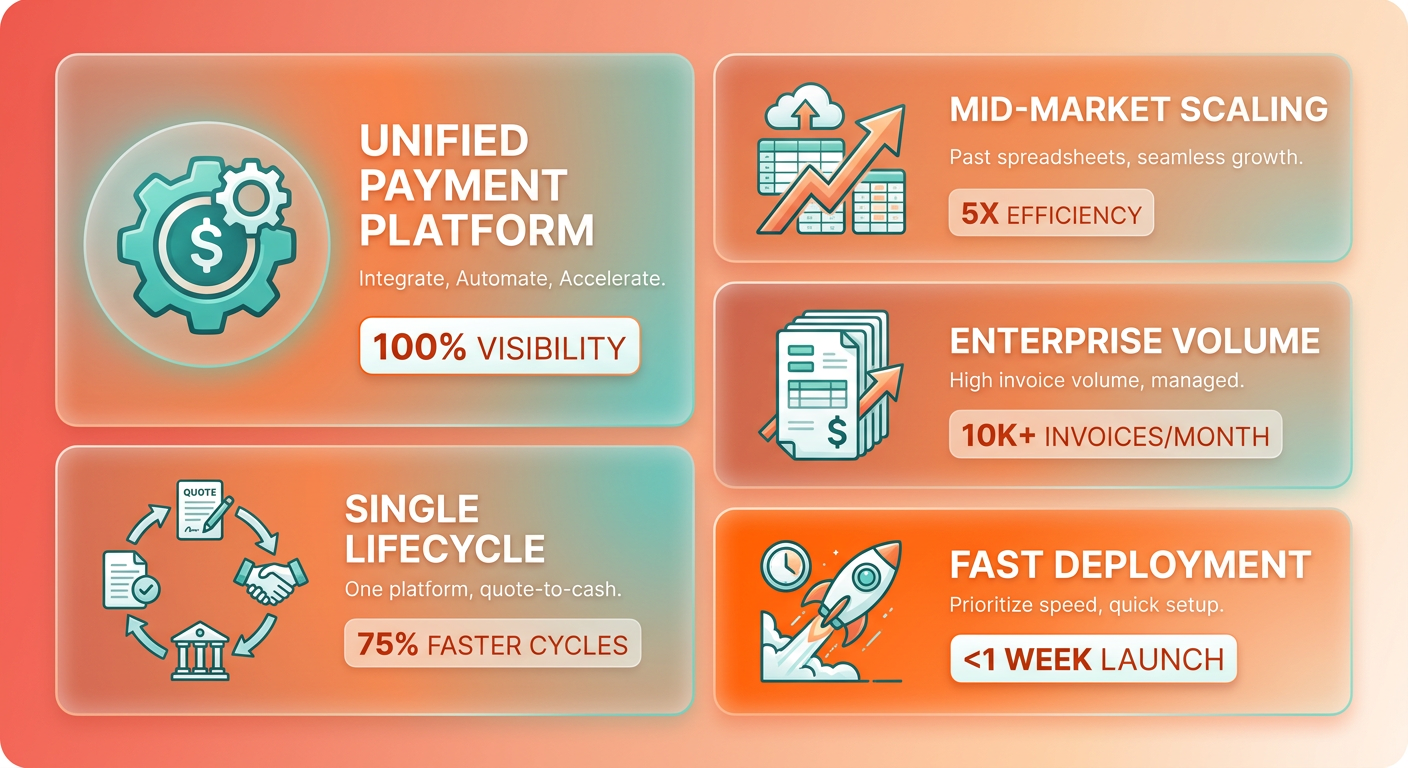
Quadient AR serves growing teams transitioning away from manual spreadsheet tracking. Its behavioral scoring queues simplify daily outreach by automatically highlighting high-priority accounts. Market feedback highlights Quadient AR’s accessible controls and straightforward interface.
Smaller finance teams processing low invoice volumes may not fully utilize advanced predictive analytics. The software delivers its highest value when managing steady balances that benefit from automated queue management.
Quadient AR integrates with NetSuite, Sage Intacct, and Acumatica. Confirming specific database version compatibility before contract execution ensures smooth data synchronization post-launch.
Enterprise agencies with complex order-to-cash stacks
HighRadius caters to high-volume enterprise environments requiring deep order-to-cash automation. Its suite includes extensive AI agent libraries, automated portal submission tools, and multi-tier collections routing designed for dedicated finance departments.
The trade-off comes in setup requirements and platform complexity. Deploying HighRadius demands structured implementation stages, specialized technical support, and extended staff onboarding to achieve full operational capability.
HighRadius fits organizations operating tier-one ERPs like SAP or Oracle that possess internal technical teams to support enterprise-grade systems. It’s less suited for organizations seeking rapid activation or simple setup paths.
The unified payment lifecycle neither addresses
Agencies frequently manage three revenue streams at once: fixed project invoicing, recurring monthly retainers, and overdue collections recovery. Quadient AR and HighRadius manage collection queues effectively, but operating separate tools for invoice generation and retainer billing fragments financial records.
This separation forces administrative staff to manually reconcile records across disparate tools. Project invoices remain in one application, subscription retainers run through another, and collections tracking operates in a third, leaving leadership without a consolidated view of client billing histories.
| Feature | Quadient AR | HighRadius | Unified Platform (Blixo) |
|---|---|---|---|
| Deployment approach | Mid-market focused | Enterprise implementation | Streamlined setup |
| Invoicing + subscription billing | No | No | Yes |
| Collections automation | Yes | Yes | Yes |
| Target market | Mid-market | Enterprise | Mid-market and scaling teams |
| Integration approach | NetSuite, Sage Intacct | SAP, Oracle, NetSuite | QuickBooks, Xero, Sage Intacct, NetSuite |
Blixo connects invoice creation, subscription retainers, and automated dunning inside a unified platform built for agency operations. By managing both project invoices and recurring billing natively, Blixo bridges the operational gaps that standalone collection engines leave open.
What to Actually Do
Skip the enterprise-versus-mid-market framing most sources push. HighRadius delivers powerful automation for enterprise operations prepared for multi-month setup phases. Quadient AR activates quickly for mid-market teams but focuses strictly on collections. Both require agencies to assemble external tools to cover the complete payment lifecycle.
Choose HighRadius when automation depth matters more than speed
HighRadius serves enterprise organizations processing high transaction volumes where automated portal submissions and risk scoring justify extended setup cycles. Its deep automation framework provides robust infrastructure for enterprise financial operations.
Complex systems involve operational trade-offs. Implementation demands dedicated management and extended training. If your team requires immediate activation and straightforward controls, enterprise automation complexity can introduce unwanted friction.
Choose Quadient AR for mid-market teams prioritizing deployment speed
Quadient AR suits mid-market teams seeking clear user interfaces and swift onboarding. Predictive payment scoring organizes outreach efficiently, and native connectors link into popular mid-market accounting systems.
Because Quadient AR operates strictly as a dunning engine, verifying ERP compatibility and accounting for separate subscription tools remains necessary. Organizations managing recurring billing alongside project work must maintain secondary applications to govern client retainers.
Blixo unifies invoicing, subscription billing, and collections in one platform
Blixo unifies invoice generation, subscription retainer management, and automated collections within a single workflow. While traditional collection tools require external billing engines, Blixo manages the complete payment cycle natively, preventing data sync errors and missed dunning schedules.
HighRadius delivers superior automation metrics alongside implementation challenges. Quadient AR earns higher usability ratings despite a narrower functional scope. Blixo eliminates this trade-off by offering end-to-end billing, subscription management, and collections automation within a single application.
If you’re comparing Quadient AR and HighRadius and discover that neither covers your complete workflow, focus on unifying your financial tools. Consolidating invoicing, retainer billing, and collections into one system delivers smoother operations and faster cash recovery.
FAQ
Q: What are the main differences between Quadient AR and HighRadius?
HighRadius targets Fortune 500 enterprises with 190+ AI agents, extensive order-to-cash automation, and 3–6 month implementations. Quadient AR serves mid-market teams with faster deployment, predictive analytics for collections prioritization, and integrations with NetSuite, Sage Intacct, and Acumatica. HighRadius excels in automation depth; Quadient AR wins on day-to-day usability. Neither includes native subscription billing.
Q: Which platform is better for small to mid-sized businesses?
Quadient AR suits mid-market teams prioritizing rapid deployment and intuitive interfaces. It can be set up in as little as one day and is designed for operations processing 500+ invoices monthly. HighRadius requires multi-month implementations and dedicated IT resources, making it less practical for smaller teams without established financial systems infrastructure.
Q: How do implementation timelines compare?
Quadient AR can deploy in as little as one day when standard ledger structures align with default templates. HighRadius typically requires 3–6 months for full implementation, involving custom workflow mapping, legacy data translation, and extensive validation. If immediate cash flow stabilization is urgent, Quadient AR’s rapid activation may take precedence over HighRadius’s deeper automation.
Q: Do Quadient AR and HighRadius support subscription billing?
Neither platform includes native subscription billing. Both focus strictly on post-billing receivables—managing collections, dunning workflows, and cash application. Agencies running recurring retainers alongside project billing must operate separate subscription management tools and manually reconcile data across systems, introducing sync delays and administrative overhead.
Q: What ERP systems do these platforms integrate with?
HighRadius integrates with enterprise platforms including SAP, Oracle Fusion Cloud, NetSuite, and Microsoft Dynamics 365, offering real-time synchronization for tier-one ERPs. Quadient AR connects with mid-market and enterprise systems like Sage Intacct, NetSuite, Microsoft Dynamics 365, SAP, Sage X3, and Acumatica, using scheduled batch updates. Always verify your specific ERP version compatibility with reference customers before signing.
Q: Which platform offers better AI and automation capabilities?
HighRadius provides 190+ AI agents across order-to-cash functions, automating 600+ AP portal uploads, multi-channel remittance extraction, and high-value balance routing. Quadient AR uses predictive scoring algorithms to prioritize daily collections queues based on historical payment behavior. HighRadius delivers greater automation depth for high-volume environments; Quadient AR emphasizes straightforward queue management for daily collector tasks.
Q: How do pricing models differ?
HighRadius uses outcome-based pricing tied to invoice volume metrics and offers $0 upfront implementation packages. Quadient AR operates a feature-based subscription model, scaling from small team plans to custom enterprise quotes. Both offer modular add-ons. Pricing structures should be evaluated alongside total cost of ownership, including implementation services, training, and ongoing administrative overhead.
Q: Can these platforms reduce Days Sales Outstanding (DSO)?
HighRadius achieved a 34-day resolution time for Coca-Cola Bottlers recovering $33.4 million—far below the 90-day industry average. Coca-Cola Bottlers also saw 20% reductions in past-due invoices and 30% productivity gains. Companies using integrated receivables platforms can reduce DSO and improve collection efficiency compared with fragmented stacks. However, both platforms require external tools for invoicing and subscription billing, limiting their impact on end-to-end payment cycles.
Q: What are the main drawbacks of each platform?
HighRadius involves complex configuration, multi-month implementations, and demands dedicated IT resources for setup and ongoing management. Mid-market teams without financial systems engineers often find it cumbersome. Quadient AR focuses strictly on collections and lacks native subscription billing, requiring external tools for retainer management and manual data reconciliation. Neither platform addresses the full payment lifecycle agencies need.
Q: Is there an alternative that unifies invoicing, billing, and collections?
Blixo consolidates invoice generation, subscription retainer management, and automated collections into a single platform. It manages both project invoices and recurring billing natively, eliminating data sync errors, manual reconciliation, and context-switching across disconnected systems. Unified platforms remove the operational barriers inherent in fragmented software stacks, delivering smoother operations and faster cash recovery for agencies of all sizes.