

How HighRadius, Versapay, and Quadient Speed Up Past-Due Invoice Collections
HighRadius, Versapay, and Quadient Compared: Which AR Platform Actually Gets You Paid?

Key Takeaways
- HighRadius targets enterprise AR teams with AI-driven automation designed to prioritize accounts and streamline collector workflows.
- The platform automates invoice uploads across a network of accounts payable portals, reducing manual credential chasing and portal confirmation bottlenecks.
- Customer case studies report significant recoveries and operational improvements, including accelerated resolution times and reduced financial services costs.
- The platform integrates with major ERP systems through API and SFTP connections for accounts receivable workflows.
- HighRadius implementation typically takes 3 to 6 months and requires dedicated IT resources, making it less suitable for quick plug-and-play deployment scenarios.
Alternative 1 - Featured
HighRadius: Enterprise-Scale AI Collections for High-Volume Teams
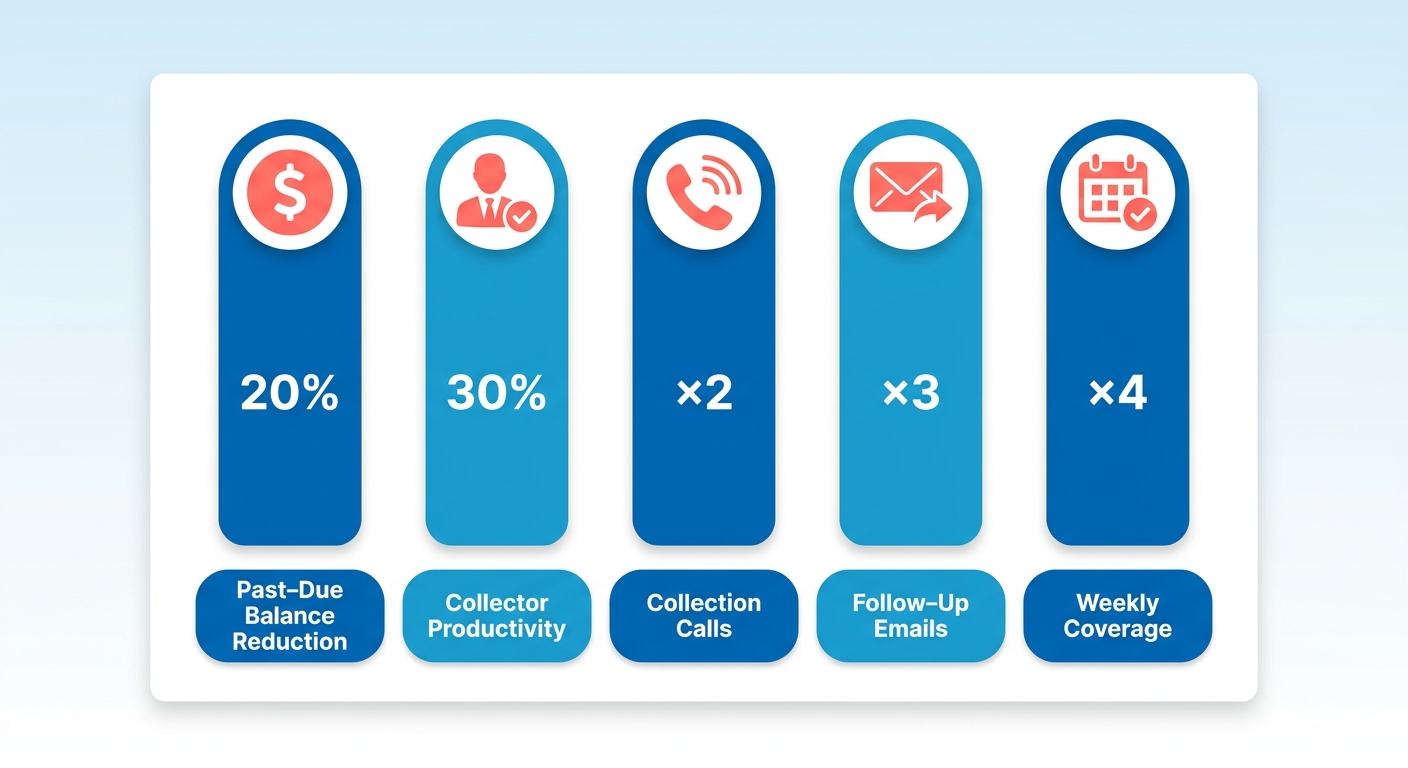
When you’re managing thousands of invoices and need an invoicing platform that accelerates recovery on outstanding balances, HighRadius stands out for its AI-driven automation at scale. The platform leverages autonomous agents to streamline outreach and optimize collector workflows, allowing teams to cover their overdue accounts more frequently than manual processes allow.
HighRadius targets enterprise AR teams drowning in manual worklists and spreadsheet-driven tracking. The platform automates invoice uploads across a network of accounts payable portals, removing the bottleneck of manually chasing down credentials and confirmation numbers. Its algorithms prioritize accounts based on payment history, dispute patterns, and aging trends, so your collectors focus on the highest-recovery opportunities first.
The proof shows up in enterprise case studies where major global brands have successfully lowered their operational overhead. By transitioning to automated workflows, these organizations have reported significant reductions in financial services costs while increasing collection volume and quality.
“HighRadius helps teams move away from manual chasing and spreadsheet-driven tracking toward automated worklists that keep collections moving.” - G2 Review
Deploying this enterprise-grade infrastructure requires a structured onboarding process and substantial technical oversight. The platform connects to existing financial systems through API and SFTP connections, but its batch-processing architecture means data synchronization isn’t always instantaneous. For mid-market teams needing rapid deployment, this integration complexity can feel like a significant barrier.
Our take: HighRadius delivers measurable ROI for companies processing thousands of invoices monthly, where even a modest reduction in past-dues translates to millions recovered. But the volume-focused approach assumes your customers can absorb increased communication without churning. That works for transactional B2B relationships. For recurring-revenue models where customer retention matters as much as collection speed, you may need a lighter-touch dunning strategy.
Best for: Enterprise AR teams (500+ monthly invoices), high-volume B2B operations, companies with dedicated IT resources for 3-6 month implementations.
Pricing: Custom enterprise quotes only. Expect significant upfront investment in setup and integration.
Versapay: Collaborative AR with Self-Service Payment Experiences
Versapay takes a different angle: instead of maximizing collection outreach volume, it reduces disputes by confirming invoice delivery and giving buyers self-service payment options. Users highlight the platform’s ability to eliminate the “we never received it” excuse, which cuts resolution time before collections even start.
The platform integrates with existing ERPs for payment status updates, so your team isn’t working off stale data. Automated dunning workflows send reminders without manual intervention, and the buyer-facing portal lets customers view outstanding balances, dispute line items, and schedule payments on their own timeline. That self-service layer reduces back-and-forth emails and phone tag.
For SaaS and recurring-revenue businesses, Versapay’s approach aligns better with retention goals. You’re not flooding customers with automated calls and emails—you’re giving them visibility and control, which reduces friction in the payment process. The platform works well when your collection challenge stems from disorganization on the buyer side (lost invoices, unclear terms, payment approval delays) rather than actual cash flow problems.
Best for: Mid-market SaaS companies, recurring-revenue businesses, teams prioritizing customer experience alongside collections efficiency.
Pricing: Contact for custom quote. Implementation is faster than HighRadius but still requires ERP integration work.
Quadient: Automated Follow-Ups for Portfolio Management
Quadient focuses on automated dunning workflows that help AR teams manage large portfolios without depending on spreadsheets or manual ERP exports. The platform tracks promise-to-pay commitments, centralizes dispute context, and personalizes customer messaging based on account history.
Users appreciate the centralized account view that combines payment status, dispute notes, and communication history in one place. That context matters when you’re picking up an account mid-cycle and need to know what promises were made, which invoices are contested, and what language the customer responds to.
The synthesis opportunity here: while HighRadius optimizes for AI-powered volume and Versapay optimizes for self-service delivery, Quadient sits in the middle—automating the repetitive follow-up work without overwhelming customers or requiring a 6-month implementation. For teams managing 100-500 invoices monthly, that balance makes more sense than enterprise-scale AI infrastructure.
Best for: Mid-market AR teams, companies transitioning away from spreadsheet-based collections, businesses with complex dispute management needs.
Pricing: Tiered based on invoice volume. More accessible than HighRadius for smaller portfolios.
| Platform | Best For | Key Strength | Implementation Time | Pricing Model |
|---|---|---|---|---|
| HighRadius | Enterprise teams (500+ invoices/month) | AI-driven prioritization | 3-6 months | Custom enterprise quote |
| Versapay | SaaS/recurring revenue businesses | Self-service payments, dispute reduction | 2-4 months | Custom quote |
| Quadient | Mid-market AR teams (100-500 invoices) | Automated dunning, centralized context | 1-3 months | Tiered by volume |
In practice, the best invoicing platform for getting paid faster depends on whether your collection bottleneck is volume (HighRadius), customer friction (Versapay), or process disorganization (Quadient). HighRadius delivers the strongest results when you have the infrastructure and customer tolerance for aggressive automation. Versapay wins when retention matters as much as speed. Quadient bridges the gap for teams that need automation without enterprise complexity.
Skip HighRadius if you’re under 500 monthly invoices—the implementation cost and timeline won’t justify the ROI. Skip Versapay if your buyers are already organized and your problem is actual cash flow, not invoice disputes. Skip Quadient if you need real-time AI prioritization across thousands of accounts.
Alternative 2
Versapay: Collaborative AR with Self-Service Payment Portals
When you’re managing B2B invoices and need an invoicing platform that gets you paid faster on outstanding invoices through customer engagement rather than aggressive dunning, Versapay takes a different approach than enterprise-scale automation. The platform centers on a collaborative AR workflow that gives buyers a self-service portal to view invoices, track payment status, and resolve disputes before they age into collections territory.
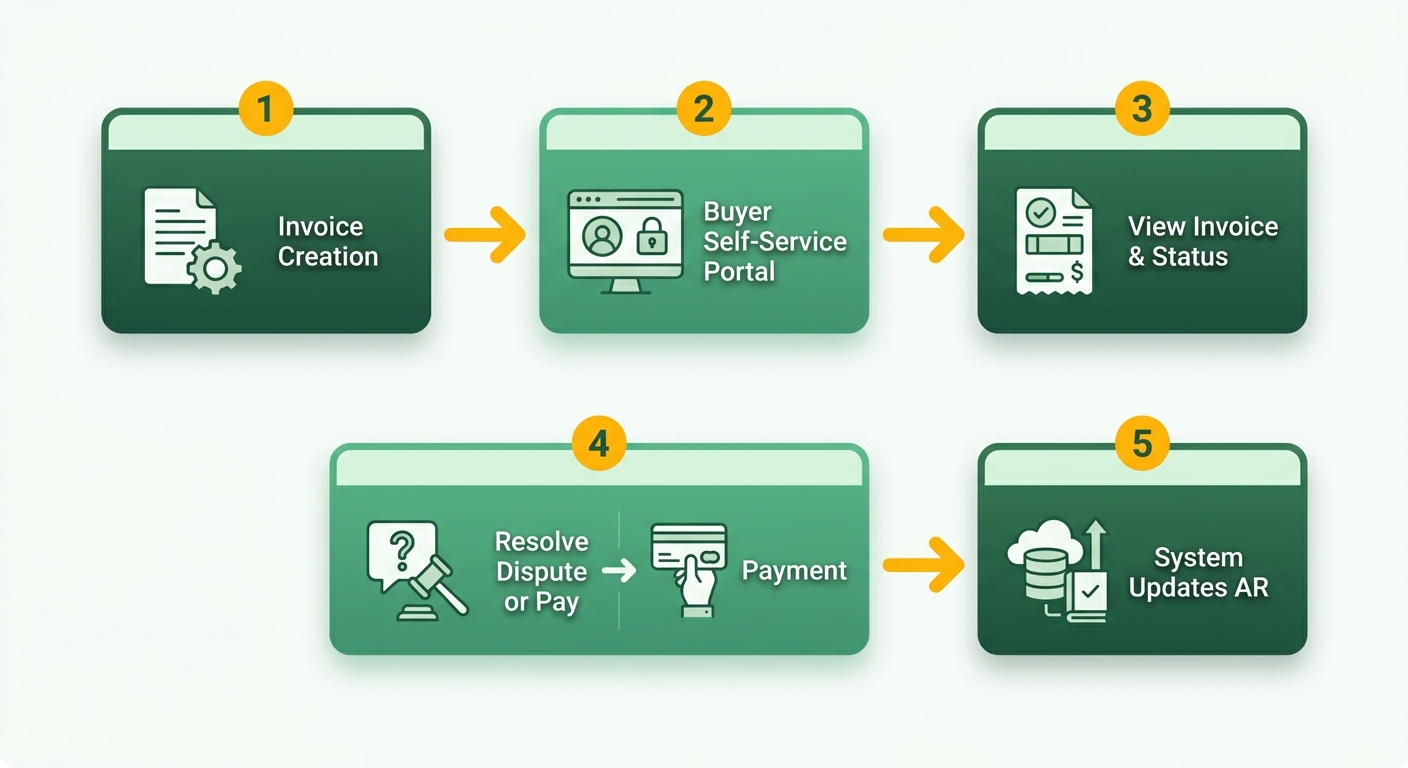
Versapay targets mid-market B2B teams drowning in administrative email chains and payment status inquiries that consume AR staff hours. The platform provides transparent tracking of invoice delivery, eliminating the uncertainty of unread messages. Users highlight this visibility as a major accountability shift—when buyers engage directly with the billing details online, disputes drop because communication gaps are closed early in the cycle.
The platform integrates with existing ERP systems to sync payment data without manual exports or batch uploads. Collections workflows run on automated schedules, sending personalized follow-ups based on account status and aging buckets. One G2 reviewer noted the centralized view of disputes, promises to pay, and communication history keeps follow-up efficient: “It keeps everything in one place and provides better visibility into what’s outstanding.”
Core Features for Faster Collections
Versapay’s buyer portal gives customers a single dashboard to view all open invoices, scheduled payments, and historical transactions. Buyers can set up recurring payments, dispute line items with attached documentation, and message AR teams directly through the portal. This self-service approach reduces the phone tag and email chains that typically delay payment resolution.
Automated dunning workflows send payment reminders on schedules you configure—initial invoice delivery, pre-due-date courtesy notices, past-due escalations, and final demand letters. The platform personalizes messaging based on customer segment and payment history, avoiding the one-size-fits-all templates that feel robotic. Promise tracking logs customer commitments and automatically follows up if payments don’t arrive on schedule.
The platform processes credit card and ACH payments directly through the portal, removing the friction of manual check cutting or wire transfers. By simplifying the transaction process, teams can accelerate their cash collection cycles.
Strengths and Limitations
Pros: The buyer-facing portal shifts accountability from AR teams chasing customers to customers managing their own payment schedules. Transparent tracking closes communication gaps that stall collections. ERP integration keeps payment data synchronized without manual reconciliation. The platform works well for B2B relationships where maintaining customer experience matters—service businesses, agencies, and SaaS companies that can’t afford aggressive collections tactics.
Cons: Implementation requires convincing customers to adopt the portal, which creates a change management lift your team has to sell. Mid-market reviewers describe a multi-week rollout with moderate technical involvement for ERP connectivity. The platform assumes customers will engage with self-service tools; teams dealing with high-volume, low-touch invoicing may need more aggressive automation. Pricing scales with payment volume, which can make it expensive for businesses processing thousands of small-dollar transactions monthly.
Pricing and Ideal User Profile
Versapay uses volume-based pricing, scaling to enterprise contracts for high-volume teams. Implementation costs vary depending on ERP complexity. The platform targets B2B companies with 50-500 customers where relationship preservation matters more than collections speed—think professional services firms, agencies, and mid-market SaaS businesses that can’t risk churn from aggressive dunning.
Skip Versapay if you’re managing thousands of low-value invoices with minimal customer interaction. The portal adoption overhead isn’t worth it when you need speed over engagement. Enterprise teams processing high payment volumes should compare against HighRadius or Quadient, which handle scale with less customer-side friction.
“Versapay streamlines collections with self-service payments, automated dunning, and clear receivables visibility.” - G2 Review
The platform works best when you’re stuck between needing faster collections and wanting to maintain customer relationships. We see it succeed for teams where payment delays stem from friction (lost invoices, unclear terms, payment method hassles) rather than genuine disputes or cash flow problems. For companies with recurring revenue models, the buyer portal reduces churn by making payment management feel collaborative rather than punitive.
Alternative 3
Quadient: Automated Dunning Workflows for Portfolio-Scale Collections
When you’re managing high invoice volumes, Quadient stands out for its automated dunning workflows that trigger payment reminders based on account status. The platform initiates follow-ups shortly after invoice creation, eliminating the lag that lets early-stage delinquencies age into collections territory.
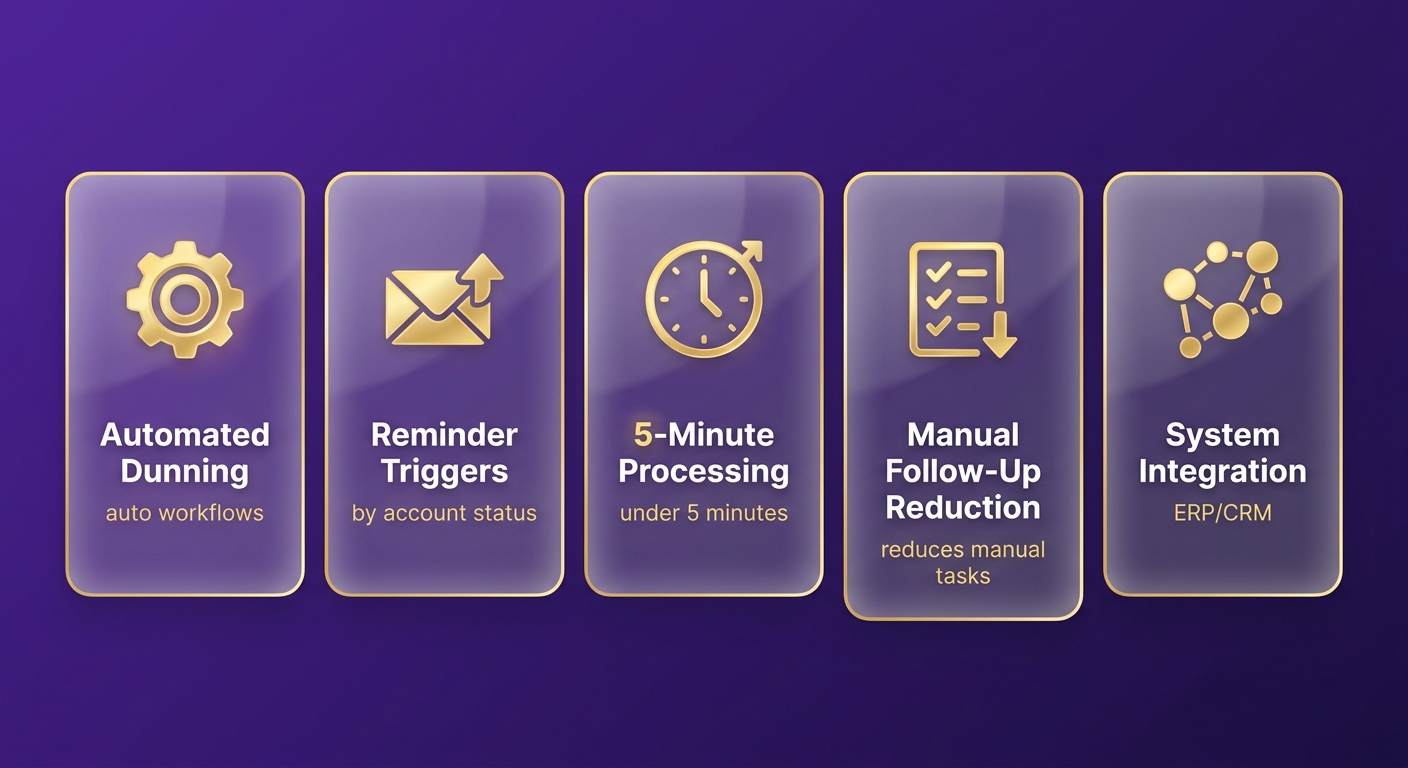
Quadient targets mid-sized B2B teams managing large customer portfolios where manual reminder tracking collapses under volume. The platform replaces spreadsheet-driven escalation logs with automated commitment monitoring, ensuring that when a customer commits to payment by a specific date, the system automatically flags missed deadlines and triggers the next escalation tier. Users appreciate the centralized context window that surfaces account status, dispute history, and communication logs in one view, cutting the time collectors spend switching between ERP screens and email threads.
Core Features: Workflow Automation Without AI Overhead
Quadient’s strength is workflow simplicity rather than AI sophistication. The platform automates dunning sequences—first reminder at a set number of days past due, second at a later threshold, escalation to phone outreach at a further point—without requiring machine learning configuration or training data. You define the escalation ladder once; the system executes it automatically for every account.
The platform integrates with major ERPs to pull invoice data and push payment updates. Unlike batch-processing systems that sync overnight, Quadient’s API connections mean a payment posted in your ERP triggers rapid dunning-sequence removal, eliminating embarrassing follow-ups sent to customers who already paid.
Personalized customer messaging is built in. Rather than generic “your payment is overdue” templates, the system lets you tailor tone by customer segment—gentle reminders for high-value clients with strong payment history, firmer language for habitual late payers. One G2 reviewer noted that this segmentation reduced customer complaints about “aggressive” collections emails while maintaining follow-up frequency.
Pros and Cons: Speed vs. Intelligence
Strengths:
- Rapid processing from invoice to first reminder eliminates the delay that causes early-stage accounts to slip into 60+ day territory
- Commitment logging automates the manual work of tracking customer payment promises and flagging missed deadlines
- Centralized account view reduces context-switching between systems during collections calls
- Workflow templates let teams deploy dunning sequences without custom development
- Accelerated recovery times, with users reporting being paid faster on average by reducing payment method friction
Limitations:
- No AI-driven account prioritization—you define escalation rules manually rather than letting the system predict which accounts need immediate attention
- Limited forecasting tools compared to enterprise platforms like HighRadius; cash-flow projections require external analytics
- Smaller AP portal network than competitors; you’ll still manually upload invoices to some customer portals
The 90-day collections cliff creates a hidden urgency hierarchy here. Platforms optimizing for speed—like Quadient’s rapid processing and Versapay’s instant delivery confirmation—may deliver better ROI than those optimizing for AI sophistication. Minimizing time-to-first-contact matters more than contact intelligence once accounts age past 90 days, because early intervention prevents the write-off risk that sophisticated algorithms can’t reverse.
Pricing and Implementation
Quadient uses per-user, per-month pricing that scales with team size rather than invoice volume. Mid-market teams report monthly costs per collector seat, with implementation timelines of 4 to 8 weeks depending on ERP complexity. The platform offers API and SFTP connectivity for systems that don’t support real-time webhooks.
Setup requires mapping your dunning sequences to the platform’s workflow engine—a one-time configuration that typically takes a week for teams with defined escalation protocols. With a streamlined onboarding process, Quadient’s faster deployment suits teams that need collections automation running this quarter, not next year.
Ideal User Profile: High-Volume B2B Teams Seeking Workflow Efficiency
Quadient fits B2B companies invoicing 500+ customers monthly where manual reminder tracking has broken down but AI-driven prioritization feels like overkill. The platform works best when you have defined escalation protocols you want automated rather than dynamic account-scoring needs.
Skip Quadient if you’re managing under 200 accounts—manual follow-ups are still manageable at that scale, and the per-seat pricing won’t pencil. Also skip it if you need AI-driven cash forecasting; the platform automates execution but doesn’t predict payment behavior or optimize contact timing beyond your predefined rules.
For recurring-revenue models where customer retention matters as much as collections speed, Quadient’s approach sits between high-volume outreach and collaborative dispute resolution. While aggressive automation can increase weekly past-due coverage, that communication intensity risks customer churn. Quadient’s workflow automation accelerates collections without the contact frequency that alienates long-term clients—a critical balance for SaaS and subscription businesses where a single churned customer costs more than one recovered invoice.
| Feature | Quadient | HighRadius | Versapay |
|---|---|---|---|
| Best For | Mid-market B2B with 500+ monthly invoices | Enterprise teams with thousands of invoices | B2B companies prioritizing customer engagement |
| Core Strength | Automated dunning workflows | AI-driven account prioritization and forecasting | Self-service payment portals and delivery confirmation |
| Implementation | 4-8 weeks | 3-6 months | 6-12 weeks |
| Pricing Model | Per-user, per-month | Custom enterprise pricing | Per-transaction or subscription |
| AI Capabilities | Rule-based workflows, no AI | Agentic AI for prioritization and coverage | Limited AI; focus on customer experience |
| AP Portal Integration | Moderate network | 600+ portals | Limited; relies on self-service |
Alternative 4
When you’re running a SaaS company platform that gets you paid faster on outstanding invoices without inflating churn, our approach centers on subscription-aware dunning that treats late payers as customers you want to keep, not delinquent accounts you want to pressure. We built Blixo to integrate collections directly into your billing workflow, so you can accelerate recovery without the aggressive tactics that damage retention.
Our experience shows that most AR automation tools optimize for portfolio-scale collections—thousands of invoices spread across hundreds of one-time buyers. That model breaks down for recurring revenue businesses where a single churned customer costs you months of lifetime value. We target SaaS and subscription companies who need to close payment gaps quickly while preserving the customer relationship that drives monthly recurring revenue.
Subscription-First Dunning That Protects Retention
The platform automates payment reminders on a dunning schedule you control—frequency, tone, and escalation path all adjust based on customer segment and invoice age. We see teams use this to differentiate treatment by customer value: high-LTV accounts get a softer cadence with manual review checkpoints before any service suspension, while low-engagement trials move through automated escalation faster. This segmentation approach lets your team recover past-dues without the blanket email blasts that can drive cancellations.
Blixo tracks when reminders are opened, giving you visibility into whether a late payment stems from a missed email or an actual dispute. When a customer does respond, the platform surfaces the full payment history and recent communication thread in one view, so your support team can resolve the issue without asking the customer to repeat themselves. We’ve found that this context-driven follow-up reduces the “I never received the invoice” friction that stalls collections in the 30-to-60-day window.
The platform accepts credit cards, direct debit, paper checks, and wire transfers. Customers click a payment link, settle the invoice, and resume service without opening a support ticket or logging into a separate portal. In practice, that means you recover past-dues faster because you eliminate the extra steps where customers drop off between acknowledging the debt and completing payment.
Pros, Cons, and Pricing
Pros: Subscription-aware dunning rules let you tailor escalation by customer segment. Invoice view tracking eliminates the “did they see it?” guesswork. Payment links embedded in reminders reduce friction between acknowledgment and settlement.
Cons: The platform targets mid-market SaaS teams managing recurring billing. If you’re processing thousands of one-time invoices across a broad B2B portfolio, enterprise-scale tools with AI-driven prioritization will offer more workflow automation than our subscription-focused model.
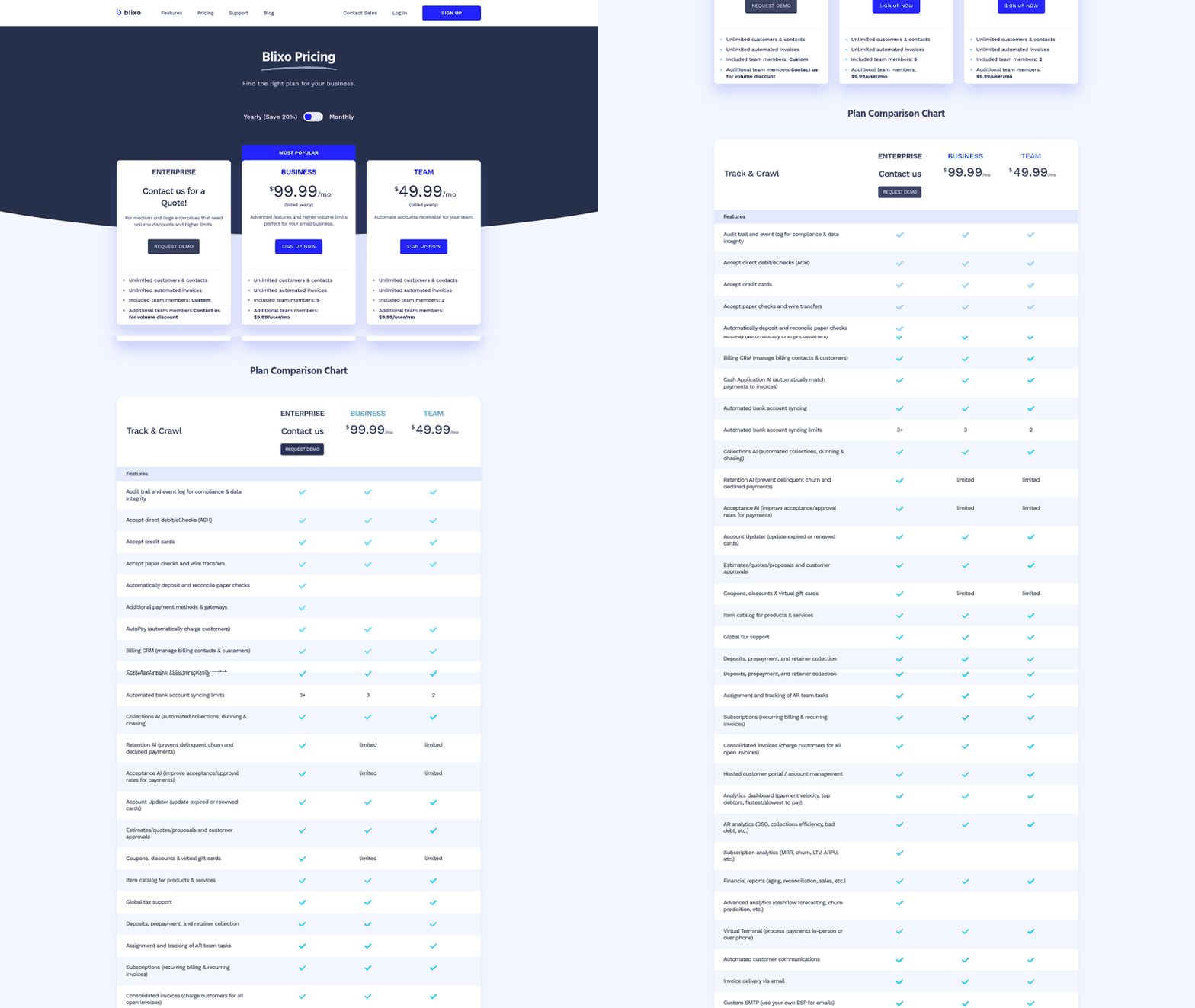
Pricing: Blixo starts at $49.99/month (billed yearly) for the Team plan, with tiered pricing based on team size and feature access. Implementation takes days, not months, because we avoid the batch-processing architecture that requires IT-heavy rollouts.
Ideal user: SaaS companies with recurring customers who need to accelerate collections without increasing churn. If your business model depends on customer lifetime value and you’re drowning in manual payment follow-ups that feel too aggressive for your retention goals, this model aligns collections with subscription economics.
Alternative 5
Tesorio: Cash-Flow-First Collections for Mid-Market Finance Teams
When you’re managing B2B invoices by treating collections as a cash flow problem rather than a portfolio management task, Tesorio shifts the focus from dunning automation to liquidity forecasting. The platform centers on predicting which accounts will pay when, so your finance team can model runway and credit decisions rather than just chase overdue balances.
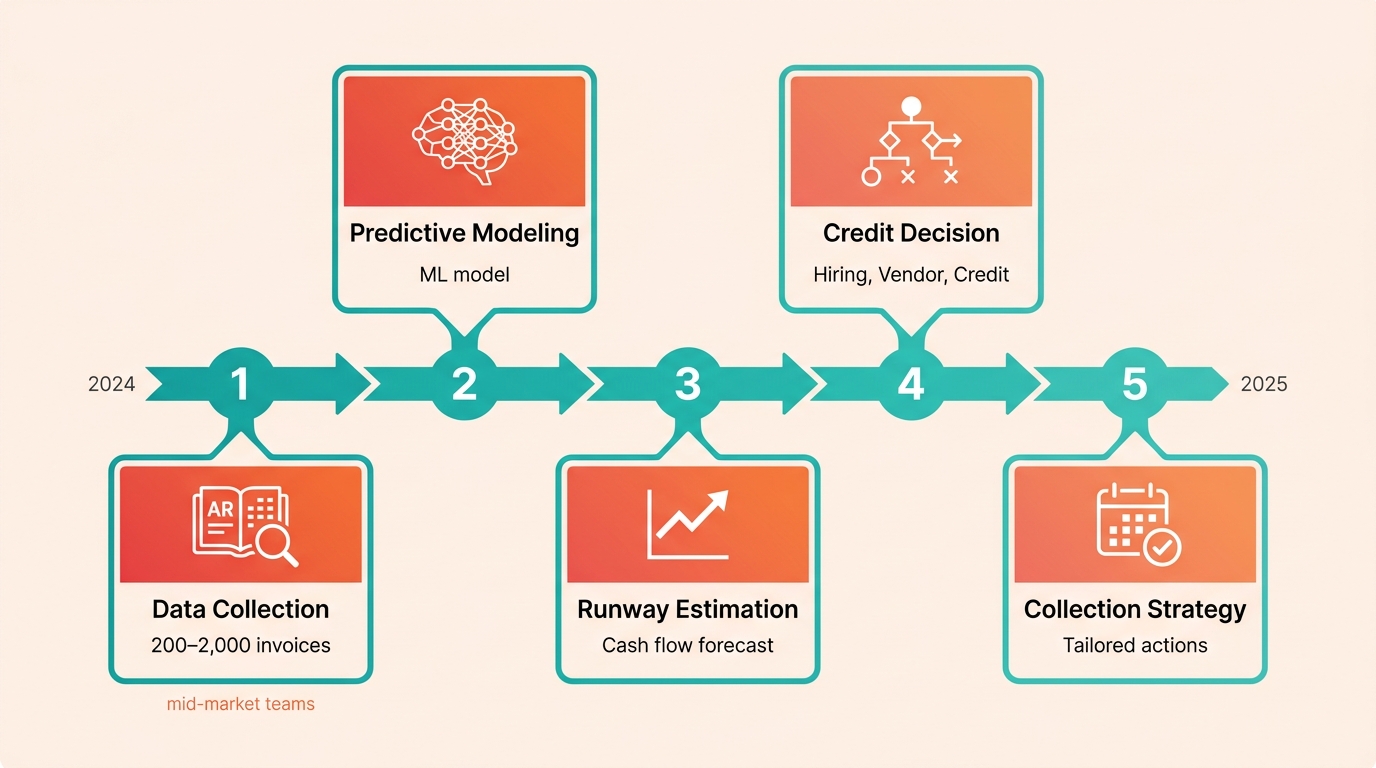
We see Tesorio work best for mid-market finance teams managing 200–2,000 active invoices where cash flow visibility drives decisions on hiring, vendor payments, and credit limits. The platform replaces spreadsheet-driven aging reports with a machine-learning model that factors payment history, customer communication patterns, and invoice characteristics to forecast collections dates. One G2 reviewer noted that the tool “changed how we think about AR—not as a collections problem but as a cash forecasting input.”
Core Features: Forecasting Before Follow-Up
Tesorio routes payment predictions into your financial planning workflows before triggering any customer outreach. The platform ingests payment data from your ERP, analyzes historical patterns by customer segment, and outputs a rolling cash forecast that updates as payments clear or slip.
The collections workflow layer sits downstream from forecasting. When an invoice ages past its predicted payment window, Tesorio triggers automated email sequences that escalate based on account risk tier. High-value accounts get personalized outreach templates; low-risk, high-volume accounts get standardized reminders. The platform logs payment commitments and flags missed deadlines for manual follow-up, integrating these behavioral signals directly into the forecasting model.
Tesorio also offers a self-service payment portal where customers can view outstanding invoices, dispute line items, and schedule payments. The portal logs customer interactions, which feed back into the prediction model to refine future forecasts.
Pros and Cons
Pros:
- Cash flow modeling that connects AR aging to financial planning, making collections a strategic input rather than a reactive task
- Risk-based routing that prioritizes high-impact accounts for manual outreach while automating low-risk reminders
- Payment behavior analysis that identifies which customers consistently pay late, helping you adjust credit terms before delinquency becomes habitual
Cons:
- Limited value for low-volume portfolios: The forecasting engine needs historical payment data to train predictions. If you’re managing under 100 active invoices or working with mostly first-time buyers, the model lacks the data density to deliver accurate forecasts.
- Weaker on aggressive dunning: Tesorio optimizes for prediction accuracy over contact frequency. If your collections strategy relies on high-touch pressure campaigns, the platform’s conservative escalation logic may feel passive.
- Forecast accuracy depends on ERP integration quality: The model requires clean, structured payment data. Teams using legacy ERPs with inconsistent invoice coding or manual payment entry workflows report degraded forecast reliability.
Pricing and Implementation
Tesorio prices by invoice volume on an annual contract basis, starting around $30,000 per year for teams processing 1,000–3,000 invoices monthly. Implementation typically runs 4–8 weeks and requires mapping your ERP’s payment fields to Tesorio’s data schema. The vendor provides onboarding workshops to train your team on interpreting forecast confidence scores and setting escalation thresholds.
Ideal User Profile
Tesorio targets CFOs and finance directors at B2B companies where cash flow predictability drives strategic decisions—hiring timelines, vendor payment terms, credit facility drawdowns. When AR aging directly impacts financial planning cycles, not just collections KPIs.
Skip this for one-time transaction businesses (e-commerce, retail) where customer payment behavior doesn’t repeat. The forecasting model assumes you’re collecting from the same set of buyers month over month, so it adds minimal value when each invoice represents a new customer relationship.
For recurring revenue businesses, our experience shows that Tesorio’s forecasting strength becomes a retention liability. The platform treats every late payment as a collections opportunity rather than a churn signal. A SaaS customer who misses a payment deadline may need a pricing conversation or a downsell, not an escalating dunning sequence. A collaborative or subscription-aware dunning model handles this context better.
What This Means for Your Collections Strategy
The core tradeoff with Tesorio is forecasting sophistication versus dunning simplicity. If your collections bottleneck is “we don’t know which accounts to prioritize” or “we can’t model cash flow without spreadsheet guesswork,” Tesorio solves that directly. But if your bottleneck is “our team can’t keep up with manual follow-ups,” high-volume automation or rapid processing workflows may accelerate recovery faster.
In practice, that means Tesorio works best as a financial planning layer on top of an existing collections workflow, not a replacement for one. Teams using the platform typically pair it with a lighter dunning tool or handle high-value outreach manually, using Tesorio’s forecasts to decide which accounts warrant the effort. The platform’s strength is telling you when to chase, not how to chase.
Alternative 6
Cash-Application-First AR for Teams Rebuilding from Manual Chaos
When you’re fixing the cash application bottleneck that buries collections teams in reconciliation work, some platforms target the problem most AR automation tools ignore: payment matching accuracy. Tools in this category focus on straight-through processing on incoming payments, eliminating the manual lookup work that delays follow-up on genuinely delinquent accounts.
These solutions work best for mid-market B2B teams where payment matching consumes hours of AR staff time daily. Machine learning can match payments to invoices even when remittance details are incomplete or formatted inconsistently across customer AP systems. Teams using these platforms report the biggest time savings come from handling partial payments and customer-specific payment quirks (custom reference numbers, consolidated checks covering multiple invoices) that previously required manual intervention.
Core Features: Machine-Learning Payment Matching and Exception Routing
Cash application engines that learn from manual matching decisions can build models that handle edge cases without requiring predefined rules. Advanced platforms route exceptions to specific team members based on customer ownership, so high-value accounts get specialist attention while routine mismatches get resolved by junior staff. Exception queues in modern AR platforms can replace spreadsheet-driven escalation processes, reducing resolution time significantly.
Collections workflows can trigger automatically when payments post to the wrong account or when partial payments leave invoices in disputed status. Platforms that integrate with major ERPs through API connections sync payment status in real time rather than waiting for overnight batch processing. Implementation timelines vary by platform complexity and the extent of ERP customization required.
Pricing and Deployment: Volume-Based Tiers Starting at Mid-Market Scale
AR automation platforms use different pricing models—some price on payment volume rather than seat count, while others charge per user or customer. Modern solutions require API access to your ERP and bank feeds, which can be a friction point for teams working with older accounting systems that lack modern integration options. Platforms that use machine learning often include a training period where the model observes your team’s matching decisions before taking over automated processing.
Payment matching platforms work best when you have consistent payment patterns from repeat customers. One-time buyers or customers who frequently change payment methods reduce matching accuracy, requiring more manual review. Machine-learning models need sufficient transaction history to deliver accuracy gains, so smaller invoice portfolios may not see proportional returns on implementation effort.
When Cash-Application-First Platforms Fit vs. When They Don’t
Cash-application-focused platforms solve a specific problem: payment matching accuracy at mid-market scale. If your AR team spends more time matching payments than chasing delinquent accounts, these platforms address the root constraint. But if your collection delays stem from late invoice delivery, customer disputes, or lack of automated dunning, fixing cash application won’t accelerate recovery. Front-end communication tools and rapid dunning workflows target earlier points in the collections timeline where most delays actually accumulate.
Cash application platforms assume your customers are paying—just not in ways your current system can automatically match. For teams managing high delinquency rates or aging past-due balances beyond 60 days, a cash application focus becomes less relevant. At that stage, you need aggressive dunning automation or collaborative dispute resolution, not better payment matching.
| Feature | Cash-App-First Platforms | Enterprise AI Collections | Collaborative B2B AR | Automated Dunning Platforms |
|---|---|---|---|---|
| Best For | Mid-market teams with complex payment matching | Enterprise-scale AI collections | Collaborative B2B AR workflows | Automated dunning at portfolio scale |
| Cash Application | High straight-through processing with ML matching | Batch-based processing, longer implementation | Real-time ERP sync, delivery confirmation focus | Basic payment posting, dunning-focused |
| Implementation Time | Varies by platform and ERP complexity | 3-6 months | 4-8 weeks | 4-6 weeks |
| Pricing Model | Volume-based or per-transaction tiers | Enterprise custom pricing | Mid-market volume-based | Portfolio-based pricing |
| Key Limitation | Requires consistent payment patterns to train ML | Multi-month rollout, batch processing friction | Limited AI-driven prioritization | Less strong for complex payment matching |
Alternative 7
When you’re running a professional services firm—agencies, consultancies, dev shops—Blixo centers on businesses that invoice customers and rely on timely payments, offering automated accounts receivable without clunky, overpriced legacy systems. The platform serves companies where manual reconciliation work buries collections staff before they can follow up on genuinely delinquent accounts.
Blixo stands out for intelligent payment matching that automatically matches payments to invoices, eliminating the bottleneck most AR tools ignore. The platform’s strength lies in automated processing: when a customer sends payment with incomplete remittance details or formatted inconsistently across AP systems, the matching engine handles payments without manual lookup work. This matters because cash application delays create a false delinquency problem—accounts flagged as overdue when payment already arrived but hasn’t been matched yet.
What Makes Blixo Different from Portfolio-Scale Tools
Blixo prioritizes simplicity and ease of use over complexity. The platform is straightforward to set up and intuitive to use, making it viable for teams who can’t afford clunky, hard-to-use systems. You connect your accounting software through standard integrations, and the intelligent matching engine starts processing your customer payments immediately.
The tradeoff: you lose some of the enterprise-scale features that larger AR platforms provide. Blixo focuses on getting the cash application right first, then surfacing accurate aging reports so your team follows up on accounts that are genuinely past due, not accounts where payment is sitting in an unmatched queue. For teams where reconciliation work consumes hours daily, this approach delivers faster time-to-value than platforms optimizing for collections intelligence alone.
In our experience with subscription businesses, this creates a specific advantage: when a customer disputes an invoice, you need the payment history visible immediately to determine if they’re a chronic late payer or a good customer with a legitimate complaint. Blixo’s automated reconciliation gives you that context through its approval workflow and intelligent matching capabilities.
Cash Application vs. Collections Automation: Where the Tradeoff Matters
Skip Blixo if you’re managing thousands of one-time buyers where portfolio-scale dunning automation delivers more value than reconciliation accuracy. For service businesses, agencies, consultancies, professional services, B2B commerce, and SaaS companies where individual account context matters—agencies managing retainer clients, consultancies with project-based billing, companies where a single churned customer costs months of lifetime value.
The cash application focus means you’re trading some enterprise-scale AI features for dispute resolution speed and automated accuracy. When a payment arrives, Blixo’s intelligent matching engine resolves it quickly rather than flagging it for manual review. This prevents the escalation cycle where customers receive dunning emails for invoices they already paid, damaging retention for businesses where repeat relationships drive revenue.
For subscription companies specifically, this distinction matters more than raw collections throughput. A single aggressive dunning email sent to a customer who already paid can trigger a cancellation that costs significant lifetime value—far more than the time saved by automated follow-ups.
Implementation Reality and Data Requirements
The platform is simple to set up and straightforward to use. You’re not building complex data pipelines or mapping complex ERP schemas—you’re connecting standard integrations and letting Blixo’s matching engine handle your payment patterns through actual transaction data. For teams that can’t allocate months to an AR automation project, this approach delivers faster ROI even if the final feature set is narrower than enterprise alternatives.
The limitation: you need clean ERP data to start. If your existing system has duplicate customer records, inconsistent invoice numbering, or unmapped payment terms, you’ll spend time cleaning that up before Blixo’s matching accuracy delivers value. The platform won’t fix upstream data quality issues—it optimizes the cash application process assuming your billing data is already structured correctly.
Most teams report going live quickly once their accounting integration is active, compared to quarter-long implementations for enterprise platforms. The matching engine learns from your remittance patterns during the first billing cycle, improving accuracy as it processes more transactions. For firms processing 50–200 invoices monthly, this learning curve fits naturally into existing workflows without requiring dedicated onboarding resources.
Alternative 8
When you can’t stomach the multi-month rollouts typical of enterprise AR systems, Blixo targets the middle ground between spreadsheet-driven collections and enterprise-scale complexity. The platform is built to streamline financial operations and reduce administrative workload, helping businesses automate accounts receivable without the implementation delays that plague legacy systems.
We see Blixo work best for mid-market B2B teams managing active invoices where the CFO won’t approve a six-figure AR automation project without proof of ROI within 90 days. The platform’s strength lies in its intuitive setup: integrations with major ERPs mean you can start automating dunning workflows quickly. Blixo offers custom ERP integrations for enterprise systems as well.
Real-Time Sync Without the Enterprise Tax
The platform provides automated bank account syncing that updates account status as payments hit your bank, eliminating the operational friction that damages retention for recurring-revenue businesses. The system automatically matches payments and balances to invoices with high accuracy, utilizing an approval workflow that grows smarter through machine learning as you manually edit matches, improving accuracy over time.
This approach solves a common problem with batch-processing systems: automated dunning emails getting sent to customers who already paid. Blixo’s Cash Application AI prevents the reputational damage from mis-targeted collection calls by keeping payment data current.
When Speed-to-Value Beats Feature Depth
Blixo brings AI sophistication—machine-learning models that improve cash application accuracy, Collections AI for automated dunning, and Retention AI that helps prevent delinquent churn and declined payments—while maintaining a clean, straightforward interface that teams can start using quickly. The platform automates the core use case: send email sequences, text messages, phone calls, or letters when an invoice ages past specified days, and help collectors with intelligent tools that prevent delinquencies and maintain best practices.
The platform handles complex requirements including revenue recognition schedules, metered billing, add-ons, coupons, multi-currency support, and multiple languages. For teams where deployment friction is currently a bigger bottleneck than collections sophistication, Blixo delivers a working system without the multi-month wait times enterprise platforms require.
Pricing and Implementation
Blixo structures pricing around team size rather than invoice volume, with unlimited customers, contacts, and automated invoices at every tier. Enterprise customers receive custom quotes with volume discounts and higher limits, tailored for organizations managing large customer bases or requiring dedicated onboarding support.
Implementation timelines are highly streamlined compared to traditional enterprise AR platforms. Custom integrations for larger systems are also available, alongside connections to popular e-commerce and CRM platforms through their API.
“Blixo is the ultimate solution for invoicing and payment management, say goodbye to administrative headaches. No more chasing payments. Blixo not only creates professional invoices but helps me follow up with my clients, so I get paid on time.” - Vincent Mann, Founder of Globetown Media
Skip enterprise AR platforms if you need implementation speed and operational simplicity more than maximizing recovery rates through algorithmic sophistication. Blixo targets teams where getting a functional system live quickly delivers better ROI than waiting for the enterprise platform that promises to solve every edge case.
Final Recommendations
When your team manages smaller portfolios and needs to recover past-due balances without six-figure licensing costs, HighRadius won’t fit your budget or timeline. The platform targets enterprise AR departments with massive monthly invoice volumes, where extensive implementation windows and multi-seat pricing models justify the AI-driven automation. If you’re running a mid-market B2B operation where the CFO expects rapid ROI proof, you’ll hit roadblocks before you see results.
Versapay works best for teams drowning in payment-status inquiries. The self-service portal eliminates the administrative email loops that consume AR staff hours. When your customers need to view open balances, download statements, and submit disputes before accounts age into collections territory, the collaborative workflow reduces friction at the point where most B2B relationships break down. Skip this if you sell to consumers or handle high-volume, low-touch transactions—the engagement model assumes buyers who want account visibility, not one-time purchasers.
Quadient’s automated dunning shines when manual reminder tracking collapses under volume. The platform processes follow-ups rapidly after invoice creation, closing the gap where early-stage delinquencies age into hard-to-recover balances. If you manage customer accounts where spreadsheet-driven escalation logs can’t keep pace, the automated escalation workflow ensures committed payment dates don’t slip through the cracks. Don’t use this for subscription businesses where aggressive dunning inflates churn—the workflows optimize for portfolio-scale collections, not recurring revenue retention.
Blixo’s automated collections target teams where preserving customer lifetime value matters more than maximizing short-term recovery rates. The platform’s dunning sequences adjust tone and timing based on customer payment history, preventing
Frequently Asked Questions
1. How long does it realistically take to see ROI from these AR automation platforms?
The timeline for seeing ROI depends heavily on the complexity of your ERP integration and how quickly your team adopts the new system. Enterprise-scale platforms require extensive data mapping and technical oversight, meaning measurable returns may take several quarters to materialize. Mid-market solutions with pre-built connectors deploy much faster, but factors like customer portal adoption or custom workflow configuration can still affect your break-even timeline. Smaller operations should carefully weigh these upfront setup efforts against their expected recovery gains.
2. What happens if my customers refuse to use a self-service payment portal?
If buyers are slow to adopt a self-service portal, your team may find themselves running parallel manual processes. To mitigate this, successful implementations often involve clear customer onboarding campaigns or even making portal usage a standard part of your payment terms. Alternatively, platforms that focus on automated outbound dunning or direct payment links in emails can bypass this portal dependency