

How choosing Blixo over PayPal Recurring Billing Works

Key Takeaways
- Recurring billing can lift retention by up to 30% over one-time payment models.
- Blixo’s tiered pricing saves high-volume businesses real money against PayPal’s flat 3.49% + $0.49 per transaction.
- A fitness subscription saw 30% higher retention after moving from PayPal to Blixo.
- Automated billing cuts manual invoicing errors and keeps charges accurate and on time.
- One e-learning platform halved its transaction costs using Blixo’s API for multi-currency support.
- PayPal doesn’t do custom application integrations, which caps how far a subscription business can scale on it.
- Real-time reconciliation and localized billing through Blixo’s API smooth out international expansion.
Why recurring billing is worth the setup pain
Recurring billing turns lumpy, unpredictable income into a stream you can actually forecast. That’s the whole pitch. It also kills the manual errors and missed payments that come with chasing invoices by hand.
For subscription businesses, that’s not a convenience. It’s the difference between a finance team that ships and one that spends its month reconciling spreadsheets. Blixo’s angle is automating the part most platforms ignore: post-payment reconciliation and collections. That’s where PayPal and friends tend to leak.
Predictable revenue is the real product
Once your billing scales on its own, you can forecast cash flow with real precision. That frees up people and budget for product and acquisition instead of billing upkeep.
There’s a second-order benefit too. When billing aligns with how customers actually use your product, you can tune pricing over time so transaction costs don’t quietly eat your margins as volume climbs.
Invoicing, tracking, scaling — where it breaks
Manual invoicing is slow and error-prone. Recurring billing automates it so customers get charged accurately, on schedule, without someone babysitting the process.
Blixo pushes further by integrating directly with custom applications: multi-currency support, real-time reconciliation, the API-driven plumbing you need to localize billing across regions. PayPal serves 430 million users, and that trust is real. But it runs on a more standardized framework, and companies with non-standard billing structures end up building manual workarounds.
Who actually needs this
Subscription services get the most out of it — SaaS, media, membership platforms. These businesses live or die on long-term relationships, and Blixo’s automation keeps payments flowing even when a customer’s card details change. Its event-driven setup catches failed payments and fires off retries automatically, so you’re not bleeding revenue every time a charge bounces. PayPal works, but a lot of that recovery is manual, and manual means gaps.
| Feature | Blixo | PayPal |
|---|---|---|
| Pricing Model | Tiered, volume-based | Fixed 3.49% + $0.49 per USD |
| Integration Flexibility | Custom API for tailored workflows | Rigid, pre-built integrations |
| Customer Management | Automated reconciliation & retries | Manual tracking for failures |
| Transaction Costs | Up to 50% lower for high-volume | Scalable but less cost-effective at scale |
For businesses where payment accuracy and retention aren’t optional, recurring billing stops being a nice-to-have. It’s table stakes.
How PayPal handles recurring payments
The two models PayPal supports
PayPal does two things: subscription-based billing (fixed intervals — monthly, yearly) and usage-based billing (charges that move with consumption). Subscriptions let you set schedules, trial periods, and tiers. Usage-based adjusts dynamically, which fits cloud storage or pay-per-use services.
One catch worth knowing upfront: PayPal’s subscription framework doesn’t natively support prorated billing for mid-cycle cancellations. If you run SaaS, that complicates revenue recognition.
Setting it up and keeping it running
You configure payment methods, intervals, and amounts through PayPal’s dashboard or API. Customers can update their own cards or bank accounts in the PayPal app. But batch updates across multiple subscriptions aren’t supported, which adds real overhead for enterprise clients managing thousands of accounts.
The WooCommerce and Magento integrations make setup easy for e-commerce teams. Custom workflows that need multi-currency support or localized tax calculations, though, usually mean bolting on third-party middleware.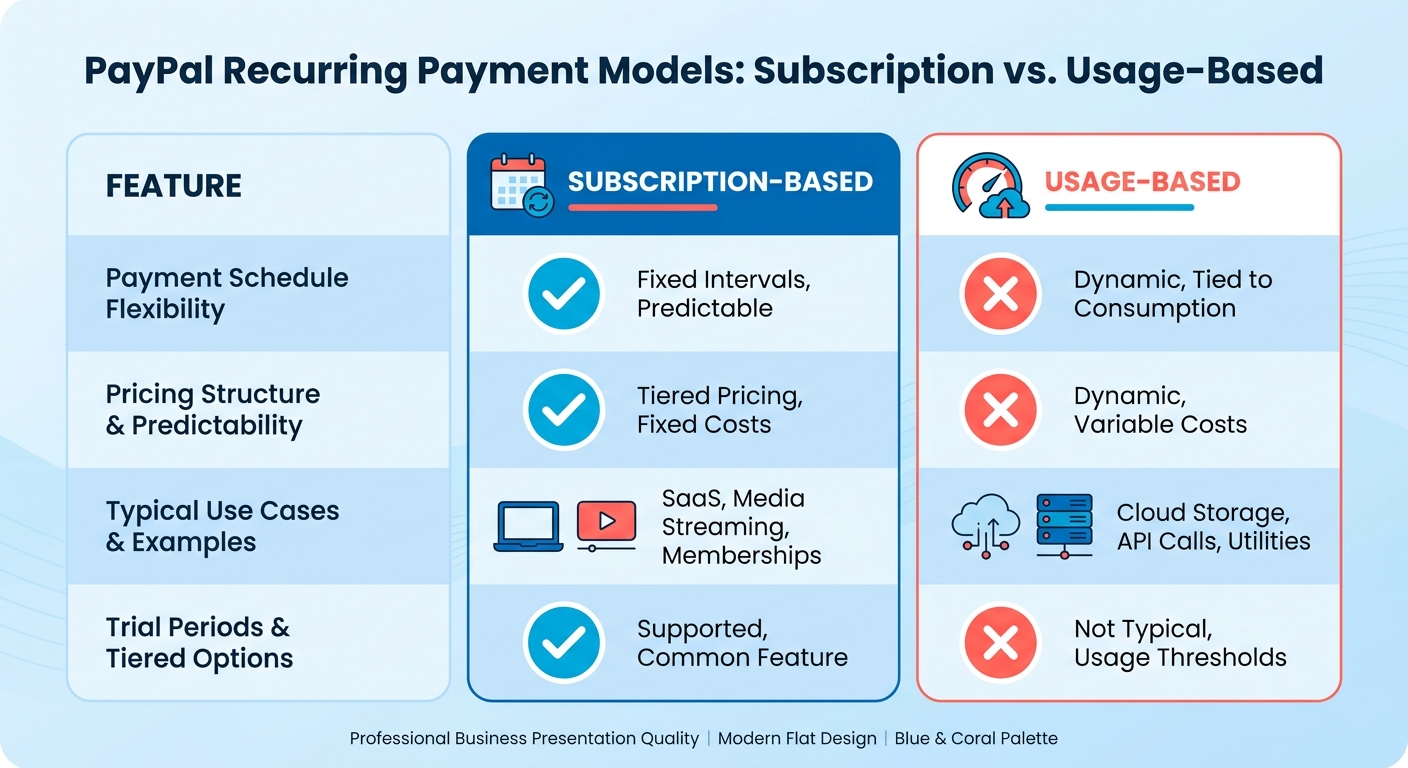
What works, what doesn’t
PayPal’s biggest asset is its user base. That brand recognition buys instant customer trust, and the e-commerce integrations are genuinely smooth. One B2B software provider reported a 20% bump in monthly recurring revenue after adopting PayPal’s subscription model — though reconciling failed payments by hand stayed a bottleneck.
Smaller shops using the API for recurring donations have flagged delays on international transactions, a symptom of PayPal leaning on intermediary banks for cross-border flows.
| Feature | PayPal | Blixo |
|---|---|---|
| Localization | Basic currency conversion tools | Advanced multi-currency support |
| Billing Flexibility | Fixed payment schedules | Customizable proration rules |
| Reporting | Standard transaction logs | Granular analytics dashboards |
PayPal makes subscription renewals easy, which helps lifetime value. But it has no embedded dunning analytics, so teams reach for external tools to track payment success rates. And the fixed-interval model fights with usage-based revenue, which pushes some companies toward hybrid setups.
What Blixo’s subscription management actually does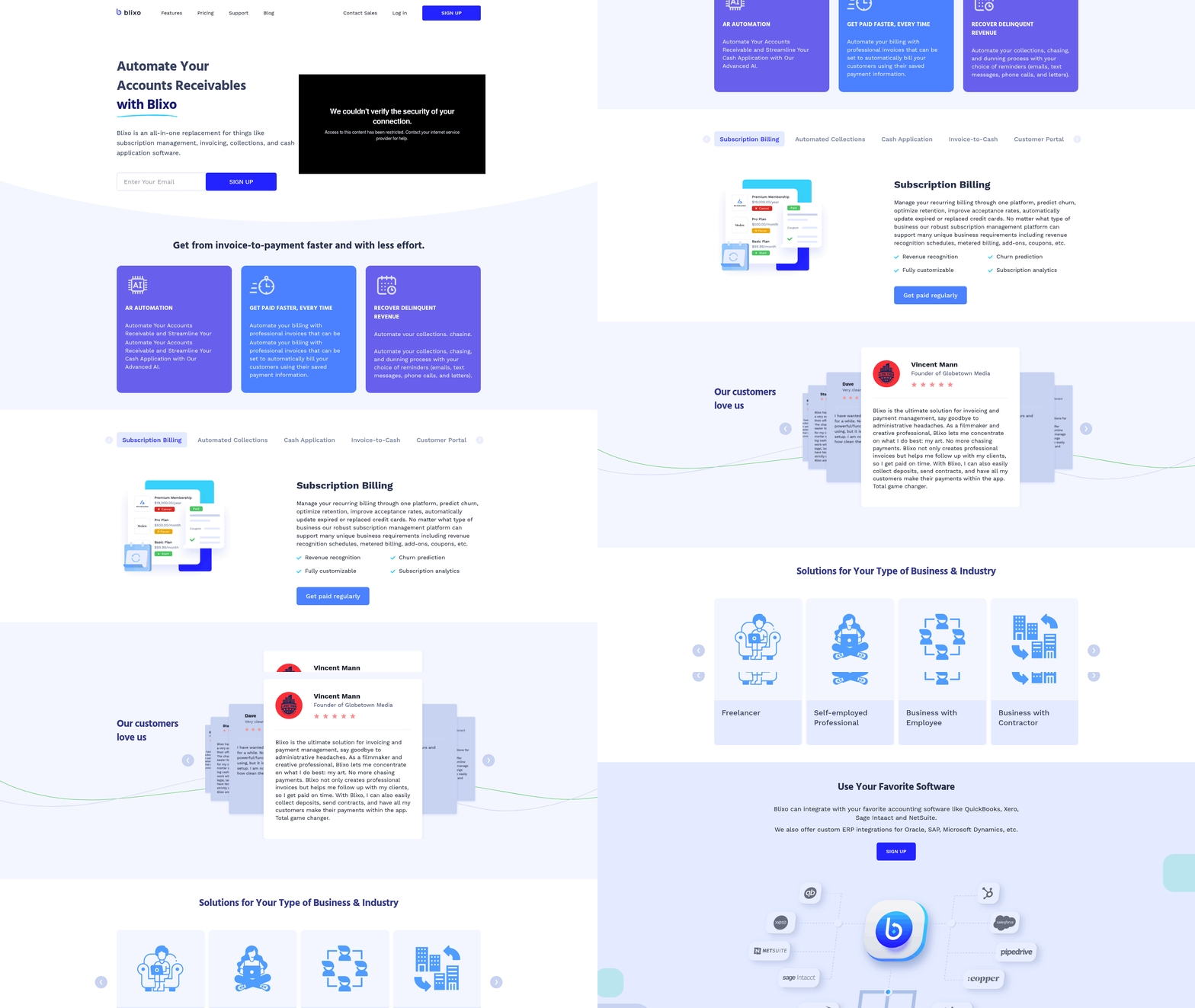
Blixo goes past basic recurring billing by automating reconciliation and collections, so you capture every payment without manual oversight. Invoicing, payment tracking, and revenue reporting live in one workflow. Fewer errors, faster cash. Here’s how that plays out.
Invoicing and payment tracking on autopilot
Blixo automates invoicing with customizable templates, payment reminders, and real-time status updates. You can set up tiered pricing or volume discounts straight in the billing system instead of adjusting them by hand. When a payment fails, the platform retries automatically and sends targeted reminders, recovering up to 56% of declined transactions per industry benchmarks. A digital publishing network running Blixo reported 40% fewer billing disputes and 35% faster payment processing after the switch.
To cut involuntary churn, the system hooks into card network updater services to refresh expired credentials in the background. When a customer’s card gets replaced, the billing cycle keeps going. No one has to re-enter anything.
Revenue insights you can actually plan around
Blixo’s dashboards run in real time, with forecasting that projects cash flow off subscription trends. It tracks churn, average revenue per user, and payment success rates, so finance teams decide with data instead of vibes. One media business improved payment accuracy by 38%, which made its quarterly forecasts a lot more reliable.
Reporting also covers multi-currency support and Net-D terms for global operations. Segment data by customer cohort or billing method and you get the granular view you need to tune pricing and manage international accounts.
How it plugs into your existing stack
Integration with accounting and CRM is a core strength. Blixo syncs directly with QuickBooks and Salesforce, so financial data flows into ledgers and customer profiles on its own. A healthcare service provider cut reconciliation delays by 42% just by connecting its billing system to tools it already used.
Side by side:
| Feature | Blixo | PayPal Recurring Payments |
|---|---|---|
| Automated Reconciliation | ✅ Full automation with AI-driven matching | ❌ Requires manual intervention |
| Flexible Pricing Models | ✅ Tiered, usage-based, and volume pricing | ❌ Limited to fixed-interval billing |
| CRM/Accounting Sync | ✅ Native integrations with QuickBooks, Salesforce | ✅ Limited to basic PayPal ecosystem |
| Revenue Recovery Tools | ✅ Smart retries + card updates | ❌ Basic retry system |
What this looks like in the wild
One specialty subscription box service automated invoicing and collections and recovered $120K in missed payments within six months. A software startup pulled 40% of its billing processes into Blixo’s payment tracking and dropped a pile of manual work.
For teams trying to scale, the win is killing the friction of fragmented systems. As one user put it in internal feedback: “The platform acts as a control tower for subscriptions — no more chasing payments or reconciling spreadsheets.”
For more on how Blixo handles invoicing automation, there’s a case study on revenue recovery worth reading.
What it actually costs: Blixo vs PayPal
Fixed fee vs. paying per transaction
The two price very differently. Blixo runs on a fixed-fee model with an upfront investment, which makes long-term budgeting simple. For businesses pushing a lot of recurring payments, that avoids the compounding cost of variable transaction rates. PayPal’s per-transaction model suits smaller operations with simpler needs.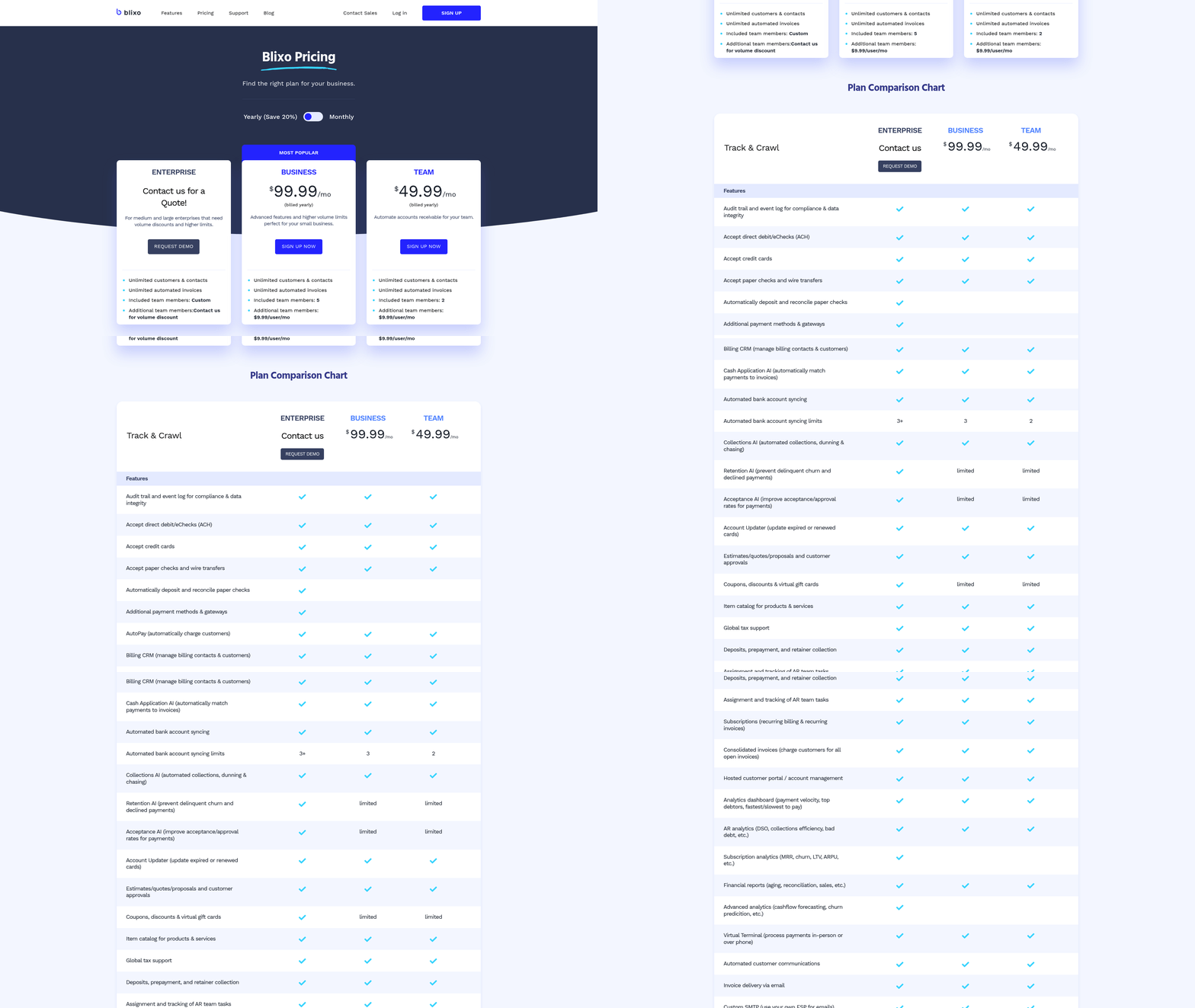
A digital publisher processing 500 payments a month watches its fees climb under PayPal’s structure. Under Blixo’s fixed pricing, transaction count doesn’t move the bill. That predictability matters most during growth, when you’re trying to plan ahead instead of react.
Cost savings and recovered revenue
Companies switching to Blixo report up to 20% less overhead on payment management versus PayPal. One online SaaS enterprise automated 90% of its payment retries and recovered $50 million in annual revenue by resolving expired cards and failed transactions without anyone touching them.
PayPal’s manual processes create bottlenecks, especially for businesses riding seasonal payment swings. Automating that recovery cuts revenue leakage and keeps customers from churning over avoidable billing hiccups.
Setup time and ongoing effort
Blixo takes minimal technical input. Its drag-and-drop interface lets non-developers build complex billing rules in minutes. PayPal handles basic configurations fine, but ongoing tasks, updating payment methods, adjusting subscription tiers, eat 8+ hours a month for medium-sized teams.
The gap widens at scale. Blixo’s centralized dashboard pulls payment tracking, dispute resolution, and reporting into one place. PayPal users tend to juggle several tools to get the same coverage. Less friction, more time for work that actually moves the business.
| Metric | Blixo | PayPal |
|---|---|---|
| Pricing Model | Fixed upfront fee + annual updates | Variable per-transaction rate |
| Monthly Cost (500 transactions) | $0 (post-purchase) | ~$250–$350 |
| Automation Level | Full: retries, dunning, analytics | Limited: basic retries only |
| Time Saved Monthly | ~12+ hours (automated workflows) | ~3 hours (basic oversight) |
| Best For | Subscription-heavy businesses | Low-volume, sporadic billing |
Blixo’s fixed costs and automation fit businesses built to scale. PayPal’s variable pricing stays practical for low-complexity use. If your goal is minimizing overhead and controlling long-term spend, Blixo has the clearer edge.
What this looks like for real businesses
Businesses on Blixo report measurable gains in revenue retention and efficiency, driven by automated reconciliation and collections. A delivery marketplace automated card updates and payment retries and recovered over $63 million in lost payments in a single year. That tracks with industry data: 25% of membership churn comes from involuntary payment failures, the kind automated systems are built to stop.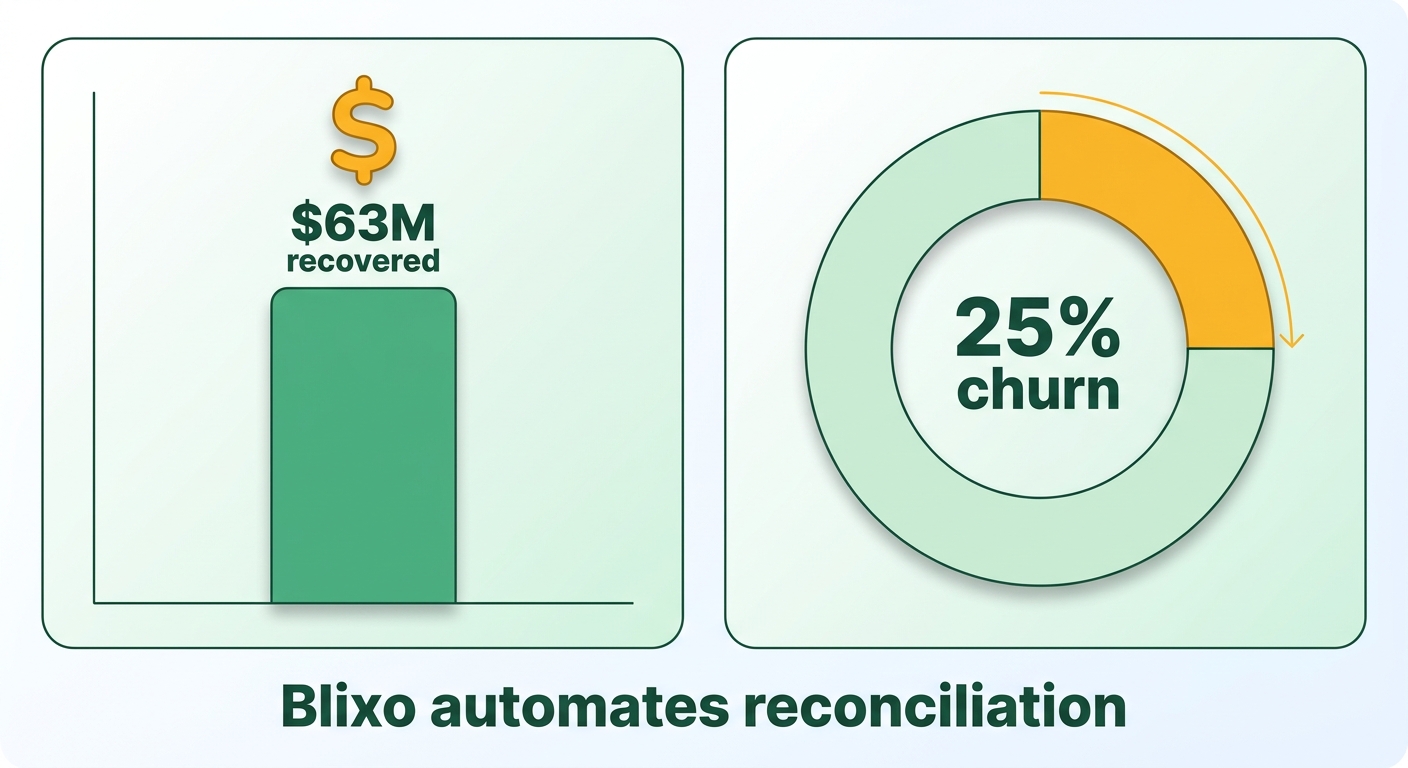
SaaS platform: cutting involuntary churn
A SaaS company with 10,000+ monthly subscribers moved from PayPal to Blixo and cut involuntary churn by 40% in six months. Automated retries and expired-card updates captured 60% of previously lost transactions. Payment success rates climbed 28%, which smoothed cash flow and cut down billing-related support tickets.
What it costs and how it feels to use
Capterra’s financial analysis shows Blixo users save a meaningful chunk of annual operating costs against competing platforms, mostly from predictable budgeting. One review called out the interface: “Configuring custom discount structures for enterprise clients was seamless, whereas previous tools required extensive back-and-forth with support.” Support got credit too, mainly for proactive alerts that flag billing issues before customers ever notice.
Sector-specific results
In digital media, a streaming platform automated invoicing and payment reminders and pushed customer satisfaction scores up 25%. Predictable billing cycles and real-time payment status were the parts users actually liked.
The throughline: Blixo turns recurring billing from a reactive chore into a revenue driver, especially for high-volume businesses or messy pricing tiers. Embedding automation into post-payment workflows means payments stop falling through the cracks — the gap that platforms without integrated reconciliation keep leaving open.
What I’d actually recommend
The choice comes down to operational priorities: pricing structure, automation, support. Blixo runs on consistent monthly fees that scale with growth; PayPal charges variable per-transaction rates. Blixo automates reconciliation and payment recovery where PayPal leans on manual work. Blixo also offers tailored support agreements and AI-assisted recovery tools, while PayPal’s resources stay more generic.
For anyone running large-scale subscriptions, Blixo cuts the administrative load hardest. A membership site with thousands of monthly subscribers gets the most out of reduced manual intervention and better revenue retention.
When Blixo is the right call
Pick Blixo when you need:
- Payment reliability: smart retries plus card-update integration to stop revenue loss from expired cards.
- Workflow integration: invoicing, payment tracking, and collections in one place instead of five tools.
- Flexible growth: tiered and usage-based pricing that moves with your transaction volume.
PayPal stays a solid pick for small operations that don’t need custom anything. But if you’re fighting frequent payment declines or burning staff hours on reconciliation, Blixo’s automation is a real upgrade.
Next steps
Blixo fits teams chasing streamlined billing, lower churn, and predictable costs. Companies that prioritize automated recovery and consolidated financial workflows generally report better efficiency and steadier revenue after switching. Generally — your mileage depends on how messy your current setup is.
Best way to know is to see it against your own systems. Book a live demo for a tailored walkthrough, or schedule a consultation to dig into enterprise features. Non-enterprise users get a 60-day test period to evaluate it without committing upfront.
Blixo is built to simplify revenue management for subscription, membership, and recurring service models, without the overhead of stitching together separate billing tools.
Frequently Asked Questions
1. How does Blixo handle failed payments differently from PayPal?
Blixo automates retries and card updates for failed payments, using intelligent scheduling to retry cards when they are most likely to be approved. PayPal relies on basic retry systems and manual interventions, leading to higher revenue leakage from uncollected payments.
2. What cost advantages does Blixo offer for high-volume businesses?
Blixo’s tiered pricing reduces transaction costs for high-volume operations by offering flat-rate or volume-based pricing structures. This contrasts with PayPal’s model, which charges a fixed percentage and flat fee per transaction, causing costs to scale linearly and eat into margins as sales volume grows.
3. How does Blixo support international transactions?
Blixo’s API enables real-time multi-currency billing and localized tax calculations, while PayPal’s cross-border processing depends on intermediary banks, causing delays and higher fees for international transactions.
4. Can Blixo integrate with custom business applications?
Yes, Blixo offers flexible API integrations for custom workflows, unlike PayPal’s rigid, pre-built solutions. This allows businesses to tailor billing processes to unique operational needs.
5. How does Blixo improve revenue recovery?
Blixo improves revenue recovery by instantly routing failed transactions into automated dunning workflows and sending targeted customer reminders. PayPal lacks this automation, requiring manual tracking and recovery efforts that often result in higher involuntary churn.
6. What about businesses with fluctuating transaction volumes?
Blixo’s volume-based pricing adapts to transaction spikes, while PayPal’s fixed fees become costly during high-volume periods. This makes Blixo more scalable for unpredictable billing cycles.
7. How does Blixo streamline customer management?
Blixo streamlines customer management by consolidating invoicing, payment tracking, and collections into a single dashboard. By automating reconciliation and customer notifications, it eliminates the need for manual spreadsheet tracking and ongoing oversight required by PayPal’s standard setup.