

Gaviti AR Automation Integration: Autonomous Processing & Cash Application for Enterprises

Key Takeaways
- AR automation tackles a cash-flow problem most finance teams underestimate: aging invoices stack up while staff hand-match payments across dozens of remittance formats.
- B2B buyers routinely stretch net-30 terms to net-45 or longer, tying up capital that could otherwise fund growth or service debt.
- Teams that automate AR workflows report meaningful drops in days sales outstanding, freeing working capital stuck in slow collections.
- Rising labor costs mean expensive analyst hours go to repetitive payment matching, work automation can absorb without new headcount.
- Manual cash application forces staff to open emails, decode spreadsheets, match line items, and post entries in a slow, error-prone sequence.
- Tighter audit and compliance rules require controllers to keep an auditable trail for every payment application across complex B2B transactions.
- Gaviti offers tiered pricing that scales from mid-market firms to larger enterprises.
Why AR automation is really a cash-flow fix
AR integration isn’t about connecting software. It’s about fixing a cash-flow problem most finance teams don’t know they have. In mid-market and enterprise shops, the AR function sits at an awkward crossroads: aging invoices pile up, staff hand-match payments across dozens of remittance formats, and leadership wants faster working-capital cycles without adding people. Every time a payment arrives, someone opens an email, decodes a spreadsheet, matches line items to invoices, and posts the entry. Slow and error-prone for complex B2B transactions. That lag compounds into real cash drag.
Three forces drive the pressure. First, payment cycles keep stretching. B2B buyers routinely push net-30 to net-45 or beyond, and manual collections can’t scale outreach to keep pace. Every extra day of delay locks up capital that could fund growth or service debt, which is why teams that automate report meaningful DSO reductions. Second, labor costs are climbing faster than finance budgets. Processing remittance advice and reconciling payments by hand isn’t strategic work, but it eats analyst time on repetitive matching. Third, audit and compliance requirements are tightening. Controllers need auditable trails for every payment application, and spreadsheet-based workflows don’t produce the timestamped, rule-documented logs external auditors want.
The financial upside of autonomous cash application
Autonomous cash-application platforms match a large share of payments before the team even logs in. One provider reports AI cash application clearing 90% of payments before the day begins. Where that accuracy translates into DSO drops, the numbers are hard to argue with: one case study showed a 30% DSO reduction within six months, another a 77% decline in receivables at risk over the same window. Those are liquidity gains that show up in working-capital ratios and credit-facility headroom. A meaningful DSO cut frees cash that was previously stuck in slow collections.
The hidden ROI lives in redeployed labor. When standard payments auto-apply overnight, analysts move from data entry to exception handling and customer relationships. That shift shows up in two places: 50% fewer late receivables, because teams finally have time for proactive outreach on aging accounts, and a better customer experience. One CFO said clients prefer automated reminders over ad-hoc collection calls, calling the workflow “genius.” Customers consistently report that automated reminders and faster collections improve how the whole billing process feels.
When manual processes cap your growth
AR bottlenecks stall expansion more often than finance teams admit. A SaaS company scaling from $20M to $50M ARR usually adds payment volume faster than it can hire and train cash-application staff. The result is a reconciliation backlog that delays revenue recognition and clouds cash forecasts. Without real-time visibility into applied payments, leadership can’t confidently commit capital to hiring, infrastructure, or M&A. One enterprise reported a 25% cash-flow increase in its first quarter post-automation. Not because customers paid faster, but because the company finally had accurate, real-time data on what it had already collected.
Manual workflows can be fine in low-complexity environments where volume is light and customers pay via ACH with clean remittance data. For companies processing high volumes across wire transfers, checks, and multi-invoice remittances, the reconciliation lag becomes a strategic constraint. Rising interest rates and tighter credit markets make cash-conversion speed more valuable than it’s been in a decade. Every day of delay now carries a measurable financing cost, and enterprises that once treated AR as back-office plumbing are reframing it as a working-capital lever.
How the integration actually fits together
A modern AR integration connects three layers: the invoice-to-cash engine, your ERP or accounting system, and the bank feeds carrying remittance data. The architecture decides whether payments post automatically or sit in a queue waiting for someone to match them by hand.
What sets this apart from older bolt-on tools is that the automation layer sits on top of your existing financial system. It reads and writes without a rip-and-replace. The engine processes payments continuously rather than in one overnight window, so matching happens throughout the day as remittances arrive. That cadence matters for high-volume teams: same-day visibility into which invoices cleared lets you prioritize collections outreach before the next batch runs.
How the data flows from invoice to cash
The pipeline runs in a straight line: invoice capture, payment ingestion, AI matching, posting back to the ledger. Each stage hands structured data to the next, so a remittance email or bank file becomes a posted entry without manual keying.
Invoices carry a core schema of customer ID, invoice number, line items, amounts, and due dates. Payments arrive with amount, date, payer reference, and remittance detail. Credit memos link back to the original invoice so partial and bulk payments resolve cleanly. The matching engine reconciles these against open receivables, then writes the result to your system of record.
This is where single and multi-bank connectivity earns its keep. Pulling remittance from every bank into one matching layer removes the manual decoding step that drags out B2B posting.
What keeps ERP integration low-risk
The automation layer is ERP-agnostic. It plugs into SAP, Oracle NetSuite, or Microsoft Dynamics without changing the underlying ERP configuration. That one design choice reshapes the project timeline.
Historically, unifying cash application meant a two- or three-year ERP transformation. Combine ERP-agnostic integration with the shift from managing cash application to enabling working capital, and a different pattern shows up. Deploying AR automation as a liquidity layer can yield cash-flow gains in a single quarter instead of over years. That reframes the whole business case.
For complex, multi-entity environments with legacy middleware, an iPaaS layer can broker the data mapping between systems. If your stack is a single clean ERP, that middleware is overkill. Skip it and connect directly.
Where humans still sit in the loop
Autonomous processing handles the transactional layer: matching payments, triggering dunning workflows, posting entries. It doesn’t remove your AR team. It redeploys them.
The automation eliminates constant human oversight of routine matching. Your people move to exceptions, disputes, and customer relationships. That distinction matters when you scope roles. A majority of finance teams still touch every remittance by hand, so the groups that make this shift early turn operational speed into a retention edge that laggards struggle to claw back.
Error handling closes the loop. Payments that fail to match route to a review queue rather than posting incorrectly, so the ledger stays clean while humans resolve the edge cases.
Real‑world impact: case studies and metrics
The clearest proof an AR integration is paying off shows up in two numbers: how fast cash lands, and how few people it takes to land it.
Two examples make the point. A building-products distributor running an agentic AI cash-application system cut bad debt by $2.1 million** and reached a **98% auto-apply rate** on incoming payments. A large beverage manufacturer saved **$2.5 million in financial-services costs by automating cash application alone. Different industries, same lesson: the ROI hides in payment matching, not flashy dashboards.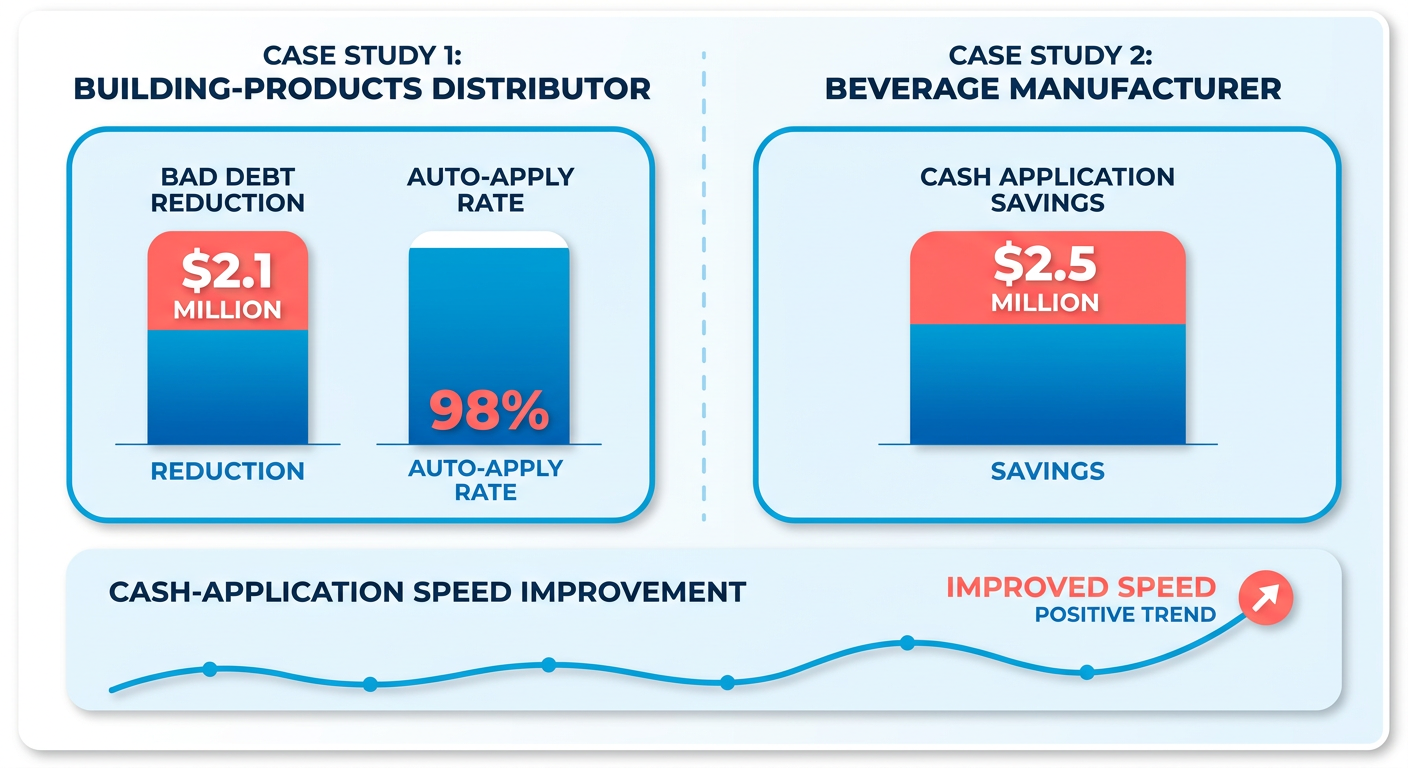
What DSO and productivity gains look like
Enterprise AR automation reliably shortens collection cycles and frees staff hours. In practice, the payoff shows up first in cash-application accuracy: automated matching handles the vast majority of daily receipts without human intervention, setting up a consistent daily clearing cycle that steadily pulls collection timelines down.
A global confectionery firm shows the upper band. After adding AI-driven worklist prioritization, it posted a 28% DSO decrease and clawed back over 1,000 hours annually in collector time. A mid-market services company hit 80% automated cash posting and shaved past-due balances by 20% through automated credit-risk checks.
The DSO number gets the executive attention, but the reclaimed hours are what compound. Those hours move senior collectors off keying and onto disputes and high-value accounts.
Traditional AR stack vs. integrated one
An integrated stack is a single source of truth: subscription billing, cash application, and ERP posting share one data layer, so payments reconcile without manual handoffs. A traditional stack bolts point tools together and leaves the seams for humans to patch.
| Dimension | Traditional AR stack | Integrated AR stack |
|---|---|---|
| Time to cash | Manual matching delays posting | Near-overnight auto-apply |
| Manual effort | High; staff key remittances | Exceptions only |
| Error rate | Rises with volume | Drops as the system learns |
| Scalability | Add headcount to grow | Volume scales without staff |
| Customer experience | Inconsistent dunning | Consistent, timely workflows |
| Data visibility | Siloed across tools | One reporting source |
The customer-experience row matters more than it looks. 75% of firms report better customer experiences after AR automation, and 87% report faster processing. Stack those on top of the DSO gains and you get a quiet competitive edge.
Why results accelerate in years two and three
The most useful lesson from these deployments is that the gains compound. The 2% to 5% of payments that need manual review early on become training data. Adaptive AI agents learn from those outcomes, so match rates climb and the exception queue shrinks over time.
The department’s focus shifts structurally, too. Instead of managing daily transactional volume, the team moves into a strategic role: optimizing credit policies, resolving complex billing disputes, and strengthening high-value client relationships. That maturity curve lets the organization scale transaction volume without a matching rise in administrative overhead.
Squeezing more ROI: advanced features
Once your integration runs the baseline workload of matching payments, posting cash, and reminding customers, the next layer delivers compounding returns. Teams that stop at straight-through processing often leave real DSO improvement on the table. The features below reshape how finance allocates attention, predicts liquidity gaps, and handles the exceptions manual workflows used to bury for weeks.
Predictive cash-flow forecasting that reads payment patterns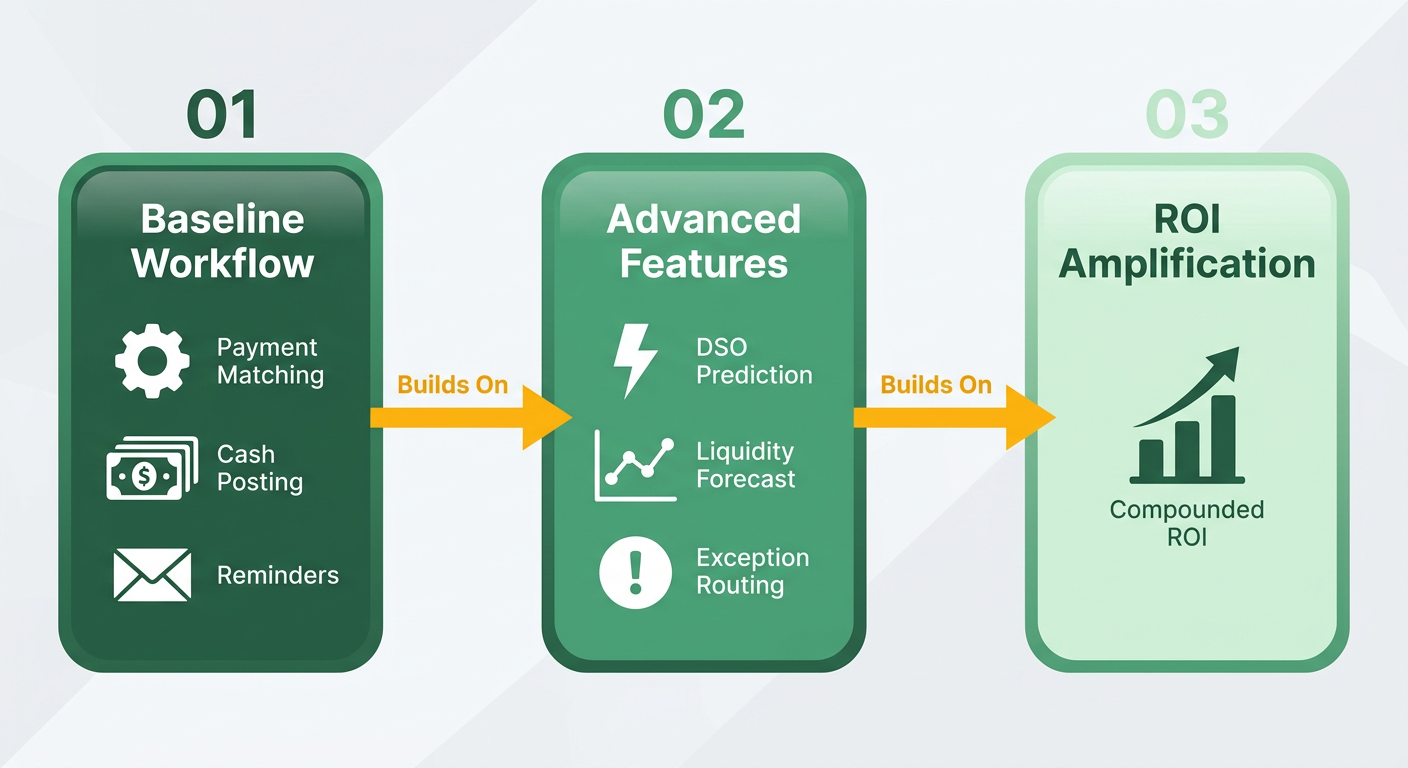
AI cash-application systems don’t just match what arrives today. They learn how your customers pay. Over time, the platform builds a behavioral model: which accounts pay early, which submit partial remittances, which habitually dispute line items before paying. That pattern recognition feeds a predictive module that can forecast cash arrival with tighter error bands than static aging reports ever managed.
In one recent deployment, the finance team projected working capital two weeks ahead with enough accuracy to negotiate better credit terms upstream. The system flagged accounts likely to remit late, and collections reached out before the invoice aged into the 60-day bucket. One controller cut forecast variance from roughly two weeks of receipts to under three days, which let treasury size a revolving credit draw far more precisely instead of padding the balance to cover uncertainty.
The inputs are straightforward: historical remittance data, customer payment terms, and invoice aging from your ERP. The algorithm cross-references those against real-time signals like bank feeds, email notifications, and portal activity to generate rolling forecasts. You’re not guessing which accounts will pay on time. You’re working from a probability distribution that updates daily.
Dynamic dunning that escalates based on risk
Generic reminder sequences treat every overdue invoice the same way: a polite nudge at 30 days, a firmer email at 60, escalation at 90. That ignores the obvious. A $500 invoice from a reliable customer at 35 days overdue is not the same risk as a $50,000 invoice from a new account with thin credit history hitting 31 days.
Advanced platforms assign customer risk scores from payment history, credit data, and account age, then route each overdue invoice into a dunning track matched to that profile. High-risk accounts trigger earlier, more frequent outreach. Low-risk accounts get softer reminders spaced further apart. The system adapts tone, escalation velocity, and channel mix across email, phone, and SMS without manual intervention.
One CFO noted that customers appreciated the change: reliable payers stopped getting aggressive collection emails, while problem accounts got the attention they warranted. You’re not just automating the send button. You’re automating the judgment call behind which message to send.
AI dispute classification that routes exceptions
Payment disputes are where straight-through processing breaks down. A remittance arrives with a deduction, the system can’t reconcile it cleanly, and someone has to dig through email threads, PO references, and delivery confirmations to figure out what happened. That triage burns hours and delays cash posting by days.
AI classification reads the remittance advice, including free-text notes, reason codes, and attached backup, then assigns the dispute to a category: pricing disagreement, quantity mismatch, delivery issue, or documentation problem. Each category routes to a predefined workflow. Pricing disputes go to sales. Delivery issues trigger a logistics lookup. Documentation problems hit the invoice attachment queue. The system doesn’t solve every dispute on its own, but it kills the “who should handle this?” delay that used to stretch resolution to weeks.
This gets tracked as dispute resolution time. Automating classification shortens the manual triage that used to drag across many days, which directly improves the cash conversion cycle. The platform also logs dispute patterns, so recurring issues like a SKU that always ships short or a billing rule that confuses customers surface as actionable feedback for operations and finance.
Real-time dashboards that surface what needs attention
Most ERP reports are backward-looking. They tell you where cash stood at the end of last week. Real-time dashboards in modern AR platforms show current aging balances, payments in flight, and forecasted receipts on one screen. That matters when you’re making same-day credit decisions or negotiating payment plans.
Gaviti’s aging reports and task management give collectors clear visibility into which accounts need attention, and the customer portal lets clients view and pay outstanding invoices, so status stays transparent on both sides. Collectors prioritize the highest-impact accounts while finance gains a single source of truth for reconciled, real-time revenue data.
One frequent question: how much automation is too much? Skip the advanced layers if your payment complexity is low, meaning straight invoices, consistent remittance formats, few disputes. The ROI threshold shifts when you handle multi-entity remittances, bulk payments spanning dozens of invoices, or high dispute rates. In those environments, matching thresholds and exception-handling logic become the difference between autonomous processing and a queue that still needs daily manual review.
Tuning matching thresholds for industry quirks
Out-of-the-box rules handle the common cases: exact invoice number match, partial payment by percentage, consolidated remittance with a reference list. Industry-specific edge cases like construction retainage, rebate offsets, and freight deductions require tuning the matching algorithm’s confidence threshold and exception rules.
Set match confidence scores that decide when the system posts automatically versus when it flags for review. Raise the bar and fewer misapplied payments slip through, but the review queue gets heavier. Lower it and more volume flows straight through, at the cost of occasional wrong postings. Some teams run a tiered setup: high confidence auto-posts, a middle band routes to a quick one-click approval, and low confidence drops into full manual review. Most cash lands untouched while only genuine edge cases reach a person. The right setting depends on your tolerance for error and the cost of manual intervention.
Gaviti’s matching engine gets smarter as you go. As you manually edit and approve matches, its machine learning improves how it matches your data next time. Paired with the built-in approval workflow, recurring variances between invoice amount and remittance get handled cleanly instead of piling up as disputes, which lifts your auto-apply rate and cuts manual touch points.
Pulling in external credit and payment data
The platform’s decisions improve when it pulls in data beyond your ERP. Credit bureau feeds provide real-time risk scores, triggering alerts when a previously reliable account’s credit profile deteriorates. Payment gateway integrations surface pending ACH or card transactions before they hit your bank account, giving you earlier visibility into cash arrival.
Gaviti integrates directly with major accounting platforms and ERPs, using secure API connections to sync ledger data in real time. Each connection shrinks the “unknown” column in your cash-application queue. The fewer manual lookups your team runs, the faster cash posts and the lower your operating cost per dollar collected. By keeping cash application, reconciliation, and invoice data in one platform, Gaviti resolves matching questions automatically that would otherwise clog a collections queue, so fewer disputes reach a customer in the first place.
Putting numbers to the incremental gains
The baseline ROI from AR automation, meaning DSO reduction and labor savings, is straightforward. The advanced features add value that compounds. Predictive cash flow lets you optimize working-capital deployment. Risk-based dunning cuts bad-debt write-offs. AI dispute routing shortens resolution cycles, which speeds cash conversion.
Baseline automation drives the first wave of DSO reduction. The predictive and exception-handling layers stack further gains on top as they mature. Faster cash conversion releases working capital that was tied up in aged receivables. The exact ROI depends on your cost of capital, but the incremental investment typically pays back quickly once the advanced layers are running.
For high-volume distributors managing complex supply-chain logistics, trade discounts, and multi-location shipping terms, a unified platform removes the reconciliation gaps that historically required a dedicated cash-application team. That’s the advantage competitors miss when they treat AR automation as a point solution instead of an integrated intelligence layer.
What’s coming next, and how to scale for it
Real-time payment mandates and embedded-finance regulations are pushing AR automation from operational tactic to compliance necessity. Over the past year, enterprise finance teams have faced a new calculus: the integration layer that once sat quietly behind cash application now determines whether you can process instant-settlement rails, meet audit trails for cross-border transactions, and scale autonomous matching across subsidiaries without rebuilding your ERP stack every time a regulator updates payment-visibility rules. Multi-entity consolidation and multi-currency reconciliation used to be phased in over quarters. Now they’re the baseline for any AR integration that expects to outlive the next regulatory cycle.
Scaling AI without breaking your architecture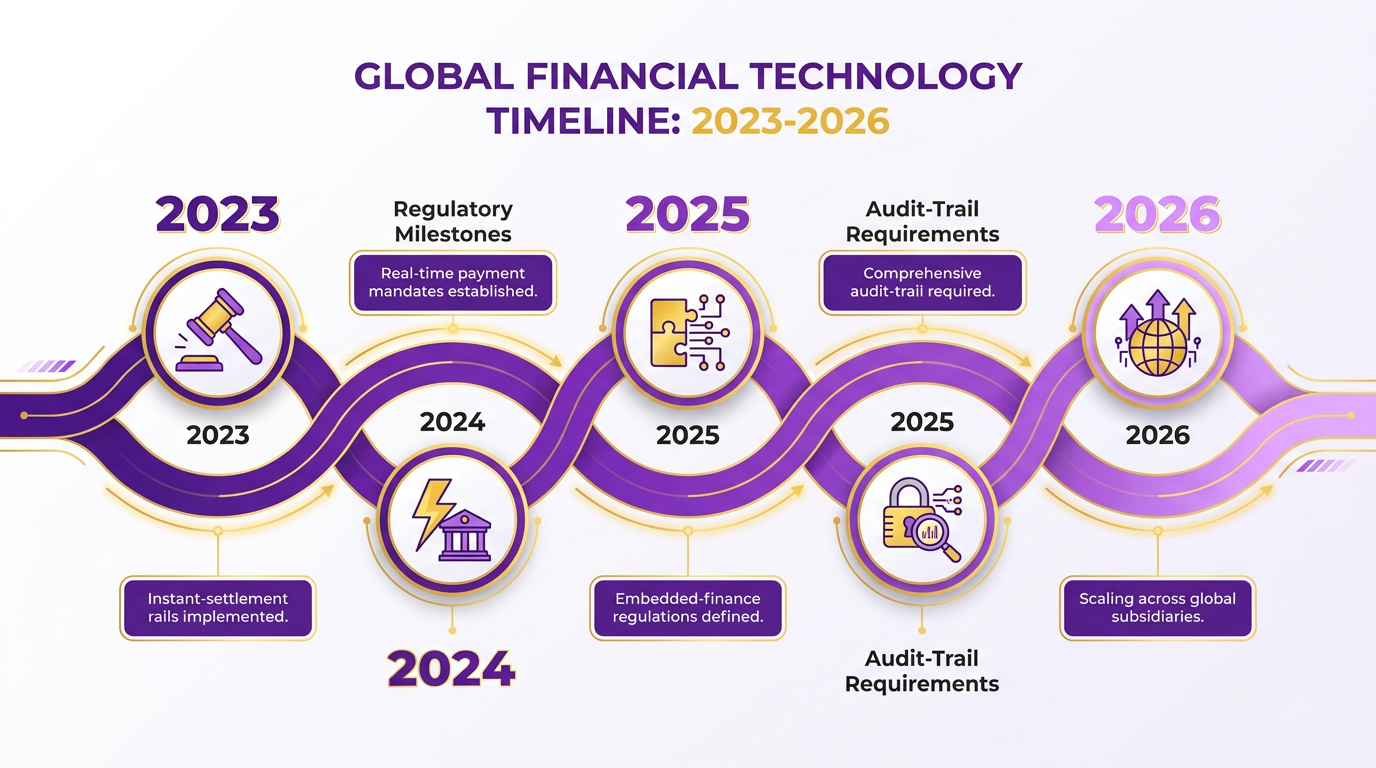
Early adopters report that the biggest scaling friction isn’t transaction volume. It’s holding match accuracy steady when you layer in new business units, currencies, or remittance formats. It happens repeatedly: a company automates cash application for its North American operation, hits the promised overnight reconciliation numbers, then hits a wall when European subsidiaries come online because the original integration can’t parse SEPA remittance advice or handle VAT line-item splits. The platforms that survive enterprise-wide rollouts share one trait. They sit on top of your ERP rather than inside it, reading and writing through APIs so a new division on a different accounting system doesn’t force a rebuild.
Modern machine-learning models analyze months of payment history to map customer-specific behavior. The system spots which accounts pay early with partial remittances and which consolidate multiple invoices into single wire transfers with non-standard reference codes, then adapts its matching rules without manual IT work. That behavioral modeling is what separates today’s goal-oriented AI agents from the older robotic process automation that broke every time a customer changed a remittance format. The difference shows up in exception queues: teams running adaptive models spend their mornings resolving genuinely ambiguous disputes, not re-teaching the system to read a spreadsheet it’s seen a hundred times.
The blockchain settlement question
Payment reconciliation on distributed ledgers is still more roadmap than reality for most enterprises, but the technical pieces are landing faster than procurement cycles suggest. The appeal is narrow and specific: instant finality for cross-border B2B payments without correspondent-banking lag, plus an immutable audit trail for compliance teams in jurisdictions where traditional reconciliation documentation creates exposure. Nobody’s seeing wholesale migration to blockchain rails, since wire transfers and ACH aren’t going anywhere. But pilot programs exist where high-value international invoices settle on permissioned ledgers, and the AR integration reads finality signals directly from the chain rather than waiting three days for SWIFT confirmation.
The practical constraint is interoperability. Your AR automation has to handle payments arriving through traditional bank feeds, blockchain settlement notifications, real-time payment APIs, and legacy lockbox scans, all posting to the same invoice in your ERP without duplicate entries or orphaned line items. Platforms building for this future use protocol-agnostic ingestion layers that normalize payment data no matter how it arrives, then apply the same matching logic downstream. If your integration can’t do that today, adding blockchain support later means rebuilding the entire cash-application stack.
Human oversight in a mostly autonomous workflow
The best implementations treat oversight as a routing decision, not a binary on-off switch. One European logistics company configured its system to auto-post payments under €5,000 from established customers with clean remittance data, while flagging anything above that threshold or from accounts less than 90 days old for manual verification before ledger entry. Six months in, auto-posted transactions had a dispute rate under 0.3%, while the manual queue surfaced two pricing discrepancies that would have cost five figures each if buried in automatic application.
The shift coming is predictive escalation: the system learns which types of ambiguity your team resolves one way versus another, then only surfaces the cases where its confidence is genuinely low. That keeps exception queues manageable even as volume climbs, because you’re not reviewing every payment that falls short of 100% certainty, just the ones where the AI hasn’t seen enough examples to make a reliable call. Finance teams that define clear confidence thresholds and dollar-based review triggers free up space for strategic work like customer relationship management, payment-terms negotiation, and credit-limit reviews, instead of spending senior analyst time confirming matches the system already knows how to handle.
Frequently Asked Questions
1. Does AR automation mean I can reduce my finance team’s headcount?
While automation handles the repetitive data entry of matching payments to invoices, it rarely leads to immediate headcount reductions. Instead, it prevents the need for future hiring as transaction volumes scale. Staff members shift their focus to higher-value activities, such as resolving complex billing disputes, conducting deeper credit risk analyses, and proactively managing customer relationships to improve overall collection rates.
2. When is manual cash application still acceptable over automation?
A manual approach may remain viable for small businesses with low transaction volumes, a highly concentrated customer base, and uniform payment methods (such as standard ACH payments with perfect remittance details). However, once an organization begins managing multiple bank accounts, diverse payment channels (including physical checks, wire transfers, and credit cards), or complex multi-invoice payments, manual processing quickly becomes a bottleneck that delays cash visibility.
3. Do I need an iPaaS middleware layer for ERP integration?
The necessity of middleware depends on the complexity of your IT infrastructure. If your organization operates a single, modern ERP system, a direct API integration is typically the most efficient and cost-effective path. Conversely, if you are managing a highly fragmented environment with multiple legacy systems, disparate databases, and existing middleware, utilizing an iPaaS layer can help standardize data flows and simplify the mapping process without disrupting established configurations.
4. What happens when a payment cannot be matched automatically?
Unmatched payments are automatically routed to a dedicated exception queue rather than being posted incorrectly to the general ledger. The system flags the specific discrepancy—such as an underpayment, a missing invoice number, or an unrecognized payer—allowing an AR analyst to review and resolve the issue. Once the analyst manually matches the payment, the platform records the resolution to improve its matching logic for similar transactions in the future.
5. How should I set match confidence thresholds for my industry?
Setting the right confidence threshold requires balancing processing speed against risk tolerance. Most enterprises begin with conservative, high-confidence thresholds to ensure absolute accuracy during the initial deployment phase. As the system gathers historical data and validates matching patterns, administrators can gradually lower the threshold for trusted accounts or specific payment types, establishing custom rules to handle common industry-specific variances automatically.
6. Why do automation results improve in years two and three?
Long-term improvements stem from the compounding effect of continuous machine learning and process optimization. As the platform accumulates months of clean transaction history, its predictive capabilities become significantly more accurate. Additionally, the system refines its understanding of customer-specific payment cycles and dispute patterns, allowing the finance team to transition from reactive collections to proactive cash management.
7. Can AR automation help forecast cash flow, not just apply payments?
Yes. By analyzing historical payment velocities, customer-specific remittance habits, and real-time bank data, the platform can project cash inflows with high precision. This predictive capability goes beyond static aging reports, allowing treasury teams to anticipate liquidity needs, optimize working capital allocation, and make more informed decisions regarding short-term investments or credit facility utilization.