

Dunning and Collections Automation for Scalable Subscription Businesses

Key Takeaways
- Failed payments drive 20%–40% of subscription churn, per Stripe. That makes dunning one of the cheapest revenue levers you have.
- Recovery speed comes down to one number: average days to cash after a missed payment. Mid-range speed with high customer-impact tends to beat pure speed.
- Rule-based dunning engines go live in a day, but expect to tune them weekly to keep collection rates from drifting.
- AI-driven platforms need a two-week pilot to train the model. After that, monthly upkeep drops below two hours.
- ERP-integrated suites take multi-week rollouts and usually a dedicated analyst, but they match cash better and need far fewer manual tweaks.
- The comparison table below ranks tools on recovery speed, customer-impact score, and operational overhead so you can pick without guessing.
Quick Summary
The table below puts the most common subscription tracking software with dunning and collections automation side by side, sorted on the metrics that actually move the needle: speed, effort, and customer experience. The right balance recovers cash fast without souring the relationship you spent money acquiring.
Which metrics should you prioritize?
Three dimensions decide this: recovery speed, customer-impact score, and operational overhead. Recovery speed is average days to cash after a missed payment. The customer-impact score blends tone-adjusted messaging with churn-risk reduction, since failed payments are a top reason customers leave. A tool that scores high on speed but low on impact will win back the invoice and lose the account. The sweet spot is mid-range speed with a high impact rating.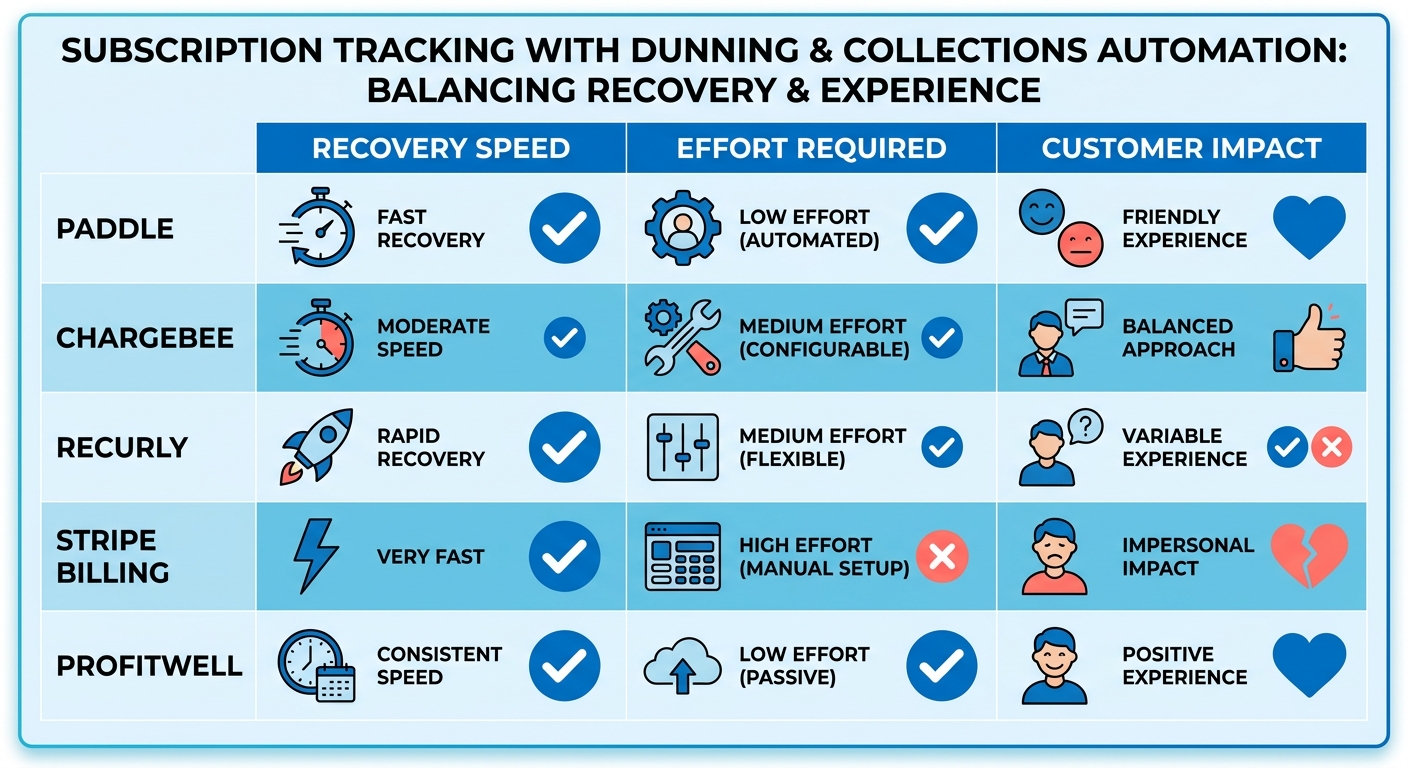
How much effort does implementation really take?
We sort effort into four buckets: setup time, maintenance hours per month, integration difficulty, and skill level required. Simple engines drop into your existing billing stack with almost no config. Predictive platforms need historical transaction data before the model earns its keep. Enterprise suites demand real integration work up front but pay you back later by syncing straight to the general ledger. One caveat: if you’re under 50 invoices a month, the admin cost of standing up these workflows can outweigh what you recover.
| Tool type | Avg. Setup time | Monthly maintenance | Integration difficulty* | Speed gain (days) | Customer‑impact rating (1‑5) | Highlight |
|---|---|---|---|---|---|---|
| Rule‑based dunning engine | 1 day | 4 h | Easy (plug‑in) | –2 days | 3 | Simple email/SMS cadence, low cost |
| AI‑driven predictive dunning | 2 weeks (pilot) | 2 h | Moderate (API + data prep) | –5 days | 4 | ML predicts payment probability, auto‑adjusts retries |
| ERP‑linked collections suite | 3 weeks | 3 h | Hard (custom connectors) | –4 days | 5 | Real‑time ledger sync, automatic cash‑application |
| SaaS‑only subscription manager | 4 days | 1 h | Easy (native) | –3 days | 4 | Built‑in portal lets customers self‑resolve |
| Hybrid rule + AI platform | 10 days | 2 h | Moderate | –4 days | 5 | Combines deterministic rules with risk scoring |
*Difficulty rating: Easy = minimal code, Moderate = some API work, Hard = custom middleware.
What real‑world results can you expect?
Companies that move to AI-driven dunning typically lift recovery rates by 12%–18% and cut 3–5 days off the cash-to-cash cycle. That turns a churn source into a retention play. In one proof-of-concept using Random Forest risk models, a firm dropped late-payment volume from 42.5% to 28% of invoices and freed up enough cash flow to fund a new product line inside a quarter. A pure rule-based setup still beat manual chasing by 30% on speed, but barely moved churn. The messages felt generic, and customers could tell.
Our recommendation: If you process more than 200 invoices a month and already track subscription health, buy the AI-enhanced tool. Below that threshold, or without any data-science help on the team, start rule-based and upgrade later. Skipping automation entirely only makes sense when manual chasing already runs under an hour a week and your missed-payment rate stays below 5%. Everything else is choosing where you want to sit on the speed-versus-experience line as you grow.
Why Dunning and Collections Automation Matters
Modern subscription tracking software with dunning and collections automation lets you chase a missed payment the moment it happens, turning a cash-flow hole into a recovery loop. The catch is tone. Pair speed with the wrong voice and you trade fast cash for a canceled account.
Blixo’s SaaS service runs a full-stack dunning workflow built to recover failed transactions while holding down involuntary churn. Smart-retry logic sits on top of automated notifications, so when a card expires or a charge fails, the system can try alternative payment methods on its own. Agents stop hand-writing notices and reconciling payments, and get their time back for work that actually needs a human.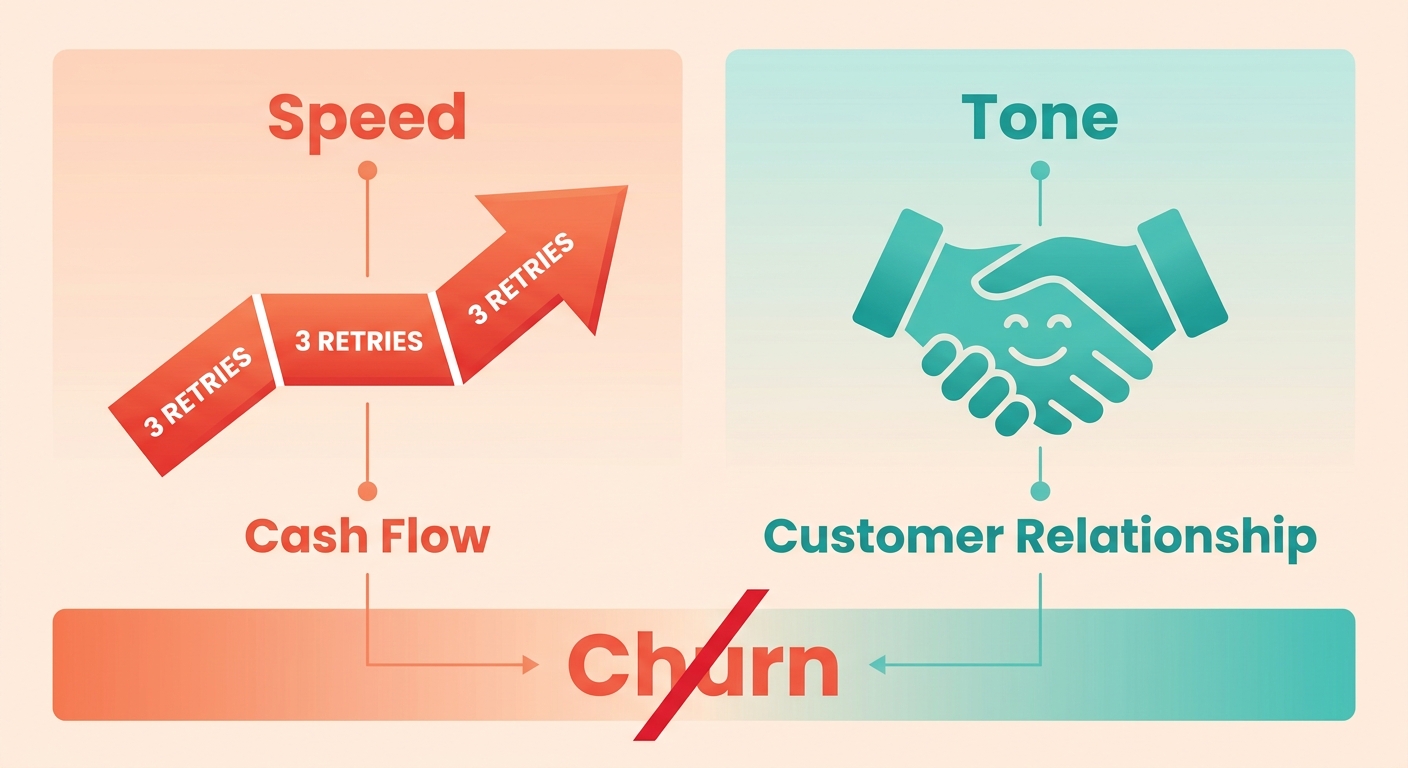
How does automation balance speed with customer experience?
The dunning journey splits into three phases, each with a job.
- Invisible smart retries run in the background the second a charge fails, testing alternative payment methods without bothering the customer.
- Gentle nudges follow: personalized, low-friction messages that remind users what they’d lose access to.
- Escalation kicks in only when the account is high-value or the failure sticks, handing off to a person who can negotiate a payment plan.
“Dunning is not a collections function. It’s a customer‑success function with billing infrastructure underneath.” – Baremetrics
Keep the first two phases automated and you get the speed. Save the human touch for last and you keep the trust. That’s the same pattern the better platforms hit with AI-driven smart retries that resolve issues quietly, then shift to a customer-first tone when a message is actually needed.
When is full automation the wrong choice?
Skip end-to-end automation for businesses running highly customized enterprise contracts with bespoke payment terms. Rigid automated rules can trample a high-touch relationship, and a manual, personal approach earns more back. Same logic if your price point is very high and each account is effectively a partnership. Human-first outreach from day one beats looking like a robot came to collect.
What tangible savings can you expect?
- Agent time: Early-stage automation kills the manual notice-writing, so teams can spend that time on upsells and support.
- Revenue lift: Consistent decline management catches late payments before cards expire, which pulls more revenue into recognition.
- Cash-flow health: Faster recoveries shrink days-sales-outstanding and steady the cash position.
For more on how structured dunning feeds retention, see our guide on What is Dunning, and Can it Improve Customer Retention?
Core Elements of a Dunning Workflow
A dunning workflow really has three linked parts: automated payment retries, intelligent decline handling, and customer-centric communication. Embed those in subscription tracking software with dunning and collections automation and you can chase a missed invoice the instant it happens while keeping the tone that holds the relationship together. Get the mix of speed and empathy right and you recover revenue without inflating churn.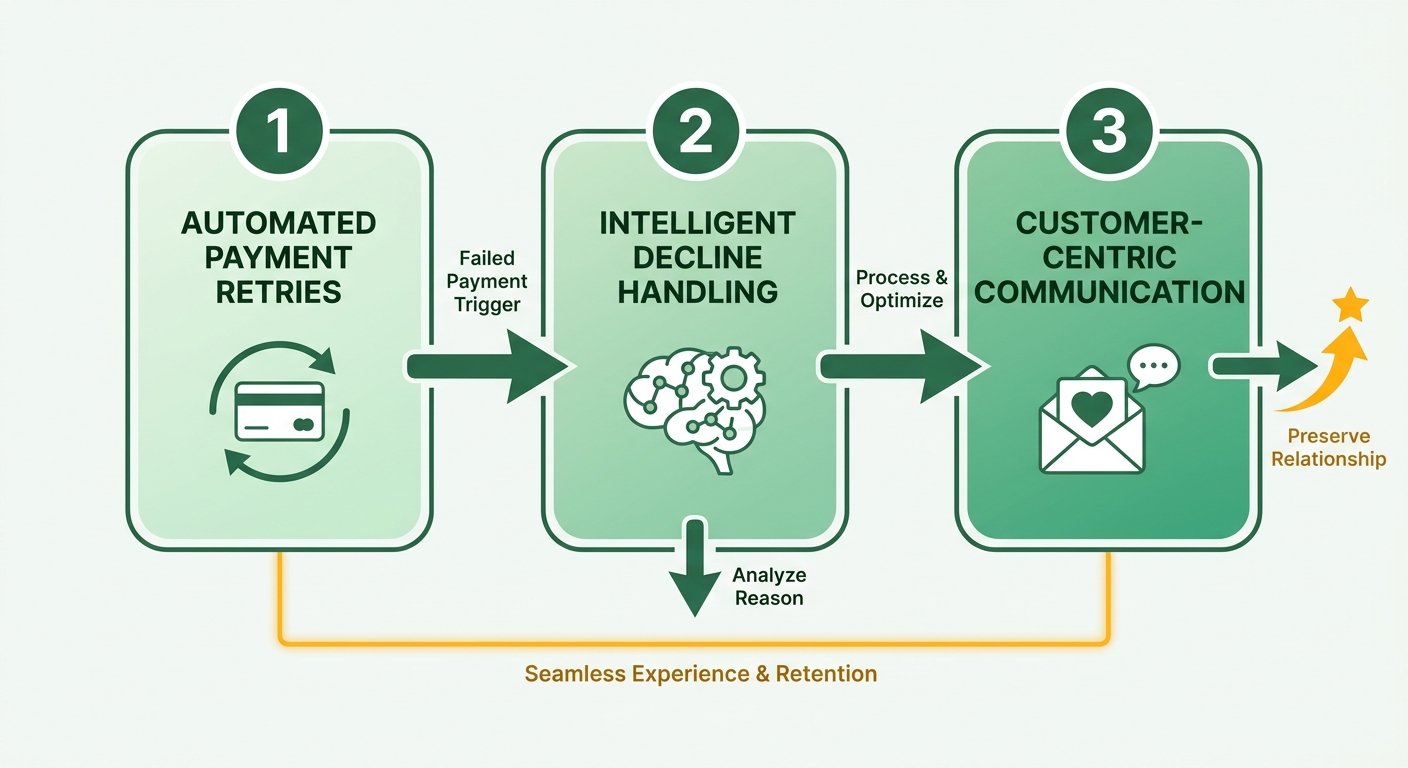
In practice, the transition logic between stages is where most of the work lives. The system watches payment status in real time and reads each account’s risk profile before it moves anything from background processing to active outreach. Set clear rules for when an account crosses that line, and customers only hear from you after the automated attempts are genuinely spent.
How do we structure payment retries for speed without hurting experience?
Start with automated retries that respect card-issuer rules and time attempts to real processing windows. Blixo’s collections engine schedules retries to avoid the pointless failures that burn through issuer goodwill. Add customizable dunning settings and you can decide how aggressively retries run for each risk level, so most customers never notice a thing.
What communication strategy keeps customers happy while we chase payments?
A multi-channel, tone-adjusted cadence that starts before the payment actually fails. Pre-dunning alerts (“your card expires soon”) give customers a chance to fix the problem with zero negative language. If a charge does fail, a structured email sequence follows, backed by SMS, in-app notices, or letters for mobile-first users. Every message leads with the value they still get, not the debt they owe. Blixo’s reminder system lets you pick the channels your audience actually reads, and you can layer in phone calls for accounts where a personal touch pays off.
When should we pause or escalate service without losing trust?
Escalation only fires after the first two phases run dry. Your own rules set the thresholds: pause access, downgrade the plan, or route to a customer-experience specialist. For premium clients, a short pause plus a dedicated outreach call can flip a would-be cancel into a stronger relationship. For smaller accounts, pause billing but keep the product live so they can reactivate whenever they’re ready. Speed first, experience close behind.
Stitch automated retries, rule-based decline handling, and empathetic multi-channel messaging together and you land the sweet spot: cash comes back fast and the customer still feels respected. That balance is what separates a dunning tool that scales from one that quietly bleeds accounts.
Automating Collections: From Retry to Revenue Recovery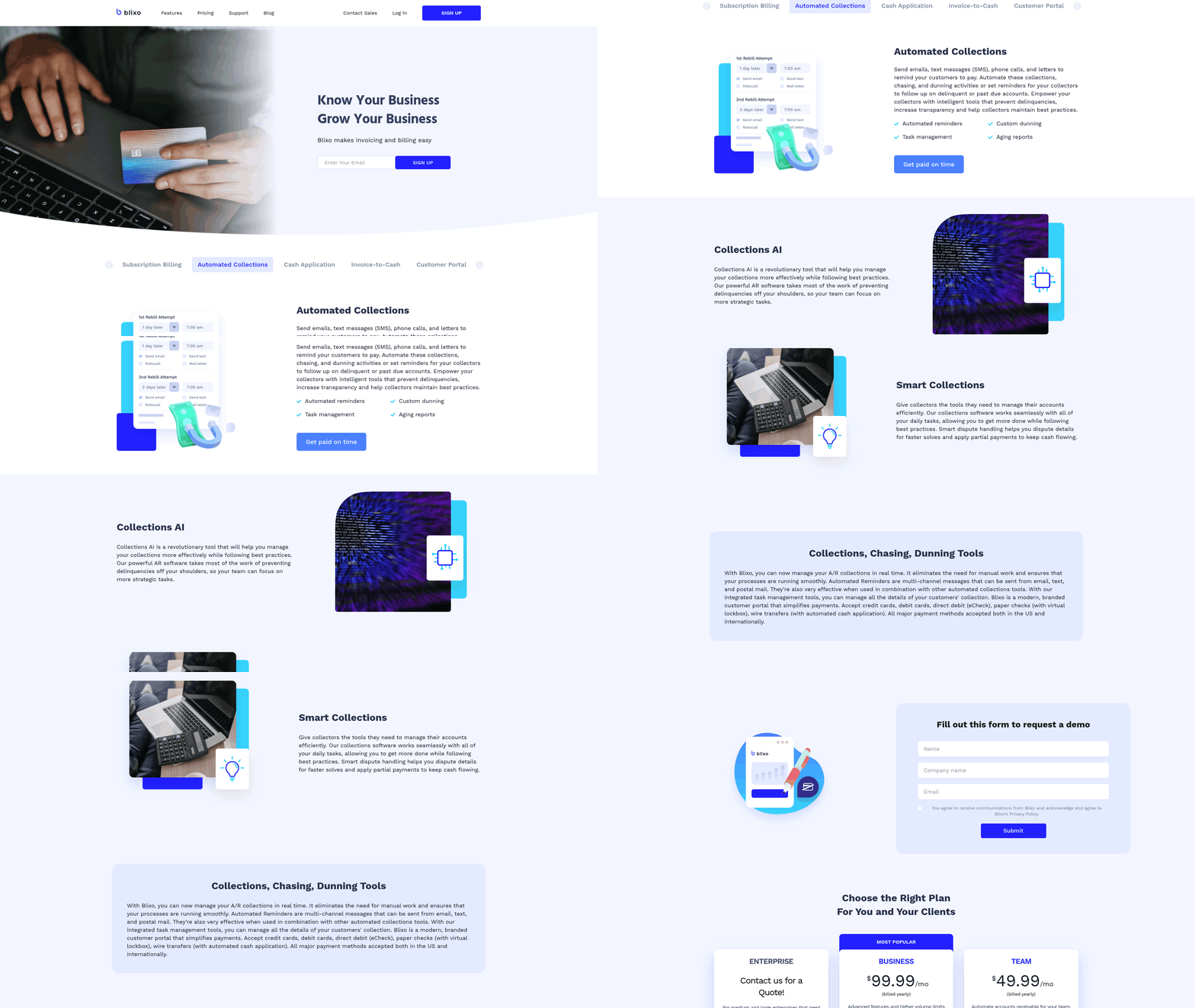
A subscription tracking software with dunning and collections automation can turn a missed charge into a quick win without alienating anyone. When a payment fails, Blixo coordinates background recovery with the customer-facing touchpoints, so you recover cash fast and the relationship stays intact.
Configuring Payment Retries in Blixo
Blixo lets you build retry schedules that follow issuer guidelines and respect your timing. You control how many attempts, how far apart, and what happens when retries run out.
- Retry schedule: Set how many times and how often the system attempts the charge after a failure.
- Maximum attempts: Cap the retries so you never loop endlessly, and auto-advance the account to the next phase when you hit the limit.
- Audit trail: Every attempt is logged, giving finance a clean record with no manual entry.
“Dunning is about politely reminding customers about overdue payments, focusing on retaining customers while recouping lost revenue.” – Stripe
Multi‑Channel Strategies for Revenue Recovery
Blixo’s collections feature reaches customers on the channels they actually respond to, without dropping the courteous tone.
- Email reminders: A sequence that opens friendly and gets more direct over time.
- SMS nudges: Short texts with a one-click payment link for fast action.
- Phone calls and letters: Optional voice or mail for accounts that warrant a personal touch.
Content and timing are yours to set on each channel, so the outreach reads as helpful, not pushy.
When to Use Segmentation for Collections
Once failed payments outgrow what a person can chase by hand, Blixo’s settings let you segment accounts on criteria you define, like invoice size or customer type. Send your higher-value accounts down a more intensive follow-up path and let automation handle the rest.
- Custom segmentation: Group accounts by plan tier or outstanding amount and apply different reminder schedules.
- Prioritized workflow: Route higher-risk or higher-value accounts to a hands-on escalation path while the engine handles the routine cases.
Configurable retries, multi-channel nudges, and optional segmentation together get you the balance you’re after: fast recovery, positive experience. That’s what lifts recovery rates while keeping the trust that funds long-term growth.
Integrating Dunning with Payment Gateways and Billing Systems
A subscription tracking software with dunning and collections automation only gets fast when it talks straight to the payment gateway and the billing ledger. In Blixo, a declined card triggers an automated retry, updates the account status, and fires a personalized reminder. No manual handoff anywhere in that loop.
The integration layer is the fulcrum of the whole speed-versus-experience trade-off. A clean API bridge removes the lag between a failed charge and the next smart retry, and it keeps every notification’s tone matched to the latest payment-method data. When gateway and billing stay in sync, you dodge the “payment-not-found” errors that frustrate users and push them out the door.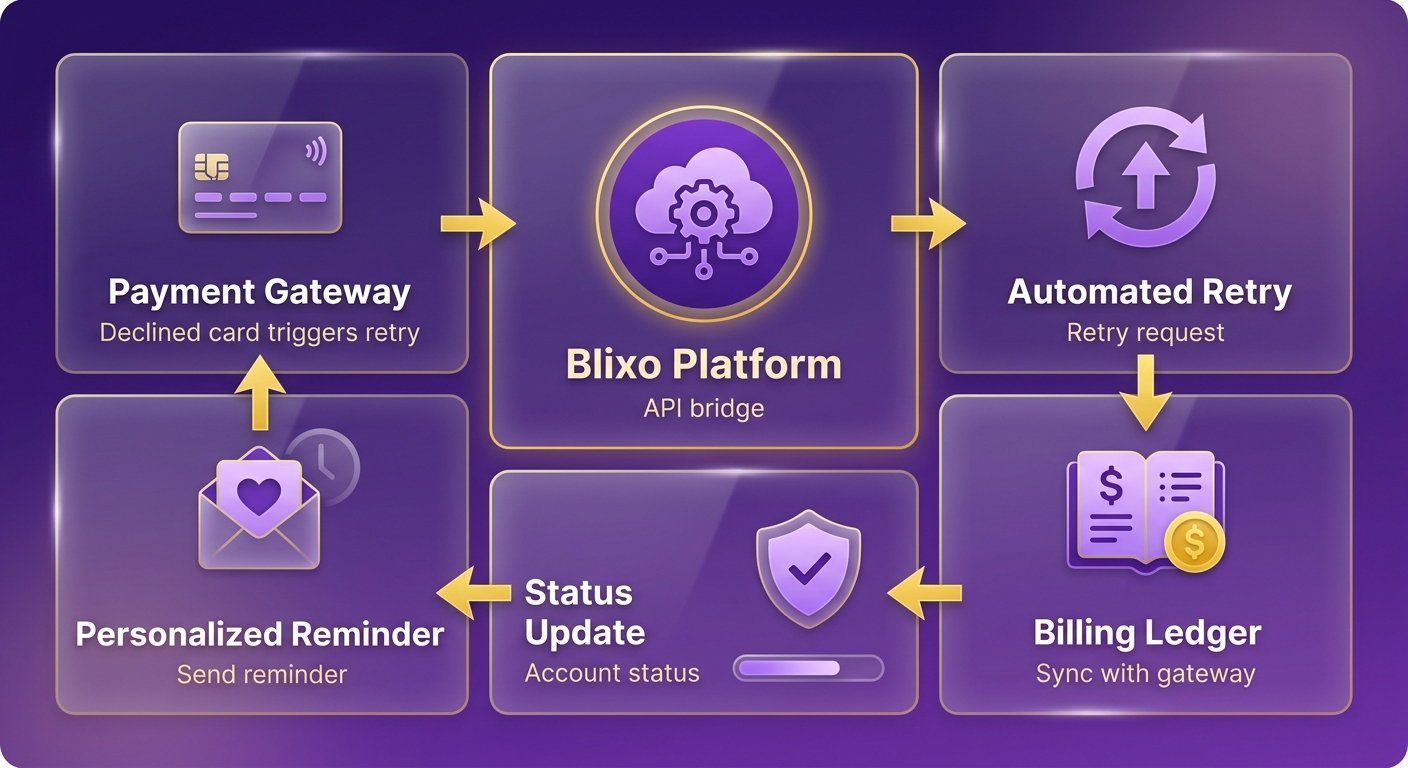
How Do We Connect Dunning Logic to Payment Gateways?
Through webhook listeners and idempotent retry endpoints. The gateway posts a payment_failed event to a secure URL; the dunning engine records it, runs the smart-retry schedule, and calls the gateway’s retry endpoint with the original transaction ID. Because the call is idempotent, repeat attempts never double-charge the card. Double-charging is the fastest way to lose the trust you’re trying to protect.
- Webhook security: verify signatures and enforce TLS so no one can spoof a failure.
- Retry payload: include
transaction_id,amount, and aretry_reasonflag so the gateway can apply issuer-specific rules. - Response handling: read success, temporary decline, or permanent failure codes to decide between a nudge and an escalation.
Keep the integration responsive and you fix cash-flow timing without burying the customer in redundant emails.
What Data Mapping Practices Keep the Customer Experience Intact?
We map three core objects between the billing system and the dunning workflow: customer profile, payment method, and invoice status. A stable customer_id is the primary key, and every gateway event carries it so the billing record updates instantly. When an Account Updater service flags an expired card, Blixo can refresh the stored payment token before the next retry, so the customer never feels the friction.
- Field alignment: standardize
last4,expiry_month, andexpiry_yearacross systems so nothing mismatches. - State machine: define clear states (
pending,retrying,awaiting_customer,canceled) with transition rules that trigger the right channel. - Audit trail: log every sync event with timestamps. That log becomes the source of truth for support and cuts manual investigation time.
When the data stays consistent, your messages can name the exact problem (“your card ending in 1234 expired”) and the tone reads helpful instead of accusatory.
Which Industries See the Biggest Gains from Tight Integration?
Late payments are everywhere. In the U.S., a large share of invoices land after the due date, and the U.K. shows the same pattern, with billions in unpaid debt behind it. Feed real-time decline signals into an automated dunning loop and the gains show up fast: a SaaS consultancy cut its days-sales-outstanding, and a digital media publisher recovered more revenue without any bump in churn.
“A seamless integration ensures that the billing system and the payment gateway act as a single source of truth, preventing embarrassing double-billing errors.”
Machine-learning risk scores sharpen the call on who gets a gentle reminder versus a direct phone call, letting high-value accounts stay in the smart-retry phase longer. Cash lands faster, often the same business day, and the customer still feels respected. Build those connections well and you scale without spending down customer goodwill.
Choosing the Right Dunning Automation Platform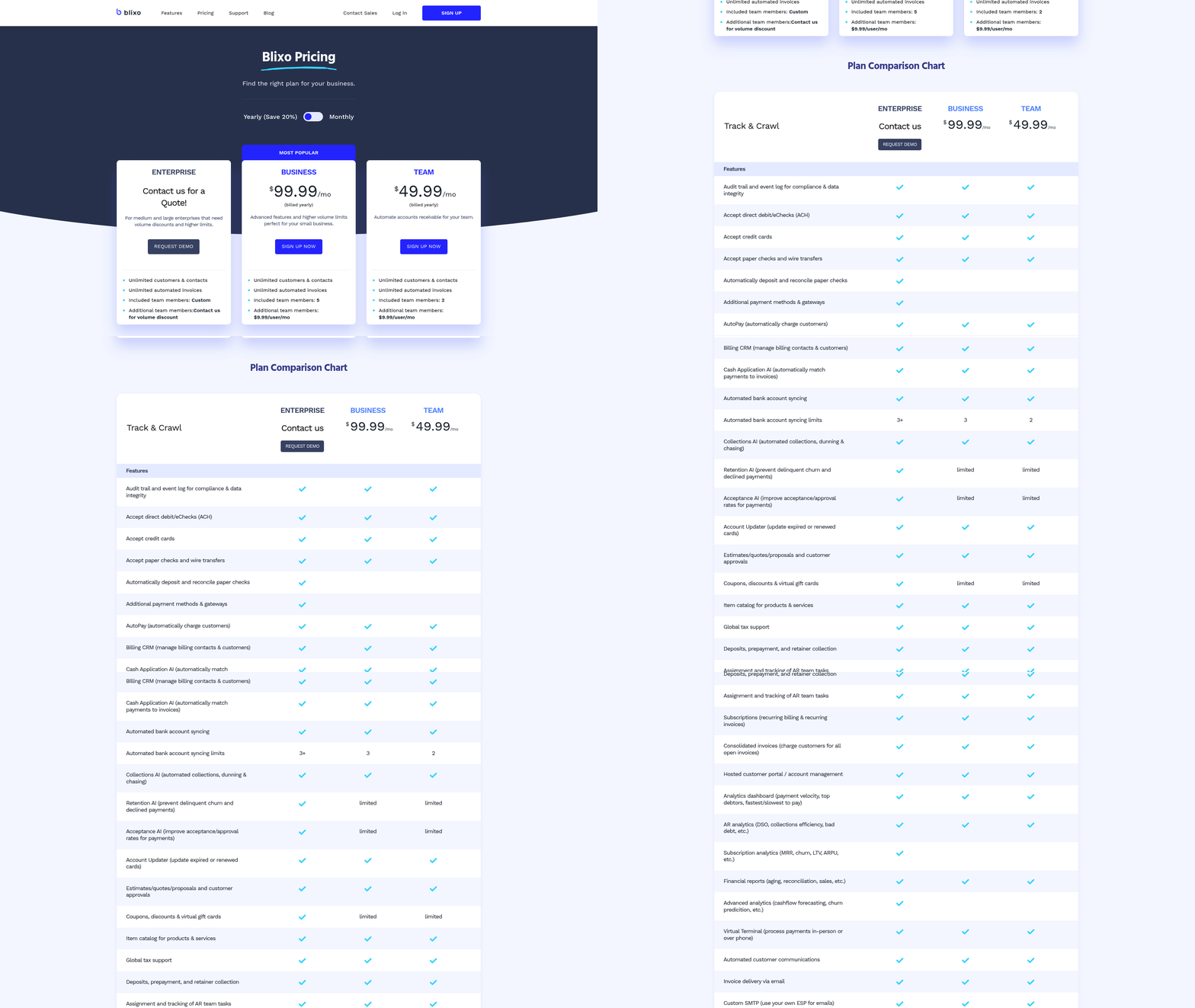
When you evaluate subscription tracking software with dunning and collections automation, the first question is whether it can turn a missed charge into cash in minutes and still sound friendly. Speed only pays when the messaging respects the customer’s context. Otherwise the speed advantage just becomes faster churn.
Think of the trade-off as a two-axis matrix, and plot your business on it to see where the current process leaks revenue. Recover fast but generate a wall of complaints, and you’re sitting in the high-speed, low-impact quadrant. The goal is both axes at once: outreach smart enough to keep goodwill while it accelerates collection.
What core features should we prioritize?
The capabilities that move you toward that quadrant:
- Pre-dunning management – step in before a subscription enters the formal dunning flow, cutting involuntary churn.
- Smart-retry logic – follow issuer-recommended intervals and skip the pointless retries that irritate customers.
- Multi-channel, behavior-driven notifications (email, SMS, in-app) – match tone to the customer’s recent activity.
- Real-time collector dashboard – surface overdue accounts instantly so agents step in only when automation stalls.
- Advanced segmentation – group accounts by risk or payment history so you can choose a gentle nudge versus a firmer reminder.
How do we evaluate pricing without sacrificing speed?
Treat pricing as cost-per-recovery, not a flat subscription fee. Take the average value of a recovered invoice and compare it to the platform’s per-transaction charge. If the platform costs $0.25 per recovered dollar and you recover $0.40 on average, the net gain covers the expense. Walk away from solutions charging high flat fees for low volume; the overhead eats the speed benefit.
Look for usage-based tiers that unlock the advanced features, like segmentation, only when your volume justifies them. That keeps you from paying for tools you don’t touch yet, while leaving room to scale automation as growth demands.
What implementation steps keep the balance intact?
- Sandbox trial – mirror one high-risk segment and measure days-to-cash against the customer-impact score, side by side.
- Pre-dunning alerts – set triggers (say, 48 hours before a card expires) to head off late payments.
- Smart-retry schedule – respect issuer rules so you don’t waste attempts.
- Multi-channel notification flow – start with a polite email, escalate to SMS only after two unanswered attempts.
- Collector dashboard integration – wire the dashboard to your CRM so any manual outreach inherits the automation’s context and the handoff stays clean.
For the first month, track recovery rates against benchmarks (roughly one in four is a common target). If you fall short, adjust the segmentation thresholds and cadence. That iterative loop lets you scale speed while you keep polishing the experience.
Align features, pricing, and rollout around the speed-experience matrix and dunning automation stops being a chore. It becomes a trust-building engine that funds sustainable growth.
Implementing Dunning and Collections Automation with Blixo
Blixo’s dunning and collections automation turns a missed charge into a cash-in event while keeping the communication clear and courteous. Automate the reminders and follow-ups, and you cut manual effort while raising the odds of getting paid on time.
What core features support fast and friendly collections?
- Automated reminders – Schedule email, SMS, phone, or letter reminders that fire automatically once a payment goes overdue.
- Custom dunning steps – Build a sequence that moves from friendly to firmer, in your brand’s voice.
- Task management & aging reports – See outstanding invoices in an aging dashboard and assign collection tasks so nothing slips.
These keep the approach professional and human while cash flow speeds up.
How to configure the dunning workflow in Blixo
- Set up a reminder schedule – Pick how many attempts and the intervals between them (2 days, 5 days, 10 days). Blixo sends the chosen channel at each step.
- Enable pre-dunning alerts – Optionally surface alerts in the collector dashboard before a full dunning cycle starts, so your team can reach out personally if they want to.
- Select communication channels and templates – Choose your channels (email, SMS, phone, letter) and write a template for each reminder stage. Blixo delivers the right one automatically as the workflow moves.
With those in place, the system handles the routine collections work and frees your team for the interactions that need a person.
Tailoring automation to your business needs
- Adjust reminder frequency – For high-value accounts, use fewer reminders on longer intervals; for riskier accounts, add extra steps.
- Customize message content – Bring your own wording, branding, and product details into each template so the tone matches the rest of the customer experience.
- Use task assignments – Route specific collection tasks to team members by invoice size or customer segment, so the right person handles each case.
Line the dunning workflow up with your own processes and Blixo collects efficiently while keeping the relationship intact.
Frequently Asked Questions
1. How can I determine whether AI‑driven dunning is worth the pilot investment for a business processing 120 invoices per month?
AI‑driven dunning becomes cost‑effective when the projected incremental recovery exceeds the pilot expense within three to six months. For 120 invoices monthly, a typical pilot costs $2,000 and can boost recovery by 10‑12 %, translating to $1,500‑$2,000 extra cash, reaching break‑even by month four.
2. What steps should I take if a payment gateway stops sending webhook events during the dunning cycle?
First verify that the webhook endpoint is reachable and the secret signature matches. If the gateway’s health page shows outages, enable a temporary polling loop that queries recent events via the API. Once events resume, replay any missed failures manually through the dunning console to keep the flow intact.
3. Can I mix rule‑based retries with AI risk scoring in the same workflow, and how does that affect maintenance effort?
Blixo’s hybrid flow merges deterministic rules with AI risk scores, letting low‑risk accounts follow a simple retry cadence while high‑risk ones receive probability‑based timing. Maintenance rises modestly to about three hours per month, because while the AI component adapts automatically, the underlying rule engine still benefits from periodic manual adjustments to align with changing business policies.
4. How does dunning automation handle customers with regulatory constraints, such as GDPR or PCI DSS requirements?
Compliance is built into the dunning pipeline by encrypting all payment tokens and never storing raw card numbers, satisfying PCI DSS. Personal data used for notifications is pseudonymized, and any EU‑resident information must be retained in a GDPR‑approved region. Audits should run quarterly to confirm adherence.
5. What are common misconceptions about pausing service access during dunning, and when is it advisable to avoid it?
Pausing service access is often assumed to pressure payment, but it can trigger churn for users who rely on continuous availability. It is advisable to keep the product active and only restrict premium features until the invoice clears, especially for SaaS products where downtime directly reduces perceived value.
6. How do I measure the “customer‑impact score” without a built‑in metric from the platform?
To approximate a customer‑impact score without native analytics, track the response rate to each reminder channel, correlate those rates with subsequent churn, and assign weighted points (e.g., email = 1, SMS = 2). Summing points per account yields a relative impact metric that can be benchmarked against industry averages.
7. If my subscription plans include multiple currencies, does the automation adjust retry timing based on local banking holidays?
Automation platforms that support multi‑currency can reference a calendar of banking holidays per locale and postpone retries until the next business day. If the system lacks this feature, you must import holiday tables manually and adjust the retry schedule via custom rules, ensuring that attempts are not blocked by regional closures.