

Cloud Based vs Manual Invoice Processing

Key Takeaways
- Manual invoice processing costs $18–$26 per invoice, while automation reduces costs to $2.50–$4, saving over 80% in expenses.
- Automated systems process invoices 80% faster than manual methods, minimizing late fees and operational delays.
- Cloud-based solutions eliminate 90% of manual data entry tasks, improving processing accuracy and efficiency.
- Switching to automation can save high-volume businesses over $500K annually in invoice processing costs.
Related Video
Watch: Resolve Invoice Disputes Fast: Flexible Invoice Control with Agentforce in Salesforce Revenue Cloud by PhiX Technologies
Why Invoice Processing Matters
Efficient invoice processing is a cornerstone of financial health for businesses of all sizes. Manual methods, which cost $18–$26 per invoice, are not only prohibitively expensive but also slow and error-prone, leading to late fees, strained vendor relationships, and operational inefficiencies. As detailed in the What Are the Financial Costs of Manual Invoice Processing? section, these costs escalate dramatically for companies handling high volumes of invoices annually. In contrast, automated systems reduce costs to $2.50–$4 per invoice, slashing expenses by over 80% in many cases. These savings, combined with faster processing times highlighted in the How Does Invoice Processing Time Affect Business Operations? section, and reduced fraud risks discussed in the Security and Compliance in Invoice Processing section, make automation a critical investment for modern finance teams.
Cloud-Based Invoice Processing Overview
Cloud-based invoice processing automates tasks like data entry, validation, and approval workflows using technologies such as optical character recognition (OCR) and artificial intelligence. This digital solution eliminates manual handling of paper invoices, reducing human errors and accelerating processing times. For example, systems like Yooz use OCR to extract invoice data and AI to match it with purchase orders, cutting processing times from 45 days to as little as 3.1 days. By centralizing invoice management in the cloud, businesses gain real-time visibility into financial transactions while reducing costs tied to physical storage and labor.
How Cloud-Based Invoice Processing Differs from Manual Systems
Manual invoice processing relies on paper-based workflows, requiring staff to input data, verify details, and track approvals manually. This method is prone to delays, with 27% of organizations still using exclusive manual entry. As mentioned in the Manual Invoice Processing Overview section, these processes are costly and error-prone, with error rates exceeding 60%. In contrast, cloud-based systems automate these steps, using machine learning to validate invoices against contracts and detect duplicates. IBM’s research shows automated systems reduce invoice cycle times to about three days, compared to 17 days for less mature processes.
Key Features of Cloud-Based Solutions
Cloud-based systems offer features that streamline accounts payable (AP) operations. OCR technology, used by platforms like Medius and Yooz, converts scanned invoices into structured data, reducing manual entry errors. Automation tools also perform three-way matching of purchase orders, receipts, and invoices, ensuring accuracy. Integration with ERP systems is another critical feature-IBM and Medius highlight seamless ERP connections to maintain financial data consistency, a benefit further explored in the Benefits of Cloud-Based Invoice Processing section. Cloud platforms also provide remote access, enabling teams to review and approve invoices from anywhere, a benefit emphasized in WAWF’s government contracting workflows.
Real-World Impact: Case Studies and Testimonials
Businesses adopting cloud-based solutions report measurable improvements. Bridgevine implemented Yooz to automate AP processes, reducing manual tasks and allowing staff to focus on strategic work. Wolf Construction transitioned from paper-based workflows to Stampli, eliminating lost invoices and optimizing cash flow. Similarly, Huuskes saw fewer errors after adopting Medius AP Automation. Government contractors using WAWF reported a 30% reduction in processing time, complying with DoD mandates for electronic invoicing. These outcomes align with findings from the Hybrid Approach to Invoice Processing section, which discusses balancing automation with compliance needs in structured environments.
Choosing the Right Cloud-Based Solution
When evaluating cloud-based invoice software, consider features like AI integration, ERP compatibility, and scalability. Yooz and IBM focus on OCR and machine learning, while Medius emphasizes three-way matching. Platforms like Stampli offer AI assistants (e.g., Billy the Bot) to streamline approvals. For industries with strict compliance needs, such as healthcare or government, systems with audit-ready workflows are essential. Cost savings and efficiency gains vary by use case. A 2025 study found top-performing automated AP teams process invoices at $3.05 each, compared to $20.11 manually, a contrast highlighted in the Why Invoice Processing Matters section. These savings compound over time, making cloud-based solutions ideal for businesses processing 200–500 invoices monthly.
Manual Invoice Processing Overview
Manual invoice processing involves handling invoices through physical documents or digital files without automation, relying heavily on human effort for data entry, verification, and payment. This method is labor-intensive, error-prone, and often slow, with processing times stretching from days to weeks. While some businesses still use it due to outdated workflows or small-scale operations, the drawbacks-like high costs and compliance risks, as detailed in the Security and Compliance in Invoice Processing section, make it increasingly obsolete in modern finance.
What Are the Key Features of Manual Invoice Processing?
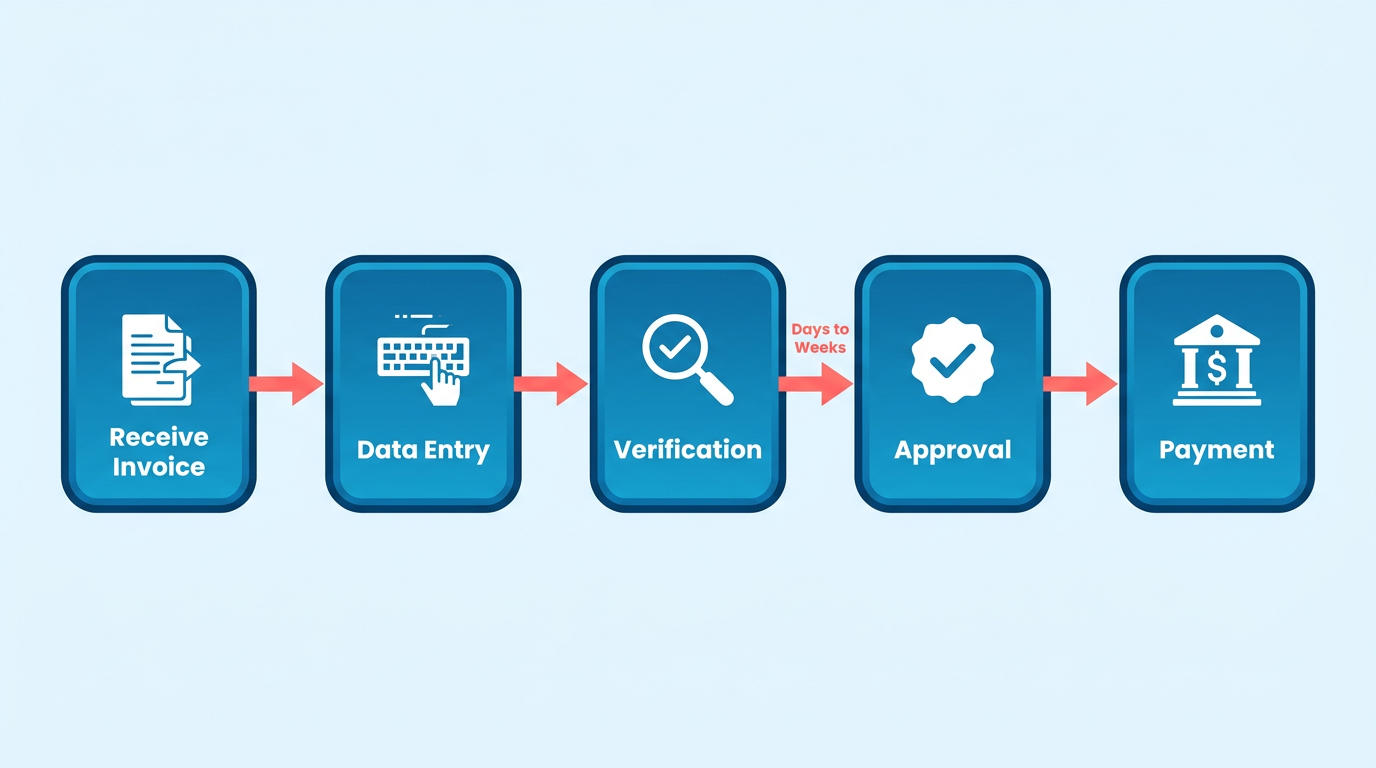
Manual invoice processing is defined by its reliance on paper-based workflows, manual data entry, and human validation. Invoices are typically received via email, mail, or fax, then printed or scanned for handling. Employees input data into accounting systems, cross-check details against purchase orders, and approve payments manually. This process lacks integration with digital tools, making it inflexible and slow. For example, Wolf Construction struggled with paper-based workflows until adopting automation, which eliminated lost invoices and improved cash flow visibility.
A critical weakness is the high error rate. Human data entry mistakes, such as incorrect numbers or missed deadlines, can lead to late fees or disputes. As mentioned in the Challenges and Risks of Manual Invoice Processing section, these errors lead to late fees and disputes. Sources like IBM and Yooz note that 60% of manual entries contain errors, compared to 1-2% in automated systems. These errors compound over time, creating bottlenecks in accounts payable (AP) departments.
Why Is Manual Invoice Processing Problematic?
The drawbacks of manual methods are significant. First, costs are sky-high. The average manual invoice costs $7.75 to $15+ to process, depending on complexity, while automated systems reduce this to $2.02–$4. Building on concepts from the Benefits of Cloud-Based Invoice Processing section, businesses can achieve significant cost savings by automating invoice processing. For a company handling 10,000 invoices annually, this difference translates to $50,000+ in savings. Second, processing times are painfully slow. IBM reports that manual workflows take 17 days on average, versus 3 days for automated systems. Delays strain vendor relationships and disrupt cash flow.
Another issue is scalability. Manual processes struggle to keep up with growing invoice volumes. Artsyl highlights that only 30% of invoices are fully automated in 2025, leaving many businesses stuck in inefficient cycles. For instance, a mid-sized company processing 25,000 invoices manually could spend $500,000+ annually on labor alone. This cost balloons further when factoring in late fees, reconciliation errors, and cybersecurity risks.
Real-World Challenges and Data
Companies clinging to manual systems face tangible consequences. A 2025 study found that 27% of organizations still rely entirely on manual data entry, lacking even basic automation. These firms often report $18–$26 per invoice in costs-over five times automated systems. For example, a retail chain with 10,000 monthly invoices spends $200,000+ per year** manually, versus **$40,000 if automated.
The healthcare sector illustrates these challenges. Manual workflows there increase compliance risks due to complex billing codes and audit requirements. Automated systems, by contrast, use AI to flag discrepancies, reducing fraud risks by 80%. Similarly, construction firms like Wolf Construction saw a 50% reduction in processing time after switching from paper-based systems to digital platforms.
| Feature | Manual Processing | Automated Processing |
|---|---|---|
| Average Cost/Invoice | $7.75–$15+ | $2.02–$4 |
| Processing Time | 10–45 days | 1–3 days |
| Error Rate | 60%+ | 1–2% |
| Scalability | Limited | High |
| Fraud Risk | High | Low (AI detects anomalies) |
The shift from manual to automated systems isn’t just about efficiency-it’s a strategic necessity. Businesses that delay automation risk falling behind competitors using cloud-based solutions for real-time insights and cost control. For companies ready to transition, the ROI is clear: faster payments, fewer errors, and staff reallocated to higher-value tasks.
Benefits of Cloud-Based Invoice Processing
Cloud-based invoice processing transforms how businesses manage accounts payable, offering clear advantages over manual methods. By automating repetitive tasks, reducing errors, and accelerating payment cycles, it becomes a cornerstone for financial efficiency. Below, we break down the key benefits, supported by real-world data and case studies.
How Much Can Cloud-Based Processing Save?
Cloud-based systems slash costs by automating labor-intensive steps. Manual invoice processing averages $7.75–$30 per invoice, depending on complexity, while automation drops this to $2.02–$5 per invoice. Labor savings from automation often exceed 70–80%, with scalable cloud solutions maintaining consistent per-invoice costs even as volumes grow. For instance, a logistics firm maintaining 50,000 annual invoices saw stable processing expenses at $2.15 per invoice after scaling operations by 40%.
| Cost Factor | Manual Processing | Automated Processing |
|---|---|---|
| Cost per invoice | $7.75–$30 | $2.02–$5 |
| Processing time | 10–45 days | 1–3 days |
| Labor cost reduction | 70–80% | . |
These savings stem from reduced labor needs and fewer errors. Bridgevine reduced processing time from weeks to hours using Yooz, allowing staff to focus on strategic tasks instead of manual data entry. As mentioned in the Manual Invoice Processing Overview section, these cost differences highlight the inefficiencies inherent in traditional methods.
Why Accuracy Matters in Invoice Processing
Human errors in manual systems-like mismatched purchase orders or incorrect amounts-cost businesses 1–2% of all invoices processed. Building on concepts from the Challenges and Risks of Manual Invoice Processing section, cloud-based solutions use OCR and AI to extract data with 95–99% accuracy, minimizing rework and fraud risks.
For example, Precoro’s AI systems flag discrepancies in real time, catching 95% of errors before invoices reach approvers. This level of precision is critical in industries like healthcare, where a single mistake could trigger compliance penalties. A healthcare provider automating its workflows saw a 90% drop in audit discrepancies.
Faster Payments and Better Cash Flow Control
Cloud platforms streamline payment recovery through automated reminders and real-time tracking. IBM’s 2024 study found that automated systems cut invoice processing time from 17 days to 3 days, ensuring vendors are paid on time and avoiding late fees.
| Metric | Manual Systems | Automated Systems |
|---|---|---|
| Average processing time | 17 days | 3 days |
| Late payment rate | 20–30% | <5% |
| Cash flow visibility | Limited | Real-time dashboards |
A construction company using Stampli eliminated $50K in annual late fees by automating approvals. Real-time dashboards let finance teams track pending invoices and allocate funds proactively, reducing cash flow gaps.
Security and Compliance in the Cloud
Manual invoice processing is vulnerable to data breaches and compliance gaps. Paper invoices stored locally risk loss or theft, while cloud systems use encryption and access controls to secure data. As detailed in the Security and Compliance in Invoice Processing section, cybersecurity incidents cost firms an average of $4.6M in 2025, underscoring the need for strong protections.
Medius AP Automation, for instance, embeds fraud detection tools that flag suspicious invoices. A manufacturing firm avoided a $100K tax penalty by adopting AI-driven compliance checks. Cloud storage also ensures audit trails are tamper-proof, meeting regulations like GDPR or SOX.
Real-World Impact: Case Studies
- Bridgevine: Automated AP workflows with Yooz reduced processing costs by 80% and freed staff for higher-value work.
- Wolf Construction: Switching to Stampli eliminated paper-based delays, improving cash flow visibility by 70%.
- Healthcare Provider: AI-powered invoice matching cut audit errors by 90%, ensuring compliance with strict industry standards.
These examples highlight how cloud-based systems address pain points like labor costs, delays, and errors, offering measurable ROI. As businesses scale, automation’s scalability becomes a key differentiator-processing 10,000 invoices monthly at $2.02 each costs **$20,200**, versus $77,500 for manual methods. By integrating cloud-based invoice processing, companies gain a competitive edge through cost efficiency, accuracy, and agility. The technology not only addresses immediate financial needs but also future-proofs operations against rising compliance and cybersecurity demands.
Challenges and Risks of Manual Invoice Processing
What Are the Error Risks in Manual Invoice Processing?
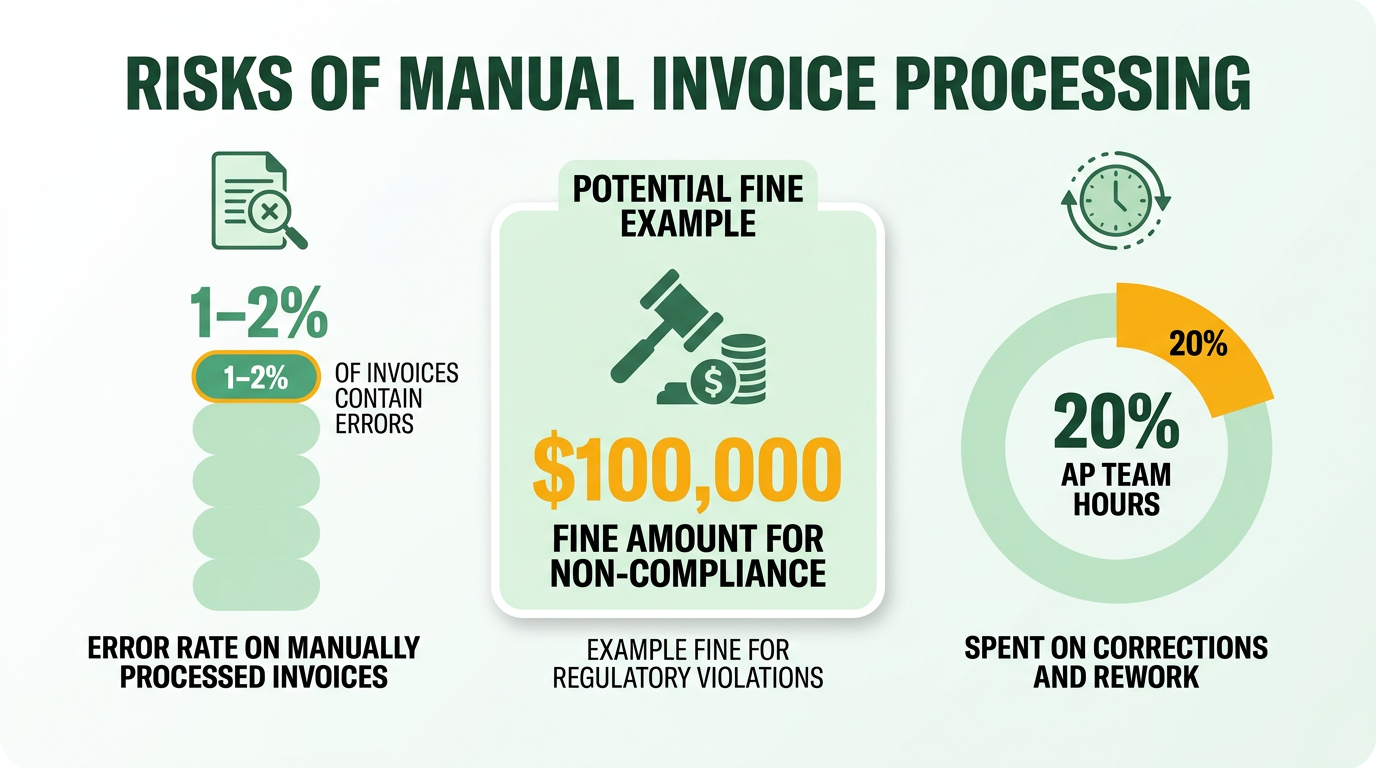
Manual data entry is inherently prone to human mistakes. Studies show that 1-2% of manually processed invoices contain discrepancies, requiring additional time and resources for corrections. For example, a manufacturing firm cited in source 7 incurred a $100,000 fine** due to tax regulation errors linked to manual processing. Correcting these discrepancies accounts for 20% of accounts payable (AP) team hours, diverting resources from strategic financial planning. As mentioned in the **Why Invoice Processing Matters** section, manual methods cost **$18–$26 per invoice, highlighting the inefficiency compared to automated alternatives.
How Do Manual Processes Cause Delays and Lost Payments?
Manual workflows involve multiple steps-physical receipt, data entry, approvals, and mailing-which slow down payment cycles. Manual workflows require 5–7 distinct steps, increasing the chance of bottlenecks during interdepartmental handoffs. For instance, one organization reported processing invoices in 45 days manually, tying up cash flow and straining vendor relationships. A government contractor in source 13 reduced processing time by 30% after switching to cloud-based systems, as discussed in the Cloud-Based Invoice Processing Overview section.
What Security and Compliance Risks Exist with Manual Systems?
Paper-based storage and manual handling expose sensitive financial data to breaches. Cybersecurity incidents in manual accounts payable (AP) teams average $4.6 million in costs per incident, according to source 5. As addressed in the Security and Compliance in Invoice Processing section, cloud-based systems mitigate these risks through encrypted storage and automated audit trails.
Cost Comparison: Manual vs. Automated Invoice Processing
| Feature | Manual Processing | Automated Processing |
|---|---|---|
| Cost per invoice | $7.75–$15 | $2.02–$5 |
| Processing time | 17–45 days | 3.1–7 days |
| Error rate | 1–2% | 0.1–0.5% |
| Annual savings (example) | $1.6M over 3 years* | N/A |
*Example: A mid-sized company processing 25,000 invoices annually saves $1.6 million by automating, as noted in source 5.
Real-World Impact of Manual Processing
A case study from source 3 highlights Wolf Construction’s struggle with paper-based workflows. Before automation, the company faced lost invoices and delayed approvals, which disrupted cash flow. After adopting a digital solution, they centralized invoice tracking and reduced processing time by 60%.
Why Automation Is Critical
Manual invoice processing is not just inefficient-it’s a financial liability. The cumulative cost of errors, delays, and compliance risks far exceeds the upfront investment in automation. As detailed in the Benefits of Cloud-Based Invoice Processing section, automation reduces human error and accelerates payment cycles, making it a strategic move for financial stability.
Hybrid Approach to Invoice Processing
A hybrid approach to invoice processing blends manual oversight with cloud-based automation to balance efficiency and control. This model uses automated systems for high-volume, standardized invoices while reserving manual intervention for exceptions like complex vendor workflows or non-standard documents. For example, cloud tools with OCR and AI handle 90% of invoices, reducing processing time from 45 days to 3.1 days, while finance teams manually review the remaining 10% to ensure accuracy. As mentioned in the Cloud-Based Invoice Processing Overview section, technologies like OCR and AI drive much of this automation, which complements manual checks for precision.
What Are the Key Benefits of a Hybrid Approach?
The hybrid model offers flexibility by adapting to diverse invoice formats and supplier requirements. Companies can scale their processes without overhauling systems-automated tools handle bulk processing, while manual checks address outliers. For instance, a mid-sized retail chain processing 5,000 invoices monthly reduced late payment penalties from $50,000 annually by automating 80% of workflows while manually resolving 20% of discrepancies. **Cost savings** are another advantage: businesses report an 80% reduction in per-invoice costs compared to fully manual methods, which range from $10 to $30 per invoice, as outlined in the Manual Invoice Processing Overview section. Additionally, the hybrid approach minimizes errors, with automation capturing 99% of data correctly and humans auditing the rest, cutting error rates from 1-2% to near zero.
What Challenges Do Hybrid Systems Face?
Integration complexity is a major hurdle. Combining cloud tools with legacy systems or manual workflows often requires custom APIs or middleware, which can delay implementation. A manufacturing firm incurred a $100,000 tax fine due to incompatible software that failed to flag compliance issues during manual reviews, highlighting risks discussed in the Security and Compliance in Invoice Processing section. Security risks also rise when sensitive data flows between automated platforms and human teams. For example, a hybrid setup might require secure file-sharing protocols to protect invoices handled manually, adding administrative overhead. Finally, training costs increase as employees must master both automation tools and traditional processes, creating a steeper learning curve than fully automated or manual systems.
Hybrid Approach vs. Full Automation: A Comparison
| Feature | Hybrid Approach | Full Automation | Manual Processing |
|---|---|---|---|
| Processing Time | 3.1–45 days (varies) | 3.1 days average | 45 days average |
| Cost per Invoice | $2–$5 (hybrid) | $1–$2 (automated) | $10–$30 (manual) |
| Error Rate | 0.1–0.5% (post-verification) | 0.1% (AI-driven) | 1–2% (unverified) |
| Scalability | High (adaptable) | High (consistent) | Low (labor-intensive) |
Hybrid systems excel in balancing scalability and adaptability, making them ideal for businesses with evolving needs. Building on concepts from the Benefits of Cloud-Based Invoice Processing section, the cost per invoice in hybrid models reflects the efficiency gains of automation while retaining manual oversight for complex cases. While full automation offers the lowest error rates, it struggles with non-standardized invoices. Conversely, manual processing remains costly and slow. The hybrid model bridges these gaps, offering a middle ground for companies transitioning to full automation or dealing with niche workflows.
Security and Compliance in Invoice Processing
Security and compliance in invoice processing determine how well an organization protects sensitive financial data and adheres to legal standards. Cloud-based systems and manual processes differ significantly in their approaches to data security, access management, and regulatory alignment. Understanding these differences helps businesses choose the right method for their needs.
How Does Data Encryption Differ Between Cloud and Manual Invoice Processing?
Data encryption protects invoice details from unauthorized access. Cloud-based platforms typically use AES-256 encryption for data at rest and TLS 1.2+ for data in transit, ensuring files are secure both stored and during transfer. As mentioned in the Cloud-Based Invoice Processing Overview section, these platforms use advanced technologies like optical character recognition (OCR) and artificial intelligence to enhance security measures. Manual methods rely on physical security measures, like locked filing cabinets, but lack digital encryption for paper or electronic documents. Without encryption, manual systems risk data exposure during storage or transmission.
For example, a cloud provider might store invoices in encrypted cloud storage and require multi-factor authentication (MFA) for access. Manual systems, however, might share invoices via unsecured email or USB drives, exposing them to interception.
| Feature | Cloud-Based Processing | Manual Processing |
|---|---|---|
| Data at Rest Encryption | AES-256 or similar | Physical locks; no digital encryption |
| Data in Transit | TLS/SSL protocols | Unsecured methods (email, USB) |
| Audit Trail | Automated logs | Manual tracking; prone to errors |
Cloud-based encryption aligns with standards like ISO 27001, while manual methods often fail to meet these benchmarks.
What Access Controls Matter in Invoice Processing?
Access controls prevent unauthorized users from viewing or altering invoice data. Cloud platforms implement role-based access control (RBAC), allowing administrators to define permissions for each user. Building on concepts from the Cloud-Based Invoice Processing Overview section, features like multi-factor authentication (MFA) and single sign-on (SSO) are integral to their automated workflows. For instance, an accounts payable clerk might only view invoices, while a manager can approve them.
Manual systems rely on physical document control, such as restricted office access or password-protected files. However, these methods lack granular permissions and audit trails. If an employee mishandles paper invoices or shares digital files without tracking, the risk of fraud or errors increases.
A cloud solution might log every action-like who viewed or edited an invoice-creating a transparent audit path. Manual processes require manual record-keeping, which is time-consuming and error-prone.
Which Regulations Impact Invoice Processing?
Global regulations like GDPR and HIPAA impose strict rules on handling financial data. GDPR requires businesses to map data flows, obtain consent, and report breaches within 72 hours. For example, processing EU supplier invoices without proper encryption could trigger fines up to 4% of annual global revenue. HIPAA applies to healthcare-related invoices, mandating secure storage and transmission to avoid penalties of $50,000 per violation.
Cloud providers often offer built-in compliance tools, such as data mapping and audit-ready dashboards. Manual systems struggle with these requirements, as they lack automated tracking and may not enforce data retention policies. As discussed in the Challenges and Risks of Manual Invoice Processing section, even small errors can lead to significant compliance issues and financial penalties.
Consider a scenario where a manual system stores invoices on a local server without encryption. If a breach occurs, the company could face fines and reputational damage. Cloud platforms, by contrast, reduce this risk through continuous compliance monitoring.
What Are the Costs of Security Breaches and Non-Compliance?
Security breaches in invoice processing can be costly. The IBM Cost of a Data Breach Report 2023 found the average breach cost $4.45 million, including legal fees, customer loss, and remediation. Non-compliance with regulations like GDPR or HIPAA adds fines on top of these expenses.
For example, in 2022, a UK company was fined £1.7 million for mishandling supplier invoices due to inadequate encryption. Manual processes are particularly vulnerable here, as human error-like sending an invoice to the wrong recipient-can trigger breaches.
Cloud-based systems lower these risks by automating compliance checks and encryption. However, they are not immune: misconfigured cloud storage or weak access controls can still lead to leaks. Businesses must balance automation with regular audits.
How Do Real-World Breaches Highlight Risks?
A 2021 incident involved a retail firm that processed invoices manually. An employee accidentally emailed an invoice containing customer data to a personal account. The breach violated GDPR, resulting in a €1.2 million fine and a loss of client trust.
In contrast, a cloud-based finance team at a healthcare provider used HIPAA-compliant software with automatic encryption and access logs. When a phishing attempt compromised an employee’s credentials, the system’s MFA and real-time alerts prevented unauthorized access to invoices.
These examples underscore the importance of aligning invoice processing methods with security and compliance priorities. Cloud-based solutions offer strong tools to mitigate risks, while manual systems demand rigorous procedural discipline.
For small businesses considering a shift to digital invoice management, Why Small Businesses Should Switch to Cloud Accounting Software provides insights into balancing cost and compliance.
Frequently Asked Questions
1. What are the cost differences between manual and automated invoice processing?
Manual invoice processing costs $18–$26 per invoice, while automation reduces costs to $2.50–$4, saving over 80% in expenses. High-volume businesses can save over $500K annually through automation.
2. How much faster is cloud-based invoice processing compared to manual methods?
Automated systems process invoices 80% faster than manual methods, reducing delays and late fees. For example, systems like Yooz cut processing times from 45 days to as little as 3.1 days.
3. What are the accuracy benefits of cloud-based invoice processing?
Cloud solutions eliminate 90% of manual data entry tasks using OCR and AI, significantly improving accuracy. This reduces errors in validation and matching invoices to purchase orders.
4. How do cloud-based systems enhance security in invoice processing?
Cloud platforms reduce fraud risks by minimizing manual handling and ensuring compliance through audit trails. Automated validation also flags discrepancies, improving financial control and transparency.
5. What are the long-term financial benefits of automating invoice processing?
Automation saves high-volume businesses over $500K annually by cutting costs to $2.50–$4 per invoice. Faster processing also avoids late fees and improves cash flow efficiency.
6. Can cloud-based systems integrate with existing financial software?
Yes, cloud solutions like Blixo offer seamless integration with platforms like Salesforce, enabling centralized invoice management and real-time visibility into financial operations.
7. What technologies do cloud-based invoice systems use?
Cloud systems use OCR for data extraction and AI for invoice validation, automating tasks like matching invoices to purchase orders and speeding up processing to 3.1 days in some cases.