

Cloud Accounting Handles Monthly Billing Fine Until Dunning Starts

Key Takeaways
- Cloud accounting generates recurring invoices and assumes payment arrives. It has no built-in way to chase a missed payment.
- Failed payments drive 20% to 40% of total churn in subscription businesses — a major revenue leak that most teams underweight.
- Subscription companies lose an average of 9% of monthly recurring revenue to payment failures the ledger quietly counts as receivable.
- There’s a narrow window between “payment expected” and formal collections. Working it protects cash flow without souring the relationship.
- Pre-dunning reconciliation checks payment-method validity and cash application against upcoming charges before billing runs, so failures surface as a recovery loop instead of bad debt.
- Card-expiration alerts and reminders sent before a charge stop failures that a forward-looking ledger only catches after the money never lands.
- A fine window costs less, resolves faster, and feels softer to customers than adversarial dunning.
Why your ledger stops helping the moment a payment fails
Your cloud accounting system handles recurring invoices well until a payment fails. The transaction gets generated on schedule, posted to the ledger, and marked as receivable. The system assumes the money arrives. The gap opens the moment it doesn’t, because that same system was built to look forward, not to chase backward.
That design leaves an operational hole. Slot in a short transitional phase before formal collections, and you can work payment issues collaboratively. Cash flow stays protected, and goodwill stays intact.
Why recurring invoices break right at the dunning handoff
Pre-dunning reconciliation works like a preventative audit. Verify account details and pending settlements before the billing cycle, and finance teams catch declines before they post as outstanding debt.
Standard cloud accounting runs a linear path: generate the invoice, expect the settlement. Dunning is the opposite — a reactive workflow that only fires after a payment fails. To bridge the two, proactive outreach can prompt customers to fix stale billing profiles, while automated matching verifies actual bank settlements against open invoices.
The stakes are real. Unresolved declines are a major source of attrition and lost recurring revenue. Catch them early, and you salvage accounts that would otherwise get written off as bad debt.
What a fine window actually saves you
A transitional grace period is cheaper and more diplomatic than jumping straight to collections. A modest, clearly communicated late fee nudges a customer to update their payment details. Immediate dunning feels punitive and dents trust.
The cost math is stark:
| Fine amount | Grace period | Automation trigger | Notification channel | Escalation to dunning |
|---|---|---|---|---|
| 1.5% of balance | 3 days | Payment failure flag | Email + in-app | Day 8 if unpaid |
| Flat $25 | 5 days | Invoice past due | Email + SMS | Day 10 if unpaid |
| 2% of balance | 7 days | Cash application mismatch | Day 14 if unpaid | |
| $0 (waived) | 5 days | Card expiry detected | In-app | Retry, no fine |
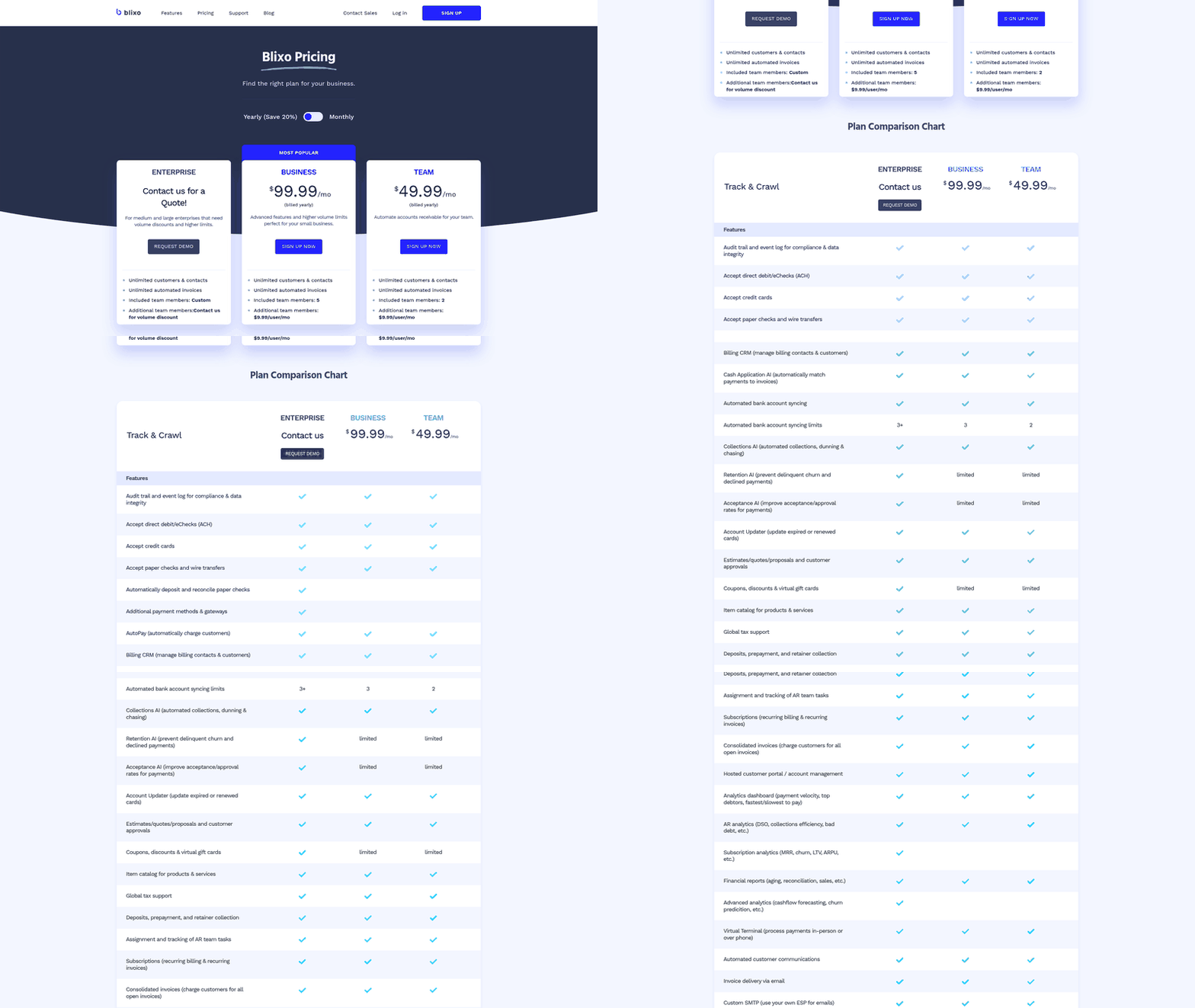
Automated fine handling typically runs under $30 per invoice. Manual collections eat administrative hours and strain client relationships. Automation lets a finance team keep up as volume grows. Blixo’s platform, for one, secures outstanding balances by auto-updating card details, managing retries, and clearing soft declines before they hit the bottom line.
Who should actually build this in
Build a fine window if you run subscription SaaS, professional services, or B2B e-commerce with recurring billing. Predictable renewal cycles make pre-dunning reconciliation both possible and worth automating.
Skip a formal fine window if you invoice one-off projects with long, negotiated terms. A penalty there just poisons the relationship, and the recovery upside is thin. The value comes from repeated billing, where a missed charge usually signals a fixable problem — an expired card, not an unwilling payer.
Late payment is the norm, not the exception. Roughly 42.5% of US invoices get paid after the due date. A fine window catches a meaningful share of those before dunning, and pairing it with automated cash application that flags failures early is how the silent leak turns into a recovery loop you can actually measure.
Automating fine notifications so nobody drafts an email

A fine notification workflow is an automated sequence: warn the customer about an upcoming late fee, deliver the fine invoice, and offer a self-service payment link. It runs entirely off trigger events. Nobody on your team drafts an email or flags an account by hand.
The common mistake is starting the workflow only after a charge has officially failed. Accounting platforms report failed charges on a delay, so waiting on those alerts leaves a gap. Move the first outreach earlier. Flag potential issues before the scheduled billing run, and prompt the card update in advance.
This isn’t a small edge. Expired or declined cards account for a large share of involuntary churn, with card-related failure rates landing at roughly 5 to 10% of recurring charges. A well-timed sequence recovers a chunk of that before it ever becomes bad debt.
Setting the trigger events
Triggers are the spine of the workflow. Fire them off invoice status changes: overdue by 1 day, 3 days, 5 days, and so on. Use native billing triggers or webhooks that push the event to your messaging layer the moment the ledger updates.
Better still, schedule pre-billing checks. An automated reminder shortly before the charge date lets customers fix a payment problem on their own, which shifts the whole operation from reactive recovery to prevention.
Then layer in escalation. If the fine goes unpaid after 48 hours, fire a second reminder with firmer language. Channel mix matters here: Blixo can send email, SMS, phone calls, and letters, and setups that reach across channels recover more than email-only ones.
What goes in the message template
Templates carry the tone and the legal weight. Pull dynamic fields straight from the invoice record: invoice number, fine amount, original due date, payment link. Keep the first message warm and the escalation direct.
Tone is not cosmetic. Nobody wants to hear their card failed and that they’re delinquent on something. The smartest dunning reads like customer success with billing infrastructure underneath. Your fine template should read like a nudge, not a threat.
On the amount itself: a flat fee is simplest, but a percentage of the invoice total scales with the risk. Common ranges land at 2 to 5% of the invoice. Set a grace period of 3 to 7 days before the fine attaches, then A/B test subject lines and CTA buttons to find what actually lifts payment rates.
Why static fine rules underperform
Fixed aging buckets treat every late customer the same. They aren’t the same. Blixo’s tools help collectors prevent delinquencies, and its custom dunning lets you tailor sequences instead of blasting the same reminder at everyone.
The lesson: eligibility rules should account for customer risk, not just days overdue. Segment by invoice type, contract tier, and usage-based versus fixed-price billing. A reliable annual-contract client and a flaky month-to-month usage account deserve different sequences.
Track four KPIs on every send: open rate, click-through, payment conversion, and total fine recovery. Automating your collections and dunning frees up the time you’d spend chasing. Route that saved time back into tuning the sequence so recovery stays consistent and targeted.
Wiring fine management into payment gateways and ERP

The integration work lives at three connection points: the payment gateway that processes the charge, the cash application engine that matches money to invoices, and the ERP ledger that records it. Each layer runs on its own clock. A recovery payment has to travel across all three without losing its link to the original charge.
That link is the whole ballgame for pre-dunning reconciliation. When you catch a failure before dunning fires, the follow-up invoice needs a hard tie back to the transaction that failed. Lose the tie and reconciliation breaks. Blixo’s matching engine ties payments and balances to invoices at the envelope and item level from multiple sources, so the recovery loop stays traceable from soft decline to settled balance.
How the gateway-to-ledger flow actually works
The recovery flow: create the invoice, match the incoming payment to the original balance, capture the payment through the gateway, then post the reconciled result to your ERP ledger.
Blixo integrates with QuickBooks, Xero, Sage Intacct, and NetSuite, plus custom ERP hooks for Oracle, SAP, and Microsoft Dynamics. The gateway processes the charge and returns a response code in real time. That response is the trigger. On success, the ledger updates in your ERP. On a soft decline, expired card, insufficient funds, the recovery workflow fires immediately instead of waiting for the next batch reconciliation.
That timing matters more than most teams realize. Cloud accounting reconciles daily or weekly. A gateway decline that sits unread until the next cycle is a failure you caught too late. Hooking into the gateway response the moment it lands is what turns a silent leak into a recovery loop. Same principle behind connecting cloud accounting to AI chasing to collect past-due invoices sooner.
When a customer only pays part of the balance
Automatic cash application means mapping an incoming payment to the correct portion of the original invoice balance, matching it accurately even when the customer pays only part.
Partial payments are where manual reconciliation eats hours. Blixo’s matching engine ties payments to invoices fast and with high accuracy, and as you manually edit records the system learns from those corrections and matches better next time. There’s an approval workflow, so the GL reflects the correct balances without anyone wrestling a spreadsheet.
The payoff is real time back to your team — capacity that partial-payment math and cross-system matching swallow fast if you do it by hand.
Fail-over, retry, and PCI compliance
When a gateway declines a charge, recovery tools should adapt to the failure reason instead of blindly re-running the same transaction. Intelligent retry logic reads the decline code to pick the right moment for a second attempt. Re-running a charge at the exact hour it first declined tends to fail again; scheduling the retry around typical corporate payment cycles or paydays clears a lot more of them.
Payment processing is the largest technical investment for subscription businesses, not a side concern. Store card data under PCI-DSS rules: tokenize the card, never hold raw numbers in your ledger, and let the gateway vault handle the sensitive fields. The invoice references the token, never the card itself.
Monitoring fine status, reporting, and the handoff to dunning
Your fine dashboard exists to catch the gap cloud accounting leaves open. The ledger marks the receivable and moves on. It won’t tell you a fine is aging toward dunning. You need a monitoring layer that watches the fine window in real time and flags accounts before they slip past recovery.

This is where pre-dunning reconciliation earns its keep. A dashboard that tracks fine status alongside payment-method validity catches failures your accounting system would only surface days later. Four widgets do the heavy lifting.
What your fine dashboard should track
Think of the fine dashboard as a real-time view of every fine-issued invoice, its payment status, and its distance from the dunning threshold. Build it around four metrics:
- Fine-issued count. How many fines are live right now.
- Fine-paid %. The share resolved before escalation — your collection ratio for the fine window: total fine payments over total fines issued in the period.
- Average time to pay fine. The lag between issue and clearance. Rising lag predicts a dunning surge.
- Revenue recovered. Dollars pulled back before formal collections.
Watch the paid rate closest. Automated dunning saves AR teams 8 to 12 hours a week, but only if the dashboard tells them where to look instead of forcing a manual aging review.
Setting escalation thresholds and alerts
Escalation should fire on rules, not on someone remembering to check. Two triggers cover most cases: auto-move to dunning after X days past the fine due date, or after N reminder attempts go unanswered. Pick whichever hits first.
Layer threshold alerts on top. If fine-paid rate drops below 60% for a customer segment, trigger a review before the whole cohort ages into dunning. A weekly fine-recovery summary to finance and sales leaders keeps both teams honest — sales often knows why a key account went quiet before finance does.
Here’s the harder part. Static aging buckets underperform. One AI-driven collection system that segmented debtors by default probability cut DSO by 25.7% and dropped the bad debt ratio by 41% in six months. So fine thresholds should predict payment behavior, not just count days. A customer who always pays late by a week doesn’t need the same escalation clock as a card that just expired.
Why you segment and log every fine action
Split escalation paths by account value. High-value accounts deserve a slower, human-reviewed path; low-value ones can escalate automatically. The math is stark: a $3M ARR business frees roughly **$8,200 in working capital for every day of DSO improvement**. Chasing the right accounts first protects that cash.
Log everything. Your audit trail should capture who changed fine rules, when each fine was issued, and every payment timestamp. That record is what lets pre-dunning reconciliation tie a recovery payment back to the failed charge without breaking the link.
Then correlate fine recovery against churn and LTV. Once you can see which segments resolve fines cleanly and which bleed into dunning, you stop treating collections as cleanup and start reading it as a retention signal.
A best-practice setup, and what one SaaS company actually saw
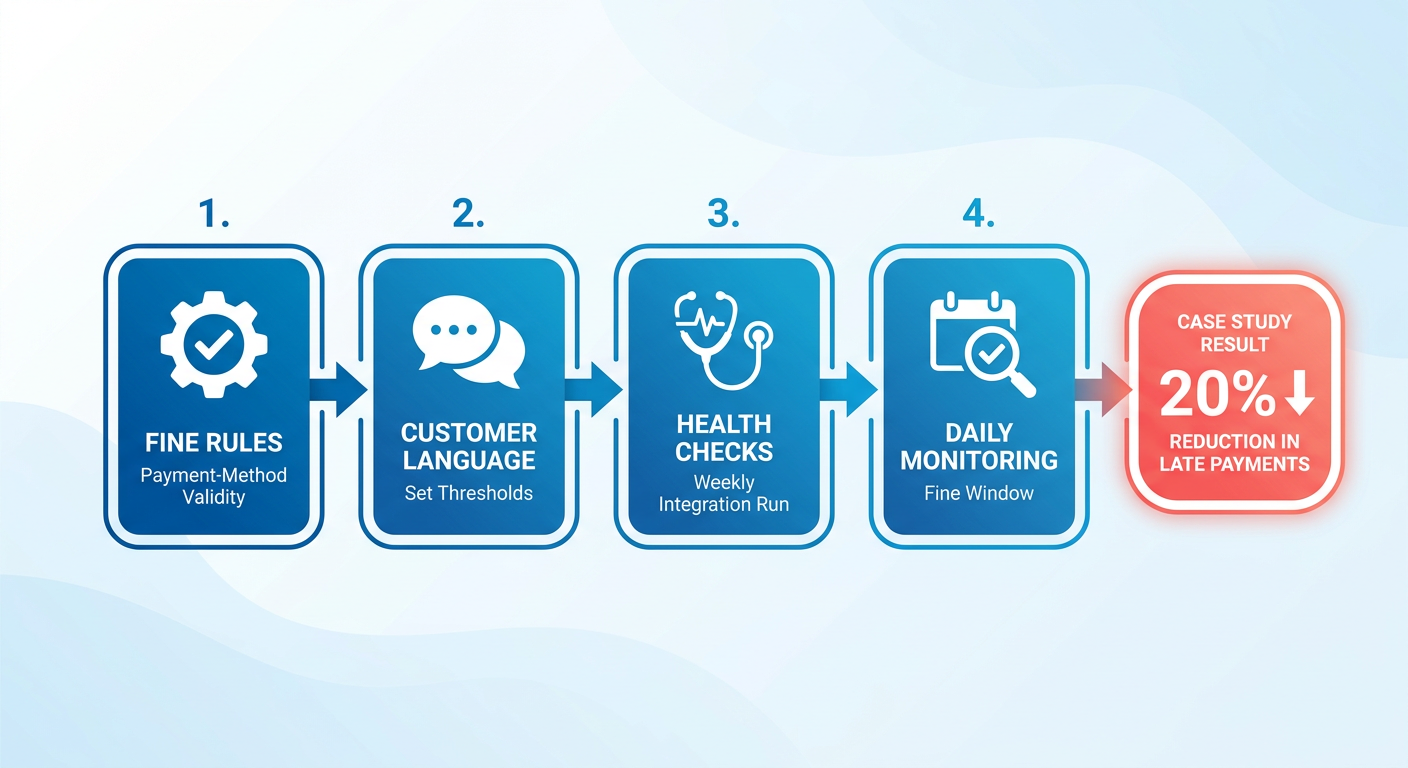
Pre-dunning reconciliation only works if you build it deliberately. The sequence that holds up: design fine rules around payment-method validity first, write the customer-facing language before you touch thresholds, run integration health checks weekly, and monitor the fine window daily. That order matters because the ledger posts the charge and assumes success. Your recovery logic has to run one step ahead of that assumption.
The timing gap is where recovery lives. A failed charge your accounting system flags days late has already cost you the easiest recovery window. Proactive checks stop failures early, when a quick customer nudge still fixes the problem. Roughly 60% of involuntary churn traces back to expired or outdated card details — exactly the kind of failure a proactive check catches before it hits the ledger.
What a best-practice fine setup looks like
Four moves turn silent revenue loss into a proactive recovery loop:
- Rule design first. Match payment-method validity against upcoming charges before billing. Score accounts by default risk, not just aging buckets. Static thresholds miss the customers most likely to fail.
- Communication tone second. A soft, professional reminder preserves the relationship. Done right, this stage improves your reputation instead of straining it.
- Integration health checks weekly. Confirm the gateway, cash-application engine, and ERP ledger still pass a recovery payment without breaking its link to the original charge.
- Monitoring cadence daily. Watch fine status alongside payment-method validity so nothing ages quietly into dunning.
Modern recovery platforms are built to sit inside this loop, automating the card updates and customer notifications so the finance team can focus on high-value accounts.
What results to expect
Grounded in what we see: a 150-person SaaS firm, roughly $12M ARR, 30-day terms, an 18% late-payment rate. They defined fine rules, wrote the legal language, and went live with a full fine workflow in four weeks.
By the end of the first quarter, the firm cut its late-payment rate to 11% and recovered a meaningful slice of MRR it had previously written off. Optimizing retry timing alone lifted recovery on declined charges by close to a third. Automation is what makes this scale — teams handle far more volume without adding headcount.
Lessons, and where this goes next
Three lessons stand out. Get the legal language reviewed before launch, not after. Test your fine amount against actual payment-history patterns instead of guessing. And align sales incentives so reps aren’t quietly promising fee waivers that break the workflow.
Keep tuning. As the system processes more transactions and takes in manual corrections, the matching algorithms get more precise and reconciliation accuracy climbs.
Where this is headed is clear: threshold-setting moves from a static rule toward a prediction problem, reading each customer’s payment history to recover the most without triggering churn. Grounding those calls in real, reconciled revenue data is exactly what a single source of truth is built to support.
Frequently Asked Questions
1. Can I use a fine window and dunning together, or is it one or the other?
They work together as sequential stages. The fine period acts as an initial, low-friction buffer. If the outstanding balance remains unresolved past the designated grace period—typically escalating between day 8 and day 14—the account transitions automatically into the formal dunning sequence.
2. Does charging a late fee risk damaging customer relationships?
When implemented transparently, a modest fee is perceived as an administrative reminder rather than a penalty. This approach is highly effective for subscription models where missed payments are usually due to administrative oversights. However, for bespoke or high-touch professional services with negotiated terms, late fees can strain client relationships and should generally be avoided.
3. Why do retries at the same time as the original decline usually fail again?
Immediate retries fail because the temporary issue that caused the initial decline—such as daily card limits or pending balance clearances—rarely resolves within minutes. Spacing subsequent attempts to align with standard banking cycles or common corporate payment schedules significantly improves the likelihood of successful settlement.
4. How does a fine workflow handle a customer who pays only part of the balance?
Automated systems allocate partial payments directly to the corresponding line items of the open invoice. This ensures the general ledger remains accurate without requiring manual intervention. Any manual adjustments made by your finance team help train the system, refining its matching precision for future transactions.
5. Should every customer get the same escalation timeline?
No. Treating all accounts uniformly can lead to unnecessary friction or missed recovery opportunities. Organizations should segment their outreach based on customer lifetime value, historical payment reliability, and contract type. This allows for automated, hands-off recovery for smaller accounts while reserving personalized, high-touch communication for key enterprise clients.
6. What causes most involuntary churn, and can it be prevented before billing runs?
The majority of involuntary churn stems from outdated payment credentials. This can be prevented by implementing pre-billing verification checks. Sending automated notifications to customers whose cards are nearing expiration allows them to update their details before a transaction is attempted, avoiding service interruptions entirely.
7. Which businesses should skip building a fine window?
Organizations that rely on bespoke, low-volume, or highly customized contracts with extended payment terms should avoid automated late fees. In these scenarios, relationship management is paramount, and payment delays are better handled through direct account management. Conversely, high-volume recurring business models benefit significantly from the structured, automated approach of a transitional grace period.