

5 Cloud Accounting Gaps That Slow Your Order-to-Cash Cycle

Key Takeaways
- Subscription renewals are where cloud accounting’s order-to-cash cycle quietly stalls. Cash you already earned sits uncollected, and Days Sales Outstanding creeps up.
- The median order-to-cash cycle runs 38 days across 574 companies benchmarked by APQC. For a recurring-billing business, that’s over a month of recoverable time.
- Order-to-cash automation cuts Days Sales Outstanding by up to 30% and lifts productivity by 40%, per HighRadius.
- Automated cash application alone can hit over 90% straight-through processing, which kills the manual matching that leaves payments unreconciled.
- Manual renewal invoicing and no auto-charge on file are the easy wins. One to three weeks each.
- Failed or expired card recovery is medium difficulty. It causes silent involuntary churn and usually takes two to four weeks to fix.
- Real-time visibility is the hard one. Four to eight weeks, and until you close it you’re blind to at-risk renewals.
The short version
The subscription renewal is where cloud accounting’s order-to-cash cycle quietly stalls. A renewal that should auto-bill instead waits on a manual invoice, an expired card, or a payment nobody matched back to the right account. Do that across a book of recurring customers and your Days Sales Outstanding climbs while cash you already earned sits there uncollected.
This checklist is built around the five gaps that slow that cycle most. Setting up automated recurring payments helps, but it only covers part of the picture. The renewal itself, the failed-card recovery, and the cash application after payment are where the real drag lives. Standard benchmarks put typical collection cycles well over a month. That’s liquidity a recurring-billing business can get back.
Which gaps hurt the most?
Each gap maps to a specific stall point in the renewal-to-cash flow. Here’s the overview, with rough effort and difficulty to fix.
| Gap | O2C Stage | Impact | Effort to Fix | Difficulty |
|---|---|---|---|---|
| Manual renewal invoicing | Invoicing | Renewals slip past due date | 1-2 weeks | Low |
| No auto-charge on file | Payment collection | Cash waits on customer action | 2-3 weeks | Low |
| Failed/expired card recovery | Dunning | Silent involuntary churn | 2-4 weeks | Medium |
| Manual cash application | Reconciliation | Payments unmatched, DSO climbs | 3-6 weeks | Medium |
| No real-time visibility | Reporting | Blind to at-risk renewals | 4-8 weeks | High |
Automating these steps isn’t cosmetic. It cuts collection delays and clears administrative load off your team. Good reconciliation tools can process the vast majority of incoming payments without anyone touching them.
Who benefits most?
Recurring or usage-based billing benefits most, because renewal volume compounds every stall. SaaS companies, agencies on retainer, and subscription e-commerce brands feel each gap every month, not once.
The numbers back it up. Sana Commerce found 80% of organizations still run order-to-cash on manual processes, and manual order entry causes errors for 33% of B2B firms weekly or monthly. Close the renewal gaps and you cut those errors while freeing your team from chasing.
- Automate renewal invoice generation so recurring bills send on schedule without anyone drafting them
- Store a payment method on file and auto-charge to remove the wait between invoice and cash
- Set up smart dunning for failed and expired cards to stop involuntary churn before it hits revenue
- Match incoming payments to open invoices automatically to keep reconciliation from becoming a bottleneck
- Build real-time visibility into renewal and payment status so you spot at-risk accounts before they lapse
Who should skip parts of this?
Skip the heavy cash-application automation if you invoice a handful of clients a month. At low volume, matching payments by hand costs less than the setup. The gap that hurts everyone is manual renewal invoicing. Even a five-client retainer business loses days when renewals depend on someone remembering to bill.
One in six small businesses reports being paid late, per TreviPay. For recurring revenue, late renewals are the version you can actually prevent.
Fragmented billing systems: where the stall starts
Fragmented billing is the first place a subscription renewal stalls. Your renewal schedule lives in one system, your invoices in another, your payment records in a third. Someone has to key the same data across all three. That manual handoff is where basic recurring billing setups quietly break down, because the automation only covers the billing step, not the renewal or the reconciliation around it.

Even after you set up recurring payments, a renewal that touches three disconnected tools still waits on human re-entry. Ardent Partners found the average cost to process a single invoice manually runs $10.89, and each re-keyed subscription adds a fresh chance for a wrong amount, a missed renewal date, or a payment nobody matched back.
Why fragmented systems slow renewals
Duplicate data entry produces errors, and errors delay collection. When your CRM, accounting ledger, and payment processor don’t share one record, a renewal invoice can go out wrong or not at all. That widens Days Sales Outstanding and leaves earned revenue uncollected.
The cost is measurable. Order entry mistakes cut profitability by up to 25% for most wholesalers and distributors surveyed. A subscription business feels this every cycle, not once.
- Map every system a renewal passes through, so you can see each manual handoff that risks a data mismatch.
- Check for duplicate customer records across billing and accounting. Mismatched records are the top cause of misapplied payments.
How much time integration saves
Pulling your billing, ERP, and payment data into one connected flow reclaims weeks of finance work per cycle. Automated invoicing draws validated data from your order and payment systems, which cuts re-entry errors and speeds collection. Teams that connect these systems often close their books days faster each month.
The proof shows up in real accounts. One mid-market retailer cut invoice disputes by 30% after linking its order system to its ledger. Another firm freed up a full month of accounts receivable work by ending duplicate entry. A third saved 200 hours a week by overhauling its billing and payment experience.
- Connect your subscription billing to your accounting ledger so renewal invoices generate without re-keying.
- Set clear ownership for each data field. Integrated systems only stay clean when one team owns each record.
What to automate first
Start with the renewal-to-invoice link, because that’s where the order-to-cash cycle stalls hardest. Automated invoicing that draws from one clean data source reduces disputes and shortens the time between a renewal firing and cash landing. That trims your DSO directly.
If you want the background on how connected accounting tools fit together, this guide to cloud accounting covers the basics.
- Standardize your renewal workflow before automating, so you’re not encoding a broken process.
- Clean your master data first. Integration only works when both systems agree on the customer.
Invoice accuracy: a wrong invoice is a stalled renewal
When a subscription comes up for renewal and the invoice goes out with the wrong amount, the wrong term, or the wrong customer attached, the payment stops right there. Even a clean automated billing setup can’t fix an invoice that was wrong before it left the door.

This is the second gap dragging out the cycle. Nearly 61% of late payments trace back to invoice errors or disputes rather than customer cash-flow problems. Every one of those errors on a renewal invoice hands the customer a reason to pause payment while your Days Sales Outstanding keeps climbing.
How invoice errors stall renewals
A mismatched amount or a missing line item turns a routine auto-renewal into a back-and-forth email thread. That thread is time your earned cash sits uncollected.
And it compounds at scale. The average B2B invoice dispute takes 15 days to resolve, and disputed invoices get paid far later than clean ones even after the issue is settled. On a renewal book, a small error rate becomes a steady leak of delayed cash.
Check these before your next renewal batch goes out:
- Verify the renewal amount matches the current contract, not last cycle’s price, so proration and mid-term changes don’t trigger a dispute.
- Confirm the correct customer and account are attached to each invoice. A misrouted renewal invoice never gets paid by the right party.
- Reconcile invoice line items against the active subscription plan to catch omitted add-ons or dropped seats before billing.
Can automation close the accuracy gap?
Mostly, yes. Automated invoicing pulls validated data straight from your CRM, ERP, and order records, which cuts the re-keying that creates renewal errors in the first place. It shrinks the time between revenue recognition and billing, and that lowers DSO.
Companies that adopt validation-driven billing report invoice error rates dropping below 1%, and first-time-right invoicing removes the rework loop that keeps renewals unpaid. Validate the renewal data at the source and you stop the error before it ever reaches the customer.
Keeping renewal invoices clean
Clean renewal invoices come from standardized data and connected systems. When your subscription record, invoice, and payment history share one source of truth, there’s no gap for a wrong figure to slip through. Master data hygiene does most of the work here.
A software provider that unified its subscription and billing records cut its dispute rate by more than half within two quarters, and a services firm shortened its renewal reconciliation from days to hours. That reclaimed time is exactly what a stalled renewal steals from you.
- Clean and standardize customer master data so renewal invoices route and calculate correctly every cycle.
- Integrate your billing system with your subscription and payment records to remove double entry.
- Set clear, consistent payment terms on every renewal invoice to prevent the ambiguity that delays collection.
Cash application: where a paid renewal still counts as unpaid
The money lands in your bank account, but until someone matches it to the right invoice, your books say the customer still owes you. That’s the third stall point, and it hits subscription businesses hardest because renewals come in fast, in bulk, and often without clean remittance data.

Even when standard accounting software auto-bills a renewal, the incoming payment still needs to land against the correct subscription. When a customer pays a lump sum for three renewals, or short-pays after a partial credit, the match breaks. Manual matching means someone reads a remittance email, finds the invoice, and posts it by hand. Multiply that across a book of subscribers and your collected cash sits unrecognized.
Why the bottleneck delays payment
Unmatched receipts sit in a suspense account instead of clearing the invoice. The customer sees an open balance. Your collections team chases a payment that already arrived. Wasted effort, and a strained relationship over money you already hold.
The cost of manual matching is real. PYMNTS found finance teams spend an average of 15 hours a week reconciling payments by hand, and unapplied cash can tie up as much as 4% of monthly revenue in limbo. Every unmatched renewal is a person hunting through email threads for remittance details that should have posted automatically.
The relationship damage compounds. When you dun a customer for a renewal they already paid, you look disorganized. For a subscription business betting on retention, that friction at renewal time is the last thing you want in front of the customer.
How automation fixes it
AI reads the remittance data, matches payments to open invoices, and posts the cash without anyone touching it. The tools capture remittance from email automatically, then reconcile receipts against outstanding renewals in real time. The suspense account shrinks and your books reflect reality.
The payoff shows up in the numbers. Companies that automate cash application typically cut their unapplied cash balance by more than half within the first quarter, and drop reconciliation labor from hours a day to minutes. One SaaS provider closed its books three business days faster after moving matching off spreadsheets. Another firm reclaimed 12 finance-team hours weekly and redirected that time to exception handling.
What your cash application checklist should cover
Close the gap between money arriving and money posting.
- Automate remittance capture so incoming renewal payments pull their matching data from payment emails instead of waiting on manual reading.
- Set match tolerances so small rounding differences or fee deductions clear automatically instead of routing every near-match to a human.
- Handle partial and lump-sum payments with rules that split a single receipt across multiple renewals rather than dumping it in suspense.
- Track cash application speed as a KPI alongside invoice aging, since a slow match hides collected cash from your books.
- Stop collections on matched accounts automatically so nobody duns a customer for a renewal that already cleared.
- Reconcile in real time, not in a month-end batch, so working capital reflects the cash you actually hold.
Get this right and the renewal cycle closes cleanly. The payment arrives, matches itself, clears the invoice, and your books tell the truth.
Visibility and disputes: the two gaps you feel but rarely measure
Visibility shortfalls hide where a renewal is stuck. Dispute inefficiencies freeze the payment while both sides argue. Together they stretch your order-to-cash cycle at the exact moment cash should be landing. Even a clean recurring payment system can’t show you a renewal that silently failed three weeks ago.
These two close the checklist because recurring billing only tells you a charge was attempted. It doesn’t tell you which renewals are aging, which customers are disputing a line item, or where the cash actually sits. Data silos block end-to-end visibility across the cycle. When you can’t see the stall, you can’t fix it, and a lot of small enterprises routinely struggle with delinquent accounts.
How visibility shortfalls delay payment
Without real-time views into outstanding invoices and deferred revenue, your team learns about a failed subscription charge weeks after it lapsed. That lag is pure Days Sales Outstanding you never needed to carry.
Poor visibility also strains customer relationships. When you can’t see that a renewal invoice went unpaid, the first contact becomes a late-payment chase instead of a friendly reminder. A customer portal with live account data fixes this by letting customers see their own renewals, invoices, and balances.
- Give customers a self-service portal so they can view renewals, invoices, and balances without emailing your team for every question.
- Track DSO and invoice aging as live KPIs so a stalled renewal surfaces in days, not at month-end close.
- Surface deferred revenue balances in real time so recurring revenue you’ve booked but not collected stays visible.
Why disputes drag out renewals
A single contested charge can hold an entire payment hostage. When a customer questions a renewal amount, the money stops until someone resolves it by hand. Manual dispute handling turns a five-minute fix into a multi-week standoff.
The cost of slow resolution compounds fast. The Credit Research Foundation found roughly 25% of past-due receivables are tied to unresolved deductions and disputes rather than customer unwillingness to pay. Every day a contested renewal sits in limbo is working capital you’ve earned but can’t touch, and the older the dispute gets, the harder the full amount is to recover.
An intelligent matching engine shortens this by tying each payment to the right renewal automatically, so short-pays and credits get flagged instead of buried. When the system already knows what was billed and what was paid, the disputed portion is obvious.
- Route disputes automatically to an owner the moment a short-pay or mismatch appears, so nothing waits in an inbox.
- Match payments to renewals with an intelligent engine so the disputed line item is isolated while the rest of the payment posts.
- Set a target resolution time for renewal disputes and measure against it, so aging deductions never quietly pile up.
Close these two and every renewal becomes visible and defensible. That’s how you stop cash you’ve already earned from sitting uncollected.
The roadmap: what to fix, in what order
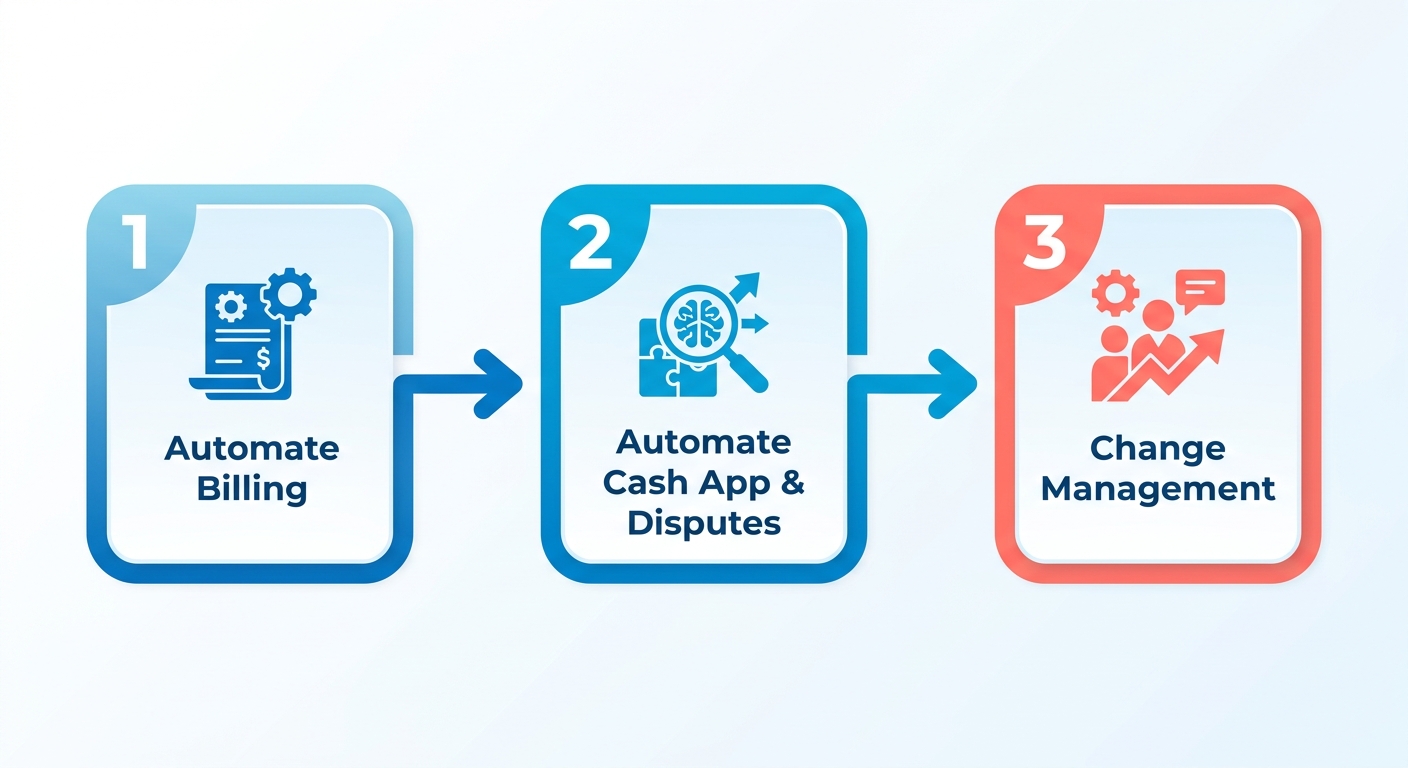
Fixing the renewal bottleneck follows a clear order. Automate billing first, then cash application and disputes, then manage the change so people actually use the new system. Skip the sequence and you end up with slick software running on top of the same manual renewals that stalled you in the first place.
The return is substantial. Companies that automate order-to-cash typically recover weeks of collection time on revenue they already earned. Setting up basic auto-pay is one early step, but the roadmap below closes the gaps around it.
Where to start with automated billing
Connect the systems that touch a renewal, then automate the billing that flows through them. Integrating data from your CRM, order, and payment systems eliminates the re-keying that breaks renewals. Teams that integrate these systems report significant drops in billing discrepancies, since data no longer gets copied between disconnected tools.
- Connect customer-facing platforms directly to the ledger to eliminate manual handoffs.
- Schedule automated invoice dispatches aligned with contract renewal dates.
- Audit and clean customer records before launch so legacy errors don’t propagate.
- Set up automated delivery that includes explicit payment terms to speed collections.
How to pick cash application and dispute tools
Choose tools that post cash automatically and flag disputes the moment they surface. Modern cash application software captures remittance data straight from payment emails, so most renewal payments match themselves and your team only touches the exceptions.
Dispute handling deserves the same treatment. When a renewal payment freezes over a line-item argument, you need the dispute visible and routed, not buried in an inbox.
- Pick reconciliation software that parses remittance details directly from incoming emails.
- Make sure the system flags underpayments and combined payments for fast manual review.
- Build a dedicated workflow to track and resolve contested renewal charges.
- Monitor reconciliation cycle times to catch bottlenecks before they hit cash flow.
One CPG company recovered $33.4 million with a 34-day dispute resolution time against the industry’s 90-day average.
Why change management decides success
New billing and cash-application tools only help if your team trusts them and follows the workflow. Standardizing how orders and renewals get entered is what makes automation stick.
The upside compounds. 77% of CFOs now see AI as a partner that handles the repetitive work, freeing their teams for exceptions and forecasting.
- Set uniform data-entry protocols across sales and finance so systems stay aligned.
- Train the finance team on managing automated exceptions rather than routine processing.
- Run monthly audits of collection performance to catch emerging friction.
Roughly 70% of automation projects fail on adoption rather than technology, so the change work is where the real gains live. Sequence the roadmap right and your renewals stop stalling.
Frequently Asked Questions
1. What DSO is considered healthy for a subscription business?
DSO under 45 days is generally healthy for recurring-billing companies, while top performers reach the low 30s. Anything climbing past 50 signals collection drag from stalled renewals or slow cash application. Track it monthly against invoice aging so a rising number flags a bottleneck before it compounds.
2. What is the difference between voluntary and involuntary churn?
Voluntary churn happens when a customer actively cancels; involuntary churn occurs when a renewal payment fails silently from an expired or declined card. Involuntary churn is preventable through smart dunning that retries failed charges and prompts card updates, recovering revenue the customer never actually intended to lose.
3. What is a suspense account in cash application?
A suspense account temporarily holds incoming payments that haven’t been matched to a specific invoice. Money sits there until someone identifies which renewal it clears. The larger the suspense balance grows, the more collected cash your books treat as outstanding, keeping DSO high and collections chasing already-paid accounts.
4. Is QuickBooks Online recurring payments enough on its own?
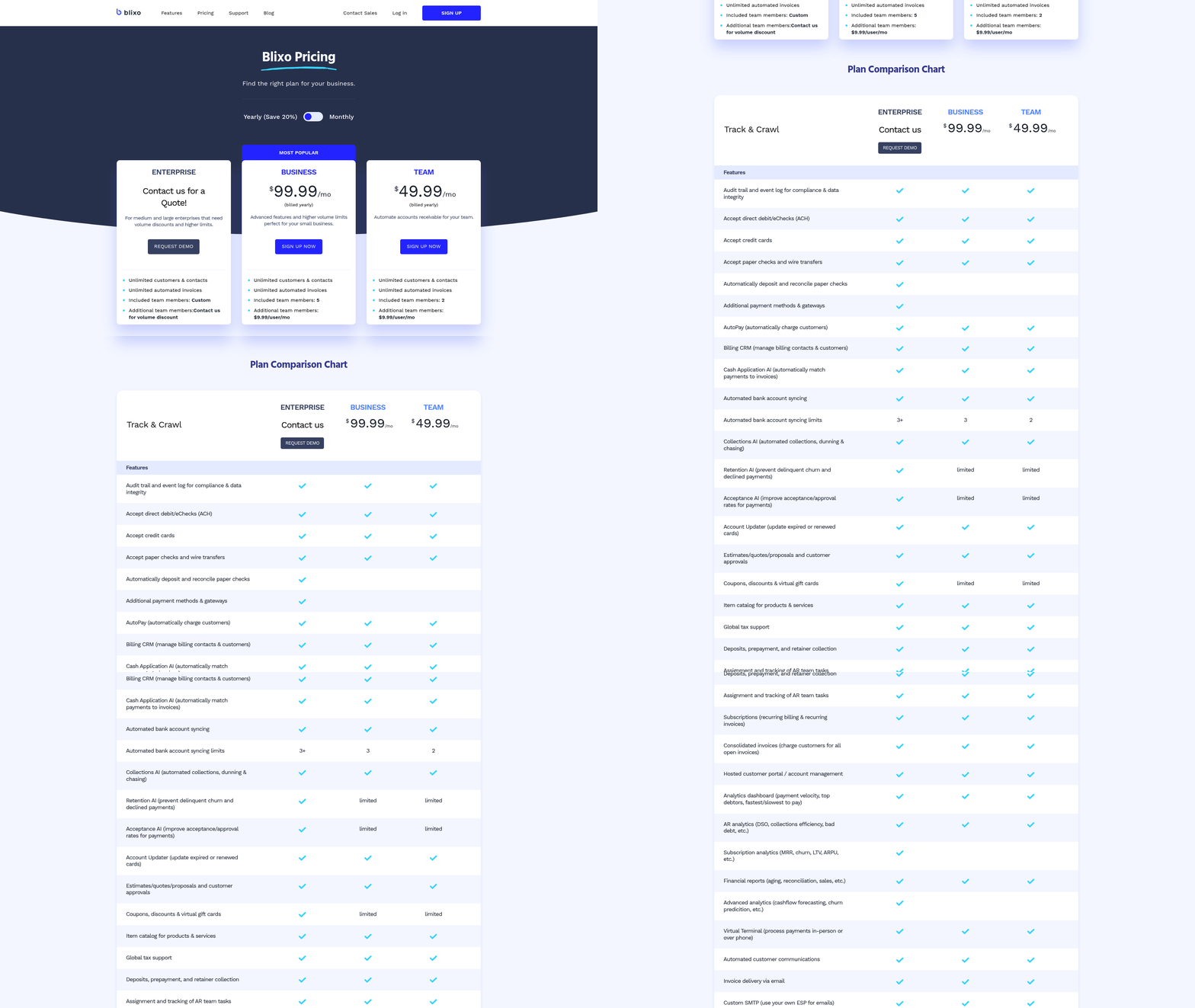
QuickBooks Online recurring payments automates scheduled billing but not renewal management, failed-card recovery, or cash application. It handles simple books well, yet leaves reconciliation and dunning manual. Businesses with high renewal volume often pair it with dedicated invoice-to-cash tools like Blixo to close the surrounding gaps.
5. How does smart dunning recover failed subscription payments?
Smart dunning automatically retries declined charges on an optimized schedule and emails customers to update expired cards before revenue lapses. Rather than one failed attempt marking a customer lost, it sequences retries around paydays and sends timed reminders, recovering payments that failed for technical rather than intentional reasons.
6. Which order-to-cash metrics should finance teams track monthly?
Track Days Sales Outstanding, invoice aging, cash application speed, and unapplied cash balance as core metrics. Add dispute resolution time and straight-through processing rate for recurring billing. Reviewing these monthly surfaces stalled renewals early, letting teams fix a bottleneck before it elevates collection times across the whole book.