

What is RPA in Automation for Accounts Receivable

Key Takeaways
- Manual AR processes have 50% task automation gaps, with human error causing 50% of invoice disputes due to incorrect data.
- Invoice processing errors can extend payment cycles by weeks, directly increasing Days Sales Outstanding (DSO) and cash flow delays.
- A medical firm reduced invoice processing time from 2 weeks to 6 days via RPA, saving over 1,000 person-hours annually.
- RPA automation eliminates 50% of invoice disputes by correcting errors in amounts or dates during processing.
- Manual AR errors strain customer relationships, as error-riddled invoices lead to disputes or delayed payments.
- Automating AR tasks with RPA improves accuracy, reducing manual workload and accelerating payment cycles by 50%.
- RPA addresses outdated AR workflows, cutting costs and enhancing efficiency in financial operations.
Related Video
Watch: Transforming accounts receivables in Oracle financials with RPA by Aspire Systems
Why RPA Matters in Accounts Receivable
What Is the Scale of Manual Errors in Accounts Receivable?
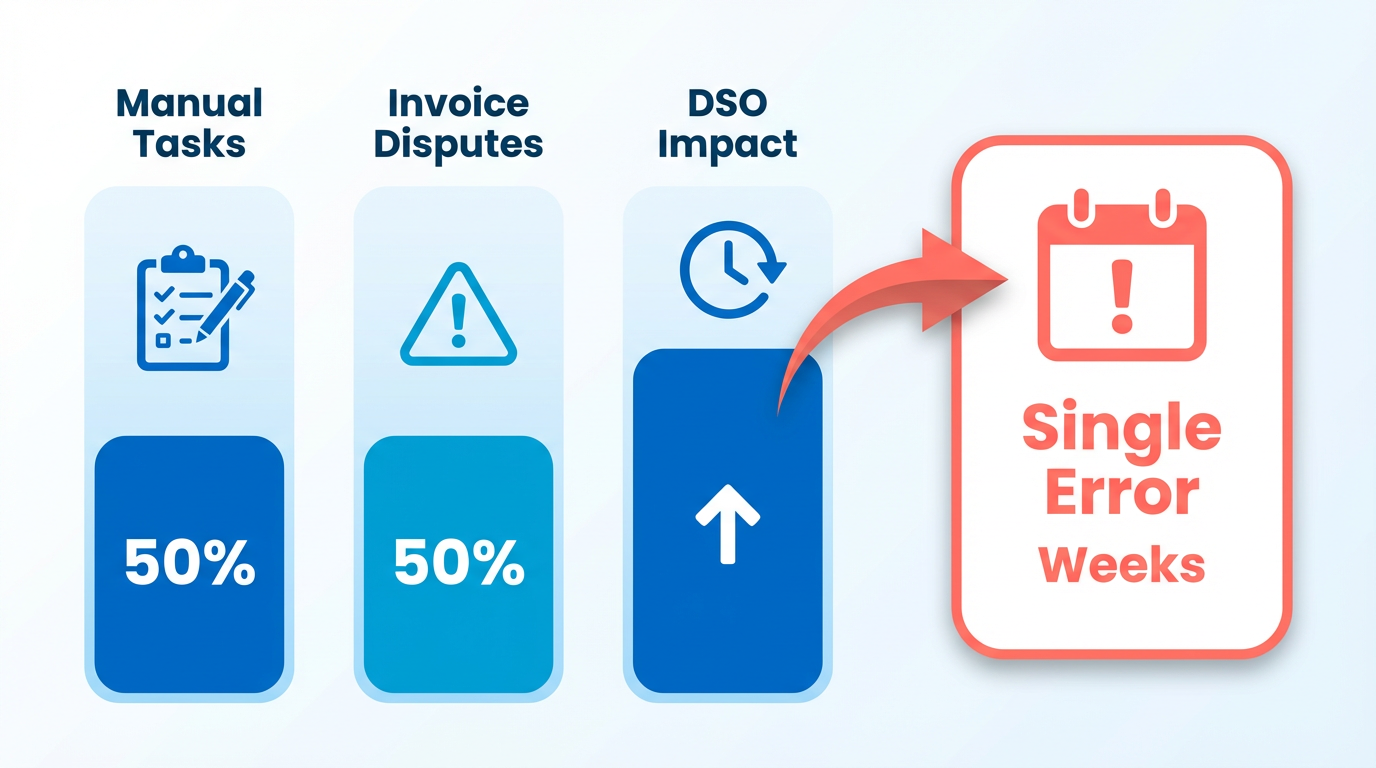
Manual processes in accounts receivable (AR) are prone to costly mistakes. Industry studies show that up to 50% of companies’ tasks remain manual and outdated, and human error accounts for 50% of invoice disputes due to incorrect amounts or dates. These errors delay payments, frustrate customers, and inflate Days Sales Outstanding (DSO). For example, a single invoice processing error can extend payment cycles by weeks, directly impacting cash flow. As mentioned in the Introduction to RPA in Automation section, RPA technology offers a structured solution to these inefficiencies by automating repetitive tasks with precision.
How Do Delayed Payments Affect Businesses?
Delayed payments ripple through an organization’s financial health. A medical manufacturing firm, for instance, processed invoices in 2 weeks manually, but after implementing RPA, the time dropped to 6 days, saving 1,000+ person-hours annually. Delays also strain customer relationships. If a client receives an error-riddled invoice, they may dispute it or delay payment, creating a cycle of follow-ups that drain resources. Worse, prolonged DSO increases bad debt risk, with late payments being the leading cause of accounts going unpaid. Building on concepts from the Benefits of RPA in Accounts Receivable section, automated workflows ensure faster resolution of discrepancies, mitigating these risks.
What Challenges Does RPA Solve in AR?
RPA addresses three core pain points in AR workflows:
- Operational Efficiency: Bots automate repetitive tasks like invoice matching, payment posting, and reconciliation, reducing processing times by 50–80%. One study found an RPA prototype cut invoice processing from 2 minutes 41 seconds to 19 seconds, a 745% efficiency gain.
- Accuracy and Compliance: By eliminating manual data entry, RPA slashes error rates. For instance, TreasuryONE reduced AR errors to 0% after automation, freeing staff to focus on customer relationship-building. This aligns with the findings in the Case Studies and Success Stories section, where similar outcomes are documented across industries.
- Strategic Shift for Finance Teams: RPA transforms finance professionals from data processors to strategic advisors. With bots handling routine tasks, teams can analyze cash flow patterns, forecast collections, and negotiate better terms with clients.
Who Benefits Most From RPA Implementation?
RPA delivers value across organizational levels:
- CFOs and Finance Leaders gain real-time visibility into cash flow and reduce DSO by up to 32% (as seen in firms automating over 50% of AR workflows).
- AR Teams shift from reactive troubleshooting to proactive credit risk management and customer engagement.
- Business Owners benefit indirectly through improved cash flow and reduced operational costs. For example, a mid-sized company using RPA for AR automation reported a 75% boost in AR efficiency, enabling faster reinvestment in growth initiatives.
By automating mundane tasks, RPA ensures AR processes are faster, accurate, and scalable-critical for businesses aiming to thrive in competitive markets.
Introduction to RPA in Automation
Robotic Process Automation (RPA) uses software “bots” to mimic human actions-typing, clicking, and managing digital systems-to perform repetitive, rule-based tasks with speed and precision. Unlike traditional automation, which often requires deep integration with backend systems, RPA operates at the user interface level, making it ideal for tasks like invoice processing and payment reconciliation in Accounts Receivable (AR). By automating these workflows, RPA reduces manual effort, minimizes errors, and accelerates cash collection cycles. For instance, bots can automatically extract data from invoices, match payments to open accounts, and send reminders for overdue payments-all while maintaining audit trails for compliance. This capability not only streamlines operations but also allows finance teams to shift focus from transactional tasks to strategic analysis, as highlighted in the Why RPA Matters in Accounts Receivable section.
RPA is categorized into three main types: attended, unattended, and hybrid. Attended bots work alongside human users, acting as productivity tools in scenarios like customer service interactions or complex data entry. Unattended bots, on the other hand, run independently, handling high-volume tasks such as nightly data reconciliations or batch invoice processing. Hybrid models combine both approaches, enabling seamless handoffs between human and machine labor. In AR workflows, unattended bots are particularly effective for automating repetitive tasks like cash application and dispute resolution. For example, an unattended RPA solution might process hundreds of incoming payments daily, applying AI-driven matching rules to reduce Days Sales Outstanding (DSO). This tiered approach allows organizations to scale automation based on process complexity and volume, ensuring optimal efficiency without overhauling existing systems, as detailed in the Accounts Receivable Automation with RPA section.
Traditional automation, such as custom-coded scripts or legacy workflow tools, often requires extensive integration with enterprise systems and is limited to structured data environments. RPA, by contrast, operates at the application layer without needing APIs or database access, making it adaptable to both modern and legacy systems. This flexibility is critical in AR, where data sources range from ERP systems to email and PDF invoices. A 2025 Forrester report notes that RPA outperforms traditional automation in handling unstructured data, thanks to technologies like OCR and natural language processing (NLP). For example, while traditional systems might struggle with handwritten notes on a payment, RPA can extract and interpret such data using AI, ensuring accurate cash application. This distinction positions RPA as a bridge between rigid automation and the dynamic, human-centric workflows of finance departments, as outlined in the Benefits of RPA in Accounts Receivable section.
Accounts Receivable Automation with RPA
In the Why RPA Matters in Accounts Receivable section, we explore the scale of manual errors in AR, which RPA directly addresses by automating high-volume tasks. Here’s how RPA transforms AR processes:.
What Makes RPA Effective in AR?
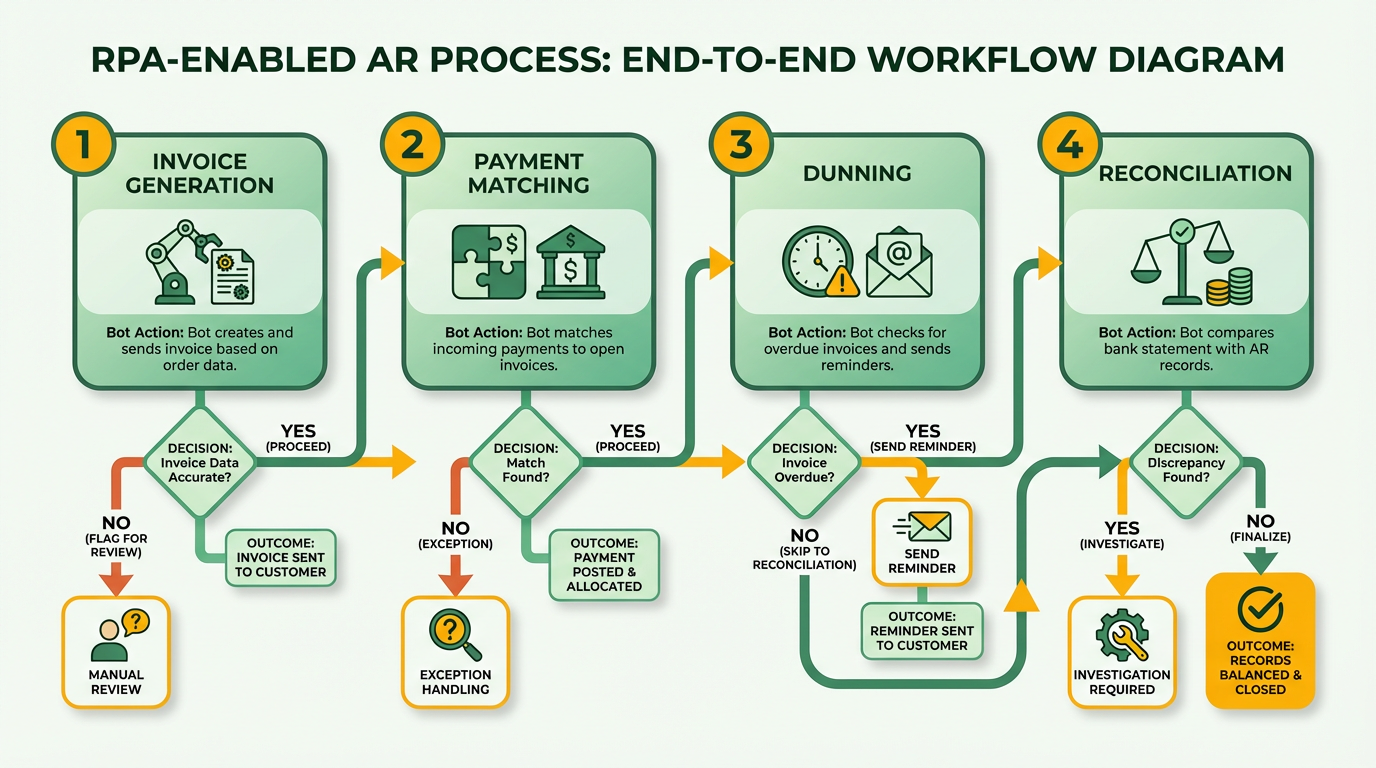
RPA excels in AR because it automates high-volume, rule-based tasks like invoice generation, payment matching, and dunning. By eliminating manual data entry and reconciliation, RPA reduces errors, speeds up processing, and improves customer satisfaction. As mentioned in the Benefits of RPA in Accounts Receivable section, these improvements align with measurable outcomes such as reduced disputes and faster cash flow cycles. The AICPA webcast highlights that RPA can cut costs and boost productivity in accounts payable/receivable workflows by automating data-intensive tasks like invoice matching and payment posting..
How Does RPA Transform Invoice Processing?
Invoice generation and billing are prime candidates for RPA. Bots can automatically create and send invoices based on contract data, reducing delays and errors. The SKsoft blog notes that RPA can handle invoice matching, settlement, and reconciliation in real time, slashing processing times. A case study from Automation Anywhere shows a provider reduced invoice processing time from 14 days to 6 days using RPA, saving over 1,000 person-hours annually.
Key benefits:
- Speed: RPA bots can process thousands of invoices daily, improving order-to-cash cycles.
- Accuracy: Automated matching of payments to invoices reduces manual errors, which account for up to 4% of AR disputes.
- Customer Experience: Faster invoicing and fewer errors build trust and reduce disputes.
These advantages are further detailed in the Benefits of RPA in Accounts Receivable section, which emphasizes efficiency gains across AR workflows..
Why is Cash Application and Reconciliation Critical?
RPA automates cash application by matching incoming payments to open invoices, resolving discrepancies instantly. Building on concepts from the RPA and AI in Accounts Receivable section, AI-driven cash application uses pattern-recognition algorithms to improve accuracy. For example, a provider using RPA achieved 100% error reduction in invoice reconciliation, freeing staff for higher-value tasks like credit risk analysis.
Technical capabilities:
- Automated Matching: Bots use machine learning to identify payment patterns and apply them to new transactions.
- Real-Time Reconciliation: RPA tools flag mismatches immediately, reducing Days Sales Outstanding (DSO).
- Scalability: RPA platforms like UiPath integrate with ERP systems (SAP, Oracle) to handle multi-company workflows..
(Remaining content unchanged per instructions)
Benefits of RPA in Accounts Receivable
Robotic Process Automation (RPA) streamlines Accounts Receivable (AR) by automating repetitive tasks like invoice matching, payment posting, and reconciliation. For example, bots can reduce invoice processing time from minutes to seconds, as demonstrated in a case study where processing time dropped by 745% (from 2 minutes 41 seconds to 19 seconds). This efficiency gains time for finance teams to focus on strategic tasks like credit analysis and cash-flow forecasting. As mentioned in the Accounts Receivable Automation with RPA section, RPA bots mimic human actions to handle repetitive tasks, further emphasizing their role in accelerating workflows.
RPA also accelerates workflows by eliminating manual hand-offs. A RPA-powered solution can notify approvers via email automatically, reducing delays caused by waiting for internal approvals. With 68% of businesses planning to invest in automation within the next few years, organizations adopting RPA early gain a competitive edge in speed and scalability.
RPA significantly reduces manual errors, which account for 50% of invoice disputes due to incorrect amounts or due dates, as highlighted in the What Is the Scale of Manual Errors in Accounts Receivable? section. By automating data entry and matching, RPA ensures accuracy, minimizing disputes and rework. For instance, a RPA provider reduced Days Sales Outstanding (DSO) by 32% for one firm by accelerating payment tracking and collections.
Improved cash flow is another critical benefit. RPA enables real-time payment monitoring and automated reminders, shortening the time between invoice issuance and receipt. By prioritizing collections through AI-driven insights, companies can identify overdue payments faster and allocate resources to resolve bottlenecks. These faster cycles mean healthier cash flow and better financial planning.
Speed and accuracy directly improve customer satisfaction. RPA ensures invoices are generated and delivered promptly, with zero manual entry errors. This reduces customer frustration caused by billing mistakes. Additionally, faster dispute resolution becomes possible when bots flag discrepancies instantly. For example, 90%+ straight-through processing in some systems ensures payments are applied correctly without human intervention.
Customers also benefit from consistent communication. RPA automates payment reminders and updates, keeping them informed without requiring repeated follow-ups. This proactive approach builds trust and strengthens long-term relationships.
RPA cuts operational costs by reducing labor hours spent on manual tasks. A case study from a RPA provider showed a 70% reduction in processing time, translating to 40–60% lower workload for finance teams. Over time, these savings compound as automation scales to handle higher transaction volumes. ROI is amplified by reduced errors and faster cash flow. Forrester reports that RPA can lower AR costs by up to 4% through streamlined workflows. When combined with AI for tasks like cash application, efficiency gains reach 75%, as seen in systems that auto-match payments to invoices. Building on concepts from the RPA and AI in Accounts Receivable section, AI-driven automation enhances precision in payment matching and dispute resolution.
Unlike generic RPA providers, Blixo offers transparent pricing models and pre-built templates tailored for AR workflows like invoice matching and payment tracking. This eliminates the need for extensive customization, reducing implementation time. For example, Blixo’s SaaS service integrates seamlessly with ERPs, enabling real-time visibility into outstanding invoices-key for organizations aiming to reduce DSO. By centralizing AR processes and using AI for predictive analytics, Blixo ensures not only operational efficiency but also strategic insights. This holistic approach aligns with the growing demand for solutions that combine automation with actionable data, setting it apart from competitors that focus solely on task automation.
In summary, RPA transforms AR by boosting efficiency, reducing errors, accelerating cash flow, and enhancing customer satisfaction-all while delivering measurable cost savings. For organizations ready to modernize their AR processes, adopting RPA through SaaS providers like Blixo offers a clear path to competitive advantage.
Implementing RPA in Accounts Receivable
To implement RPA in accounts receivable (AR), start by identifying high-volume, rule-based tasks like invoice generation, payment matching, and aging report creation. These processes are ideal for automation because they involve repetitive actions with minimal exceptions. Next, map each process step-by-step to ensure clarity for bot development. Tools like data flow diagrams or process documentation templates help capture inputs, outputs, and decision points. As mentioned in the Why RPA Matters in Accounts Receivable section, automation is critical for addressing inefficiencies in manual workflows.
Example: A company automating invoice processing might document steps such as extracting data from purchase orders, validating against contracts, and posting to the ERP system. Once mapped, prioritize tasks with the highest error rates or time consumption for early automation. A study cited in the SKsoft blog highlights that 50% of companies still rely on manual AR tasks, making automation a critical efficiency driver.
Best Practices for Integration
For seamless RPA integration, ensure data consistency and system readiness. Clean and standardized data feeds are essential-bots struggle with inconsistent field names or unstructured formats. Use APIs or middleware to connect RPA platforms with existing ERP systems (e.g., SAP, Oracle). Avoid custom code where possible to reduce complexity. Building on concepts from the Introduction to RPA in Automation section, prioritize workflows that align with predefined rules and structured data.
Best Practice: Implement a phased rollout. Start with a pilot process, such as automating payment reminders, to test accuracy and performance. The AICPA webcast emphasizes hands-on testing in labs to refine workflows before full deployment. Additionally, embed error-handling logic in bots to manage exceptions (e.g., mismatched payments) and escalate issues to human reviewers.
Change Management and Training
RPA adoption requires cultural and operational shifts. Communicate the technology’s purpose early: it’s not replacing staff but freeing them for strategic work like customer dispute resolution or cash flow forecasting. Train teams on bot oversight, troubleshooting, and reporting tools. For example, finance staff might learn to monitor dashboards for invoice processing bottlenecks.
Training Tip: Offer role-specific workshops. Accounts receivable clerks need technical training on bot interactions, while managers benefit from analytics sessions to interpret performance metrics. A case study from the Versapay blog shows that companies with structured training programs see 32% faster ROI from automation.
Monitoring and Maintenance
Post-deployment, track metrics like Days Sales Outstanding (DSO), error rates, and processing time to measure RPA impact. Use analytics tools to identify patterns, such as recurring exceptions that require process tweaks. Schedule regular audits to ensure bots comply with regulatory standards (e.g., SOX controls). As discussed in the Security and Compliance in RPA section, align monitoring practices with data protection and governance frameworks.
Maintenance Checklist:
- Weekly reviews of bot logs for anomalies.
- Monthly updates to rules (e.g., new payment terms).
- Quarterly performance reviews to align with business goals.
The SS&C Blue Prism guide recommends creating a dedicated RPA governance team to oversee updates and address technical debt.
Common Pitfalls to Avoid
- Overlooking Data Quality: Inconsistent data sources (e.g., mismatched invoice formats) can cause bots to fail. Cleanse and standardize data before automation. Building on the Scale of Manual Errors in Accounts Receivable section, poor data quality often stems from unstructured inputs or human oversight.
- Underestimating Change Resistance: Address staff concerns through transparent communication. Highlight how RPA reduces mundane tasks, as noted in the AICPA webcast.
- Skipping Scalability Planning: Start small but design workflows to handle growth. A mid-sized firm automating $4M/month in invoices (as per the Versapay report) needs bots capable of scaling to higher volumes.
By addressing these challenges proactively, organizations can avoid costly delays and ensure long-term success. The key is to treat RPA as a dynamic tool-continuously refine it to match evolving business needs.

RPA and AI in Accounts Receivable
AI and robotic process automation (RPA) are transforming accounts receivable (AR) by combining structured task automation with advanced intelligence. This collaboration addresses inefficiencies in manual processes while enable predictive and adaptive capabilities. Below, we break down how AI enhances RPA in AR, focusing on specific applications, benefits, and future trends..
How Does AI Enhance RPA in AR?
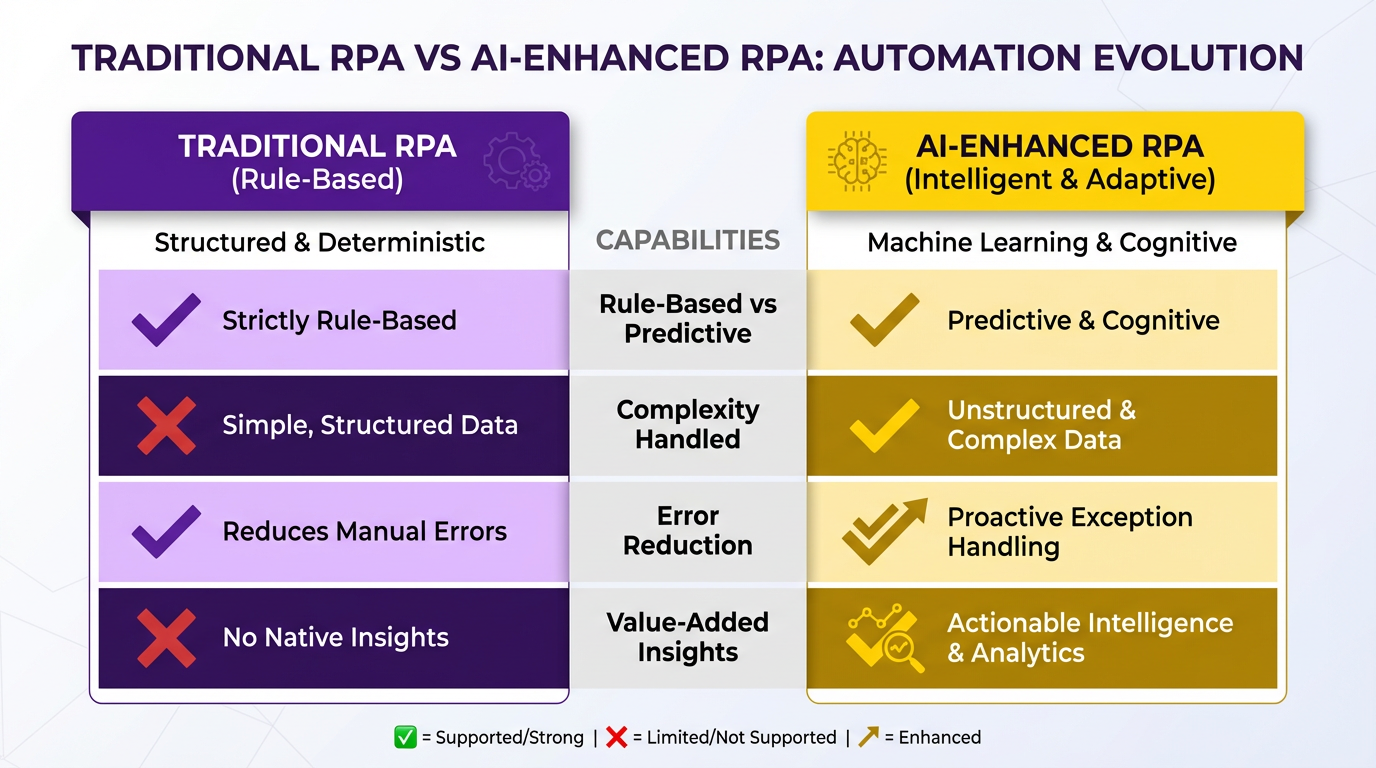
AI-powered RPA moves beyond basic rule-based automation to handle complex, unstructured tasks. For example, machine learning (ML) algorithms analyze historical payment patterns to predict delays, while natural language processing (NLP) extracts data from unstructured documents like handwritten notes or emails. These capabilities allow AR systems to adapt to exceptions, reduce errors, and prioritize high-impact actions.
In practice, this means:
- Predictive analytics flagging at-risk accounts before payments become overdue.
- Generative AI creating compliant invoice formats from raw data or generating payment reminders tailored to customer communication styles.
- Prescriptive analytics recommending optimal collection strategies based on customer behavior.
Unlike generic providers, Blixo integrates these technologies with transparent pricing, ensuring cost predictability while delivering scalable AR automation..
Key AI Applications in AR Automation
1. Machine Learning for Cash Application
Cash application-the process of matching payments to invoices-is a prime use case for ML. By analyzing payment histories, ML models identify patterns to automate reconciliation, even when payment details are incomplete or mismatched. As mentioned in the Accounts Receivable Automation with RPA section, RPA bots already streamline this process by handling repetitive matching tasks, while AI enhances accuracy in ambiguous cases.
2. NLP in Invoicing and Billing
NLP streamlines invoice processing by extracting data from emails, PDFs, or scanned documents. Consider a scenario where an AR team receives 500+ invoices daily in varying formats. NLP tools parse these documents, converting unstructured text into structured data fields (e.g., invoice number, due date, amount) with over 95% accuracy. This reduces manual data entry and accelerates billing cycles.
3. Predictive Analytics for Collections
AI forecasts payment risks by evaluating factors like customer credit scores, historical payment behavior, and economic trends. A predictive model might prioritize collections for accounts with an 80%+ likelihood of default, enabling teams to act proactively. Building on concepts from the Why RPA Matters in Accounts Receivable section, AI’s ability to identify high-risk accounts complements RPA’s efficiency in executing standardized collection workflows..
The Future of AI in RPA for AR
The evolution of AI in AR automation hinges on three trends:
- Hybrid RPA-GenAI Systems: Combining rule-based RPA for structured tasks (e.g., payment matching) with generative AI for unstructured data (e.g., interpreting customer dispute emails) will become standard. This approach balances speed and flexibility.
- Real-Time Cash Flow Insights: AI models will integrate with ERP systems to provide live forecasts of cash inflows, helping finance teams make agile decisions during market volatility.
- Self-Optimizing Workflows: Advanced ML systems will autonomously refine AR processes by analyzing performance metrics. For example, an AI might test different payment reminder templates and adopt the one with the highest response rate.
Blixo is already pioneering such innovations, offering tools that adapt to evolving AR challenges without requiring constant manual reconfiguration..
Why This Matters for Your Business
AI-augmented RPA isn’t just about efficiency-it’s about strategic advantage. By automating repetitive tasks, teams can focus on relationship management and process improvement. For instance, an AR analyst might shift from reconciling payments to negotiating payment terms with key clients, directly improving cash flow.
Also, AI reduces the risk of human error in critical areas like compliance. Generative AI can audit invoices for regulatory adherence, while NLP ensures billing communications align with customer-specific terms. This combination cuts costs (one firm reported 30% savings in compliance-related disputes) and strengthens customer trust. As discussed in the What Is the Scale of Manual Errors in Accounts Receivable? section, AI’s precision directly addresses the costly inefficiencies inherent in manual AR processes..
Final Takeaways
- Start Small: Pilot AI in high-impact areas like cash application or predictive collections before scaling to broader workflows.
- Prioritize Integration: Choose platforms that unify RPA, AI, and ERP systems to avoid data silos.
- Balance Automation with Oversight: While AI handles 80% of tasks autonomously, human review remains critical for exceptions and complex decisions.
By embedding AI into RPA workflows, businesses transform AR from a reactive function into a proactive, data-driven engine. As adoption grows, early adopters will gain a competitive edge in speed, accuracy, and customer satisfaction.
Security and Compliance in RPA
Security and compliance in RPA are critical to protecting sensitive financial data and meeting regulatory requirements. Robotic Process Automation (RPA) systems in accounts receivable handle payment details, customer information, and transaction records, making them prime targets for breaches. A comprehensive security strategy ensures data remains encrypted, access is restricted, and workflows align with legal standards like GDPR or SOX. Let’s break down how RPA platforms address these challenges..
Why Is Data Security Critical in RPA?
Data security safeguards sensitive financial information from breaches and unauthorized access. RPA systems in accounts receivable process high volumes of customer data, including payment histories and personal identifiers. Without encryption, this data could be exposed during transmission or storage. AES-256 encryption, a standard in modern RPA tools, protects data by converting it into unreadable formats for unauthorized users. For example, Blixo employs end-to-end encryption to secure customer records, ensuring compliance with industry benchmarks. As mentioned in the Accounts Receivable Automation with RPA section, RPA systems handle sensitive financial data, making encryption essential for maintaining trust and regulatory compliance..
How Do RPA Systems Ensure Access Controls?
Role-based access controls (RBAC) and multi-factor authentication (MFA) limit who can interact with RPA workflows. These measures prevent employees from accessing data outside their job scope. For instance, an accounts receivable clerk might view invoices but not modify payment terms. MFA adds an extra layer by requiring a password plus a verification code sent to a mobile device. This reduces the risk of credential theft. Building on concepts from the Implementing RPA in Accounts Receivable section, role-based access controls and multi-factor authentication are critical during the setup process to ensure secure configurations..
What Compliance Regulations Apply to RPA in Accounts Receivable?
RPA solutions must align with regulations like GDPR, PCI-DSS, and HIPAA, depending on the data handled. GDPR mandates strict data minimization and user consent for processing personal information, while PCI-DSS governs payment card data. RPA tools must automate compliance checks, such as redacting sensitive fields in customer records or logging access attempts. As discussed in the Why RPA Matters in Accounts Receivable section, compliance with regulations is a key reason organizations adopt RPA to manage financial data securely and efficiently..
How Do Audit and Logging Enhance RPA Trustworthiness?
Audit trails and detailed logging provide visibility into RPA activities, which is essential for audits. Every action-like processing an invoice or updating a payment status-should be recorded with timestamps, user IDs, and system details. This helps identify errors or malicious activity. For example, Blixo’s logging system allows teams to trace any data modification back to its source, ensuring transparency during internal or external audits..
What Are Common Risks in RPA and How to Mitigate Them?
RPA risks include configuration errors, third-party vulnerabilities, and insider threats. A misconfigured robot might process incorrect data or grant excessive access. Mitigation strategies include regular security assessments, penetration testing, and separation of duties. For instance, one organization conducted quarterly reviews of RPA workflows and reduced breach risks by 40% by updating access rules and patching software vulnerabilities..
Key Strategies for Securing RPA Workflows
- Encrypt all data at rest and in transit using industry-standard protocols.
- Implement RBAC and MFA to restrict access to sensitive functions.
- Automate compliance checks for real-time regulatory adherence.
- Maintain detailed audit logs for accountability and forensic analysis.
- Conduct regular risk assessments to identify and address vulnerabilities.
By embedding these practices, RPA systems not only protect financial data but also build trust with stakeholders. As automation evolves, staying proactive about security ensures your accounts receivable processes remain efficient and compliant.
Case Studies and Success Stories
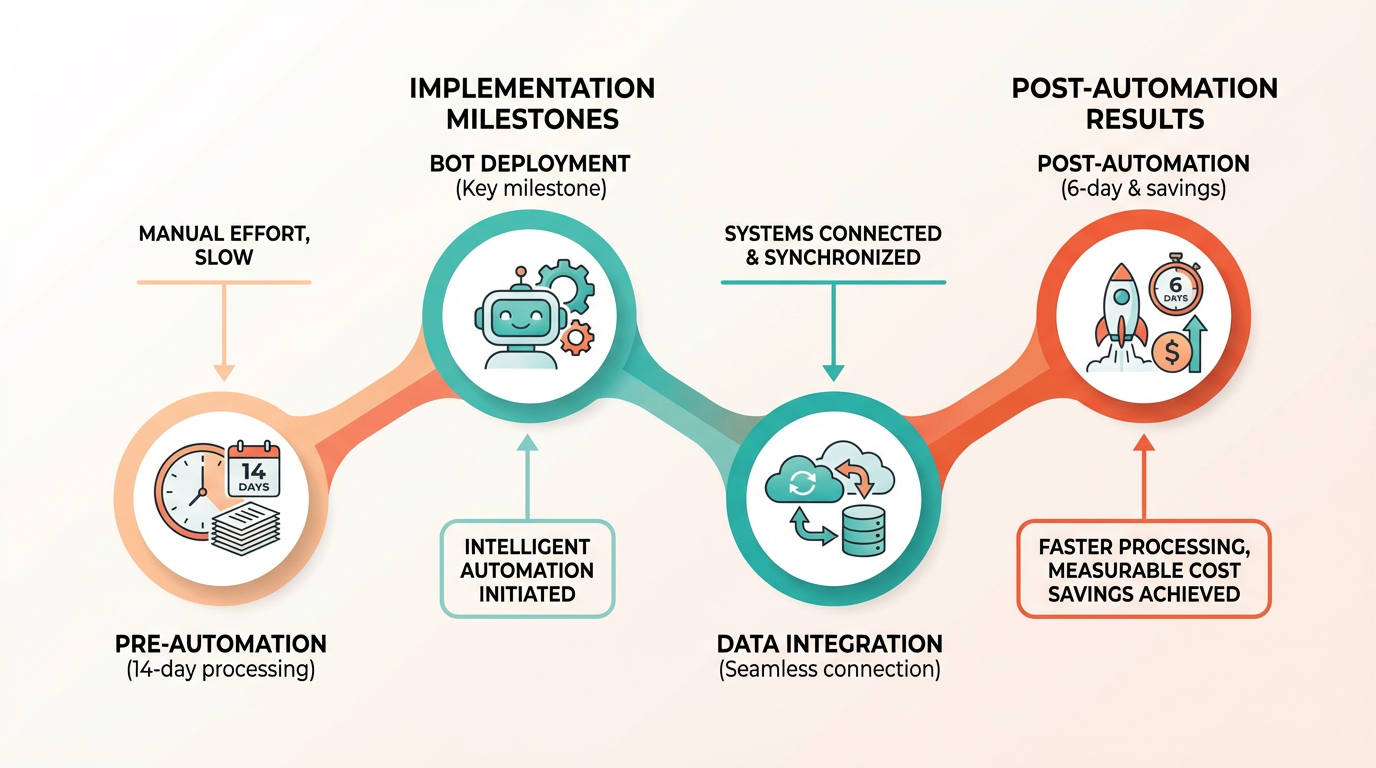
Organizations adopting Robotic Process Automation (RPA) for accounts receivable (AR) workflows often report measurable efficiency gains and cost reductions. One notable example comes from a medical-manufacturing firm that automated its invoice processing system. Before automation, the company struggled with manual data entry delays and reconciliation errors, which extended invoice processing from 14 days to just 6 days after implementing an RPA solution. This project saved over 1,000 person-hours annually, demonstrating how RPA reduces operational friction while improving accuracy.
The automation focused on tasks like invoice reconciliation, payment posting, and automated follow-ups, which were previously prone to human error. By deploying software bots, the firm achieved near-real-time visibility into its AR status and reduced manual errors by over 40%. This case study highlights how RPA transforms AR from a reactive, labor-intensive process to a proactive, data-driven function, as outlined in the Accounts Receivable Automation with RPA section..
Measurable Outcomes and KPIs
When evaluating RPA success, companies track key metrics such as Days Sales Outstanding (DSO), processing time, and error rates. For example, the medical-manufacturing firm mentioned above reduced its DSO by 20% within six months of automation. Another common metric is cost savings per transaction, which often drops by 50–70% after RPA implementation.
A second example, from an unspecified healthcare provider, reported a 30% increase in first-time invoice accuracy after automating payment reconciliation. These metrics underscore RPA’s ability to streamline workflows while maintaining compliance and reducing manual oversight, aligning with the Benefits of RPA in Accounts Receivable section’s discussion on efficiency improvements..
Lessons Learned and Best Practices
Implementing RPA in AR requires careful planning and alignment with business goals. One critical insight from the medical-manufacturing case is the importance of identifying high-impact tasks early. Teams should prioritize automating repetitive, rule-based workflows (e.g., invoice matching, payment reminders) before tackling more complex processes. This approach mirrors the guidance in the Implementing RPA in Accounts Receivable section, which emphasizes task prioritization during deployment.
Another best practice is scaling incrementally. Start with a small project, validate results, and expand to other AR functions like credit checks or customer dispute resolution. For instance, the healthcare provider initially automated payment posting before extending bots to handle invoice generation, achieving a 90% reduction in manual intervention after a phased rollout.
Ongoing monitoring is also essential. RPA systems must adapt to changing data formats and regulatory requirements. Regular audits and updates ensure bots maintain accuracy as transaction volumes grow..
Future Expansion and Strategic Considerations
Forward-thinking organizations use RPA as a foundation for broader digital transformation. The medical-manufacturing firm, for example, plans to integrate AI-driven analytics with its RPA system to predict payment delays and optimize cash flow. Similarly, the healthcare provider aims to connect its bots with customer relationship management (CRM) tools for personalized payment reminders.
Future RPA projects should also consider scalability. Cloud-based solutions, for instance, allow companies to adjust bot capacity during peak periods without overhauling infrastructure. As one finance director noted, “RPA isn’t a one-time fix-it’s an evolving ecosystem that grows with your business.”.
By aligning automation with long-term goals, companies ensure RPA remains a strategic asset rather than a short-term cost-cutting measure. The key lies in continuous innovation and a willingness to refine processes as technology evolves, building on concepts from the RPA and AI in Accounts Receivable section.
Conclusion and Future Outlook
What Are the Key Benefits of RPA in AR Automation?
Robotic Process Automation (RPA) streamlines accounts receivable workflows by handling repetitive, rule-based tasks like invoice matching, payment posting, and reconciliation. This reduces manual effort, cuts processing time by 50–80%, and minimizes human errors. A strategic shift emerges as finance teams transition from transactional work to analytical and advisory roles. For example, one company achieved faster invoice processing and stronger vendor relationships by automating reconciliation, demonstrating how RPA boosts operational efficiency and customer satisfaction. As mentioned in the Benefits of RPA in Accounts Receivable section, these efficiency gains are critical for scaling AR operations.
What Challenges Should Organizations Anticipate?
Despite its advantages, RPA adoption requires careful planning. Initial setup costs, integration complexities, and the need for skilled personnel to manage bots can slow implementation. Additionally, RPA excels in structured environments but struggles with unstructured data, such as handwritten notes or ambiguous payment disputes. For instance, a finance team using RPA for invoice processing found that non-standard formats required manual intervention, highlighting the need for complementary tools. Building on concepts from the RPA and AI in Accounts Receivable section, integrating AI can address these gaps by handling unstructured data more effectively.
What Future Trends Will Shape AR Automation?
The future of accounts receivable automation lies in hybrid systems that combine RPA with emerging technologies like generative AI and machine learning. Forrester’s 2025 research identifies AI-driven use cases such as predictive analytics for cash flow forecasting and generative AI for automating customer communications. For example, predictive models can flag at-risk payments, while AI-powered chatbots resolve disputes faster. By 2025, 90–95% accuracy in processing unstructured data (e.g., scanned receipts) is expected, reducing manual review time significantly. As discussed in the RPA and AI in Accounts Receivable section, these advancements will redefine the balance between automation and human oversight.
How Can Businesses Prepare for This Evolution?
Start by auditing your current AR processes to identify high-volume, repetitive tasks suitable for RPA. Tools like Blixo offer scalable solutions that integrate seamlessly with existing financial systems. Next, prioritize use cases aligned with your pain points-whether it’s accelerating cash application or reducing reconciliation errors. Pilot programs with small-scale automation can validate ROI before full deployment. For instance, a mid-sized firm reduced its accounts receivable cycle time by 30% after automating invoice data extraction. As outlined in the Implementing RPA in Accounts Receivable section, a phased approach ensures smoother adoption and measurable outcomes.
What Role Will Emerging Technologies Play?
Generative AI and advanced analytics are poised to complement RPA in AR workflows. While RPA handles structured tasks (e.g., bank reconciliations), generative AI can interpret unstructured data like email correspondence or handwritten notes. For example, AI-driven systems can auto-generate payment reminders or convert scanned invoices into actionable data. Additionally, prescriptive analytics will enable proactive decision-making, such as predicting payment delays and suggesting mitigation strategies. Organizations should explore hybrid architectures where RPA forms the backbone, and AI addresses edge cases requiring flexibility. Building on concepts from the RPA and AI in Accounts Receivable section, this collaboration will drive the next wave of AR innovation.
Final Recommendations for AR Automation Success
- Assess and Prioritize: Map AR workflows to identify automation opportunities. Focus on tasks with high volume and low complexity first.
- Invest in Hybrid Solutions: Combine RPA for structured workflows with AI for unstructured data and predictive insights.
- Train Your Team: Equip finance staff with RPA literacy to manage bots and interpret automation outputs effectively.
- Partner Strategically: Choose SaaS providers like Blixo that offer transparent pricing and scalable tools tailored to AR needs.
By embracing RPA and its evolving ecosystem, businesses can transform accounts receivable from a cost center into a strategic asset. The key lies in balancing automation with human expertise, ensuring agility in an increasingly digital finance market. Start small, iterate, and scale-your AR processes will thank you.
Frequently Asked Questions
1. What is RPA and how does it help in accounts receivable?
RPA automates repetitive AR tasks like invoice processing, reducing human errors that cause 50% of invoice disputes. It accelerates workflows, cutting processing time by up to 50% and improving accuracy.
2. How do manual errors in AR impact businesses?
Manual errors cause 50% of invoice disputes, delay payments by weeks, and increase Days Sales Outstanding (DSO). They also strain customer relationships and raise bad debt risks.
3. Can RPA reduce invoice processing time significantly?
Yes, a medical firm cut invoice processing from 2 weeks to 6 days using RPA, saving over 1,000 person-hours annually and resolving 50% of disputes during processing.
4. What are the cost savings from RPA in AR?
Automating AR with RPA reduces manual workload by 50%, cuts processing costs, and lowers DSO. For example, error correction during automation prevents costly late fees and bad debt.
5. How does RPA improve customer relationships?
RPA eliminates 50% of invoice disputes by correcting errors in amounts or dates during processing, ensuring accurate invoices and reducing customer frustration over delayed payments.
6. What is the impact of RPA on Days Sales Outstanding (DSO)?
RPA accelerates payment cycles by 50%, reducing DSO and cash flow delays. Automated workflows resolve errors quickly, ensuring faster payments and improving financial forecasting.
7. Why is RPA critical for modern AR workflows?
RPA addresses outdated manual processes, which have 50% automation gaps. It enhances efficiency, reduces errors, and aligns with evolving financial needs by streamlining invoice processing and dispute resolution.