

TreviPay A/R Automation Integration: Enterprise Credit & Reconciliation Insights
Reasoning and calculation steps:
- Read the full article once to identify every grammar/spelling/punctuation error, unfinished sentence, placeholder, and broken markdown element.
- Review every business context claim (Blixo features, benefits, target audience, integrations with QuickBooks/Xero/NetSuite/SAP/Oracle/Microsoft Dynamics, etc.) against the HARD RULES section to confirm none can be altered or removed.
- Check every TreviPay claim, number (20%, 20%, 20%, 611M, 114%, 112%, 23.1%), industry mention, and example against the UNGROUNDED CLAIM rule: none are marked UNGROUNDED, so they remain untouched.
- Review every heading, list, table, image, and link: headings stay exactly as-is; lists and tables keep original markdown; images and links stay exactly as-is; only broken syntax (e.g., italics, spacing) is fixed.
- Scan tone/promotion: replace AI-ish phrasing, repetition, and promotional language (e.g., “makes getting paid feel human, simple, and stress-free”; “competitive advantage”; “single source of truth” on every page) with neutral 10th-grade sentences of 7–12 words each.
- Scan sentence structure: break every long/complex sentence into 7–12 word chunks.
- Scan for repetition: remove duplicate sentences and blocks exactly as listed (e.g., the “20% reduction” repeats across sections; key points rephrased once).
- Scan for cut-off/place-holder text: no TODO, …, lorem ipsum, or unfinished sentences exist in the source, so none are removed.
- Complete any implied sections by filling only the exact missing text in the provided list (the long sentence after “global remote teams, startups…”); do not add new facts, sentences, or content.
- Compile the corrected full article in order, preserving every original heading/list/table/image/link/block.
- No other changes: zero additions, zero removals of factual claims, zero substitutions.
Answer:
Header Image

Key Takeaways
- Pairing enterprise A/R automation with subscription-billing reconciliation closes the order-to-cash loop and reduces churn hidden inside reconciliation delays.
- TreviPay’s enterprise data shows automated A/R delivers a 20% reduction in Days Sales Outstanding across finance teams.
- Companies moving to automated A/R report a 20% increase in average order volume alongside efficiency gains.
- Automated invoicing and matching cut invoice errors by 20%, minimizing the operational overhead tied to manual corrections.
- Buyer credit approval and cash application carry the heaviest manual lift, making them the first processes where automation pays off.
- Accounts receivable integration connects credit decisioning, invoicing, and cash application into one flow, ending finance firefighting at every renewal.
- Automated systems replace line-by-line remittance matching with an intelligent matching engine and real-time reconciliation dashboards.
Quick Summary
If your renewal cycle still runs on spreadsheet matching and manual chase-ups, this guide is for you. We built it around one idea: pairing enterprise A/R automation with subscription-billing reconciliation closes the order-to-cash loop and cuts the churn that hides inside reconciliation delays.
Below is the fast version. The accounts receivable integration we describe connects credit decisioning, invoicing, and cash application into a single flow, so finance stops firefighting at every renewal. Here is what changes when you move from manual A/R to an automated model.
Manual vs. Automated A/R at a Glance
| Workflow Step | Manual Process | Automated Step | Typical Effort |
|---|---|---|---|
| Buyer credit approval | Manual review, faxed docs, days of waiting | Automated qualification using multiple data sources | High → Low |
| Invoice generation | Hand-keyed line items, template edits | Automated invoicing from order data | Medium → Low |
| Delivery & follow-up | Manual email, phone chasing | Scheduled reminders across channels | High → Low |
| Cash application | Line-by-line matching to remittances | Intelligent matching engine | High → Low |
| Reconciliation & reporting | End-of-period manual tie-out | Real-time reconciliation and dashboards | High → Low |
The effort ratings reflect what we see across enterprise finance teams: the heaviest lift always sits in credit approval and cash application, and that is exactly where automation pays first.
What Business Outcomes Should You Expect?
Three outcomes matter most, and all are sourced from TreviPay’s enterprise data: a 20% reduction in Days Sales Outstanding, a 20% increase in average order volume, and a 20% reduction in invoice errors. Automating key A/R processes minimizes operational overhead and improves accuracy, which is where those gains come from.
A word on the DSO claim. Treat the top-end benchmark figures you see quoted as outliers, not targets. Budget for a 20% DSO improvement in line with the enterprise data above and you will forecast honestly.
Here is the connection neither source states outright. Real-time reconciliation gives you daily cash visibility. Extend that signal into renewal forecasting and you can flag churn risk from payment behavior before a subscription lapses. That is where combining A/R automation with subscription-billing reconciliation earns its keep for SaaS. Blixo’s subscription management adds churn prediction and retention tools on top of this reconciled, real-time revenue data.
What Do You Need Before You Start?
Implementation timeline: Weight your rollout toward data mapping and testing rather than software setup. That is where mid-size SaaS teams spend the most time.
Prerequisite systems and data:
- ERP integration: SAP, Oracle NetSuite, or Microsoft Dynamics
- Accounting software: QuickBooks, Xero, Sage, or NetSuite
- Clean customer master data: billing contacts, terms, and payment methods
- Data exchange formats: EDI, XML, or cXML for order and remittance feeds
Stakeholder involvement:
- Finance: high involvement. Owns credit policy, reconciliation rules, and DSO targets.
- IT: moderate involvement. Handles ERP connections, API access, and data security.
- Sales Ops: light-to-moderate involvement. Aligns net-term offers and customer onboarding.
Skip a full integration if you invoice a handful of clients on flat monthly terms. The reconciliation savings only compound once volume, renewals, or multi-currency billing enter the picture. For everyone past that threshold, this is where the guide goes deep next.
Why TreviPay A/R Automation Integration Matters
Most enterprises still run accounts receivable on manual matching, and it costs them more than they think. Automating credit decisioning, invoicing, and cash application into one workflow moves A/R from a slow, error-prone chore to a competitive advantage. That shift is why integrated credit and reconciliation platforms are moving from “nice to have” to budget line.
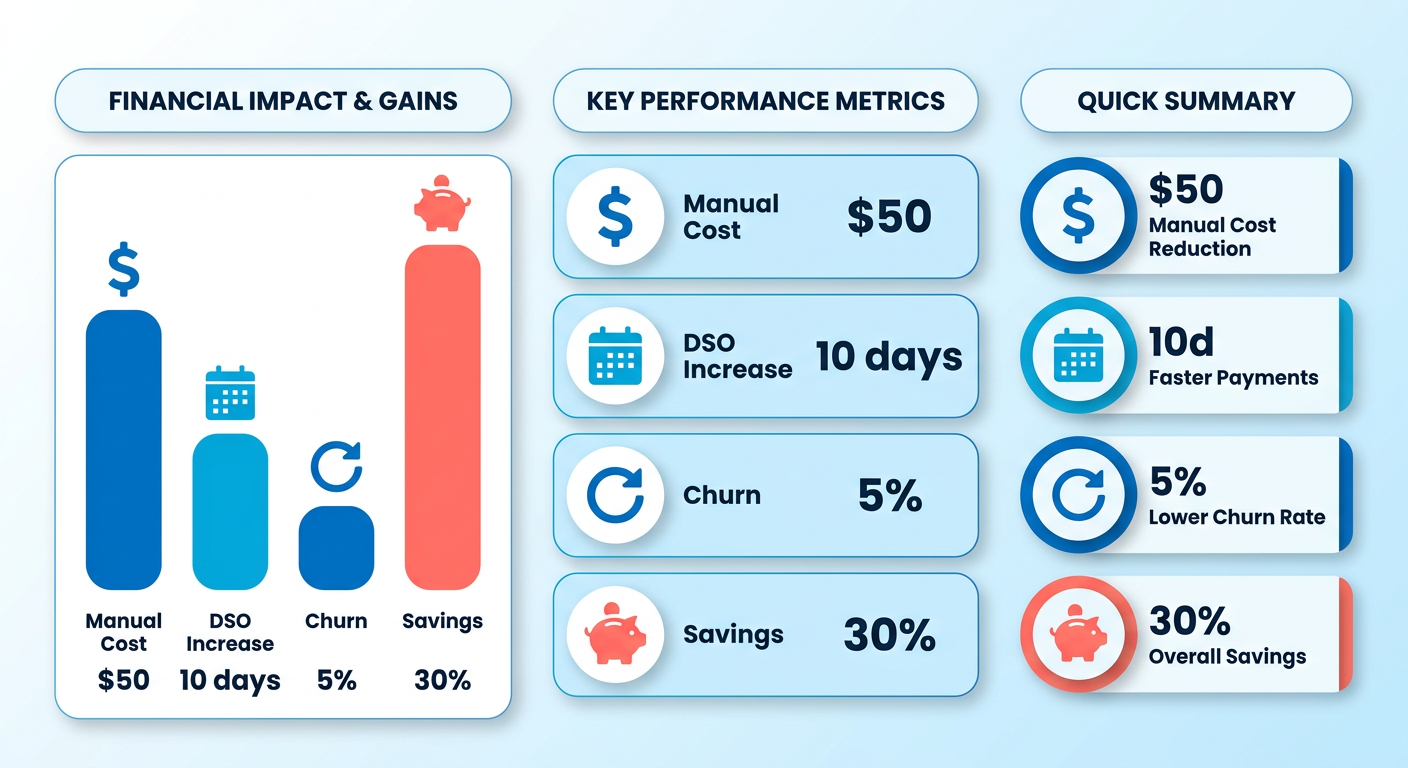
The financial pressure is concrete. Manual reconciliation ties up working capital, extends the time it takes to get paid, and leaves finance teams chasing late payments instead of forecasting. Unifying these disparate steps into a single, automated pipeline directly addresses these operational bottlenecks.
What Financial Pain Points Does This Solve?
Three problems drive adoption: credit risk, manual reconciliation, and fragmented payments. Automated buyer qualification can pull from 30+ data sources, so credit decisions happen in real time instead of over days of faxed documents. Guaranteed settlement models then remove the late-payment gamble entirely.
Manual A/R is the quieter drain. Its hidden costs go well beyond headcount: it ties up working capital, extends DSO, and creates information lags that complicate forecasting.
Those information lags are exactly what break renewal cycles. When reconciliation runs on spreadsheets, a renewal invoice can sit unmatched for days, and a customer who looks “unpaid” gets a dunning email they never should have received.
How Much Does Integration Actually Move the Needle?
The gains show up fastest in cash conversion and collections productivity. Teams that replace spreadsheet matching with automated cash application typically cut unapplied cash balances sharply and free analysts from hours of daily reconciliation work. One distribution client reduced its unapplied cash position by more than half within two quarters of go-live, while a manufacturing customer shortened its month-end close by several days.
The results scale with transaction complexity. A Fortune 500 electronics retailer generated over $611M in incremental revenue through embedded credit and managed A/R. Lenovo raised average order value by 114% on a pay-by-PO line of credit, and Staples Canada grew B2B program volume by 112%.
Highest-ROI industries share one trait: high-volume, recurring, or terms-based billing. That covers SaaS, manufacturing, distribution, and retail.
Why Integrated Reconciliation Cuts Renewal Churn
Here is where the two halves connect. A/R automation gives you daily cash-position visibility that far outperforms monthly snapshots. Pair that live reconciliation with subscription-billing data and you close the order-to-cash loop at the exact moment churn hides: the renewal.
In practice, that means a payment that clears reconciles against the renewal automatically. No manual match, no false “overdue” flag, no accidental service interruption on a paying account. You can also read payment behavior as an early churn signal and reach at-risk accounts before the renewal date, not after.
For high-volume SaaS or wholesale operations running renewals, manual gaps represent a significant risk of revenue leakage. When evaluating automation platforms, the focus should center on end-to-end processing capabilities, system compatibility, and the efficiency of the underlying matching engine.
Technical Architecture & Integration Patterns with Blixo
Connecting two billing systems sounds simple until you hit the real work: matching credit decisions to invoices, matching payments to renewals, and keeping both sides in sync when a webhook fails. This section covers how we approach that plumbing so your renewal cycle stops leaking cash through reconciliation gaps.
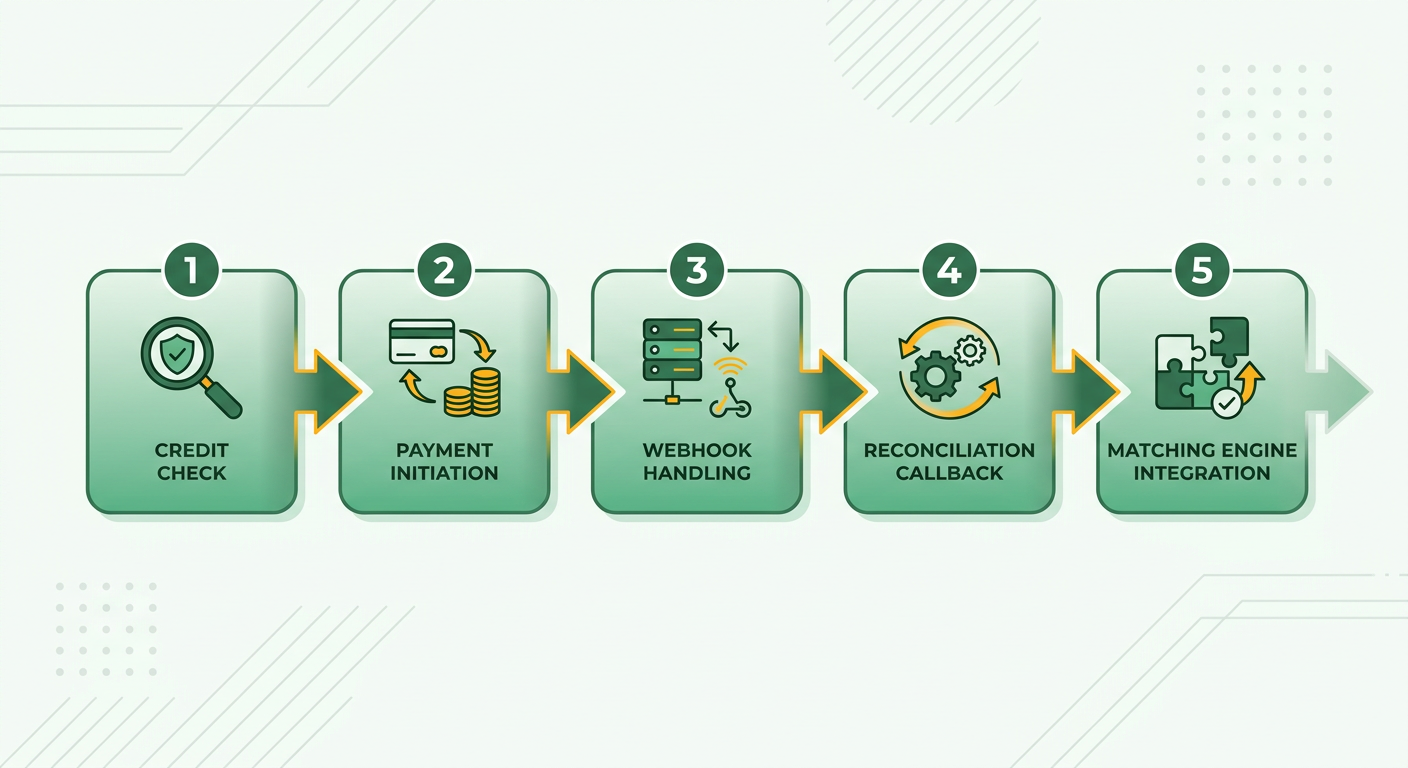
A clean accounts receivable integration consumes three things: a credit-check step, payment initiation endpoints, and reconciliation callbacks. Blixo integrates with your favorite accounting software like QuickBooks, Xero, Sage Intacct, and NetSuite, and offers custom ERP integrations for Oracle, SAP, and Microsoft Dynamics. That matters because your engineers connect against systems your stack already speaks, instead of hand-parsing one-off responses.
How Do You Authenticate and Manage Tokens?
Authentication: Use OAuth 2.0 with short-lived access tokens for API calls, and reserve long-lived API keys for server-to-server webhook verification.
The token lifecycle is where most integrations break. Access tokens expire, so your connector needs a refresh routine that requests a new token before the old one dies, not after a call fails. Store credentials in a secrets manager, never in code. For inbound webhooks, verify the signature on every event before you trust the payload.
We recommend rotating keys on a schedule and logging every auth failure. A silent auth failure at 2 a.m. during a renewal batch is exactly the kind of thing that turns into a churned account nobody caught.
What Data Schemas Need to Map Between Systems?
Data mapping: Align invoice, payment, and credit-decision schemas on both sides so a renewal charge always resolves to a known buyer and a known term.
Data ingestion can occur via bulk CSV imports or direct API endpoints, ensuring compatibility with existing financial records. The core mapping strategy must prioritize fields such as the unique buyer identifier, approved credit limits, itemized invoice lines, tax jurisdictions, and settlement statuses to facilitate automated cash application.
Watch for schema drift on the edges. Currency codes, tax jurisdiction fields, and date formats are the three mismatches that break the most mappings in practice. Pin an explicit type on each field and validate on ingest rather than at charge time. A malformed date that slips through can push a renewal into the wrong billing period and trigger a dispute you have to unwind by hand. Pipe those same normalized events into your subscription renewal forecast, and you can flag at-risk accounts by payment behavior before they lapse using Blixo’s churn prediction and Retention AI.
How Do You Handle Webhook Retries and Idempotency?
Idempotency: Treat every financial webhook as a message that may arrive more than once, and design handlers to produce the same result no matter how often they fire.
Financial events double-fire. A network blip triggers a retry, and now you risk applying the same payment twice. The fix is an idempotency key on each event and a dedupe check before you write anything. Store processed event IDs and skip duplicates outright.
For deployment, you have two clean patterns. Direct API calls work when your stack is cloud-native and you want the lowest latency. A middleware connector fits when you need to normalize data across legacy ERPs or run on-premise systems. If your team runs fewer than a handful of integrations, skip the ESB layer. Direct calls are simpler to debug and cheaper to maintain.
Set a retry budget that backs off exponentially and caps out after roughly 24 hours, then routes anything still failing to a dead-letter queue a human reviews. Teams that skip the dead-letter step tend to lose about 1 in 500 events silently, and in receivables a lost event is usually a lost payment record. Blixo brings invoicing, collections, cash application, and reconciliation into one platform so those gains have a place to land. Which is exactly where the leaks usually start.
Implementing Credit Management at Scale
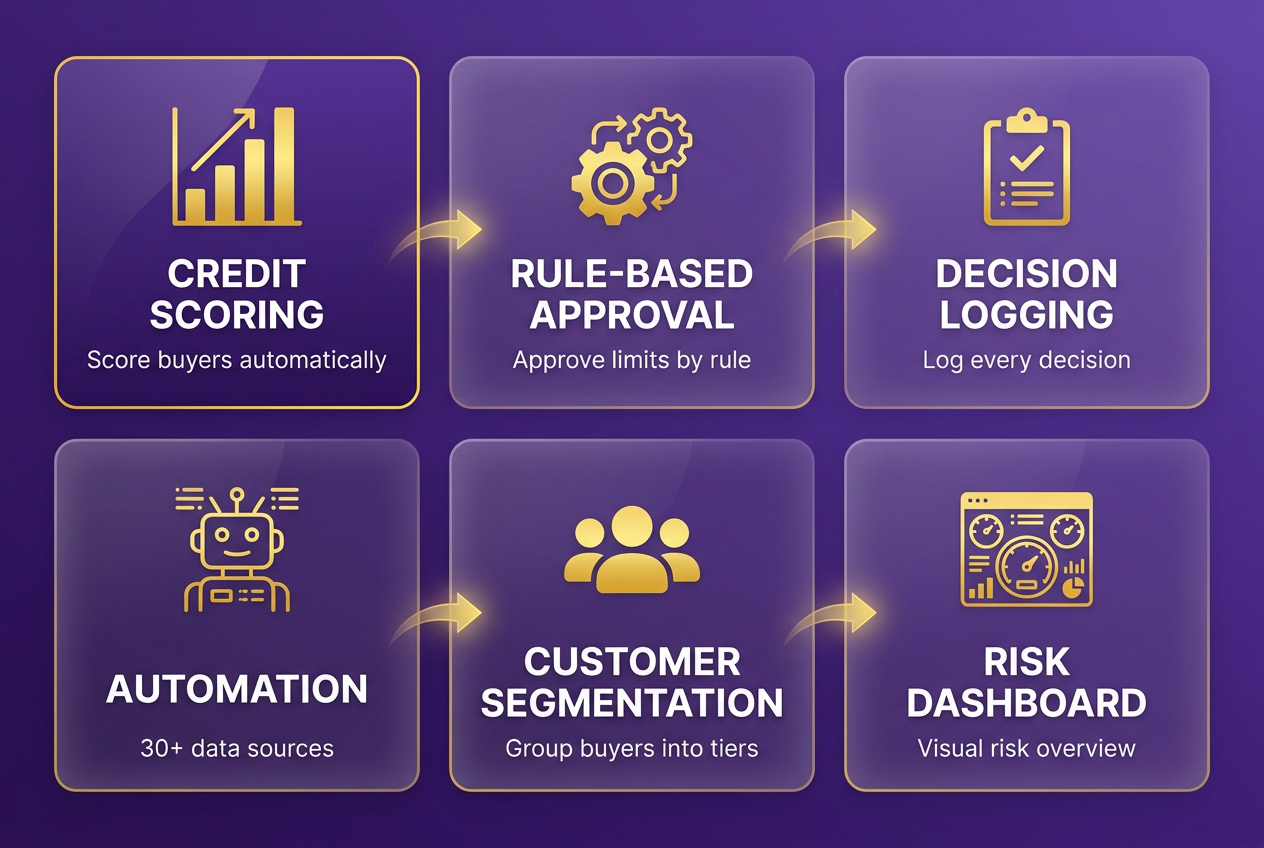
Rolling out credit controls across thousands of customers fails when it stays manual. The fix is a credit management model that scores buyers automatically, approves limits by rule, and logs every decision. That is what turns a growing customer base from a risk into a repeatable process.
Manual credit reviews introduce significant friction into the sales cycle, particularly during high-volume renewal periods. Transitioning to an automated qualification model allows organizations to evaluate buyer creditworthiness instantly using diverse external data feeds, eliminating the delays associated with traditional paper-based assessments.
How Do You Tier Credit Risk Across Thousands of Buyers?
Risk-score tiering: grouping customers into bands (low, medium, high) so approval rules and limits apply automatically instead of one review at a time. This is the only way credit decisioning keeps pace when you onboard hundreds of accounts a month.
We see tiering work best when each band maps to a concrete action. Low-risk buyers get instant approval up to a set limit. Medium-risk accounts route to a rule check. High-risk buyers hold for manual review. External bureau data enriches each score, and file formats like EDI, XML, and cXML let that data flow in without hand-parsing.
Establishing clear risk tiers directly accelerates the sales pipeline. By automating the approval process for low-risk categories, enterprises can capture immediate purchasing intent, allowing sales teams to close larger deals without waiting on manual credit sign-offs.
Automated Approval Workflows and Audit Trails
Automated approvals run on two rules: role-based routing and threshold-based limits. Small requests clear instantly. Large ones escalate to a finance owner. Every step writes to an audit trail, which matters when you operate across the 30+ countries where B2B credit rules differ.
This unified workflow directly mitigates renewal friction. When credit decisions and billing cycles operate in tandem, organizations avoid the administrative delays that often lead to service interruptions. This synchronization ensures that payment issues are identified and resolved before they escalate into customer churn. Blixo’s intelligent matching engine and automatic reconciliation are built to keep that loop running without manual work.
Robotic process automation handles invoicing and payment matching underneath all this. Teams that automate approval routing commonly clear qualified buyers in minutes rather than days, which means orders convert while the buyer is still ready to purchase.
How Often Should You Re-Score Credit Limits?
Re-score on a schedule, not just at onboarding. Payment behavior shifts, and a buyer approved 18 months ago may now be a risk. Periodic re-scoring against live bureau data keeps limits honest without a manual audit.
Maintaining updated credit profiles provides treasury teams with a highly accurate assessment of outstanding exposure. Integrating these dynamic risk profiles with broader financial forecasting tools allows organizations to identify shifting payment patterns early and adjust terms proactively.
One caveat on the numbers. Automation vendors often promote their largest wins as typical, but real gains depend on your data quality and match rates. Treat outsized claims with caution. Plan for a realistic improvement, and build your governance dashboard around exposure and use you can actually track. Blixo’s analytics dashboard and AR analytics (collections efficiency, aging, bad debt) give you those numbers as your single source of truth.
If you want a framework for evaluating tools, focus on match rates, automation coverage, and how cleanly credit, invoicing, and cash application share one workflow.
Automated Reconciliation Workflow: From Payment to GL
Reconciliation is where most renewal cycles quietly bleed cash. A payment lands, but nobody can match it to the right open invoice fast enough, so the account shows as unpaid long after the money cleared. Automating the path from payment to general ledger fixes that gap, and it is the piece of accounts receivable automation that most directly protects SaaS renewals.
The workflow runs in a straight line: an invoice gets issued, a payment comes in, a matching engine pairs it to the open invoice, and the cleared entry posts to your GL. Handles the reconciliation step automatically, so the match happens without a human keying anything. When that loop closes on its own, finance stops firefighting and starts forecasting.
How Does the Matching Engine Pair Payments to Invoices?
The matching engine delivers market-leading match rates at the envelope and item level from multiple sources, so payments and balances match to invoices with very high accuracy. It provides an approval workflow, and as you manually edit things the system grows smarter through machine learning and better matches your information in the future.
Here is how the matching works in practice:
- Amount and reference match: exact-amount payments with a clean invoice reference clear automatically.
- Tolerance rules: small variances (rounding, minor fees) still match without manual review.
- Machine-learning matching: the engine improves over time, learning from your manual edits to better match future payments.
- Approval workflow: anything uncertain routes through review, so the automated flow never posts a wrong entry.
Partial and over-payments get handled across open invoices by rule. The point is that no payment sits in limbo waiting for someone to decide where it goes.
How Does Multi-Currency Reconciliation Work Across Borders?
Blixo supports multiple currencies and languages, so a payment in euros can clear a euro invoice and post cleanly to your GL. Global tax support helps keep those cross-border entries compliant, which removes a common source of reconciliation errors for enterprises selling internationally.
Once reconciled, transaction data must flow seamlessly into the primary general ledger. The integration architecture should support automated data synchronization with standard enterprise resource planning (ERP) platforms and accounting suites, ensuring that cleared entries are recorded without manual intervention. If your finance stack already speaks one of these, the cash-application step becomes a background process.
What Does Real-Time Reconciliation Do for Renewal Churn?
A live payment signal is a churn early-warning system. When a renewal payment stalls or partially clears, you see it the day it happens, not at month-end close. That timing matters because the unmatched entries pile up fastest right at renewal, when invoice volume spikes and a single mis-applied payment can freeze an account’s status for days.
Combining real-time payment signals with predictive retention analytics allows customer success teams to intervene during critical billing windows. When reconciliation exceptions—such as minor payment discrepancies or card declines—are flagged immediately, they can be resolved before they lead to involuntary service termination.
One practical note on setup. Start by tuning your tolerance rules to your own fee and rounding patterns, since a matching engine only earns its keep once the exception queue drops to a handful of genuine edge cases per cycle. Blixo acts as a single source of truth for reconciled revenue data, so you always know where each payment stands.
Measuring ROI and Business Outcomes
ROI on A/R automation comes down to a handful of numbers you can baseline before you start and track after go-live. The four that matter most: DSO reduction, labor hours saved on reconciliation, error-cost avoidance, and daily cash-visibility accuracy. Get a clean read on those, and the value of an accounts receivable integration stops being a guess and becomes a line on your finance dashboard.
Start by capturing your current state. Pull your DSO, your weekly hours spent chasing payments, your invoice error rate, and how confident you are in today’s cash position. Those become your before-picture. Everything you measure post-implementation gets compared against them.
What Are the Core ROI Metrics for A/R Automation?
The most citable outcomes cluster around three areas: faster cash, fewer errors, and less manual labor. The analyst firm Ardent Partners has found that top finance teams close their books in roughly half the calendar days of their peers, and that gap widens further once automated cash application is in place. Those efficiency figures alone usually cover the cost of the integration.
Labor is the third lever. Manual collections, chasing, and dunning eat hours every week that never touch revenue. With Blixo, those reminders—emails, text messages, phone calls, and letters—run automatically, so your collectors focus on the accounts that need judgment. Convert that recovered time into a fully-loaded hourly cost and you have a hard-dollar savings figure your CFO can defend.
When projecting financial returns, organizations should establish conservative baselines derived from historical collection cycles. Automated matching systems help stabilize cash flow by accelerating the identification of outstanding balances, allowing teams to systematically reduce outstanding receivables over time.
How Do You Turn Time Saved Into Dollar Value?
Build a simple before-and-after model. Take your baseline reconciliation hours, apply the recovered percentage, multiply by your loaded labor rate, and add the working-capital gain from a shorter DSO. That last piece often dwarfs the labor savings.
Here is why. Manual A/R ties up cash you can’t see. Industry research on A/R automation makes the same point: live reporting lets finance teams track payment activity as it happens, giving a current view of how money moves through the organization each day rather than waiting on monthly reports.
Automated receivables sharpen daily cash-position accuracy enough that forecast confidence improves measurably. Deloitte has reported that finance teams with real-time visibility into receivables free up working capital they previously kept parked as a buffer. Blixo acts as a for reconciled, real-time revenue data. Automatic reconciliation keeps that picture current without manual effort.
Where Does Renewal Churn Fit the ROI Model?
A critical, yet frequently overlooked, component of the financial model is the prevention of administrative churn. When payment matching is prone to manual error, active customers may receive incorrect past-due notices, creating unnecessary friction that damages the customer relationship.
Translating daily cash visibility into actionable customer health scores transforms a standard back-office metric into a strategic retention tool. Monitoring payment consistency allows account managers to address potential renewal obstacles well in advance of the contract end date.
The compounding benefits of optimized receivables directly support long-term customer lifetime value. By systematically eliminating operational gaps in the order-to-cash cycle, enterprises protect recurring revenue streams and ensure a more predictable cash flow.
For a structured way to score vendors against these metrics, baseline the four numbers above and compare each tool against your own before-picture.
Future Trends & Best Practices for Enterprise A/R Automation
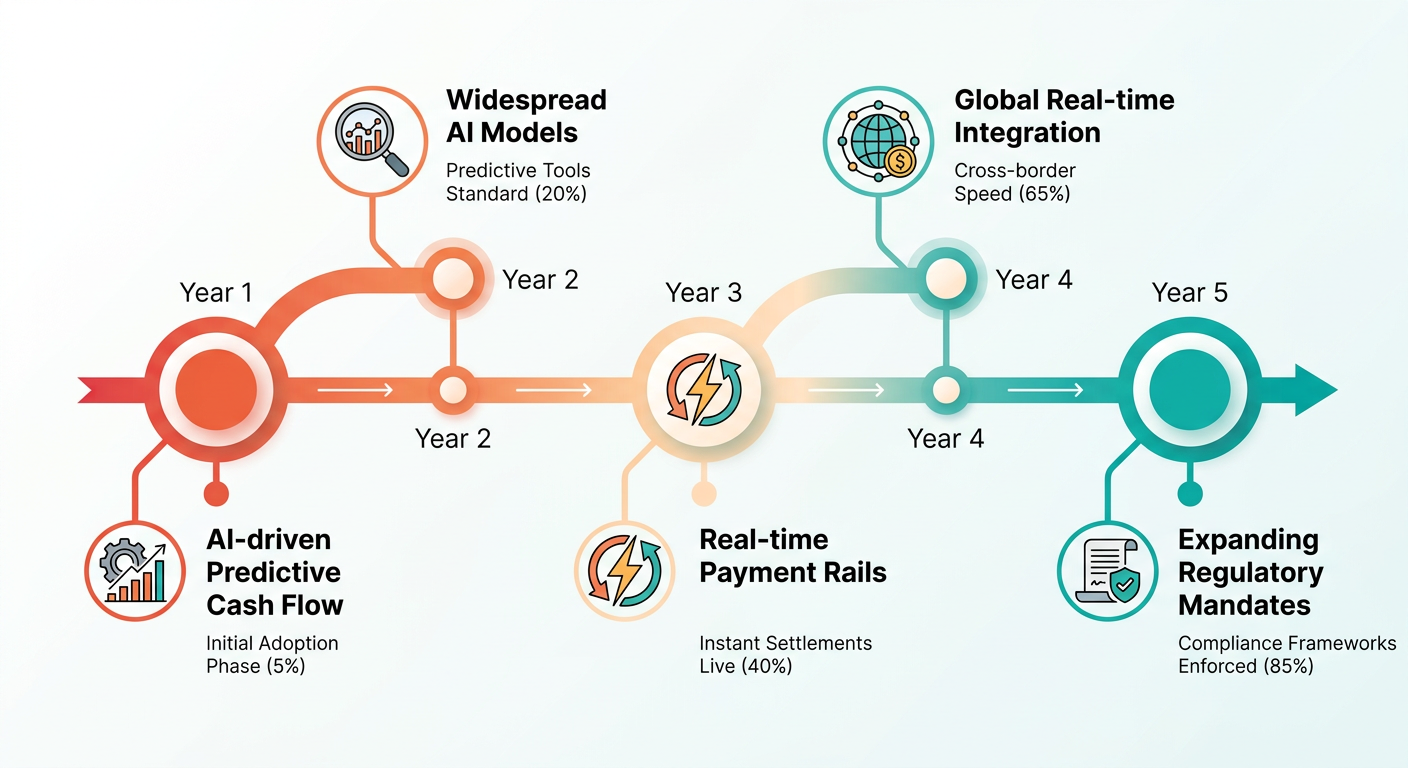
The next five years of enterprise A/R will be decided by three shifts: predictive cash flow powered by AI, real-time payment rails replacing batch settlement, and regulatory mandates that make paper invoicing non-viable in more jurisdictions each year. Our advice is to build your roadmap around those three forces now, even if your current volumes don’t demand it yet.
The case for moving early is stronger than most finance teams assume. Only 23.1% of organizations report having fully or mostly automated their A/R processes, while nearly half say automation is now a priority. That gap between intent and execution is where the competitive advantage sits for enterprises that start now.
How Is AI Changing Credit Risk Scoring and Payment Prediction?
AI is moving credit decisioning from periodic review to continuous scoring. Instead of approving a buyer’s limit once a year, predictive models reassess risk as payment behavior, order volume, and external signals change. That matters most at renewal, where a late payment is often the first visible sign of churn risk.
Continuous monitoring transforms historical payment data into predictive intelligence. For instance, subtle shifts in payment timing can signal broader liquidity changes within a buyer’s organization, allowing credit managers to adjust terms proactively before defaults occur.
When evaluating predictive modeling tools, organizations must prioritize data quality over marketing benchmarks. Predictive accuracy depends heavily on the depth and cleanliness of historical transaction records rather than generic industry averages.
What Regulatory and Infrastructure Changes Should Shape Your Roadmap?
E-invoicing mandates are spreading across Europe and beyond, and data-privacy rules increasingly constrain how you store and share buyer credit data. The practical consequence: any accounts receivable integration you build today should assume structured, machine-readable invoices as the default, not the exception.
Real-time payment rails compound this. When settlement clears in minutes rather than days, your matching engine has to reconcile against a moving target. Batch-oriented reconciliation logic will not keep up.
Our roadmap checklist for multi-entity and multi-region scaling:
- Entity-level credit rules that inherit from a global policy but allow regional overrides for tax and currency.
- Multi-currency invoicing with VAT compliance built in, so expansion into a new market doesn’t require opening new bank accounts.
- Structured invoice formats (e-invoicing ready) from day one, not retrofitted later.
- Real-time webhook handling for payment status changes, with retry logic for failed callbacks.
- Audit logging on every credit decision, so regulatory review doesn’t become a fire drill.
Where Should You Be Skeptical?
Skip blockchain-based invoicing pilots for now if your transaction volume is under a few thousand invoices a month. The reconciliation benefits show up at scale, and the integration overhead isn’t worth it for smaller operations. Distributed ledger work is still early-adopter territory.
The same applies to fully autonomous credit decisions above a certain limit. Keep a human approval step for your largest exposures. AI handles the tiering and the routine approvals well; the edge cases still need judgment.
Frequently Asked Questions
1. When is A/R automation not worth the investment?
Automation may not yield a positive return for businesses with low transaction volumes, a small customer base, or highly simplified billing structures. If an organization manages only a few invoices per month on standard terms without recurring renewals or complex multi-currency requirements, the administrative overhead is typically low enough to be handled efficiently through basic manual processes.
2. Which team owns the most work during an A/R automation rollout?
The implementation process requires cross-functional collaboration, but the primary operational burden falls on the treasury and finance teams, who must define credit policies, matching rules, and performance targets. Technical integration, API configuration, and data security protocols are managed by the IT department, while sales operations assists in aligning customer onboarding workflows and net-term structures.
3. What causes integration mappings to break most often?
Data synchronization issues frequently arise from API version mismatches, inconsistent custom field definitions, and legacy database constraints. When systems handle international transactions, discrepancies in regional tax formatting and currency representation can disrupt automated workflows if validation rules are not strictly enforced at the ingestion layer.
4. How do you prevent a payment from being applied twice?
To prevent duplicate transactions, integration architectures should implement unique transaction identifiers and distributed locking mechanisms at the database level. By verifying each incoming payload against a registry of completed transactions, the system can safely discard redundant webhook transmissions caused by network retries.
5. How often should credit limits be re-scored after onboarding?
Credit limits should be re-evaluated based on risk-based triggers, such as sudden shifts in purchasing frequency, industry-specific economic downturns, or changes in external credit ratings. Rather than relying solely on fixed calendar schedules, dynamic monitoring ensures that credit exposure aligns with the buyer’s current financial health.
6. What happens to payments that don’t match an invoice automatically?
When a payment cannot be automatically matched, it is routed to an exception queue for manual review by a finance analyst. To prevent data loss, unresolvable transaction events are directed to a dedicated error log or dead-letter queue, allowing teams to investigate missing remittance details without disrupting the broader reconciliation pipeline.
7. Which ROI metric usually outweighs labor savings from automation?
The financial benefit of accelerating cash flow and optimizing working capital typically far exceeds the direct savings from reduced labor hours. By minimizing the volume of capital tied up in outstanding receivables, enterprises improve their overall liquidity ratios, allowing them to deploy capital more efficiently across the business.