

Pagero for Invoice Management: How Its E-Invoicing Network Compares With Billtrust and Corcentric

Key Takeaways
- Pagero handles e-invoicing compliance across 70 countries and serves 86,000 customers, with a 2% churn rate and 84% CSAT.
- Teams running AR automation report cost savings of up to 80%.
- One global food and agri conglomerate cut invoice cycle time by over 70% and hit 99% error-free transactions.
- Mandates are active or close in Belgium, Poland, France, and India, so e-invoicing is a legal requirement in those markets, not a preference.
- Penalties run from Rs 10,000 to Rs 25,000 in India and up to €15,000 per year across several EU countries.
- Pagero’s marquee deployments run full AR automation in far fewer countries than it validates. Hewlett Packard Enterprise covers 29 of the 70 supported.
- E-invoicing networks kill manual re-keying by passing validated, structured documents straight from sender to recipient.
Why E-Invoicing Went From Optional to Mandatory
In much of the world, e-invoicing stopped being optional. It is law now, and the numbers explain why buyers care. Evaluate an AP/AR automation vendor like Pagero on invoice management, and you are looking at compliance coverage across 70 countries with real-time schema validation, 86,000 customers, a 2% churn rate, and 84% CSAT. Those figures show the model works at scale.
The financial case is just as direct. Teams running AR automation report cost savings of up to 80%. One global food and agri conglomerate cut invoice cycle time by over 70%, halved operational costs, and reached 99% error-free transactions with full audit traceability. That is the payoff on both the payable and receivable side.
What E-Invoicing Networks Actually Fix
They remove manual data entry, shorten payment delays, and keep you compliant as tax rules change. Instead of re-keying invoice data across systems, documents move validated and structured from sender to recipient. The errors and lag that plague paper and PDF workflows go away.
Compliance is the sharpest pain right now. Belgium, Poland, France, and India have active or imminent mandates, and the penalties have teeth. Fines run from Rs 10,000 to Rs 25,000 in India and up to €15,000 per year across several EU countries. A network that keeps pace with each government’s technical specs reduces that exposure.
One catch is worth flagging. Pagero validates compliance across 70 countries, but its flagship deployments (Hewlett Packard Enterprise across 29 countries, plus Ricoh) run full AR automation in far fewer. Broad compliance reach and deep workflow automation are separate purchases, not one. A tool that validates an invoice but never connects to matching, approval, and posting leaves a gap you will feel later.
Who Gets the Most Out of These Networks
Enterprises with multi-country operations. HPE meeting tax and legal requirements in every country it operates is the proof point. That capability comes with enterprise pricing, though.
And there is a gap. Every major platform here is built and priced for large multinationals. Billtrust runs roughly $20K to $150K+ annually, and Pagero’s marquee cases span dozens of countries.
| Factor | Pagero | Billtrust | Blixo |
|---|---|---|---|
| Compliance coverage | 70 countries | Broad enterprise | Global tax support |
| Annual cost | Enterprise-tier | $20K–$150K+ | SMB-friendly |
| Built for subscription billing | No | No | Yes |
| AP + AR + cash application | Partial | Partial | All-in-one |
SaaS SMBs face the same mandates and the same fines, without a vendor built for their budget or recurring billing cycle. That is the space we built for. Blixo handles invoicing, collections, and cash application together, so smaller subscription businesses get end-to-end automation without stitching together enterprise tools they cannot justify. And when payments run late, our automated collections and dunning go out across email, text, phone, and letters, so chasing is not your job.
What Pagero’s Network Really Does
Pagero’s core value is its compliance architecture. The platform validates e-invoices in real time against local mandate schemas, runs a PEPPOL-first network, and connects to major ERP systems. Multinationals route transactions through certified access points, and documents clear validation across tax jurisdictions without a custom integration per region.
The scale is real, and it is aimed squarely at companies filing taxes in many countries at once. The network spans thousands of connected trading partners and routes through certified PEPPOL access points, so a single invoice can clear validation in one country and move to the next without a new build. For cross-border tax obligations, that breadth matters. The question we keep circling back to is whether it fits a SaaS SMB on subscription billing, and the honest answer is usually no.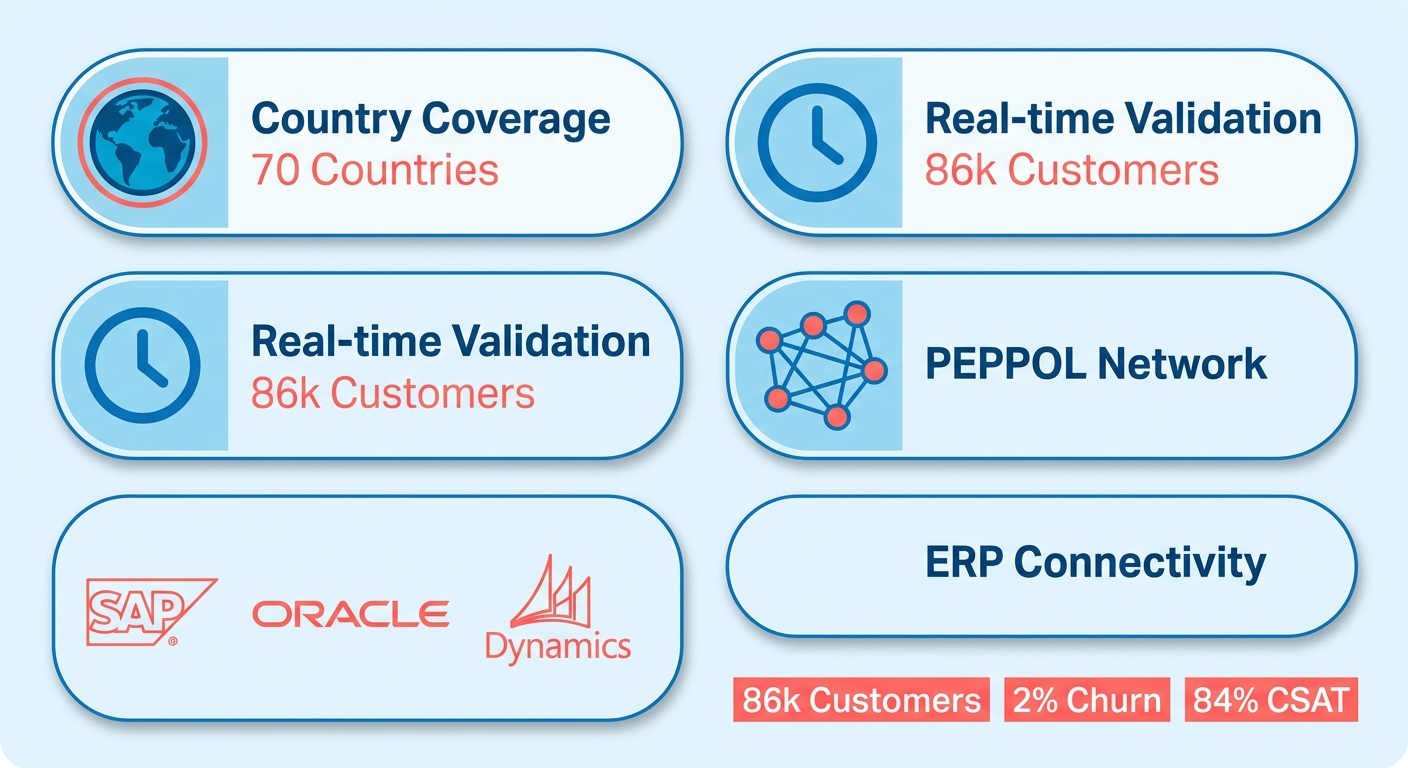
Validation Is Not the Same as Automation
When an invoice hits a government portal, the network checks its structure against local XML schemas. Once the tax authority accepts it, your billing team still has to track payment status, work disputes, and reconcile the transaction in the ledger. Different job entirely.
Without native workflow tools, you are building custom middleware to bridge the compliance network and your internal AR systems. That overhead bites hardest when a tax authority updates its technical specs and IT has to adjust data mappings to avoid rejections.
What Pagero Costs, and How to Read the Reviews
Pagero targets enterprise budgets, and the pricing model confirms it. Contracts are quote-based and scale with transaction volume, connected entities, and the number of jurisdictions in play, so the entry point climbs fast as you add countries. Review data is thin and contradictory. Pagero shows a perfect 5.0 on G2 but a 3.0 from a single review elsewhere, while Billtrust holds a 4.5 from 643 reviews. Neither Pagero score is statistically meaningful. Weight documented enterprise deployments over aggregate stars.
The platforms in this category are priced and positioned for multinationals invoicing across dozens of countries, with implementation timelines and minimum commitments to match. That leaves smaller businesses hunting for a simpler way to run their billing cycle without paying for global infrastructure they do not need. A unified workflow that folds invoicing and collections together is usually the more practical option for them.
Where Blixo Fits in AR Automation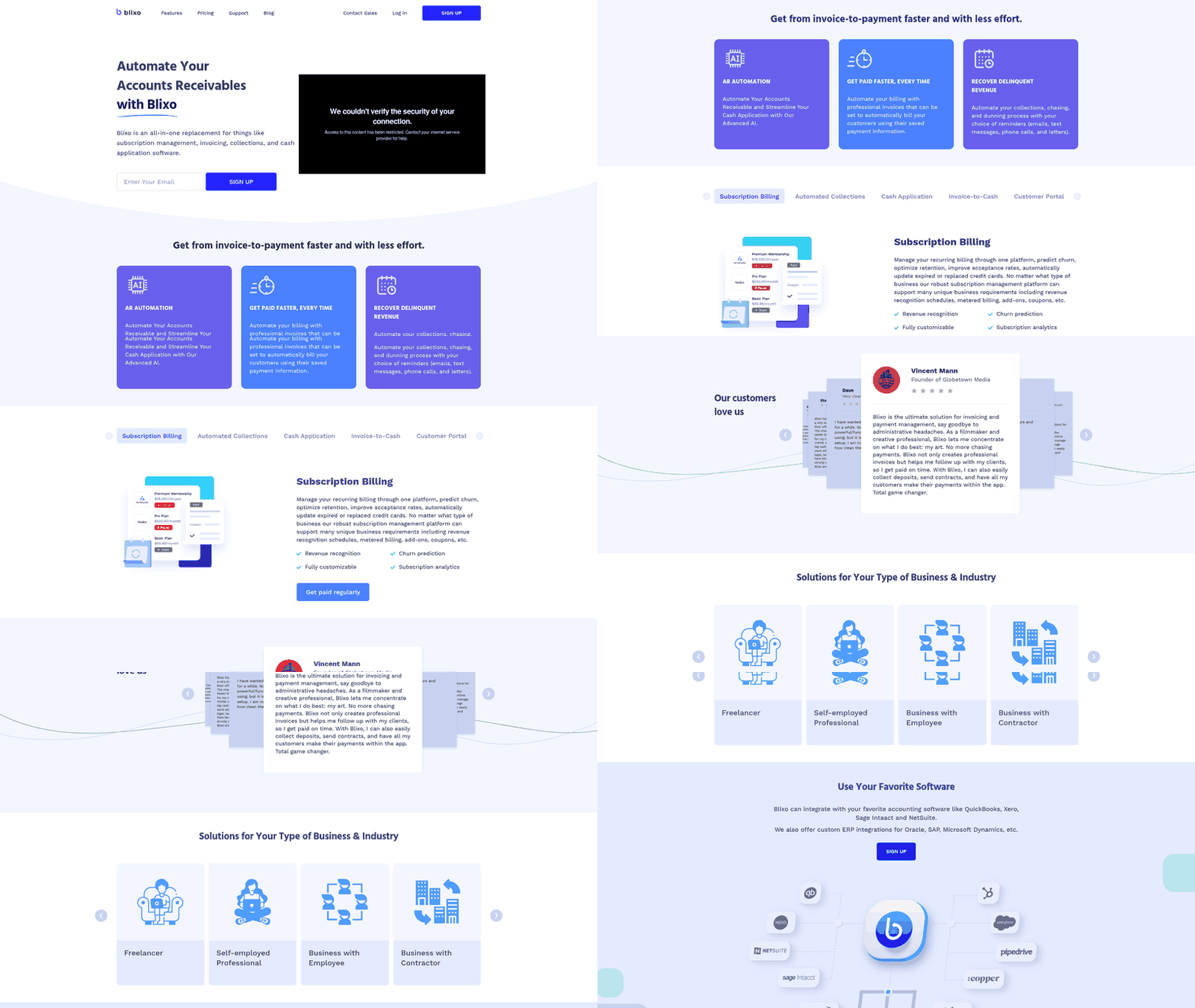
Evaluate an AP/AR automation vendor for invoice management and you are often looking at enterprise-grade compliance reach. But if you are a SaaS business or service company invoicing on recurring terms, you need something built for subscription billing, automated collections, and fast cash application. That is us. Blixo handles the full AR cycle, invoicing, dunning, payment matching, and customer portals, without forcing you to stitch tools together or pay for global tax mandates you do not touch.
We built Blixo for the moment mid-market companies outgrow spreadsheets but cannot justify the cost or complexity of enterprise AR suites. You get automated invoice generation tied to your subscription plans, AI-powered cash application that matches incoming payments to open invoices in seconds, and a custom customer portal where clients view balances, pay invoices, and manage accounts without emailing your team. It all runs on one platform, so no data-syncing headaches and no middleware licenses.
Automation Across the Whole Receivables Cycle
Our AR automation starts before you send the invoice. The system generates recurring invoices from your subscription plans, applies usage-based charges when needed, and sends them on the schedule you set. Once an invoice goes out, the dunning engine takes over. It tracks due dates, sends reminders at intervals you configure, and escalates follow-ups on overdue accounts. No manual chasing, no trying to remember which customer needs a nudge.
The intelligent matching engine takes on the messiest part of AR: reconciling payments to invoices. When a payment lands, the system matches it to open invoices using reference data, customer identifiers, and amount logic. Partial payments, overpayments, and multi-invoice settlements get applied correctly without manual intervention. As you edit matches by hand, the system learns and matches more accurately over time.
Collections automation goes beyond reminders. It tracks payment behavior, flags high-risk accounts before they turn into write-offs, and gives you a live view of aging receivables. You can set custom dunning sequences by invoice amount, customer segment, or payment history. Every interaction gets logged, so your team knows where each account stands without digging through email threads.
Integration and Security for Finance Teams
We connect to the tools you already run. Blixo works with QuickBooks, Xero, Sage Intacct, and NetSuite, offers custom ERP integrations for Oracle, SAP, and Microsoft Dynamics, and syncs customer data with Salesforce, HubSpot, and Shopify. No exporting CSVs or updating records across systems by hand. Our bank and ERP integrations feed the cash application engine directly, so invoice creation, payment updates, and customer changes flow through automatically.
On security, we keep an audit trail and event log for compliance and data integrity, and we enforce granular roles and permissions (IAM) so team members see only what they need. If you handle client payment information, that structure matters. The detailed audit logs cover most internal compliance requirements without extra reporting overhead, and you can take ACH/eChecks, credit cards, paper checks, and wire transfers through the platform.
The custom customer portal gives clients a branded space to view invoices, download statements, update payment methods, and check subscription details. It cuts support volume because customers answer their own questions instead of emailing you. You control what shows up, and clients reach it through a secure login. Self-service portals reduce payment friction. Customers tend to pay faster when they can click a button instead of waiting for someone to process a request.
| Feature | Blixo | Pagero | Billtrust |
|---|---|---|---|
| Subscription Billing | Native support with usage-based charges | Not designed for recurring billing | Limited subscription handling |
| AI Cash Application | Automated matching with partial payment logic | Manual or ERP-dependent | Available in premium tiers |
| Custom Customer Portal | Included, fully branded | Not offered | Available as add-on |
| Pricing Model | Transparent per-user or transaction pricing | Enterprise quotes only | Volume-based, complex tiers |
| Best For | SaaS and service businesses with recurring invoices | Multinationals with cross-border compliance needs | Large enterprises with high invoice volumes |
Our pricing scales with your business. You’re not paying for global tax validation networks you do not use, and you’re not locked into multi-year enterprise contracts. The Team plan runs $49.99/mo, Business is $99.99/mo, and Enterprise is quote-based for higher volume. By removing manual AR work and speeding up cash flow, the platform helps you recover revenue faster and reconcile in real time. If you are a service business, agency, or SaaS company that wants to automate receivables without overpaying for enterprise infrastructure, we are worth a look next to the bigger names.
Pagero vs. Billtrust vs. Corcentric vs. Blixo
These are enterprise-grade tools built for genuinely different workflows. Pagero validates documents against government schemas. Billtrust automates payment collection and AR for businesses invoicing on net terms. Corcentric leans into source-to-pay automation with supplier management and procurement controls. Blixo runs the recurring billing cycle, an option for businesses that do not need global compliance infrastructure.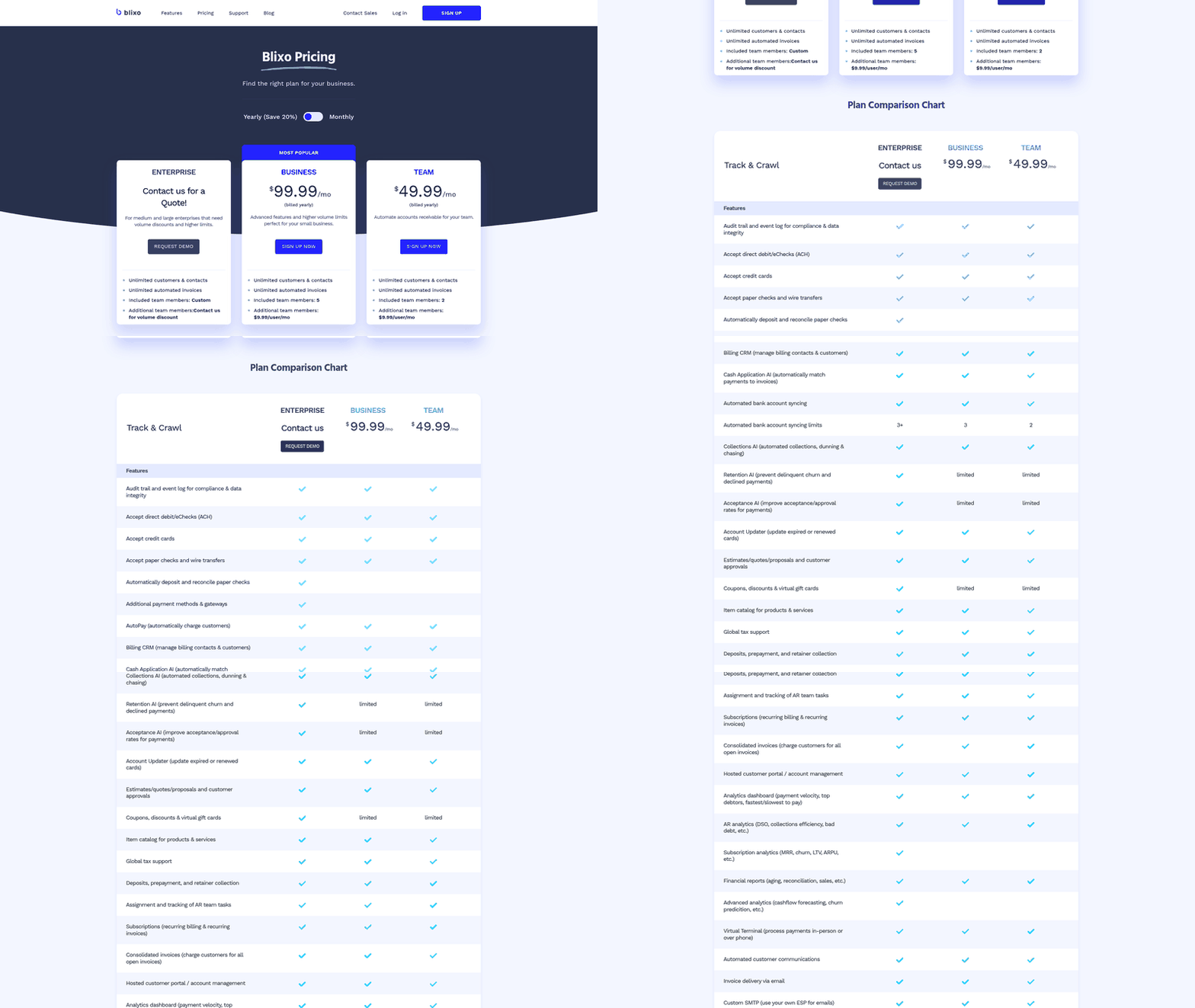
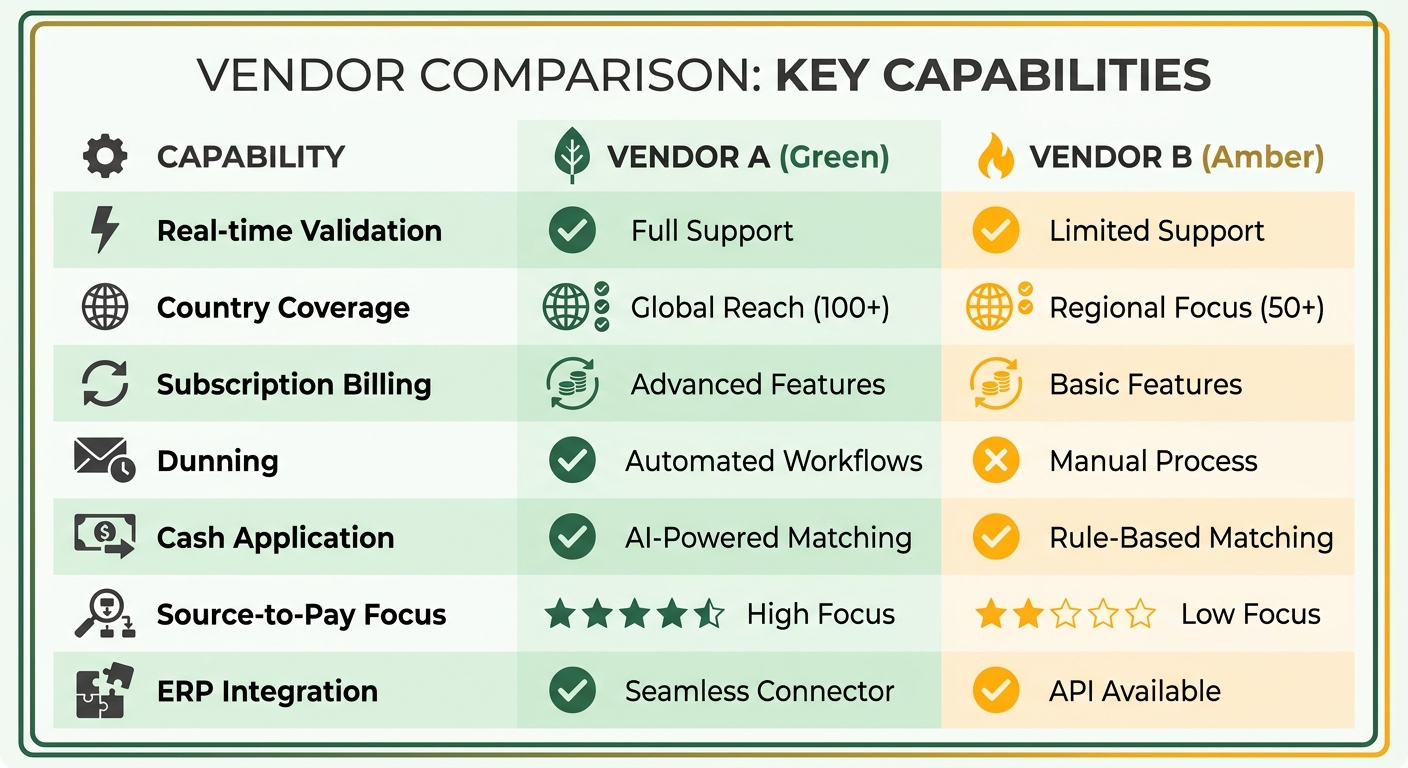
The buying decision usually comes down to invoice volume and geography. Billtrust and Corcentric price by transaction tiers and solution modules, which rewards high-volume B2B senders but adds cost as you bolt on credit, collections, and procurement. Pagero scales with the number of country mandates you activate, so a company in three markets pays far less than one in thirty. We price for SaaS SMBs and service businesses invoicing on recurring terms, not enterprises filing taxes across dozens of jurisdictions.
Compliance Reach vs. Workflow Depth
This distinction is the whole game. A platform that validates invoices against government schemas but lacks native matching, approval, and posting creates a gap in your AR process. You stay compliant with local tax law, but your team is still reconciling payments by hand.
Billtrust has been implemented in over 2,400 organizations since 2001, which shows real depth in AR automation and payment collection. Its cloud-delivered model needs deep ERP integration for meaningful rollouts, and that works well for traditional enterprise setups. For businesses on subscription or usage-based pricing, that ERP-centric architecture can feel like overkill next to a system that manages recurring billing and automates collections straight from billing events.
Implementation Effort
Some platforms need extensive IT work to map custom data fields into standard e-invoicing formats. Others are closer to plug-and-play.
Timelines track vendor architecture. Pagero emphasizes API-first document exchange, so rollout speed depends on how complex your existing systems are. Billtrust also requires integration for core functionality, often weeks to months depending on your data architecture. Blixo runs subscription management, invoicing, collections, and cash application from one system and connects directly to standard accounting tools, which keeps setup simpler.
What Each Platform Does Best
| Feature | Pagero | Billtrust | Corcentric | Blixo |
|---|---|---|---|---|
| Best For | Multinationals with cross-border tax mandates | AR automation and payment collection on net terms | Source-to-pay automation with procurement controls | Subscription billing, automated collections, SaaS SMBs |
| Compliance Coverage | Global coverage, PEPPOL-first, real-time schema validation | North America focus, moderate compliance tooling | VAT compliance, supplier management | Core compliance for recurring billing, not global mandates |
| Workflow Automation | E-invoicing, CTC compliance flows | AR automation, payment collection, credit management | AP/AR, procurement, supplier onboarding | Full AR cycle: invoicing, dunning, payment matching, portals |
| ERP Integration | SAP, Oracle, Microsoft Dynamics, API-first | Cloud-delivered, requires ERP integration | ERP-agnostic, source-to-pay focus | Subscription-plan native, no ERP dependency |
| Pricing Model | Enterprise, mandate-based (not published) | Transaction-tier and module-based | Enterprise (not published) | SaaS SMB pricing |
| Implementation Time | Weeks to months (ERP-dependent) | Weeks to months (ERP integration required) | Weeks to months (procurement workflows) | Subscription-plan native, no ERP dependency |
Pagero is the right pick if you file taxes across multiple jurisdictions and need real-time validation against changing government schemas. User feedback says it reduces manual work and improves visibility into AP, and it helps multinational deployments meet tax and legal requirements in every market they operate.
Billtrust fits businesses invoicing on net-30 or net-60 with high transaction volumes. Its strength is payment collection and AR automation, a strong fit for distributors or manufacturers pushing thousands of B2B invoices a month.
We built Blixo for businesses that invoice on recurring terms and need automated collections without paying for compliance infrastructure designed for multinationals. If you are a SaaS company, agency, or professional services firm on subscription billing, you do not need global mandate coverage. You need a system that automates the AR cycle from invoice generation to payment matching.
What I’d Actually Recommend
Evaluate Pagero for invoice management and the read is straightforward: it is a compliance engine for multinationals, not a full AR suite for everyone. It wins on schema validation and country coverage. It does not solve subscription billing, dunning, or cash application on its own.
That distinction matters more than any star rating. Look past the aggregate scores and focus on how well a platform’s architecture matches your billing model. A tool that excels at validating cross-border tax documents may still miss what you need to manage recurring customer relationships.
Which Platform Fits Which Business
It comes down to what you actually need: compliance coverage, workflow automation, or both. A standalone compliance tool with no link to approval and posting leaves a real gap. That is the trade-off with validation-first tools. They confirm your documents pass, but payment matching and reconciliation still land back on your team.
| Need | Best fit | Why |
|---|---|---|
| Multi-country compliance mandates | Pagero | Real-time schema validation, PEPPOL-first |
| Enterprise AR + strong support | Billtrust | Established enterprise track record |
| Source-to-pay + procurement | Corcentric | Supplier management focus |
| SaaS/SMB subscription billing | Blixo | Recurring invoicing, dunning, cash application in one service |
Notice the gap. Every enterprise option here is priced for large multinationals, which leaves smaller subscription businesses without a vendor built for their budget or their billing cycle.
Where Mandates Are Headed
They are expanding fast, and the penalties are real. Germany plans to phase in mandatory B2B e-invoicing starting January 2025, with full enforcement by 2028. Saudi Arabia’s ZATCA system now requires all taxpayers to issue electronic invoices with QR codes, and non-compliance triggers immediate transaction rejections at the platform level.
A platform that makes your IT team rebuild schemas every time a government revises its specs is not sustainable. If you operate across borders, buy compliance you do not have to maintain yourself. If you invoice domestically on recurring terms, do not pay for global mandate infrastructure you will never touch.
How to Decide
Match the tool to your operating reality, not a feature checklist. Broad reach does not equal deep automation.
For most subscription businesses, the right move is an all-in-one service that runs the billing cycle without the enterprise price tag. Skip the heavyweight compliance suites if your invoicing lives in one or two countries and your real pain is getting paid on time.
Start by mapping where you invoice and where your cash actually leaks. If it is cross-border compliance, shortlist Pagero. If it is slow collections and messy reconciliation, pick a tool built for the invoice-to-cash cycle.
Frequently Asked Questions
1. Does Pagero handle subscription billing for SaaS companies?
Pagero is not designed for recurring or subscription billing. Its architecture is built for multinationals filing taxes across many countries. SaaS businesses on recurring terms are better served by platforms like Blixo, which handles invoicing, dunning, and cash application natively without requiring global mandate infrastructure.
2. Why does Pagero cover 70 countries but only automate 29?
The difference lies in the distinction between document validation and end-to-end workflow automation. While a provider may support schema validation in a wide range of countries, actual customer deployments for full accounts receivable automation often cover a smaller subset of those regions. Compliance validation and deep workflow automation are separate capabilities.
3. What happens if I ignore e-invoicing mandates?
Non-compliance carries financial penalties, audit failures, and operational disruptions. Depending on the jurisdiction, tax authorities may impose flat fines per incorrect invoice or annual penalties for systematic non-compliance. In some regions, government portals will immediately reject transactions that lack the required electronic formatting or QR codes, blocking payments entirely.
4. Should I trust Pagero’s online review scores?
It is best to weight documented enterprise deployments over aggregate star ratings. When a vendor has very few public reviews, the scores can be skewed by single entries and are not statistically meaningful. Look for detailed case studies and peer references that match your company’s scale and ERP setup instead.
5. Do I need ERP integration to run these platforms?
Enterprise platforms typically require deep integration with major ERP systems, meaning rollout speed depends on the complexity of your existing database. Other platforms run subscription management, invoicing, collections, and cash application from a single system with no ERP dependency, connecting instead to standard accounting software via pre-built APIs.
6. When do the major upcoming e-invoicing mandates take effect?
Several European countries have already activated their mandates, while others are phasing them in over the next few years. For example, major rollouts are scheduled to begin in late 2026, with full enforcement across other key European economies planned by 2028. Mapping where you invoice against these timelines helps determine when you need to have a compliant solution in place.
7. How does Blixo’s pricing compare to enterprise AR tools?
Enterprise tools use quote-based pricing that scales with transaction volume, connected entities, and the number of active jurisdictions, often requiring significant annual commitments. In contrast, Blixo offers transparent, tiered monthly plans for smaller businesses, allowing them to automate their accounts receivable without paying for global tax networks they do not use.