

Order to Cash Automation for SaaS: Where Manual Invoicing Leaks Revenue

The Short Version
In short: manual invoicing and slow collection follow-up leak revenue you’ve already earned. Accounts receivable automation closes that gap by making invoice delivery timely and follow-up automatic, the two recovery steps manual systems most often miss.
- Businesses can lose measurable income to revenue leakage. Optimizing order-to-cash is often cited as a material earnings improvement, though the size of that improvement depends on billing model and process maturity.
- Leakage tends to concentrate in recurring billing errors, failed payment recovery, and manual AR follow-up, not early sales steps. The contract-to-invoice gap and manual dunning cycles are two of the biggest culprits.
- The KPIs that move first: days sales outstanding, revenue leakage percentage, and collection cost per invoice.
- Finance teams often spend substantial time each week on invoice processing, overdue payment tracking, and reconciliation before automation removes those repetitive tasks.
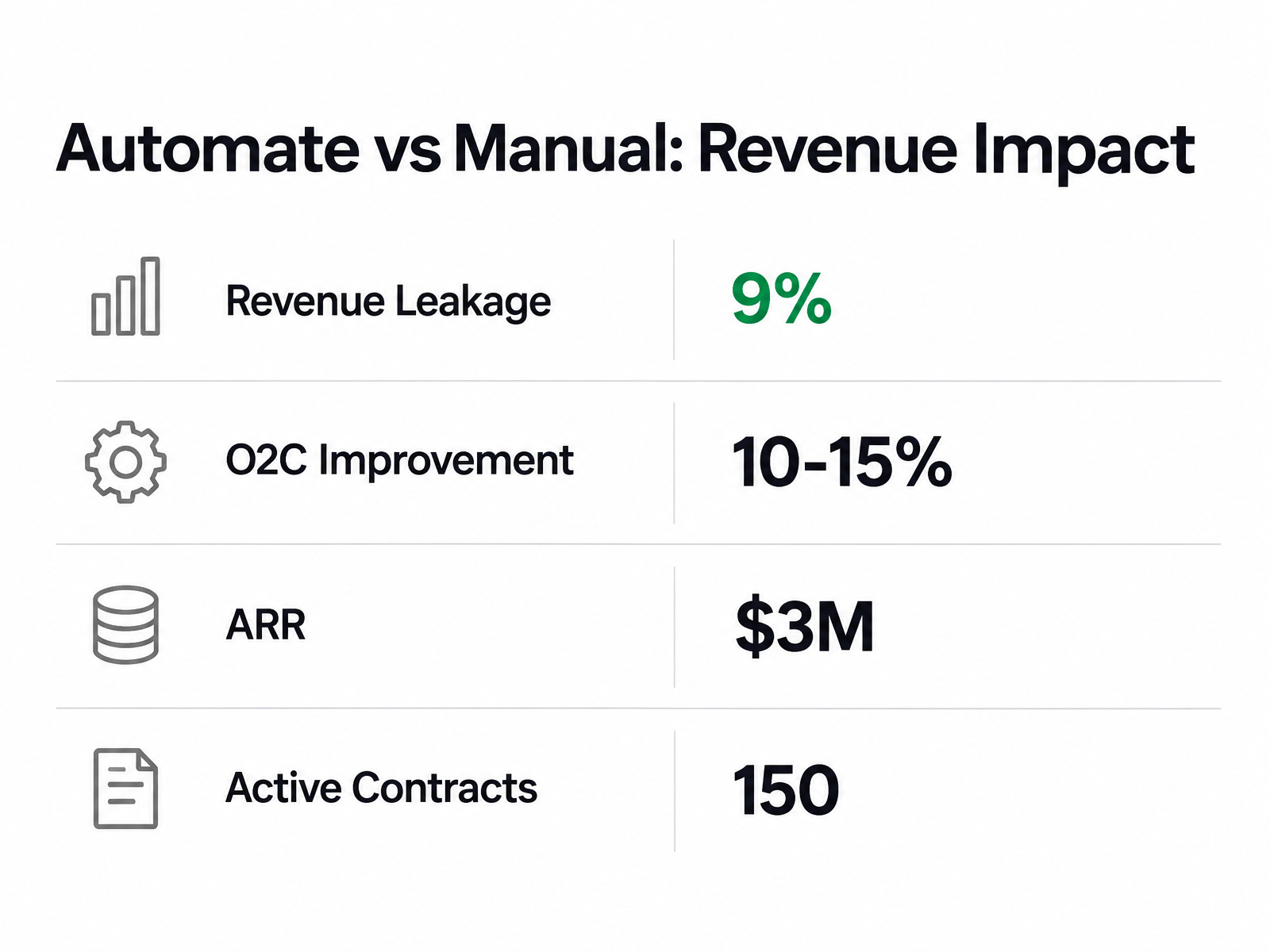
Skip full-scale AR automation if you send a handful of simple invoices each month. The setup may not justify the payoff. For recurring, usage-based, or milestone billing, leakage compounds fast. Optimized O2C can also free working capital that would otherwise sit in unpaid receivables.
Where SaaS Cash Actually Leaks
For SaaS, the invoicing and payment-recovery stage is where earned revenue either becomes cash or quietly leaks. AR automation matters here because manual follow-up is too slow to catch two common leaks: late invoices, and payment failures that never get a timely second attempt.
Some public order-to-cash materials point to delayed invoicing, rising DSO, revenue leakage, and compliance and audit exposure when manual silos and disconnected systems go unaddressed. In subscription businesses, that leakage tends to concentrate in recurring billing errors, failed payment recovery, and manual AR follow-up. None of these appears as a single obvious line item. They sit inside DSO and the aging receivables report, compounding every week.
The three KPIs that move first
Days sales outstanding, revenue leakage percentage, and collection cost per invoice shift before anything else. DSO can fall because invoices go out on time and dunning starts before a payment slips too far past due. Revenue leakage can shrink when billing automation is configured to retry failed charges, update expired cards, and send dunning prompts instead of silently cancelling a healthy subscription. Collection cost per invoice can drop because your team stops doing manual reminder work that a scheduled sequence can handle.
There’s also a customer-experience multiplier here. A late invoice creates a late payment. A late payment creates a collection touch. That touch arrives after the customer has already experienced a broken billing moment. At that point, you’re re-earning trust, not just chasing cash. Treat invoicing and recovery as revenue protection, not back-office cleanup, and you keep the ASC 606 audit trail intact.
The Six Hand-offs That Leak Cash
Manual leaks in SaaS order-to-cash concentrate in invoicing and accounts receivable automation, not the earlier sales steps.
I map the cycle as six hand-offs: quote, contract, provisioning, invoicing, collections, and cash application. Public finance guides describe the same stages with slightly different labels. The failure pattern doesn’t change. Each manual hand-off creates a small delay that compounds into days of DSO.
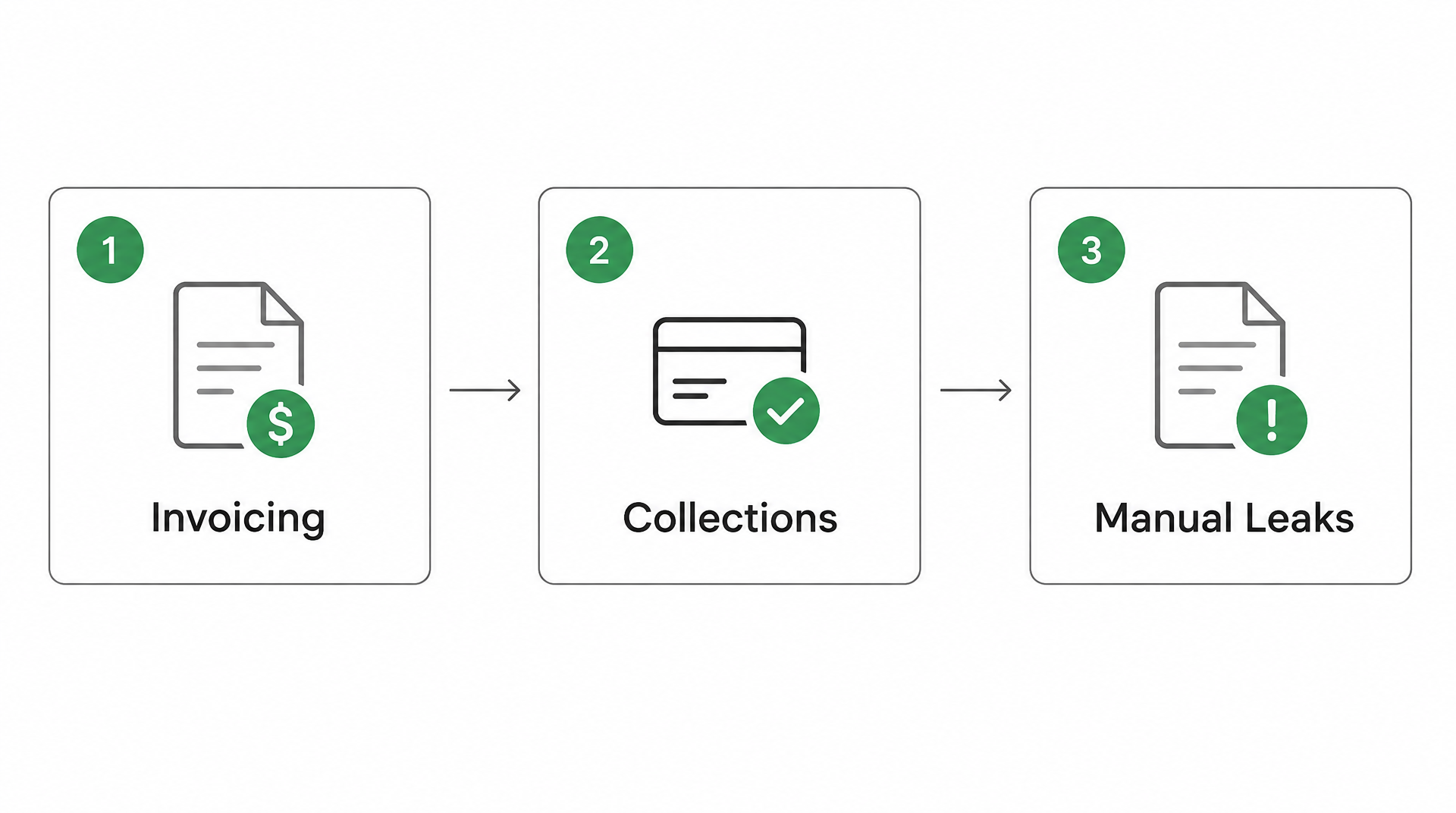
Where AR automation pays off fastest
- Quote: pricing errors and unapproved discounts enter before billing.
- Contract: terms fail to translate into billing schedules.
- Provisioning: usage-based charges and renewals get missed.
- Invoicing: delivery slips late, totals mismatch, disputes rise.
- Collections: manual dunning leaves failed payments untouched.
- Cash application: reconciliation delays hide receivables health.
Public finance guides identify revenue leakage, delayed invoicing, rising DSO, and audit exposure as recurring costs of manual order-to-cash hand-offs. That leakage isn’t a penalty for bad sales. It’s earned revenue that never gets collected. In collections, manual dunning cycles are the biggest culprit: unpaid invoices sit untouched until someone finds time, and failed card payments rarely get a second attempt without automation.
If your SaaS uses usage-based billing, hybrid pricing, or recurring failed payments, invoicing and collections are where automation earns its keep.
Where Automation Actually Closes Leaks
The leaks worth automating first are the two that compound fastest on your aging report: invoice delivery and failed payment recovery. That concentration is why AR automation tends to pay for itself in the collections stage, not in earlier sales steps.
The three triggers that matter
The first trigger is the contract-to-invoice gap. A signed contract waits for someone to manually create the invoice, and delivery slips days past the billing date. Platforms like Blixo can be configured to send recurring invoices on schedule, so the collection window starts when it should.
The second is the payment failure blindspot. Your finance team may not see card declines and ACH returns until the payment window has already started slipping. The longer the delay between failure and first recovery contact, the lower the chance of collection. Documented Blixo dunning features include retrying failed charges and sending payment-update reminders to customers.
The third is silent non-response. If an invoice stays unacknowledged, automated chasing and dunning workflows can send follow-up reminders so silence does not become aging receivables. Manual teams often let that silence become aging receivables.
For a B2B SaaS with mixed monthly, quarterly, and annual billing, those three triggers rely on the same automated chasing, dunning, and recurring invoice generation Blixo documents as core services. The savings sit in the O2C improvement, not in chasing more late payments. Public materials describe these triggers. Missing from the docs isn’t the same as missing from the product, so verify exact timing and escalation in a live demo before assuming it matches your stack.
What to Measure After Go-Live
Most finance teams measure AR automation by days sales outstanding. The more honest benchmark is leakage that never reaches the aging report. Some finance reviews on real-time revenue assurance describe recurring leakage risk in subscription and usage-based billing: billing inaccuracies, contract misalignment, delayed event processing, pricing configuration errors, and fragmented order-to-cash workflows. That isn’t a one-time failure. It’s the absence of a continuous control. Treat leakage as a recurring process risk, not a reporting anomaly.
A practical scoreboard
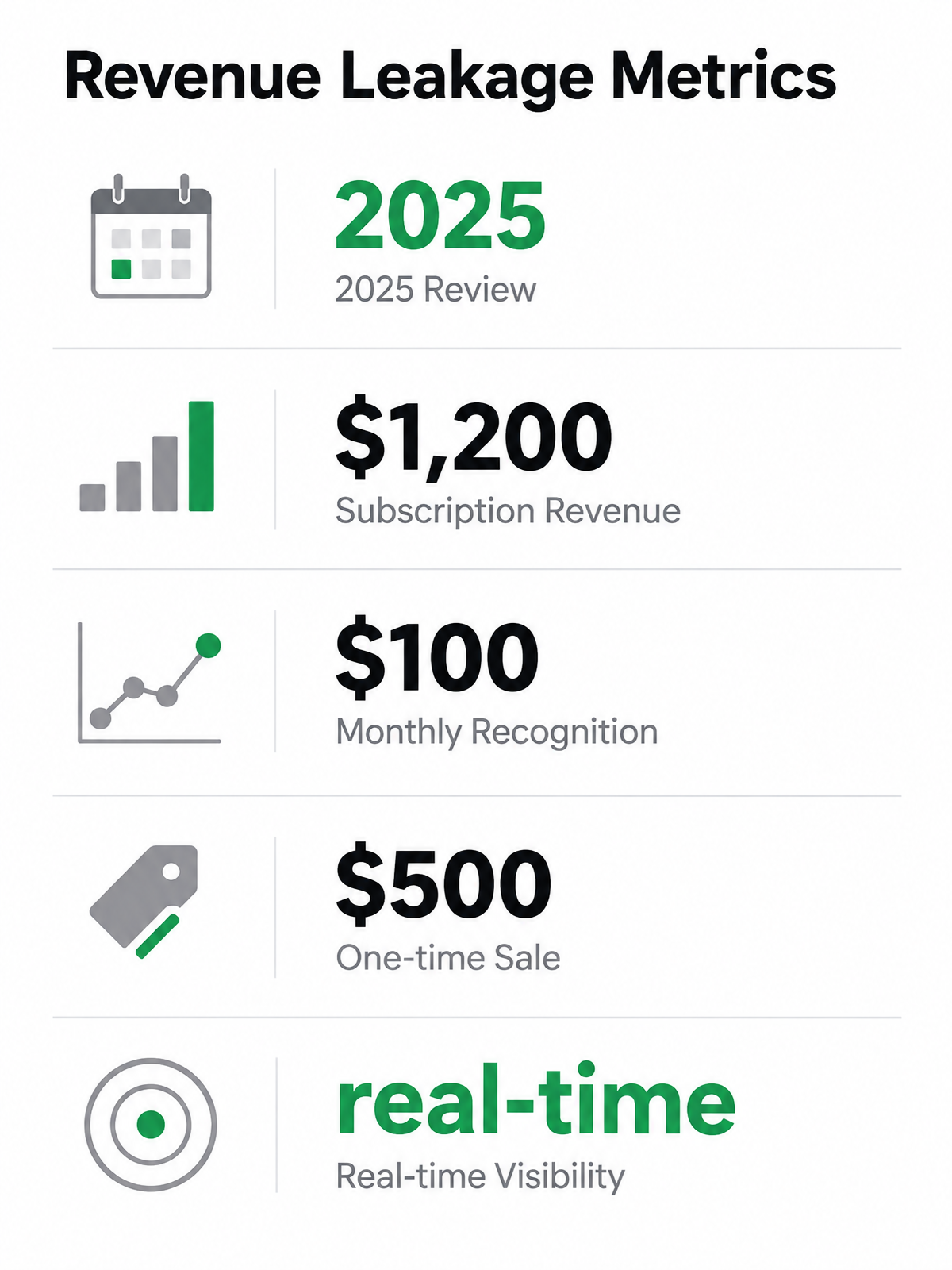
A workable scoreboard mixes process, liquidity, and recognition measures:
- Some finance teams report prioritizing real-time visibility over periodic audits and rule-based reconciliation, with order-to-cash inside that scope.
- Optimized working capital management can improve liquidity and lower days sales outstanding.
- SaaS recognition math: for example, a $1,200 annual subscription sits in deferred revenue and recognizes at $100 per month. A $500 one-time sale recognizes immediately.
Manual checks miss these leaks in high-volume billing streams. You want accounting-anchored anomaly checks across order creation, provisioning, invoicing, and cash application events, not retrospective spreadsheet reconciliation.
Those two accounting treatments change what “recovered” means. A failed subscription payment recovered in month two still has recognition implications. A one-time sale recovered late is purely cash. If your revenue is recurring, skip a DSO-only scoreboard. Measure leakage by stage instead.
One right-sizing note: you don’t need a full ERP to get this visibility. SMBs can gain automation benefits without enterprise complexity. You do need event-level data from contract creation through cash application. That creates a tension worth naming: CRM data alone is often an incomplete order signal because it may stop at the signed deal, while order-to-cash work depends on contract, provisioning, invoicing, and payment events. The alternative is not to bolt together disconnected point solutions; the reconciliation overhead becomes the new leak.
What I’d Put in Place First
Automate the two moments manual teams lose money: an invoice no one acknowledges, and a payment failure that waits for AR review.
Follow-up sequence that works
For example, a follow-up sequence can trigger at the 48-hour mark. If an invoice goes unacknowledged that long, the sequence should trigger and pull in a secondary billing contact. Escalation catches an invoice stuck in spam or a departed contact before the due date has already passed.
Payment failures should never wait for manual AR review. When a declined card or ACH return sits unnoticed until a scheduled review, the recovery window can close before anyone acts. The longer the delay between failure and first contact, the lower the chance of collection. Automated monitoring should retry the payment chain and notify the customer immediately, but exact retry and notification behavior depends on the processor and the AR tool you configure.
Use a benchmark scenario to keep scope honest. For example, a $3M ARR B2B SaaS with 150 active contracts across monthly, quarterly, and annual billing needs invoicing automation that separates billing schedules from deferred revenue schedules. A quarterly account that adds 12 seats mid-cycle should generate one prorated invoice for the new seats and a separate deferred schedule for the added amount. Your implementation must handle both without manual journal entries.
Skip full ERP-level complexity for this scale. But don’t bolt together disconnected point solutions; the reconciliation overhead becomes the new leak. Treat the earnings uplift from earlier as your outcome target, not a time-to-deploy metric. Keep automation focused on the invoicing and payment-failure stage, not the entire order-to-cash chain.
Still Wondering?
When is manual invoicing still acceptable for a SaaS business?
Manual invoicing is acceptable only when you send a handful of simple invoices each month. In that low-volume case, full accounts receivable automation may not justify the setup effort. For recurring, usage-based, or milestone billing, skipping automation compounds leakage quickly.
What’s the difference between following up on a failed payment and an unacknowledged invoice?
A failed payment should never wait for manual AR review; the longer it sits before first contact, the lower the chance of collecting. An unacknowledged invoice is different—schedule a fast reminder that includes a secondary billing contact, catching spam or a departed owner before the due date.
Does DSO alone tell you if accounts receivable automation is working?
DSO alone misses leakage that never reaches the aging report, especially for recurring revenue. A recovered subscription payment still carries deferred revenue recognition effects, unlike a late one-time payment that is purely cash. Track leakage by stage to see automation’s real impact.
Can a small SaaS use accounts receivable automation without a full ERP?
SMBs don’t need a full ERP to gain automation benefits. You do need event-level visibility from contract creation through cash application. Documented Blixo features cover recurring invoice generation, failed-payment retries, and dunning prompts for the invoicing and recovery stages—verifying exact behavior in a demo is wise.