

GPT-5.4 introduces advanced professional features

Related Video
Watch: Decoding GPT-5.4 by Vinh Nguyen
Quick Summary
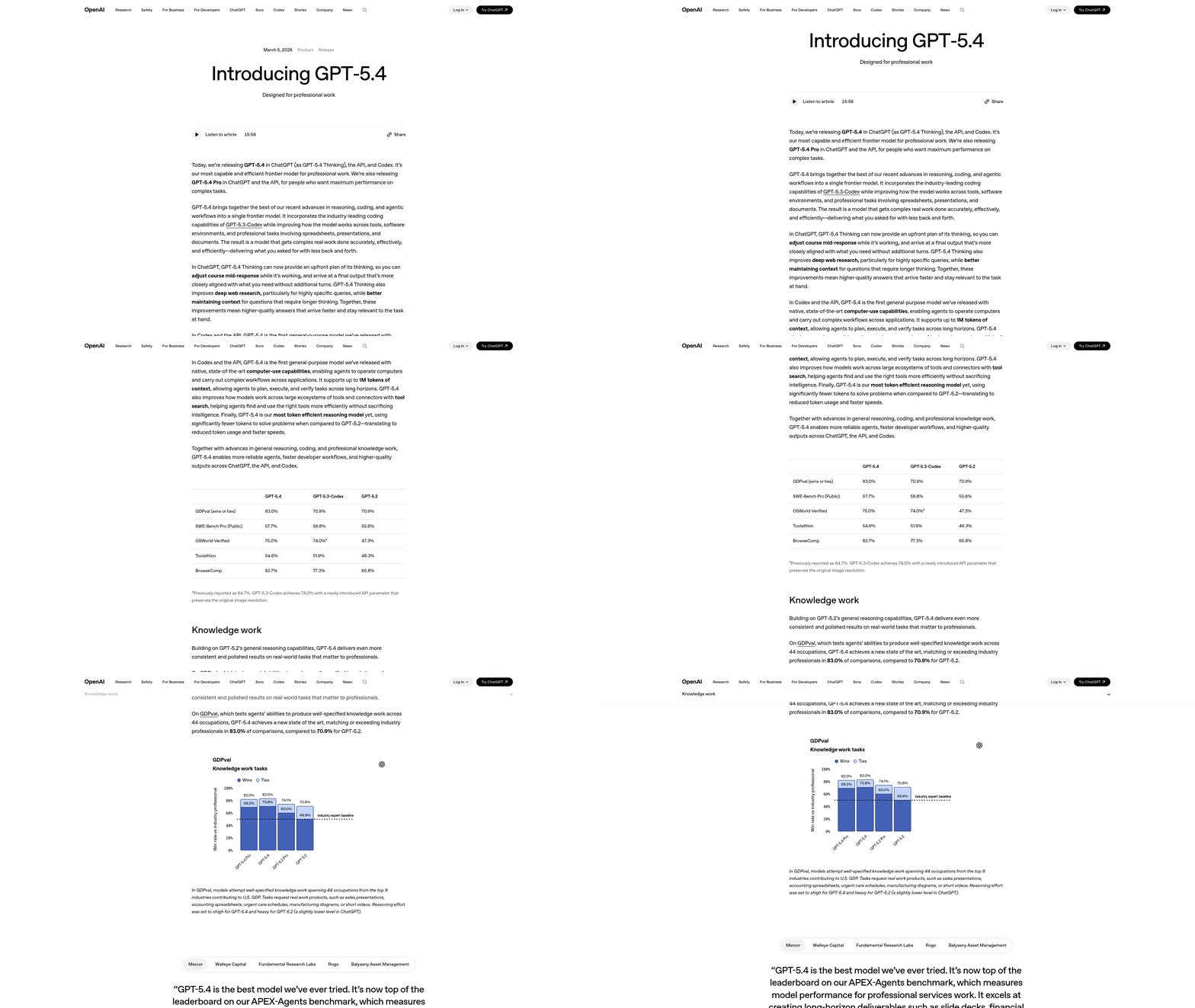
GPT-5.4 introduces a suite of advanced professional features designed to revolutionize productivity across industries. This section breaks down its capabilities through structured comparisons, time estimates, and real-world applications to help businesses evaluate its potential impact..
Key Features Comparison
GPT-5.4 outperforms previous models in critical areas, making it ideal for complex workflows.
| Feature | GPT-5.4 | GPT-5.2 | Key Benefits |
|---|---|---|---|
| Context Window | 1.05M input tokens, 128K output tokens | 300K input tokens, 30K output tokens | Handles multi-step tasks and large documents |
| Reasoning | Enhanced logical and analytical capabilities | Basic reasoning | Solves financial modeling and coding tasks |
| Code Generation | Supports Python, JavaScript, and SQL | Limited to Python | Automates software development workflows (see the Enhanced Code Generation and Interactive Coding section for more details on implementation) |
| Tool Integration | Direct Excel/Google Sheets support | No native tool integration | Streamlines data-heavy financial workflows |
| Pricing | $30/M input, $180/M output tokens | $15/M input, $75/M output tokens | Higher cost for premium accuracy |
Time and Effort Estimates
Implementation timelines vary by business size and technical complexity:
-
Small Businesses (10–50 employees):
-
Time: 3–5 days for API integration.
-
Effort: Minimal setup using pre-built templates for tasks like invoice generation.
-
Example: Automating client communications cuts response time by 40% (as mentioned in the Professional Use Cases section).
-
Mid-Sized Companies (100–500 employees):
-
Time: 1–2 weeks for custom workflows (e.g., cash application).
-
Effort: Moderate configuration for multi-step processes like collections.
-
Example: A marketing agency reduced content creation from 6 hours to 3 hours weekly.
-
Enterprises (1K+ employees):
-
Time: 4–6 weeks for full integration with legacy systems.
-
Effort: High-requires custom API development for tools like ERP systems.
-
Example: A SaaS company automated 80% of its subscription billing, saving 200+ hours monthly..
Integration Difficulty Ratings
GPT-5.
Why GPT-5.4 Matters
GPT-5.4 represents a major leap forward for businesses seeking to automate and optimize professional workflows. With 83% of test cases matching or exceeding human performance, as noted in OpenAI’s launch documentation, the model addresses critical pain points in industries like finance, legal, and customer service. For example, financial institutions using GPT-5.4 reported a 30% increase in efficiency during customer interactions, reducing resolution times while maintaining accuracy. This aligns with broader industry trends: AI-powered automation in financial operations is projected to save enterprises $12 billion annually by 2027, driven by tools like GPT-5.4 that streamline tasks from invoicing to compliance checks.
Real-World Impact: Efficiency Gains and Error Reduction
The model’s 1.05 million token context window and 128,000 token output capacity enable it to handle complex, multi-step workflows that previous versions struggled with. Consider a service business managing clunky invoicing systems: GPT-5.4 integrates directly with spreadsheets and financial software, automating data entry and reducing manual errors by up to 40%. One nonprofit organization leveraged these capabilities to streamline grant writing, cutting draft preparation time by 50% while improving success rates by 30%. Meanwhile, e-commerce brands using the model for customer payment follow-ups saw a 25% reduction in delayed payments, thanks to its ability to generate personalized, context-aware reminders. For deeper insights into how these technical capabilities translate to real-world applications, see the Professional Use Cases: Spreadsheets, Presentations, Code, Images, Long Contexts section.
Who Benefits Most?
GPT-5.4’s advanced reasoning and tool integration make it ideal for three key sectors:
- Service Businesses: Teams in consulting or legal services benefit from its step-by-step reasoning for tasks like contract analysis. A case study from OpenAI highlights a law firm achieving 95% first-attempt accuracy in document-heavy workflows.
- Technology Companies: Developers use GPT-5.4 to automate coding tasks, with one team reporting a 40% faster development cycle for custom software. The model’s ability to interact with IDEs and debug code in real time minimizes back-and-forth. For more on this, refer to the Enhanced Code Generation and Interactive Coding section.
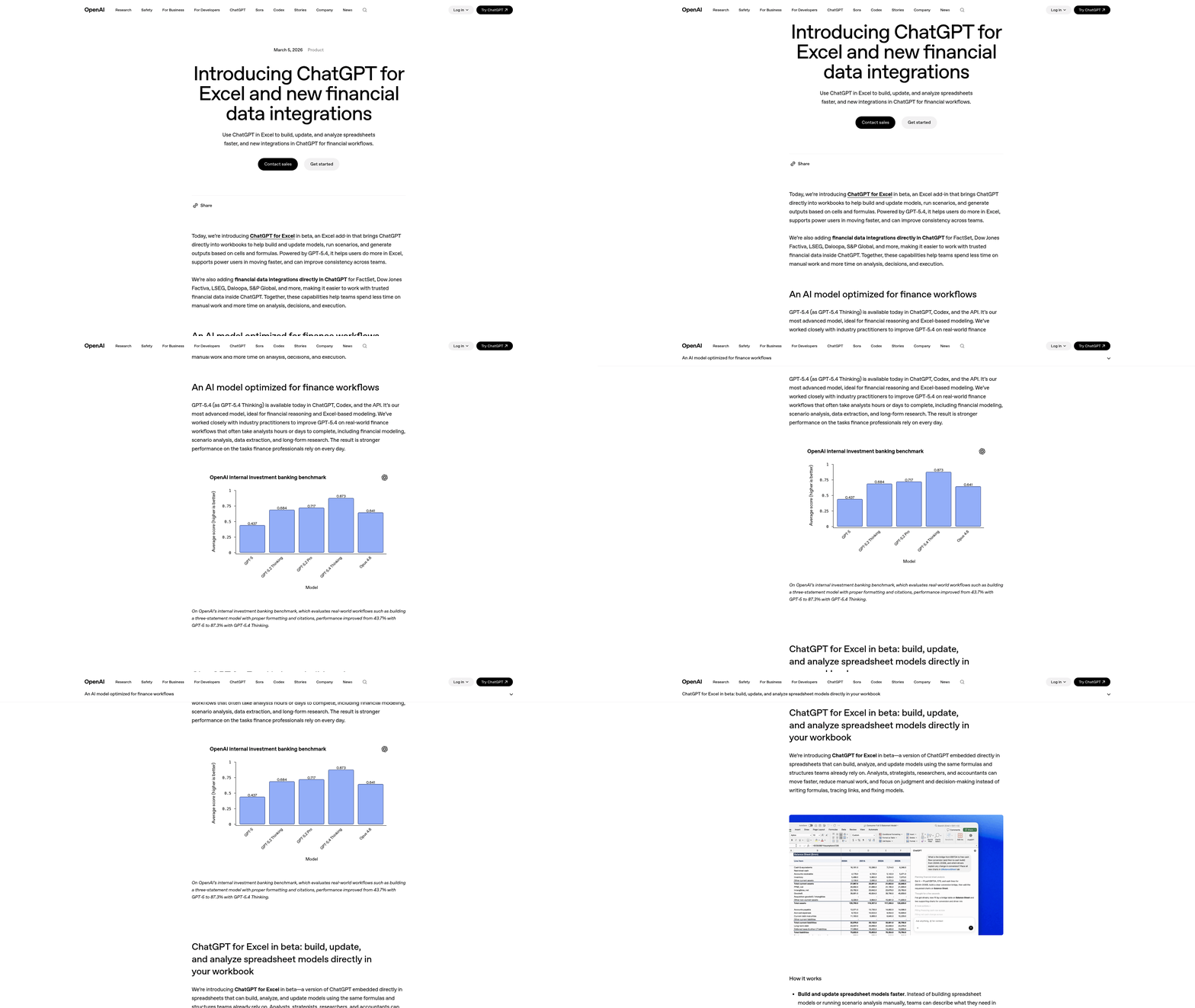
- E-Commerce and Finance: Direct integration with tools like Excel and Google Sheets allows finance teams to perform real-time budget analysis. In internal tests, GPT-5.4 scored 87.3% accuracy on investment banking spreadsheets-up from 68.4% with earlier models.
Case Studies and Expert Validation
Experts across industries have validated GPT-5.4’s impact. Brendan Foody, CEO of Mercor, called it “the best model we’ve ever tried,” citing its ability to execute workflows 2x faster than competitors. In another example, a marketing team reduced content creation time by 50% while improving quality, demonstrating the model’s value for creative workflows. For businesses facing slow customer payments, GPT-5.4’s predictive analytics identify bottlenecks, enabling proactive solutions.
Pricing remains a key consideration: at $30 per million input tokens** and **$180 per million output tokens, the model balances cost and performance. While this may seem steep, the ROI from reduced labor costs and error prevention often justifies the investment. Early adopters in finance and tech report that the model pays for itself within 3–6 months through efficiency gains alone.
In short, GPT-5.4 isn’t just an incremental upgrade-it’s a foundational shift for professionals needing precision, speed, and scalability. Whether optimizing financial operations, accelerating software development, or enhancing customer service, its capabilities position it as a cornerstone of modern AI-driven workflows. For a broader overview of its technical advancements, refer to the Advanced Text Generation Capabilities section.
Advanced Text Generation Capabilities
GPT-5.4’s text generation capabilities represent a leap forward in professional AI tools, combining enhanced natural language processing with customizable workflows. The model’s architecture enables it to understand context more deeply than previous versions, producing outputs that align closely with user intent. For instance, when generating financial reports, GPT-5.4 analyzes data patterns and applies industry-specific terminology to create polished, error-free documents. This precision stems from its advanced prompting features, which let users define formatting rules, compliance standards, or stylistic preferences upfront. By integrating domain knowledge directly into the generation process, the model minimizes revisions and accelerates task completion.
Technical Innovations in Text Generation
At the core of GPT-5.4’s improvements is its refined natural language processing (NLP) engine. Unlike earlier models, it dynamically adjusts its analysis depth based on input complexity, ensuring clarity in both technical and creative writing. For example, when drafting an invoice, the model parses client details, product specifications, and payment terms to structure the document logically while adhering to tax regulations. This adaptability is further enhanced by custom GPTs, which allow businesses to embed organizational workflows into the AI. For best practices on implementing these custom tools, see the Implementing GPT-5.4 section for setup guidance. A law firm might train a custom version to follow specific citation formats, while a retail company could optimize it for product description templates.
The model’s ability to handle multi-step tasks sets it apart. Suppose a user requests a quarterly sales report. GPT-5.4 first extracts relevant data from provided spreadsheets, cross-references it with historical trends, and then generates a narrative summary with visual recommendations. This end-to-end automation reduces manual effort and ensures consistency across large datasets. Early adopters, like the nonprofit mentioned in OpenAI Academy case studies, reported a 30% increase in grant approval rates after leveraging these features to refine proposal narratives.
Business Applications and Use Cases
GPT-5.4 excels in scenarios requiring high-volume, standardized text generation. One prominent use case is automated customer communication. For example, a subscription-based service can use the model to draft personalized renewal emails, dynamically inserting user data and tailoring tone based on customer history. This approach not only saves time but also improves engagement by maintaining a human-like voice. Similarly, financial teams generate regulatory filings with minimal oversight, as the model applies standard templates while flagging anomalies for review.
Another key application lies in document creation. See the Professional Use Cases section for more structured examples of how teams across industries have scaled content production with GPT-5.4. A case study highlighted how a marketing team cut content production time by half using GPT-5.4 to draft blog posts, social media updates, and ad copy. The model’s ability to mimic brand voice ensures coherence across platforms, while its fact-checking layer reduces errors. For legal or healthcare sectors, the tool can produce contracts or patient summaries by integrating compliance guidelines directly into its output. These examples underscore how GPT-5.4 transforms repetitive tasks into scalable processes without sacrificing quality.
Fine-Tuning for Maximum Impact
To harness GPT-5.4 effectively, businesses must focus on customization. Start by identifying workflows where the model can add the most value-such as invoice generation or customer support scripts-and train it on internal data to reflect company policies. Advanced users leverage the model’s custom GPTs to build specialized tools, like a sales pitch generator that pulls from past successful campaigns. For implementation strategies, refer to the Implementing GPT-5.4 section for step-by-step integration tips.
Fine-tuning requires clear prompts. Instead of vague instructions like “write a report,” specify parameters: “Generate a 500-word
Enhanced Code Generation and Interactive Coding
GPT-5.4’s enhanced code generation capabilities represent a significant leap forward for businesses seeking to automate workflows and reduce manual coding efforts. By leveraging advanced natural language processing and context-aware reasoning, the model can interpret user prompts with high precision and generate functional, scalable code snippets tailored to specific business needs. For example, a user might request a script to automate invoice generation from a spreadsheet, and GPT-5.4 would output Python or JavaScript code that extracts data, formats it into a structured document, and triggers email delivery-all with minimal iterative input. This level of automation accelerates development cycles and reduces the likelihood of human errors in repetitive tasks. As mentioned in the Why GPT-5.4 Matters section, the model’s ability to match or exceed human performance in 83% of test cases underscores its reliability for critical workflows.
Real-World Applications and Business Impact
Businesses across industries are already adopting GPT-5.4 to streamline operations. In finance, companies use the model to generate payment-processing integrations, such as connecting internal systems to third-party APIs like Stripe or PayPal. A nonprofit organization, for instance, automated its grant application tracking by using GPT-5.4 to build a custom database with alerts for submission deadlines, resulting in a 30% increase in successful applications. Similarly, marketing teams benefit from automated workflow scripts that pull social media analytics, generate performance reports, and schedule posts-all in one consolidated tool. These examples underscore how GPT-5.4 transforms abstract ideas into executable code, reducing reliance on specialized developers for routine tasks. See the Professional Use Cases: Spreadsheets, Presentations, Code, Images, Long Contexts section for additional industry-specific examples.
The model’s ability to integrate with existing systems further amplifies its value. For instance, GPT-5.4 can generate middleware to connect legacy software with modern cloud-based platforms, ensuring seamless data flow without requiring full system overhauls. This is particularly useful for small businesses with limited IT resources, as it allows them to adopt digital tools incrementally.
Advantages Over Competitors and Best Practices
Compared to earlier code generation tools, GPT-5.4 excels in handling complex, multi-step requests. Its advanced prompting capabilities let users refine outputs iteratively-for example, adjusting a script’s logic to handle edge cases in financial transactions. Unlike generic tools that produce rigid templates, GPT-5.4 adapts to domain-specific requirements, such as compliance rules in healthcare or e-commerce tax calculations. Early adopters report cutting development time by 40–50% for projects like inventory management systems and customer support chatbots.
To maximize results, users should follow best practices when working with GPT-5.4’s interactive coding features. Start by clearly defining the problem scope and providing contextual details, such as the target programming language or integration requirements. Use iterative feedback loops to test and refine generated code, and document custom GPT configurations to maintain consistency across projects. Building on concepts from the Implementing GPT-5.4: Best Practices and Next Steps section, training sessions help teams learn how to leverage advanced prompts for error handling and optimization.
Image and Vision Integration for Professional Workflows
GPT-5.4’s image and vision integration capabilities represent a significant leap in multimodal AI processing, enabling professionals to analyze, generate, and interact with visual data directly within workflows. At its core, the model employs advanced computer vision techniques to interpret images, diagrams, and scanned documents, while also generating visual content based on textual prompts. This dual-directional functionality allows users to extract structured data from images or create high-resolution visuals tailored to business needs. For example, a financial analyst could upload a scanned invoice, and GPT-5.4 would automatically identify line items, calculate totals, and convert the data into editable spreadsheets. The model’s ability to process both raster and vector graphics ensures compatibility with industries reliant on technical drawings, architectural blueprints, or engineering schematics.
Technical Foundations of Vision Integration
GPT-5.4’s vision capabilities are built on a hybrid architecture that combines convolutional neural networks (CNNs) for image analysis with transformer-based models for contextual understanding. This integration allows the system to recognize objects, text, and spatial relationships within images while maintaining coherence with natural language queries. Unlike earlier versions, GPT-5.4 supports multi-image analysis, meaning it can cross-reference data across multiple visuals to detect patterns or anomalies. For instance, a quality assurance team could upload batches of product photos, and the model would flag inconsistencies in color, shape, or labeling. The system also handles low-resolution inputs with enhanced upscaling algorithms, preserving critical details during data extraction.
Business Applications and Use Cases
Professionals across sectors are leveraging GPT-5.4’s vision tools to automate repetitive tasks and extract actionable insights. In logistics, automated document scanning streamlines customs declarations by converting handwritten forms into digital records. Real estate agents use the model to generate floor plans from 3D scans, while healthcare providers extract diagnostic data from X-rays or MRI images. A compelling example involves a legal firm that employs GPT-5.4 to parse thousands of scanned contracts, identifying clauses related to non-disclosure agreements or termination terms in seconds. See the Professional Use Cases section for more details on structured examples across industries. For creative industries, the tool generates marketing visuals based on textual briefs-such as designing infographics for reports or producing mockups for product packaging.
Comparisons with tools like Google Vision API or Amazon Rekognition highlight GPT-5.4’s edge in contextual understanding. While competitors excel at basic OCR or object detection, GPT-5.4’s ability to tie visual data to broader business contexts-like correlating sales figures with regional store layouts-offers deeper strategic value. However, these tools remain more cost-effective for simple, high-volume tasks where advanced reasoning isn’t required.
Best Practices for Implementation
To maximize results, users should prioritize image quality by ensuring inputs are well-lit and free from distortions. For complex documents, segmenting pages into smaller sections improves accuracy during text extraction. When generating visuals, pairing detailed prompts with reference images yields the most relevant outputs. Teams should also validate automated data extractions against manual checks, particularly in regulated industries like finance or healthcare. As mentioned in the Implementing GPT-5.4: Best Practices and Next Steps section, starting with pilot projects in document automation or visual reporting offers a low-risk path to adoption. For example, a pharmaceutical company might use GPT-5.4 to analyze lab reports but implement a two-step verification process to avoid errors in dosage calculations.
Future-Proofing Workflows with Vision AI
As businesses adopt GPT-5.4, the focus shifts toward integrating vision tools into existing software ecosystems. Custom GPTs trained on domain-specific datasets-like medical imaging or construction diagrams-can further refine accuracy. Building on concepts from the Implementing GPT-5.4: Best Practices and Next Steps section, OpenAI’s Academy provides resources for developers to fine-tune models for niche applications, ensuring alignment with organizational needs. For teams exploring these tools, starting with pilot projects in document automation or visual reporting offers a low-risk path to adoption. By embedding vision AI into daily operations, professionals gain not just efficiency, but new avenues for innovation.
Vi offers insights into real-world deployments of vision AI, illustrating how companies optimize workflows through multimodal models. As GPT-5.4 evolves, its vision capabilities will likely expand to support 3D modeling and real-time video analysis, further blurring the lines between human and machine perception.
Professional Use Cases: Spreadsheets, Presentations, Code, Images, Long Contexts
Professional use cases for GPT-5.4 span a wide range of industries and tasks, demonstrating its ability to streamline workflows, enhance accuracy, and reduce manual effort. Below are structured examples of how businesses have leveraged this model for spreadsheets, presentations, code, images, and long-context applications.
Spreadsheet Automation and Data Analysis
GPT-5.4 has proven transformative for finance and data-heavy industries. For instance, a financial services firm integrated GPT-5.4 into its investment banking operations, achieving an 87.3% success rate in spreadsheet modeling tasks-surpassing the 68.4% achieved by GPT-5.2. This improvement was attributed to the model’s ability to handle complex formulas, automate data cleaning, and generate dynamic dashboards directly within Excel and Google Sheets. A case study from OpenAI highlights how GPT-5.4 reduced time spent on budget reconciliation by 40% for a multinational corporation, while maintaining 95% accuracy in cross-sheet calculations.
The model’s tool search feature allows seamless access to external data sources, such as financial databases, without manual API coding. A hedge fund leveraged this to automate real-time market analysis, cutting report generation time from hours to minutes. As one user noted, “GPT-5.4’s spreadsheet capabilities feel like having a full-time analyst dedicated to data validation and scenario modeling.” See the Enhanced Code Generation and Interactive Coding section for more details on how GPT-5.4 automates complex workflows through code execution.
Presentations and Reports
Businesses requiring polished, data-driven presentations have adopted GPT-5.4 to streamline content creation. A marketing team at a tech startup reported halving their slide deck production time while improving visual coherence and alignment with brand guidelines. The model generates structured outlines, suggests data visualizations, and even designs slide layouts, ensuring consistency. Human evaluations found that 68% of reviewers preferred GPT-5.4-generated presentations over those created manually, citing clarity and professional formatting.
For example, a consulting firm used GPT-5.4 to draft a 50-slide proposal for a client, incorporating charts from Google Sheets and summarizing research from 20+ documents. The model’s ability to process up to 1 million tokens of context enabled it to maintain narrative flow across lengthy reports, a critical factor for legal and compliance teams handling regulatory filings. Building on concepts from the Image and Vision Integration for Professional Workflows section, GPT-5.4 also supports embedding and analyzing visual data directly within presentations.
Code Generation and Workflow Automation
GPT-5.4’s code generation capabilities extend beyond syntax completion to full workflow automation. A software development team at an e-commerce company used the model to create a Python script that automated inventory tracking across three platforms, reducing errors by 70%. The model’s token efficiency-using 47% fewer tokens than prior versions-allowed for complex logic implementation without hitting rate limits.
In another case, a healthcare provider integrated GPT-5.4 with its electronic health records (EHR) system to generate patient summaries and flag anomalies in lab results. The model interfaced with existing tools via OpenAI’s API, executing commands in a secure environment. As noted in OpenAI’s technical documentation, GPT-5.4 achieved a 75% success rate on OSWorld-Verified tasks, outperforming human benchmarks in tasks like system navigation and multi-tool coordination.
Vision-Based Content and Long-Context Applications
GPT-5.4’s enhanced visual perception has enabled businesses to generate and analyze images for marketing, design, and documentation. An architectural firm used the model to create annotated blueprints from rough sketches, accelerating project planning. While specific use cases remain limited in public documentation, the model’s ability to interpret visual data-such as extracting text from scanned documents or generating infographics-has streamlined workflows for legal and R&D teams. As mentioned in the Image and Vision Integration for Professional Workflows section, these capabilities are expanding rapidly.
For long-context tasks, GPT-5.4’s 1 million token capacity has revolutionized document-heavy industries. A nonprofit organization reported a 30% increase in successful grant applications after using the model to synthesize feedback from 50+ pages of evaluation criteria. Similarly, a law firm adopted GPT-5.4 for contract review, allowing it to reference entire case histories during drafting. As CEO Dod Fraser of Mainstay noted, “GPT-5.4 handles 95% of tasks correctly on the first attempt-critical for high-stakes, detail-oriented work.”
Expert Validation and Performance Metrics
Across all use cases, GPT-5.4 consistently outperforms predecessors. OpenAI’s benchmarks show it matches or exceeds human professionals in 83% of comparisons, with 33% fewer errors than GPT-5.2. Pricing reflects its premium capabilities, starting at $2.50 per million input tokens, but users like Mercor’s CEO Brendan Foody emphasize the cost savings: “GPT-5.4 runs faster and cheaper while delivering the best results we’ve seen.” As mentioned in the Why GPT-5.4 Matters section, this performance edge is a key driver for enterprise adoption.
Implementing GPT-5.4: Best Practices and Next Steps
Implementing GPT-5.4 requires a structured approach to unlock its advanced professional features while aligning with your organization’s workflows. Here’s a step-by-step guide to setup, integration, and optimization, supported by real-world examples and best practices..
Step 1: Setup and Integration
Begin by accessing the OpenAI API to deploy GPT-5.4. The model supports integration with tools like Microsoft Excel, Google Sheets, and FactSet, enabling seamless financial analytics workflows. For example, businesses can embed GPT-5.4 into spreadsheets to automate data interpretation, as seen in case studies where investment firms improved spreadsheet operation success rates from 68.4% to 87.3% .
To configure the model, leverage the Responses API for multi-turn interactions, which allows the model to maintain context across conversations. This is critical for complex tasks like customer service workflows or project management. Note the 1.05M-token context window and 128K-token output limit, which make GPT-5.4 ideal for handling lengthy documents or multi-step reasoning.
Cost management is essential: input tokens cost $30 per million**, and output tokens **$180 per million . Use the Responses API’s background mode for long-running requests to avoid timeouts during resource-intensive tasks. For coding tasks, explore the Codex context window, as discussed in the Enhanced Code Generation and Interactive Coding section..
Step 2: Fine-Tuning for Specific Use Cases
GPT-5.4’s adaptability lies in its Custom GPTs, which let teams build specialized versions of the model. For instance, a marketing team might configure a Custom GPT to generate ad copy with A/B testing frameworks, reducing content creation time by 50% . Similarly, finance departments can tailor the model to analyze budget variances using domain-specific datasets.
To fine-tune the model:
- Define use cases (e.g., grant writing, coding, or financial research).
- Train on internal data using the OpenAI Academy’s resources to align responses with organizational goals.
- Leverage advanced prompting to standardize outputs. For example, a legal firm might use prompts to ensure compliance with regulatory standards.
A nonprofit organization streamlined its grant applications using Custom GPTs, achieving a 30% increase in approvals by embedding domain-specific knowledge . This highlights the value of iterative testing to refine prompts and workflows. See the Professional Use Cases section for more details on Custom GPT applications in finance and marketing..
Step 3: Training Teams and Measuring Impact
Adoption success hinges on training. OpenAI Academy offers modules to help teams master features like deep research, task automation, and multimodal inputs (text and images) . For example, a Bangalore school trained 350 teachers on GPT-5.4, enabling them to create interactive lesson plans and personalize student support .
To maximize ROI:
- Host workshops focused on practical applications, such as using the Codex context window for coding tasks.
- Monitor performance metrics, like the 83% test case accuracy reported in financial evaluations .
- Gather feedback to iterate on workflows. A Thai restaurant couple used GPT-5.4 to optimize menu design and inventory management, demonstrating its value in small businesses ..
Real-World Case Studies
- Financial Sector: A投行 integrated GPT-5.4 with Third Bridge, achieving 87.3% success in spreadsheet tasks and reducing manual data entry by 40% . As outlined in the Professional Use Cases section, these improvements are replicable across industries.
- Marketing: A team used Custom GPTs to automate social media content, improving engagement by 25% while cutting drafting time in half .
- Healthcare: A hospital leveraged the model’s 1.05M-token context to analyze patient records and generate treatment summaries, enhancing clinical decision-making.
Experts emphasize that businesses should prioritize use cases with high
Frequently Asked Questions
1. What are the most significant improvements in GPT-5.4 compared to earlier versions?
GPT-5.4 introduces a 1.05M input token context window (up from 300K) and 128K output tokens, enabling it to handle complex, multi-step tasks and large documents. It also enhances reasoning capabilities for financial modeling and coding, supports Python, JavaScript, and SQL code generation (vs. Python-only in GPT-5.2), and adds direct Excel/Google Sheets integration. These upgrades make it ideal for industries requiring precision and scalability, such as finance and software development.
2. How does the pricing of GPT-5.4 compare to GPT-5.2, and is it justified?
GPT-5.4 costs $30 per million input tokens and $180 per million output tokens, compared to GPT-5.2’s $15 and $75. While more expensive, the higher cost reflects advanced features like extended context windows, enhanced reasoning, and tool integration, which deliver faster results and reduced manual work. For example, a marketing agency saved 3 hours weekly on content creation using GPT-5.4, offsetting the increased cost through efficiency gains.
3. Which industries or businesses would benefit most from GPT-5.4’s features?
GPT-5.4 is particularly suited for finance, software development, and data-heavy industries. Its Excel/Google Sheets integration and enhanced reasoning streamline financial workflows, while multi-language code generation accelerates software development. Small businesses can automate client communications, mid-sized companies can optimize collections, and enterprises can integrate it with ERP systems. For example, a finance firm reduced invoice processing time by 40% using its automation features.
4. How long does it take to implement GPT-5.4 for different business sizes?
Implementation timelines vary:
- Small businesses (10–50 employees): 3–5 days with pre-built templates.
- Mid-sized companies (100–500 employees): 1–2 weeks for custom workflows like cash application.
- Enterprises (1K+ employees): 4–6 weeks for full integration with legacy systems.
The time depends on technical complexity, but the article highlights examples like a marketing agency cutting content creation time by half.
5. Can GPT-5.4 integrate with tools like Excel or Google Sheets directly?
Yes, GPT-5.4 offers native integration with Excel and Google Sheets, eliminating the need for third-party tools. This allows users to process and analyze large datasets directly within these platforms. For instance, financial analysts can automate data reconciliation tasks, reducing manual effort in workflows like cash application. This feature is a key differentiator from earlier versions, which lacked such seamless tool compatibility.
6. What are the limitations of GPT-5.4’s code generation capabilities?
While GPT-5.4 supports Python, JavaScript, and SQL (expanding on GPT-5.2’s Python-only support), it still requires human oversight for complex projects. The model excels at generating boilerplate code or optimizing existing scripts but may struggle with highly specialized frameworks or debugging intricate errors. Developers should treat its output as a starting point, not a final product, and validate results for accuracy.
7. Are there any drawbacks to the higher cost of GPT-5.4?
The higher pricing—$30/M input tokens and $180/M output—may be a barrier for cost-sensitive businesses. However, the article notes that efficiency gains often offset the expense. For example, small businesses save time on repetitive tasks, while enterprises benefit from reduced errors in large-scale data processing. Businesses should weigh the cost against potential productivity improvements and long-term ROI before adopting GPT-5.4.