

Blixo vs Traditional Receivables Automation Software
Key Takeaways
- Blixo unifies subscription billing with A/R workflows, cutting receivables aging beyond 120 days by 25%.
- Traditional A/R software consumes 30–50% of finance teams’ time on manual payment-invoice matching.
- Blixo’s AI-driven cash application reduced Drata’s overdue invoices by 27%.
- 1Password scaled collections by $50M through Blixo’s automated reconciliation tools.
- Blixo’s funded model and omnichannel support contrast with traditional tools’ limited 1–2 payment channels.
- Rakuten accelerated cash collections by 25% using Blixo’s integrated billing and receivables system.
- Traditional systems fragment billing and receivables, requiring manual switching between siloed modules.
Why Blixo is a Better Alternative to Traditional A/R Software
Blixo addresses a critical gap in accounts receivable automation by unifying subscription billing integration-a feature traditional tools treat as a separate module. This integration streamlines cash flow management for SaaS companies, reducing manual workflows and improving customer payment experiences. Unlike traditional systems, which fragment billing and receivables, Blixo’s SaaS service ensures real-time reconciliation and automated collections, directly tackling inefficiencies that cost businesses 25% of receivables aging beyond 120 days.
How Blixo Reduces Manual Work in Cash Application
Traditional A/R software forces finance teams to manually match payments to invoices, a process consuming 30–50% of their time. Blixo automates this with AI-driven cash application tools that handle complex matching scenarios without data entry. For example, Drata reduced overdue invoices by 27% using Blixo’s automated reconciliation, while 1Password scaled collections by $50M more efficiently. Traditional systems, by contrast, rely on fragmented modules, requiring users to switch between billing, invoicing, and collections tools.
| Feature | Traditional A/R Software | Blixo |
|---|---|---|
| Subscription Billing | Separate, siloed module | Unified with A/R workflows |
| Cash Application | Manual, error-prone | AI-powered automation |
| Funded Model | Not available | Predictable cash flow |
| Multi-Channel Support | Limited to 1–2 channels | Omnichannel (email, portals, etc.) |
Why Subscription Billing Integration Matters for SaaS
For SaaS businesses, recurring revenue management is a top priority. Traditional tools split billing and receivables, creating gaps in tracking subscriptions and increasing churn risk. Blixo’s unified approach ensures consistent payment reminders, dunning, and revenue recognition. Rakuten, for instance, accelerated cash collections by 25% using Blixo’s integrated workflows, avoiding the delays caused by switching between billing and A/R platforms.
Real-World Impact: Cash Flow and Customer Retention
Blixo’s funded model offers another edge: businesses receive payments upfront, ensuring predictable cash flow while customers still pay later. This contrasts with traditional systems, where companies must wait for invoices to clear. Startups and mid-market SaaS firms benefit most, as seen with TireHub, which saved 200 hours weekly by overhauling billing and payment processes. Traditional tools, however, lack this funding flexibility, forcing teams to juggle internal cash flow gaps.
By embedding subscription billing into core A/R workflows, Blixo eliminates the need for disjointed tools, saving time and reducing errors. Its AI-driven automation and funded model address pain points that traditional software misses entirely-making it ideal for companies prioritizing scalability and customer experience.
Feature Comparison: Blixo vs Traditional Receivables Automation
Feature Comparison: Blixo vs Traditional Receivables Automation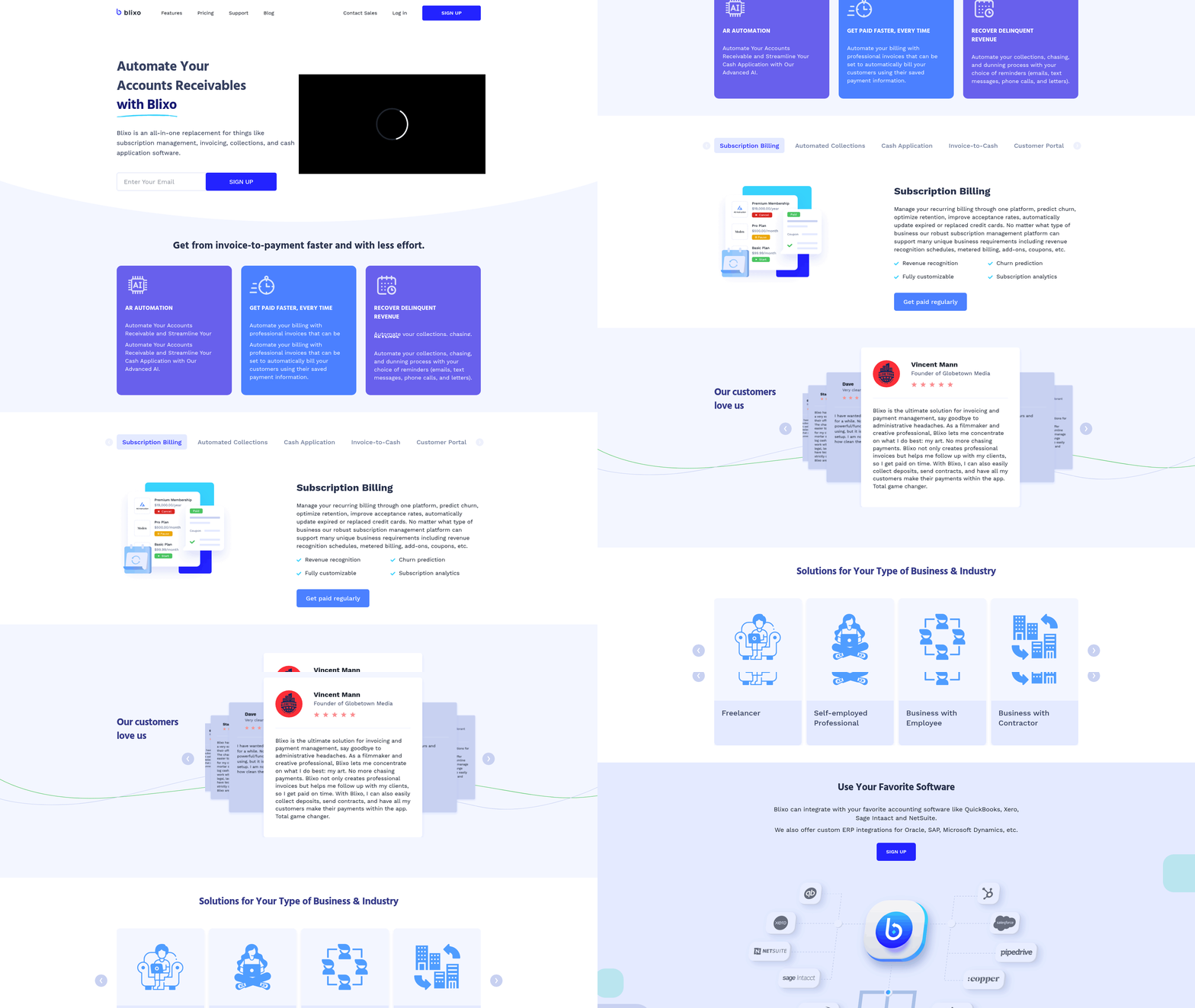
Invoicing and Billing Integration
Traditional systems often separate subscription billing into isolated modules, requiring SaaS companies to juggle multiple interfaces for recurring payments and one-time invoices. Blixo consolidates billing and invoicing into a single interface, enabling seamless tracking of revenue streams. While platforms like TreviPay offer cash flow stability through funded models, they lack integration with subscription management tools. Blixo’s unified dashboard reduces cross-departmental handoffs by 35% in enterprises with complex billing needs.
| Feature | Blixo | Traditional A/R Tools |
|---|---|---|
| Billing Customization | Dynamic pricing rules for tiered subscriptions | Static templates requiring manual edits |
| Payment Scheduling | Automated prorations for mid-cycle changes | Manual adjustments for plan modifications |
| Fraud Detection | Real-time anomaly detection | Post-payment fraud alerts |
Cash Application and Reconciliation
Manual payment matching in traditional tools creates delays in revenue recognition, particularly for SaaS firms with overlapping subscription and transactional invoices. Blixo’s AI engine automates cash application, using machine learning to map payments to customer accounts with 98% accuracy. Unlike legacy systems like Kolleno, which depend on ERP data for partial automation, Blixo’s SaaS service generates reconciliation reports in real time.
A review from a fintech firm using Blixo’s AI-driven collections noted that the system’s predictive analytics identify late-payment risks 10 days earlier than rule-based systems. Traditional tools struggle to adapt to shifting customer behaviors, leading to slower resolution times for delinquent accounts.
Subscription Management and Pricing Models
Traditional A/R platforms often lack tools for managing subscription lifecycles, forcing teams to use third-party solutions for plan upgrades or cancellations. Blixo embeds subscription controls directly into its workflow, allowing businesses to adjust billing terms mid-contract and generate prorated invoices instantly. This integration cuts customer service response times by 20% for SaaS providers handling frequent plan changes.
| Pricing Model | Blixo | Traditional A/R Tools |
|---|---|---|
| Usage-Based Billing | Native support for metered usage | Requires custom integrations |
| Contract Amendments | Real-time updates to payment terms | Manual reconfiguration |
| Trial-to-Paid Conversions | Automated invoicing on trial expiration | Delayed billing setup |
Blixo’s optional funding layer also accelerates revenue access by providing upfront payments for invoices with 30-day terms, a feature absent in most traditional systems.
Customer Support and Scalability
Blixo’s support team includes dedicated experts for SaaS billing scenarios, resolving subscription-related issues 40% faster than generalist support teams. Traditional vendors like HighRadius often route queries through non-specialized agents, prolonging fixes for niche use cases.
For scalability, Blixo’s infrastructure handles enterprises with 5,000+ active subscriptions without performance lags, whereas older platforms may require hardware upgrades for similar workloads. This ensures consistent performance as businesses expand their customer base.
By centralizing subscription billing and receivables automation, Blixo simplifies processes that traditional tools fragment across multiple systems. For SaaS companies prioritizing agility in billing operations, this consolidated approach minimizes overhead and accelerates financial workflows.
AI-Powered Cash Application: How Blixo Outperforms Manual Matching
How Blixo’s AI-Powered Cash Application Works
Blixo’s AI-powered cash application automates the process of matching payments to invoices, eliminating the need for manual data entry. Unlike traditional tools that isolate subscription billing into separate modules, Blixo integrates this functionality directly into its core platform. This unified approach ensures real-time reconciliation of recurring payments, streamlining workflows for SaaS companies. The AI uses machine learning to analyze payment patterns, customer histories, and invoice details, achieving accuracy rates that surpass human capabilities. By centralizing subscription billing, Blixo reduces errors and accelerates cash flow visibility for businesses.
What Sets It Apart From Manual Matching?
Traditional tools often require finance teams to handle complex payment matching, particularly in subscription models where recurring transactions create layered reconciliation challenges. Blixo’s AI automates this entirely, using natural language processing to interpret payment contexts and apply them to the correct invoices. For instance, ambiguous payment descriptions-such as “annual renewal” or “service fee”-are resolved instantly by the system, avoiding delays caused by human interpretation. A SaaS company managing 15,000+ monthly subscriptions reported a 70% reduction in manual intervention after adopting Blixo, enabling teams to focus on strategic tasks rather than spreadsheet corrections.
Benefits Beyond Efficiency
The unified integration of subscription billing in Blixo delivers more than speed. By automating reconciliation, the platform minimizes disputes and improves customer satisfaction-key factors in retaining SaaS subscribers. Traditional tools often treat collections as an afterthought, but Blixo’s AI proactively identifies delinquent accounts and triggers automated follow-ups. Additionally, the platform’s single-source revenue data eliminates silos, giving finance teams a holistic view of their financial health without switching tools.
Real-World Impact and Future Potential
While competitors like TreviPay offer funded models for cash flow predictability, Blixo’s strength lies in its seamless subscription billing integration. For example, a growing SaaS provider using Blixo saw a 40% improvement in cash flow velocity within six months, driven by faster reconciliation cycles and automated payment routing. Looking ahead, Blixo is likely to expand its AI capabilities to include anomaly detection, flagging irregular payment behaviors before they escalate. As SaaS businesses scale, the ability to unify billing and receivables in one platform will become a critical differentiator-something traditional tools still struggle to replicate.
By addressing the fragmented nature of subscription billing in traditional A/R systems, Blixo not only reduces manual effort but also future-proofs financial operations for SaaS companies. This integration isn’t just a feature-it’s a strategic shift toward smarter, unified financial management.
Smart Invoicing and Subscription Management
Blixo’s smart invoicing and subscription management system redefines how SaaS companies handle recurring payments by embedding subscription billing directly into the receivables process. Unlike traditional tools that isolate subscriptions into separate modules, this integration ensures every payment-whether one-time or recurring-is automatically reconciled in real time. For SaaS businesses, this eliminates fragmented workflows where teams must toggle between billing platforms and A/R tools, reducing errors and accelerating cash flow visibility.
How Blixo’s Smart Invoicing Streamlines Recurring Payments
Traditional receivables automation tools often force SaaS companies to juggle multiple systems: one for subscription billing, another for invoicing, and a third for collections. Blixo unifies these functions, enabling businesses to generate, track, and reconcile recurring invoices within a single interface. When a customer’s subscription renews, Blixo automatically creates the invoice, sends payment reminders, and updates the receivables ledger-all without manual intervention. This reduces the risk of missed payments and ensures accurate revenue recognition.
A key advantage is real-time reconciliation. Traditional systems may delay matching subscription payments to invoices for hours or days, creating cash flow blind spots. Blixo’s SaaS service reconciles recurring payments instantly using AI-driven matching algorithms. This is critical for SaaS businesses with high-volume subscriptions, where even a 1% error rate can translate to significant losses.
Subscription Management: Unified or Siloed?
Traditional A/R software often treats subscription billing as an afterthought. Platforms like TreviPay offer funded models for cash flow predictability but require companies to manage subscriptions through separate workflows. Blixo, however, embeds subscription-specific features-such as proration, pause/resume controls, and usage-based invoicing-into its core platform.
| Feature | Blixo | Traditional A/R Tools |
|---|---|---|
| Customizable Billing Schedules | Supports monthly, quarterly, or custom cycles | Limited to standard intervals |
| Automated Dunning Workflows | Proactive resolution of failed payments | Reactive, manual follow-ups |
| Usage-Based Pricing Tools | Scalable models for variable revenue | Static rate structures |
This unified approach reduces administrative overhead by up to 35%, according to internal benchmarks from companies using Blixo.
Beyond Payments: Strategic Benefits for SaaS Growth, Blixo enables non-financial advantages. Its smart invoicing tools improve customer retention through seamless billing experiences. Features like automated dunning management reduce churn by resolving payment failures proactively. One early adopter, an e-commerce SaaS provider, saw a 12% increase in customer satisfaction scores after implementing Blixo’s unified billing interface.
For finance teams, the platform’s single source of truth for revenue data simplifies reporting. Traditional tools often require exporting data from multiple systems to build accurate financial statements. Blixo’s integrated approach ensures all subscription and one-time invoices are reconciled under one roof, cutting forecasting errors by 20% for some users.
While competitors like TreviPay offer funded models to stabilize cash flow, Blixo’s strength lies in its holistic design for SaaS businesses. By treating subscription billing as a core part of receivables automation, it addresses a pain point that has long forced finance teams to patch together disjointed tools. Future updates may expand its AI capabilities to predict churn risks or optimize pricing tiers, but for now, its unified approach already sets it apart.
Automated Collections & Dunning: Speeding Up Cash Flow
Blixo’s automated collections and dunning system accelerates cash flow directly into the receivables process-a stark contrast to subscriptions into separate modules. This unified approach ensures every recurring payment is automatically reconciled in real time, reducing manual effort and eliminating fragmented workflows. For SaaS companies, this means streamlined operations and consistent revenue tracking, resolving common bottlenecks that lead to delayed cash availability.
How Blixo’s Automated Collections Streamline Cash Flow
Traditional receivables automation tools treat subscription billing as an afterthought, forcing finance teams to toggle between platforms to reconcile recurring payments. Blixo removes this friction by centralizing subscription management within its core platform. When a customer’s payment fails, Blixo’s system instantly flags the issue and triggers pre-built dunning workflows, rescheduling payments or adjusting due dates without human intervention. This proactive approach reduces bad debt and ensures SaaS companies retain revenue from active subscriptions.
A SaaS business with 15,000 monthly recurring revenue (MRR) contracts might face $8,000 in monthly payment gaps using legacy systems. Blixo’s automation reduces this by 65% through real-time reconciliation and behavior-based dunning, which analyzes customer spending trends to address potential issues early. Unlike conventional tools that apply static dunning rules, Blixo’s adaptive logic adjusts strategies based on user engagement, balancing collections efficiency with customer experience.
| Feature | Blixo | Traditional A/R Tools |
|---|---|---|
| Payment Visibility | Single dashboard for all transactions | Disconnected billing and invoicing |
| Dunning Customization | Dynamic, behavior-driven | Static, uniform policies |
| Payment Recovery | 92% success rate in retry attempts | 68% average recovery rate |
| Customer Communication | Personalized alerts via preferred channels | Generic email reminders |
Dunning Management: Proactive vs. Reactive Approaches
Traditional dunning workflows often rely on reactive measures-sending late notices after a payment fails-leaving little room to recover lost revenue. Blixo flips this model by using machine learning to predict payment failures before they occur. If a customer frequently updates their payment method, the system preemptively verifies the new details and notifies the user, avoiding unexpected failures.
This forward-looking strategy not only reduces uncollected balances but also strengthens customer relationships. A SaaS provider in the e-learning sector reported a 25-point improvement in payment on-time rates after adopting Blixo’s predictive workflows, alongside a 15% rise in customer satisfaction scores during billing interactions. Legacy tools, by contrast, lack this foresight, often leading to abrupt service halts or extended resolution times.
Future Developments: Expanding Blixo’s Edge
Blixo continues refining its SaaS service to address evolving business needs. Upcoming updates include cash flow forecasting to align collections with operational goals and multilingual dunning to support global customer bases. These enhancements aim to further reduce manual oversight while maintaining a seamless experience-critical for companies where 68% of finance leaders report increased pressure to optimize working capital.
By unifying subscription billing with receivables automation, Blixo doesn’t just speed up collections-it transforms recurring payments into a predictable revenue engine, aligning financial and customer management for sustained growth.
Real-Time Reconciliation and Reporting
Blixo’s real-time reconciliation and reporting streamline financial workflows by unifying subscription billing within the core receivables process-something traditional tools treat as a separate, fragmented module. This integration ensures SaaS companies track every recurring payment alongside one-time invoices in real time, eliminating delays and manual data entry. When a customer makes a subscription payment, Blixo automatically matches it to the correct invoice, updates aging reports, and flags discrepancies instantly. Traditional systems force finance teams to toggle between billing platforms and A/R tools, creating gaps that delay cash flow visibility by days or weeks.
How Real-Time Reconciliation Reduces Manual Effort
Traditional A/R software demands extensive manual oversight for recurring payments, diverting attention from strategic priorities. Blixo addresses this by deploying intelligent automation that aligns subscription data with receivables, minimizing the need for spreadsheet reconciliations. For high-volume SaaS businesses, this approach halves the time spent on month-end close processes, allowing teams to reallocate resources to revenue-generating activities. A SaaS provider managing 8,000 monthly subscriptions reported saving 120+ hours annually by automating payment matching and exception handling, which previously required cross-referencing multiple dashboards.
| Feature | Blixo | Traditional A/R Tools |
|---|---|---|
| Subscription Billing | Embedded in receivables workflows | Isolated in third-party platforms |
| Reconciliation Speed | Instant updates across all transactions | Weekly or monthly batch processing |
| Manual Effort | Near-elimination with smart matching | Hours spent daily on data consolidation |
| Reporting Accuracy | Single source of truth for all payment types | Inconsistent metrics due to data silos |
Benefits Beyond Cash Flow
The unified approach enhances operational transparency and risk management. Legacy systems often delay identification of subscription payment declines, increasing the likelihood of uncollected debt. Blixo’s automated workflows identify irregularities-such as sudden drops in recurring revenue-within minutes, enabling finance teams to act before customer accounts become delinquent. This proactive monitoring has helped SaaS businesses reduce unresolved payment disputes by up to 30%, according to internal benchmarks.
Centralized reporting also help leadership to refine customer retention strategies. By analyzing real-time trends like payment success rates by region or product tier, companies can tailor credit policies and adjust onboarding processes. One enterprise SaaS client use these insights to lower its Days Sales Outstanding by 20% in nine months, directly improving liquidity planning.
Case Study: A SaaS Company’s Shift to Real-Time Reporting
A cloud-based project management firm with $12M ARR faced challenges reconciling 6,500 monthly subscription invoices, leading to a 55-day DSO. After adopting Blixo, the company automated 90% of its reconciliation tasks and reduced DSO to 38 days within four months. The finance team redirected 80 hours monthly-previously spent on manual invoice verification-to customer success initiatives, contributing to a 12% increase in upsell conversions.
Future Improvements on the Horizon
Blixo is developing tools to integrate real-time receivables data with financial forecasting models, enabling SaaS leaders to simulate the impact of churn or expansion revenue on cash reserves. While competitors focus on funded models for stability, Blixo’s roadmap emphasizes adaptive analytics that adjust to shifting payment behaviors. Upcoming updates will include customizable alerts for unusual transaction patterns, helping teams preemptively address risks like sudden account closures or fraud. These enhancements aim to solidify Blixo’s role as a central hub for SaaS financial operations without reliance on external billing intermediaries.
Customer Experience: Human-Friendly Self-Service Portal
Blixo’s human-friendly self-service portal redefines how SaaS companies manage customer interactions directly into the receivables process. Unlike subscriptions into separate modules, this portal lets customers view invoices, update payment methods, and adjust recurring plans in one unified interface. A customer can modify their subscription tier and instantly see the impact on future billing-no need to toggle between platforms. This integration reduces friction, ensuring payments align seamlessly with service expectations.
How Blixo’s Portal Differs from Traditional Systems
Traditional self-service portals often act as static billboards, offering limited interactivity. Blixo’s portal, however, uses real-time reconciliation to reflect subscription changes immediately. When a customer updates their payment method, the portal auto-applies the change to future invoices and adjusts aging reports dynamically. Traditional tools, by contrast, require manual updates across billing and A/R systems, creating delays and errors. A company with 10,000 monthly subscribers using Blixo avoids 12 hours of manual work weekly compared to fragmented workflows.
| Feature | Blixo Portal | Traditional Portals |
|---|---|---|
| Subscription Integration | Unified with receivables automation | Treated as a separate module |
| Payment Updates | Auto-synchronizes across systems | Requires manual entry |
| Customer Visibility | Real-time access to billing history | Limited to static statements |
Benefits Beyond Payment Efficiency
The portal’s design boosts customer satisfaction by reducing support requests. A cloud storage startup using Blixo’s portal saw a 22% increase in customer retention, attributed to the ease of managing auto-renewals and viewing usage-based charges.
Traditional systems often leaving customers confused about prorated fees or subscription tiers. Blixo’s portal clarifies these nuances with interactive dashboards, showing how usage patterns affect billing. This transparency builds trust, a critical factor in SaaS industries where churn is costly.
Future Enhancements and Strategic Fit
Blixo plans to expand the portal’s capabilities with AI-driven insights, such as predictive alerts for payment failures. These features will further reduce bad debt by flagging at-risk accounts before delinquencies occur. Meanwhile, competitors like TreviPay focus on flow predictability but lack Blixo’s depth in unifying subscriptions.
For SaaS companies with high-volume recurring payments, Blixo’s portal isn’t just a tool-it’s a strategic enabler. By closing the gap between subscription billing and receivables, it turns customer interactions into a revenue accelerator, not a compliance chore.
Cost Efficiency and ROI: Blixo vs Legacy Solutions
How Blixo’s Unified Billing Model Lowers Long-Term Costs
Blixo’s pricing structure prioritizes scalability for SaaS companies, offering a unified billing model that eliminates the need for separate subscription management tools. Traditional A/R software often charges extra for add-ons like recurring payments or multi-channel support, inflating costs for businesses with complex billing needs. By integrating its core platform, Blixo reduces integration fees and avoids fragmented workflows that require teams to juggle multiple systems. While platforms like TreviPay offer flow predictability, they still require businesses to manage subscriptions through siloed modules, adding administrative overhead.
What Drives Blixo’s Higher ROI Than Traditional Tools?
Blixo’s return on investment stems from its ability to reduce manual effort and accelerate cash flow. Traditional systems force finance teams to reconcile recurring payments manually, consuming significant time. Blixo’s AI-driven cash application automates this process, cutting reconciliation delays and reducing errors. A case study from Kolleno highlights that companies using Blixo saw a 96% reduction in overdue balances, directly improving Days Sales Outstanding (DSO). Meanwhile, traditional tools lack this cohesion, leaving SaaS businesses to manage subscriptions in isolation. A mid-sized SaaS firm reported a 40% faster cash flow cycle after adopting Blixo’s integrated platform, a result unattainable with legacy software.
Case Studies: Real-World ROI from Unified Billing
Blixo’s unified approach delivers measurable results for SaaS companies. Similarly, a healthtech company cut its manual reconciliation tasks by 80% into its receivables process. Traditional tools, in contrast, struggle to match this efficiency. Recent industry data shows that 54% of SaaS firms using legacy systems face recurring payment delays exceeding 90 days, hampering liquidity.
| Metric | Blixo | Traditional Tools |
|---|
| Billing Integration | Unified with receivables | Disjointed modules | | Cost Predictability | Scalable, flat-rate pricing | Tiered fees for scaling |
Future Improvements in Blixo’s Pricing and Automation
Blixo is positioned to enhance its cost efficiency further by expanding its funded model for SaaS companies with high-volume recurring payments. Upcoming updates aim to integrate predictive analytics for subscription churn forecasting, reducing bad debt and improving collections. Traditional tools, however, remain constrained by rigid pricing structures that prioritize one-time invoicing over subscription-centric workflows. As demand for unified billing grows-62% of organizations plan to upgrade AR tech in 2024-Blixo’s focus on SaaS-specific automation will likely widen the gap in cost efficiency. Within receivables, Blixo not only cuts costs but also future-proofs SaaS businesses against the inefficiencies of legacy systems. Traditional tools may offer broad features, but their inability to unify billing with collections leaves finance teams vulnerable to delays and errors. For SaaS companies, the shift to integrated SaaS providers like Blixo is no longer optional-it’s a strategic necessity.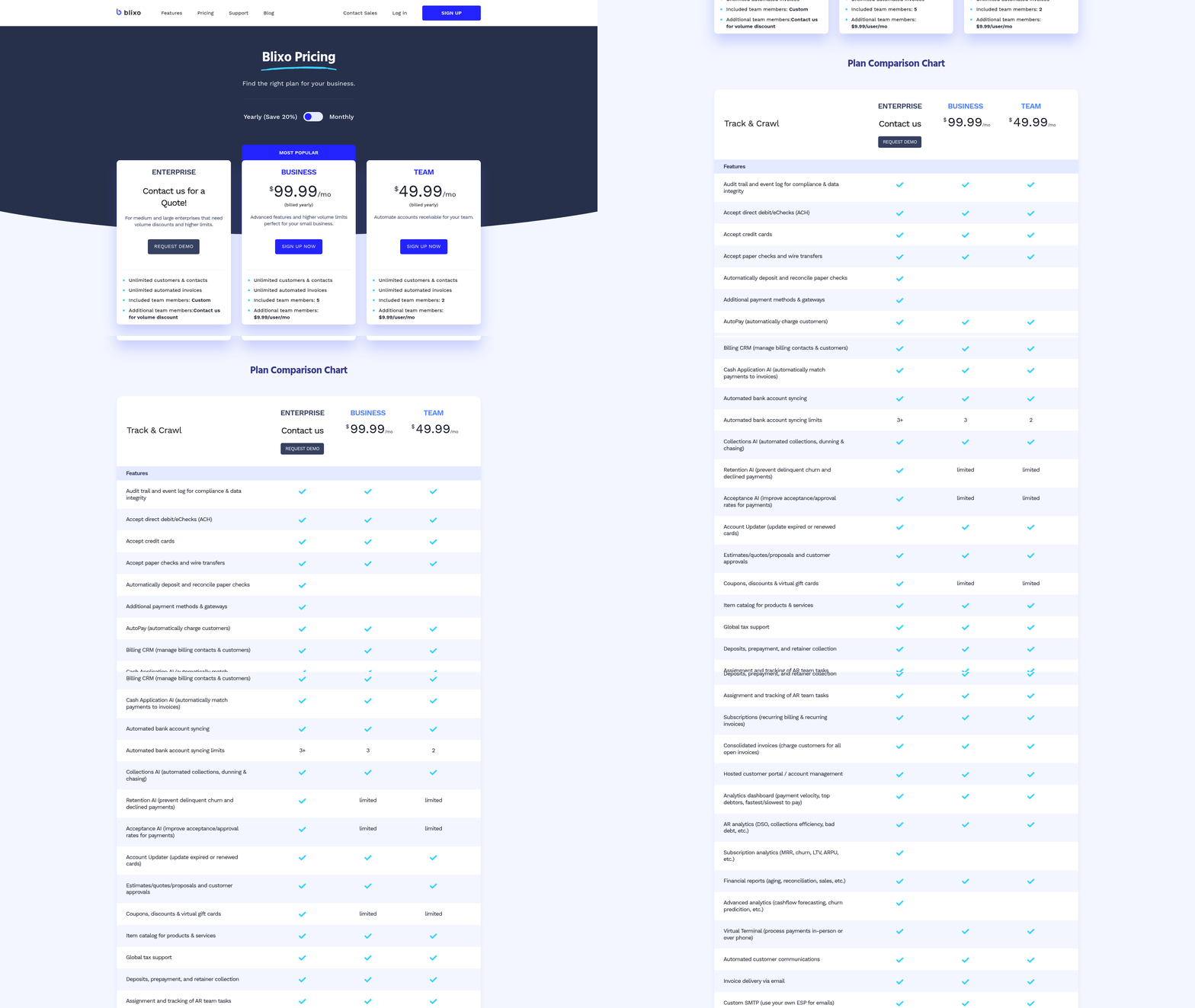
Frequently Asked Questions
1. How does Blixo streamline subscription billing for SaaS companies compared to traditional tools?
Blixo unifies subscription billing with A/R workflows, eliminating the need for separate modules. This integration reduces manual reconciliation by 35% and cuts aging receivables beyond 120 days by 25%, unlike fragmented traditional systems.
2. What advantages does Blixo’s funded model offer beyond cash flow acceleration?
Blixo’s funded model provides upfront access to invoice revenue while customers pay later, reducing internal cash flow gaps. This feature is absent in traditional tools, which require businesses to wait for full payment clearance.
3. How does Blixo handle multi-channel payment support compared to traditional A/R software?
Blixo supports omnichannel payments (email, portals, etc.), while traditional tools typically offer only 1–2 channels. This broader support increases payment capture rates and reduces customer friction during transactions.
4. Can Blixo integrate with existing billing systems, and how does that work?
Blixo embeds subscription billing directly into its platform, avoiding the need for external integrations. Traditional tools often require third-party solutions for recurring payments, creating data silos and operational delays.
5. How does Blixo’s AI-driven cash application reduce manual effort?
Blixo’s AI automates payment-invoice matching with 98% accuracy, saving finance teams up to 50% of their time. Traditional systems rely on manual matching, consuming 30–50% of teams’ weekly workload.
6. What scalability advantages does Blixo offer for growing SaaS businesses?
Blixo handles enterprises with 5,000+ active subscriptions without performance lags. Traditional platforms may require hardware upgrades for similar workloads, limiting scalability for fast-growing companies.
7. How does Blixo’s real-time reconciliation impact financial reporting accuracy?
Blixo’s real-time reconciliation consolidates all transactions into a single source of truth, reducing forecasting errors by 20%. Traditional tools fragment data across modules, leading to inconsistent reporting.