

Automated vs Manual Invoice Processing Systems Compared

Key Takeaways
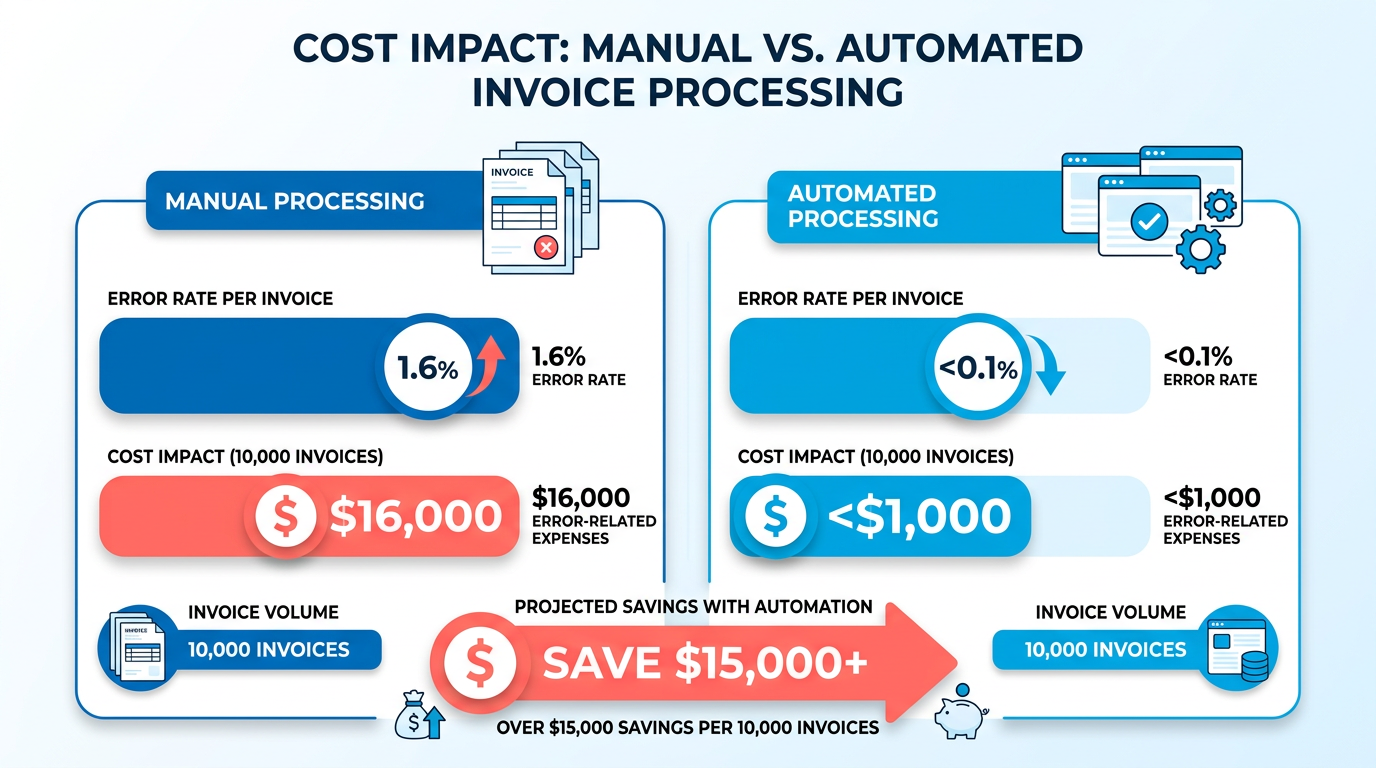
- Manual invoice processing errors occur at a 1.6% rate, costing $16,000 annually for 10,000 invoices.
- Automated systems reduce invoice processing costs to $3–$5 per invoice versus $15–$40 manually.
- Automation slashed a manufacturer’s annual payment-related losses from $250,000 to $15,000.
- Manual processing wastes 158 hours yearly for 60,000 invoices at 15 minutes per invoice.
- Labor costs comprise 60–80% of total expenses in manual invoice processing systems.
- Companies save up to 80% on processing costs by switching to automation.
- Manual delays risk supplier relationships and late fees, unlike automated systems.
Related Video
Watch: Invoice Processing AI Agent Demo by Bizagi
Why Automated Invoice Processing Matters
Automated invoice processing is no longer a luxury but a necessity for businesses aiming to stay competitive. Manual systems are error-prone, slow, and costly, with industry data showing manual processing errors occur at a 1.6% rate per invoice, leading to significant correction costs. For example, companies processing 10,000 invoices annually could face **$16,000 in error-related expenses** alone. As mentioned in the **Error Reduction: Manual vs Automated** section, these errors compound across high-volume operations, creating avoidable financial and operational drag. Worse, manual delays can damage supplier relationships and trigger late fees. A manufacturer in one case study lost $250,000 yearly due to delayed payments, while automation slashed this to $15,000.
What Are the Real Costs of Manual Processing?
Manual invoice processing is a financial burden. The average cost per invoice ranges from $15 to $40, with labor accounting for 60–80% of expenses. Building on concepts from the Cost Analysis: Manual vs Automated section, automation reduces this to $3–$5 per invoice, saving companies up to 80% on processing costs. For a business handling 5,000 invoices monthly, automation delivers $156,000 in annual savings. Beyond money, manual systems waste time: one finance team spent 15 minutes per invoice, totaling 158 hours yearly for 60,000 invoices-time automation cuts to just 1–3 minutes per invoice.
How Does Automation Solve Critical Pain Points?
Automation addresses three major challenges: accuracy, speed, and compliance. AI-powered systems achieve 95–99% accuracy by using optical character recognition (OCR) and machine learning, eliminating human data entry errors. As detailed in the Automated Invoice Processing: A Closer Look section, these technologies streamline workflows while minimizing risks like duplicate payments. For instance, a retail chain with 10,000 suppliers reduced coding errors by 80% and cut invoice cycle times by 80% using automated workflows. Automation also prevents duplicate payments and fraud, as seen in a case where Wolf Construction eliminated lost invoices entirely after adopting AP automation.
Manual Invoice Processing: An Overview
The disadvantages of manual systems include scalability, cost, and accuracy issues:
| Feature | Manual Processing | Automated Processing |
|---|---|---|
| Cost per invoice | $9–$15+ | $3–$5 (as detailed in the Cost Analysis: Manual vs Automated section) |
| Error rate | 1.6% per invoice | 0.3% or less (referenced in the Error Reduction: Manual vs Automated section) |
| Processing time | 15+ minutes per invoice | 2–3 minutes (explored further in the Time Savings: Manual vs Automated section) |
| Labor costs | 60–80% of total expense | Reduced by 50–70% |
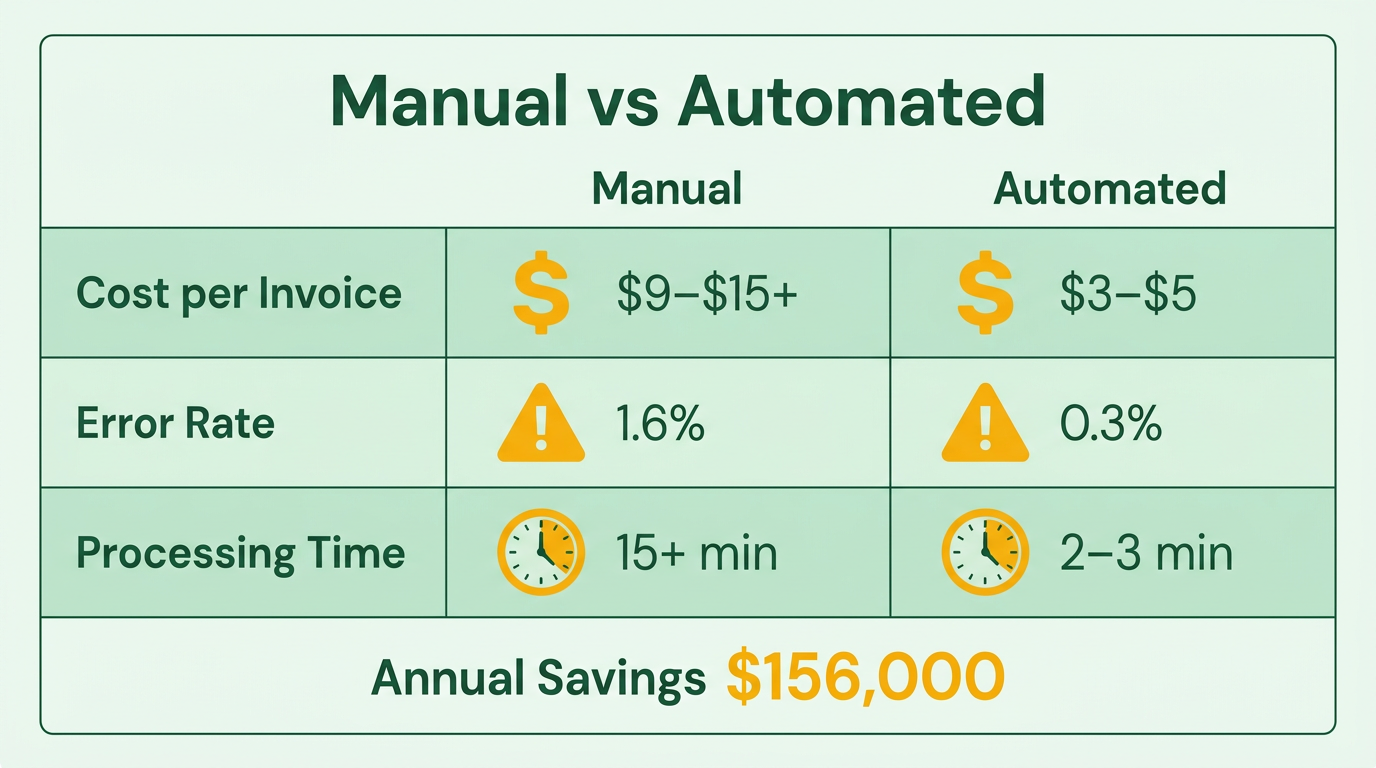
High error rates lead to costly corrections. Resolve Pay reports that 1.6% of manual invoices require rework, translating to $156,000 annual savings for a business processing 1,000 invoices monthly. Similarly, a 2025 study by Artsyl found only one-third of invoices are processed end-to-end manually without errors, highlighting the risks of relying on human oversight.
…
The cost savings are undeniable. At $7.75 per invoice manually versus $2.02 with automation, businesses processing 10,000 invoices monthly could save $57,300 annually. As AI and OCR technologies mature, even industries like healthcare and government are reevaluating manual systems to reduce fraud risks and boost compliance.
Automated Invoice Processing: A Closer Look

Automated invoice processing replaces manual data entry and paper-based workflows with digital tools powered by AI, OCR, and machine learning. This system automates tasks like data extraction, validation, approval routing, and payment processing, reducing human intervention to near-zero for high-volume invoices. By integrating with ERP systems and using technologies like AI-assisted capture and three-way matching, automated solutions minimize errors and accelerate processing times. For example, IBM’s research shows that organizations with mature automation complete invoices in 3 days versus 17 days manually, while Resolve Pay’s stats highlight cost reductions from $15–$40 per invoice to $3–$5. As mentioned in the Cost Analysis: Manual vs Automated section, these cost savings align with broader trends in operational efficiency.
At its core, automated systems use AI-powered data extraction to parse invoice details, match them to purchase orders, and validate against contracts. Optical Character Recognition (OCR) scans documents, while machine learning improves accuracy by learning from past transactions. For instance, Precoro’s AI systems combine OCR, NLP, and RPA to process 95–99% of invoices without human input. Integration with ERP platforms ensures seamless data flow, as seen in Blackbaud’s case, where Workday integration cut journal entries by 25%. Building on concepts from the Implementation Considerations for Automated Systems section, such integrations require careful alignment with existing workflows.
Automation delivers increased efficiency, accuracy, and scalability. For example, Wolf Construction eliminated manual tasks with Stampli, improving cash flow visibility. Retailers with high supplier counts benefit from automation’s ability to handle seasonal spikes, while manufacturers gain real-time spend insights. MADP’s hybrid AI-human model achieves 97% automation with environmental benefits, reducing CO2 emissions by 69% compared to manual processing. As highlighted in the Error Reduction: Manual vs Automated section, automated systems drastically cut error rates, contributing to these sustainability gains.
While automation offers clear advantages, implementation requires strategic planning. Costs vary: Initial setup may involve ERP integration, software licensing, and employee training. However, ROI typically materializes within months, as seen in Resolve Pay’s case, where a business saved $156,000 annually by automating 1,000 monthly invoices. Building on concepts from the **Cost Analysis: Manual vs Automated** section, these savings underscore the long-term financial benefits of automation. A phased rollout-starting with high-volume, low-variation invoices-is recommended. **IBM advises piloting automation** on 20–30% of invoices first to identify bottlenecks. For instance, **Hilti’s e-invoicing overhaul** reduced processing costs to $2.18 per invoice by 2024, using AI for validation and exception handling.
Automated systems excel in industries with high transaction volumes or complex workflows. Manufacturers use them to reduce coding errors and track plant-level spend, while retailers streamline PO matching during peak seasons. The MADP pipeline demonstrates sustainability gains, handling 100,000 invoices yearly with 70% fewer FTEs. Meanwhile, PaperTrl’s clients report 80% fewer duplicate payments via secure payment methods like ACH and virtual credit cards. For organizations evaluating automation, prioritizing ROI-driven workflows is critical. Start by auditing current processes to identify high-cost areas-such as manual data entry or delayed approvals-and target those first. By combining AI’s speed with human oversight for exceptions, businesses can achieve 98%+ accuracy while maintaining compliance, as noted in Artsyl’s expert insights.
“Automation consistently improves speed, accuracy, and visibility, while supporting stronger compliance and fraud prevention.”. Expert in Manual vs Automated Invoice Processing.
In summary, automated invoice processing transforms financial operations by cutting costs, reducing errors, and freeing teams for strategic work. With scalable solutions ranging from AI-driven ERP integrations to sustainable multi-agent pipelines, the technology adapts to diverse business needs, making it a cornerstone of modern AP strategy.
Cost Analysis: Manual vs Automated
In the Labor Costs: Manual vs Automated subsection, automation cuts error rates from 1.6% to 0.3%, saving $120–$200 per invoice in correction costs. As mentioned in the Error Reduction: Manual vs Automated section, these reductions stem from minimized data entry and approval errors inherent to manual workflows.
The Software and Implementation Costs section highlights that ERP integration adds $10,000–$50,000 to automation costs. Building on concepts from the Implementation Considerations for Automated Systems section, these costs depend on the complexity of aligning automation with existing financial platforms.
By automating workflows, companies save 80% on processing time. As discussed in the Time Savings: Manual vs Automated section, this speedup enables faster supplier payments and access to early-discount opportunities, further amplifying cost savings.
Time Savings: Manual vs Automated
Automated invoice processing slashes processing times, approval cycles, and payment delays compared to manual methods. By using AI, OCR, and workflow automation, businesses eliminate hours of manual data entry and reduce human error. Below, we break down the time savings across key stages and provide real-world examples.
How Much Faster Is Automated Invoice Processing?
Manual processing requires extensive human intervention, from data entry to validation. Automated systems streamline this with AI-driven capture and validation.
| Metric | Manual Processing | Automated Processing |
|---|---|---|
| Time per invoice | 15 minutes (13) | 1–3 minutes (13) |
| Cost per invoice | $7.75–$15+ (3)(1) | $2.02–$5 (3)(5) |
| Error rate | 30%+ (2)(6) | 2–5% (Error Reduction: Manual vs Automated) |
For example, a company processing 60,000 invoices manually would spend ~1,580 hours annually (13). Automation reduces this to just 600 hours-a 62% time saving. IBM’s research shows automated systems cut invoice cycle times from 17 days (manual) to 3 days (5).
What About Approval and Payment Cycles?
Automation accelerates approvals by routing invoices to the correct stakeholders instantly. Manual approvals often stall due to lost documents or unclear ownership.
- Approval cycles: Artsyl reports automation reduces approval times by 80% (1). A manufacturer using automation cut approval delays by 60%, resolving backlogs in days instead of weeks (1).
- Payment cycles: Timely payments improve vendor relationships and avoid late fees. Automated workflows flag due dates and process payments in real time. One CFO noted automation “ensures vendors are paid accurately and on time” (4).
A retail company with 100,000 PO invoices annually saved 3,500 hours by automating approvals (9). Non-PO invoices saw similar gains, dropping from 6 minutes per invoice (manual) to 1.8 minutes (automated) (9).
Real-World Examples and Best Practices
Case studies highlight measurable efficiency gains:
- Wolf Construction: Eliminated manual tasks with AP automation, improving cash flow visibility and reducing invoice status checks from days to real time (3).
- MADP System: A hybrid AI-human workflow achieved 97% automation for invoices, reducing FTE requirements by 70% (11).
- A logistics firm: Automated 80% of its invoice processing, cutting manual review time from 4 hours per week to 30 minutes (10).
Best practices for maximizing savings:
- Start with high-volume invoices: Pilot automation on repetitive, high-volume workflows (e.g., utility bills) to show quick wins (Implementation Considerations for Automated Systems).
- Integrate with ERP systems: Syncing with platforms like NetSuite ensures seamless data flow and reduces reconciliation errors (Cost Analysis: Manual vs Automated).
- Use phased rollouts: Gradually expand automation to complex invoices after mastering simpler ones (1).
Key Takeaway
Automation transforms invoice processing from a labor-intensive task to a streamlined operation. By reducing processing times by 80% or more (1)(5), accelerating approvals, and ensuring timely payments, businesses free AP teams to focus on strategic work. With 98% of CFOs investing in automation (4), the shift is no longer optional-it’s a competitive necessity.
Error Reduction: Manual vs Automated
Error reduction is one of the most significant advantages of automated invoice processing over manual methods. Manual systems are prone to data entry errors, approval errors, and duplicate payments, while automation use technologies like OCR and AI to minimize mistakes. Below is a structured comparison of error types, their frequency, and the financial impact they create..
What Errors Do Manual Systems Commonly Produce?
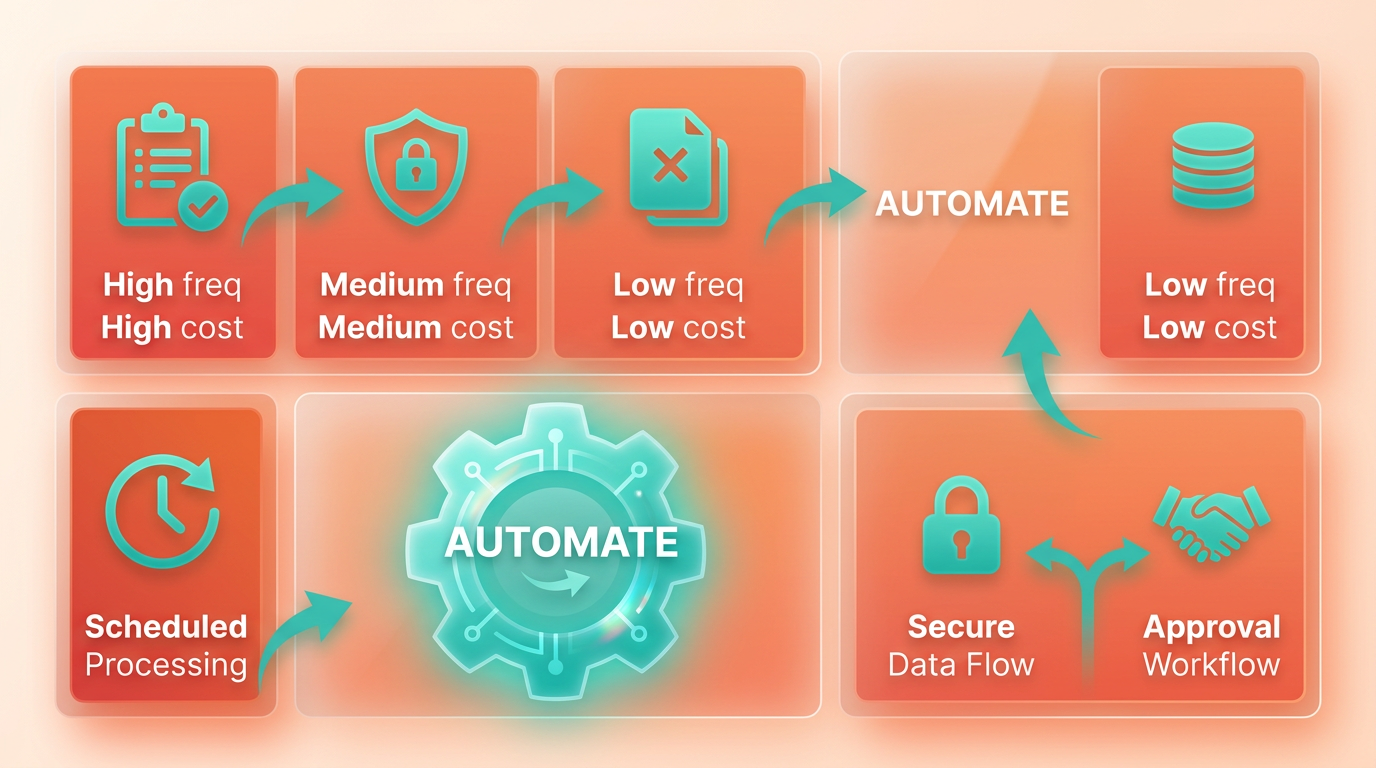
Manual invoice processing introduces human errors at multiple stages. Data entry errors occur when clerks manually input invoice details, such as vendor names, amounts, or tax codes. Even a single digit mistake can delay payments or trigger compliance issues. Approval errors happen when invoices are routed to the wrong approvers or overlooked entirely, leading to delayed or missed payments. As mentioned in the Cost Analysis: Manual vs Automated section, manual processing costs range from $15 to $40 per invoice, with labor making up 60–80% of expenses. Manual systems also struggle with duplicate payments. Without automated validation, teams may inadvertently pay the same invoice twice. One case study highlighted a business that reduced duplicate payments by 95% after implementing automated three-way matching. The same study noted that manual processes increase the risk of information leaks and invoice fraud, as physical documents or unsecured digital files become vulnerable to tampering..
How Much Do Errors Cost Businesses?
The financial impact of manual errors is staggering. Manual processing costs range from $15 to $40 per invoice, with labor making up 60–80% of expenses. Errors compound these costs: correcting a single mistake can cost up to $50, and error rates of 1.6% mean businesses processing 1,000 invoices monthly face **$156,000 in annual correction costs**. Building on concepts from the Cost Analysis: Manual vs Automated section, duplicate payments alone cost organizations an average of $2.50 per invoice, with some companies reporting losses in the millions annually. Reputational damage is another hidden cost. Late payments due to approval bottlenecks or missed deadlines can harm vendor trust. A 2024 survey found that 40% of businesses report delayed vendor payments because of scattered manual workflows. Over time, these issues erode supplier partnerships and increase the cost of goods due to lost early-payment discounts..
What Evidence Supports Automation’s Error Reduction?
Automated systems reduce errors through machine learning, OCR, and workflow validation. For example, IBM’s automated systems cut invoice processing time from 17 days (manual) to 3 days (automated), while error rates dropped by 80%. A 2024 research study demonstrated that AI-powered OCR systems achieved 95% accuracy in extracting invoice data, compared to 75% accuracy in manual entry. This precision reduces mismatches between purchase orders and invoices, a common source of disputes. Case studies reinforce these findings. Wolf Construction eliminated 80% of manual errors after adopting Stampli’s AI-driven platform, which uses machine learning to match invoices with contracts and purchase orders. Similarly, a 2024 analysis of 32 enterprises showed that automated systems reduced invoice exceptions by 82% and processing errors by 95%. These improvements translate directly to cost savings: automated systems cut per-invoice costs to $2.02–$3, compared to $7.75–$16 manually..
Best Practices for Minimizing Errors in Automation
To maximize error reduction, businesses should focus on system integration and workflow design. Automated systems must sync with ERP platforms to ensure data consistency. For instance, IBM highlights that integration with ERPs like SAP or Oracle reduces reconciliation time by 40%. As outlined in the Implementation Considerations for Automated Systems section, organizations must align automated invoice processing systems with their existing workflows and data infrastructure. Additionally, AI validation rules-such as matching invoice line items to contracts-prevent overpayments and fraud. Training teams to use automation tools is equally critical. A compliance manager at a mid-sized firm noted that “lost invoices and delayed approvals are a thing of the past” after adopting Stampli’s user-friendly interface. Regular audits of automated workflows also help catch edge cases, such as unconventional invoice layouts that OCR systems might misinterpret.. | Error Type | Manual Processing Impact | Automated Processing Impact |. |—-|—–|—–| | Data Entry Errors | 1.6% error rate per invoice | 0.3% error rate per invoice | | Approval Delays | 15–30 minutes per invoice | 2–3 days for full approval cycle | | Duplicate Payments | 32% of errors stem from this | Reduced by 95% with three-way matching | | Cost per Invoice | $15–$40 | $2.02–$3 | | Reconciliation Time | 17 days average | 3 days average |.
Conclusion
Automated invoice processing systems drastically reduce errors by combining AI, OCR, and workflow automation. By eliminating manual data entry, enforcing approval rules, and catching duplicates, these systems cut error rates by 80% or more while saving businesses thousands annually. For companies struggling with manual inefficiencies, automation isn’t just a cost-saving tool-it’s a strategic move to enhance accuracy, vendor trust, and financial oversight.
Implementation Considerations for Automated Systems
Organizations must align automated invoice processing systems with their existing workflows and data infrastructure. A critical first step is assessing invoice volume, format diversity, and integration requirements with ERP systems. For example, companies handling high-volume vendors should prioritize scalability, while those dealing with non-PO invoices need flexible data extraction capabilities. The aircc study highlights the importance of image preprocessing techniques-such as noise reduction and contrast enhancement-to improve OCR accuracy, especially for scanned or low-quality invoices. As mentioned in the Automated Invoice Processing: A Closer Look section, integration with ERP systems is foundational to reducing manual handoffs.

A realistic timeline and stakeholder alignment are also essential. Teams must evaluate whether current accounting software supports AI-powered validation or requires third-party integrations. For instance, Precoro recommends starting automation with high-volume vendors to deliver immediate cost savings, as manual processing costs $12–$30 per invoice compared to $1–$5 for automated systems. Building on concepts from the Cost Analysis: Manual vs Automated section, these cost savings compound with scale, making automation critical for high-volume operations. Additionally, organizations should inventory vendor formats to train machine learning models effectively, ensuring the system adapts to variations in invoice layouts.
| Planning Priority | Manual Processing Limitations | Automated System Requirements |
|---|---|---|
| Data preparation | Relies on human data entry | Requires clean vendor master data |
| Integration | Siloed approvals slow processing | ERP or accounting software sync |
| Format flexibility | Struggles with non-standard layouts | AI models trained on diverse samples |
Rolling out automated systems demands rigorous testing and user training. The aircc research emphasizes validating convolutional neural networks (CNNs) and recurrent neural networks (RNNs) against real-world invoice datasets to minimize errors. For example, their system achieved 95% accuracy by training on cross-industry data, reducing error rates by 80% compared to manual entry. Teams should conduct pilot tests with a subset of invoices to identify edge cases, such as handwritten notes or irregular layouts, before full deployment.
User adoption hinges on clear training programs and ongoing support. Precoro suggests involving finance teams early to demonstrate how automation streamlines tasks like three-way matching or duplicate detection. For instance, a company processing 100,000 PO invoices annually could save 3,500 hours by automating validation, allowing staff to focus on exception resolution. Additionally, automated systems like NetSuite-native solutions simplify workflows by embedding invoice capture, coding, and approvals into a single SaaS solution, reducing manual handoffs. As outlined in the Error Reduction: Manual vs Automated section, minimizing duplicate payments and data entry errors is a core benefit of automation.
A structured rollout plan is crucial. Start by configuring workflows for high-volume vendors, ensuring optical character recognition (OCR) aligns with existing tax codes or procurement policies. For example, Capital City’s case study demonstrated how automated validation reduced duplicate payments by flagging inconsistencies in vendor codes. Teams should also establish feedback loops-such as dashboards tracking processing speed or error logs-to refine the system iteratively.
Post-implementation reviews (PIRs) must measure speed, accuracy, and cost efficiency against manual benchmarks. The aircc study reports automated systems process invoices at 10 per minute-compared to several minutes per invoice manually-while Precoro notes organizations processing 1,000 invoices monthly save 50–80 hours monthly. Accuracy is equally critical: AI systems achieve 95–99% accuracy, whereas manual entry errors exceed 60% due to data entry fatigue.
| Performance Metric | Manual Baseline | Automated Improvement |
|---|---|---|
| Processing time (PO invoices) | 3 minutes per invoice | 54 seconds per invoice |
| Error rate | 60%+ | 5–10% |
| Cost per invoice | $12–$30 | $1–$5 |
Long-term success depends on continuous optimization. For instance, machine learning models improve over time by learning from each transaction, adapting to new vendor formats or regional tax rules. Companies should schedule quarterly reviews to update training datasets and refine natural language processing (NLP) for unstructured data like invoice descriptions. By aligning automation with evolving business needs, organizations maximize ROI and maintain operational agility.
Frequently Asked Questions
1. How much does manual invoice processing cost per invoice compared to automation?
Manual processing costs $15–$40 per invoice, while automation reduces this to $3–$5. This cuts expenses by up to 80%, saving $156,000 annually for 5,000 monthly invoices due to lower labor and error correction costs.
2. What is the error rate in manual invoice processing?
Manual systems have a 1.6% error rate, costing $16,000 yearly for 10,000 invoices. Automation minimizes these errors, reducing correction costs and improving accuracy significantly.
3. How much time does manual invoice processing waste annually?
Manual processing wastes 15 minutes per invoice. For 60,000 invoices, this totals 158 hours yearly, whereas automation cuts time to 1–3 minutes per invoice.
4. What percentage of manual processing costs is labor?
Labor accounts for 60–80% of manual invoice processing expenses. Automation reduces this by streamlining workflows and minimizing human intervention.
5. How do manual delays affect supplier relationships?
Manual delays risk late fees and strained supplier relationships. Automated systems ensure timely payments, avoiding these issues and improving vendor trust.
6. Can automation reduce payment-related losses?
Yes; a manufacturer’s losses dropped from $250,000 to $15,000 annually by adopting automation, showcasing its impact on reducing errors and payment delays.
7. Why is automated invoice processing critical for businesses?
Automation reduces costs, errors, and delays, saving up to 80% on processing expenses. It ensures efficiency, maintains supplier trust, and avoids late fees, making it essential for competitiveness.