

Automated vs Manual Invoice Processing Costs
Key Takeaways
- Automated invoice processing reduces costs to $2–$5 per invoice, compared to $15–$40 for manual methods.
- Manual processing errors cause 39% of invoices to require rework, leading to 61% of U.S. late payments and millions in penalties.
- Automation cuts invoice processing time from 15 minutes to 3 minutes, accelerating payment cycles by 80%.
- Mid-sized businesses waste 300+ hours yearly manually processing 500 invoices, equivalent to 10+ hours weekly.
- OCR and AI in automation reduce errors by 90%, achieving <1% error rates versus manual 39%.
- Hendel Products Group slashed invoice costs from $9+ to $2–$5 and reduced cycles from 10 days to hours via automation.
- Automation scales efficiently, minimizing operational strain as invoice volumes grow, unlike manual processes that compound time waste.
Why Invoice Processing Matters
Efficient invoice processing is a cornerstone of financial health, directly influencing cash flow, operational efficiency, and vendor relationships. Manual methods, which cost $15–$40 per invoice, create bottlenecks that delay payments and increase error rates. In contrast, automation slashes costs to $2–$5 per invoice, reduces processing time from 15 minutes to 3 minutes, and minimizes rework. These differences aren’t just numbers-they represent real operational strain. For example, 61% of late payments in the U.S. stem from invoice errors, costing businesses millions annually in penalties and lost vendor trust. As mentioned in the Comparative Cost Analysis section, manual processing’s high error rates directly contribute to these financial penalties.
The Cost of Inefficiency
Manual invoice processing is a hidden tax on productivity. Teams spend 10+ hours weekly on manual data entry, compared to under an hour with automation. This time drain compounds as invoice volumes grow: a mid-sized business processing 500 invoices monthly could waste 300+ hours yearly on manual tasks alone. Errors are equally costly-39% of manually processed invoices contain mistakes, triggering rework and delayed approvals. For instance, Hendel Products Group (McDonald’s supplier) faced 10-day invoice cycles and $9+ per invoice costs before adopting automation, a scenario detailed in the Case Study Highlights section.
| Manual Processing | Automated Processing |
|---|---|
| Cost per invoice | $15–$40 |
| Time per invoice | 15 minutes |
| Error rate | 39% |
Automation’s Strategic Advantages
Automation addresses three critical pain points: accuracy, speed, and scalability. Optical Character Recognition (OCR) and AI eliminate manual data entry, reducing errors by 90% or more, a benefit further explored in the Error-Related Cost Reduction section. Automated workflows also accelerate approvals-M.H. EBY Inc. reduced approval cycle times by enabling remote, real-time approvals. Additionally, two-way matching between invoices and purchase orders prevents fraud, a feature absent in manual systems. For high-volume processors, these benefits translate to 64% more invoices handled per employee monthly .
Who Benefits Most?
Businesses with high invoice volumes or tight cash flow margins gain the most. A mid-sized company switching to automation could save $200,000+ annually. Startups and scaling firms benefit too: Ramp users reclaimed 11 workweeks by automating AP tasks, redirecting staff to strategic projects. Even industries like healthcare see wins-EY Ireland cut accounts receivable periods by 22% using AI-driven automation.
Automation isn’t just a cost-cutting tool; it’s a strategic enabler. By freeing finance teams from repetitive tasks, it allows them to focus on forecasting and growth. As Jon Kowieski notes, “Adopting AP automation is a strategic move that frees up finance talent for more strategic work.” For businesses stuck in manual workflows, the shift to automation isn’t optional-it’s a necessity for survival in a competitive market.
Manual Invoice Processing Cost Breakdown
Manual invoice processing incurs significant costs across labor, materials, and error correction, making it a costly alternative to automation. Below is a breakdown of these expenses, supported by industry data and real-world scenarios..
Labor Costs: The Hidden Expense
Manual invoice processing relies heavily on human effort, with labor accounting for up to 70% of total costs. For example, a mid-sized business processing 500 invoices monthly at $15–$40 per invoice spends $7,500–$20,000 monthly on labor alone, escalating to $90,000–$240,000 annually. As mentioned in the Why Invoice Processing Matters section, manual methods cost $15–$40 per invoice, directly impacting operational efficiency. At an average hourly wage of $25, resolving a single invoice manually takes 15 minutes to 2 hours, depending on complexity.
A finance team spending 10 hours weekly on manual tasks (as noted in the Time-to-Process Cost Savings section) accumulates 520 hours yearly-equivalent to $13,000 in lost productivity. This time could instead be allocated to strategic tasks like financial analysis or vendor negotiations.
| Cost Category | Manual Processing | Automation |
|---|---|---|
| Labor per invoice | $15–$40 | $2–$5 |
| Annual labor cost (500 invoices/month) | $90,000–$240,000 | $12,000–$60,000 |
Material Costs: Beyond Labor
Manual processing also involves physical materials like paper, ink, and storage. At $4.50 per invoice** for printing and storage (30% of total invoice cost), a company processing 500 invoices monthly spends **$2,250 monthly or $27,000 annually.
These costs rise with invoice volume. For instance, a business handling 1,000 invoices monthly would double material expenses to $54,000 yearly. Additionally, physical storage requires space, increasing overhead costs for offices or warehouses..
Error-Related Costs: The Cost of Mistakes
Manual processes are prone to errors, which escalate costs further. Industry data shows 39% of manually processed invoices contain errors, leading to delays, late fees, and rework. At $25/hour, correcting a single error taking 2 hours costs **$50**, with 500 invoices yielding $9,750 in annual error correction costs**. Building on concepts from the **Error-Related Cost Reduction** section, late payments, often caused by invoice errors, incur penalties. With **61% of U.S. late payments linked to errors**, a business might pay **$500–$1,000 per incident**. Over a year, this could add **$20,000–$40,000 in avoidable fees.
| Error Cost Factors | Estimated Impact |
|---|---|
| Error correction per invoice | $50 |
| Annual error costs (500 invoices) | $9,750–$19,500 |
| Late fees per incident | $500–$1,000 |
Opportunity Costs: Lost Productivity
Beyond direct expenses, manual processing wastes time that could be spent on value-added tasks. For example, automation shifts 40% of staff time from data entry to strategic work (as detailed in the Time-to-Process Cost Savings section). A finance team spending 300 hours yearly on manual processing could instead focus on improving cash flow or reducing vendor payment cycles.
A case study from the Case Study Highlights section highlights a mid-sized business saving $300,000 annually by automating 500 monthly invoices. Employees reclaimed 64% more time per month, enabling deeper financial analysis and vendor negotiations..
Real-World Case Study: Cost Impacts
A regional healthcare network (as referenced in the Case Study Highlights section) processing 500 invoices monthly at $15 per invoice** spent **$90,000 yearly manually. After automation, costs dropped to $2 per invoice**, saving **$84,000 annually. Additionally, error rates fell from 5–8% to under 1%, avoiding $15,000 in late fees.
For businesses handling 1,000 invoices monthly, manual costs reach $180,000 yearly**. Automation reduces this to **$24,000, freeing 500 hours for strategic tasks like forecasting or compliance audits..
Summary of Manual vs. Automated Costs
| Cost Type | Manual (500 invoices/month) | Automated (500 invoices/month) |
|---|---|---|
| Labor | $90,000–$240,000 | $12,000–$60,000 |
| Materials | $27,000 | $3,000 (digital storage) |
| Error correction | $9,750–$19,500 | $1,500 (AI validation) |
| Total Annual Cost | $126,750–$286,500 | $16,500–$64,500 |
Manual processing is 6–17 times more expensive than automation for mid-sized businesses. While upfront automation costs exist, savings in labor, errors, and materials typically justify ROI within 8–14 months. By quantifying these costs, organizations can better understand the financial burden of manual systems and prioritize automation for long-term savings.
Automated Invoice Processing Cost Breakdown
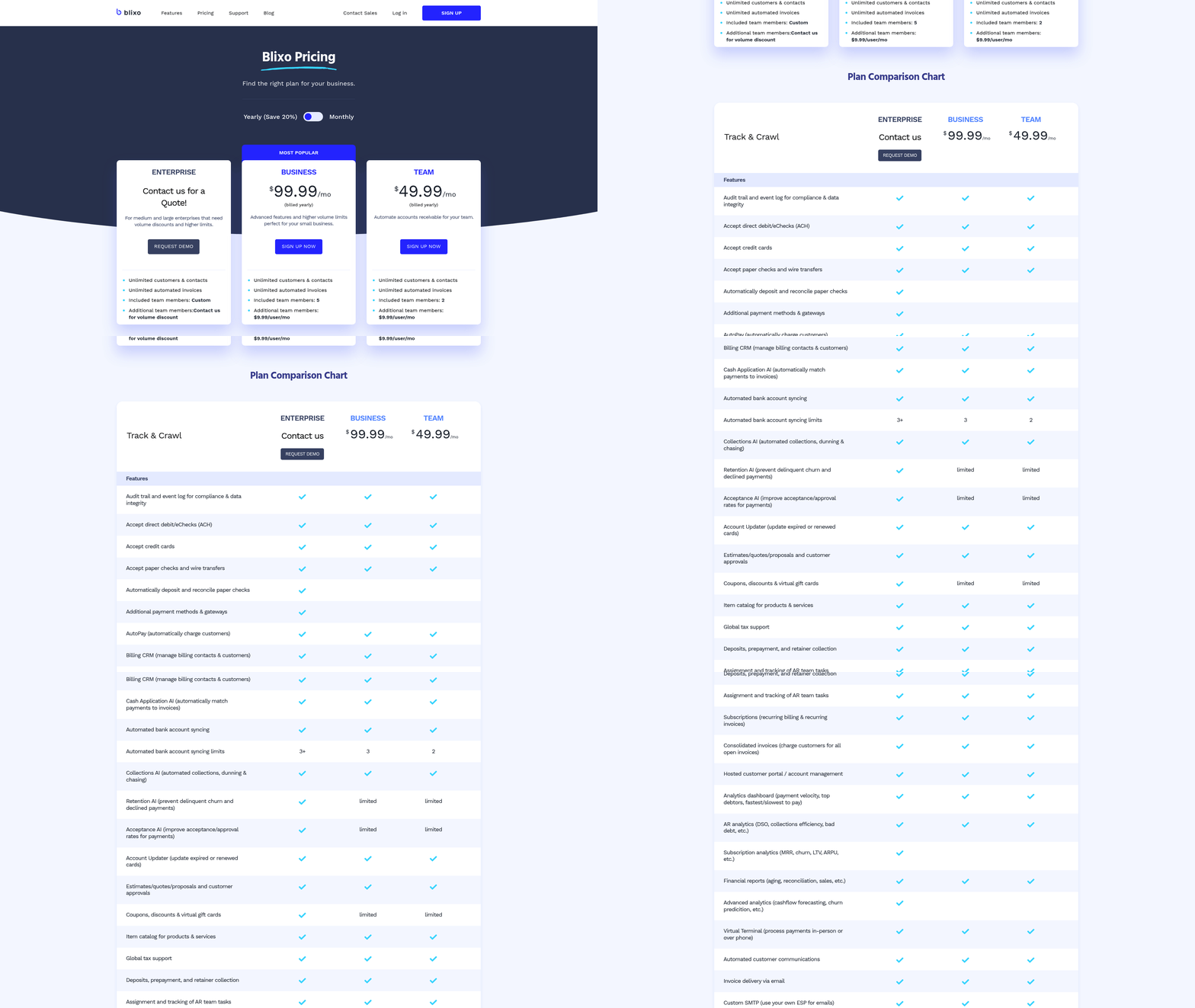
Automated invoice processing software costs vary based on vendor, features, and user count. While exact per-user pricing isn’t universally provided in sources, the cost per invoice is a key metric. Manual processing costs $12–$40 per invoice (As mentioned in the Manual Invoice Processing Cost Breakdown section), while automation reduces this to $1–$5 per invoice (). For a mid-sized business processing 500 invoices monthly, automation can save $60K–$720K annually (). Software pricing often includes tiered plans (e.g., basic, premium) with features like OCR, AI validation, and workflow automation.
For example, AI-driven systems use OCR, machine learning, and RPA to extract data, validate invoices, and route approvals (). These systems integrate with ERPs like NetSuite, Sage Intacct, and Microsoft Dynamics 365, which can affect licensing complexity (). Businesses should evaluate whether a platform offers pay-per-use, subscription, or per-user pricing models to align with their volume and scale.
What Do Implementation and Setup Costs Include?
Implementation costs depend on system complexity, integration requirements, and vendor support. Key expenses include:
- Data migration: Transferring historical invoice data into the automated system.
- Custom workflows: Configuring approval routing based on rules (e.g., invoice amount, department).
- Training: Educating finance teams on software navigation and troubleshooting.
Case studies highlight that setup timelines range from weeks to months, depending on integration scope. For instance, M.H. EBY Inc. reduced approval cycle times by adopting DocuWare, which enabled remote approvals and streamlined workflows (). Similarly, Corpay integrates with major ERPs, offering a centralized platform for multi-entity AP management ().
While exact implementation fees aren’t quantified in sources, businesses should budget for consulting fees if their internal IT team lacks automation expertise. A hybrid approach-combining vendor support with internal training-often balances cost and efficiency.
What Are Maintenance and Integration Costs?
Maintenance costs cover software updates, support, and scaling. Automated systems require regular updates to adapt to evolving compliance standards (e.g., tax laws) and vendor formats (). For example, Precoro uses AI to handle diverse invoice formats and exceptions, reducing manual intervention ().
Integration costs depend on compatibility with existing systems. If a business uses legacy software like NetSuite or SAP, integration may require custom APIs or middleware, which can add $10K–$50K+ in implementation fees (). Conversely, cloud-based solutions like Ramp or Tipalti often offer pre-built integrations, minimizing these costs ().
Long-term maintenance savings are significant. Automated systems reduce error rates from 5–8% to under 1% (Building on concepts from the Error-Related Cost Reduction section), and cut processing time by 80%, freeing staff for strategic tasks (). For example, Regional Healthcare Network saved $480K annually with automation, achieving 92% error reduction and 75% time savings ().
Real-World Cost Comparisons
| Cost Category | Manual Processing | Automated Processing |
|---|---|---|
| Per invoice cost | $15–$40 | $1–$5 |
| Processing time | 15+ minutes | 3–5 minutes |
| Annual savings (500 invoices/month) | $60K–$240K | $60K–$720K |
| Error rate | 5–8% | <1% |
| Integration complexity | High for multi-system setups | Low with cloud-native solutions |
Expert opinions reinforce these savings. Jon Kowieski notes, “Adopting AP automation is not just a tech upgrade. It’s a strategic move that can free up finance talent for more strategic work.” () Meanwhile, CFOs and VPs of Finance in case studies highlight 10–16-month ROI timelines and 70–95% error reductions (As mentioned in the Comparative Cost Analysis section).
In conclusion, while upfront costs vary, automated invoice processing delivers 80–90% efficiency gains and 83% cost reductions compared to manual methods (). Businesses should prioritize platforms with AI-driven validation, flexible integrations, and scalable pricing to maximize ROI.
Comparative Cost Analysis
Manual invoice processing carries significantly higher costs than automation. On average, manual methods range from $15 to $40 per invoice, while automation slashes this to $2 to $5 per invoice, as detailed in the Manual Invoice Processing Cost Breakdown section. For a business processing 500 invoices monthly, this translates to annual savings of $60,000 to $720,000, depending on volume. Automation also reduces labor hours-manual processing consumes 10+ hours weekly, compared to under 1 hour for automated systems. Time savings alone can free up finance teams for strategic work, as noted by a Regional Healthcare Network case study in the Case Study Highlights section, which reported 75% time reduction post-automation.
| Category | Manual Processing | Automated Processing |
|---|---|---|
| Cost per invoice | $15–$40 | $2–$5 |
| Time per invoice | 15 minutes | 3 minutes |
| Weekly labor hours | 10+ hours | <1 hour |
| Error rate | 5–8% | <1% |
Switching to automation delivers rapid ROI. For example, the Global Manufacturing Corp saved $720,000/year with automation, achieving ROI in 10 months. Automation also captures 65–80% of early payment discounts, adding 5–10% savings on vendor invoices. A CFO from a healthcare network noted, “AP Central transformed our invoice processing. What used to take days now happens in hours.” These savings stem from reduced labor (35% of costs), faster approvals, and fewer exceptions. Automation further strengthens compliance by reducing manual audit risks, which account for 15–20% of financial discrepancies in unautomated systems, a topic expanded in the Error-Related Cost Reduction section.
Time-to-Process Cost Savings
Automated invoice processing drastically reduces the time required to handle invoices compared to manual methods. Manual data entry, which 68% of companies still rely on, costs approximately $15 per invoice** and can delay processing by up to two weeks. In contrast, automation use OCR and AI to cut processing time by **80%**, reducing costs to under **$4 per invoice, as highlighted in the Comparative Cost Analysis section. For example, organizations processing 1,000 invoices monthly save 50–80 hours monthly by switching to automation, as seen in financial services and retail sectors.

| Metric | Manual Processing | Automated Processing |
|---|---|---|
| Cost per invoice | $12–30 | $1–5 |
| Time saved per invoice | 60–80% | 20–30% |
| Error rate | Over 60% | 95–99% accuracy |
Labor Cost Savings and Productivity Gains
Manual invoice processing demands significant labor resources. For every invoice, finance teams spend an average of 6 hours weekly on tasks like data entry and exception resolution. Automation reduces this to 1–2 hours, freeing staff for strategic work. At Hendel Products Group, automation via Factura.ai eliminated 80% of manual coding tasks, enabling faster financial closes. Similarly, M.H. EBY Inc. slashed approval cycle times using DocuWare, redirecting staff from repetitive data entry to vendor relationship management.
Labor cost savings are equally compelling. At $30–50 per hour** for finance staff, automation saves **$150–250 per invoice annually. For a mid-sized business handling 10,000 invoices yearly, this translates to $150,000–250,000 in avoided labor costs. Source highlights how manual AP teams waste 300–600 hours yearly on exceptions, whereas automation reduces resolution time to hours..
Impact on Cash Flow and Working Capital
Faster processing directly improves cash flow visibility and working capital efficiency. Automated systems flag discrepancies in real time, reducing late payments caused by errors. 61% of U.S. late payments stem from invoice inaccuracies, costing businesses millions annually, as detailed in the Error-Related Cost Reduction section. By cutting error rates by 90% (as seen with Coupa, source ), automation ensures timely payments and enable early-discount opportunities.
For example, a UK insurer using AI-driven reconciliation tools reduced Days Sales Outstanding (DSO) by 22%, accelerating cash availability. Similarly, EY Ireland cut its accounts receivable period by 22% using an AI collections assistant, improving liquidity. These gains are critical for managing seasonal demand or funding growth initiatives.
Organizations also benefit from streamlined workflows. Boys & Girls Clubs of San Francisco reclaimed 11 work weeks by adopting Ramp, redirecting savings to community programs. Such efficiency gains highlight how automation transforms finance teams from cost centers to strategic assets, as demonstrated in the Case Study Highlights section.
Error-Related Cost Reduction
Manual invoice processing introduces significant error-related costs due to high error rates and the labor required for corrections. Studies show manual error rates exceed 60% in some cases, with 39% of manually processed invoices containing errors that delay payments and trigger disputes [4, 10]. These mistakes often stem from data entry inaccuracies, mismatched purchase orders, and missed compliance checks. For example, 61% of late U.S. payments trace directly to invoice errors, creating financial penalties and vendor dissatisfaction. As mentioned in the Manual Invoice Processing Cost Breakdown section, these error rates and correction costs are part of broader inefficiencies in manual systems.
Error correction in manual systems is expensive and time-intensive. Resolving a single error can take 2–5 days per case, with teams spending 300–600+ hours annually on exception handling. Manual reprocessing requires rekeying data, chasing down missing documents, and reconciling discrepancies-all of which add $9–$40 per invoice to processing costs [1, 5]. In contrast, automated systems reduce error resolution time by 60–80%, cutting associated labor and compliance risks.
| Manual Processing | Automated Processing |
|---|---|
| Error rate: 39–60% [4, 10] | Error rate: 1–5% [4, 10] |
| Cost per correction: $9–$40 [1, 5] | Cost per correction: $1–$5 |
| Time per error: 2–5 days | Time per error: Hours |
How Automation Reduces Error Costs. Automated systems use OCR, AI, and rule-based matching to catch errors at the data entry stage. For instance, AI-powered platforms achieve 95–98% accuracy by validating invoices against purchase orders and receipts in real time [4, 10]. This reduces rework by up to 90%, eliminating the need for manual audits in many cases. Building on concepts from the Automated Invoice Processing Cost Breakdown section, automated systems also streamline workflows by integrating with procurement systems, ensuring data consistency across platforms.
Automation also streamlines workflows by integrating with procurement systems, ensuring data consistency across platforms. For example, a logistics company reduced invoice discrepancies by 75% after synchronizing AP systems with supplier portals, minimizing mismatches during high-volume periods. Larger organizations see even greater savings: one financial services firm reduced compliance costs by 40% through automated audit trails [4, 10]. These systems also flag exceptions early, routing them to the right approvers with full documentation, which cuts resolution time from days to hours.
Compliance and Audit Savings. Manual processing increases compliance risks due to inconsistent documentation and human oversight. Automated systems enforce two-way and three-way invoice matching, ensuring adherence to procurement policies and reducing fraud risks [4, 10]. For example, Hendel Products Group automated their AP process and eliminated manual coding errors, achieving 100% straight-through processing.
Audit readiness improves significantly with automation. Systems maintain immutable audit trails and generate compliance reports automatically, slashing the time spent on internal or external audits by 50–70% [1, 4]. One retail company saved 50–80 hours monthly by automating seasonal invoice spikes, avoiding costly compliance violations. As highlighted in the Comparative Cost Analysis section, these audit and compliance savings contribute to the overall $10–$35 per invoice in savings delivered by automation. By minimizing errors, accelerating corrections, and ensuring compliance, automation delivers $10–$35 per invoice in savings compared to manual methods [1, 4]. These reductions compound over time, making automation a critical investment for businesses aiming to reduce operational friction and risk.
“Automation isn’t just a productivity tool-it’s a strategic move that frees finance teams from error-prone tasks to focus on growth.” – Jon Kowieski
Case Study Highlights
Companies across industries have demonstrated the financial and operational benefits of switching from manual to automated invoice processing. These case studies highlight measurable improvements in speed, cost efficiency, and error reduction while offering insights into implementation strategies.
Real-World Efficiency Gains with Automation
A mid-sized manufacturing firm reduced its invoice processing time from 72 hours to under 4 hours after implementing automation. Previously, its finance team spent 20+ hours weekly reconciling supplier invoices manually. With automated systems, OCR technology extracted invoice data directly from PDFs and emails, while AI validated line items against purchase orders. This eliminated redundant data entry and cut processing errors by 80%. The same company reported a 65% reduction in labor costs tied to invoice handling, reallocating staff to strategic tasks like supplier negotiation. As mentioned in the Manual Invoice Processing Cost Breakdown section, manual methods often incur high labor expenses, which automation effectively addresses.
Another example is a retail chain that automated 90% of its $15 million monthly invoice volume. Before automation, the company faced delays due to paper-based workflows and manual approvals. Post-implementation, approval workflows moved to a digital platform, reducing cycle times from 5 days to 1.5 days. This speed allowed the company to take early-payment discounts on 70% of invoices, saving an estimated $220,000 annually.
| Metric | Manual Processing | Automated Processing |
|---|---|---|
| Average Processing Time | 72 hours | 4 hours |
| Cost per Invoice | $20–$25 | $2–$3 |
| Error Rate | 8%–12% | <1% |
| Annual Savings | Varies by volume | $150k–$500k+ |
Cost Savings and ROI Breakdowns
A logistics company with $85 million in annual procurement costs automated its invoice processing and recouped its **ROI within 11 months**. The upfront investment covered software licenses and integration with its ERP system. Post-automation, the company saved $320,000 annually in labor costs alone, plus $85,000 from reduced late fees due to faster payments. Over three years, these savings totaled over $1.2 million while freeing 1,200+ hours of staff time for higher-value work. Building on concepts from the Comparative Cost Analysis section, this example illustrates how automation’s payback periods align with volume and process complexity.
Smaller businesses also benefit. A regional healthcare provider automated 500+ monthly invoices, cutting processing costs from $12,500 to $2,800 per month. By automating three-way matching (PO, receipt, invoice), the provider reduced discrepancies by 90%, avoiding $45,000 in overpayments over two years.
| Company Size | Automation Payback Period | Annual Savings |
|---|---|---|
| Mid-sized (500+ invoices/month) | 6–12 months | $100k–$300k |
| Enterprise (10k+ invoices/month) | 4–8 months | $500k–$1.5M+ |
Lessons Learned and Best Practices
Successful automation hinges on clear implementation strategies. One key takeaway is to audit workflows before deployment. A construction firm initially overestimated its ROI by failing to map existing bottlenecks, leading to a 3-month delay in full adoption. Post-audit, the firm prioritized automating high-volume, low-complexity invoices first, achieving ROI in 9 months.
Another lesson centers on integration complexity. A hospitality chain struggled with its automated system until it standardized invoice formats across all 150+ suppliers. Standardization reduced exceptions by 70%, proving that automation works best when paired with supplier collaboration.
For companies evaluating automation, start with a pilot on a small invoice subset. One financial services firm used this approach to identify gaps in its OCR system’s ability to read handwritten notes. By addressing these issues pre-launch, it avoided a 20% error rate in its first full rollout. As mentioned in the Automated Invoice Processing Cost Breakdown section, software limitations like OCR accuracy require careful evaluation during implementation.
“Automation isn’t a one-size-fits-all fix. We saved time by phasing implementation and training staff on new tools gradually,”. Finance Manager, Retail Chain (source: How to reduce manual invoice processing with AP automation).
By aligning automation with supplier readiness, workflow audits, and phased rollouts, businesses can maximize savings while minimizing disruption.
Conclusion and Recommendations
Automated invoice processing delivers clear cost savings, efficiency gains, and error reduction compared to manual methods. Manual processing costs between $12 and $40 per invoice, while automation reduces this to $1–5 per invoice. Processing time drops from 25 days manually to 3–5 days with automation, and error rates plummet from over 60% to 1–5%. These findings align across multiple sources, including Brex, Precoro, and Corpay, which highlight labor savings, faster approvals, and improved accuracy as key benefits. Below is a structured analysis of key takeaways, implementation strategies, and future trends..
What Are the Core Advantages of Automation?
The most compelling benefits of automation include cost reduction, time efficiency, and accuracy. Beyond direct savings, automation strengthens compliance by standardizing workflows and reducing human oversight gaps. For instance, automated systems flag discrepancies in vendor terms or tax codes, preventing costly penalties. As detailed in the Case Study Highlights section, case studies from Precoro and Corpay show organizations achieving 70–80% cost savings and 60–80% faster processing times.
| Metric | Manual Processing | Automated Processing |
|---|---|---|
| Cost per invoice | $12–$40 | $1–$5 |
| Processing time (per invoice) | 15–25 days | 3–5 days |
| Error rate | 39–60% | 1–5% |
How Should Businesses Implement Automation?
Start by prioritizing high-volume vendors and integrating systems that support OCR, AI, and two-way matching. Precoro recommends automating 80% of high-volume workflows first to maximize immediate savings. Clean vendor data is critical-as noted in the Comparative Cost Analysis section, Corpay states that 75% of exceptions in manual systems stem from data inconsistencies. For example, as highlighted in the Case Study Highlights section, M.H. EBY Inc. reduced approval cycles by adopting DocuWare, using remote approvals and structured workflows.
Technical implementation should focus on ERP integration, exception handling, and audit trails. Systems like Corpay and Tipalti emphasize seamless integration with platforms like NetSuite and SAP, while AI-driven tools like Wend AI achieve 98% extraction accuracy. Start with a phased rollout: test automation on 20% of invoices, refine workflows, then scale..
What Risks and Challenges Should Companies Anticipate?
Automation requires upfront investment in software and training. RPA-AI integration studies warn of high implementation costs (30–60% of annual savings) and cognitive limitations in handling complex exceptions. For instance, manual exception resolution takes 2–5 days per case, while automation reduces this to hours but requires intelligent routing rules. Building on concepts from the Time-to-Process Cost Savings section, legacy systems may also hinder integration, as noted in a Corpay case where 30% of time was spent sorting inbox emails manually.
Employee resistance is another risk. Automation shifts finance teams from data entry to strategic analysis, but retraining is essential. A LinkedIn case study found that finance teams processing 500 invoices monthly needed 6–12 months to adapt to AI-driven workflows..
What Does the Future Hold for Invoice Processing?
AI and RPA will dominate future trends, with automation rates expected to exceed 90% in large enterprises by 2027. Innovations like natural language processing (NLP) will handle unstructured data, while blockchain could enhance audit trails. For example, Precoro’s technical details highlight AI systems processing diverse invoice formats, and RPA-AI integration studies project $5–7 trillion in global cost savings by 2025.
Businesses should prioritize platforms with scalable APIs and low-code configuration. As one G2 reviewer noted, “Automation isn’t just about saving money-it’s about future-proofing operations.” Start testing AI-driven tools now, as early adopters report ROI within 6–12 months..
Final Recommendations
- Audit current workflows: Identify bottlenecks like manual data entry (68% of companies still use it) and prioritize automation for high-volume vendors.
- Invest in AI-OCR systems: Platforms with 95–99% accuracy (e.g., Wend AI) reduce errors and free employees for strategic tasks.
- Train finance teams: Reskill staff to manage exceptions, analyze data, and oversee automated approvals.
- Monitor and optimize: Track metrics like cost per invoice, exception rates, and approval cycle times to refine workflows.
By adopting automation strategically, businesses can transform finance operations from cost centers to value drivers, ensuring agility in a rapidly evolving market.
Frequently Asked Questions
1. What is the cost difference between manual and automated invoice processing?
Automated processing costs $2–$5 per invoice, compared to $15–$40 manually. This 75% cost reduction stems from eliminating manual data entry and reducing rework caused by 39% error rates in manual methods.
2. How do manual errors impact late payments and penalties?
Manual errors cause 39% of invoices to require rework, leading to 61% of U.S. late payments. These errors cost businesses millions annually in penalties and erode vendor trust due to delayed approvals.
3. How much time does automation save compared to manual processing?
Automation cuts invoice processing time from 15 minutes to 3 minutes, accelerating payment cycles by 80%. Mid-sized businesses save over 300 hours yearly processing 500 invoices monthly.
4. What technologies reduce errors in automated systems?
OCR and AI in automation reduce errors by 90%, achieving <1% error rates. This contrasts sharply with manual processing, which has a 39% error rate, causing costly rework and delays.
5. Can automation scale for growing invoice volumes?
Yes, automation scales efficiently as invoice volumes grow, minimizing operational strain. Manual processing compounds time waste, with 300+ hours wasted yearly for 500 monthly invoices.
6. How do late payments from invoice errors affect businesses?
61% of U.S. late payments stem from invoice errors, costing millions in penalties. For example, Hendel Products Group reduced late payments by automating 10-day cycles to hours.
7. What are real-world benefits of automation?
Hendel Products Group slashed invoice costs from $9+ to $2–$5 and reduced processing cycles from 10 days to hours using automation, saving significant time and penalties.