

Accounts Receivable RPA for Finance Teams

Key Takeaways
- For subscription SaaS, accounts receivable RPA pays back through churn reduction and upsell lift, not just labor savings.
- At €100M revenue, cutting a single day from DSO frees roughly €274,000 in working capital you can redirect to product or sales.
- A business processing 5,000 payments monthly saves between €17,500 and €37,500 each month by eliminating manual cash application.
- Payback period takes 1-2 hours to calculate: divide implementation cost by monthly savings.
- Automation shortens the collection cycle, fixes payment matching, and lowers transaction costs. Operational wins show up fast.
- Churn reduction analysis takes 1-2 days but captures the involuntary churn recovered when billing friction disappears.
- For recurring-revenue businesses, cleaner billing feeds directly into retention, keeping subscribers from canceling over payment problems.
Quick Summary
For subscription SaaS, the ROI of accounts receivable RPA comes down to two numbers your competitors almost never calculate: churn reduction and upsell lift. Faster, cleaner billing keeps subscribers from canceling over payment friction. That retention math dwarfs the labor savings most calculators stop at.
Compare accounts receivable automation against traditional manual processes and the operational wins are immediate. Automation speeds the collection cycle, fixes payment matching, and cuts transaction costs. For recurring-revenue businesses, that efficiency feeds straight into retention.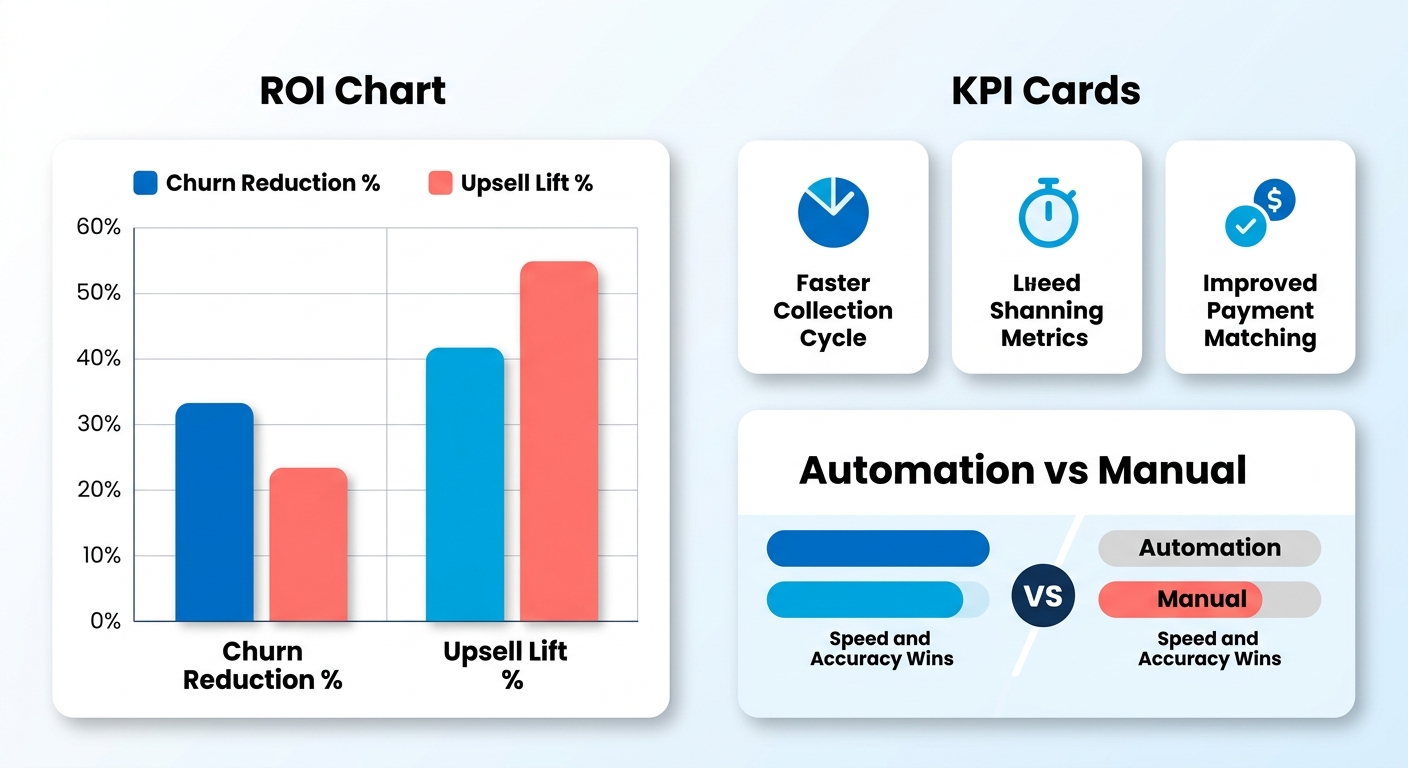
Which ROI methods actually matter for SaaS
The useful methods measure both operational savings and revenue protection. Here’s how the main approaches stack up.
Payback period tracks months to recover automation cost. It takes 1-2 hours to calculate and gives you a fast go/no-go signal. The math: divide implementation cost by monthly savings.
DSO reduction measures working capital freed per day cut. At €100M revenue, every single day you trim from DSO releases roughly €274,000 in working capital. That’s cash you can push into product or sales instead of chasing invoices.
Labor cost avoidance counts manual hours removed. For a business processing 5,000 payments monthly, savings run €17,500 to €37,500 per month. Automated cash application and intelligent matching eliminate the manual work that bogs down AR teams.
Churn reduction captures subscribers retained through smoother billing. This one takes 1-2 days to calculate properly but recovers involuntary churn from failed cards. Most SaaS firms lose 2-3% of subscribers to payment failures that automation prevents entirely.
Upsell lift measures expansion revenue from self-service portals. When collectors aren’t chasing overdue accounts, they run expansion conversations instead. Automated collections free your team to focus on high-value accounts and strategic work rather than chasing routine payments.
What realistic payback looks like
Most SaaS firms recover their automation investment inside the first few months. A study found 93% of finance leaders confirmed their AR automation delivered the expected return, and 100% reported measurable gains like faster payments and lower costs.
The working capital math is concrete. A company at €200M revenue can release €5.48M from a 10-day DSO improvement. Streamlined invoicing and automated payment processing compress collection cycles that used to drag for weeks.
On timing: AI-native AR tools deploy in 4-8 weeks. Legacy systems drag out to 3-6 months. For subscription firms, faster deployment means the churn-reduction clock starts sooner.
RPA can cut invoice processing time by up to 80% and reduce manual work by 70-90%. That’s not just efficiency. That’s reclaimed capacity your team redirects toward customer health scoring and renewal conversations.
Why churn and upsell belong in the formula
Skip the churn calculation only if you bill one-off invoices with no recurring relationship. For everyone running subscriptions, involuntary churn from expired cards and failed retries is a silent revenue leak. Automated dunning and card updates plug it directly.
Over 25% of receivables age beyond 120 days, with recovery rates dropping to 20-30%. Automation flips that. Automated collections and intelligent cash application accelerate payment recovery and reduce outstanding balances by removing manual bottlenecks.
The hidden upsell engine is the reclaimed capacity. Up to 40% of transactional accounting work is now automatable, which means nearly half your team’s time can shift from collection to growth.
Add it up. Labor savings pay for the tool. Churn reduction and upsell lift turn AR automation into a growth investment instead of a cost cut. That’s the calculation to run before you sign anything.
Key Benefits of Accounts Receivable RPA
Subscription finance teams get paid on renewal cycles, and that rhythm is exactly what makes accounts receivable RPA pay off. In studies of AI-assisted AR, 99% of companies saw their Days Sales Outstanding fall, and 75% cut DSO by six days or more. For a recurring-revenue business, six days of faster collection across every renewal cohort compounds into real working capital.
The bigger win is what fewer late payments do to churn. When 69% of companies report rising late payments and 77% of CFOs say they are behind on invoice processing, the friction shows up as failed renewals, not just aging receivables. Accounts receivable automation attacks that friction directly by sending invoices with the right due date and terms the moment a subscription renews.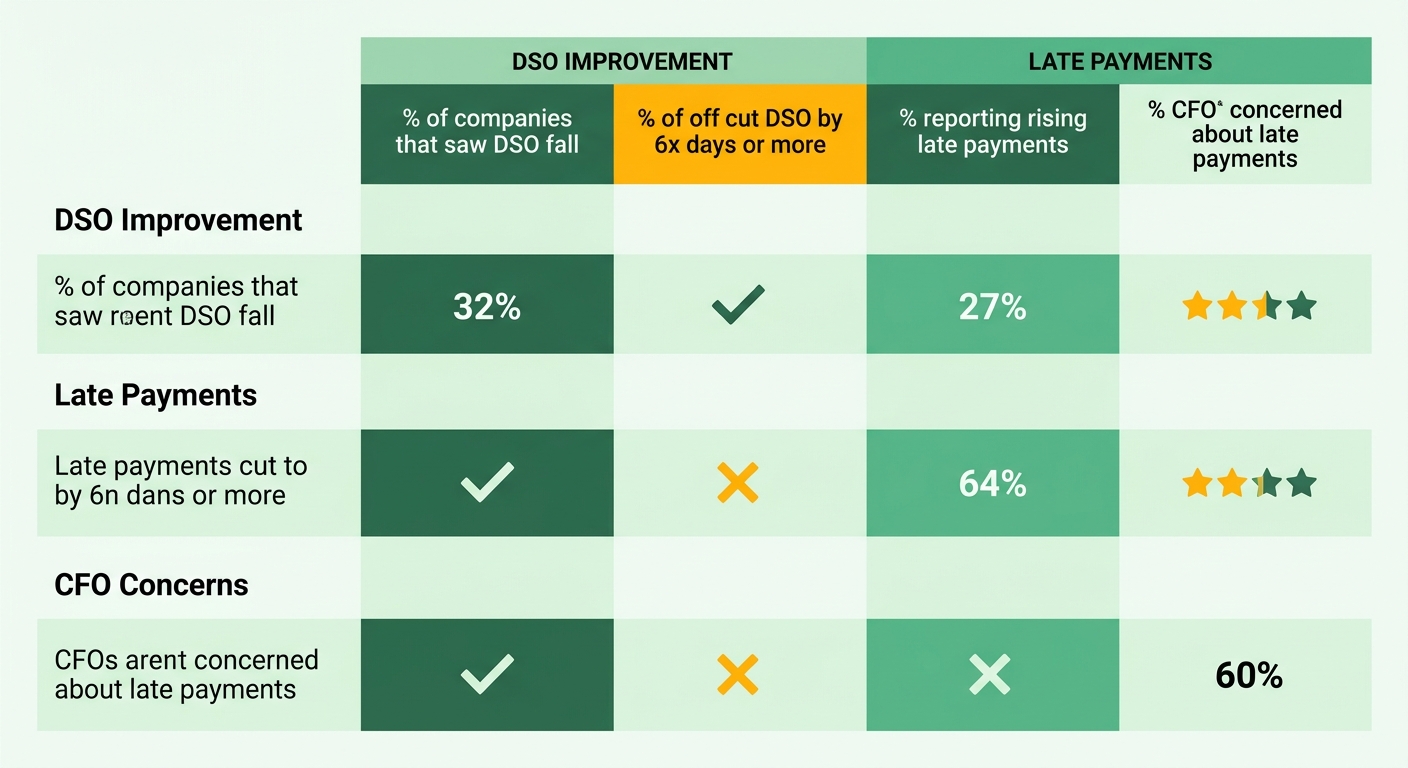
How does RPA cut DSO on renewal cycles?
RPA compresses the collection cycle by removing the manual handoffs that create delays between renewal and payment. Companies using automated AR workflows see collection rates improve by 15-20 percentage points in the first quarter, and finance teams report closing their books three to five days faster each month. When renewal-day volume spikes, automation scales instantly without adding headcount.
Here’s where SaaS teams should start. Renewals are high volume, highly predictable, and directly tied to churn. That combination makes them the single best first automation target. You get clean audit trails, deterministic matching for revenue recognition, and faster cash all at once. For the broader playbook, our guide on mastering accounts receivable management covers the workflow end to end.
Can automation make cash flow forecasting reliable?
Yes, and this is where RPA and AI split the work. RPA gives you clean, structured payment data by eliminating the manual entry that produces over 70% of finance errors. Predictive models then read that data to forecast payment timing and flag accounts likely to slip before they churn.
That division matters for compliance. RPA’s rule-based matching produces the deterministic audit trails SOC 2 and revenue recognition demand. AI layers on the judgment: prioritizing follow-ups, scoring account health, and writing dunning reminders that sound human instead of robotic. Neither piece alone covers both retention and compliance. Together they do.
Where does RPA improve customer experience?
Automation improves customer experience by removing the errors and delays that make renewals feel adversarial. Bots match remittances to invoices automatically, so customers stop getting chased for payments they already made. One company cut its dunning campaign time by 75% while lifting cash collections 60%.
A quick reality check on the “replace vs. help” debate. One camp argues RPA won’t replace accountants, only free them for strategic work; another shows RPA finishing month-end close in minutes instead of weeks. Both are right at different scales. For subscription billing, the predictable patterns let RPA genuinely compress close cycles, and the hours you reclaim go toward churn analysis and customer health scoring.
One caveat: skip full RPA buildout for low-volume, one-off invoicing. The setup cost outruns the benefit when there’s no recurring pattern to automate against. The moment your billing runs on renewal cadence, though, the math flips hard in automation’s favor.
Automating Accounts Receivable Processes
Automating your accounts receivable means handing the repetitive, rule-based steps to software so your team stops rekeying data and starts working the accounts that matter. For subscription SaaS, the stages worth automating map onto the renewal cycle: invoice generation, delivery, payment matching, cash application, and at-risk flagging.
Accounts receivable RPA works best when you sequence it. Start with the highest-volume, most predictable step, then expand. Renewals are the obvious first target. They spike on a schedule, follow the same rules every cycle, and drive churn when they go wrong. Automating them first gives you the fastest payback and the biggest retention win.
Which AR stages should you automate first?
Automate invoice generation and delivery first, then payment matching, then cash application. These are the deterministic steps where RPA cuts cycle time 50 to 80 percent and processes matching 2 to 3 times faster than manual work.
Here’s the practical order we recommend:
Invoice generation and delivery: A bot fires the invoice the moment a subscription renews, with the correct due date and terms attached. Businesses that automated invoice generation saw DSO fall by up to 32 percent. RPA can cut invoice processing time by as much as 80 percent.
Payment matching: Bots scan remittances and match incoming payments to open invoices. Auto-match rates climb above 95 percent even on messy multi-invoice payments.
Cash application: This is where machine learning earns its place, which we cover next.
How does machine learning handle cash application?
Cash application is matching a payment to the right invoice and posting it to the ledger. RPA handles the clean, rule-based matches. Machine learning takes over when the data is fragmented or the remittance is unstructured.
The gains are real. One SAP Cash Application pilot from Accenture reported a 24 percent rise in automated clearing success using ML-proposed one-touch approvals. Field-extraction models hit 97.8 percent accuracy on standard invoice templates and still managed 91.2 percent on unstructured documents.
Our take: pair the two. Let RPA own the deterministic matching that your audit trail and revenue recognition depend on, and let ML parse the exceptions and flag accounts trending toward churn. Neither alone covers both compliance and retention.
What are the implementation best practices and pitfalls?
Standardize your data first, pilot on one high-volume process, and keep a human in the loop for exceptions. The most common failure is pointing a bot at inconsistent field names across your ERP and CRM. It breaks.
A phased rollout beats a big-bang launch. Prepare and clean your data, build a bot for one process, test it against a small batch, then scale once accuracy holds. Track DSO and match rates so you can prove the return.
On build vs. buy: simple ingestion bots are fine to build in-house as a learning exercise. Production-grade AR automation with multi-system integration and compliance rules warrants a proven platform. We’ve watched teams sink months into brittle in-house bots that a bought solution would have handled on day one.
Skip full automation for genuinely ambiguous disputes. Route those to a person. Bots liberate your team for that judgment work rather than replacing it.
Selecting the Right RPA Platform for Accounts Receivable
We built our automated accounts receivable platform on a simple premise: subscription finance teams need automation that handles renewal spikes without falling apart on the edge cases. Most platforms optimize for transaction volume. We optimize for the rhythm of recurring revenue, which means predictable billing cycles interrupted by failed payments, plan changes, and manual adjustments that break rule-based bots.
When evaluating platforms, start with integration depth, not feature breadth. The clean gains you expect from automation only materialize when the platform connects directly to your ERP and payment gateway. The moment you introduce manual handoffs (exporting CSVs, rekeying transaction IDs, reconciling in spreadsheets), those gains evaporate. Teams spend months customizing a “comprehensive” platform only to find it can’t post payments back to their ledger without a custom API layer.
What integration capabilities actually matter for subscription billing?
Real-time payment matching is the non-negotiable baseline. Your platform needs to pull payment data from Stripe, PayPal, or your gateway the moment it arrives, match it to the correct invoice and subscription record, and update your ERP without human review. One provider reported a 24% rise in automated clearing success and 67% accuracy when they layered machine learning onto this workflow. The ML handles the ambiguous cases (partial payments, customer credits, currency conversions) that trip up pure rule-based matching.
Bi-directional sync with your billing system prevents the data-drift problem that kills automation projects. If a customer upgrades mid-cycle in your subscription platform but your automation pulls stale invoice data from the ERP, it sends the wrong renewal reminder. The best platforms treat your billing system as the source of truth and sync changes in near real-time. Accurate, up-to-date subscription status is what separates effective dunning from error-prone reminders.
How do you evaluate scalability for renewal volume spikes?
Subscription businesses face predictable load patterns (end-of-month renewals, annual plan cycles, promotional cohorts) that stress automation differently than steady-state transaction flow. Ask vendors how their system handles a 10× spike in invoice generation over 48 hours. The wrong answer is “we’ll scale your bot instances.” That works for isolated tasks but creates race conditions when multiple bots try to update the same customer record simultaneously.
The right architecture uses queue-based processing with concurrency controls. Invoices stack in a queue, workers pull them sequentially, and the system dynamically adds capacity without duplicating work. When billing delays pile up during peak cycles, invoices that should clear in days instead sit unresolved for weeks, and each stalled renewal raises the odds of an involuntary churn event. A platform that throttles gracefully during spikes keeps those renewal invoices moving before they drift into the high-risk aging bucket.
Exception handling is where scalability meets reality. No-code platforms promise you can automate AR “without technical expertise,” but subscription billing generates exceptions that require judgment (disputed charges, prorated refunds, plan-change adjustments). A large share of edge cases still needs human review, so the platform should flag exceptions clearly, route them to the right team member, and let you adjust the rules as your subscription model evolves. If every edge case requires vendor support to patch the workflow, your scalability ceiling is their support queue depth.
Why combining automation with intelligent decision-making wins for SaaS
Pure rule-based automation handles the deterministic renewal workflow: generate invoice, send email, post payment, update ledger. But the retention game requires more nuance. AI-enhanced systems add the predictive and conversational capabilities that keep subscribers from churning over billing friction. A hybrid approach uses automation for reliability and AI for the judgment calls: which overdue accounts get a friendly reminder versus a payment-hold notice, when to offer a payment plan before auto-canceling, how to phrase dunning emails so they don’t read like collections threats.
The two technologies play different roles. Rule-based robots excel at high-speed, repeatable account matching, while AI’s optical character recognition reads varied invoice formats with strong accuracy and can predict payment delays before they happen. For subscription teams, that combination solves the compliance-and-retention problem: automation ensures audit trails and deterministic matching required for revenue recognition standards, while AI flags at-risk accounts and drafts human-tone reminders that preserve the customer relationship.
Finance teams that adopt a hybrid model consistently report the same shift: less time firefighting overdue accounts, more time on the strategic relationships that drive renewals. The efficiency comes from letting automation handle the volume and letting people handle the relationships.
Skip platforms that force you to choose between rule-based reliability and intelligent decision-making. The evidence is clear: subscription AR needs both.
Measuring Success: KPIs and ROI for Accounts Receivable RPA
The numbers that prove accounts receivable RPA is working aren’t the ones most calculators highlight. For subscription SaaS, the KPIs that matter tie automation directly to retained revenue: renewal collection rate, cash application match rate, and how many at-risk accounts get flagged before they lapse. Track those and you see the real return, not just headcount saved.
Start by baselining before you automate. You can’t measure the lift from accounts receivable automation if you never recorded what manual processing cost you. Document your current error rates, processing times, and DSO before implementing any solution.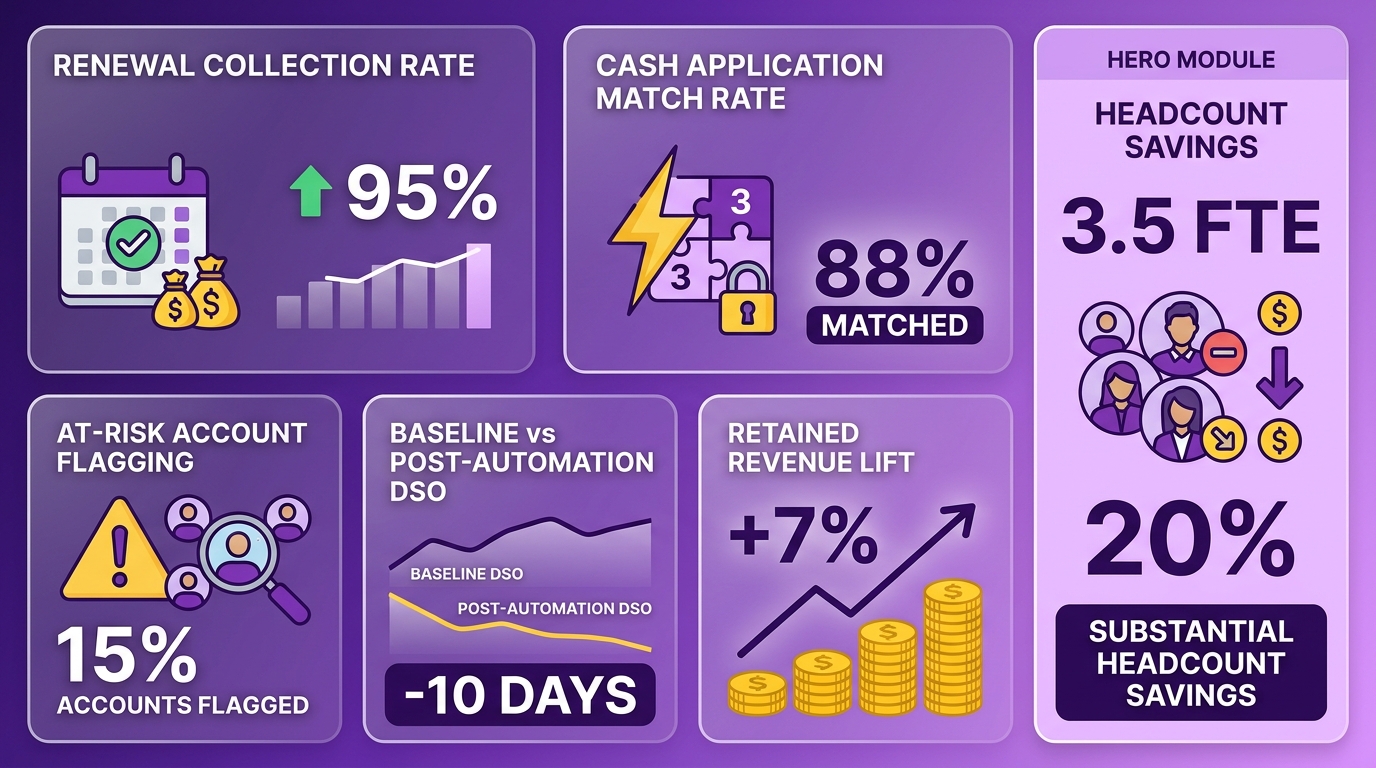
Which KPIs should you track?
Track four categories, weighted toward revenue protection over pure efficiency.
Operational speed: Invoice processing time is the fastest signal. Measure the gap between renewal trigger and invoice delivery. For recurring billing, that lag directly affects when cash lands. One operations team reduced invoice-to-delivery cycles from 48 hours to under 6 hours after deployment.
Accuracy: Watch your cash application match rate and reconciliation exceptions. Clean matching means fewer disputes and fewer subscribers stuck in billing limbo. A mid-market SaaS company improved their auto-match rate from 58% to 94% within the first quarter, cutting manual reconciliation volume by half.
Revenue protection: This is where SaaS teams differ from everyone else. Measure renewal collection rate and count how many at-risk accounts your system flags early. Catching a stalled renewal at day 5 instead of day 90 is worth more than any labor line item. Track your aging bucket distribution weekly. Shifts in the 31-60 day bucket are leading indicators of collection problems.
Team reallocation: Track hours redirected from data entry to account work. One finance manager cut high-priority client management down to half a day a week after automating. Another AR lead dropped time spent on lower-priority accounts from a quarter of the weekly schedule to under two hours.
How do you calculate ROI for AR RPA?
ROI for AR RPA combines operational savings with protected recurring revenue. Add labor and error-correction savings, then layer in the renewals you keep from failing. Divide the total annual benefit by implementation cost. For subscription businesses, the retention component usually outweighs the efficiency component.
Here’s the piece most teams miss. A B2B platform cut their DSO from 52 days to 41 days in the first year, freeing over $2M in working capital. Another company reduced write-offs from 3.1% of billings to 1.4% by catching payment issues earlier in the cycle. Those aren’t just cost figures. Faster, cleaner collection means fewer subscribers churn over payment friction, and that retained MRR is the real numerator in your ROI math.
On payback: organizations typically see measurable financial benefits within the first few months of implementation. At enterprise scale, internal automation programs have driven substantial cumulative savings, but you don’t need that scale to see returns fast.
Where does data analytics fit?
Analytics turns your KPIs from a scorecard into an early-warning system. RPA handles the deterministic work (posting payments and matching invoices), while predictive analytics reads payment behavior to flag accounts drifting toward cancellation.
Our take: report renewal cohort health monthly, not just aggregate DSO. Aggregate numbers hide which subscriber segments are slipping. Cohort-level analytics tells you where friction is building so you intervene before a renewal fails, which is the whole point of measuring this at all.
Best Practices for Accounts Receivable RPA Deployment
Deploying accounts receivable RPA well comes down to three phases: plan against your renewal calendar, implement on clean data, then review relentlessly. Skip the planning and your bots break on the first plan change or partial payment. For subscription SaaS, the sequence matters more than the tooling.
Start by mapping the exact tasks you want your accounts receivable RPA to handle. List the high-volume, rule-based steps first: invoice generation at renewal, delivery, payment matching, and cash application. These repeat every cycle and follow the same rules, which makes them the safest place to begin. We see teams get burned when they try to automate exception-heavy work before proving the basics.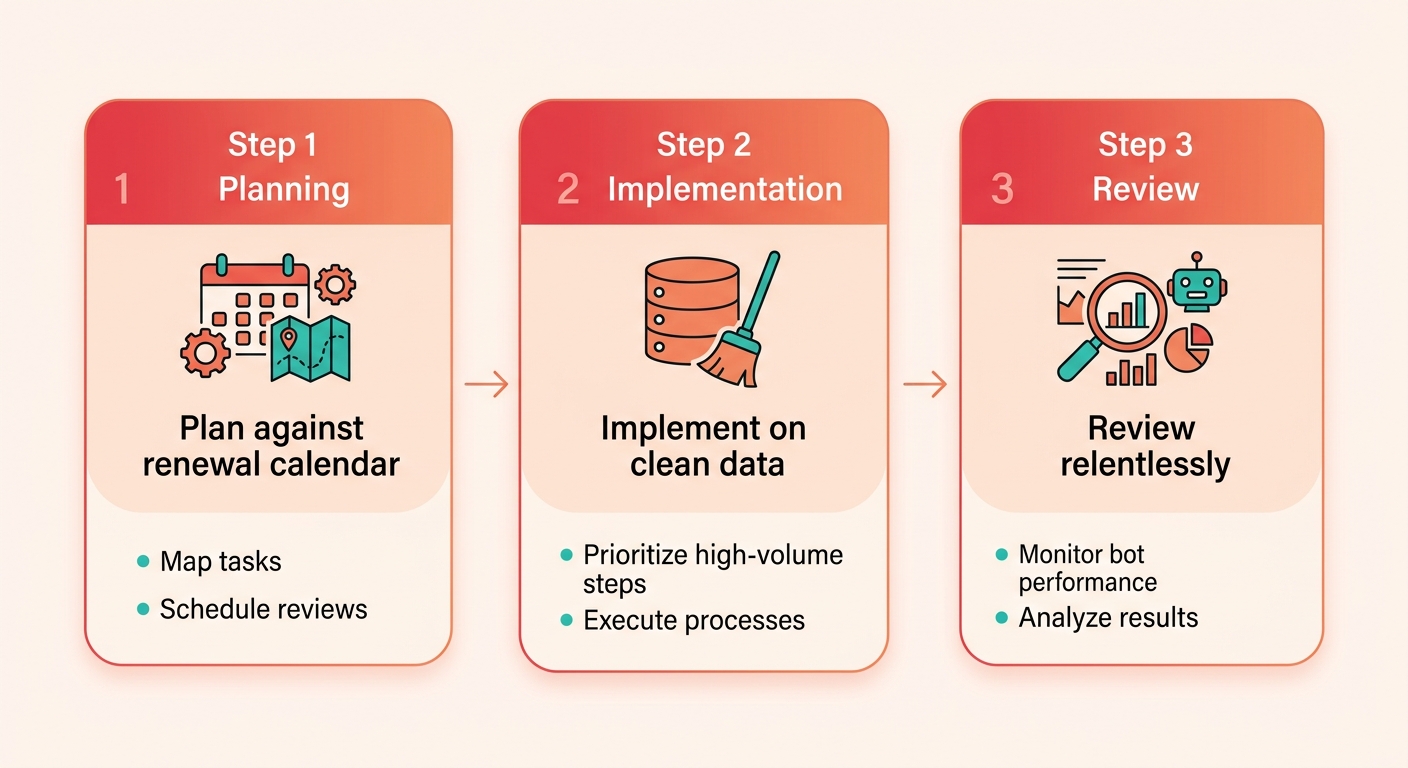
How should you plan an RPA deployment?
Standardize your data before you build a single bot. Inconsistent field names across your ERP, CRM, and payment gateway are the number one reason automation fails. Centralize and clean those sources first, then document every current step so the bot has a reliable script to follow.
Data hygiene is not glamorous, but it decides everything downstream. Manual entry errors in AR compound quickly, and a bot trained on messy data just makes those errors faster. Assign clear ownership for each data source and set your baseline KPIs now: renewal collection rate, cash application match rate, and Days Sales Outstanding.
One more planning truth worth naming. Map your dunning cadence to the renewal date, not the invoice date. A reminder that lands three days before a subscription renews recovers far more than one sent after the billing attempt fails. Plan your automation to intervene ahead of the renewal event, when the customer relationship is still active.
How do you implement and test with our platform?
Build small, pilot on one renewal cohort, then scale. We designed our automation to send human-tone reminders, reconcile incoming payments, and flag at-risk accounts as renewals approach. Run it against a limited batch first, validate every matched transaction, and only expand once accuracy holds.
A single misconfigured matching rule can cascade across hundreds of invoices before anyone notices, so gate each expansion behind a review checkpoint. Here’s where a common contradiction resolves. RPA does not replace your team; it liberates them. Both are true at once. The machine handles the repetitive posting and matching, and your analysts redirect that freed time toward churn analysis and customer health scoring.
For deeper guidance on which manual tasks to hand off first, start with the high-volume, rule-based steps: recurring invoice generation, automated collections, and cash application through our intelligent matching engine. Handing those off first is the most reliable way to reclaim hours lost to manual AR work.
What should your post-implementation review measure?
Most organizations see measurable financial gains within the first few months, so review early and often. Our intelligent matching engine grows smarter as you edit and approve matches, so your cash application accuracy improves over time rather than plateauing. Pair that with automated dunning and card updates, and you close the loop on both faster matching and recovered involuntary churn.
Our take: track the composite, not just the components. If your RPA cuts DSO and your reminders reduce involuntary churn by even two or three points, the combined cash impact beats the sum of the parts. You collect faster from customers who actually renew. That interaction is the metric to optimize, and it’s the one most teams never calculate.
FAQ
What is accounts receivable RPA?
Accounts receivable RPA is software that automates repetitive AR tasks like invoice generation, payment matching, and cash application. For subscription businesses, it handles the predictable billing cycles and removes the manual work that creates payment delays and involuntary churn.
How does RPA improve cash flow in subscription businesses?
RPA compresses your collection cycle by removing manual handoffs between renewal trigger and payment posting. Companies using automated AR workflows see collection rates improve by 15-20 percentage points in the first quarter, which means more cash arrives faster and fewer subscribers slip into aging buckets where recovery rates drop.
What is the typical ROI timeline for AR RPA?
Most SaaS firms recover their automation investment within the first few months. The payback combines labor savings with retained recurring revenue from subscribers who don’t churn over billing friction. For subscription businesses, the retention component usually outweighs the efficiency component.
Can small businesses benefit from AR RPA?
Yes, if you run recurring billing. Skip full RPA buildout for low-volume, one-off invoicing where setup cost outruns the benefit. The moment your billing runs on renewal cadence, automation pays back by preventing the involuntary churn that quietly drains MRR.
What are the key features to look for in an AR RPA platform?
Real-time payment matching, bi-directional sync with your billing system, and exception handling that routes ambiguous cases to a person. For subscription businesses, the platform needs to handle renewal volume spikes without creating race conditions when multiple invoices update the same customer record.
How does RPA integrate with existing accounting systems?
The best platforms connect directly to your ERP and payment gateway, pulling payment data in real-time and posting matched transactions back to the ledger without manual review. The moment you introduce manual handoffs like exporting CSVs or rekeying transaction IDs, the automation gains evaporate.
What challenges might arise during RPA implementation?
The most common failure is pointing a bot at inconsistent field names across your ERP, CRM, and payment gateway. Standardize your data before you build a single bot. A single misconfigured matching rule can cascade across hundreds of invoices before anyone notices.
How does AI enhance accounts receivable RPA?
AI adds the predictive and conversational capabilities that keep subscribers from churning over billing friction. Rule-based automation handles deterministic renewal workflow, while AI flags at-risk accounts, predicts payment delays before they happen, and drafts human-tone reminders that preserve the customer relationship.
References
[1] AP Automation ROI Challenges - https://www.teampay.co/blog/ap-automation-roi-challenges/
[2] Robotic Process Automation Accounting - https://www.celigo.com/glossary/robotic-process-automation-accounting/
[3] Unlocking Efficiency Understanding ROI AR Automation - https://www.linkedin.com/pulse/unlocking-efficiency-understanding-roi-ar-automation-billtrust-ghmkc
[4] The Robots Are Coming for Wall Street - https://hbr.org/2016/04/the-robots-are-coming-for-wall-street
[5] AI-Powered AR Automation Solutions - https://www.cfo.com/news/ai-powered-ar-automation-solutions/720956/
[6] Does AR Automation Replace Accountants - https://www.versapay.com/resources/does-ar-automation-replace-accountants
[7] Artificial Intelligence Accounts Receivable Cash Application SAP Accenture - https://www.accenture.com/us-en/blogs/technology-innovation/artificial-intelligence-accounts-receivable-cash-application-sap-accenture
[8] AI Redefining Accounts Receivable More Than Just Numbers - https://www.linkedin.com/pulse/ai-redefining-accounts-receivable-more-than-just-numbers-harini-t-wuczf
[9] Robotic Process Automation AI Accounts Receivable Bots - https://www.linkedin.com/pulse/robotic-process-automation-ai-accounts-receivable-bots-michael-ross-g6sae
[10] Mastering Accounts Receivable Management - https://blixo.com/blog/en/post/account-receivable/
Frequently Asked Questions
1. How long does it take to see ROI from accounts receivable RPA in a SaaS business?
Most SaaS firms recover their automation investment within the first few months. Operational metrics like faster invoice processing appear immediately, while churn reduction and working capital gains compound over the first quarter as renewal cycles complete under the new system.
2. What happens if my subscription business has irregular billing patterns instead of predictable renewal cycles?
RPA delivers the strongest returns on high-volume, recurring processes where patterns repeat. For businesses with one-off invoicing or highly variable billing, the setup cost often exceeds the benefit because there’s no recurring pattern to automate against, making manual processing more cost-effective.
3. Can RPA handle mid-cycle subscription changes like upgrades or downgrades without breaking?
RPA excels at deterministic workflows but struggles with exceptions that require judgment, including prorated refunds and plan adjustments. The platform should flag these cases for human review rather than attempting automated resolution, which is why bi-directional sync with your billing system matters for keeping data current.
4. Why do some companies report failed RPA projects despite strong vendor promises?
The most common failure is deploying bots against inconsistent data across ERP, CRM, and payment systems. When field names vary or manual entry errors exist in source data, automation amplifies those problems instead of solving them, which is why data standardization must happen before any bot is built.
5. How does combining RPA with AI change what your finance team actually does day-to-day?
RPA handles high-speed matching and posting while AI flags at-risk accounts and drafts contextual reminders. Finance teams shift from firefighting overdue invoices to strategic account conversations, with collectors spending time on expansion discussions instead of chasing routine payments that automation now resolves automatically.
6. What makes renewal collection rate more valuable than DSO as a metric for subscription businesses?
Renewal collection rate directly measures how many subscribers pay on schedule versus lapse due to billing friction. Aggregate DSO hides which cohorts are slipping, while cohort-level renewal rates reveal where friction builds before subscribers churn, letting you intervene when intervention still works.
7. Should a small SaaS company build RPA bots in-house or buy a platform?
Simple ingestion bots work as learning exercises for low-stakes processes. Production AR automation with multi-system integration, compliance requirements, and exception handling warrants a proven platform, because teams often spend months building brittle in-house solutions that bought platforms handle immediately with fewer maintenance burdens.