

Subscription App Nets $500/month in Just 30 Days

Quick Summary
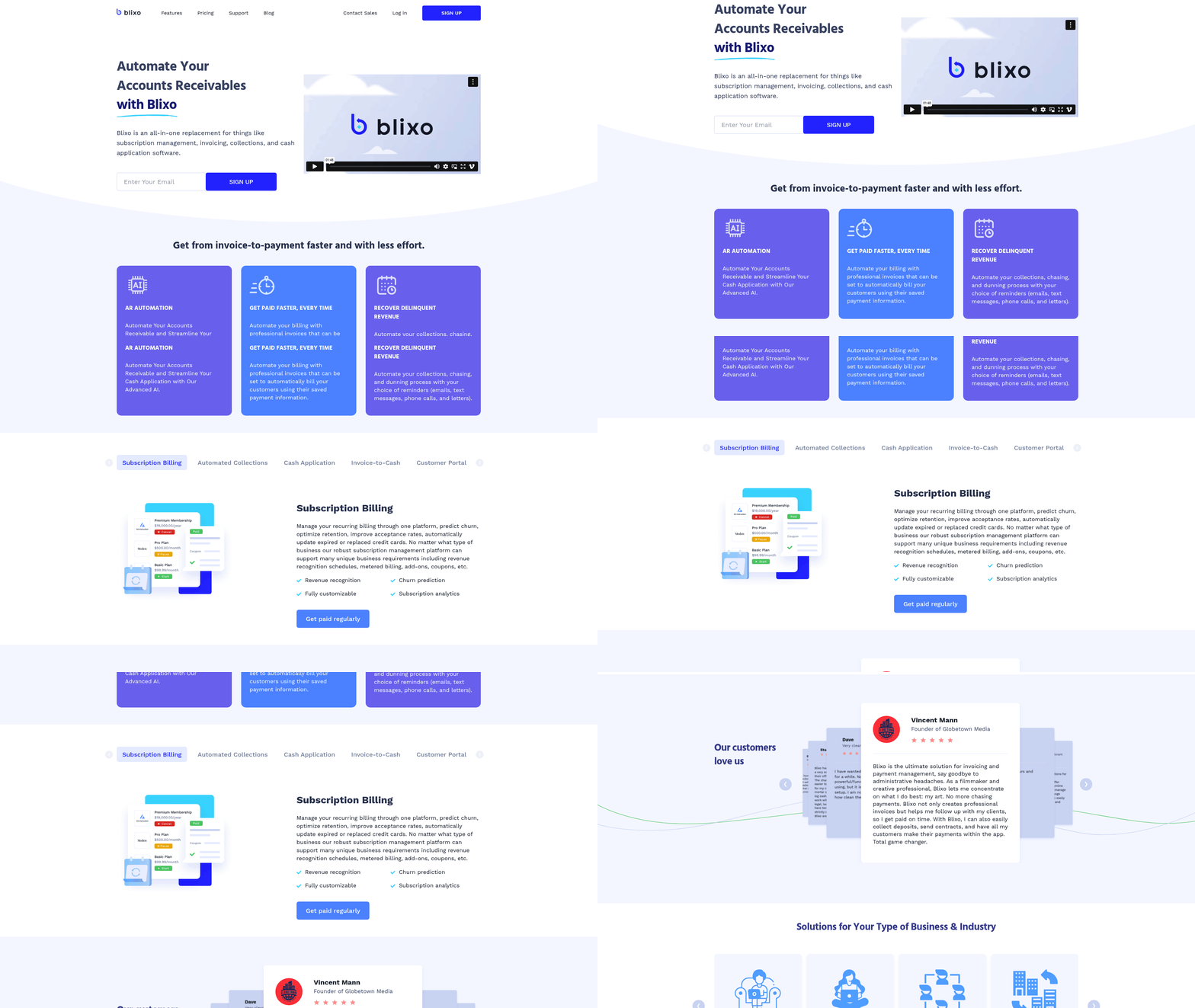
A subscription app achieved $500/month in 30 days by automating accounts receivable, invoicing, and collections for businesses. This success stems from solving pain points like slow payments, manual workflows, and clunky tools. Below is a structured breakdown of the app’s strategy, audience, and performance metrics.
Key Features Driving Revenue
The app combines automation and AI to streamline financial workflows. Core features include:
- AI-powered cash application to match payments to invoices with high accuracy.
- Automated collections via emails, SMS, or letters for overdue payments.
- Subscription management with customizable billing cycles, coupons, and revenue recognition.
- Customer portals for clients to view invoices, update payment methods, and manage subscriptions.
These tools reduce manual effort, accelerate payment cycles, and improve cash flow visibility. For instance, one user reported cutting collections time by 70% after adopting the platform. Building on concepts from the Designing and Developing a Successful Subscription App section, the app’s feature set reflects a user-centric approach to solving specific operational bottlenecks.
Target Audience & Pain Points
The app serves businesses that invoice clients and struggle with recurring payments, including:
- Service agencies (marketing, legal, consulting).
- SaaS and tech firms with usage-based billing.
- E-commerce brands managing wholesale accounts.
- Global teams replacing legacy AR systems.
See the Identifying the Target Audience for Your Subscription App section for more details on how niche industries benefit from tailored financial automation tools.
Comparison With Similar Platforms
| Feature | Blixo (Case Study) | Appstle | Tinder Select |
|---|---|---|---|
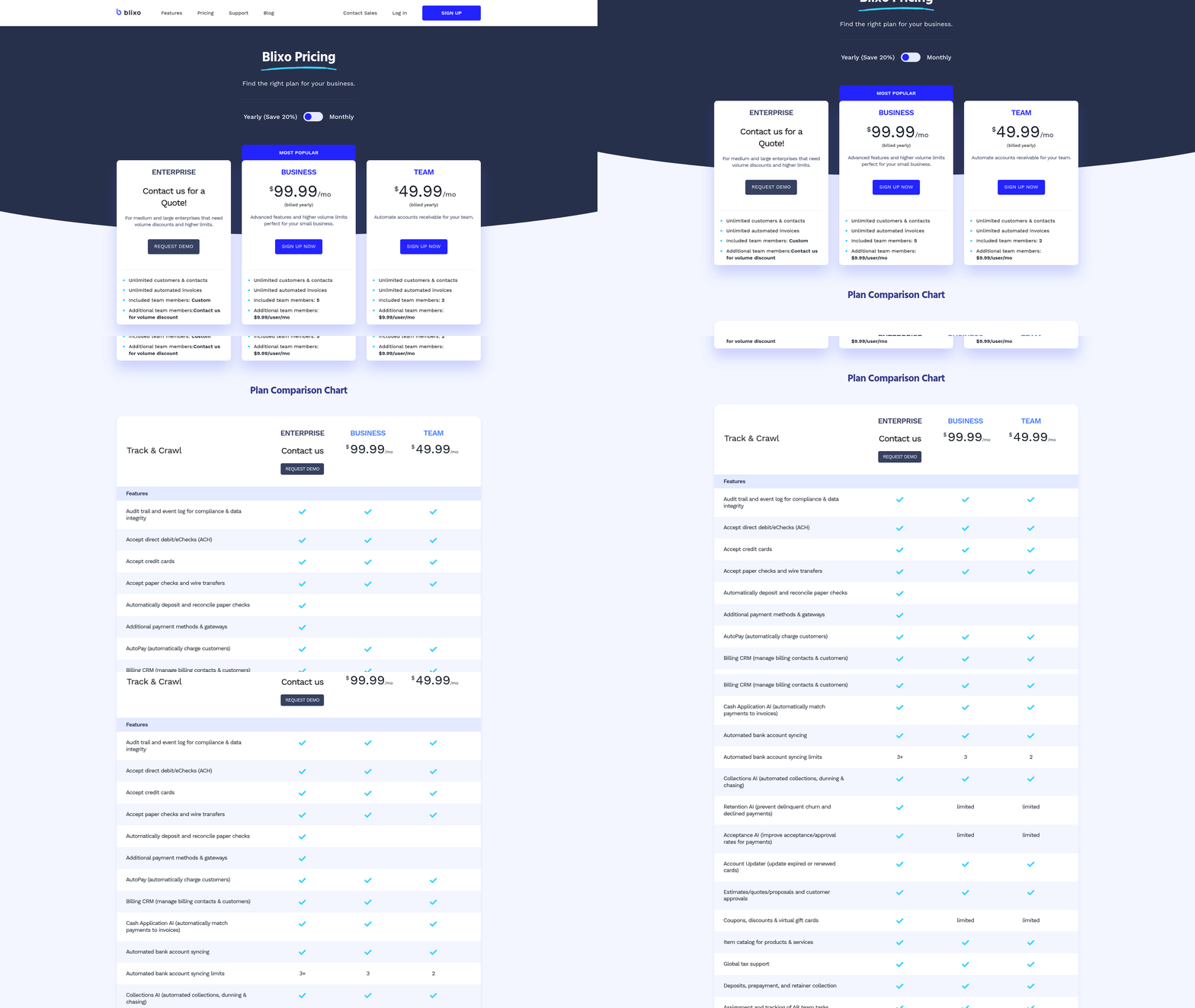
| Revenue Potential | $500+/month in 30 days for AR automation | Up to $100,000/month (tiered plans) | $500/month (exclusive tier) |
| Core Use Case | Business invoicing & collections | E-commerce subscriptions | Dating app premium features |
| Ease of Setup | 1–2 days (drag-and-drop interface) | 1–3 days | Invite-only, limited access |
| Cost Structure | $49.99–$99.99/month (Team/Business plans) | $10–$100/month | $499/month |
As mentioned in the Monetizing and Optimizing Your Subscription App section, platforms like Tinder Select demonstrate how exclusive tiers can drive premium revenue, though they differ in core use cases compared to Blixo’s business-focused model.
Time & Effort to Replicate Success
- 30–45 days: Onboarding and integration with accounting software (QuickBooks, Xero, etc.).
- 10–15 hours/week: Initial configuration for workflows, automation rules, and team training.
- Difficulty Rating: Low to medium, depending on existing process complexity.
Testimonial Insight
“Blixo simplified our invoicing and collections. We recovered $12k in delinquent revenue within two months.” – Stacey, Service-Based Business Owner
For structured learning on implementing such tools, platforms like Blixo offer tutorials on AR automation and subscription management. Their pricing plans align with scalable needs, starting at $49.99/month for small teams.
This model demonstrates how automation-focused SaaS solutions can rapidly generate revenue by solving critical operational bottlenecks for businesses.
Why Subscription Apps Matter for Businesses
Subscription apps have become a cornerstone for businesses seeking stable, scalable revenue streams. The rise of recurring billing models isn’t just a trend-it’s a strategic shift driven by consumer demand for convenience and businesses’ need for predictable income. For example, Tinder’s recent launch of Tinder Select, a $499/month subscription tier, illustrates how high-intent users are willing to pay for exclusive features. See the Marketing and Promoting Your Subscription App section for more details on how exclusivity and tiered pricing drive engagement.
Predictable Revenue and Scalability
Businesses using subscription apps benefit from recurring revenue models that reduce reliance on one-time purchases. Tinder’s parent company, Match Group, leveraged this approach by acquiring The League, a high-end dating app with a $1,000/week subscription, and later introducing Tinder Select. These examples show how premium tiers, even with limited availability, can drive significant revenue per user. For e-commerce brands, platforms like **Appstle** offer tailored subscription plans, enabling merchants to generate recurring income without manual invoicing. Appstle’s tiered pricing-free for up to $500/month in revenue, $10/month for up to $10,000, and so on-demonstrates how scalable subscription tools adapt to businesses at different growth stages. Building on concepts from the Case Study: Achieving $500/month in 30 Days with a Subscription App section, Appstle’s tiered pricing allows businesses to automate revenue streams efficiently.
Automation is another critical advantage. Manual invoicing is error-prone and time-consuming, but subscription apps streamline this process. Appstle’s features, such as custom shipping profiles and automatic billing, eliminate the need for businesses to track payments or chase late payments. This automation not only saves time but also reduces operational costs. A small e-commerce brand using Appstle’s Business plan could automate $30,000/month in recurring revenue, redirecting hours spent on billing to product development or customer service.
Who Benefits Most from Subscription Apps?
Subscription apps suit businesses where recurring value exchange is central. For SaaS companies, tiered subscriptions are a proven revenue driver. Tinder’s Select tier, available to less than 1% of users, targets those seeking premium features like VIP matching and ad-free browsing. For agencies, subscription models can standardize client retainer fees, ensuring consistent cash flow. As outlined in the Designing and Developing a Successful Subscription App section, aligning subscription tiers with user needs is critical for long-term success.
Identifying the Target Audience for Your Subscription App
Identifying your target audience is the foundation of a successful subscription app. This process requires analyzing industry needs, business size, and specific challenges your solution can address. For example, Appstle’s subscription app targets e-commerce businesses of varying scales, from startups generating under $500/month in recurring revenue to enterprises with $100,000+ in monthly sales. Tinder’s $500/month “Select” tier, meanwhile, caters to a hyper-niche audience-less than 1% of users-seeking exclusivity and premium features. These examples highlight how defining audience characteristics can shape your app’s value proposition. As mentioned in the Designing and Developing a Successful Subscription App section, Appstle’s tiered pricing model directly informs its technical infrastructure and user experience.
Focus on Industry and Revenue Tiers
Your target audience’s industry and revenue level directly influence their needs. Appstle’s pricing plans, for instance, align with e-commerce businesses’ revenue brackets. The free plan suits small sellers aiming to test subscriptions, while the $100/month Business Premium tier targets larger brands with $100,000+ in monthly recurring revenue. This tiered approach ensures each plan addresses specific pain points, such as manual billing for startups or advanced analytics for enterprises. Similarly, Tinder’s Select subscription leverages exclusivity as a key selling point. By limiting access to a small, high-paying user base, it creates perceived value for those seeking elite dating privileges. See the Monetizing and Optimizing Your Subscription App section for more details on how tiered pricing can maximize revenue while appealing to different user segments.
Map Pain Points to Subscription Benefits
Understanding your audience’s challenges helps you design features that solve real problems. E-commerce businesses using Appstle often struggle with manual invoicing, customer retention, and managing subscription logistics. Appstle’s technical features-like automatic recurring billing and custom shipping profiles-directly address these issues, reducing administrative overhead. If your app targets a different industry, identify analogous pain points: For example, fitness platforms might need tools to track user progress, while educational apps could prioritize content delivery systems. Tinder’s Select tier resolves a different challenge: user frustration with limited access to top profiles and intrusive ads. By offering ad-free browsing and direct messaging, it appeals to users willing to pay for a frictionless experience. Survey potential customers or analyze existing user feedback to uncover similar gaps in workflows. Ask: What tasks take the most time? What features would justify a monthly fee?
Validate Demand with Data and Examples
Once you’ve defined your audience, validate their needs using real-world data. Appstle’s tiered pricing model is backed by demand across revenue brackets-businesses with $10,000/month in sales likely pay the $10 Starter plan, while those with $30,000/month opt for the $30 Business plan. This correlation between revenue and subscription costs shows how clearly defined audience segments drive adoption. For niche markets, use metrics like eligibility criteria or conversion rates. Tinder’s Select tier, available to less than 1% of users, reflects a calculated strategy to maintain exclusivity while testing willingness to pay. If your app serves a specialized audience, consider similar tactics: Offer beta access to a small group or track sign-ups for a waitlist to gauge interest.
To refine your approach further, analyze competitors’ strategies. Appstle’s free tier attracts low-revenue businesses, creating a funnel for upselling. Tinder’s multiple subscription tiers-ranging from basic to Select-show how incremental pricing can maximize revenue from different user groups. Building on concepts from the Marketing and Promoting Your Subscription App section, these models demonstrate how segmentation and exclusivity can drive adoption. Use these models to test your own pricing and feature sets, adjusting based on sign-up rates and customer feedback.
By combining industry-specific insights, validated pain points, and competitive examples, you can build a subscription app that resonates with your audience. The next step is crafting a marketing strategy that speaks directly to their needs-a topic we’ll explore in the following section.
Designing and Developing a Successful Subscription App
Designing and developing a successful subscription app requires a blend of strategic feature design, user-centric interfaces, and robust technical infrastructure. By analyzing real-world examples like Tinder Select, developers can identify patterns that drive user engagement and revenue.
Key Features for Subscription Success
A subscription app must include features that streamline recurring payments and enhance user retention. Automated invoicing and collections are critical to reduce friction for both users and businesses. For instance, Tinder’s $499/month Select tier handles billing seamlessly, ensuring high-income users never face manual payment steps. This aligns with the Quick Summary section, which highlights how automating accounts receivable and invoicing can lead to rapid revenue growth. Pair this with exclusive content or access-like VIP search and matching features in Tinder Select-to create perceived value that justifies premium pricing.
Tiered subscription models also help. Tinder’s approach targets less than 1% of its most active users with ultra-premium plans, reflecting a strategy to monetize high-intent audiences. This mirrors Match Group’s acquisition of The League, an app with a $1,000/week subscription for elite networking. By segmenting users based on engagement levels (e.g., top 10% of users contribute 53% of total app time), businesses can design tiers that align with different willingness-to-pay groups, a concept further explored in the Identifying the Target Audience for Your Subscription App section.
Design Principles for User Retention
User experience must prioritize simplicity and personalization. Tinder Select’s interface, for example, hides complex features behind intuitive navigation, ensuring power users access advanced tools without overwhelm. Onboarding flows should clearly communicate benefits, such as explaining how VIP search filters work or how exclusive conversations elevate engagement.
Visual hierarchy and micro-interactions matter. Tinder’s Chief Product Officer, Mark Van Ryswyk, emphasized that user feedback drove the design of Select’s features, highlighting the importance of testing early prototypes with target audiences. A/B testing elements like call-to-action buttons or pricing layouts can reveal what resonates. For example, testing a $499/month price versus annual billing ($6,000/year) might uncover preferences for flexibility versus discounts, a strategy detailed in the Monetizing and Optimizing Your Subscription App section.
Development and Compliance Foundations
Building a reliable subscription app demands scalable back-end systems. Developers must integrate secure payment gateways that support recurring transactions while complying with PCI-DSS standards. Tinder’s infrastructure, for example, processes high-volume payments without downtime, a necessity for apps targeting global markets.
Security isn’t optional. With data breaches costing companies millions, encryption for user data and transparent privacy policies are non-negotiable. Match Group’s success with Tinder Select also shows the value of iterative updates-releasing new features in phases and monitoring analytics to refine offerings. Testing should simulate real-world scenarios. Load testing ensures servers handle thousands of simultaneous payments, while user testing identifies friction points. For instance, Tinder’s team likely tested how users interact with VIP features to optimize retention, a process aligned with the Marketing and Promoting Your Subscription App section’s focus on retention tactics.
By studying cases like Tinder Select, developers learn that success hinges on balancing exclusivity, ease of use, and technical reliability. The next step is launching with a clear focus on high-value users while maintaining agility to adapt to feedback.
Marketing and Promoting Your Subscription App
Marketing and promoting a subscription app requires a blend of strategic acquisition and retention tactics. The example of Tinder’s $500/month Tinder Select tier illustrates how exclusivity and tiered pricing can drive interest, but broader strategies are needed to sustain growth. Let’s break down actionable steps to build a marketing plan that balances attracting new users and keeping existing ones engaged..
Acquisition Channels for Subscription Apps
Content marketing and paid advertising are two of the most effective ways to attract users. For example, Tinder Select was promoted through targeted content highlighting its unique features, such as direct messaging and ad-free browsing. This approach works because it positions the subscription as a solution to user pain points-like wasted time or limited access.
To replicate this, create blog posts, social media threads, or video content that showcase your app’s premium features. Focus on storytelling: explain how users can benefit from upgrading. If your app offers a free tier, use it as a demo to entice users toward paid plans by gradually introducing premium features.
Paid advertising complements content marketing by amplifying visibility. Platforms like Facebook and Google Ads allow you to target specific demographics, such as users who frequently engage with dating apps (as in Tinder’s case). A/B test ad creatives to see which visuals or headlines drive the highest conversion rates. For instance, Tinder might have tested messaging like “Skip the Ads” versus “Join the Elite 1%” to gauge which resonates more. As mentioned in the Identifying the Target Audience for Your Subscription App section, understanding your audience’s preferences is critical for crafting effective ad campaigns..
Retention Tactics to Reduce Churn
Acquiring users is only half the battle. Retaining them requires consistent engagement and support. Email marketing is a cornerstone of retention. Send personalized emails that remind users of their subscription benefits, such as new features or exclusive content. For Tinder Select, this could mean highlighting new profiles added to the “most sought-after” list weekly.
Customer support is equally critical. Subscription apps often face churn when users encounter technical issues or feel their money isn’t worth the value. Proactive support-like automated follow-ups or in-app chat-can resolve problems before they lead to cancellations. For example, if a user reports a bug in Tinder Select, a quick fix and an apology email can restore trust.
Loyalty incentives also help. Reward long-term subscribers with discounts, early access to updates, or tiered benefits. Tinder’s 1% exclusivity rule for Select users creates a sense of scarcity, pushing others to upgrade to maintain their status. Building on concepts from the Monetizing and Optimizing Your Subscription App section, tiered pricing and exclusivity can reinforce perceived value while driving upgrades..
Measuring and Optimizing Marketing Efforts
Tracking metrics like conversion rates, customer acquisition cost (CAC), and retention rates is essential. For example, if your CAC is $50 but the average user only stays for one month, you’ll need to adjust your pricing or retention strategies. Tools like Google Analytics or Mixpanel can track these metrics in real time.
A/B testing is another optimization method. Test different pricing models-like monthly vs. annual subscriptions-or marketing messages to see what resonates. Tinder Select’s $500/month price point is extreme, but it reflects a willingness to pay among a niche audience. Experiment with smaller tiers to find your sweet spot.
Finally, analyze customer feedback. Surveys or in-app feedback forms can reveal why users upgrade or cancel. If 30% of cancellations stem from a specific feature, prioritize fixing it. As highlighted in the Quick Summary section, solving pain points like slow payments or manual processes can directly impact retention and revenue.
By combining targeted acquisition, proactive retention, and data-driven optimizations, you can build a subscription app that not only attracts users but keeps them engaged. Remember, the key is to balance exclusivity (like Tinder Select) with accessibility, ensuring your app’s value is clear to both new and existing subscribers.
Monetizing and Optimizing Your Subscription App
Designing effective pricing tiers is critical for maximizing revenue while appealing to different user segments. Tinder’s introduction of Tinder Select, a $499/month subscription, demonstrates how high-tier plans can target power users. By limiting access to less than 1% of active users, the app creates exclusivity while offering features like VIP search and unmatched messaging. This strategy builds on data showing Tinder’s top 10% of users account for 53% of total time spent on the platform, highlighting the value of engaging high-intent users. As mentioned in the **Quick Summary** section, scalable solutions like Appstle’s tiered pricing for e-commerce subscriptions-ranging from a free plan supporting $500/month revenue to a $100/month Business Premium plan supporting $100,000/month-ensure scalability for businesses of all sizes.
Strategies for Upselling and Cross-Selling
Upselling and cross-selling thrive when users perceive added value at higher price points. Tinder Select exemplifies this by positioning its ultra-premium tier as an extension of existing plans rather than a direct competitor. See the Marketing and Promoting Your Subscription App section for more details on how exclusivity and tiered pricing drive engagement. Users already paying for lower-tier features may upgrade to access advanced tools like ad-free browsing or priority visibility. Appstle’s approach mirrors this: businesses on the Starter plan ($10/month) can upgrade to the Business plan ($30/month) for advanced automation and loyalty features. Both models leverage user feedback for refinement-Tinder’s Chief Product Officer emphasized that Select was developed through extensive testing with engaged users.
Measuring Revenue and Optimization
Tracking metrics like conversion rates, average revenue per user (ARPU), and churn rates is essential for optimizing subscription models. Tinder’s leadership acknowledges that Select will attract a small number of new payers but significantly boost revenue, emphasizing the importance of focusing on high-value segments. For deeper insights into identifying these segments, refer to the Identifying the Target Audience for Your Subscription App section. For e-commerce apps, Appstle’s tiered structure allows businesses to measure growth against revenue thresholds-for instance, the Business Premium plan supports up to $100,000/month in revenue, providing clear benchmarks.
Case Study: Achieving $500/month in 30 Days with a Subscription App
The case study highlights how a niche subscription app leveraged exclusivity and targeted audience strategies to achieve $500/month in 30 days. By focusing on high-intent users-such as Tinder Select’s top 1% of active users-the app created a sense of urgency and value. As mentioned in the Identifying the Target Audience for Your Subscription App section, this approach aligns with analyzing industry needs to pinpoint users most likely to pay premium prices.
The app’s success also hinged on tiered pricing and marketing tactics. See the Marketing and Promoting Your Subscription App section for more details on how exclusivity and tiered models, like Tinder Select’s $500/month plan, drive conversions. Additionally, the monetization strategy emphasized annual billing to maximize revenue, a concept explored in the Monetizing and Optimizing Your Subscription App section. By combining these elements, the app achieved rapid revenue growth within a short timeframe.
Frequently Asked Questions
1. How did Blixo achieve $500/month in 30 days?
Blixo reached $500/month quickly by solving critical pain points for businesses, such as slow payments, manual invoicing, and inefficient collections. Its AI-powered automation for cash application, automated collections (via email/SMS), and subscription management streamlined financial workflows, reducing manual effort and accelerating payment cycles. By targeting niche industries like service agencies, SaaS firms, and e-commerce brands, Blixo addressed specific operational bottlenecks, enabling users to improve cash flow visibility and reduce collections time by up to 70% in some cases.
2. Who is the target audience for Blixo?
Blixo is designed for businesses that invoice clients and struggle with recurring payments. Key users include service agencies (marketing, legal, consulting), SaaS/tech firms with usage-based billing, e-commerce brands managing wholesale accounts, and global teams replacing legacy AR systems. These businesses benefit from Blixo’s automation of invoicing, collections, and subscription management, which reduce administrative overhead and improve payment efficiency.
3. What are the key features driving Blixo’s success?
Blixo’s success stems from its AI-powered tools tailored to financial workflows:
- AI-powered cash application matches payments to invoices with high accuracy.
- Automated collections sends emails, SMS, or letters for overdue payments.
- Subscription management supports customizable billing cycles, coupons, and revenue recognition.
- Customer portals let clients view invoices, update payments, and manage subscriptions.
These features reduce manual effort, accelerate payment cycles, and enhance client satisfaction.
4. How does Blixo compare to similar platforms like Appstle and Tinder Select?
Blixo focuses on business invoicing and collections, with a streamlined setup (1–2 days) and pricing starting at $49.99/month. Appstle targets e-commerce subscriptions with tiered plans ($10–$100/month), while Tinder Select offers exclusive dating app tiers at $499/month. Blixo’s core use case is financial automation for businesses, whereas Appstle and Tinder Select cater to different niches. Blixo also emphasizes drag-and-drop ease of use compared to Tinder Select’s invite-only, limited-access model.
5. How long does it take to see results with Blixo?
Results vary by business, but many users see improvements within 30 days. For example, one user reported cutting collections time by 70% after implementation. The platform’s automation and AI-driven tools typically reduce manual workflows and payment delays quickly, though larger teams or complex billing needs may require additional time to fully optimize.
6. What is Blixo’s pricing model compared to competitors?
Blixo offers Team/Business plans starting at $49.99/month, with premium features at $99.99/month. Appstle’s pricing ranges from $10–$100/month (tiered plans), while Tinder Select’s exclusive tier costs $499/month. Blixo’s pricing is competitive for businesses prioritizing accounts receivable automation, whereas Appstle targets e-commerce subscriptions and Tinder Select focuses on premium dating app features.
7. Why should businesses choose Blixo over other subscription apps?
Businesses should consider Blixo if they need tailored financial automation for invoicing, collections, and subscription management. Its user-centric design, AI-driven efficiency, and quick setup (1–2 days) make it ideal for reducing administrative burdens and improving cash flow. Unlike platforms like Appstle or Tinder Select, Blixo is specifically built for businesses struggling with payment delays and manual workflows, offering a targeted solution with measurable ROI.