

Enterprise Search Agent Enhances Data Retrieval

Related Video
Watch: Agentic RAG vs RAGs by Rakesh Gohel
Quick Summary
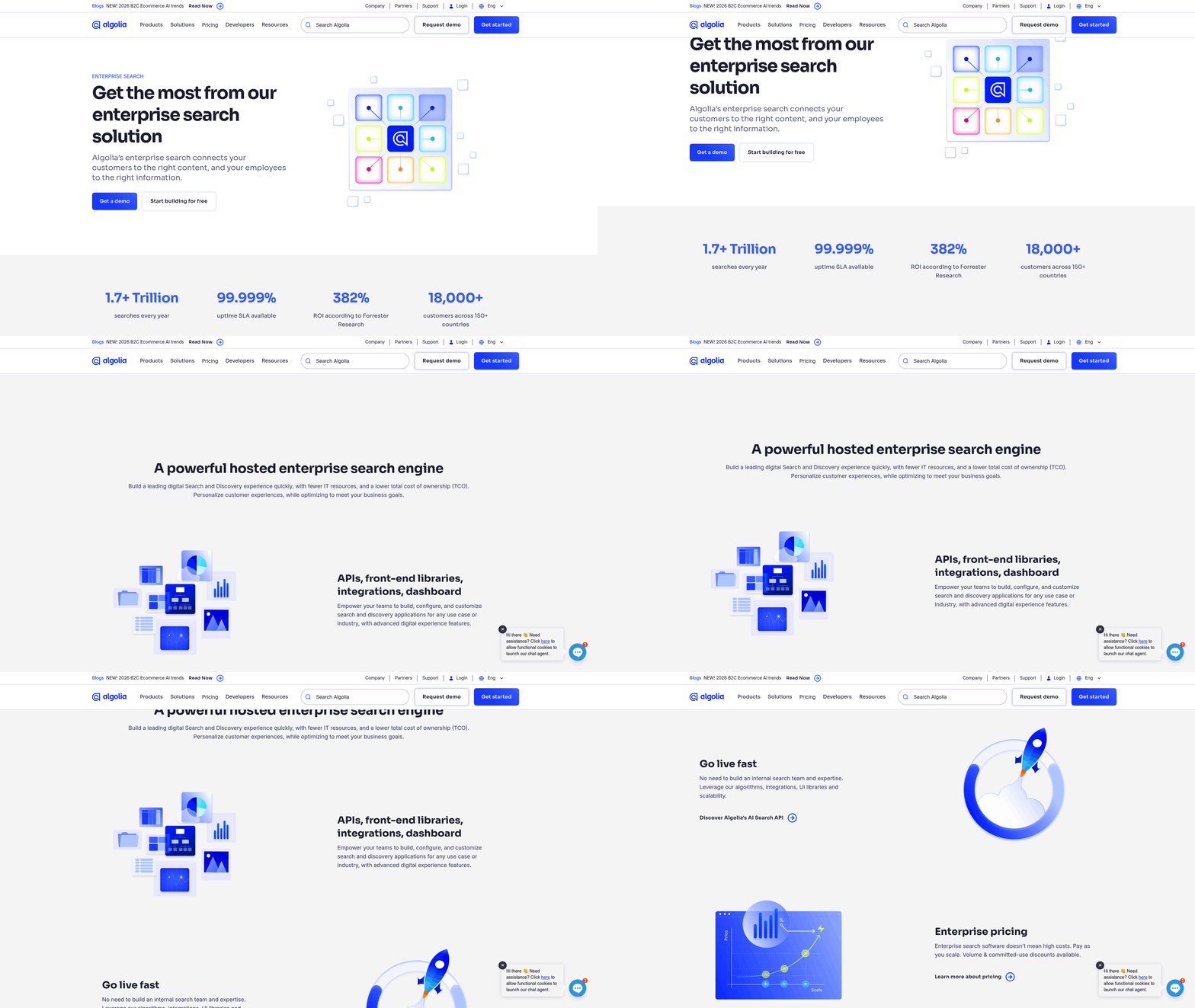
Enterprise Search Agents revolutionize data retrieval by addressing the limitations of traditional search methods, which often struggle with fragmented datasets, slow query resolution, and poor contextual understanding. Unlike conventional tools that rely on keyword matching or basic metadata queries, modern Enterprise Search Agents integrate AI-driven logic, multimodal data support, and real-time analytics to deliver precise, intent-aware results. For instance, platforms like Glean reduce information search time by 70% for employees, while NVIDIA’s AI-Q extracts insights from unstructured data sources like PDFs and images at petabyte scale. As mentioned in the Why Enterprise Search Agents Matter section, fragmented datasets and poor accessibility remain critical pain points for enterprises, making these agents a vital solution.
Key Benefits of Enterprise Search Agents
- Accuracy and Relevance: Advanced agents like Vertex AI Search leverage Retrieval-Augmented Generation (RAG) to combine generative AI with indexed data, ensuring answers are grounded in verified sources. This reduces hallucination risks by up to 80% compared to standalone LLMs.
- Multimodal Capabilities: Tools such as NVIDIA’s NeMo Retriever support text, audio, video, and structured data, enabling cross-format queries (e.g., “Find all reports mentioning climate change in Q3 2024”).
- Scalability: Solutions like Snowflake’s Cortex Agents handle billions of records with sub-second latency, outperforming legacy systems by 12% in retrieval accuracy.
- Integration: Platforms like Glean connect to 100+ enterprise apps (Slack, Salesforce, etc.), unifying fragmented data silos into a single searchable interface. This directly addresses the data fragmentation challenges discussed in the Why Enterprise Search Agents Matter section.
Implementation Time, Effort, and ROI
Deploying Enterprise Search Agents requires planning, but modern solutions prioritize speed and ease:
- Time Estimates: Basic setups (e.g., Vertex AI Search) can be operational in 1–3 days, while custom integrations (e.g., AI-Q with NVIDIA NIM) may take 2–4 weeks.
- Difficulty Ratings:
- Low: Cloud-based platforms (e.g., Google Vertex AI) offer drag-and-drop workflows and pre-built connectors.
- Medium: On-premise deployments (e.g., Snowflake Cortex) require API configuration and infrastructure tuning.
- ROI Metrics:
- Glean users report saving 110 hours per employee annually, translating to 360% faster task completion.
- Algolia’s AI Search boosted conversion rates by 4x for brands like
Why Enterprise Search Agents Matter
Enterprises today face staggering challenges in data retrieval. Industry research reveals that 68% of organizational data remains unused due to fragmented storage, poor accessibility, and complexity in extracting insights . This inefficiency directly impacts productivity: employees spend an average of 110 hours annually searching for information, time that could be redirected toward strategic tasks . Compounding this issue are data silos-disconnected repositories across departments-and information overload, where critical data gets buried under irrelevant results. Without a unified search solution, businesses risk missed opportunities, delayed decisions, and operational bottlenecks.
Enterprise Search Agents Solve Core Productivity Challenges
Modern search agents address these pain points by unifying data access and automating retrieval processes. For example, Snowflake’s Cortex Agents streamline access to both structured datasets (like databases) and unstructured sources (emails, PDFs) with 12% higher retrieval accuracy than leading embedding models . Similarly, Glean’s AI-powered platform connects 100+ enterprise tools (Google Drive, Slack, Salesforce) into a single search layer, reducing onboarding time by 36 hours per employee and cutting internal support requests by 20% . These systems eliminate manual data hunting by prioritizing relevance and context, ensuring users find what they need in seconds. See the Understanding Enterprise Search Agents section for more details on how these systems integrate structured and unstructured data.
Real-World Impact: Case Studies and Metrics
The value of enterprise search agents is evident in measurable outcomes. Luminate Data, a Snowflake client, leveraged Cortex Search to analyze entertainment industry trends, delivering precise insights for clients like streaming platforms and production studios . Confluent, using Glean, consolidated information from 20+ systems into a searchable knowledge base, boosting employee satisfaction and reducing time spent on redundant queries . On the technical side, Vertex AI Search simplifies complex RAG (Retrieval-Augmented Generation) workflows, automating tasks like OCR, chunking, and indexing to deliver accurate AI-generated responses grounded in proprietary data . For industries like healthcare, NVIDIA’s AI-Q framework accelerates drug discovery by synthesizing medical research, proving how search agents transform unstructured scientific data into actionable insights . For additional case studies, see the Real-World Use Cases of Enterprise Search Agents section.
Who Benefits and Why
The benefits span teams and roles:
- IT departments gain control over data governance, ensuring compliance while reducing integration costs (Cortex Search cuts serving costs by 30% ). For deeper insights into governance frameworks, refer to the Governance, Security, and Privacy in Enterprise Search Agents section.
- Business users-from sales teams to executives-access real-time, role-tailored results. Glean’s personalized assistant, for instance, adapts to user behavior, delivering context-aware answers .
- Developers benefit from APIs and SDKs (e.g., Algolia’s 70+ data centers ) that enable custom workflows without rebuilding infrastructure.
Expert validation underscores this shift. Glenn Walker, Chief Data Officer at Luminate Data, notes, “Snowflake’s unified platform turns raw data into precise insights, fueling smarter decisions” . Meanwhile, Glean users report 93% adoption rates in two years, with one CIO remarking, “We’re up and running in three weeks” .
By addressing fragmented data ecosystems and humanizing search through AI, enterprise search agents are no longer a luxury-they’re a necessity for competitive agility. The next section will explore how to implement these solutions effectively.
Understanding Enterprise Search Agents
Enterprise Search Agents are AI-powered systems designed to streamline data retrieval by integrating structured and unstructured datasets across enterprise environments. These agents leverage advanced technologies like natural language processing (NLP), machine learning (ML), and knowledge graphs to deliver precise, context-aware results. As mentioned in the
Implementing Enterprise Search Agents
Implementing Enterprise Search Agents requires a structured approach to ensure seamless integration, optimal performance, and scalability. Below is a step-by-step guide to help organizations deploy these systems effectively, leveraging insights from industry frameworks and real-world applications..
Pre-Implementation Planning: Assess Data Sources and Requirements
Before deploying an Enterprise Search Agent, organizations must evaluate the scope and structure of their data. Start by identifying the types of data to be indexed, such as text documents, images, audio, or video. The NVIDIA RAG Blueprint emphasizes multimodal data ingestion, supporting formats like PDFs, databases, and unstructured text. For example, biomedical research firms using the AI-Q NVIDIA Blueprint extract insights from thousands of research papers, images, and clinical trial data. See the Understanding Enterprise Search Agents section for more details on the capabilities of these systems.
Next, define functional requirements based on use cases. Will the system prioritize document summarization, query decomposition, or dynamic metadata filtering? The Google Vertex AI Search pricing model highlights the need to choose between its Standard and Enterprise Editions: the latter adds website search and generative AI features at no extra cost. For instance, a healthcare organization might opt for the Enterprise Edition to leverage advanced generative answers for patient documentation, while a retail company could use the Standard Edition for product catalog search..
Integration Methods: APIs, SDKs, and Hybrid Retrieval
Integration hinges on selecting the right tools for data extraction, indexing, and querying. The NVIDIA RAG Blueprint recommends using GPU-accelerated APIs like NVIDIA NeMo Retriever for high-throughput data ingestion. This microservice can process petabyte-scale datasets, extracting embeddings for hybrid dense and sparse retrieval. For example, the AI-Q Research Assistant uses NeMo Retriever to index academic papers, achieving 15x faster performance than traditional systems.
Google’s Vertex AI Search offers APIs like the Document AI Layout Parser for structured data extraction and the Ranking API to refine search results. A hospitality company could use these tools to build a hotel booking system, where semantic search identifies user intent from natural language queries (e.g., “Find a family-friendly resort in三亚 with spa facilities”). Similarly, Algolia’s platform integrates via REST APIs, enabling real-time indexing and neural search for e-commerce. Under Armour reported a 35% conversion rate boost after implementing Algolia’s APIs for product discovery. Building on concepts from the Performance Metrics and Benchmarking section, organizations should track API performance to ensure alignment with business goals.
For custom workflows, the Vertex AI Search provides pluggable vector databases like ElasticSearch or Milvus, allowing organizations to tailor indexing strategies. A financial services firm might combine these tools with EICopilot’s Gremlin scripts to query enterprise knowledge graphs, reducing syntax errors in complex data relationships..
Maintenance and Updates: Ensuring Freshness and Performance
Enterprises must establish protocols for data freshness and system optimization. The NVIDIA RAG Blueprint recommends periodic retraining of models using updated datasets. For example, a pharmaceutical company using the Biomedical AI-Q Agent refreshes its knowledge base weekly with new clinical trial data to maintain accuracy.
Monitoring performance metrics is equally critical. Vertex AI Search charges $0.00685 per GiB-hour for index storage and bills overages at the Standard Edition rate ($1.50/1,000 queries) if query limits are exceeded. Organizations should track storage usage and query volumes to avoid unexpected costs. As mentioned in the Performance Metrics and Benchmarking section, consistent benchmarking ensures systems meet SLAs and remain cost-effective. The AI-Q framework suggests using NVIDIA’s NIM APIs for GPU-accelerated indexing, reducing latency in large-scale deployments.
Regular maintenance also includes refining search relevance. Algolia’s Ranking API allows businesses to adjust result rankings based on user behavior. Zenni Optical increased page views by 10% after optimizing rankings to prioritize high-demand products..
Best Practices for Training and Fine-Tuning
Training Enterprise Search Agents requires iterative refinement. The NVIDIA RAG Blueprint incorporates shallow and deep summarization techniques to condense documents while
Real-World Use Cases of Enterprise Search Agents
Enterprise search agents have delivered measurable productivity improvements across sectors. For example, Glean’s AI-powered platform reduced internal support requests by 20% and saved employees 110 hours annually per user-equating to 36 hours saved during onboarding alone. A financial analyst using EICopilot, an agent-based system, can now investigate shareholder investments in catering companies in minutes, compared to days of manual research. This efficiency stems from EICopilot’s low syntax error rate (10%) and its ability to process billions of data points in knowledge graphs.
Snowflake’s Cortex Search further demonstrates cross-industry impact. At Luminate Data, Cortex AI enhanced data-driven insights for entertainment clients by unifying structured and unstructured datasets. Cortex Search outperforms OpenAI embeddings by 12% in accuracy, while Cortex Analyst achieves 90% precision in text-to-SQL queries-critical for finance teams needing rapid database access. NVIDIA’s AI-Q framework, meanwhile, tackles underutilized data: 68% of organizational data goes unused, but AI-Q’s multimodal agents extract insights from text, images, and databases, accelerating biomedical research by synthesizing hours of studies into actionable summaries. As mentioned in the Why Enterprise Search Agents Matter section, this highlights the urgency of leveraging dormant datasets.
Industry-Specific Transformations
In finance, Avalara’s Avi agent automates tax compliance workflows, reducing errors and processing time for regulatory tasks. Similarly, EICopilot’s deployment as a chatbot on Baidu Enterprise Search allows financial analysts to query complex shareholder relationships with natural language, streamlining decisions on investment patterns. Healthcare benefits from NVIDIA’s NeMo Retriever, which operates at petabyte scale to accelerate drug discovery by analyzing medical literature and clinical trial data. See the Governance, Security, and Privacy in Enterprise Search Agents section for more details on securing sensitive healthcare datasets.
Retail and e-commerce see dramatic ROI. Algolia’s AI search boosted The Times’ conversion rate by 360%, while PetSmart increased search-driven revenue by 34%. GoSearch’s federated search agents unify data from siloed systems, enabling real-time access to documents and files. For instance, a pharmaceutical company using GoSearch’s personalized agents could prioritize clinical trial data for R&D teams while filtering irrelevant results for administrative staff.
Future Directions and Emerging Trends
The next frontier lies in agentic AI integration and open-source frameworks. Google Cloud’s Agent Finder, with 1900+ industry-specific agents, highlights the shift toward tailored solutions-such as Box AI’s secure content analysis for enterprises. Meanwhile, the NVIDIA AI-Q open-source blueprint lowers barriers for developing custom agents, democratizing access to advanced retrieval systems.
Scalability remains a focus. Glean’s 100+ app connectors and extensible APIs allow seamless integration with tools like Slack and Salesforce, while Algolia’s 70+ global data centers ensure sub-second response times for multinational firms. As seen in the HR sector, “YourJourney” leverages agent registries and task planners to match job seekers with roles, showcasing how compound AI systems can orchestrate workflows across departments.
Challenges persist. Integrating large language models (LLMs) with legacy systems demands robust orchestration, as outlined in the Implementation Roadmap and Best Practices section. However, platforms like Snowflake’s Cortex and Google Cloud’s Gemini agents address these gaps by combining structured data governance with unstructured text analysis. As enterprises adopt these tools, the emphasis shifts from mere search efficiency to predictive analytics-where agents don’t just retrieve data but anticipate user needs, transforming static repositories into dynamic decision-making engines.
“We’re up and running in three weeks…” – Sharon Milz, CIO (Glean case study)
“Glean saves people 2–3 hours of time a week.” – Steve Januario, VP of Technology (Glean case study)
For deeper exploration, Google Agentspace and Glean’s enterprise search tools offer insights into scalable agent deployment. These examples underscore how search agents evolve from data access tools to strategic assets driving innovation.
Governance, Security, and Privacy in Enterprise Search Agents
Implementing enterprise search agents requires a robust framework for governance, security, and privacy to protect organizational data while ensuring compliance. These systems handle vast amounts of sensitive information, so addressing risks like unauthorized access, data breaches, and regulatory violations is critical. Below, we break down key strategies to secure enterprise search agents and align them with organizational and legal standards.
Data Governance: Ensuring Quality and Compliance
Data governance establishes the rules for managing data accuracy, consistency, and accessibility. Enterprise search agents rely on high-quality data to deliver relevant results, so organizations must implement frameworks that define ownership, validation processes, and retention policies. For example, Snowflake emphasizes the need for governance tools to track data lineage and audit usage, ensuring transparency in how search agents interact with datasets.
A key challenge is maintaining data integrity across siloed systems. NVIDIA’s RAG pipeline blueprint highlights the importance of cleansing and normalizing data before ingestion, which reduces errors in search outputs. Organizations should also classify data by sensitivity-such as public, internal, or confidential-to enforce appropriate access controls. This classification becomes the foundation for both security policies and compliance workflows, as outlined in the Implementation Roadmap and Best Practices section.
Security Considerations: Protecting Against Unauthorized Access
Search agents often process sensitive information, making them a target for attacks. Encryption at rest and in transit is a baseline requirement, as noted in Google Cloud’s Vertex AI Search documentation. Role-based access controls (RBAC) further limit who can query specific datasets, reducing the risk of insider threats. For instance, a finance team’s search agent might restrict access to payroll data to HR personnel only.
Authentication mechanisms like multi-factor authentication (MFA) add another layer of defense. Glean’s enterprise search tools incorporate MFA and session timeouts to prevent unauthorized access. Regular security audits and penetration testing are equally vital. These practices help identify vulnerabilities in the agent’s infrastructure, such as misconfigured APIs or unpatched dependencies. For a step-by-step guide on securing APIs during implementation, see the Implementing Enterprise Search Agents section.
Privacy and Regulatory Compliance: Handling Personal Data
Privacy concerns intensify when search agents process personally identifiable information (PII) or health records. Google’s Agentspace platform emphasizes privacy-by-design principles, such as anonymizing data before processing and logging user consent preferences. This aligns with regulations like GDPR and CCPA, which mandate explicit consent for data collection and the right to delete personal information.
To comply with these laws, organizations must implement data minimization practices. For example, a retail search agent might strip customer emails of metadata before indexing, retaining only what’s necessary for queries. Audit trails are also essential for demonstrating compliance during regulatory reviews. Tools like EICopilot enable granular tracking of how search agents handle data, ensuring transparency in privacy practices. For real-world examples of privacy compliance in action, refer to the Real-World Use Cases of Enterprise Search Agents section.
Best Practices for Governance, Security, and Privacy
- Conduct Regular Risk Assessments: Map all data sources processed by search agents and evaluate vulnerabilities. Tools like Benchmarking Deep Search can help identify gaps in handling heterogeneous data.
- Train Teams on Privacy Standards: Ensure developers and administrators understand regulations like HIPAA or GDPR. Google’s blog on agents-driven enterprises offers guidance on integrating compliance into workflows.
- Use Secure APIs and SDKs: Leverage enterprise-grade APIs from providers that enforce encryption and RBAC. NVIDIA’s NIM APIs, for instance, prioritize secure data flow in AI applications.
- Monitor Access and Usage: Deploy real-time monitoring to detect anomalies, such as sudden spikes in queries for sensitive data. Glean’s search tools provide metrics that can be benchmarked against performance standards detailed in the Performance Metrics and Benchmarking for Enterprise Search Agents section.
Performance Metrics and Benchmarking for Enterprise Search Agents
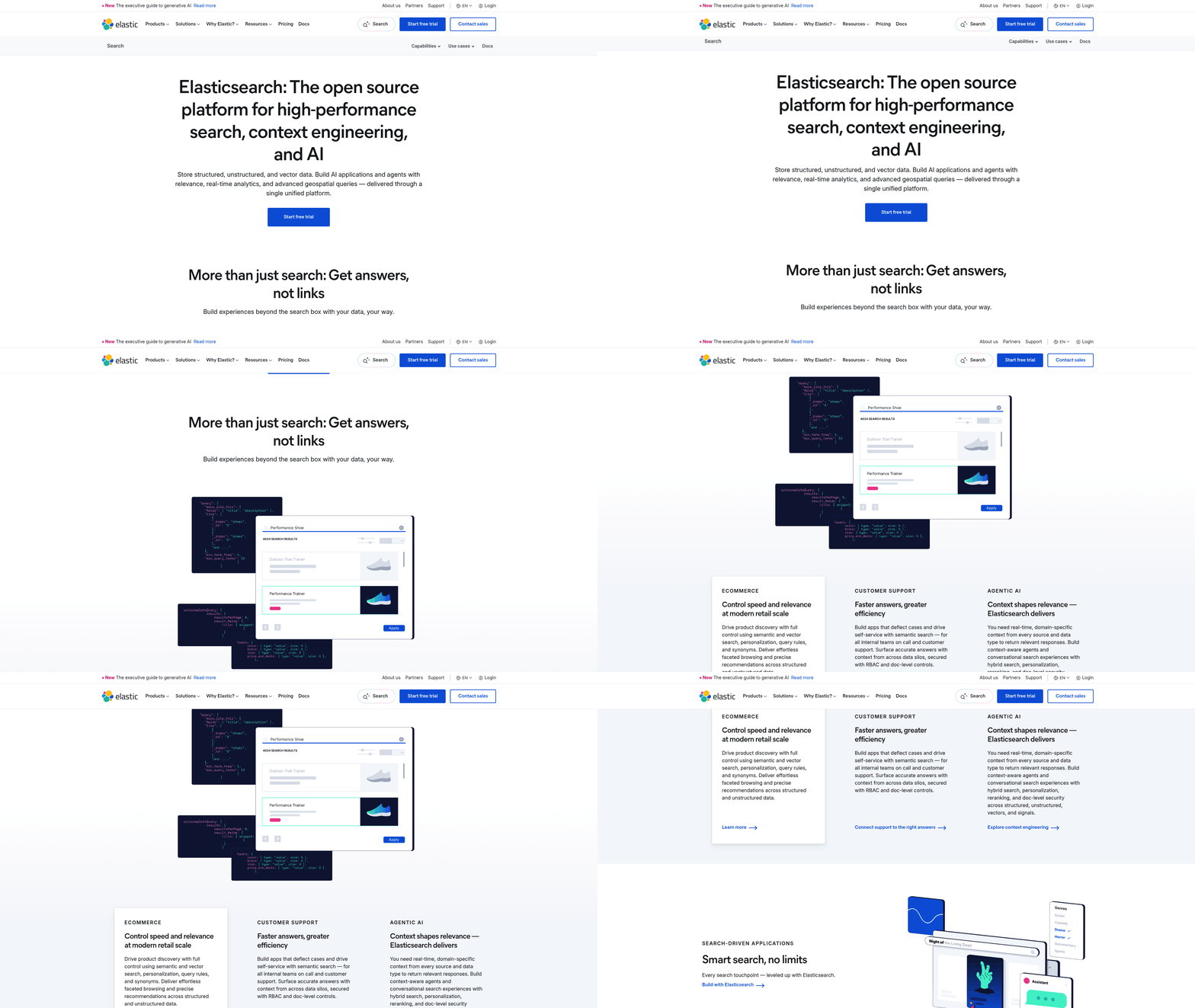
Measuring and comparing the effectiveness of enterprise search agents requires a structured approach to performance metrics and benchmarking. This ensures systems deliver accurate, efficient, and cost-effective results across diverse data environments. Below is a breakdown of key considerations, tools, and real-world applications..
Key Performance Indicators (KPIs) for Enterprise Search Agents
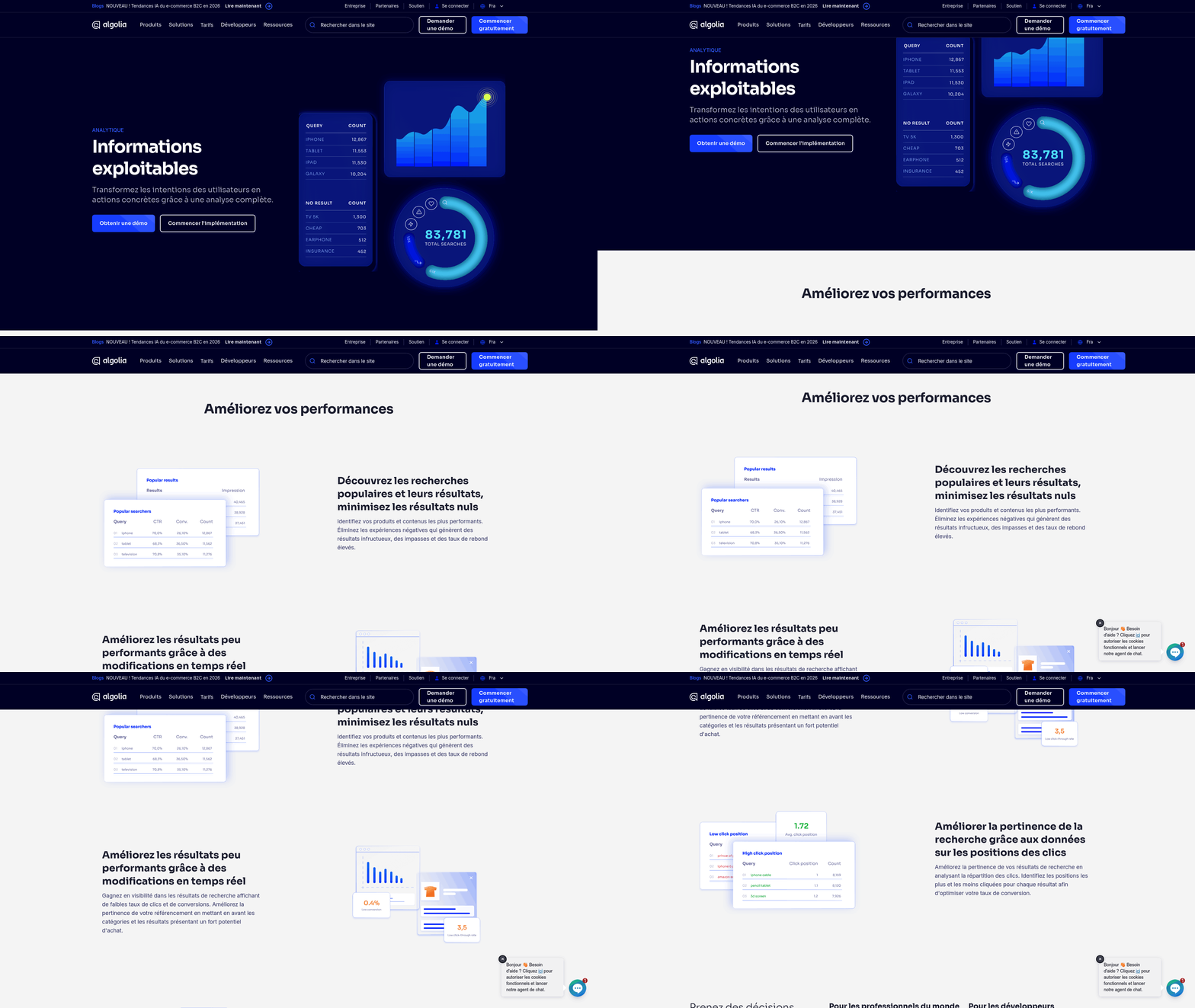
To evaluate enterprise search agents, organizations must track metrics that reflect both functional success and operational efficiency. Core KPIs include:
- Retrieval Accuracy: Measures how often the system returns correct, relevant results. For example, Snowflake’s Cortex Search outperforms OpenAI embedding models by 12% in retrieval accuracy, making it a strong benchmark for structured and unstructured data tasks .
- Query Execution Speed: Critical for real-time use cases. NVIDIA’s NeMo Retriever operates 15x faster at petabyte scale, enabling rapid indexing and search across multimodal data sources .
- Cost Efficiency: Balancing performance with budget constraints. Google Vertex AI Search offers tiered pricing, with the Enterprise Edition charged at $4.00 per 1,000 queries-a metric businesses use to forecast expenses based on query volume . See the Governance, Security, and Privacy section for more details on budgeting and compliance considerations in enterprise search deployments.
- Execution Correctness: For agents handling complex workflows, such as EICopilot, this metric evaluates the accuracy of generated scripts. EICopilot achieves 82.14% correctness in executing Gremlin scripts for knowledge graph queries .
- User Satisfaction: Captures subjective feedback on relevance and usability. GoSearch’s AI-powered tools report improved user satisfaction due to personalized results and federated search capabilities ..
Benchmarking Methods: Comparing Systems and Implementations
Benchmarking involves evaluating agents against standardized datasets or real-world scenarios to identify strengths and gaps. Two prominent approaches include:
- HERB Benchmark: Designed for heterogeneous enterprise data, HERB (Heterogeneous Enterprise Retrieval Benchmark) tests retrieval-augmented generation (RAG) systems using 39,190 artifacts and 815 complex queries. For instance, the best-performing RAG methods score 32.96/100, while standard systems struggle with a baseline of 20.61. HERB emphasizes multi-hop reasoning, such as extracting employee IDs from Slack messages and meeting notes . Building on concepts from the Real-World Use Cases section, HERB’s methodology reflects challenges seen in industries like finance and media.
- Edition-Based Comparisons: Platforms like Vertex AI Search allow businesses to compare Standard vs. Enterprise Editions. The Enterprise Edition includes advanced generative answers (e.g., AI Mode) but adds $4.00 per 1,000 queries to the base cost, helping teams assess feature-value trade-offs .
These methods reveal how agents handle challenges like semantic search, structured vs. unstructured data, and domain-specific queries (e.g., healthcare or media use cases)..
Evaluation Tools and Best Practices
Effective evaluation requires combining metrics with actionable tools and strategies:
- HERB Framework: Ideal for stress-testing RAG systems. By simulating workflows across product planning, development, and support stages, HERB highlights retrieval bottlenecks and reasoning gaps .
- Google Vertex AI Pricing Calculator: Businesses use this tool to estimate costs for query volume, storage, and add-ons. For example, a hotel-search scenario with 10M monthly queries costs $9,000/month** for query capacity alone, plus **$32,500 for add-ons like semantic search .
- NVIDIA AI-Q Toolkit: Offers performance monitoring for multimodal agents. Its NeMo Retriever and Llama Nemotron models optimize indexing and reasoning, while built-in analytics help refine workflows for accuracy .
Best Practices include:
- Regularly auditing retrieval accuracy against benchmarks like HERB.
- Using pay-as-you-go models (e.g., Vertex AI’s per-query pricing) for unpredictable workloads. As mentioned in the Implementation Roadmap and Best Practices section, this aligns with strategic deployment planning for scalable systems.
- Implementing query masking strategies to reduce errors in complex systems like EICopilot ..
Real-World Applications and Outcomes
Case studies demonstrate how metrics and benchmarks translate to business value:
- Luminate Data leverages Snowflake’s Cortex Analyst to deliver 90% accuracy in text-to-SQL queries, streamlining data analysis for entertainment clients .
- EICopilot reduces manual search errors for financial analysts by enabling chatbot-driven exploration of enterprise knowledge graphs, achieving 10% syntax errors and 82% execution correctness .
- Vertex AI Search’s hotel-search pricing example shows how 10M queries with generative AI features cost $49,960/month, helping enterprises plan budgets for large-scale deployments .
By aligning KPIs with benchmarks and tools, organizations ensure their search agents evolve to meet growing demands in accuracy, scalability, and cost control.
Implementation Roadmap and Best Practices
Implementing an Enterprise Search Agent requires a structured approach that balances strategic planning, technical execution, and ongoing optimization. Below is a step-by-step roadmap and best practices to guide enterprises through deployment, supported by real-world examples and technical insights from industry leaders..
Pre-Implementation Planning: Define Requirements and Scope
Before deployment, enterprises must align the search agent’s capabilities with business goals. Start by assessing data sources, including structured databases, unstructured documents, and multimodal content like images or audio. For example, Snowflake’s Cortex Search excels at bridging structured and unstructured data, while NVIDIA’s RAG Blueprint supports GPU-accelerated indexing for high-throughput environments. As mentioned in the Why Enterprise Search Agents Matter section, 68% of organizational data remains unused due to fragmented storage, making this alignment critical.
Next, define user needs. Will the agent serve internal teams for HR or IT tasks, or external customers for product support? Google Cloud’s AI Agent Finder offers 1,900+ pre-built agents tailored to industries like finance or healthcare, reducing customization effort. Use this phase to identify pain points, such as slow query resolution or inaccurate results, and prioritize features like text-to-SQL capabilities (Cortex Analyst achieves 90% accuracy) or multimodal retrieval (NVIDIA’s blueprint handles text, images, and video).
Budgeting is equally critical. Vertex AI Search charges $1.50 per 1,000 queries for the Standard Edition, while advanced features like generative answers cost an additional $4.00 per 1,000. Start with a free trial to test scalability, as seen in Vertex AI’s hotel-search example, where 10 million queries cost $9,000 under a subscription model..
Implementation Roadmap: Step-by-Step Deployment
- Choose a Platform: Select a solution that matches your infrastructure. Snowflake’s Cortex Agents integrate via REST API, ideal for cloud-native workflows. NVIDIA’s RAG Blueprint provides a modular architecture with GPU acceleration for high-performance needs.
- Data Ingestion and Indexing: Use tools like NVIDIA NeMo Retriever (15x faster at petabyte scale) or Vertex AI’s Document AI for OCR and layout parsing. For example, EICopilot processes billions of nodes in knowledge graphs, reducing syntax errors to 10% through Gremlin script automation. See the Understanding Enterprise Search Agents section for more details on how these systems handle complex data.
- Build and Train: Leverage pre-trained models like Llama Nemotron for reasoning or Gemini for Gemini Enterprise agents. Train on internal datasets, ensuring compliance with governance rules. Cortex Search supports indexing hundreds of millions of rows, reducing serving costs by 30%.
- Integration and Testing: Deploy APIs into applications. Test query accuracy-Cortex Search outperforms OpenAI embeddings by 12%-and latency. Use Vertex AI’s Ranking API ($1 per 1,000 documents ranked) to refine results..
Post-Implementation Review and Maintenance
After deployment, evaluate success using metrics like retrieval accuracy, query response time, and user satisfaction. For instance, Luminate Data improved entertainment industry insights using Snowflake’s Cortex AI, while AI-Q Research Assistant reduced research synthesis time from hours to minutes.
Best Practices for Ongoing Maintenance:
- Monitor Costs: Track query volumes and storage usage. Vertex AI’s subscription model avoids overage charges, but Google’s Enterprise Edition costs $4.00 per 1,000 queries.
- Iterate Based on Feedback: Use Vertex AI’s Grounded Generation API to verify answers against source data, reducing hallucinations.
- Scale Strategically: Expand indexing capacity incrementally. EICopilot handles 82.14% execution correctness on large graphs, demonstrating scalability. Building on concepts from the Performance Metrics and Benchmarking for Enterprise Search Agents section, prioritize metrics like retrieval accuracy and latency for continuous improvement..
Real-World Success Stories
- Luminate Data deployed Snowflake Cortex to unify structured and unstructured data for entertainment clients, achieving precise insights with minimal latency.
- NVIDIA’s AI-Q Biomedical Agent accelerated drug discovery by synthesizing 68% of untapped research data (per Gartner).
- Vertex AI’s Hotel-Search Example demonstrated $39,960 cost savings for 10 million queries using the Enterprise Edition, highlighting the value of configurable pricing.
By following this roadmap-starting with clear requirements, leveraging modular architectures, and prioritizing continuous optimization-enterprises can deploy search agents that deliver actionable insights, reduce operational costs, and adapt to evolving data landscapes.
Frequently Asked Questions
1. What are Enterprise Search Agents, and how do they differ from traditional search tools?
Enterprise Search Agents are AI-powered systems that enhance data retrieval by combining advanced logic, multimodal support, and real-time analytics. Unlike traditional tools that rely on keyword matching or basic metadata queries, these agents use AI-driven techniques like Retrieval-Augmented Generation (RAG) to deliver intent-aware, contextually accurate results. For example, platforms like Vertex AI Search integrate generative AI with indexed data to reduce hallucinations by up to 80% compared to standalone LLMs.
2. What are the key benefits of using Enterprise Search Agents?
The primary benefits include accuracy and relevance (e.g., Vertex AI Search reduces hallucinations by 80%), multimodal data support (e.g., NVIDIA’s NeMo Retriever handles text, audio, video, and structured data), scalability (e.g., Snowflake’s Cortex Agents process billions of records with sub-second latency), and integration (e.g., Glean connects to 100+ enterprise apps like Slack and Salesforce). These features address fragmented datasets, slow query resolution, and poor contextual understanding in traditional systems.
3. How do Enterprise Search Agents improve accuracy and reduce hallucinations?
Agents like Vertex AI Search leverage Retrieval-Augmented Generation (RAG), which combines generative AI with verified indexed data. This ensures answers are grounded in authoritative sources, significantly reducing the risk of hallucinations. For instance, RAG-based systems improve accuracy by 80% compared to standalone large language models (LLMs), as they cross-reference results with structured datasets before generating responses.
4. Can you provide examples of real-world applications of Enterprise Search Agents?
Yes. Glean reduces employee search time by 70% by unifying data from internal tools. NVIDIA’s AI-Q extracts insights from unstructured data like PDFs and images at petabyte scale. Snowflake’s Cortex Agents handle billions of records with sub-second latency, while NVIDIA’s NeMo Retriever enables cross-format queries (e.g., “Find all reports mentioning climate change in Q3 2024”). These examples highlight their versatility across industries.
5. How long does it take to deploy an Enterprise Search Agent solution?
Deployment timelines vary based on complexity. Basic setups, such as Vertex AI Search, can be operational within 1–3 days. More intricate implementations involving custom integrations or multimodal data support may take longer, but modern platforms prioritize speed and ease. For example, Glean’s integration with 100+ enterprise apps streamlines deployment by unifying fragmented data silos quickly.
6. How do Enterprise Search Agents integrate with existing enterprise systems?
These agents are designed for seamless integration. Glean, for instance, connects to 100+ tools like Slack, Salesforce, and Google Workspace, creating a unified interface for fragmented data. Similarly, Snowflake’s Cortex Agents work directly within cloud data warehouses, enabling real-time analytics without requiring data migration. This ensures minimal disruption during implementation while maximizing accessibility.
7. What is the ROI of implementing Enterprise Search Agents?
ROI varies by use case but is often substantial. Glean reduces employee search time by 70%, directly improving productivity. Snowflake’s Cortex Agents outperform legacy systems by 12% in retrieval accuracy, reducing errors and rework. Additionally, platforms like NVIDIA’s AI-Q unlock value from previously inaccessible unstructured data, enabling data-driven decisions at scale. These benefits often justify the investment within months.